
W
When our family lived in Brussels, Belgium, I would catch the number 12 bus after my weekly French class to disembark at NATO headquarters, where my husband worked, for our weekly cafeteria lunch date. As I waited for him to arrive, I often explored its forum, the more public area of the complex, perfect for people-watching, with officers in a wide variety of national military dress striding purposefully here and there.
The “new” NATO headquarters building was completed in 2018, standing just across the street from its former facility. Its design resembles interlaced fingers from above, like folded hands in prayer, intended to articulate the intricacies of multilateral decision-making among its member states. The white sparkling NATO star on its blue flag is the most recognizable symbol of the alliance, signified in an enormous, compass-like steel sculpture that stands at its formal entrance.
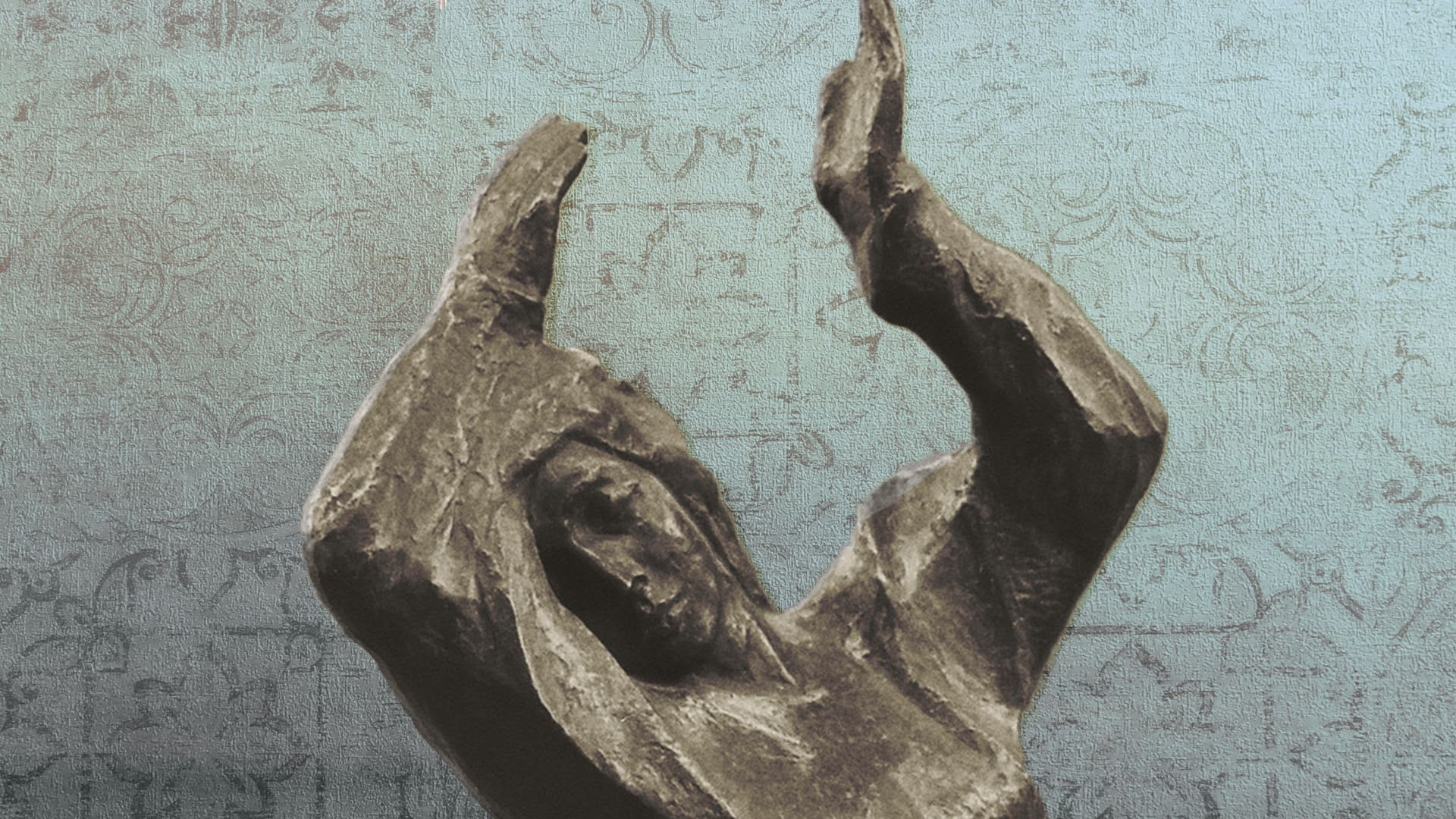
My attention was frequently drawn, though, toward another statue in NATO’s public forum. Die Betende, the Praying Woman, is a female figure captured in a whirl of movement. She is kneeling, eyes and mouth closed, arms raised and hands cupped in supplication. Her head and torso twist to the right, her head nearly lying on her upstretched right arm in a dance-like pose. Stilled in bronze yet energetic with potentiality, her entire body prays.
An archival pamphlet cataloguing letters, art, and gifts received by the alliance from various member nations includes a five-page spread devoted to Die Betende, Germany’s gift to NATO in February 1960. Commissioned by Chancellor Konrad Adenauer and created by the Munich-born artist Yrsa von Leistner, the sculpture has a plaque accompanying it that notes, loftily, that it “represents NATO and its mission of hope and peace.” But the archival pamphlet also observes that, strangely, there is no actual record of its commissioning, nor any archival correspondence between the German chancellor and the artist despite the obvious friendship between them.
I have meditated on this statue—its ambiguous, obscure history and its poignant presence in the public forum—ever since we departed Belgium in 2021. The Praying Woman came to mind during the rumoured rumblings of a potential Russian invasion of Ukraine, cast in dubious commentary in both Russian and American forms as a response to so-called NATO encroachment. I would think of her, too, when I saw footage of Ukrainian women sweeping up after a Russian bombing, or when I joined other volunteers in a community parking lot to bag up and deliver donated food to refugees who had fled wars.
I’m interested in neither making nor defending a theological justification of NATO. But there’s significance for me in how the Praying Woman appeared in the alliance’s headquarters, and a broader lesson for institutions and the frail humans that design and staff them.

The Praying Woman’s posture of vulnerable agency gestures to spiritual realities that are at the same time immanently lively and embodied. She serves as an icon of the cross-pressures at work within and around her, of grief’s relationship to hope and the moral imagination. She is not an incarnated idea or abstraction, neither timeless Geist nor goddess of anything. Rather, contemplative and active in equal measure, she seems to represent nameable, historical particularities—a bold Miriam, perhaps, or a misunderstood and beseeching Hannah, a pondering Mary, a prophesying Anna.
Then and now, I marvel that this praying figure in its vulnerability and weakness once served as a symbol of a powerful defensive military alliance, expressing something of its mission and hope. And I marvel that for me she has come to represent far more.
Following World War I, Germany’s attempts to recover a sense of its former self—and its imagined past of greatness—allowed an already morally disoriented nation to be led, and deeply misled, into even greater forms of disaster and self-debasement. At the close of World War II, the once mighty nation, confidently self-assured in its Christian faith and cultural might, stood sundered in ruins—as did its churches, spiritually captured and morally complicit. Germany’s defeat was an answer to many difficult, righteous prayers. There was now no distance between its spiritual ruinations and its physical ones.
The North Atlantic Treaty Organization was founded in that devastated aftermath. Colloquially, the NATO alliance was forged for Europe to “keep the Americans in, the Russians out, and the Germans down.” Pivoting from its previous posture of isolation, the United States now extended itself to help rebuild a decimated, demoralized, and divided Europe. Through mutual consultation and aid, NATO sought to deter Soviet expansion and counteract nationalist militarism on the continent. The alliance formalized and tended genuine bonds of affection, mutual trust, shared values, and moral and political principles of human rights, rules, and international law.
Thus, Western political elites mobilized to rebuild and reorganize on high what the postwar American architects called being “present at the creation” of the new international rules-based order. At the same time, down below, Berlin’s Trümmerfrauen—women of the rubble—combed through the vast destruction by hand, carting away debris in wheelbarrows, eking out slightly better ration cards in exchange for their heavy labours.
There is no iron law in the world nor in foreign policy that necessitates, much less makes normative, that a large and powerful nation must swallow a smaller one. Similarly, there is nothing that determines that more vulnerable human beings merit suffering and molestation at the hands of the strong, other than the tired tendency of the strong to grow stupid with success. The female figure of Die Betende, in her earnest posture of prayer at NATO headquarters, prompted me to consider all the shadowy moral fallout of war that lands most horrifically on the most vulnerable: women, children, the elderly. Her body’s beseeching stance points to the inescapable dignity and vulnerable interdependence of all human beings.
Weapons of strength so quickly become objects of worship, deepening a drunken appetite for dominance and the addictive, binding pleasures of lethality itself.
When we imagine what keeps peace, it is easy to think in symbols of war and its awesome violence, the glorious beauty of human brawn—usually a distinctly masculine brawn. The Bible warns us about trusting in chariots and horses, and though I don’t know anyone who trusts in chariots, far too many these days put their trust in guns and in the hulking bodies of war-fighters and military hardware, ships, missile systems, artillery, and now drones and disembodied artificial intelligence.
Weapons of strength so quickly become objects of worship, deepening a drunken appetite for dominance and the addictive, binding pleasures of lethality itself. These bent cravings constitute what Augustine called libido dominandi. Whether we try to control and dominate with weapons or through words, as James’s epistle warns, each one of us is capable of setting worlds on fire.
Die Betende’s sculptor, von Leistner, was adept at capturing the emotional cross-currents of war’s complications on the powerless. She often presented the female form in her work as connected to themes of memory and peace. In a similar statue titled Mutter von Nagasaki, or the Mother of Nagasaki (1979), von Leistner memorialized the atomic bombing of that city in 1945. A female figure stands, lifting a smaller human in one arm, her other raised to heaven in an agonized, full-bodied cry for recognition and vindication.
I can only imagine how quickly my thirst for revenge might consume me if I had to suffer what the mothers of Nagasaki suffered, how much I might call on chariots and horses to crush my enemies and satisfy my hunger for vengeance. Perhaps it is mothers like these that Jesus thought of when he identified as a hen sheltering her young, expressing his longing to stave off the stupidity that careens toward destruction. Maybe he held in mind his own mother’s coming anguish, and any human heart pierced by the suffering of swords and soldiers, when he taught his followers to pray for their enemies.
It is not in my instinct to pray for my enemies. Yet I always feel relieved when an intrepid prayer leader invites a congregation to do so during the Prayers of the People. Privately, mindlessly, and prayerlessly, I prefer the brief, immediate dopamine hits of demonization, imagining my favourite enemies in less-than-human ways. They are the problem. They are the broken and the morally deficient. Oh, to be free of them!
Yet in the helpless posture of prayer, I do not have to pretend that I love them (I don’t) nor deny their power to instill fear in me (they do). Jesus doesn’t invite his students into sentimentality, as if praying for enemies were spiritual Stockholm syndrome. Instead, in the mystery of the dance, prayer helps me safely and securely acknowledge that my humanity and theirs appear together in this shared world—as perplexing, infuriating, and terrifying as that is. It helps me remember that sometimes God is the only one capable of hearing such a lament.
Theologian Matthew John Paul Tan asks in a scholarly article on prayer and political theory “whether one’s prayer makes any political difference.” Against a backdrop of assumed disconnection between physical and spiritual realities, Tan first argues that prayer is as much a bodily act as it is a cognitive and epistemological one. Prayer is not “some vague emotional or cognitive inspiration, or some miraculous interruption to what seem to be natural social processes.” Prayer brings the world, articulated as data in our minds and imprinted on our bodies, before God and into God’s attention.
Prayer is a “transcorporal” business, as Tan puts it. The language of the Psalms, the prayer book of the Bible, exercises our affective tendencies, giving them a structure to encounter and knitting us transcorporally both to other praying people and to the God who is our hope. The recovery of prayer, personally and communally, conditions the human body and the church body to respond within the world while critically challenging the inevitability of dominant political presumptions. Praying for others, Tan observes, allows us to see them as avenues of self-knowledge, as possible fellow citizens in the body of Christ, and as bound up with us in the tragedy of the world, hopeful in anticipation of a comically good end.
The Psalms also help us hold the jumbled tangle of human emotion—from its ecstasies to its angry agonies—and the pure and impure motives we bring to prayerful work. As Sara Ritchey observes in Acts of Care: Recovering Women in Late Medieval Health, the Psalter has long served as a “therapeutic technology” that heals the one praying as well as those being prayed for. Ritchey describes how a medieval-era Beguine, Odilia of Liège, saw her practice of Psalter-led prayers as a “physiological exercise,” as transforming and “reconditioning” her “bodily sensorium.”
Prayer keeps open the window of our bodies, minds, and hearts to hope, and cultivating hope is essential to growing flexible, agential capacities in a world that tends to train us to be brittle, violent, closed, and inert. Hope has nothing to do with optimism or with ignoring real threats; rather, hope nourishes our “capacities to envision and work toward good outcomes in the face of uncertainty and risk,” as psychology professor Lauren Kuykendall argues. Prayer keeps us in the dance even when we are faced with a world’s end.
And worlds repeatedly come to ends. On Epiphany, our priest in Copenhagen illustrated his homily with an electric light-up globe from the 1980s, still inscribed with the names that were once to him, as a little boy in Finland, omnipotent political powers: the Soviet Union and a divided Germany. These powers seemed immovable at the time, yet their omnipotence proved fragile. The globe also names the river Tornio, a boundary between Finland and Sweden and a shared source of provision, across which relationships have long been maintained despite immense differences. He observed how, unlike the changed superpowers, the seemingly weak bonds of citizens across language and cultural differences, disagreements, and water boundaries still endure to this day.
Worlds come and go, and the Praying Woman remains, seemingly articulating all forms of life-waging and peace-keeping—candles, brooms, wheelbarrows, whistles, grocery bags, all the tools of daily human work in a world of tumult and turmoil, taken up by those who are not thought to wage at all.
When worlds come to their endings, how do we account for and recalibrate what is regarded as strong and what is regarded as weak?
The dubious history of the statue reflects how postures of prayer like hers are rarely accounted for in military histories. Yet, at times, historians cannot help but recognize the role of prayer and the people who pray.
In 1982, a handful of people began showing up for a weekly Friedensgebete (peace prayer) service at the Nikolaikirche. The church was in the east German Democratic Republic (GDR) city of Leipzig, not far from the city’s dreaded secret police intelligence and state security headquarters, commonly known as the Stasi.
At first, the Stasi did not take the praying seriously. But more and more people began to come and pray, even those who had never really prayed before. Years of praying passed before the prayer meetings began to flow into protest marches in the city. Sometimes marchers carried helium balloons, forcing the Stasi to ludicrously wield balloon-popping pins in chase. Other times, marchers walked with candles, which the Stasi tried to extinguish.
The security forces repeatedly tried to draw the praying protestors into violent confrontation, but the protesters repeatedly refused. “We had planned everything, we were prepared for everything,” one GDR regime leader said, after the regime’s grip on power slipped in 1989. “But not for candles and prayers.”
When worlds come to their endings, how do we account for and recalibrate what is regarded as strong and what is regarded as weak? Today, the Stasi headquarters is a memorial museum, exposing the truth of its crimes. In the square next to the Nikolaikirche, a granite fountain representing the prayers of the people quietly and perpetually overflows.
A wise friend of mine recently observed that the purpose of any contemplative practice, including prayer, is not primarily to calm or soothe us but to quiet us sufficiently to hear better, to be more alert and responsive to the groanings and possibilities of the world. The entire exercise is for practicing attention and cultivating creative agency. In this way, prayer can be quickening and galvanizing, at once physical and affective training. And like any training, it takes endurance.
Jesus invites us, both in how he lived and prayed and through his storytelling, to see what happens when we take him seriously about prayer and persist in it. And if there is any biblical figure who best fits the Praying Woman of NATO, it is Jesus’s character of the importunate widow.
“Importunate” means persistent, almost annoyingly so. Children have a knack for importunacy, wearing one down into a yes after repeated noes. Diplomats can be inveterate optimists in the tightest of negotiating corners, drawing on their training in relational and imaginative skills with dogged importunacy. At times, this childlike persistence can seem downright foolish, naive, and even dangerous.
German theologian Helmut Thielicke, rector of the University of Hamburg and a Nazi critic, lifts Jesus’s importunate widow to our minds when he likens the church to “a defenseless widow” who, when engaging “in ecclesiastical politics and strategy,” fails to do much even in her striving, like “a feeble arrow launched at armored giants.” But the church does have one thing, Thielicke notes: “access to that Other who causes the unfolding of the drama of the world.” Therefore, “it has a power greater than the magnificent and arrogant figures in gleaming armor who enter and leave the stage.”
Cyrus and Nebuchadnezzar, Hitler and Stalin, who “for a few moments were able to make us little people down in the pit of history hold our breath and set us trembling,” were really only deluded, Thielicke says. They were in actuality “only supers and extras . . . permitted to walk for a moment across the stage in grandiose costumes” before exiting. In the end, only the crucified Christ will remain.
We access and anticipate what Thielicke calls “this great finale of history” most often and necessarily through the hidden work of prayer. Refusing to perform it before others helps ensure it does not fuel warped hopes or satisfy our appetite for domination. Prayer surrenders to God what we would be tempted to wield foolishly for ourselves. It is a meeting with God, a practice of mutual listening, seeking a face in a holy kind of effacement. It is to allow our hearts to take the posture of the Praying Woman before the world’s stage, and to persist in prayer so doggedly as to become immovable in our dance.
Lex orandi lex credendi—the way we pray is the way we believe, which is also to say it is our way of life, revealing who and what we trust, who and what we actually are. As we seek to hear and attend to what remains true, precious, and worthy of defence amid the massive global changes underway, NATO’s Praying Woman invites us to recognize the reality of God who is still with us, without using him as a weapon, and to acknowledge the reality of human beings made in his image who are also with us.
Among the swift and varied changes of this world, I hold out hope that what she represents will not be overlooked or forgotten.