I
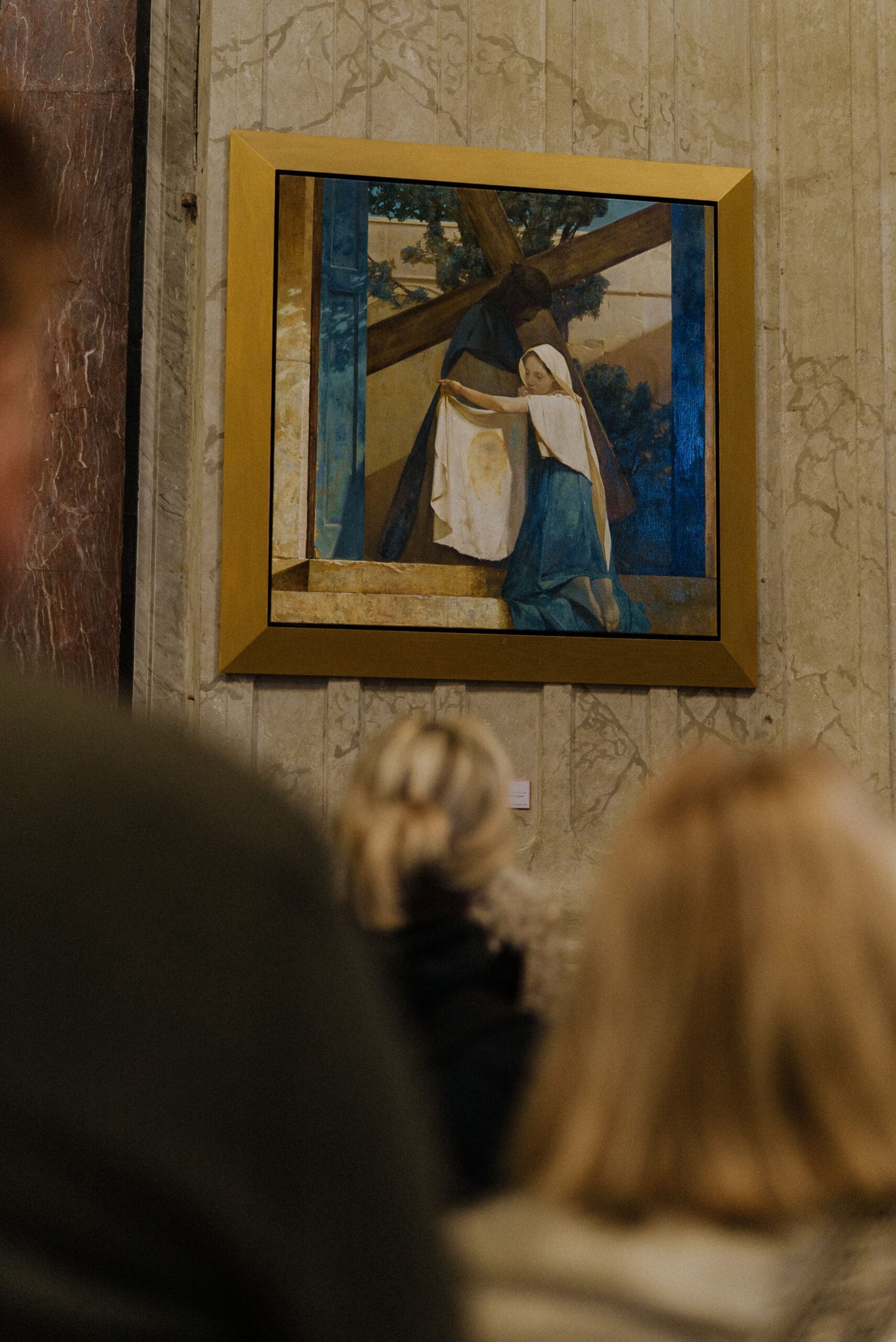
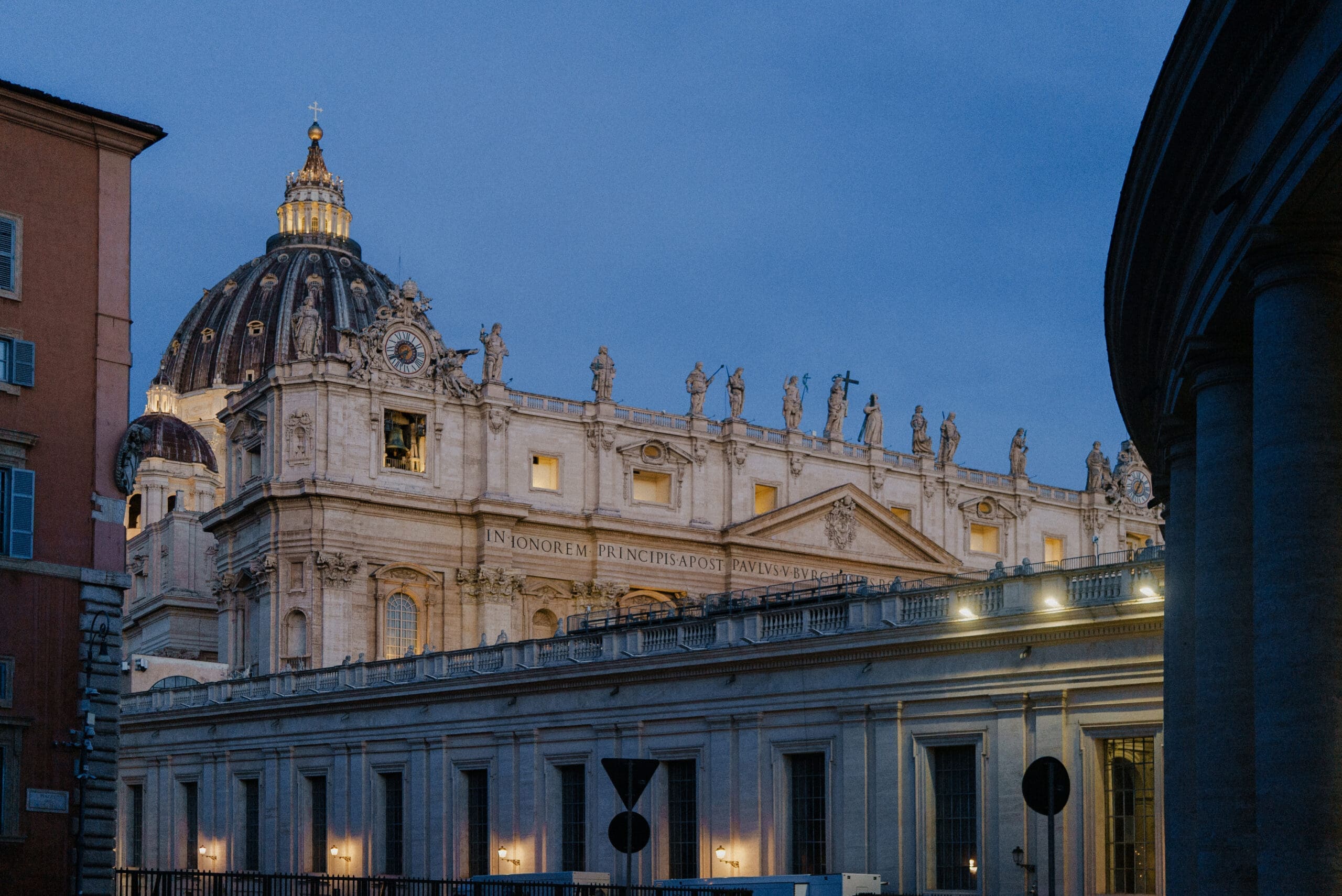
In early 2026, at the beginning of Lent, St. Peter’s Basilica unveiled its first new Stations of the Cross in generations: fourteen paintings by Manuel Andreas Dürr, a thirty-six-year-old Swiss painter selected through an anonymous international competition that drew over a thousand applicants from eighty countries. Dürr was not a celebrity artist. He had, in fact, nearly given up painting altogether.
A commission of art historians, liturgists, and Vatican representatives chose Dürr’s work unanimously for what they saw in its compositional balance and expressive strength in interpreting the Paschal Mystery. Dürr is a painter deeply attentive to how images appear and what they ask of the viewer; his work compels you to be present to what the piece is disclosing.
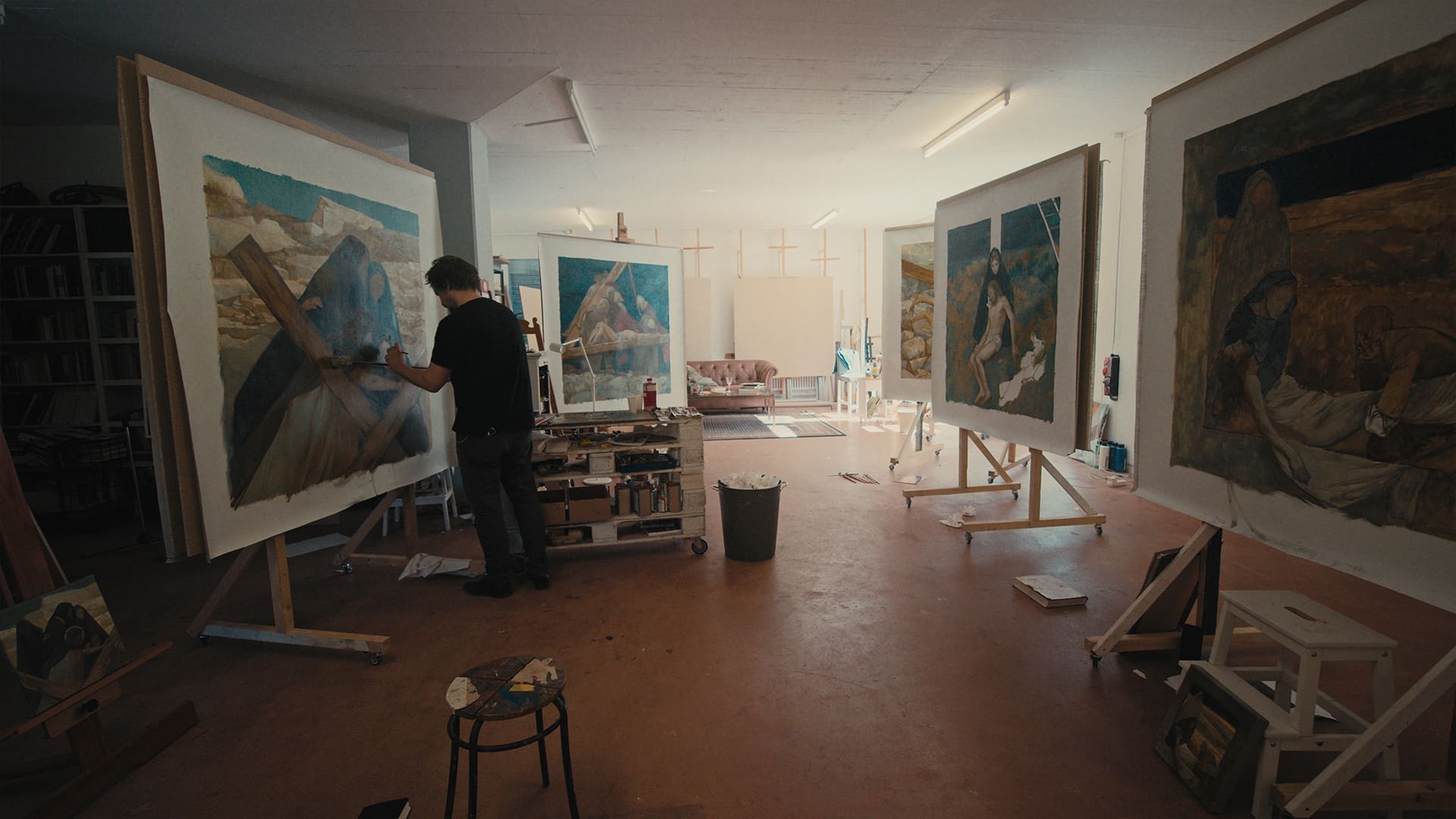
Intrigued by what I’d heard about Manuel’s character and the quiet significance of what he’d been asked to do, I travelled to Biel with Laura Fabrycky, a Comment contributor whose own essay appears in this issue. We visited Dürr at his studio in the foothills of the Swiss Jura, where he works within the daily rhythm of a community that has bloomed around the Jahu Church, a small Reformed congregation oriented toward ecumenism, discipleship, and the arts. Life here is structured around shared meals and common prayer, members of the community live and work in proximity, and the boundary between domestic life and creative work is kept deliberately porous. Over the course of a long afternoon, embedded in the rhythm of this place, we spoke about vocation, the theology of paint, the crisis of images in a digital age, and what it costs to finish a work and let it go.
—Anne Snyder
Anne Snyder: The story of how you came to this commission is remarkable. Can you please share with us how it happened?
Manuel Dürr: Approximately a thousand people applied, from eighty countries. You first submitted a portfolio of ten works, and from those they chose about thirty artists to submit an actual painting to Rome, a version of the crucifixion. Then they had an anonymous exhibition, and a commission decided then and there who the winner was. Only afterward did they invite me to Rome to get to know me.
I can honestly say I never in a thousand years thought I would win. A friend had submitted me and pushed the application; I only agreed because I didn’t want to put down his idea. Actually getting to do this was not a real possibility in my mind.
I think the judges took a big risk. It was a blind process, so they had no idea who I was. But when an Orthodox nun from Essex came to see the work, she said, “I’m not quite sure what this is. It’s not Catholic. It’s not Orthodox. It’s not Protestant. I think this is the early church.” That was the best thing I could hear.
Anne: Had you ever painted Christ before this project?
Manuel: I’ve been painting Jesus since I was about fifteen. My mother brought the Via Crucis tradition into our church. I painted maybe five stations over the years, some with her, some myself, for different liturgies. Not thinking of it as art, just as a contribution to our local church life. Then one of these images ended up in a Catholic church in Bern, and they commissioned me with the full Stations of the Cross for their church. We agreed on a sum, and the whole thing felt like a breakthrough. Then suddenly, out of nowhere, it was cancelled. Just after that, the Vatican competition came.
Anne: I understand you were close to giving up painting altogether before all this happened, yes?
Manuel: When my oldest son was born, I thought, “It’s kind of not okay to smear pigments on canvas all day, letting your wife work for you.” Somewhere between drinking cappuccinos and just painting paintings not asked for, it didn’t sit right with me. I was ready to let painting become a hobby for Saturdays.
But just at that point, someone had one month of gallery space open in a small place. I thought, “What would it hurt?” And there I sold enough that we could manage to try it another year. From there it just took off. My dad was always very supportive, never said anything against it, but I think the academic careers of my brothers made much more sense to him. Only now, with the Vatican, has he actually understood that it’s a real thing.
Anne: How would you describe your vocation today?
Manuel: Giving shape to certain intuitions or ideas in various media—that might be the surface description. More deeply, I think it’s about becoming the kind of person through whom certain things can manifest themselves. Through years of practice, through years of living in community.
Anne: You’ve rooted yourself here, in this communal rhythm, rather than in the solo artist’s life. How does that shape your creativity?
Manuel: A high value for us is interruptibility. Don’t be too full of your own ideas, or of the idea that time belongs to you personally. I think the controlling, dominating subject who wants to shape the world after his own devices is really bad for creativity. Interruptibility and responsiveness might be much better.
I do struggle with having concentrated time. But when I zoom out, I realize that many of the interruptions and stray stories that hit my life, just by proximity, are very enriching. It’s a bit like improv theatre, the “yes, and” kind of thing. Living here keeps me from calcifying in my own habits. When I was in Florence, there were older people in my art courses who all, without exception, had a tendency to calcify in their very specific needs and patterns. They knew exactly what angle the window had to be open, the temperature of the tea they needed. They had too much time specifying their preferences.
That doesn’t work here, because everything gets thrown into everything else. But that does keep you dynamic.
I also had to learn something about myself through living this way. I was prone at one point to a kind of existential dread, a sense of doom. And what I came to understand is that the projected self into the worried future is a very thin ghost without any resources, apart from the very limited imagination. But the real self, the embodied self surrounded by friends, drawing on resources that only the moment itself reveals, is in a very different position to face the feared problem. Jesus says, “Don’t worry, every day has its own troubles.” I think this saying has a psychological principle at its core: In your mind you are not capable of dealing with the real thing, because the moment has resources that only the moment will show. You don’t know how other people around you might react when tragedy strikes. Those things can’t be anticipated.
Anne: Is there an artist whose inner life you feel a kinship with?
Manuel: I spent a long time navigating where I should sit in terms of communication. Is this work a cultural generic language that invites people from different premises into a thought? Is it explicitly theological? I kept finding that the questions that most interested me were theological questions. Maybe all interesting questions are, at bottom, theological.
My wife told me not to worry about the strategic placing of the work but just to do the creative work itself. And now with the Vatican commission, I don’t have to ask too much about where I’m situated.
A biography that moved me was Ray Monk’s on Ludwig Wittgenstein. What touched me was that Wittgenstein was a promising philosopher with all the world listening, but his philosophy led him to radical conclusions, which implied for him the end of his own work as a philosopher. He didn’t just carry on playing the game of philosophy. He gave away the equivalent of a billion euros in inheritance and became a primary-school teacher in the countryside. He was actually dealing with the real thing, not the perception of the real thing. I think it’s so easy to play a Christian, or to play church, or to play an artist. To actually do it—not just use the right words but live inside them—that is a goal to aspire to.
As for painters, my taste moves backward. I started with nineteenth-century academic realism and gradually went earlier and earlier. Now I’m at Fra Angelico and his cell paintings in San Marco in Florence. He painted during a time of great innovations and deliberately chose other means. As the tradition tells it, he prayed for the monk who would live in each cell, received an image, and painted it without correction—as a gesture of humility. He didn’t paint it with any viewer other than the praying monk in mind. It was serving art, created from deep humility.
The artist today is free to create their own language. But as Wittgenstein said, no one can have a private language—or if you do, there’s not much of interest that can be said in it. I appreciate how those monastic and painterly traditions were so interlocked that they allowed for enormous heights of subtlety. I wish we could, as a culture, retrieve a common language—not abandon private freedom, but recognize that private freedom alone doesn’t allow us to co-create a shared world.
Anne: I’d love for you to describe the relationship between spiritual listening and your creative process. How much does it feel like obedience, and how much does it feel like a gift, the divine image in you creating?
Manuel: I think multiple pieces have to be in place at the same time. One is our own community’s strong emphasis on habit formation, on virtue formation. For every person here, creative agency is not about conjuring up a specific thing spontaneously; it’s about becoming the person who can respond spontaneously and well, even becoming the medium through which certain things can manifest themselves.
A lot of so-called prophetic art does the Holy Spirit a bit of a disservice, because it tends to be very untrained artists who want to be especially pure channels. And one would just wonder why the Holy Spirit can’t paint better if he’s infusing them. A good preacher has to have basic language skills. Why wouldn’t that apply to painting? You form the skill, and then you become someone who can spontaneously become a vessel.
The other thing is that what I as a subject bring to the world is much less interesting by itself than what I might co-create in response to what’s already there. The world itself is a much richer fabric than my imagination. Something interesting can happen when my imagination becomes aligned and responsive to the world.
But the “me” is a very thin thing. Hartmut Rosa’s thinking around resonance has been very important for me: the idea that rich creativity comes out of a healthy to-and-fro, a responsive relationship, rather than the thin thing I would produce on my own.
And then there’s self-sacrifice, which I have come to experience as the most important thing in the creative endeavour. Dying to one’s own ideas opens up a space. I think perception is wider when the ego dies. The ideas flow much better when I’m not in the way of myself. The Greeks had to thank their muses, and psychologically the muses were there to blame when the artwork came up wrong. I think that’s a healthier way to be an artistic subject. Everything other than humility might just be a misunderstanding.
Anne: You’ve spoken about the importance of a tragic sensibility in art. Can you share how you came by your own?
Manuel: I grew up very blessed. When I think back on my childhood, it’s only fun birthdays and hot chocolates before Christmas. There’s no trauma. But through my parents and their thousands of pastoral concerns, my brothers and I saw how many people would spend their evenings on our parents’ couch, burdened with problems. Sometimes we would hear stuff. Screaming or crying.
I have an image of my mother sitting on the couch with a deeply creased forehead. My father always had an optimistic bounce in his step and could shake off things easily. But my mother absorbed the full brunt. She never left out one drop of a problem. She’s not at all a sad person, but she did co-suffer for many other people, many times. I think that instilled in us the sense that the world is full of trouble, and even if our life is going well, it’s really just a small oasis. As Goethe said, “In the middle of life, we are surrounded by death.”
The other answer is harder to put into words. I had one moment of genuine atheism in my life. I was alone in Florence, struggling with some anxiety. (There’s a Stendhal syndrome, something that apparently happens to people there.) And the question crept up on me: What if the resurrection didn’t happen? It really brought me down to a plateau of actually accepting that it didn’t.
In normal life I had believed it, but it didn’t cost me anything to believe it. But suddenly I had specific things I desperately didn’t want to happen to me. And when you want, like an obsessive person, to fully guarantee that those things will not happen, that tends to lead you toward only one solution, which is suicide. And suddenly to have that not be an option, to embrace the risk that even the most horrible things might happen to you—that costs something. It costs something to put your hope in that story.
Within seconds, the question flipped: But what if the resurrection did happen? It would be tragic if there were a solution to everything and I had missed it because I gave up slightly too early. So I built my way back up to “What if it did happen?” I also realized in that moment something about what mental illness must feel like, which made me far more sympathetic to others who suffer in that way. Having grown up in a very protected household, I had tended not to fully understand mental illness. And I think I only saw the wonder of the resurrection when it started to cost me something to stick to it. Before that, I believed it, but it didn’t cost me anything. That was maybe the only real philosophical moment I’ve had in my life.
Anne: Let’s talk about the paintings themselves, because I think what you’ve just described is in them. You’ve described the central metaphor as “the paint being paint.” Can you help me understand what you mean?
Manuel: The central question these paintings deal with is: How could something specifically historical and particular—a body, wood beams, contingent empirical stuff—have transcendent significance? How could a metaphysical dimension be present in it?
It would be very easy to paint agnostic paintings of eternal truths, where the painting clearly just refers to another space. But these paintings don’t just refer to a specific historical space; they refer to the very space where you’re looking at them right now.
So the paint on the surface always needs to come forward. Some abstract expressionists have made that their main principle: The paint is just paint on the surface—and that probably goes too far for these purposes. I want a negotiation between the paint that lends itself to the image and the paint that, as the means by which the image comes to presence, remains part of the visual experience. This is the central metaphor for how mediation works: How does the mediated come into the mediating thing?
Think of the messenger. The body of the messenger incarnates the message, and there’s no access to the message apart from the body, the materiality of the messenger. Two mistakes are possible: You can reduce the messenger to a contingent body, thinking it can’t really transmit anything beyond itself. Or you can confuse the message for the messenger and identify the two completely. Magic and reductionism are two opposite errors. In between, there’s an interesting, complicated, and necessary tension. And I think painting allows one to reflect on that.
The stations I’ve painted start with rather classical, affirmative architecture, and then progressively the paint moves from a servant function to the image, forward to the surface. By the Pietà, the space cannot be coherently read as a scene (of course, hopefully it works as a scene), but the paint itself comes to the surface. And in the final station, the image that is mediated by the material collapses into the material itself, without that being a contradiction.
Anne: I’m curious about your colour choices. You use a very particular palette.
Manuel: The basic look of the Basilica is olive and gold. So I tried to have olive, beige, goldish colours as the base where the paintings sit. Then there are two symbolic colours quite prominent in the Basilica. One is the porphyry red, the emperor’s marble. Hadrian found it in Egypt and realized the marble had the same colour as the senatorial robes, so he claimed the whole deposit. Only emperors ever used it. The largest single piece of porphyry marble is inside St. Peter’s Basilica.
The other is blue, which appears mainly in the dome, associated with Mary, with the church, with eternity. So I had red as an accent for imperial power and blue for the salvation-history context. Mary’s robe is painted so that the blue paint deliberately disrupts the illusion of cloth. The sky, too, is painted differently in each station to emphasize the compositional nature of the series rather than a single linear story. But in the crucifixion and final station, the paint doesn’t play that function in quite the same way. In the last one, what appears as sky could equally be read as an abstract painterly surface.
The skies vary across the stations for another reason: Since the iconographic ingredients are so similar, a viewer’s eyes might glaze over after seeing cloth and wood beams seven or eight times over. I deliberately tried to make fourteen different paintings, not fourteen iterations of the same ingredients. Whether I succeeded, I don’t know.
Anne: I’m also curious about something practical. How do you paint Christ’s hands?
Manuel: The banal answer is that it has to be learned. But what I love about painting is that there’s no linear way of going about it. You can’t assemble the relevant information and then synthesize it into a hand. The hand, the head: you need all the intuitions in the background at the same time, and then you don’t focus on them. And then, somehow, a little bit magically, you know things you don’t know why you know. Tacit knowledge. All the anatomy lessons are there but forgotten. A second spontaneousness occurs. When that happens, I love it. That’s what I love most about painting.
I always stuck with what I perceived as the hard road: painting purely from imagination, truly from scratch. I could have used photographs. Many people can paint convincingly that way, but it doesn’t come from an inner understanding of what’s there. I always felt committed, like a maniac, to learning the full language rather than memorizing a poem. You can learn a poem in any language rather fast and impress people at a party. But you can’t impress people so fast with learning a language, because it takes years. Now that AI is creating very convincing images in seconds, I feel even more vindicated. Each line in my paintings is far from perfect. But that imperfection now feels like a virtue. Both the artist and the viewer can count on everything being a conscious decision.
Anne: Did you paint the stations in order?
Manuel: No. I always started four at the same time, brought them to a certain point, then the next four, then the next four, then the final two. I basically tried to finish them all at the same time, which made the studio a huge mess for eight months. I worked six days a week, Saturdays included. A group of nuns came to the studio every Saturday for three hours of prayer. So the paintings were already being prayed with for eight months before they reached Rome.
I didn’t want to listen to music or podcasts while painting, especially not while painting Jesus. I wanted to go about it prayerfully. It felt wrong to be anything other than fully present. On one Christ I worked for three months; another came in what seemed like very few moments. One arrived very early, very fast. Another hid itself from me for a long time. It was a purely intuitive thing.
Anne: You also seem to have deliberately refused strict perspective in these paintings. Why?
Manuel: I painted them to seem as if there is perspective, but in fact there isn’t. I like that, because it suggests there is no one privileged point of view. Central perspective submits the whole image to one particular spot. The pre-modern image and the high-modern image both have a certain spatial presence without a privileged point of view.
I find it interesting that the Renaissance’s central perspective became a mode of thinking for the modern world: the idealized spectator point toward which all of reality is ordered. Alberti’s emblem was a flying eye, a winged eye. I think our social media world is the complete fulfillment of Alberti’s fantasy, accessing the world as a disembodied spectator who has the algorithmically enforced illusion of choosing your own reality. You end up with a world you’ve almost created yourself.
That’s why I like the slightly obsolete technology of painting: It binds you back to the actual space where the painting is. There’s no accountability for the pixel on your screen. At least painting is the expression of a certain seriousness of care, enough care for someone to have spent weeks doing it, even spending money on the materials.
Anne: Of the fourteen stations, which do you have the most intimate relationship with?
Manuel: The Pietà, quite clearly.
There’s a thought I once heard about Michelangelo’s Pietà, which is just around the corner in St. Peter’s. If the most horrible image of a mother and her dead son can be translated into a form still recognized as beautiful, that might encourage the thought that maybe God can, much as Michelangelo did, translate even what looks very horrible to us now into something we will recognize as beautiful.
The crucifixion we read now as a heroic image, and with good reason. But the Pietà hits home more for me. The vulnerable and awkward pose of the son lying in his mother’s lap, like a very dark nativity scene. I wanted that image to be slightly awkward, because it is like an unnatural birth: What came from that womb is, in a very dark sense, returning to it.
Anne: Thinking of what you said earlier about your mother, her absorption of suffering, her co-suffering, is it possible that laced your experience of painting the Pietà?
Manuel: I paint without photographs, just painting the face until the right expression emerges. And this face . . . I realize it only now, as you’ve drawn the connection—it is my mother’s face. That creased forehead. Not her whole self. My mother is a happy woman. But that specific image: her taking it in without evading it. That’s what always touched me, because I am an evader. I have many strategies for not becoming sad.
Mary is perhaps even more powerful here than Christ, because Mary was in the position that we are with suffering, where all we can do is trust and we have no idea what’s happening.
Anne: You mentioned painting Veronica and the veil. I’d love to hear more about that station.
Manuel: Veronica is unclear historically—whether she’s even supposed to be a real figure, or an art figure explaining vera icon, the true image. As I painted her, I was clearly painting paintings of and within a tradition. So I thought: The only Christ who looks directly out of the images at us should be the stain on the cloth, the veil.
There’s a play there. It’s the image on the cloth of an image on the cloth. I’m painting on cloth an image on a cloth. And I think it serves as a metaphor for painting Christ, or for all liturgical and artistic forms that are supposed to give access to Christ. Christ needs to be such that he could leave a trace on a physical cloth. And if we are now creating traces on cloth, or forms in rock, or whatever the expression might be, we are repeating that gesture of mediation. The question of whether mediation works—that’s of course a question of faith. But this self-reflectivity seems important in order not to have a naive immediacy that in reality cannot exist.
Anne: Can you walk me through the final station, Christ being laid in the tomb?
Manuel: That one plays with the central metaphor explicitly. It’s basically an image with a secondary image inside it, framed: the landscape beyond, drenched in what I call a hint of Easter light. We don’t yet depict the resurrection; we hint at it. We have the clearest image of the new world to come without that realization being fulfilled.
But then there’s also this: Christ being laid into the grave makes us, the viewers, the ones in the grave. Christ is being laid to us. And there’s a secondary light, a gold one, that might be read as a hint of the resurrection. But it might also be the light in St. Peter’s Basilica itself, making the Basilica the tomb. And the Mass celebrated on Bernini’s altar, representing the empty tomb, gives sense to these stations, this specific history of a young man being killed, read through the implied resurrection, which would be the fifteenth station.
So these fourteen stations need to be understood against that: They are, ultimately, a history of victory. I wanted the sense to be basically hopeful. I didn’t want them to be bloody, or full of pathos. They live inside a basilica where there is already a central, essentially empty tomb.
Anne: You’ve painted a white Christ. And you kept the stigmata in the hands rather than the wrists, the full cross rather than just the horizontal beam. Can you talk about those choices?
Manuel: I didn’t want to have a statement about myself inside the Basilica. I wanted to serve that particular context without being naive or submissive. The Christ that people see in my stations should be roughly the same Christ already present in hundreds of images throughout this church. If I were painting for a church in Addis Ababa with Black Christs already there, it would be fitting to add Black Christs in the stations.
I didn’t want to portray myself as a corrective. I think that would have been, in a sense, more naive, acting as a de facto teacher telling them how he really was. The sacrifice is that I open myself to the criticism of not having been critical enough. Some people will object in principle. Others will think: “What a wasted opportunity not to show something more original, more Manuel Dürr.” But I quite consciously made these decisions.
The deeper thing is that I didn’t want these to be about Christ’s suffering substitutionally, invoking guilt. I wanted them to reflect the Christus Victor tradition, the more Eastern image tradition. Why are we looking at a man killed by Romans two thousand years ago? Because of the implied resurrection. It is in fact a beautiful thing as much as it is a horrible thing. And I think it’s more beautiful than horrible.
And that raises the question: Why would someone today attempt earnestly to paint something beautiful without irony, without the self-immunizing strategies of distancing himself from the subject? Even my sensibilities rebelled against such blatantly affirming images. They are affirming, they are unironic, and they’re not brutalist. I make myself vulnerable to everything you could object to.
I think art would be much more interesting if artists were again vulnerable to the public and their judgment. A lot of what dominates artistic production today functions as strategies for evading public criteria. Beauty is one such criterion. It’s very banal in a sense—every child can be a judge of it—but it can also be very deep. I hope that something of that honesty could translate into an actual feeling of reverence toward the thing shown. And hopefully that translates into a piqued interest in the story behind it. If people could pray with these images, that would be even better. And people have.
Anne: I understand you had an intense experience finishing these paintings. Would you mind describing what happened near the end?
Manuel: I was becoming self-absorbed. As long as the process was open, full of potentiality, I was confident. But as soon as all the possibilities collapsed into one reality, I became nervous. The ego crept in at the very end: “I had a once-in-a-lifetime chance. Did I really do as well as I could have?” Suddenly the ideas were not circling around creative problems within the work but around how others would perceive me. Ambition of the wrong kind: not the ambition to make it excellent, but the ambition to have it mean something for me.
That led to a literally destructive loop. I thought of asking for another two months, putting paintings fully away, starting again. And the reasons were not creative. They were ego reasons.
To accept the concrete reality—that I wasn’t going to “make it,” whatever that means—took a responsiveness that the controlling ego just doesn’t have. As long as I could project myself into the future, some kind of infinity was available. But to accept limits takes a flexibility the ego can’t muster.
I caught it just in time. My wife caught it, really. We went back together to San Marco in Venice, where I’d had a kind of mystical commissioning experience early on, when the Vatican was still reviewing my application. Now, this second time, at the end of it all, what struck me was that all these artworks in and around the Basilica were spolia from Constantinople. The artists who made them didn’t know where their stuff would end up. And I don’t know what my paintings will mean. That’s not my job. We are only fragments, and God will take care of the rest.
So I gave the commission back to the place where I thought I’d received it. I put a finish line under it. And now I live in acceptance with that. It is what it is.