





How do we relate to the work we’ve done at an institution that no longer exists?




Biologist Jeffrey Schloss—longtime Westmont College professor and senior scholar at BioLogos—offers an intimate, scientifically precise account of his recent diagnosis with multiple system atrophy, a rare, terminal, and rapidly progressive neurological disease. Speaking with Mark Labberton, Schloss reflects on what it means to experience dying rather than simply anticipate it: the grief of losing decades of surfing and guitar-playing to pain and paralysis, the sacredness of family, and the surprising nearness of Christ as everything else falls away. Drawing on a life that began in a nonreligious Jewish refugee family and turned through a dramatic conversion as a young surf bum in Hawaii, Schloss traces what has changed and what hasn’t now that death is no longer abstract but a daily fact in his body. The conversation moves through Simone Weil’s writing on suffering and the Heidelberg Catechism’s opening words on “our only comfort in life and in death,” arriving at a vision of a good death that seeks a daily, humble communion with Christ.
Mark Labberton: Every guest on Conversing is someone that I receive as a gift—a gift to have a person take time out of their schedule to have a conversation, and a gift to talk to someone about some things that they are about: their thinking, their activities in the world, where what they do and what they’re writing or what they’re thinking all really matters. Today, I have an exceptional sense of the gift, both because of who I’m interviewing and because of what we’re going to be talking about. My guest is Dr. Jeff Schloss, professor of biology at Westmont College in Santa Barbara, California. Jeff has been teaching at Westmont since 1981, many, many years now—which happens to be the very same year that I began as the college pastor at the First Presbyterian Church of Berkeley, so many years ago. He’s continued in this faithful work. And today we’re going to talk a bit about his journey as a person of faith and of science. And we’re also going to talk about a recent diagnosis, a terminal diagnosis.
I’ve known so many students at Westmont who would say that Jeff Schloss is surely one of the most influential professors they ever had. It’s his intellect. It’s his spirit. It’s his compassion. It’s his relentless truthfulness. It’s his readiness to be dependent on a God that we know in Jesus Christ, but that we cannot see or measure in the tools of science.
Jeff Schloss, how great it is to have you on Conversing today. Thank you for being a guest.
Jeff Schloss: It’s great to be with you.
Mark Labberton: Over a decade ago, you and I shared a panel together right here in Santa Barbara.
Jeff Schloss: Yes, we did.
Mark Labberton: We had a wonderful conversation about faith and science and the moment that we were in. In fact, in a way, that’s part of where I want to begin. I’m just really curious, first of all, if you can tell us a little bit more about your faith and science scholarship journey that you’ve been on for—really, I’m sure probably the whole of your life in some ways, but certainly the whole of your educational and professional life. Your faith journey and your faith and science journey. Tell us a bit about that story.
Jeff Schloss: Well, Mark, I grew up in a family of German Jewish Holocaust refugees who were not religious, actually. They thought religion was the source of the world’s problems. And I knew from the second grade that I wanted to be a scientist—out collecting butterflies and dragonflies, looking through microscopes, all sorts of things that I couldn’t believe were there. And for some reason, I knew it. It was my chief goal.
And then I wondered at the same time if there was a God. And in the sixth grade, I still recall opening, in world history class, the book chapter on China. And there’s a quote there that said, “To know what you know and to know what you don’t know is the characteristic of one who knows.” Confucius. Beautiful. I ran up to the teacher. I said, “Mr. Damsky, what’s this? I want to study this.” And he told me, “Oh, that’s philosophy. You have to wait until you get to college.” So for some reason, those two domains, those two perspectives of inquiring, had gripped me.
And by the time I got to college, I was a philosophy major, wanting to know—thinking, is there a purpose in life? Is there a God? I worried about my academic studies and dropped out of college for a while. And I met Christ, who, I have to say, radically changed my life. And when I went back to school, I thought, okay, I don’t need my studies to answer the deepest questions—what do I love? And I was a bio major, but I found, interestingly, that the then-current ideas in biology, which were, at that time, just beginning to turn evolutionary theory to human nature, raised those philosophical questions again. So I actually chose for graduate school a department that had, in the program, tenured historians and philosophers of science. So even in grad school, I kind of had a two-pronged notion of inquiry, and here I am.
Mark Labberton: Tell us how you met Christ.
Jeff Schloss: I met Christ as a college dropout surf bum in Hawaii. That was the one thing I did know, that I loved surfing. And I lived a life which I won’t recount here. It was not pretty. If any life can have a dark ages, that was it. [garbled passage—possibly describing scavenging food]—grazing food off tables one night, a man asked me, “Hey, you look like you could use a meal. Can I take you out to dinner? But I want one thing understood up front: if you come, I want to tell you what Jesus has done in my life.” And as we were talking, it just occurred to me he wasn’t faking it. He wasn’t on a related trip. He either had what I wanted or he was clinically crazy.
I told him that. And he said, “Okay, well, how about praying with me? If I’m not crazy and there is a God, he’ll reveal himself to you.” And I did pray that with him and went back home, feverishly invested in those questions. And I read Bertrand Russell’s Why I Am Not a Christian and C.S. Lewis. I found, to be honest, both of them mildly irritating in that they were so sure, but the arguments didn’t seem persuasive.
And I laid my head—this is not everybody’s story, Mark—but I laid my head on my pillow one night, despairing of reason and study alone to answer these questions. And I said, “God, I give up. If you’re there and I’m never going to get to know you, you’ll have to meet me where I am.” And the microsecond that prayer was out of my skull—I never heard the term, but the Holy Spirit flooded my heart and filled the room. Changed my life forever.
Mark Labberton: Wow. Extraordinary.
Jeff Schloss: But it also changed my epistemology—that there’s some things that reason can make plausible but not compelling, and there’s some things we know by other means. You know, Pascal says it’s not by reason that we may truly know ourselves. And he also says it’s by reasoning rightly that we distinguish ourselves.
Mark Labberton: So was it for you then a journey that immediately began to encompass science, or did you have to go through a second process of somehow thinking, how does this encounter that I’ve had actually converge with the world of science—which, I realize, you hadn’t fully re-entered again, but—
Jeff Schloss: Yeah, it didn’t immediately. I ended up in a community that was alien to me as a young person in the ’60s, and they were—the Christian community I became part of was amazingly supportive and embracing. And also, to me, amazingly pro-Vietnam, pro-Nixon, pro-conservative. But it didn’t impact science. I had no particular views. As I read the scriptures, and as I began to study science when I went back to school, first of all, there were the historiographic questions. And I dove deep in that, and I found that in a lot of the creationist literature—I had no convictions, I was completely open-minded—when I ran down some of the quotes and facts that were cited, I didn’t believe they were accurate.
But deeper than that—I think this didn’t happen until I was in my PhD work—not the historiographic questions, but what you might consider the moral, meta-ethics, and anthropological questions. Is there a moral reality? Is there a distinction about human beings? Why are people religious, cross-culturally, universally? Those questions gripped me, and they have been the focus of my work.
Mark Labberton: Right, right. It’s an amazing story to me, because—well, I have certainly heard other people describe, first, the kind of conversion that you had, that sort of experience of an infilling of the Holy Spirit—that’s, as you said, not common to everyone, that they have that experience. But then for you to be on this science road, where these deep questions that you’ve been asking, in a certain way, drawn to since you were in second grade, sixth grade—these are remarkable things. Then to end up majoring in philosophy, and then that gives you a certain amount of equipment to be able to then ask these larger, more metaphysical questions alongside studying biology. Were there others in your graduate degree who were sharing any of that similar journey with you?
Jeff Schloss: An interesting question. I had some very, very dear friends from those days. We all convened a study group to study for prelims—those are qualifying exams. And every major topic that came up was so rife with philosophical questions. I would constantly raise them. And they had to very graciously ask me to leave the group. So, no, there were not others.
Mark Labberton: Right, right. That must have been quite an experience in its own right. And I—
Jeff Schloss: That’s pretty common, actually, in the larger discipline—that people integrate or implement philosophical preconceptions or assumptions. I think not with a lot of acknowledgement or awareness that they’re even doing that.
Mark Labberton: Yes. We’ve had Francis Collins on Conversing before, and he had a different journey than yours, but a journey that is, speaking, parallel—at roughly the same time in his life—more existentially laid before him, through a patient who asked him a provocative question about God, as you know. And his experience over time has been as profound as yours has been in this holding together of the hardest questions philosophically, the hardest questions scientifically, and a belief that God gives us the opportunity and privilege, in part as creatures made in God’s image, to be able to grapple with such significant questions, and to do so over a long period of time in your personal development, your academic and professional development. Has that journey been—how would you describe it, as a journey of holding those two things together?
Jeff Schloss: Well, first of all, I have immense respect for Francis, and have served as a senior scholar at BioLogos, the foundation. I think that the journey for me has involved—there are many Christians who do what is called natural theology. They try to make inferences about the existence and character of God from the structure of creation. I am skeptical that that gets us as far as we would yearn for. I do believe the heavens declare the glory of God. The question is, does it declare God’s glory for those who already have an ear to hear, who already believe in the existence of God?
Anyway, my approach has been somewhat different. It’s what the philosopher Alvin Plantinga calls Augustinian science. Natural theology might be: you’re walking on the beach, your dog digs up a treasure chest, and you think, “Aha, there must be pirates here.” And for the Augustinian scientist, you say to yourself, “I already have a map, and this map tells me where to go digging. And I’ll dig and see what I find. If I don’t find what I think I should find, I’ve got to be candid about it.” It’s good to be in dialogue with people who don’t share my map. But for me, religious perspectives have more informed the reservoir of hypotheses that you might deem viable to investigate.
So, as an example: prevailing evolutionary theory twenty years ago viewed altruism as a literal impossibility if natural selection is sufficient and real. [Christian scholarship] claims that it’s not only a possibility, it’s the telos of life. So could you go looking? And for many years, it simply wasn’t deemed sufficiently plausible even to look at. But I think that’s dramatically changed, in part because of a number of Christians who rolled their sleeves up and had a look.
Mark Labberton: Yes. One of the things that’s most troubling in our society right at the moment is this breakdown between the church and its confidence in science. And this is happening particularly in America, but it’s happening in other places too. And one of the things that I think is so important about the work that BioLogos is doing, the work that you’re doing, the work that Francis has been doing, is trying to help people understand that these two things can be held together, and that they also have benefits to us which are part of the stewardship of creation, rather than something that’s fighting creation. And the thing that often distills this most poignantly are things like debates and various government appointments and other things—that’s a much bigger subject than I’m interested in going into altogether today. But I’m just curious, having spent your life at this intersection between faith and science, to see the direction of the national conversation about faith and science take the direction that it has, especially as it’s related to Christian people rejecting science, whether it’s COVID vaccines or other vaccines or other medical points of view—I’m just curious what you have observed about that, and what you would comment on.
Jeff Schloss: Oh, that’s so important, but so complicated at the same time. I think, on the one hand, the practice of science over the last generation or so bears some of the responsibility for this. I think what I was mentioning earlier—metaphysical presuppositions informing, or even directing, science. I think the church has been aware of the extent to which much science, not all of it for sure, has assumed naturalistic perspectives, and viewed as unscientific the inquiry into anything that isn’t concordant with those beginning—I would say not just naturalistic, but ultimately nihilistic—perspectives. So on the one hand, I think science bears some of the weight of this, and the elitist subculture of academia in general.
And on the other hand, I do think that science itself points out some ways that Christians would need to exhibit life if, in fact, what they claimed to be the unique transforming properties of the Christian faith—what would that look like? For example, Jesus says that they’ll know you are my disciples by your love for one another. The natural sciences say, “We don’t believe this love is possible.” But if there were a God who called people to that, I want to see it—and not just virtue posturing. So I actually think that the natural sciences can propose some illumination of virtue signalling, or hypocritical Christianity, that we might be disposed to avoid.
Mark Labberton: Right, right, yeah. When we’re in the midst of COVID, the phrase that was passed around a lot is just, “Trust the science.”
Jeff Schloss: And I actually think, as a scientist, that’s wrong. You should respect the science, but I don’t think you should trust it. Science is about reflecting on itself, having a healthy amount of distrust. And what we trust is our God, our Redeemer and Creator. And our science can give us tools to work out his purposes.
Mark Labberton: That’s a very helpful way of framing it. Thank you.
Jeff Schloss: In a recent book by Jerry Coyne, an evolutionary biologist at the University of Chicago, he says science is true whether you believe it or not. And actually, that’s just not true. Facts are true whether you believe them or not. Science is a pretty reliable way at getting at facts. But science is not necessarily intrinsically true.
Mark Labberton: Right. Very important distinction. Thank you. Thank you. So, Jeff, biology has now become existential. And while it’s always existential, in fact, it becomes more existential the closer we come to facing our own mortality. And in some ways, biology, from the beginning, is a study of life and death—that’s the nature of what biology actually encompasses. So you now have received a very serious diagnosis. You’re willing to have this conversation today, relating some of that story—what the diagnosis is, what the journey has been like for you, and how it might be similar to or different from what you might have ever imagined. Let’s just start with the story itself. How did you come to hear this diagnosis?
Jeff Schloss: Yeah. A few years ago, I got COVID, and then it was a pretty light case. But a few months after COVID, I started fainting. It was diagnosed as long COVID. I’m a lifelong surfer and I couldn’t surf anymore. And I thought that diagnosis was bright—but then things began to unravel in an unusual way for long COVID. And an insightful physician here in Santa Barbara hypothesized—guessed, really—that there might be something going on here that’s a rare neurological disease. Only four out of 100,000 people have it. And, long story short, through visits to Mayo Clinic and things like that, it was diagnosed as something called multiple system atrophy. It is terminal, it is incurable, and it’s rapidly progressive.
The nerd biologist in me finds not just death, but in this disease at least, the process of dying, fascinating. There’s an eruption of new symptoms really every week. It’s not fun, but it is fascinating.
When we finally got the word in a waiting room at Mayo Clinic, my wife looked across at me. It’s also changed our marriage, I would say. She looked across at me, and her eyes met mine in a saddened gaze. And I could somehow tell she wasn’t sad just for herself—”I’m going to lose you.” And she wasn’t sad empathetically just for me—”I’m so sorry for you.” It was a joint sadness that the life we’d hoped to share together, we’re not going to have. And she was wonderfully supportive.
So that was the beginning of a journey that has not been easy. But so far—I don’t want to sound cliché here—but so far it has been immensely constructive. And what has been the challenge is not just the fact that the end is near. You know, the scriptures tell us, “You’ve given us hearts of wisdom, that we might count our days.” It’s been helpful to know that I don’t have forever. On the one hand, to look back with immense gratitude. And on the other hand, to look forward with clear recognition that it’s time to prioritize the priorities. And the advanced training I have in procrastination needs to be set aside.
But, in addition to that, knowing the end is near—what’s been most significant, I would say, Mark, is not the fact that I am going to die, but that, unlike some people who die of a heart attack or a car wreck, I am experiencing dying. And the relinquishment of things that I’ve done all my life, capacities that I’ve had all my life, are progressively out of reach. And it has felt like I’m only half alive.
As I said, I’m a lifelong surfer—I can’t do that. I picked up the guitar the other day, which has been a source of great joy and consolation for me. I can’t play that. And the one thing, though—I thought, wow, the things that are most life-giving are out of reach. And I’ve come to see it’s actually not true. The things that have been delightful are out of reach. But the thing that is most life-giving—and that is commerce with Christ—for some reason, it’s not only in reach by his grace, it’s more in reach than I think it’s ever been. Paul tells us to pray without ceasing, and just spontaneously I’m praying without ceasing. And the aspects of the things that I can’t do is almost like a devotional fast, where I can turn my attention to the comforts of Christ.
Mark Labberton: Jeff, I want to explore these things that you’ve just shared with us. Each one of them is so significant in the story that you’re living. How many months has it been now since you received the diagnosis?
Jeff Schloss: I received a hypothesis last fall, in November or so. There were a series of diagnostic tests that were confirmed in February.
Mark Labberton: I see. And have they given you a sense of the length of time this disease will—how it will progress?
Jeff Schloss: I think, both by general principles of practice and by this particular ailment, they have not—the average is three years, but there’s much diversity around that average.
Mark Labberton: Yes. It could be months, it could be longer.
Jeff Schloss: Right, right.
Mark Labberton: So you could think of it, in this sense, as genuinely a chapter—like it’s going to be a substantial—it could be up to a substantial period, a few years even would be remarkable.
Jeff Schloss: The way I’m feeling now, it would be remarkable.
Mark Labberton: Yes, I hear you.
Jeff Schloss: Yeah, and there’s no way of predicting that. Even if it’s not long, though, it’s still, I think, for me, in my experience, the most amazing chapter of my life.
Mark Labberton: Wow. So let’s unpack that statement—just that statement, the most amazing chapter of your life. You’ve shared some of the reasons, but tell us a little bit more about what causes you to make a statement like that.
Jeff Schloss: I think mostly, Mark, because when I met Christ through this amazing experience with his Holy Spirit, I voraciously pursued—read the scriptures, and C.S. Lewis, and E. Stanley Jones—I think hours and hours a day, out of passion but not discipline. And as I grew in Christ, I think I assumed various spiritual practices of pursuing Christ, but I still wouldn’t call them disciplines. I would pick up a practice when I felt the need to pursue God, or overwhelming gratitude for God, but they weren’t embodied rigorously in my life.
And I began to feel, a few years ago—I need more. I thought of it as doing a radical re-budgeting, like zero-based budgeting. Every few years, I clean up my office by moving everything out, every book, every paper, and then it needs to have an argument to get back in. I thought, Jeff, you need to do that with your life, with your Christian life. Take a retreat, a week long, in silence, and just pursue God above all else. And I felt it wasn’t a guilt trip—I felt it was an invitation to a new stage of life. And, you know, speaking invitations and writing commitments—it didn’t happen. I didn’t do it.
And with this disease, so many things were no longer accessible. This will sound almost masochistic, but I experienced it as God’s gift—like, Jeff, if doing this is out of reach for you, I’ll allow it to be more in reach by taking away those things that are distractions. So I felt, initially, it was a gift from God, just to know—of the end coming near, reflecting on the people and the opportunities with immense gratitude. I mean, come on—this surf bum from the beaches of Hawaii, it’s inconceivable to me.
But then, as I said, as not just the end, but as the end itself was filling the present as capacities dwindled, that was a more emphatic invitation, not a punishment. And most recently, what has happened is not just the loss of things that have filled my life, but the addition of things that I don’t want in my life. Pain. And that’s been a different story. And it’s caused me, I think, though—I can’t say I don’t live up to the scriptural invitation to take joy in afflictions—but I have learned to respond to affliction by more intensely and sincerely pursuing the comfort of God. He says, God has shut up all iniquity that he might show forgiveness to all. I think there’s a unique aspect of love that only comes with the addition of something we don’t love—either our sin, accessing forgiveness, or our trials, accessing his comfort.
Simone Weil, a Holocaust-era thinker who became a Christian—her thoughts have become important to me—says that the greatness of Christianity lies not in its being a supernatural remedy against suffering, but a supernatural use of suffering. So it’s not an expression of “why would God allow us,” but it is an affirmation of what he can accomplish in us through it.
Mark Labberton: Jeff, I’m curious to go back to your Holocaust-affected family, and wonder what it means that that background—I would have thought that would put death vividly on the table, even from being a young child—and how your experiences and understanding of death have been part of your life before you’ve come to this particular turning point with this diagnosis.
Jeff Schloss: You know, I encountered two radically different perspectives, even as a young child, on death and suffering and human cruelty and evil. One man that I knew—I mean, many, many of my relatives, well, many didn’t make it out, but the ones who did—my father saw his father hauled off [garbled: possibly “by the Gestapo”] into a concentration camp. But one man in particular—he was not a German, but a Russian Jew. The Cossacks came out one day and stabbed him and his brothers with swords, raped his mother and children, and then stabbed them. They thought he was dead, but he didn’t die, and he witnessed the whole thing. His name was Peter. And he said, “That was it. There is no God, and if he is, I hate him, and he’s a monster.”
And another man, Isaac, was the opposite. He had a similar experience, and he said, “I could have never made it through those times without my faith in God.” And I have to say, their postures were very different. They were both fine men, but Isaac was so extending of himself to others. He introduced me to classical music. So at an early age, both these views seemed to have integrity to me. I had to choose who I was going to be—not just who I was going to be, Isaac or Peter, but what I was going to believe. But I couldn’t criticize either.
Mark Labberton: Right. Did your family talk about the Holocaust a lot? Some families do, some families hardly at all.
Jeff Schloss: Ours was hardly at all, until we reached junior high, I’d say.
Mark Labberton: Uh-huh, yeah. Yeah, that makes sense.
Jeff Schloss: I was sitting at the kitchen table once when—we called her Auntie Margaret, but she wasn’t an aunt—she walked by, and I was doodling. In those days, World War II was a big deal with kids. So I was doodling, drawing a swastika, and she looked down and broke into tears, and said, “Do you know what that is?” Which I didn’t. She said, “You need to talk to your father about that.” So at that point, I think we started talking more openly.
Mark Labberton: Right, right. I think in my family, it was certainly not through the Holocaust, but both of my grandfathers died when my respective parents were less than ten, and so they grew up in a home—each with one side with four boys, the other side with four girls—neither side having a father. And therefore conversations about the passing of their fathers were just frequent conversations as a kid growing up, because it was just a reference point. It would be natural, of course, to be referring to how defining that event was. And I think it gave me both a soberness about death that didn’t feel fearful—I think that was the interesting thing, it didn’t make me fearful of death, but it made me very sobered by this, like, this is really something that actually happens. And of course, as a young child, you’re not really thinking that that feels very imminent at all. But then there were plenty of other relatives, in between those generations, who continued to die in our family, which was a fairly large and extended family. So it kept death very much on the table for me as a kid. And maybe I had an unusual sensitivity to it, but I was aware that it was approachable, that it was something that could be talked about, that you could not die for anyone else, but you could be near people in their dying. That was a really important thing to try to do—you moved toward people who were dying, you didn’t move away from death or dying. And I’m sure a lot of that was because it was in family, and it was a close-knit family, so there was a strong sense that, of course, we love these people, and if they’re dying, then, of course, we’re with them, and they’re dying. But this was long before I came to any Christian faith of any kind. And I think it shaped me really early on in my sensibility about what dying was—as a physical thing, as a family thing, as a family whose script was rewritten by death, for sure.
And my two respective grandmothers ended up having really different stories. One grandmother saw herself, from that point on in her life, really as a victim. And the other grandmother saw herself as a person who had serious commitments to now step into, in work and in economics, but even more in the raising of four little girls on a wheat ranch in eastern Oregon, with no electricity and no indoor plumbing. So it was this really fascinating thing of watching two different women’s stories, both affected by death, both left with four children, very, very different, vividly different responses to death. And I think one of the interesting things about being a pastor for over forty years has been to watch how differently people carry the story of death—and how, not in every case, but I have to say, as a pastor, I’ve had the privilege of being with many people in the process, sometimes long, sometimes short, of what I’ve come to call good dying. And I’m just curious, given where you are right now in your own journey, if you are, or if you want to be, experiencing, quote, “a good death”—a good dying process, this chapter that you’re in—what would you hope that will encompass?
Jeff Schloss: Yeah, that’s a great question, and it’s pretty imminently on my mind these days. I think what I said before, Mark—it doesn’t just erupt out of sentimentality. It is really true that this is a season of gratitude and of pursuing Christ. And what I’ve found is that, as I mentioned earlier, things are not just being removed, but things are being added, especially pain.
Well, first of all, what good dying would mean to me is continuing to be grateful, continuing to pursue God. And as Paul says, we comfort others with the comfort that we receive from the Father. I don’t want, in this period, to be enveloped by my own self-centeredness, even if it’s grateful self-centeredness, looking back on my life. I want to be available to pour into the lives of those I love—my grandkids, my former students, who I really do love. And the challenge is that I don’t know quite what to do about this, as pain increases—I’m finding it harder to be other-centered.
It’s like the metaphor I use, and this isn’t quite it, but, you know, if you’re walking down the side of the road and you get hit by a car, and you see a friend—who just went to the movies—you’re probably not going to say, “Hey, how was the movies?” On the other hand, Jesus on the cross remained other-centered. It’s amazing to me. But good dying would be that—to maintain gratitude, but above all, to remain other-centered. And that’s what I’m seeking God for. And I know, as tough as things are, he’s never done with us. So in this season of life, can I believe that he is not only accessible, but that his work in my life, in terms of the fruits of the Spirit, and even now, Christian maturity—I need to believe that it’s not over.
Mark Labberton: Right. How remarkable. That’s a beautiful way of capturing it. Jeff, I’m curious—is it all right if I ask about your pain?
Jeff Schloss: Yeah.
Mark Labberton: So is it pain that is pervasive, or is it in parts of your body? And what do you do to cope with that? And how does your medical life and your spiritual life converge around pain?
Jeff Schloss: Well, right now, it’s not like a knee surgery—it’s not local, it’s systemic. It’s just a headache everywhere. And then the other—I’m not sure I’d call this pain, but it’s distress. Many days, I can’t get beyond half awake. It’s like I’m in a coma. I want to be present for myself and others. You know, I’ll be having lunch with somebody I deeply care about, and I’m thinking, “Oh, I just want to go home to bed.” And I don’t want that—I want to be here with those. And that’s why I was a little reticent to have this conversation with you—I didn’t even know whether I could be present. And my wife tells me that I’m more aware of the gulf between my brain and what comes out, and others might be, but I’m not feeling fully present, Mark.
Mark Labberton: Yes, yes, right. Well, I experienced you as being present, and I’ve experienced you, in the years that I’ve known you, as a person who’s very present. So I can imagine a break or a difficulty in that system would be very, very hard to experience.
Jeff Schloss: The one upside is—this particular neurological disease severs the connection between motion centers of the brain and muscles, and other forms of paralysis are actually increasing. But it also involves a cognitive decline, where loss of executive function and memory and impulse control—and I asked my neurologist, “Loss of executive function—could that explain juvenile sense of humour?” And he put the clipboard down and looked me in the eyes and said, “Well, yes, actually it could.” “Are you experiencing that?” I said, “Well, yeah—my whole life.” So he finally got there. I was kidding. I said, “I don’t think this is early onset.”
Mark Labberton: Right. The gaining of things that you really don’t want, and the losing of things that you really have cherished over your life—I’m just curious how you hold on to those two things, whether the experience of the two things feels like the rift that you’re describing, or whether it feels like you actually process it differently. On the one hand, I’m sure you must be grieving the things that you’re no longer able to do. On the other hand, you’re experiencing things you really don’t want to be experiencing. Is gratitude potentially one of the grounds on which those two things meet, in a certain way?
Jeff Schloss: That’s a good question, and a complicated one, because in a sense, the extent to which I’m grateful for things I can’t do anymore is also an amplifier of grief. As things have exited my life, there’s a continuum of how important something is. I came back, a few years ago—quite unusual, I think I was in my sixties—but I spent the day surfing the biggest waves I’ve ever surfed. And my wife said, “How was it?” And the answer that came out immediately was, “I think it was the single most thrilling day of my entire life.” To which she said, “Well, how about our marriage, or the birth of our sons?” And I said, “No, those weren’t thrilling. Those were sacred.”
On the one hand, that was a kind of a rhetorical comeback, but it’s really true. And what the loss of these things has done is illuminate for me what really is sacred and unlosable. The one question I have is the difference between not being able to surf anymore—I saw my surfboards out on the lawn, to be given away, and I realized, okay, that’s gone. And I reached for my guitar, which I’ve played avidly for fifty years, and I couldn’t play it. And that felt different than not being able to surf. Surfing is a thrill—it’s something I do. And somehow, in playing the guitar, I was, I think, exercising what it means to be made in the image of God, created co-creators. I was producing something. I’m not an excellent guitarist, but I was creating something beautiful, and I could not do it anymore. And I thought, whoa, I’m really useless—and other forms of creative activity. And that pushed me into thinking, I am who God made me, and I need to trust him with the consequences of who I am now, in a way that is different than just not being able to surf.
Mark Labberton: Yes. Jeff, in those moments, do you respond with anger? I would think that would be a possibility, for sure.
Jeff Schloss: No, there was a flickering of despair. And I’ve had several prior experiences where I have just recognized—God, why did you make me like this?—or I’ve recognized something that was important that was genuinely beyond me. And I’ve had the question put to me, by me, I think: if you really think you were made like this, will you trust God with the consequences? And Mark, there’s some incidents that have turned out amazingly. So I don’t think it was anger. It was the appearance of despair, and the choice not to despair—that this is one more thing to trust God with.
Mark Labberton: Yeah, yeah. I’m curious, Jeff, at this stage—has this knowledge of your finitude, that’s been suddenly brought so close and concrete, and is manifesting itself in your body every day—is it causing you to approach death in a way that… I’ve often observed that people seem to, unless they have a personality-changing disease, tend to die as they’ve lived, and that the process of their dying is quite similar to the way that they’ve done many other things in the course of their life. It strikes me that that is true of where you are in your dying. I mean, even this character of this conversation feels so deeply consistent with who I know you to be—as a thoughtful person, as a gentle-spirited person, as an honest person, as somebody who wants to tell the truth, who wants to testify to the faithfulness and power of God. So many of those elements feel really beautifully present in your journey, in the way you’re describing it. Has it felt that way to you, or do you feel like you’re becoming someone?
Jeff Schloss: It has. Yes and no. It has felt that way remarkably, actually—not that I have just been me, but that I have been gifted to be beyond me. For example, some people have told me, “Jeff, you’re so resilient, you are maintaining such a good attitude.” And I’m not being falsely humble—I really don’t think so. I think it’s a gift that I’ve been given. I think it could have turned out differently and still have been consistent with who I am. So I feel so grateful, so blessed.
I mentioned earlier that what I thought was most life-giving was out of reach, and I’ve come to see that as untrue. What’s most life-giving, what would be consistent with me, is still within reach. What’s beyond me is—the sense of God’s presence and embrace and comforting, never letting me go—is beyond me. It’s just a gift. Now, what I’m concerned about—because I have to choose to believe what I think is true, but there is effort there. It’s effort, but it’s not manufactured, if that makes any sense. I don’t have to, for the sake of appearance or making things easy, force myself to accept what I don’t really believe is true.
I do wonder, Mark, about what the future holds. Will the pain, or the discomfort, or something, become so burdensome that I can’t make those choices—that I find it harder to make those choices? I think those I love would be disserved, and the witness to Christ, I think, would be disserved. But can I be pushed beyond what I’m able to bear? The scriptures say no, but I’m praying that’s not going to be the case.
Mark Labberton: Well, I have, since learning of your diagnosis, been praying for you. And one of the things I’ve been praying for you is that you would feel completely free to be who you are, in the moment and chapter of your decline that will come in time, and that you are free from needing to die a hero’s death.
Jeff Schloss: Yeah, right.
Mark Labberton: That you get to just have a real death—and I mean that with, of course, the greatest dignity and honesty—you get to walk a real road with a God who is really present with you on the real road, and not any sense that you have to die for the sake of, quote, “your witness.” You get to die as who you are.
Jeff Schloss: That’s so well said. That’s wonderful. Yeah. Yeah, yeah.
Mark Labberton: You’re a lionized figure because people have such regard for you. And I guess that’s why I felt inclined to pray that you’ll not have to have a lionized death, that you could get to just be Jeff, who is known and loved by God, whose heart and mind and soul and strength have been all that they have been, which has been an extraordinary gift to you and an extraordinary gift to others. And God will be enough. And that’s the storyline.
Jeff Schloss: So that’s it. Yeah.
Mark Labberton: Maybe one closing question. And that is—you know, of course, we each die individually, and in that sense, quote, “alone.” But in your case, as in the case of many, many people, we also know that death is a communal experience. Your wife is experiencing this. Your children, your grandchildren are experiencing this. And the circle of your community at Westmont, and far, far beyond Westmont, is experiencing this. Just recently, I was in a setting where I happened to mention your name, and there was a person there whom I didn’t know, who had no reason to know that she would have known you—she didn’t go to Westmont, she wasn’t in that setting—but somehow she has encountered you, and she was really given pause. I mean, it wasn’t just a person nodding, but like, “Oh, my gosh, that’s really, really significant to me.” And I thought it was incredibly beautiful, but I also thought it was a tangible example of just how communal someone’s dying actually is. I think of you as a very communal person. How is that part of dying for you?
Jeff Schloss: Well, what I’ve been thinking is how, in these closing days—on the one hand, I don’t want to market this season. I’m not looking for a hero’s death, or any kind of publicly attended death. On the other hand, I don’t want somebody that I love, and I’m grateful for, and have delighted in—I don’t want that person to just hear through the grapevine one day, “Hey, did you hear that Jeff Schloss died?” I really want to reach out and thank those who have meant much to me. And that’s different than just, you know, a dozen close friends. Having taught at Westmont for forty years, my heart is seared by the love of students. And I don’t just mean caring for them—I mean delighting in them. So that’s a great gift. Such a great gift.
Mark Labberton: Yeah, so I wonder how one does that.
Jeff Schloss: Yes, right, right. Yeah, well, God will give you grace. I mean, the other side of that is, during dying, as much as possible, not becoming a burden on those you do know. A few years ago—you can decide whether to leave this in or not—but I had a serious surfing injury that bed-bound me for a week or ten days. I mean, really bound, couldn’t even get out for anything. My wife was doing—bed-bound, I asked her, “Do you feel like killing me?” And she said, “No, but if you do this again, I might let you die.” And she has been so much—she was kidding, of course, but so much the opposite—supportive and loving. So real. But wife and kids, those closest—you thank them. Not wanting to become a burden.
Mark Labberton: Yeah, yeah. Well, Jeff, Jesus said, “I am the resurrection.” And we live in light of resurrection hope. How are you hoping to look beyond the transition from this life?
Jeff Schloss: Yeah. Well, first of all, like many, I don’t think I’ve repressed it—I just haven’t thought much of it. [garbled passage—unclear] Across my life, Jesus hasn’t been a hobby. He’s been the centre of my life—but the centre of my life now. And when Paul says, you know, I’m convinced that the present sufferings are nothing compared to the glory that is to come—I haven’t lived that. I have lived, and I am living now, the present sufferings that lead me to the comfort of what is offered. That question mark weighs very significantly.
Over forty years, I’m convinced that I have known the mercies and the love of Christ. And yet there is, all through the New Testament, teaching about those who have experienced, perhaps experienced—Paul says that God’s patience is meant to lead us to repentance. There are people who have experienced the love of God but who, as Jesus says in Matthew 25, did not respond adequately or appropriately. So it’s a time of self-examination for me, Mark. Not in terms of, am I grateful? Do I know that Christ’s love is the one deepest and most important aspect of life? Have I given him all he deserves? And the answer to that, for all of us, of course, is no. Our response doesn’t earn us salvation. And our response—the adequacy of our response—doesn’t assure us of salvation. E. Stanley Jones says, “But I have given all of my heart that I know to all of him I know.” And so what our heart is is never adequate. I think he may demand all of our heart. And what does that mean? And I’m asking God, even now—is there more I can give you? And I should give you.
Mark Labberton: Jeff, does that make sense to you?
Jeff Schloss: It does. It makes great sense to me.
Mark Labberton: It makes great sense to me. And I do think that the way you framed it is really as honest as a person can get. We can’t press beyond boundaries. We can’t make ourselves more than we have ever been, suddenly, as we’re in the process of dying. There’s no illusion going on. There’s no sleight of hand. We are what we are. We have lived how we have lived. We are as needy as we can be. And God is faithful. And I thought maybe I would close our time today with the opening part of the response to the first question in what’s called the Heidelberg Catechism—probably something you’re familiar with:
What is your only comfort in life and in death?
That I belong, body and soul, in life and in death, not to myself, but to my faithful Saviour, Jesus Christ.
Lord, I pray that you would be with this brother, this fellow human being, this grandfather and father and husband, the one that you have known his whole life and will know through his dying and into his eternal life. You, oh God, are the one who owns his life. And to all of us, who as mortal human beings—every person that listens to this—knows that our life is on a road toward death, and that’s a road that leads to the fulfilment of your greatest hope, that will set all things right. In the name of Jesus Christ. Amen.
Jeff Schloss: Set all things right. Great praise.
Mark Labberton: Jeff, are there things that you would have wished we had talked about more? Are there things that you may have come prepared to comment on or talk about?
Jeff Schloss: I kind of thought about what we might talk about, and I think it’s good. Can I ask you a question?
Mark Labberton: Sure, of course.
Jeff Schloss: My conception of—well, we love because he first loved us.
Mark Labberton: There it is.
Jeff Schloss: And we comfort others with the comfort we receive.
Mark Labberton: There it is.
Jeff Schloss: And my conception of the foundation of the Christian life is that we’re free to love others and free to give out of gratitude for what we have been given. So on the one hand, there’s that—it’s the very basis. It’s not just belief in a proposition, but it’s the experience of God’s love. And on the other hand, Jesus says, well, it’s like a man who discovers that there’s a treasure buried in a field, and he goes and sells all he has to buy the field. He doesn’t have enough to buy the treasure, but he can buy the field, and it costs him everything.
So I know in some Catholic traditions they speak of the hope of salvation. In much evangelical traditions, it’s not in an arrogant sense, but in a life-founding sense—it’s a certitude, if I’m certain of anything. What are your views, personally? I mean, if the man doesn’t sell all he has, he doesn’t get the treasure. And I look around—this is sounding, it’s not hypercritical, or ex-evangelical, or anything, but I do look at my own life. I mean, there are bookshelves of books in North American evangelicalism assuring us that no matter how many times we screw up, there’s a home in Christ, which I believe—but the emptying of lives for the sake of others, I wonder to what extent we’re doing that.
Mark Labberton: Yes. Well, I take your point exactly. And in fact, it’s the thing that I’m writing about right now—this call, this vocation, really, of living a life beyond ourselves, for the sake of others and for the worship and honouring of the Lord that we claim to serve. And the disconnection that often exists between that and simply what Bonhoeffer, as you know, called cheap grace—where we just keep responding to the altar call in some way or another, doing what we can do to claim Christ, but then go on living as though we had never encountered him.
And so I do think that God offers us costly grace, and that costly grace is costly to us, for the reasons that we’ve talked about. Costly, because we surrender a life that doesn’t belong to us—like the Heidelberg Catechism says, that my life does not belong to me, that I belong to Christ, and that therefore I am a steward of what’s being given to me. And what I do and don’t do that discredits that gift is costly to me, it’s costly to God, it’s costly to the people around me, because I have failed in this or that or the other way. But I also think there’s a sense that the greater cost of that is what I do believe is through Christ’s death, which is a sacrifice that makes a place for God’s love to pour out to people of whatever tribe and tongue and nation, and whatever circumstances of failure and human ineptitude and sinfulness. So it’s not an excuse for cheapening God’s grace—I don’t think there is an excuse for cheapening God’s grace. But what I do find astonishing is that God’s grace is always greater than our failure, and that however great that failure seems to be, he’s still ready, willing, and able to forgive us.
Jeff Schloss: And so there is a mystery, absolutely, in what you’re describing, or pointing out.
Mark Labberton: It’s hard to say. We can wish that it’s going to be clear boundaries. I think there are texts that suggest that, but there’s plenty of other texts that also suggest that there’s a kind of mercy that is boundless and hyper-abundant.
Jeff Schloss: I think it would seem to me the hardest sin, or among the hard sins, for God to forgive, I would think, is simply our presumption that by our sheer existence, God should provide us what we need. That feels like it’s pure presumption—I exist, therefore I’m entitled. I don’t think that’s the way it goes. I exist, therefore I am loved. That’s something really quite different.
Mark Labberton: Yeah, actually not being entitled leaves more room for gratitude.
Jeff Schloss: Indeed. For gratitude, absolutely.
Mark Labberton: Yeah, this is not an act of entitlement.
Jeff Schloss: Yeah, such a good question.
Mark Labberton: So do you personally look toward the other side, your future?
Jeff Schloss: Yeah, I do. I don’t anticipate it—I don’t have that sense of longing for it. What I do have is a kind of ringside seat that I’ve had for decades in the processes of different people dying, which is always very distinct. So I have a lot, a lot, a lot of very intimate narratives of people dying. And then, so I think—who knows, because it’s never the same for anyone else as it is when it’s really our story—but I think I have a sense of how that part could go, and how I would want it to go, which is very parallel and similar to the things you’ve said. And then there are things that I just don’t know about how that will happen. Pain is not an altogether easy thing for me—I don’t have a particularly high pain tolerance, so that’s a factor. I don’t think I have a fearfulness of death, but again, that could be tested in the process.
What I have experienced countless times—as I’m sure you have, in memorial services—is that when people, if given the opportunity, will speculate and start describing, in some specificity, what they think the character of life after death is. And they’ll be making claims of various kinds, which are just expressions of love and of delight, and the hope that the joy that person brought—the humour, the beauty, the kindness, the thoughtfulness, whatever—that all of that will be simply met on the other side. I don’t have an active expectation of a specific Mark Labberton, as it were, on the other side. I have much more of a sense of entering into something that is finally, for me, a release from still more of that specificity that’s uniquely me, into something that includes me—the full me, but the me that is healed, redeemed, made new, and is part of an us, and a we, that is something that I do long for, and I do anticipate with great hope.
Mark Labberton: Yeah. Yeah, the completion of the work started in us.
Jeff Schloss: Yes, yes, exactly. Yeah. You know, the one thing that occurs to me now that we didn’t talk about is—I think this may happen to many others, but in one sense, this season has felt like an extended sabbatical, where all the to-do list on the desk has shrunk. I can pursue God as I believe he wants me to, and as I yearn to. On the other hand, preparing for death—making sure that life is in order, my wife’s wills and estate plans and finances—can become obsessively consuming.
Mark Labberton: Yes, yes, it can. Yeah, yeah.
Jeff Schloss: When our youngest son was about two, he was in the bathtub. I was sitting with him as he was having a bath, and he was a chattery little two-year-old—he’d been chattering along and playing in the water. And then he just became very still, and then almost completely without motion. And he said to me, “Daddy, God is speaking to me.” So we sat in stillness for a while—certainly a couple of minutes. Very unusual for a two-year-old. And he gradually, very gently, but gradually, started moving again. And I said, “What did God say?” And he paused, and then, with complete sobriety, he just said, “Yes.”
Obviously, I’ve remembered it all these years. And I pray that that “yes” is at the core of our living and our dying and our life to come.
Mark Labberton: Wow, that’s amazing.
Jeff Schloss: It was totally amazing.
Mark Labberton: Yes, it was.
Jeff Schloss: It was remarkable.
Mark Labberton: Jeff, may the Lord keep you always. Hold you tightly in his embrace—unrelenting love for you, for your family, and for all the people that you’ve loved and cared for over your life. And that God’s arms are open to receive you, to receive the fullness of who you are, in life and in death and in life to come. Amen.
Jeff Schloss: Thank you so much. Thanks, brother.
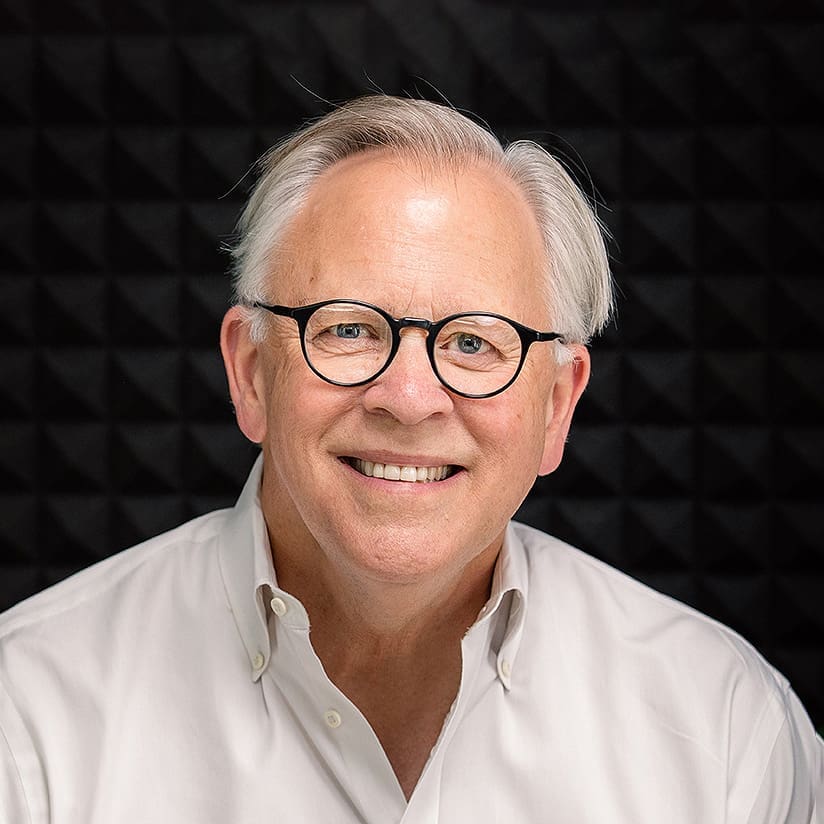
Mark Labberton hosts the Conversing podcast and is the Clifford L. Penner Presidential Chair Emeritus and Professor Emeritus of Preaching at Fuller Seminary.

Jeffrey Schloss is a retired Distinguished Professor of Biology and T. B. Walker Chair of Natural and Behavioral Sciences at Westmont College and remains a senior scholar at BioLogos, writing and speaking on the intersection of evolutionary science and Christian theology.
Love the show? Help others find it by reviewing it on your favourite podcast app. We also welcome your ideas and feedback. Email us at conversing@comment.org. Thanks for your support.
How do we relate to the work we’ve done at an institution that no longer exists?
SITE DESIGN AND DEVELOPMENT BY POLYMATH