


I
I am the oldest of three brothers, and every four years we make pilgrimage together. In 2017 we travelled to Israel with each of their best friends. In 2022, delayed a year by the pandemic, we travelled to Greece with our father. And this year, in late May, we travelled to France, accompanied by two of my best friends.
Each trip runs nine to twelve days. We bid farewell to our wives and children and promise not to do anything exotic. We avoid, as best we can, hot spots and tourist traps. We set our sights on relics and ruins, museums and monasteries, cathedrals and caves, icons and saints. We eat street food. We sleep in hostels. We travel with backpacks. We walk a lot.
We pray even more. The prayer beads in our hands are a silent sign to caretakers and gatekeepers that, in the taxonomy of theologian William Cavanaugh, we are neither tourists nor migrants nor monks. We are pilgrims. We are wayfarers in search of the holy.
To protect the innocent I’ll give my companions pseudonyms. There’s Matthew, a convert to Eastern Orthodoxy; Mark, a low-church pastor; Luke, a Roman Catholic philosopher; and John, an Anglican social scientist. As for me, I’m a theologian, a Texan, and an ambivalent Protestant. You can imagine the conversations we had.
As the Lord wills, my brothers and I hope to continue this practice as long as we live. If we’ve learned anything, it’s that Christian pilgrimage is different from, say, a standard evangelical trip to the Holy Land. By all means believers should visit Israel, should walk where Jesus—and Peter, and Mary, and John, and David, and Hannah, and Jacob, and Abraham—walked. But there is a difference between archaeological tourism and Christian pilgrimage. The one visits dead places where living things once happened; the other visits living places where holiness dwells. The former employs imagination to conjure a time now lost to history, as in D-Day at Normandy or the battle at Gettysburg; the latter petitions the Lord, together with his saints, to grant blessing, vision, presence, and healing in the present tense. The first wonders what it might have been like, then and there; the second receives the past into the present, here and now.
In a word, archaeologists suppose time’s arrow runs in one direction only. Pilgrims know time bends around the resurrection. Holiness is at once timeless and temporally specific, since time and space are coordinated. Where holiness erupted into history at a certain point in time, it also spilled out into a certain place. Pilgrims look for the places on earth into which the holy has leaked from heaven. Like radiation, it seeps into matter and stays there, charging. Like the fringe of Christ’s garment, it waits to be touched. Like the power of Christ’s divinity, it touches back.
Archaeologists suppose time’s arrow runs in one direction only. Pilgrims know time bends around the resurrection.
So having been to Capernaum and Nazareth, Bethlehem and Jerusalem, Athens and Corinth, Patmos and Athos, we five pilgrims journeyed to France, the first daughter of the Church. We were in country for a total of nine days. We began in Paris and made a rough counter-clockwise circle, with a brief foray into western Italy. In our rental car we drove over two thousand miles, visiting more than fifteen cities and twenty churches in the process. We lost track of the relics we saw or touched or kneeled before—literally hundreds—but four was the number of doctors of the Church whose crypts or consecrated basilicas we visited.
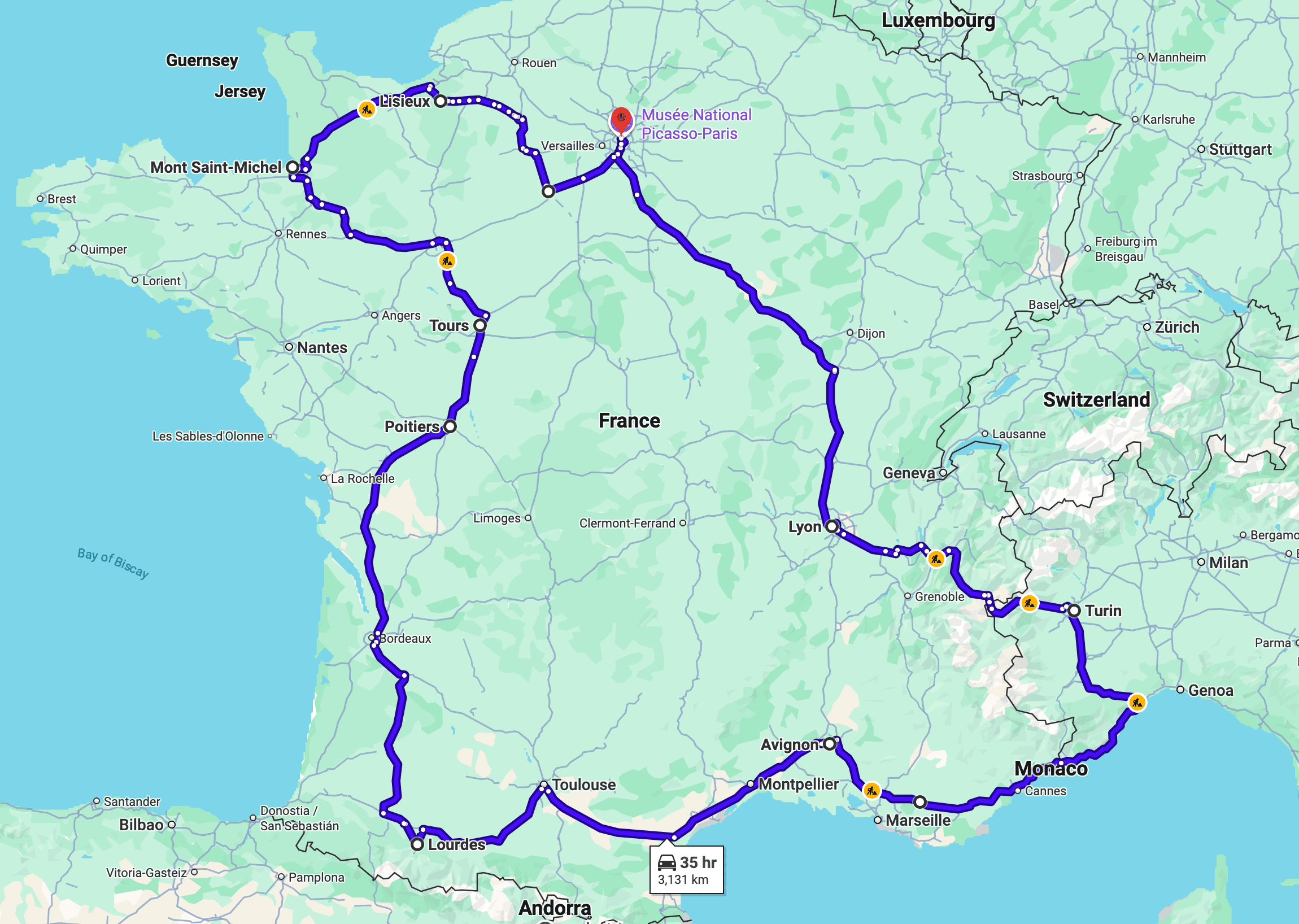
Our travels took us counter-clockwise out from Paris and back again.
Days 1–2: Paris
Our first two days were in Paris: hot, overcrowded, and stuffed with Americans. One “must do Paris,” but here at the outset we were least like pilgrims and most like tourists. We paid our obligatory visit to the Louvre. We saw the Mona Lisa. We saw Campi, Rosa, El Greco, Solario, Bellini, Gozzoli, and Fra Angelico. We saw the coronation of Napoleon, liberty leading the people, and the death of Marat. We saw the Arc de Triomphe and the Eiffel Tower.
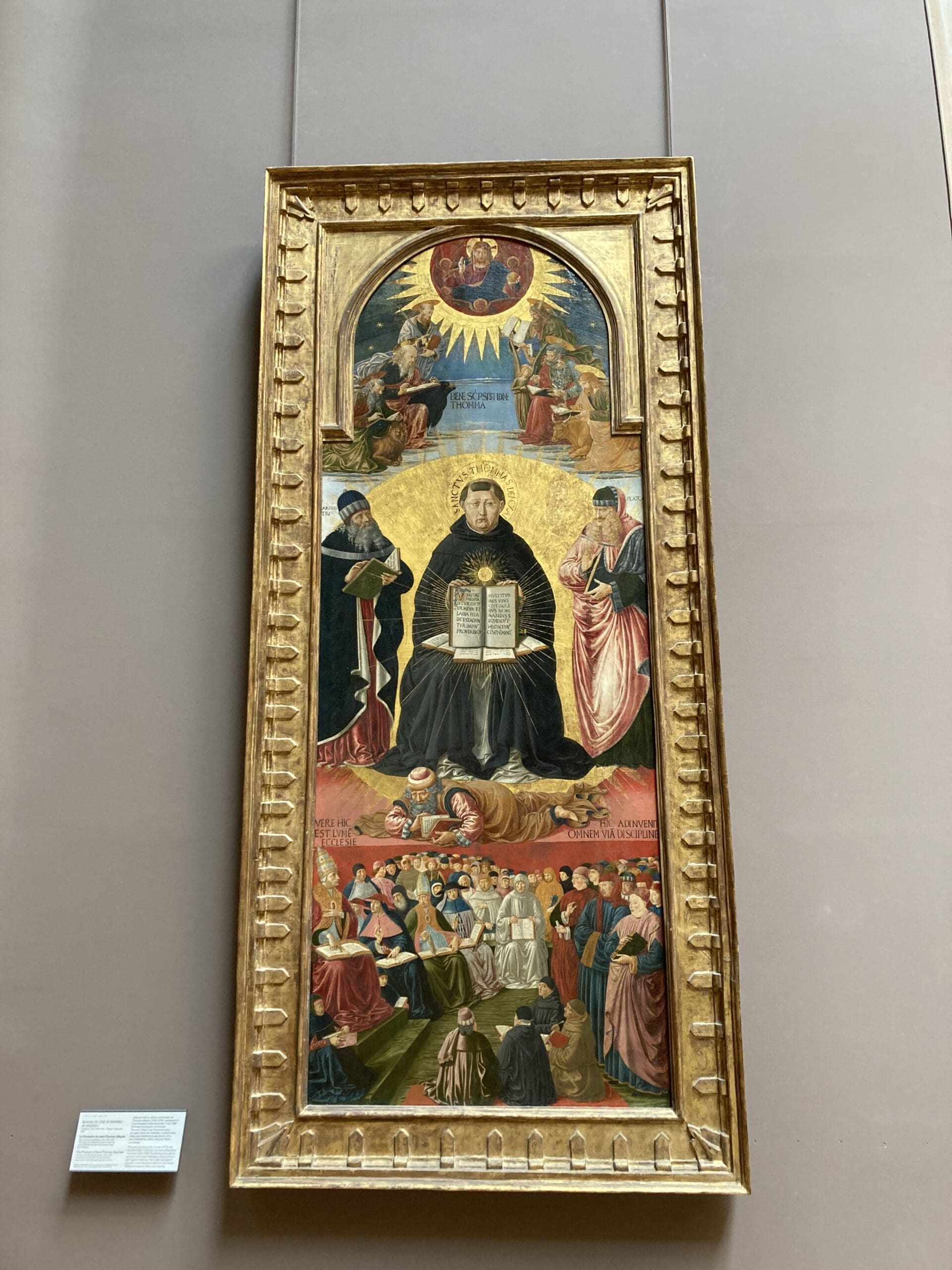
Le Triomphe de saint Thomas d’Aquin by Gozzoli.
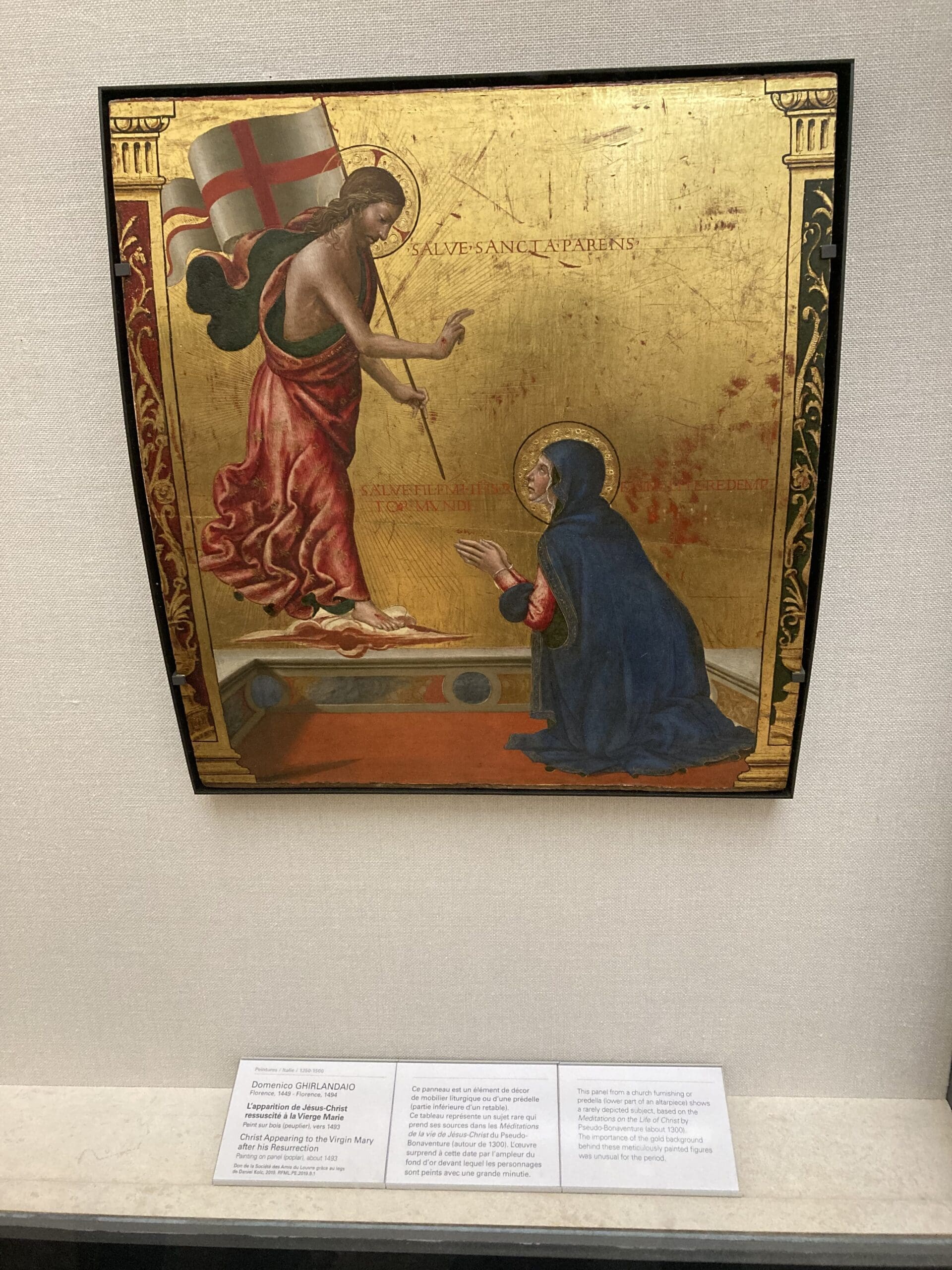
L’apparition de Jésus-Christ ressuscité à la Vierge Marie by Domenico Ghirlandaio.
These were lovely, and I’m glad I saw them with my own eyes. But so much of the “religious art” that hangs in museum hallways once adorned the walls of cathedrals, monasteries, palaces, and public places of assembly, devotion, and prayer. Transposing them from one to the other—sometimes as an act of rescue, more often the result of plunder—is a bit like an organ transplant.Doubtless it is good that they have not been lost to history. It would be better for them to reside in, or in some cases to be returned to, their original bodies. As it is, the effect is a kind of aesthetic taxidermy. Formaldehyde may preserve a body part, but it putrefies an icon.
Even Paris still has signs of life, though. Some places, like Notre-Dame, Sacré-Coeur, and Église Saint-Étienne-du-Mont, straddle the line between tourist trap and house of worship. Others, like the Église Saint-Pierre de Montmartre and the Orthodox Cathedral of Alexander Nevsky, are sufficiently small and off the beaten path to retain a lifeblood of prayer and reverence. And Sainte-Chapelle is a world unto itself: A royal chapel in centuries of disuse, built by King Louis IX to house Christ’s crown of thorns, it is simultaneously an eight-hundred-year-old museum and an overwhelming spiritual marvel. If Chartres is the Bible in stone, Sainte-Chapelle is the Bible in stained glass.
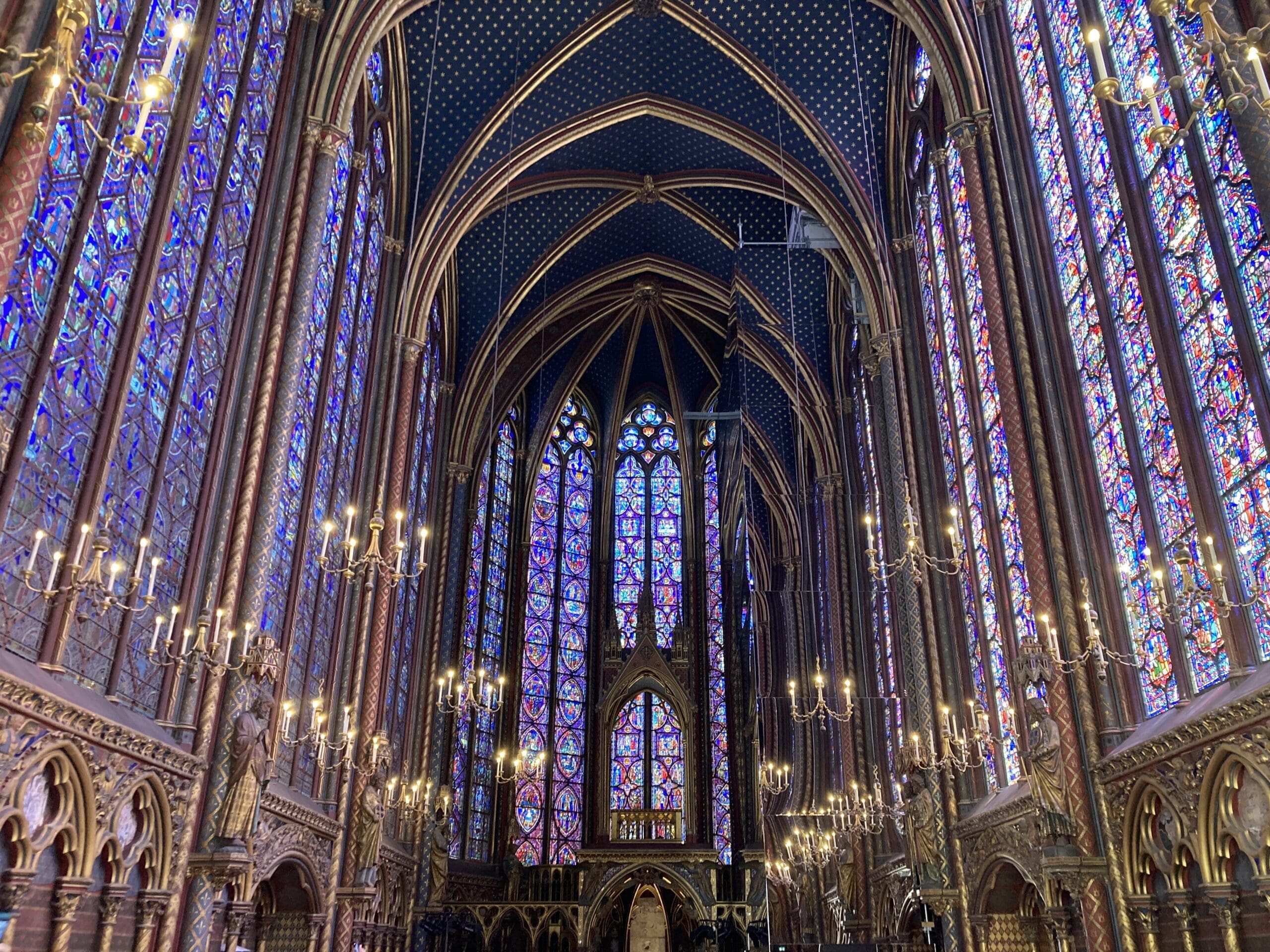
The more than one thousand stained-glass windows of La Sainte-Chapelle in Paris.
My fellow pilgrims and I worked our way around the chapel, delighting together in following the story of Scripture as each column moved upward in Genesis, Exodus, or 1 Samuel. These windows are visual proclamation, sermons of colour and light, and therefore they are a form of exegesis no less serious or scholarly than a peer-reviewed monograph published today. What stands out most clearly in the vision of these medieval exegetes is the presence of Christ in every jot and tittle of the sacred page. There he is, visiting Abraham; here he is, showing Moses the Promised Land before burying him. (You know it’s Moses by the horns on his head.)
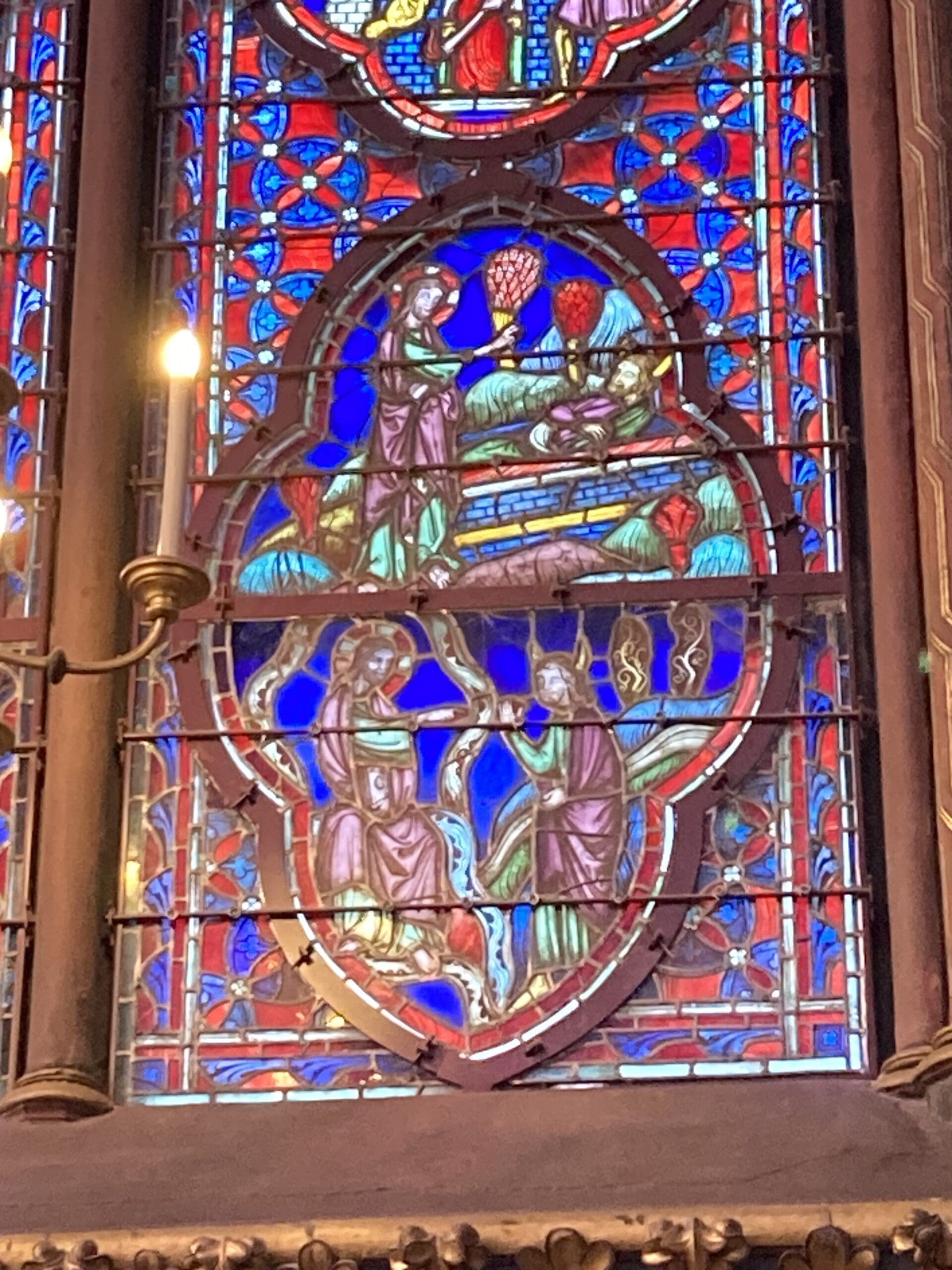
Christ plays in ten thousand places, including the stained-glass windows of France.
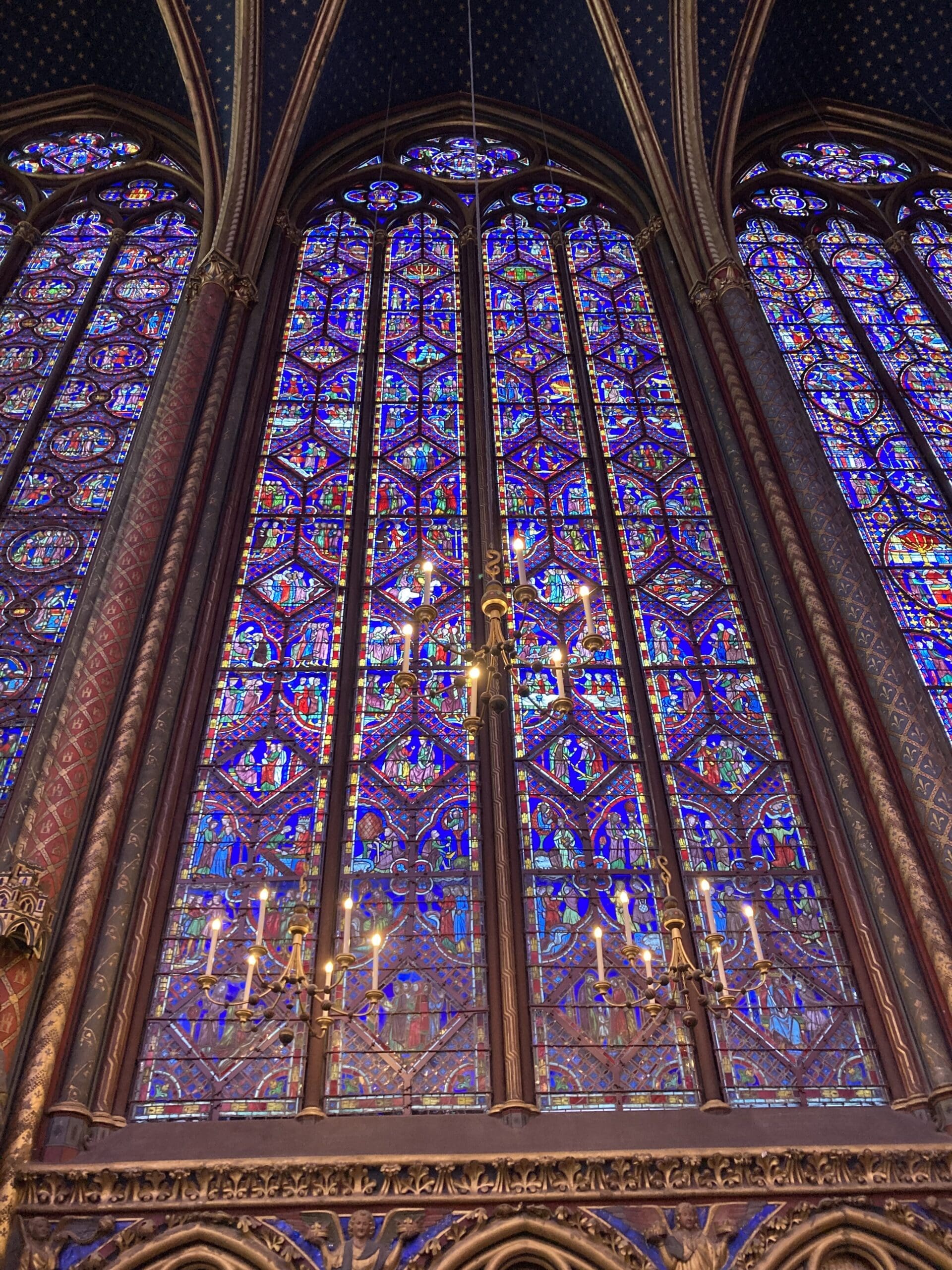
The story of Moses in the book of Exodus, moving upward from left to right.
Before leaving Paris, let me share three observations relevant to the rest of the pilgrimage. First, you never know when you are going to bump into a relic. Lisieux was on the agenda for day three, but in the shadow of Sacré-Coeur, in the Église Saint-Pierre de Montmartre, we happened upon a relic of Saint Thérèse hanging humbly on a side wall in a dark, unattended church.
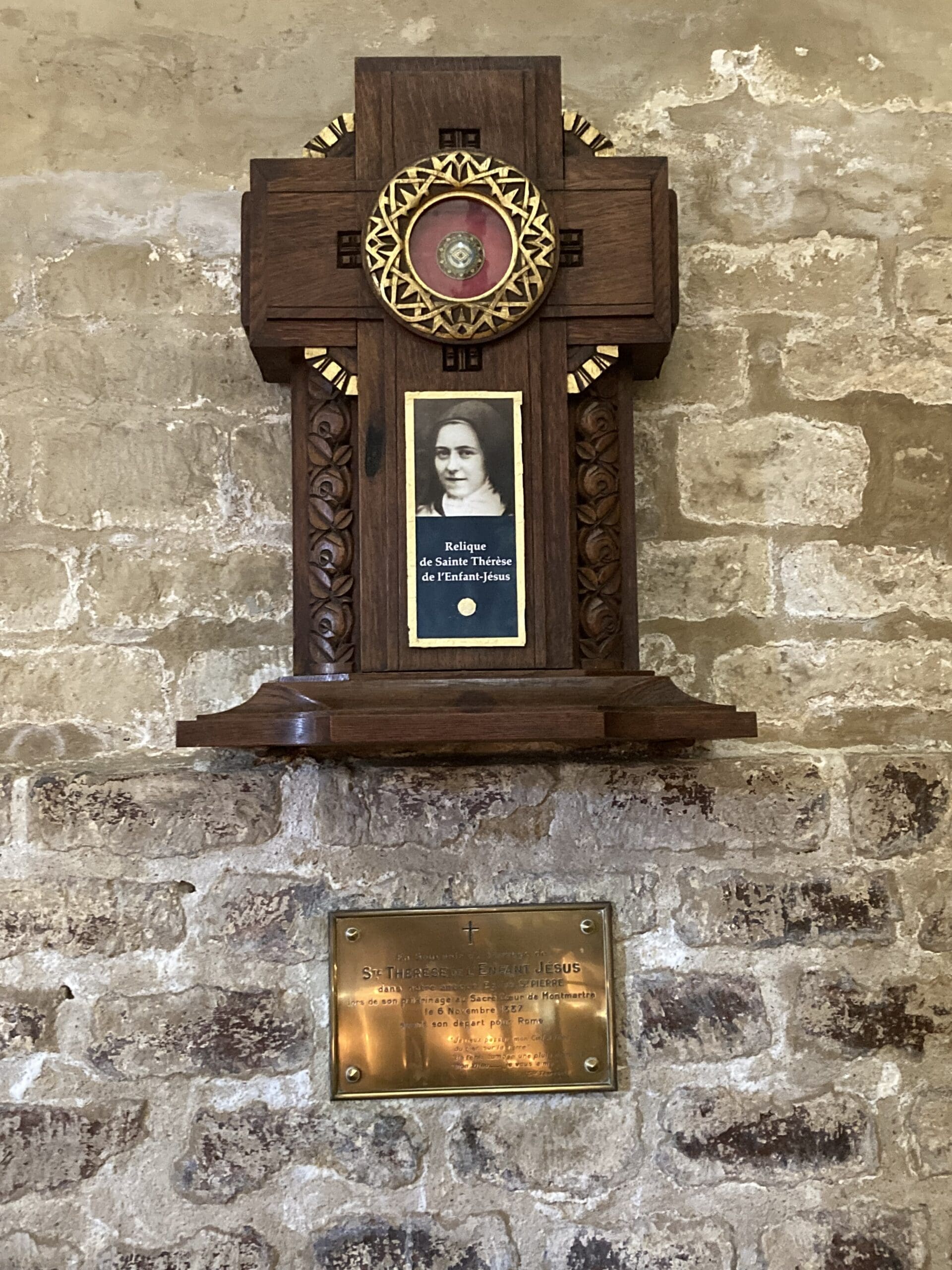
A relic of Saint Thérèse of Lisieux in the Église Saint-Pierre de Montmartre.
Second, in Paris we encountered our first portrayals of Saint Michael the Archangel. They were far from the last. The sword of Saint Michael became an unexpected theme of our pilgrimage.
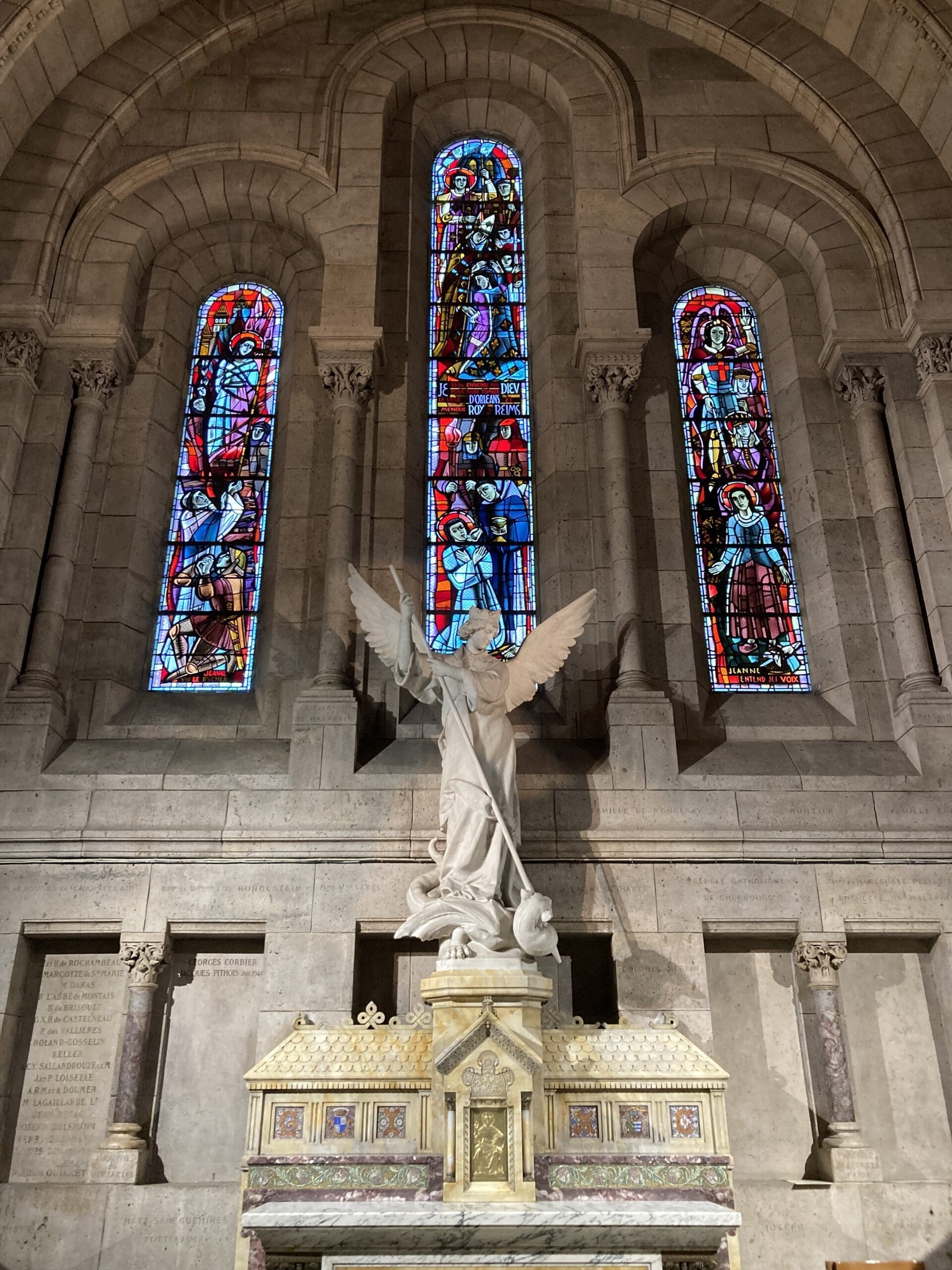
A sculpture of Saint Michael the Archangel slaying the dragon in Sacré-Coeur.
And third, a more regrettable theme emerged in Paris: transgression of the second commandment. That is to say, visual Christian art depicting God the Father.
To be sure, sometimes one can squint and choose to see the old man with the white beard as Christ in the form of the Ancient of Days. But most of the time the image in question is undeniably trinitarian: a descending dove, a man on a cross or emerging from a tomb, and the grave visage of a heavenly sovereign peering down upon the earth. Time after time, church after church, image after image, the pattern was the same, even if the art had been created in the last century. Somehow the teaching of the seventh ecumenical council, which permits icons of the incarnate Son but not of God the Father, has been forgotten. And if not forgotten, then ignored, and a more grievous sin for that.
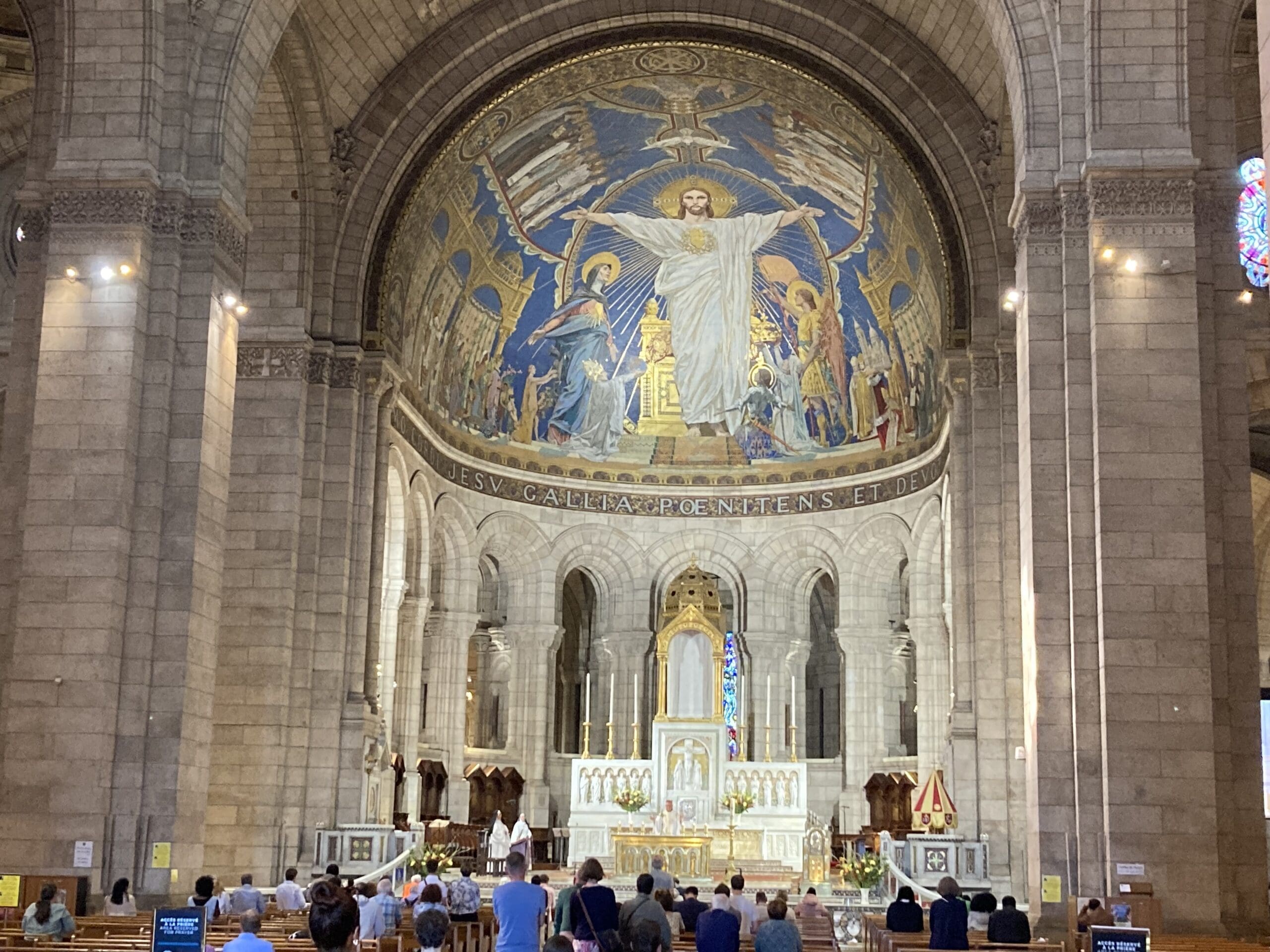
Altar and apse of Sacré-Coeur; “above” the dove descending on Jesus is God the Father depicted as an old man with a crown and a white beard.
Day 3: Chartres and Lisieux
On our way out of Paris we stopped for a brief morning stroll at Versailles, but we knew our true destination: Cathédrale Notre-Dame de Chartres.
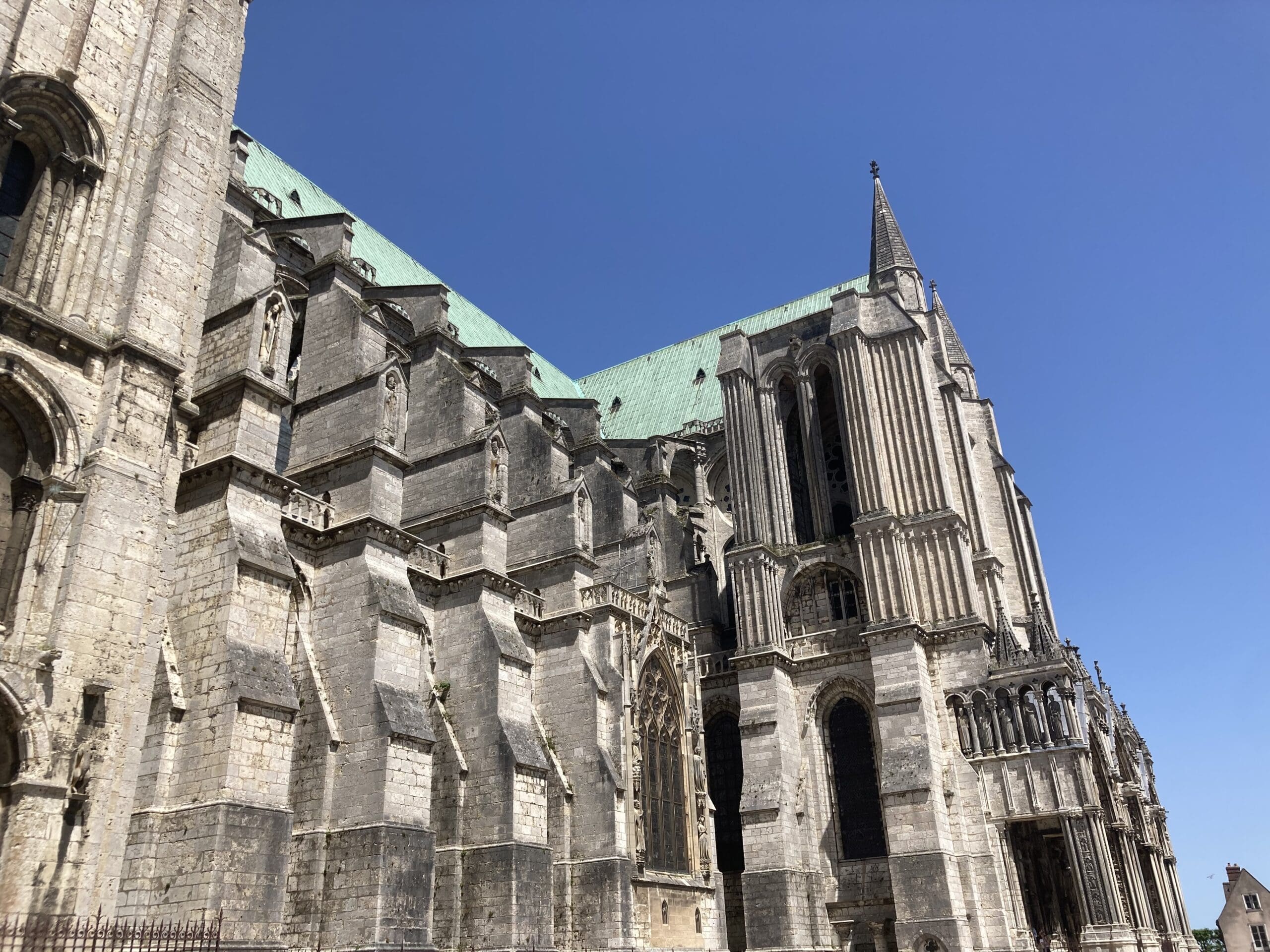
Chartres Cathedral.
Inside, carved in stone are two scenes from Scripture for which I am always on the lookout. One is the Visitation, when the Blessed Virgin Mary journeys to Saint Elizabeth and Saint John leaps in utero before the new ark of the covenant (Luke 1:41). Back in 2017 we visited the Church of the Visitation in Ein Karem outside Jerusalem. Here is the statue in the church’s courtyard:
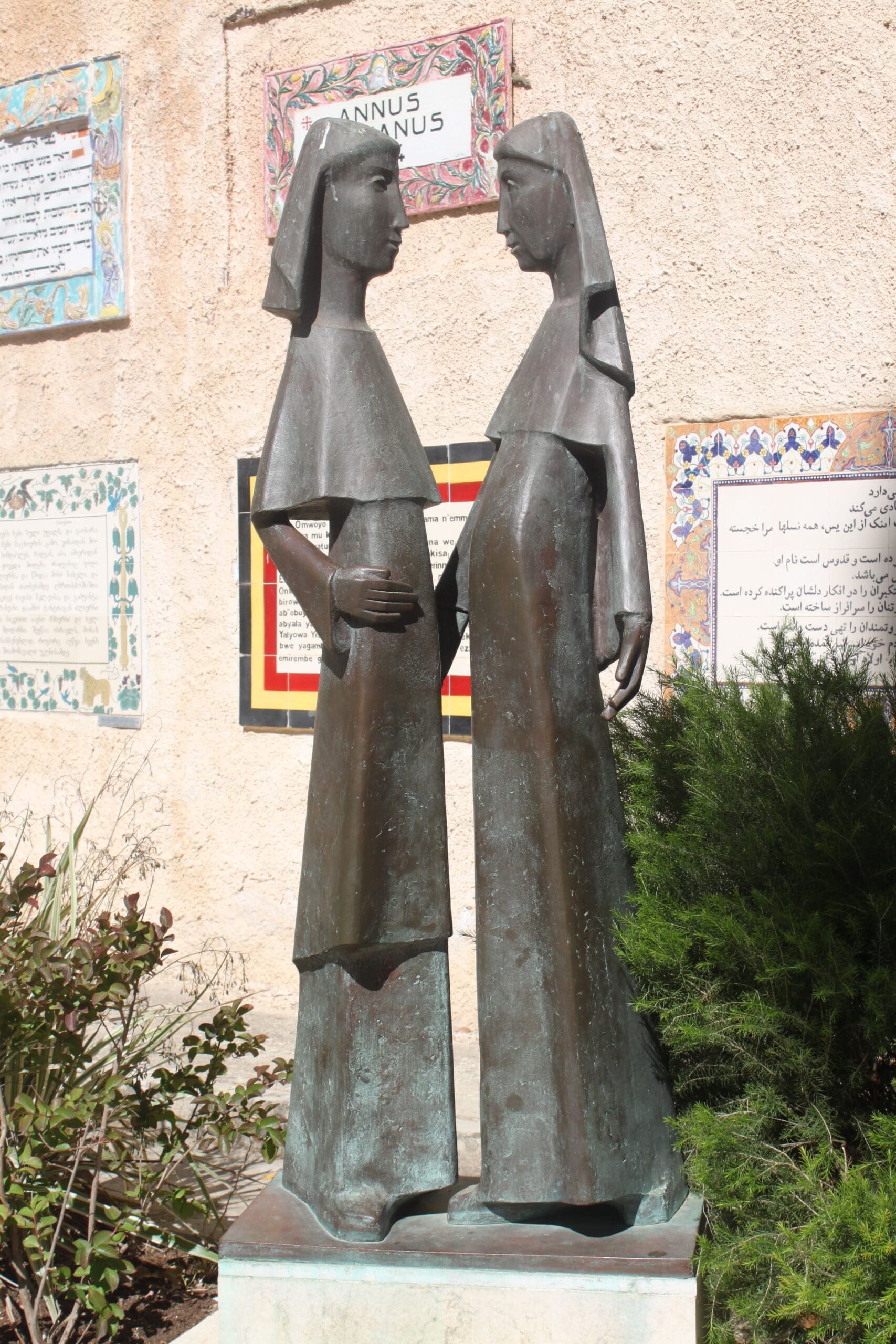
A stone sculpture of Mary visiting Elizabeth outside the Church of the Visitation in Ein Karem.
Now here is the same scene, together with the Annunciation, inside Chartres:
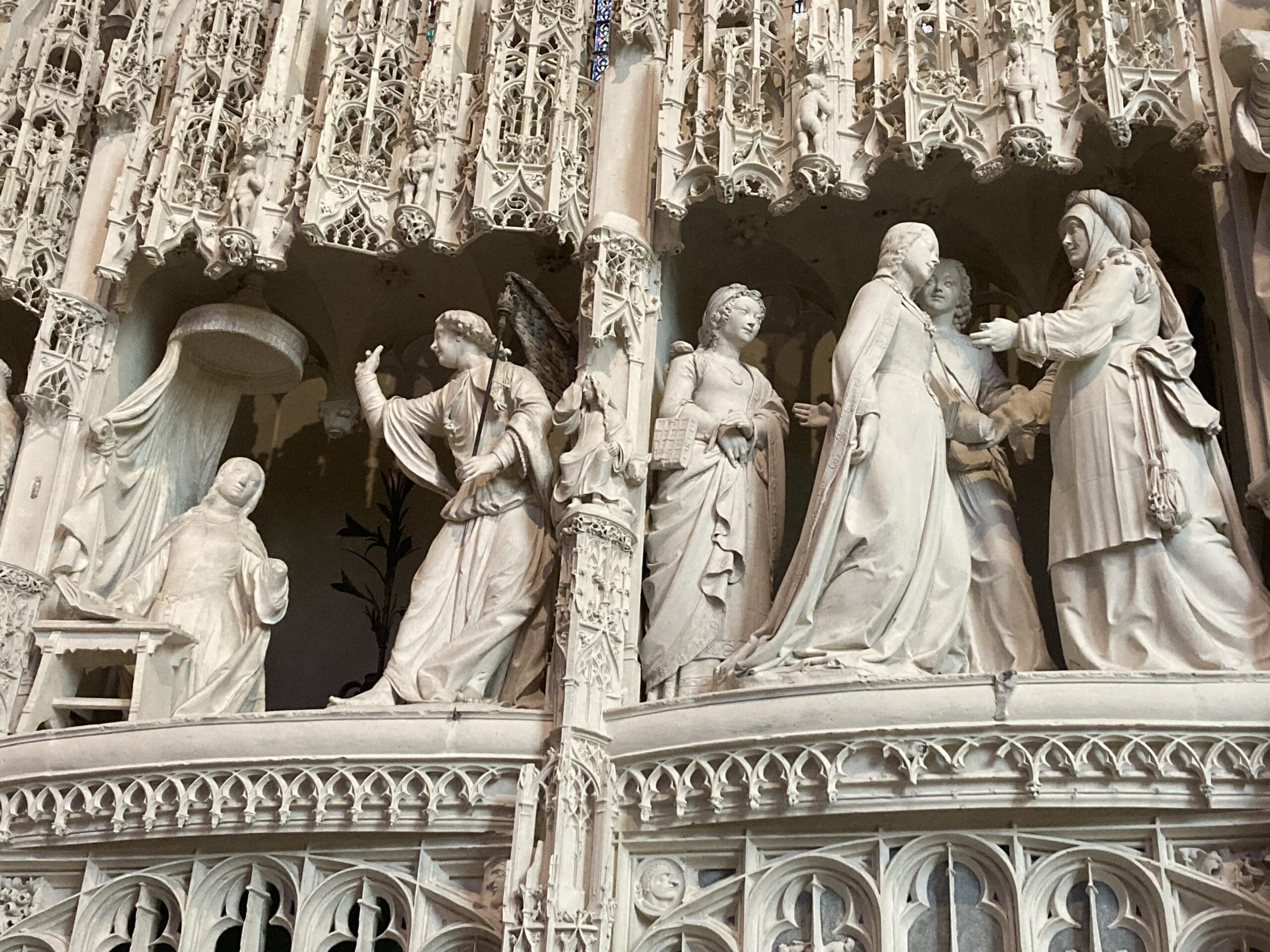
These sculptures form a choir wall in the ambulatory surrounding the chancel, where the altar is located and the priest says mass. They tell the story of Mary—and thus of Christ, and thus of his body—in a series of biblical and extra-biblical episodes. Here was the other one that caught my eye:
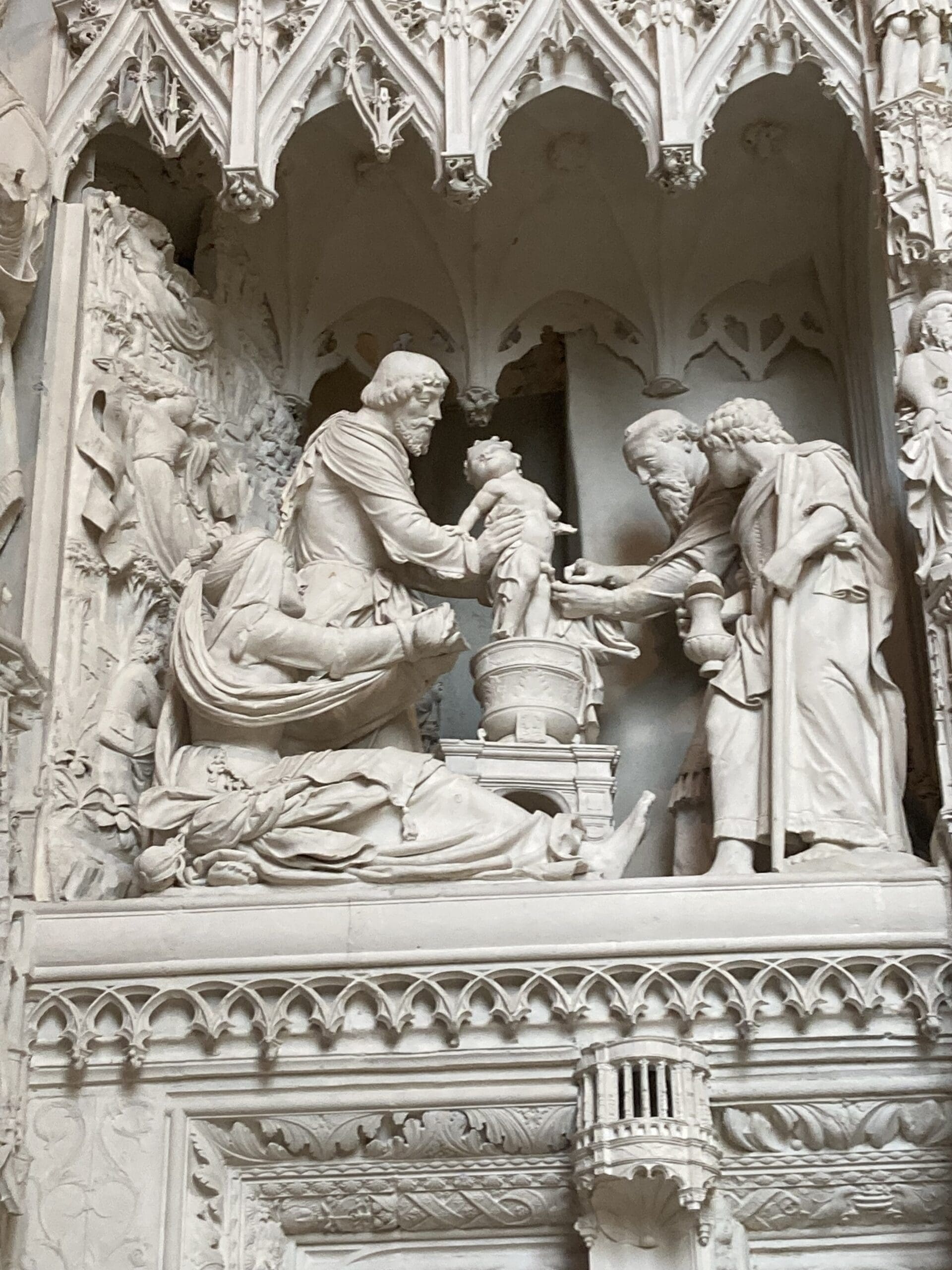
The circumcision of Jesus on the eighth day in accordance with the commandment (Luke 2:21).
This, if you can’t tell, is the circumcision of Jesus. Luke 2:21 tells us this happened on the eighth day in accordance with the commandment of Moses. For this reason the Feast of the Circumcision of Christ comes on January 1, which is the octave of Christmas. It is also the Feast of the Naming of Jesus.
Liturgically speaking, this memory of the Jewishness of Jesus is a counterweight to the (let us hope temporary and forgivable) forgetfulness of the second commandment. We are permitted to image the Image of God incarnate. We are not permitted to image God as such—that is, in his immaterial and incorporeal nature. It is the God of Moses who forbids it. That this God, as a newborn babe, submitted himself to his own commandment—that the Lord of Israel received the mark of circumcision in his own flesh—brings both truths together in a single mystery. Notice Mary’s outstretched arms, as much in prayer as in the hope of catching the first blood shed by her Son.
From Chartres we drove to Lisieux, to the Basilica of Sainte-Thérèse.
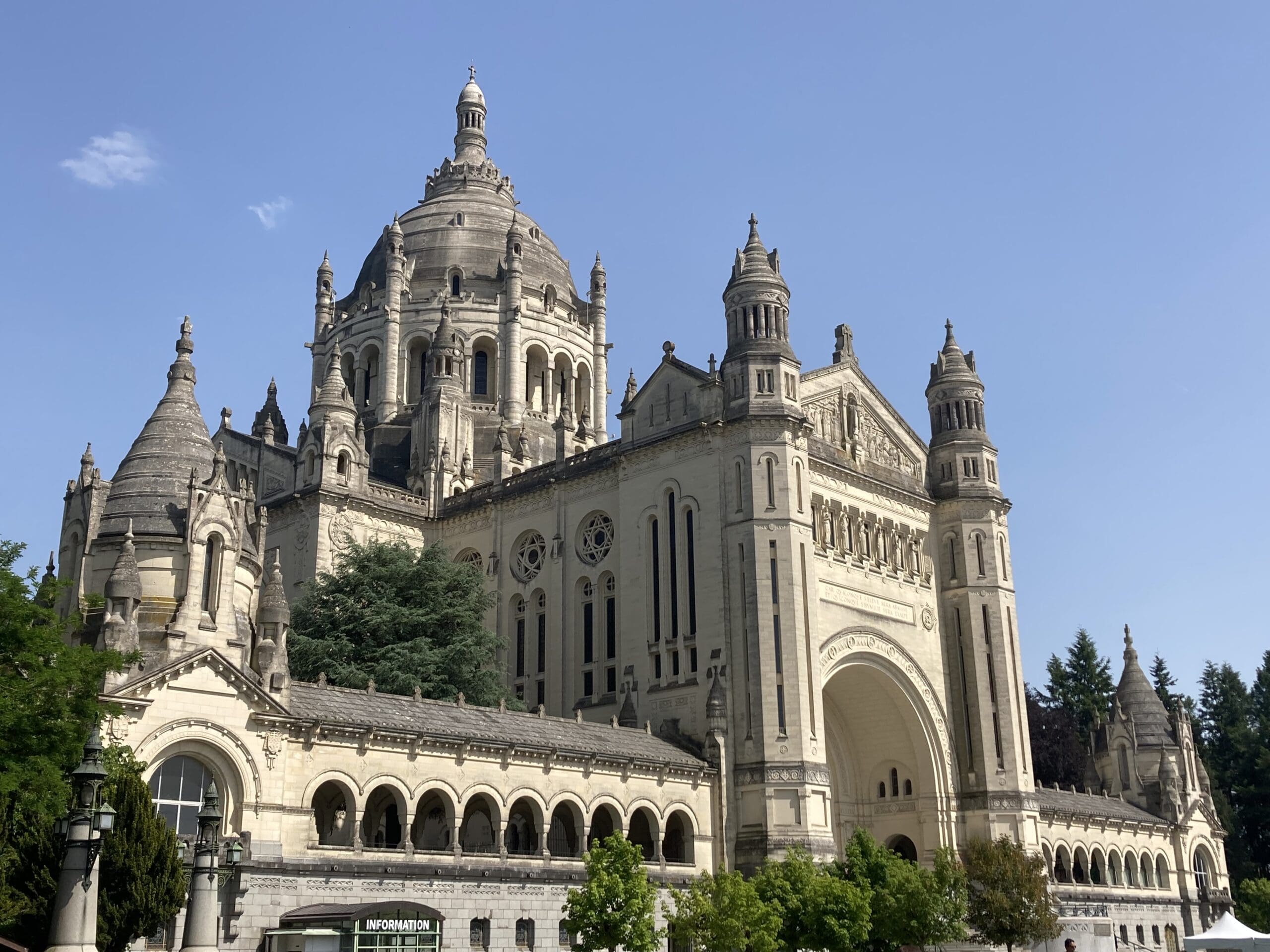
The Basilica of Sainte-Thérèse of Lisieux, consecrated in 1951.
Saint Thérèse of the Child Jesus and the Holy Face—also called the Little Flower of Jesus: great saints have many names—was a discalced Carmelite who died in 1897 at the age of twenty-four. She was canonized in 1925 and declared a doctor of the Church in 1997. She is known around the world for her memoir The Story of a Soul. If, like most Christians past and present, you believe that the saints in heaven pray for the souls of the living on earth, then to ask Saint Thérèse to pray for you is like asking Achilles to fight for you. It is to petition the greatest of warriors to enlist on your behalf. As she wrote to a priest late in her short life:
Jesus wants to possess your heart completely. He wants you to be a great saint. For that you will have to suffer very much, but then what joy will flood your soul when you reach the happy moment of your entrance into Eternal Life! My brother, I shall go soon to offer your love to all your friends in heaven and beg them to protect you. Dear little Brother, I would like to tell you a thousand things which I understand as I stand at the door of Eternity. But I am not dying, I am entering into life, and all that I cannot say to you while I am still here below I shall make you understand from the heights of Heaven.
What Christian pilgrim, so poor in spirit, can read these words without falling in love?
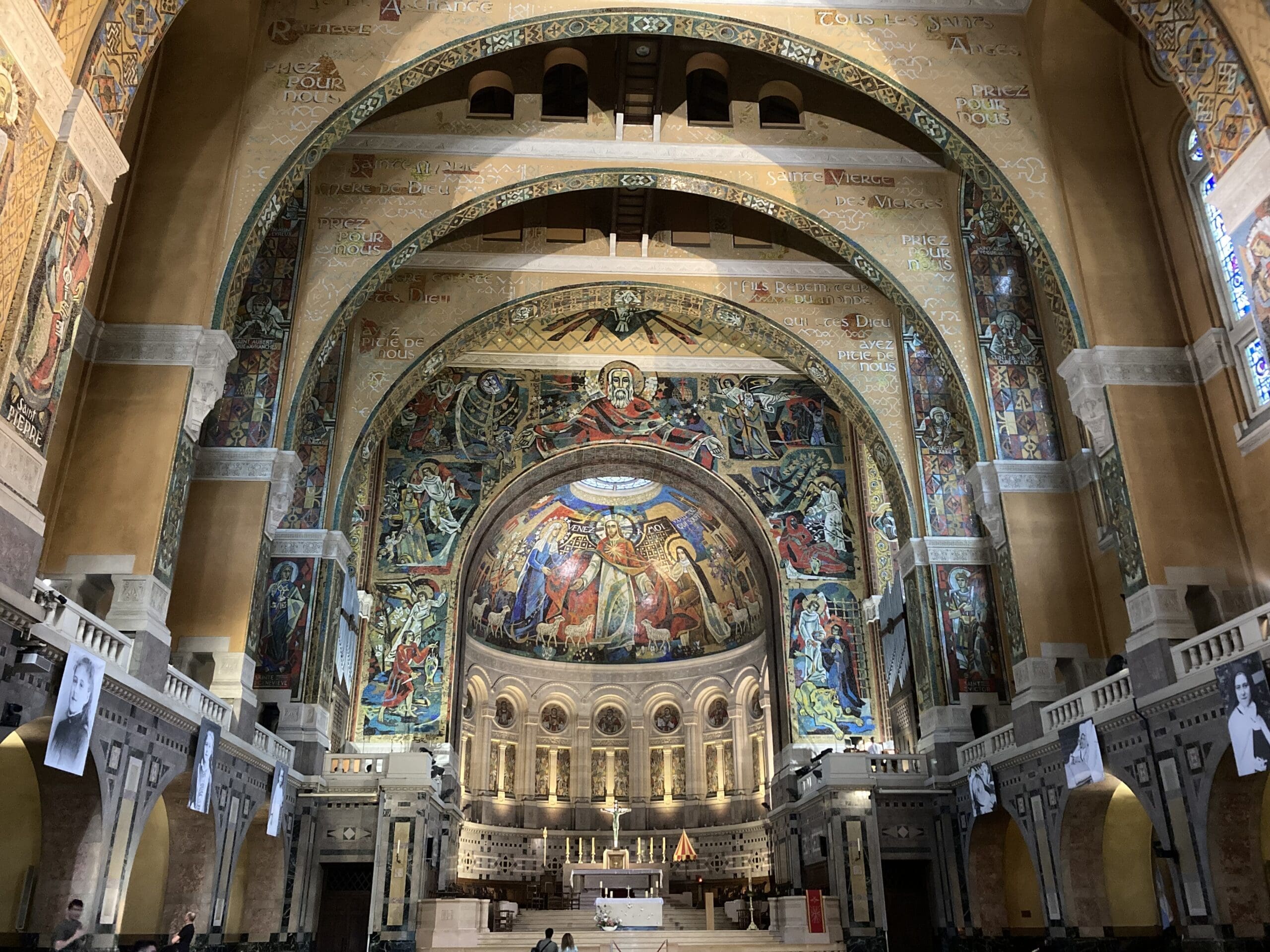
Interior of the Basilica of Sainte-Thérèse.
When we entered the basilica, without preface or prelude the organist began playing “Sinfonia,” the first movement of Bach’s twenty-ninth cantata (“Wir danken dir, Gott, wir danken dir”). My friend John is more than a Bach aficionado. He’s a devotee. The blast of the organ brought him to his knees, tears streaming down his face. It felt as if the Lord—or the Lord’s beloved Thérèse—had arranged it just for him. Maybe they had.
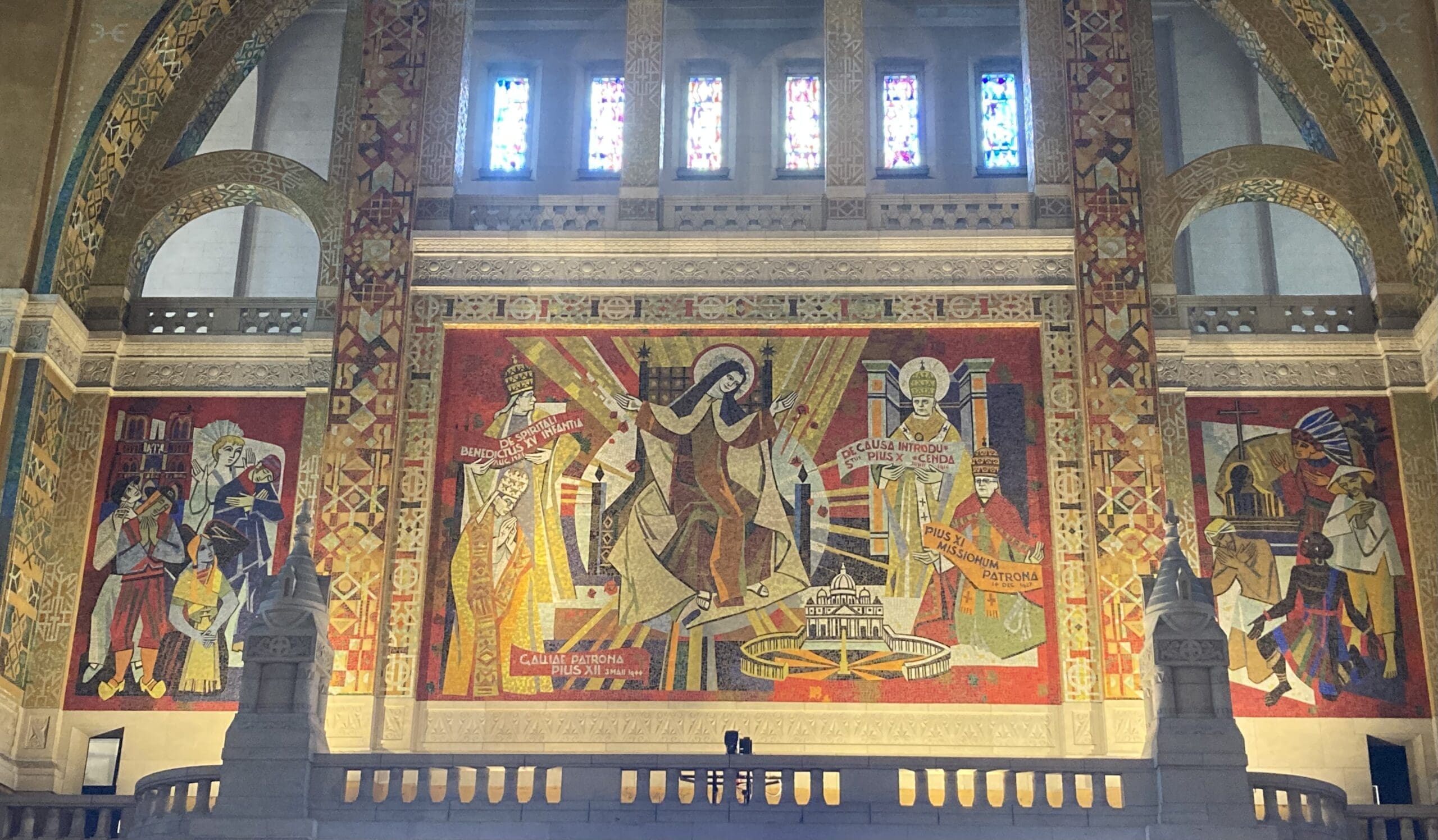
A mural depicting the titles and honours bestowed on Thérèse by various popes, including co-patroness of France (alongside Joan of Arc).
In every corner, it seemed, some country or church from across the world had sent a gift or prayer to be housed in the basilica. Thérèse’s relics are kept beneath a crucifix on which the arms of Jesus seem to be lifted more in prayer than in pain. Above him, carved in stone, sits Mary holding the child Christ, with words in French (not in Latin) taken from Thérèse: Elle est plus Mère que Reine—she is more mother than queen. Like her Son and Lord, Mary calls for affection and trust, not fear. Or perhaps love follows fear, once perfect love has cast it out (1 John 4:18).
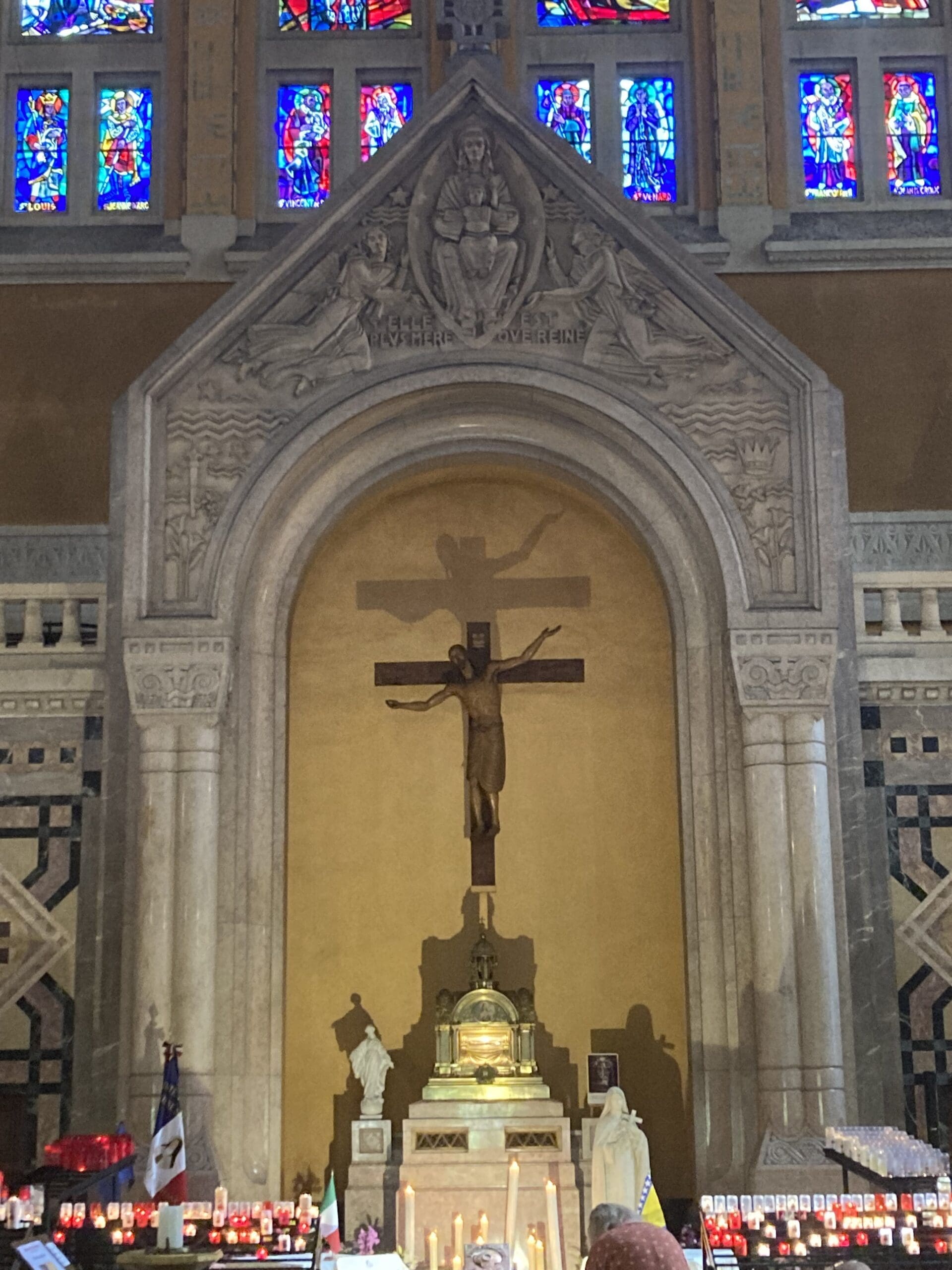
The relics of Saint Thérèse.
Unlike Mary, Thérèse is no queen. Like Mary, her spiritual motherhood is vast beyond reckoning. How many souls know Jesus because of her witness? because of her prayers? Her final words inspired those of the late Pope Benedict XVI. The great man of letters, the scholar, the bishop, the successor of Saint Peter—he made himself a little child by learning from one, and like hers his dying breath was simple: Jesu, ich liebe dich—Jesus, I love you!
Part of the basilica complex includes a crypt dedicated to the extraordinary parents of Thérèse and of her many siblings. When I call them extraordinary, I don’t mean that they performed heroic feats. Saint Louis and Saint Zélie were ordinary Christians who were faithful to Christ, a faithfulness reflected in their household and their children. When, in 2015, they were canonized by Pope Francis, they were the first married couple in Christian history to be made saints together: one in flesh and now one in Spirit with their Lord.
Here were saints my fellow pilgrims and I could relate to. In the face of Thérèse we were awestruck, reduced to silence. Before Louis and Zélie, we were in the presence of fellow parents: a father and a mother who baptized their children and gave them the faith. Francois Mauriac said that it’s never too late to become a saint, but it can certainly feel too late for some of us. Between Matthew, Mark, Luke, John, and myself, we had nineteen children waiting for us back in the States. Maybe, like Saint Monica, we could pray our kids into heaven. Maybe, like Saint Louis, we could be spiritual and not only earthly fathers. Maybe there was hope for us yet.
From Lisieux we made our way to the northwest coast of France. We arrived at dusk. We parked the car, hopped on a bus, then walked the rest of the way. As the sun set behind it, Mont-Saint-Michel awaited.
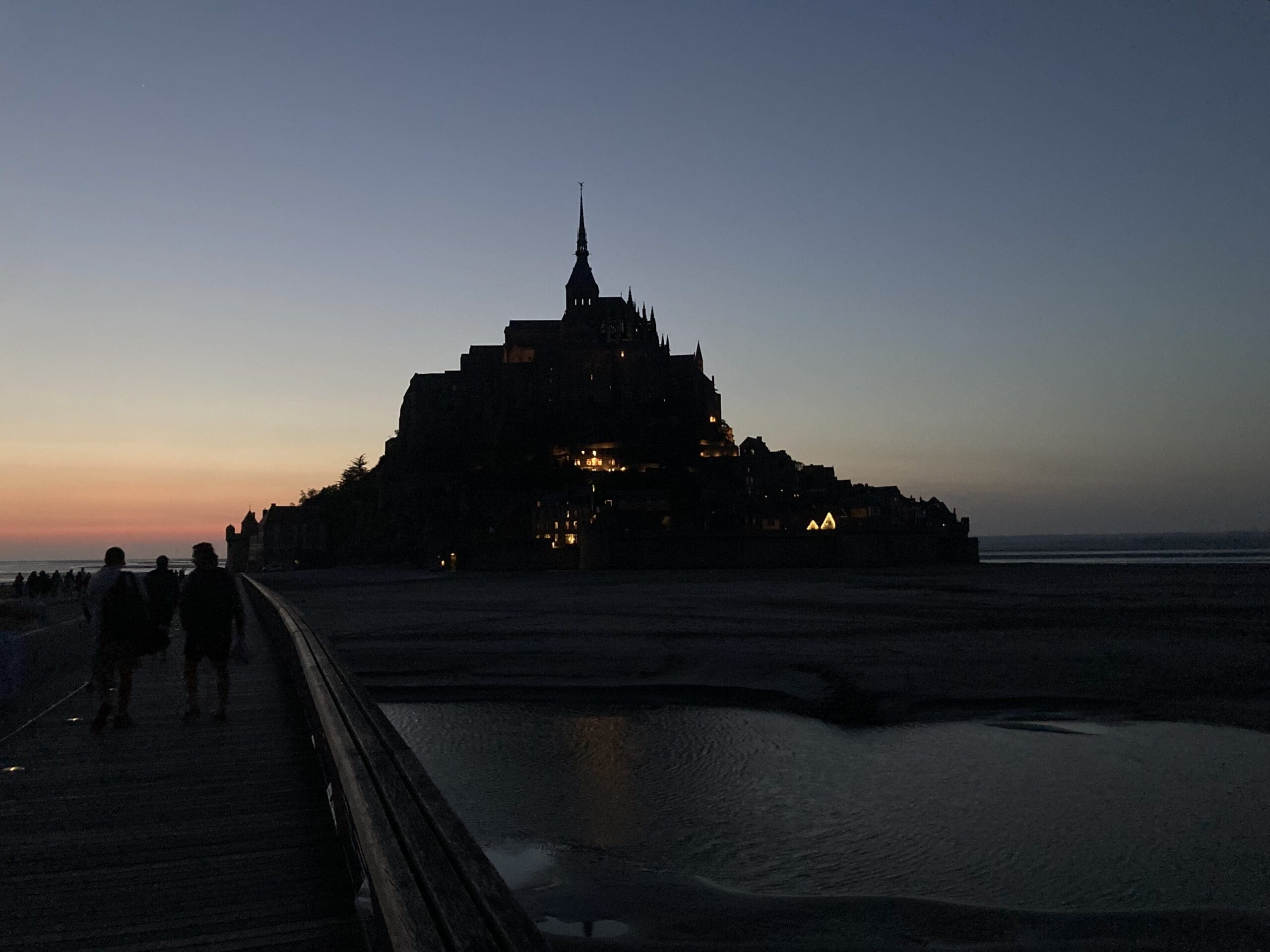
Mont-Saint-Michel, or the Mount of Saint Michael, once a Benedictine monastery.
Day 4: Mont-Saint-Michel and Tours
The morning we awoke on Mont-Saint-Michel was a Sunday. Matthew was our trip planner—he’d sketched the whole trip more than a year prior; we simply nodded our heads to his itinerary—and he’d been keen to arrange our time in France around just this moment: worship on the mount with fellow pilgrims.
But before mass we toured the island in the light of day.
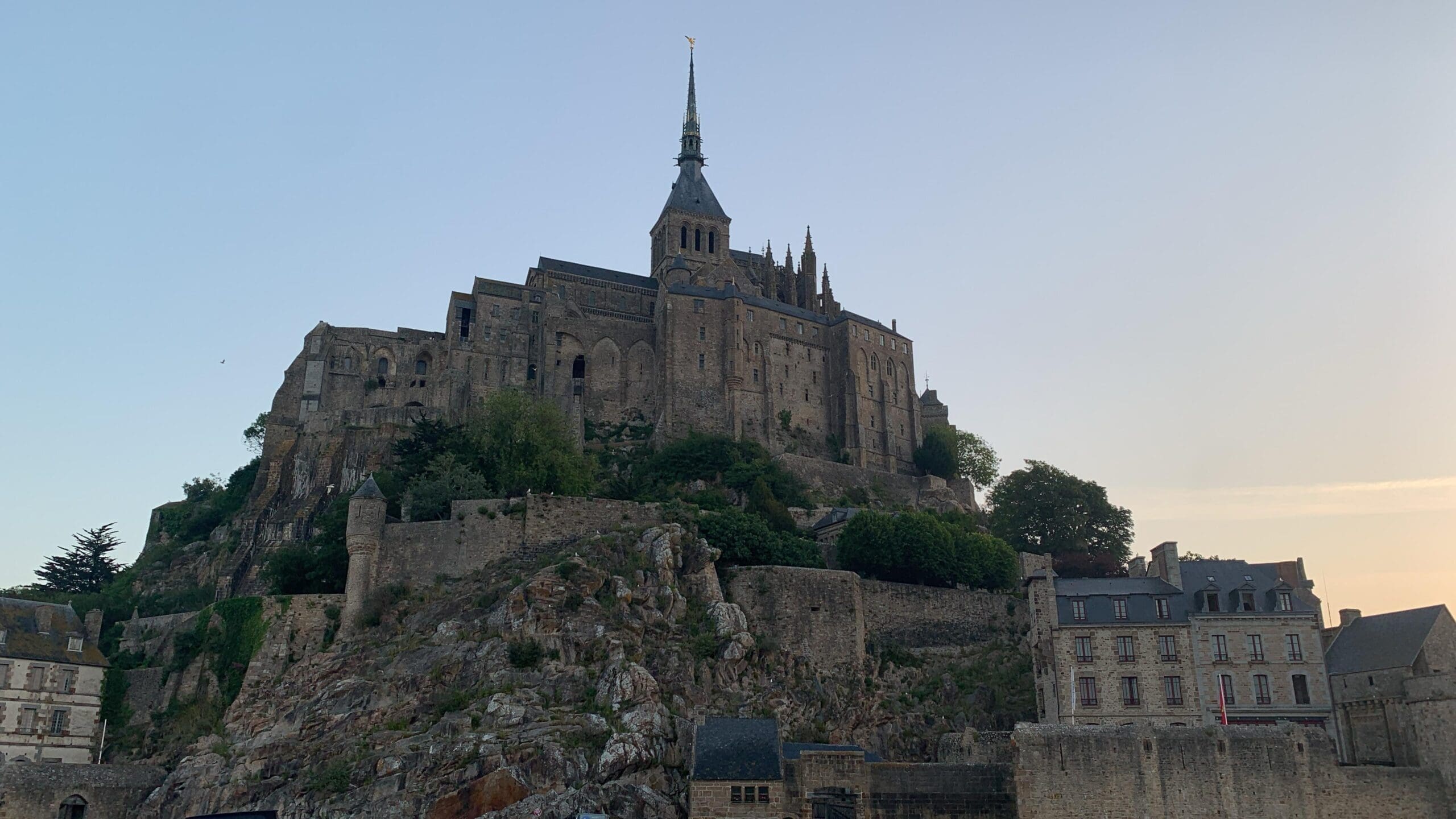
Mont-Saint-Michel in the light of day.
Mont-Saint-Michel, we learned to our surprise, is a popular destination for non-religious tourists. Its tiny streets are packed wall to wall with moneyed visitors looking for coastal beauty and architectural selfies. The shops are gaudy and filled with cheap trinkets. We had imagined monastic quiet and solitude. We got the opposite.
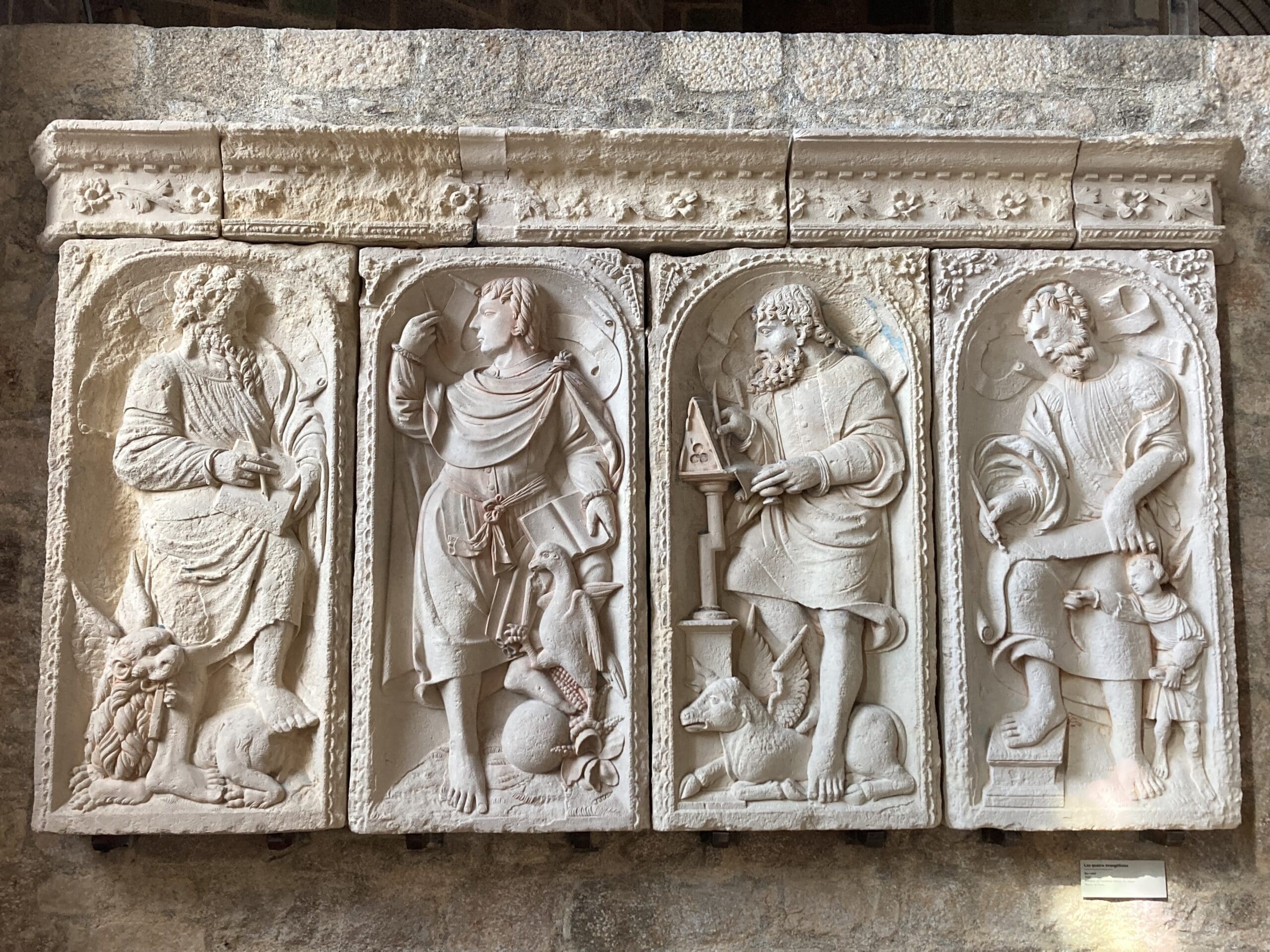
Each of the four Evangelists, identified by the figures of the Tetramorph: Mark (lion), John (eagle), Luke (ox), Matthew (man/angel).
Nevertheless we were able to attend mass, which was said by a priest from the Monastic Fraternities of Jerusalem, a group that took leadership of religious services in the chapel only a few decades ago. Like so many Catholic sites in France, Mont-Saint-Michel was expropriated by the French Revolution and for a time converted to a prison. Too many such places exist now as memorials to their own seizure and desecration. Revolutionaries looted the relics of Saint Genevieve once held in the Église Saint-Étienne-du-Mont; rioting Protestants threw the bones of Saint Irenaeus into a river. Perhaps one reason Calvin lies buried in an unmarked grave is so that no one returns the favour.
After mass we said goodbye to the great mount and journeyed south to Tours. There we visited the Cathédrale Saint-Gatien and the Basilique Saint-Martin de Tours. The reliquary of Saint Martin contains part of his skull: hence the name l’autel du chef—the altar of the head. We slept in Tours that night.
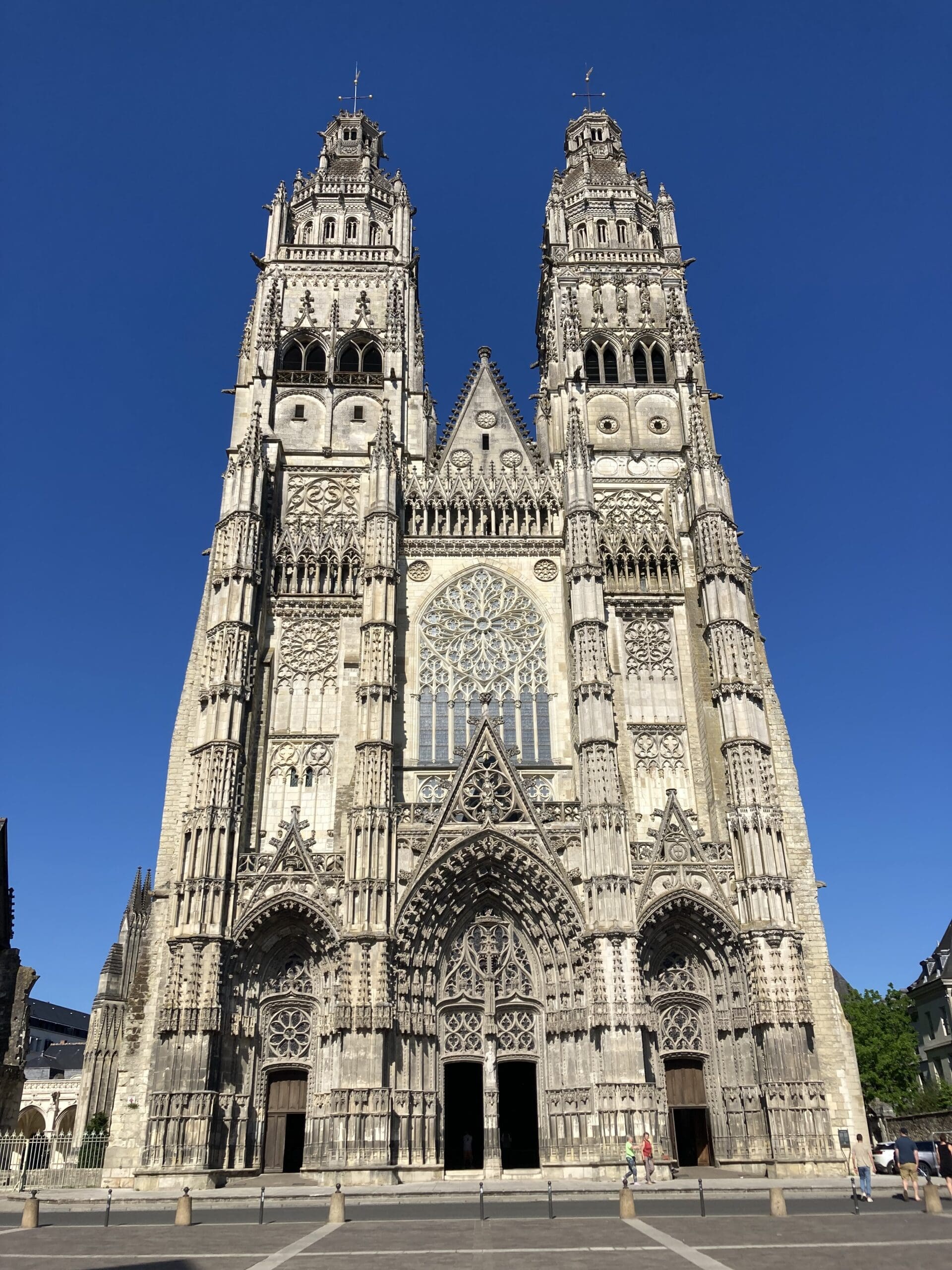
The Basilique Saint-Martin de Tours.
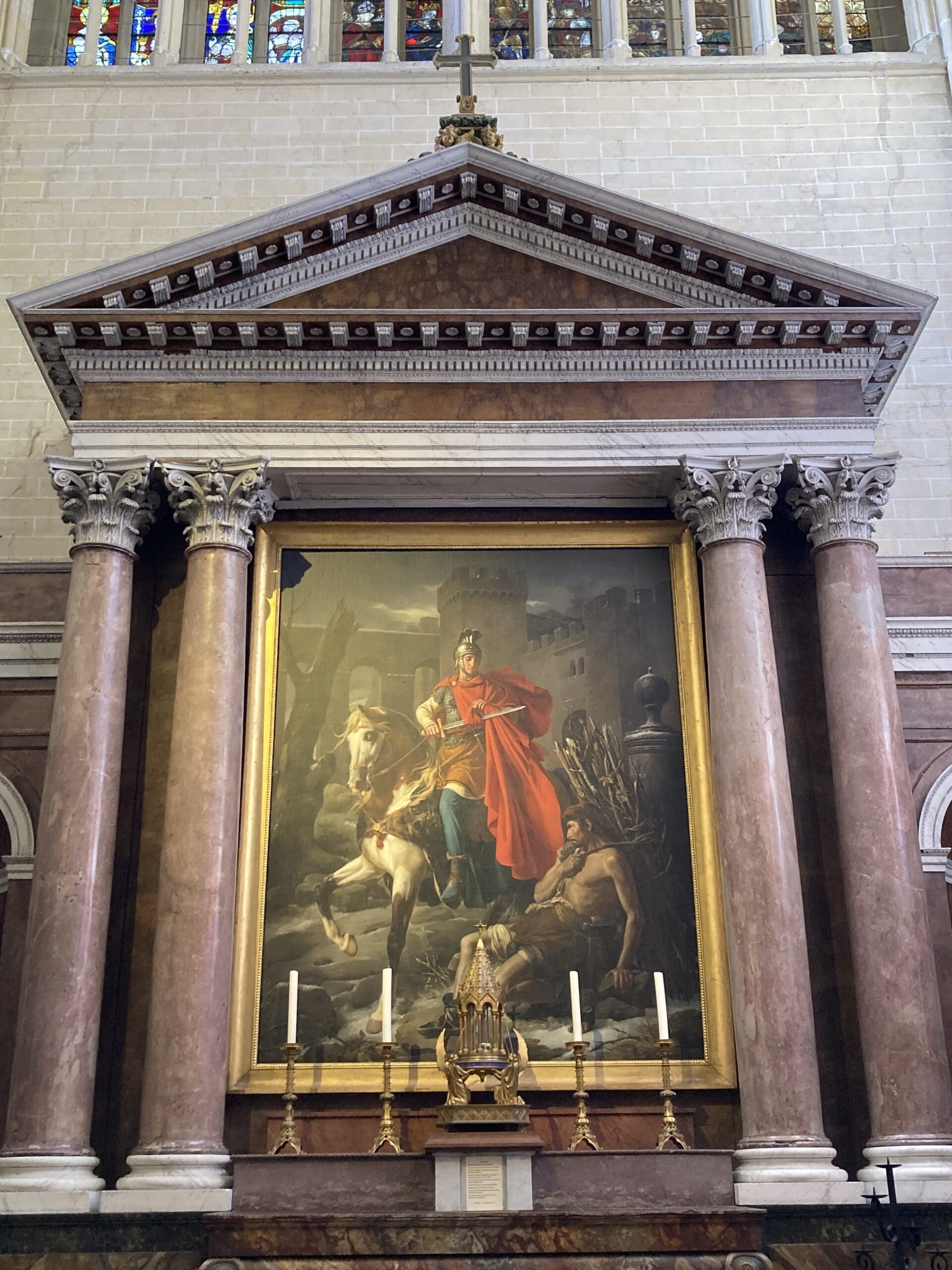
The reliquary of Saint Martin.
Day 5: Poitiers and Lourdes
The next morning we drove about an hour to visit the Église Saint-Hilaire-le-Grand de Poitiers, but unfortunately it was closed. So we paid our respects to Saint Hilary, doctor of the Church, and got back on the road. By late afternoon we arrived at one of the most visited destinations for Christian pilgrims in the world: Lourdes.
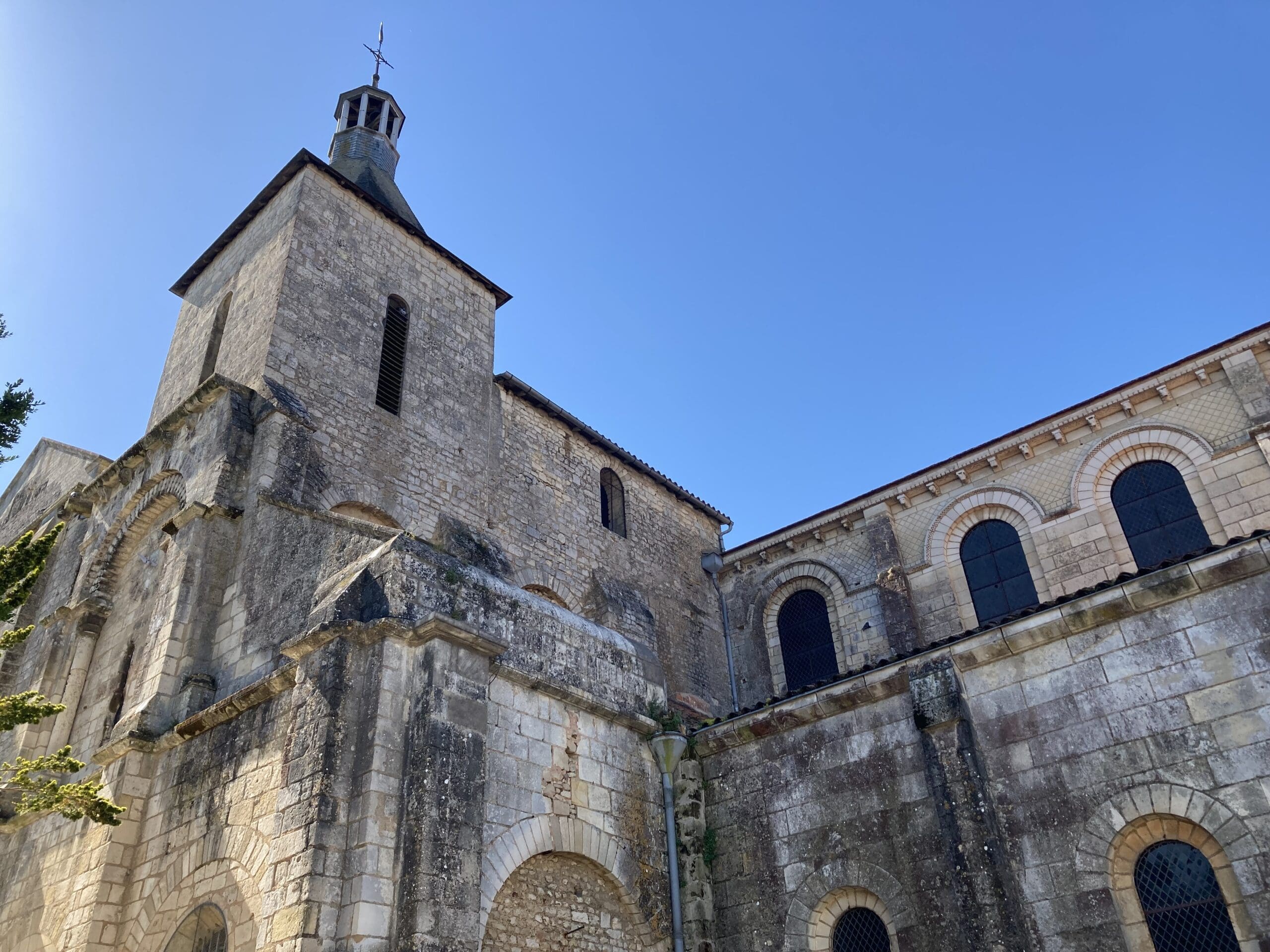
The Église Saint-Hilaire-le-Grand de Poitiers.

The Basilique de Notre-Dame de l’Immaculée-Conception de Lourdes.
Lourdes is not one church but a sprawling estate with three distinct basilicas built alongside the Gave de Pau; together the entire complex is called the Sanctuary of Our Lady of Lourdes.
The story goes that, in 1858, Mary appeared numerous times over the course of many weeks to a young girl named Bernadette, now canonized. She identified herself as the Immaculate Conception. The apparitions were ratified and declared valid by the Roman hierarchy. The Basilica of the Immaculate Conception was consecrated exactly 150 years ago. No fewer than four million pilgrims visit the Sanctuary annually; a purported ten thousand masses are said across all the basilicas for them.
They come, above all, for the healing powers of the water of Lourdes, which the church provides without charge, and which by the testimony of the sick has been God’s chosen means for thousands of miracles. Of these, Rome officially recognizes around seventy.

The basilica and grotto following the candlelight procession.
The day of our arrival was May 25, the day after the Feast of Pentecost. The Catholic Church dedicates this day to the Blessed Virgin Mary, Mother of the Church. That evening, at Lourdes, there was a candlelight procession of hundreds of pilgrims in honour of Mary (“henceforth all generations will call me blessed,” Luke 1:48). They hailed from six continents and spoke dozens of languages; the prayers and scriptures over the loudspeaker were read in French, Italian, English, Spanish, German, and Hindi.
The capstone of the night came when Mark introduced himself to a cardinal in attendance. The man stopped what he was doing, listened, stretched out his hand, and solemnly blessed him in the name of the Trinity.
Day 6: Toulouse and Avignon
After the midpoint summit of Lourdes, we expected day six to be something of a bridge to the rest of the pilgrimage: a lot of driving and little more. On the way to Avignon we stopped in Toulouse to visit the Church of the Jacobins.
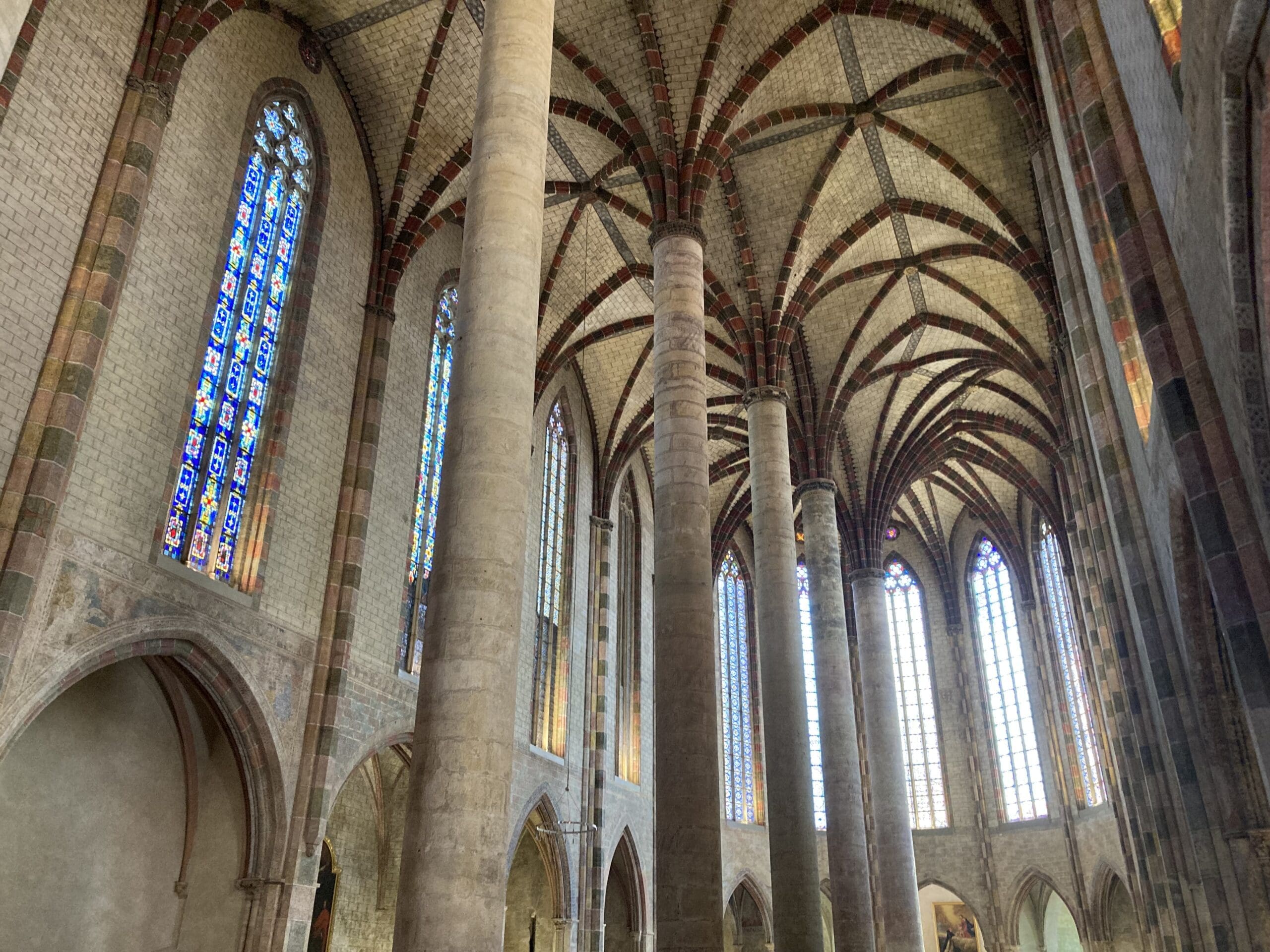
The Couvent des Jacobins de Toulouse.
The now decommissioned church is fittingly named, although it came long before actual Jacobins ruined it. For centuries it belonged to the Dominicans, who kept the relics of Saint Thomas Aquinas there, including his skull. After the Revolution Napoleon converted it into a barracks for soldiers. It’s only recently that the reliquary was returned, although the site remains a museum, not a house of worship.
Still, the bones of the angelic doctor are beneath the altar, and before the altar is where pilgrims come to pray—especially Catholics like Luke, whose philosophical voice sings in a Thomistic key.
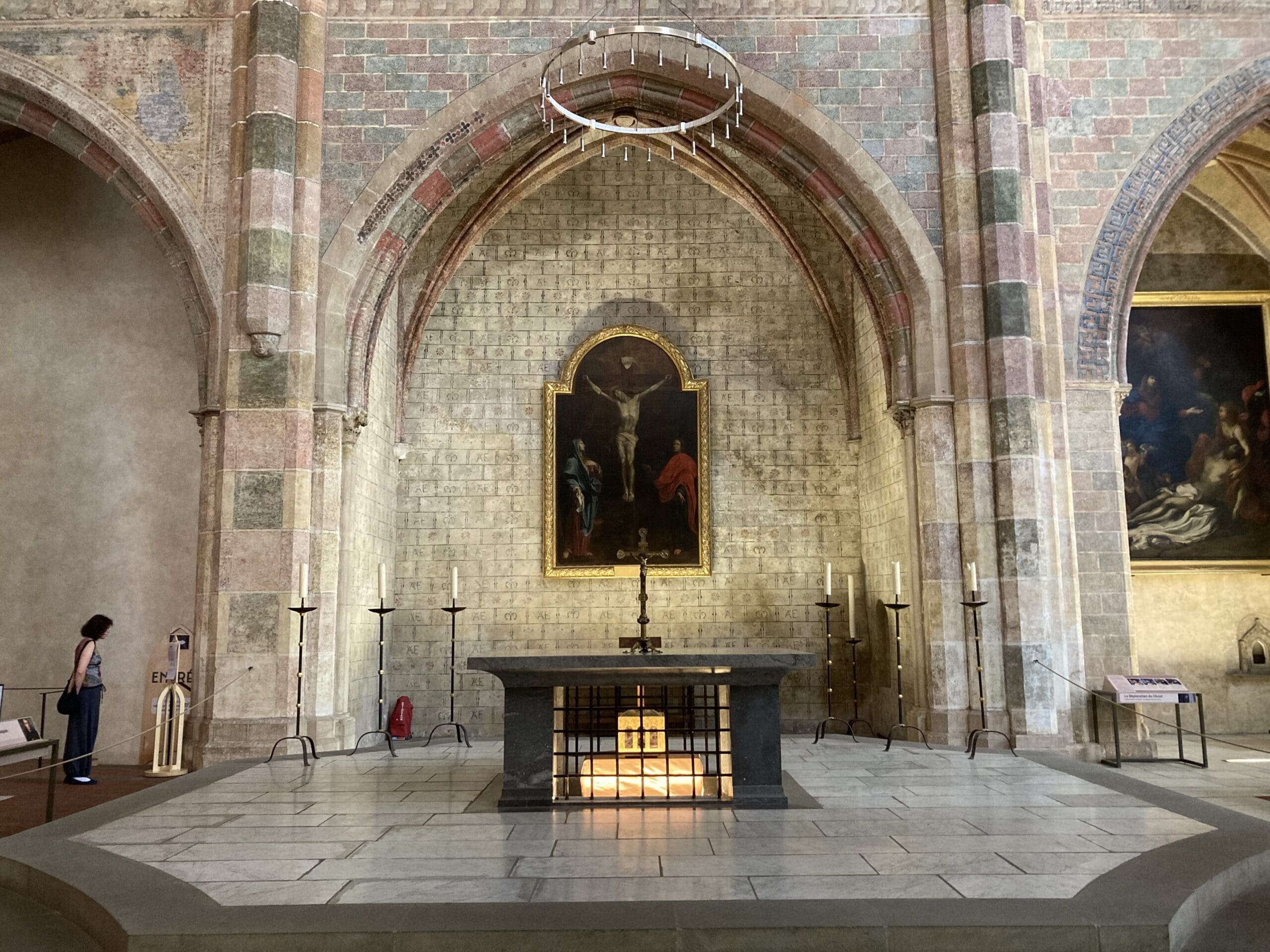
Thwarted again by Bolsheviks and Bonaparte, we wandered to the car. But John had done some googling, so we tried a church off the itinerary: the Basilique Saint-Sernin. As it turns out, Saint Sernin’s has a strong claim to possessing more relics than any other Catholic Church in the world. Naturally, the claim is disputed, but as we saw with our own eyes, it was a plausible thing to say.
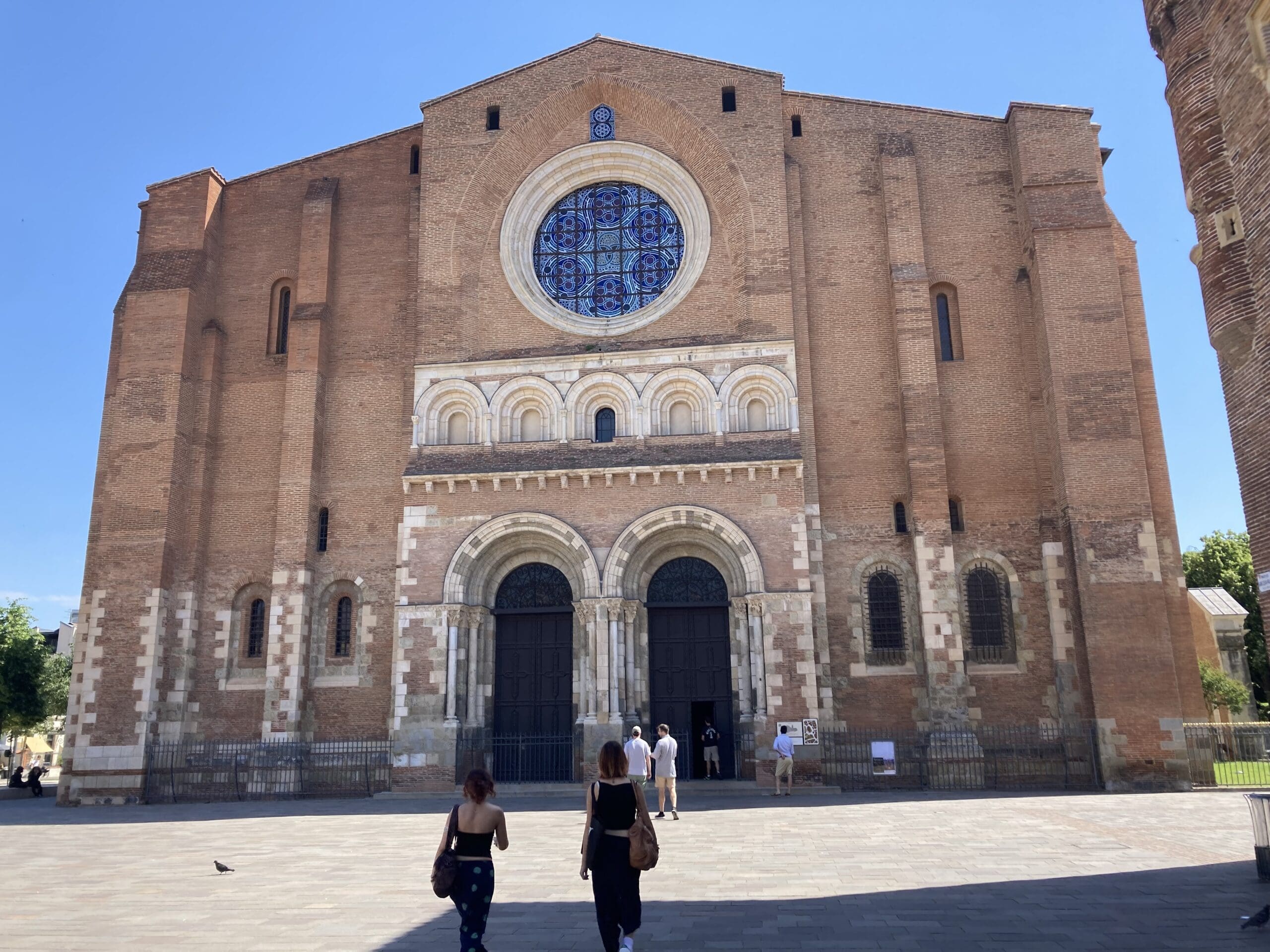
The Basilique Saint-Sernin in Toulouse.
Whose bones are housed in this humble basilica? Five apostles, for starters: Saint James, brother of Saint John and first to be martyred; Saints Simon and Jude, two of the original Twelve; and Saints Peter and Paul, brothers in Christ and heralds to Jews and gentiles, respectively.
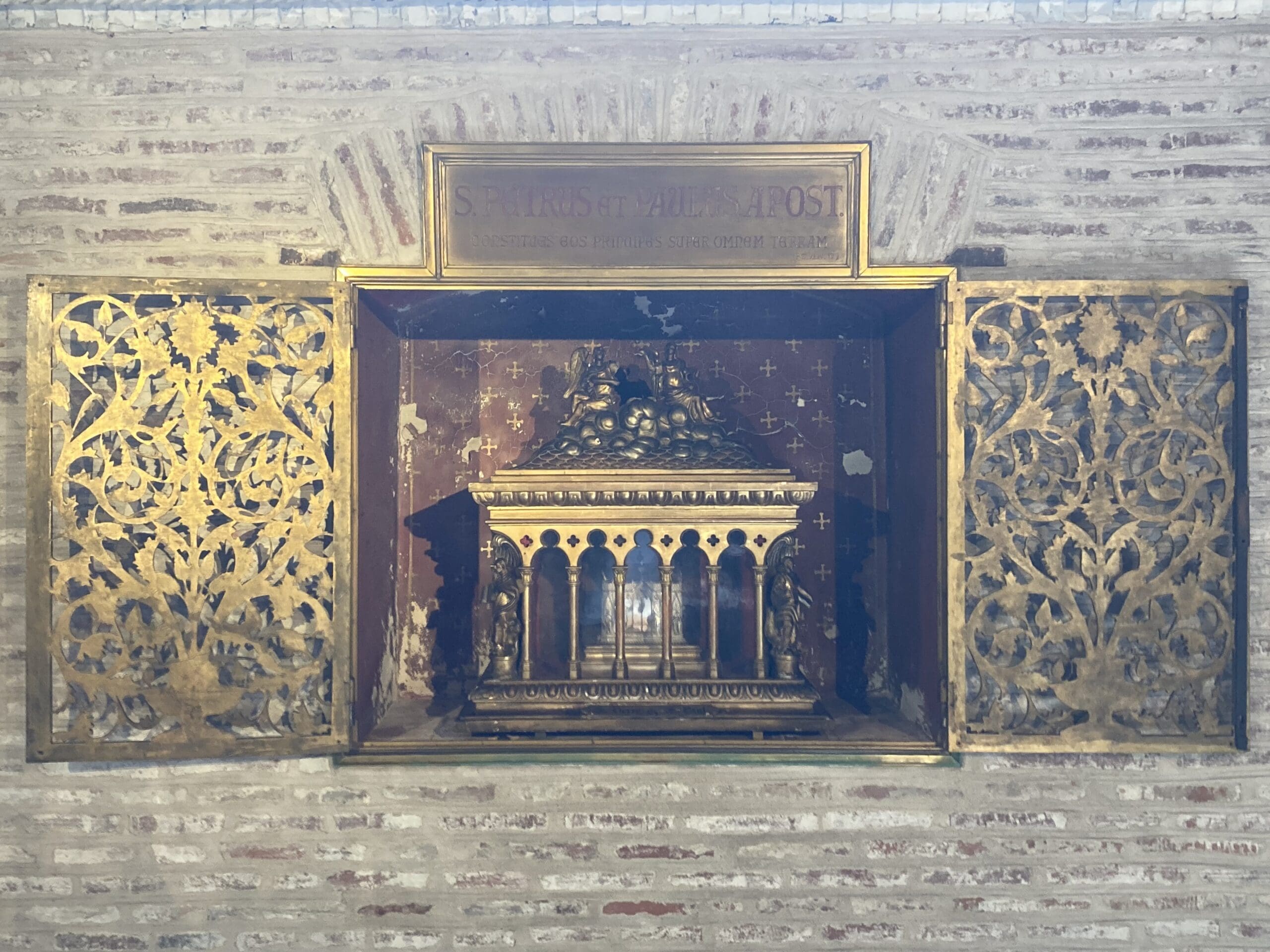
Relics of Saints Peter and Paul.
Are you squeamish about relics? Don’t be. It isn’t only Christ’s garment, fingers, or spittle that irradiated power (Mark 5:25–34; 8:22–26). It was the apostles’ too:
And more than ever believers were added to the Lord, multitudes both of men and women, so that they even carried out the sick into the streets, and laid them on beds and pallets, that as Peter came by at least his shadow might fall on some of them. The people also gathered from the towns around Jerusalem, bringing the sick and those afflicted with unclean spirits, and they were all healed. (Acts 5:14–16)
The point is reiterated later in the story: “And God did extraordinary miracles by the hands of Paul, so that handkerchiefs or aprons were carried away from his body to the sick, and diseases left them and the evil spirits came out of them” (Acts 19:11–12). The upshot is simple: Holiness lingers; holiness catches; holiness transfers. The power of the holy is like a good infection. It goes viral. From the apostles to the present, this is the continuous experience and unbroken testimony of God’s people.
The power of the holy is like a good infection. It goes viral.
In accepting this, one need not be credulous or uncritical. But it does poke holes in an immanent frame. It’s also strong counter-evidence to the so-called disenchantment of the world. Pilgrims who touch ancient bones or drink holy water still believe in miracles. They may pay lip service to Weber’s instrumental reason, but they harbour a secret faith in a deeper magic, one far older than our flattened world of credentialed experts. A truly cessationist cosmos is bereft of the Holy Spirit. But Christ has not left us orphans. As he puts it in John 5:17, “My Father is working still, and I am working.” Father and Son together work by the Spirit, and their Spirit is alive. He blows where he wills, on earth as it is in heaven.
After saying our prayers we departed for Avignon. There we toured the Palace of the Popes, which housed the popes during the schism of the papacy in the thirteenth and fourteenth centuries. A highlight for some and a feast for historians, it was mostly a shrug for us.
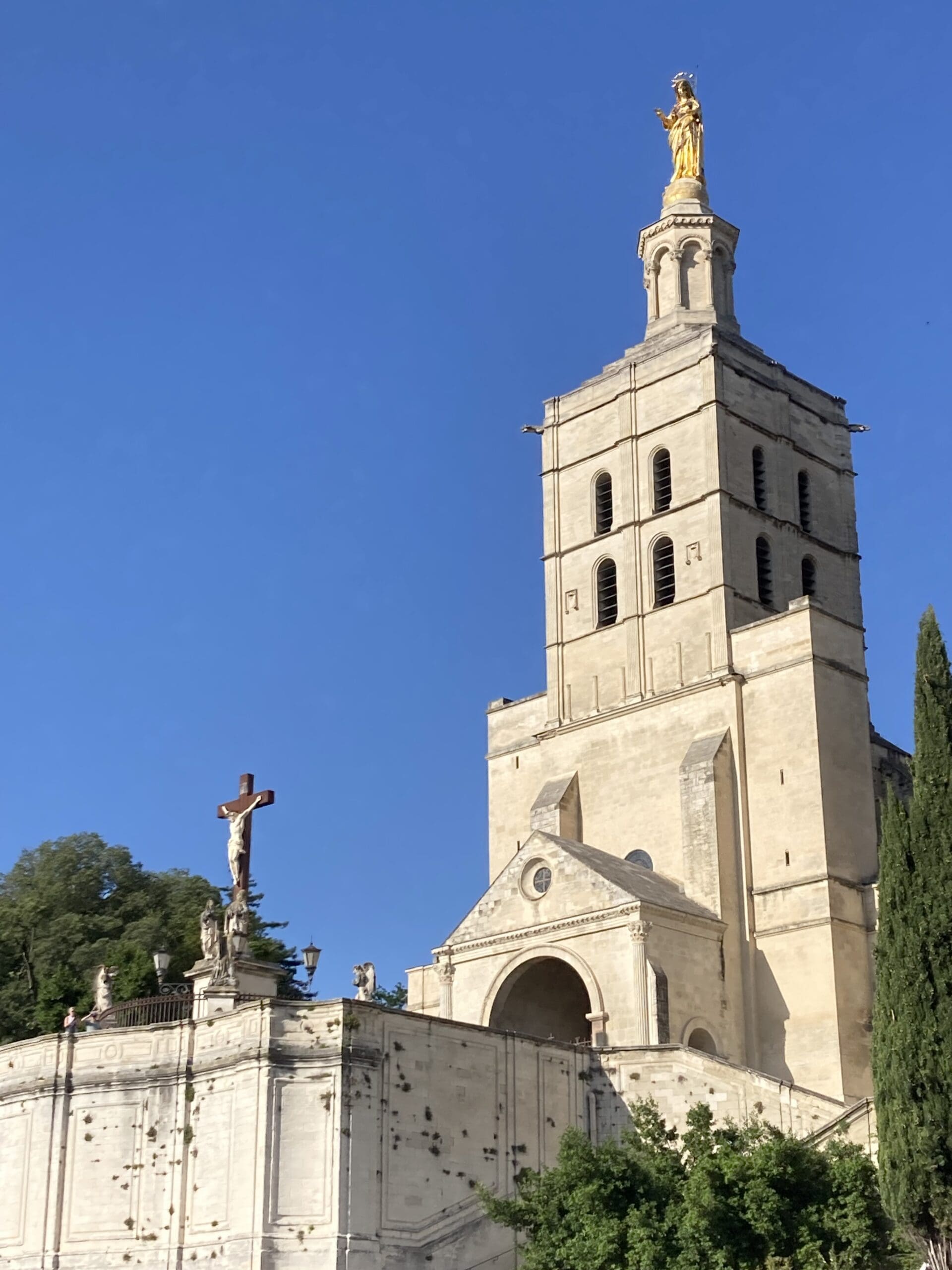
The Cathédrale Notre-Dame des Doms d’Avignon next to the Palace of the Popes.
Besides the architecture—always a marvel to American eyes—the palace felt stripped, whitewashed, empty. A place of ruins and, for all its historical importance, a testament to an unhappy and even shameful period of the Church’s past.
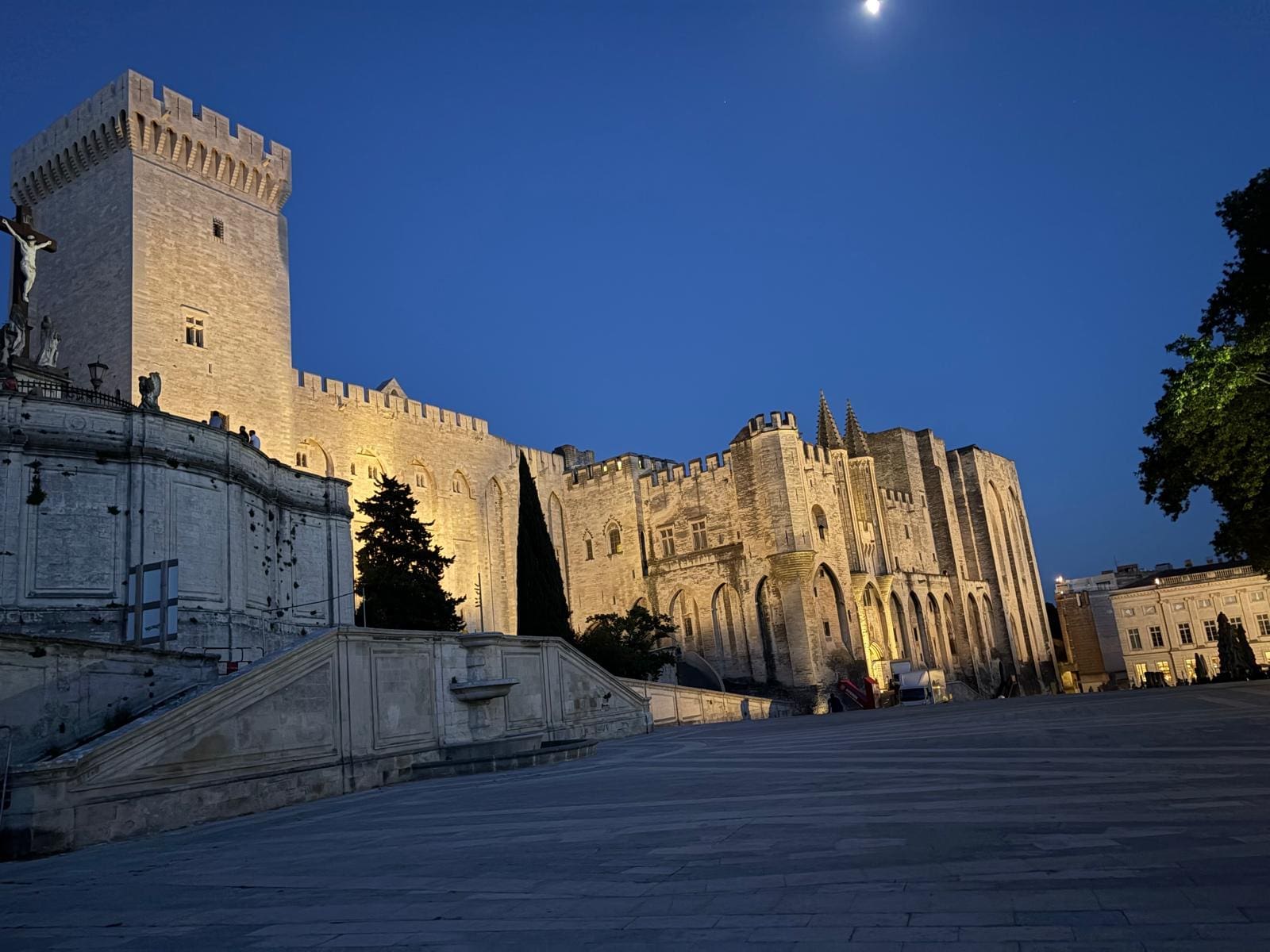
The palace at night.
Tourists visit Avignon, it turns out, not for papal intrigue or historical curiosity but for the beautiful summer nights and the excellent food. We dined, we gave thanks, and we went to bed.
Day 7: Sainte-Baume and Torino
If our sixth day had been rescued from oblivion by John, Mark did the same for the seventh. We were due to drive nearly six hours east from Avignon to Torino, Italy. Just a couple months before our trip, Mark had found a potential stop for us in the state forest of Var along the way.

On the path to Sainte-Baume.
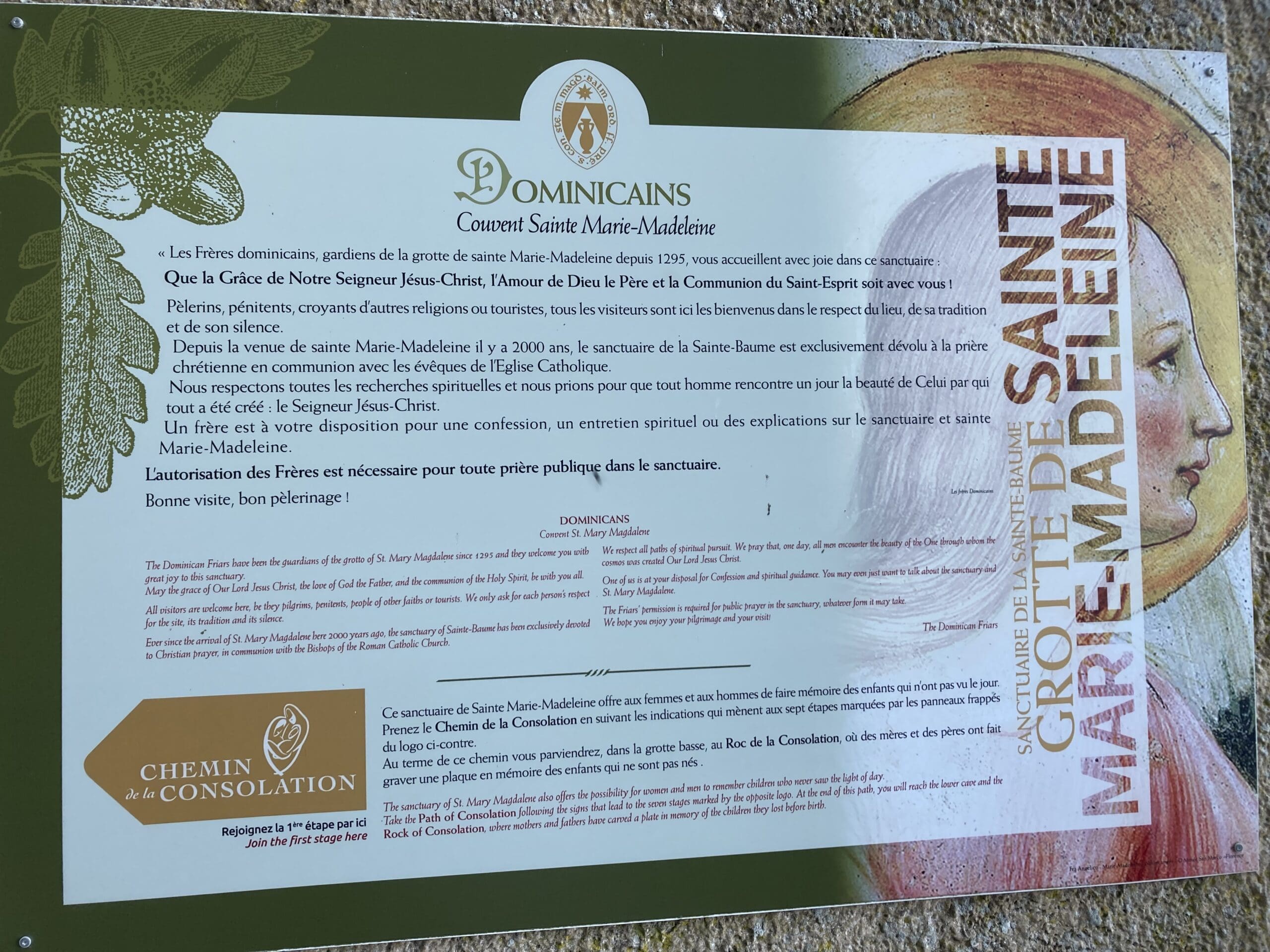
A plaque explaining the grotto and the Dominicans’ guardianship of it since 1295.
We parked at the bottom of a small mountain and hiked about a mile uphill on gentle switchbacks. When we got to the top, we found that we had arrived at Sainte-Baume, or the Grotto of Saint Mary Magdalene.
We stood before a great cave in the face of the rock. According to early Christian tradition, this cave is where Saint Mary Magdalene retired to pray at the end of her life.
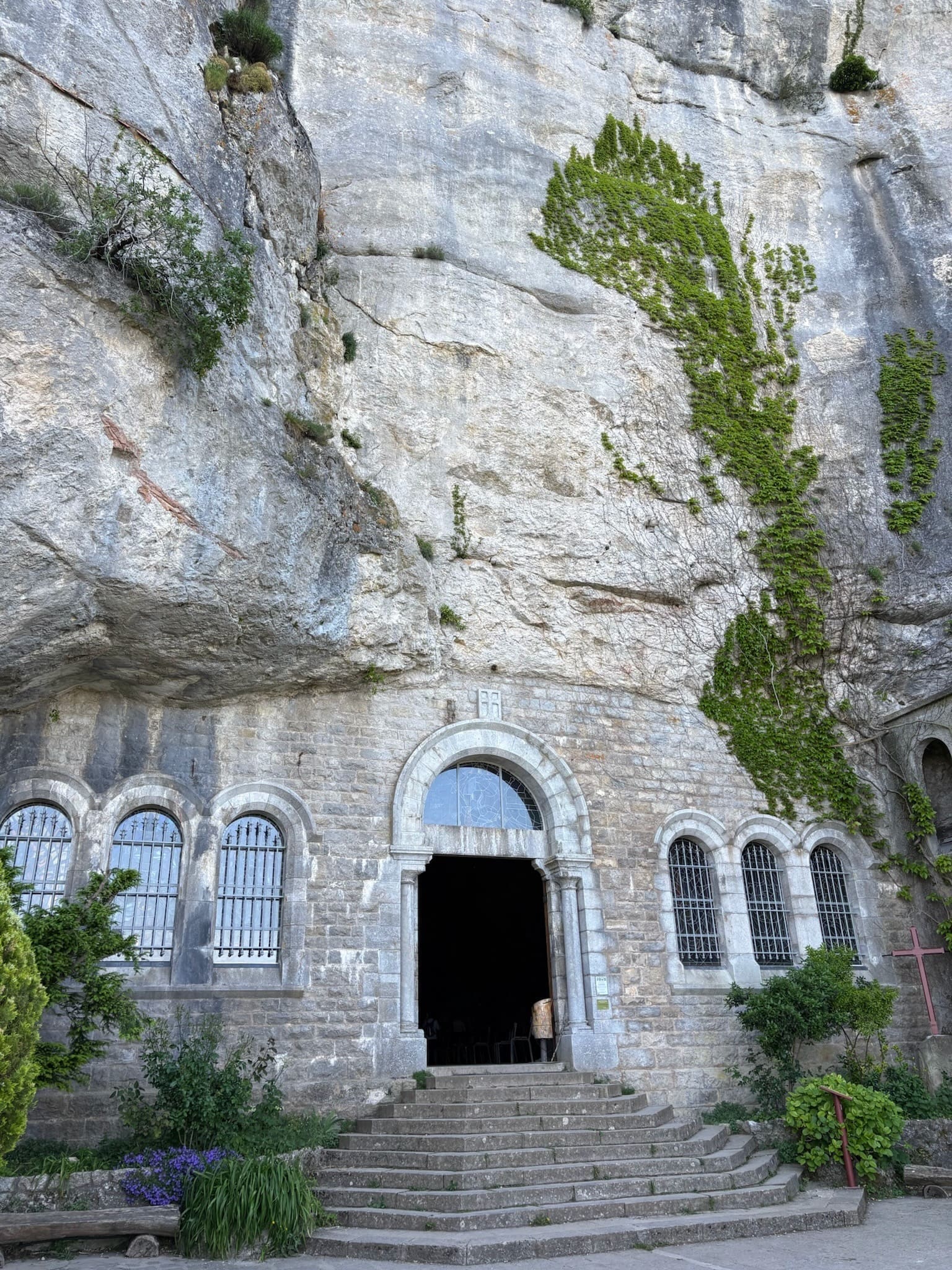
The doorway into the grotto.
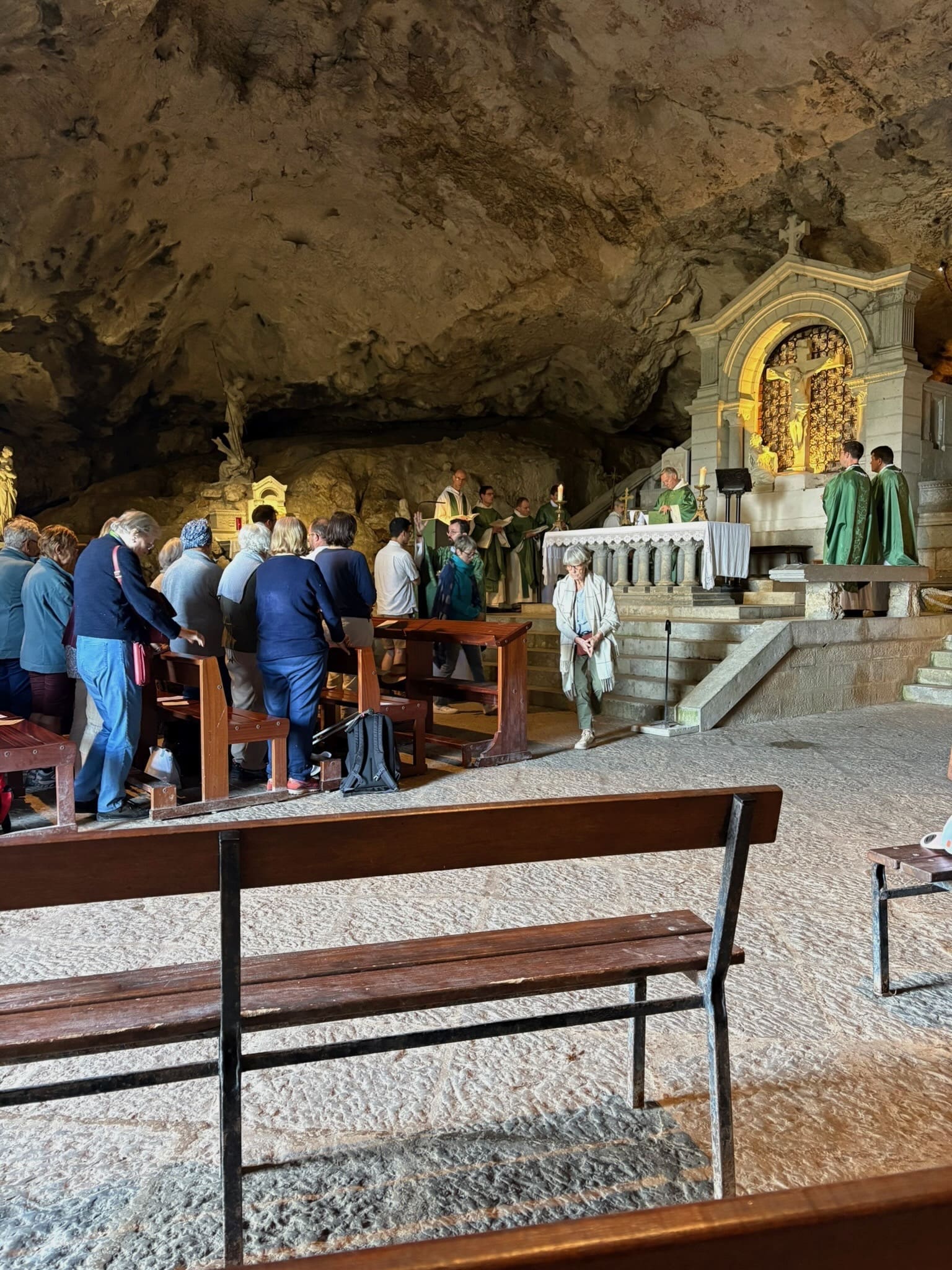
The altar inside the grotto; the men in green vestments are the Dominicans who pray, say mass, and watch over the site.
The cave houses her relics. Aside from a long interruption by the French Revolution and its many half-lives, the Dominicans have maintained a physical presence and continual prayer there for centuries. Mass began just moments after our arrival.
The mass, sung in French by a group of Dominicans in Pentecost green, including a responsorial psalm, was the most beautiful liturgy any of us could recall having ever attended.
As in Lisieux with Saint Thérèse, each of us left with an icon of Saint Mary. Both women now face me on the shelf above my desk as I write. We know so little of Mary. She was a follower of Jesus from Magdala. Saint Luke places her alongside the Twelve, before adding that Jesus had cast out seven demons from her (8:1–2). Together with Joanna, Susanna, and other women, Mary helped provide for Jesus’s itinerant ministry (8:3). Perhaps tradition is right to identify her with “the woman of the city” in the previous story (7:37): not only formerly demon-possessed but also a former prostitute.
That is about it. And yet this woman was the first to see the Lord raised from the dead. Christ appointed her and her sisters apostles to the apostles: “Do not be afraid; go and tell my brothers to go to Galilee, and there they will see me” (Matthew 28:10). Before commissioning the Twelve (“Go therefore and make disciples of all nations,” 28:19), he commissioned them. He commissioned her.
Just as the Lord’s Mother is a figure of the Church, so is the Magdalene. Both share a name with Miriam, sister of Moses. Both receive the word of God. Both do it. As Jesus says, “My mother and my brothers are those who hear the word of God and do it” (Luke 8:21). The first Mary hears and does it by giving birth to God’s Word incarnate. The second Mary hears and does it by giving birth, as it were, to the apostles, the twelve pillars of the church. Together with the prophets, the apostles are the “foundation,” in Saint Paul’s words, “of the household of God” (Ephesians 2:19–20).
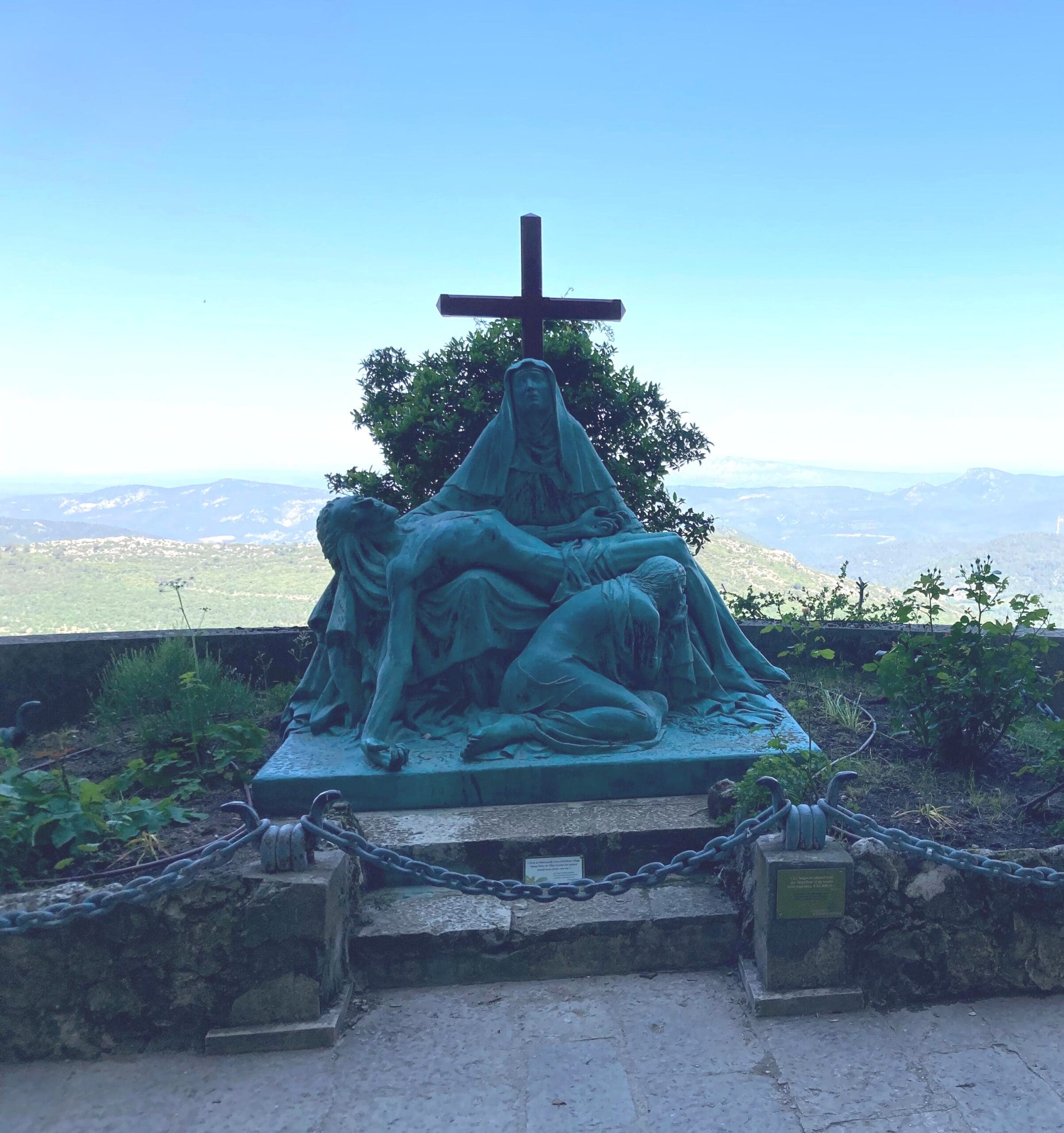
A stone sculpture of the pietà outside the grotto; notice the Magdalene at the feet of the Virgin, who holds the corpse of her Son beneath the cross.
We should not be surprised that each Mary made her way west by sea to bear witness among the churches to what she had seen and heard: one testifying to the Lord’s birth from a virgin womb, the other to the Lord’s birth from a virgin tomb. Both births came from God. But God chose them, the two Marys, as the sacred vehicles for his saving work. No wonder that, from Jerusalem to Ephesus to Sainte-Baume, the memory of their travels and testimonies endures to this day.

A view of the entry from within the grotto.
From this quite literal high we descended to our car and drove into Italy, past the Riviera, with an altogether different kind of glory on our mind. Truly our hearts burned within us.
Day 8: The Shroud, Sacra di San Michele, Chartreuse
We went to Italy to see the Shroud of Turin. None of us was quite prepared for the oddity of its presentation, or rather its non-presentation—even Mark, the expert among us on the Shroud.
Seekers of the Shroud will find it in the Church of Saint John the Baptist, but I wouldn’t say they’re overselling it. When you walk in, you’re not quite sure where to go. “Where is the Shroud?” was not a question I expected to ask inside the church that houses it.
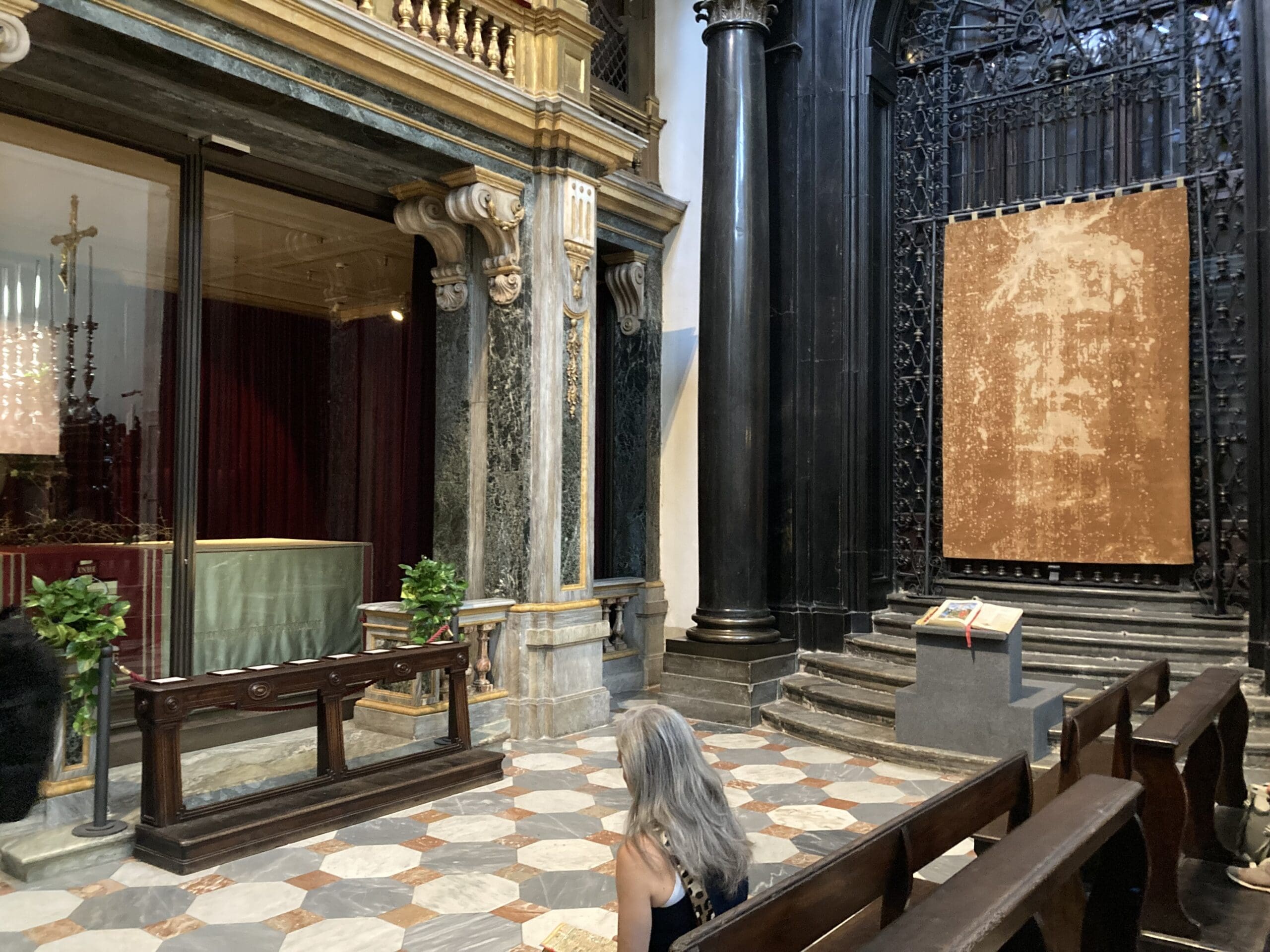
The corner of the church in which the Shroud of Turin is protected in a sealed case.
It turns out that the Shroud is tucked away in the corner of the church. And “tucked away” is an understatement: it is sealed inside a climate-controlled case, which in turn is protected by a wall of glass. Before the glass there is a small bench for kneeling prayer and two or three narrow rows for sitting.
For Mark, this was the climax of his trip. He had been reading and learning about the Shroud for years. He is convinced that the only explanation for the Shroud is that it really did cover the body of Jesus when he lay in the tomb. But the church seemed almost embarrassed by it. The atmosphere was scientific, antiseptic, museum-like. Instead of taxidermy, it suggested a laboratory. Is this how one of the great relics of the world ought to be handled and presented to pilgrims?

Praying before the Shroud.
But perhaps I’m being too harsh, binding my sentiment too closely to the moment of anticlimax. Rome’s possession of the Shroud is very recent. I trust that, if my great-grandchildren journey to Torino to see the Shroud, their experience will be much different from mine.
Not in one respect, though. Matthew, perhaps sensing a certain discontentment, whispered to Mark and me that we ought to walk up together, kneel before the Shroud, and recite aloud the Our Father. So we did. And he was right. Pilgrims are not tasked with assessing the quality of the places they visit. To do so reduces them to tourists looking to optimize a trip. Rather, pilgrims are called to pray: nothing more, nothing less. So we three brothers prayed, and I’ll never forget it.
Our plan was to head straight from the Shroud out of Italy into the French Alps. But on the highway we noticed something on the horizon: some ancient structure built into the mountain. A quick Google search discovered that it was Sacra di San Michele, a historically Benedictine abbey dedicated to Saint Michael the Archangel (and, apparently, the inspiration for Umberto Eco’s The Name of the Rose). So we plugged it into Maps and took a detour.

Saint Michael’s Line. Wikipedia (public domain).
Earlier in the trip we had all learned about Saint Michael’s Line, a stretch of seven medieval monasteries built and dedicated to Saint Michael independently of one another. Beginning with Skellig Michael off the coast of Ireland and ending with Monastero Stella Maris del Monte Carmelo in Israel, they form a supernaturally straight line (or loxodrome). We had begun our pilgrimage with Mont-Saint-Michel. Now we happened upon Saint Michael’s Abbey in Italy. What were the odds?
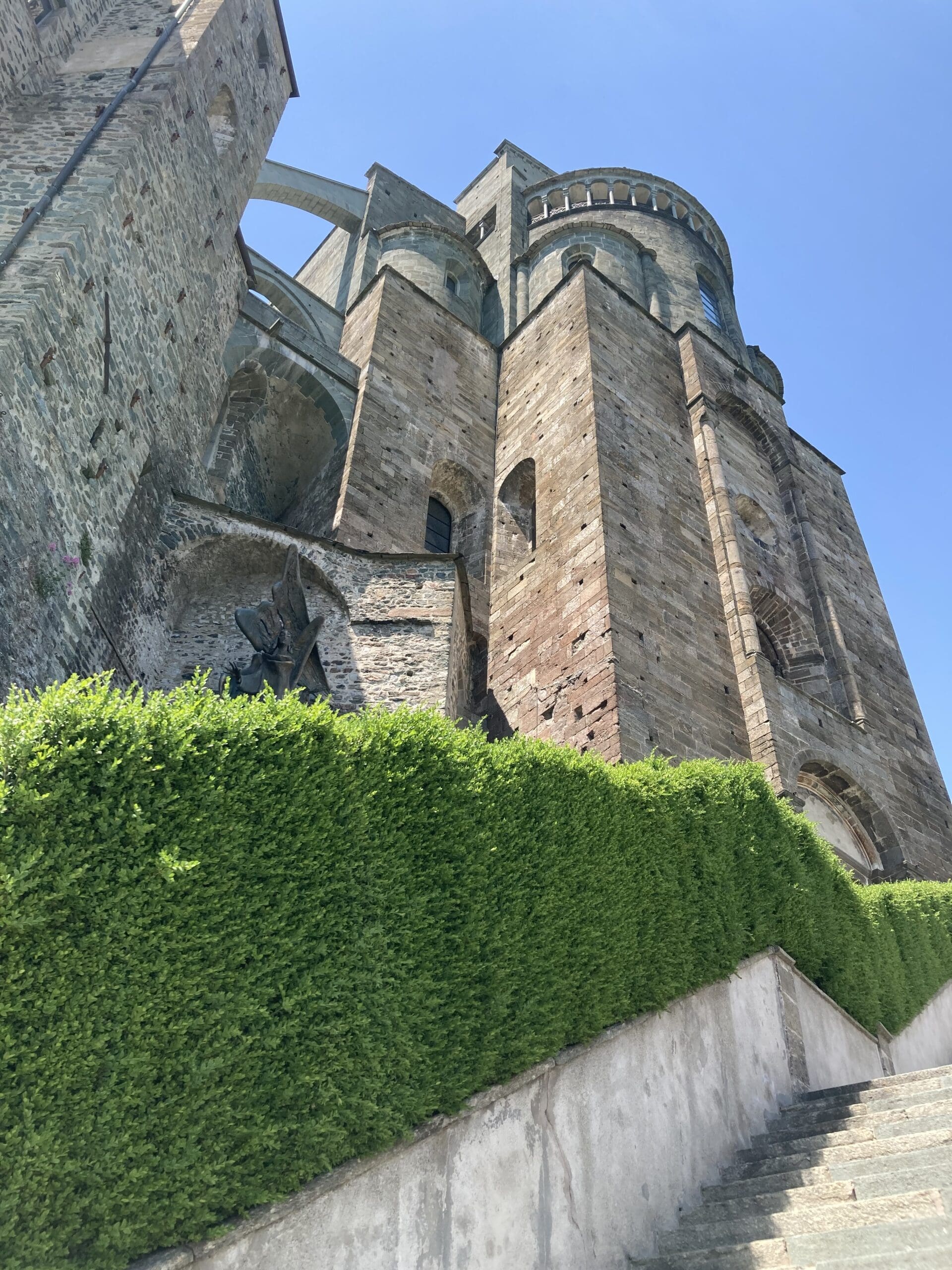
The Benedictines no longer occupy the Abbey, and no mass was being said when we arrived. But there was no doubt that the chapel was playing host to worship. We just needed the ears to hear. For when we sat down on the pews, there was no sound in the air—except, once you stilled yourself enough to catch it, the sound of birdsong. Looking up, there were nests everywhere, and birds alighted from one perch to another, singing to one another. And to the Lord:
Even the sparrow finds a home,
and the swallow a nest for herself,
where she may lay her young,
at thy altars, O Lord of hosts,
my King and my God.
Blessed are those who dwell in thy house,
ever singing thy praise! (Psalm 84:3–4)
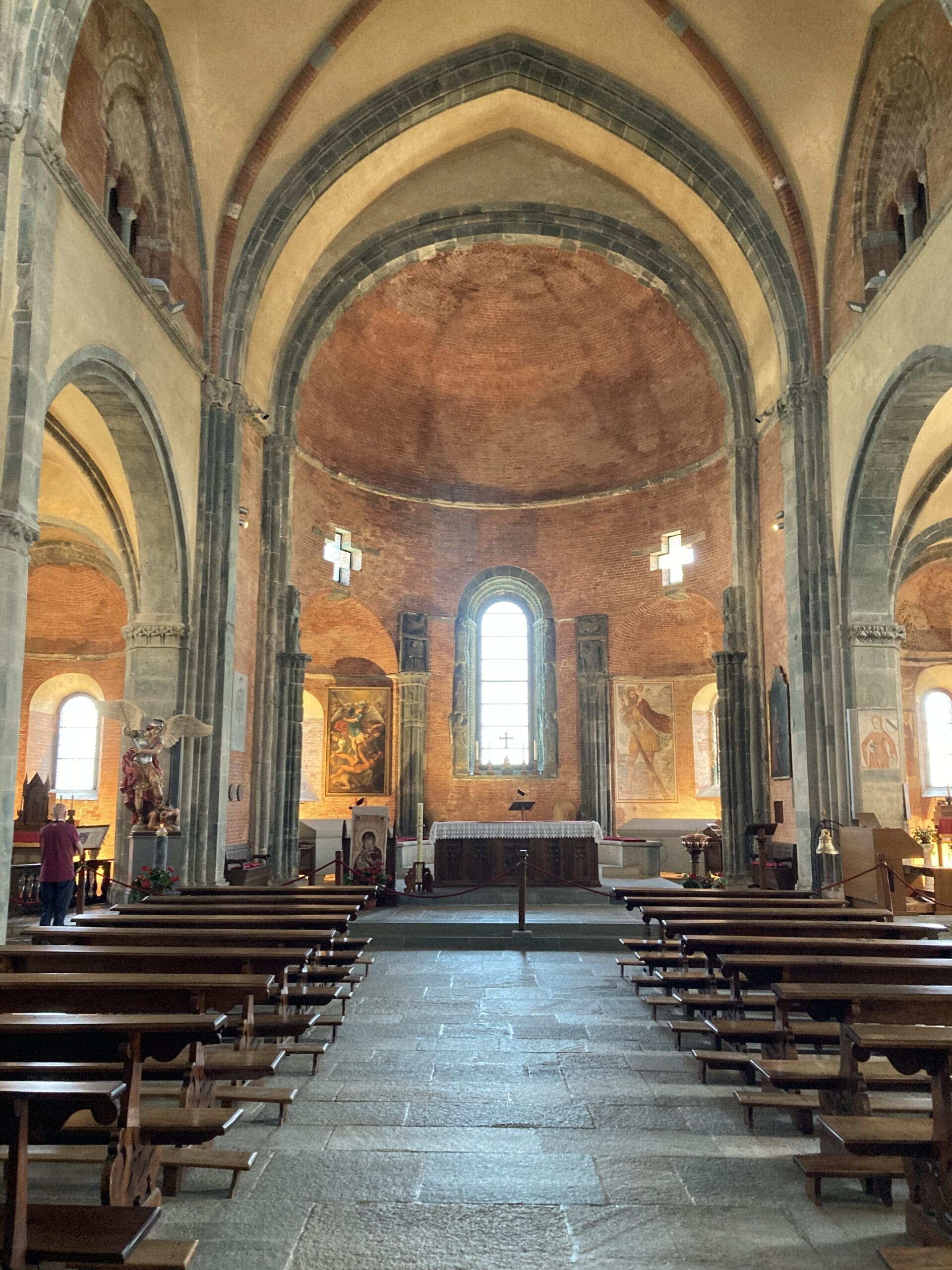
Inside the abbey: a few pilgrims in silence, many birds in song.
That is the psalm that came to our minds: peaceful, liturgical, a hymn to a nature that hymns its Creator. But we were also in the monastery of a warrior. So I brought home cards for my sons that contain, in French and English, a martial call for heavenly aid:
Saint Michael the Archangel, defend us in battle. Be our defense against the wickedness and snares of the devil. May God rebuke him, we humbly pray, and do thou, O Prince of the heavenly hosts, by the power of God, thrust into hell Satan, and all the evil spirits, who prowl about the world seeking the ruin of souls. Amen.
After some time we bade farewell to the birds, blessed Saint Michael the Archangel, and continued on our way. Before nightfall we found our destination. We parked and walked in silence to the Grand Chartreuse.
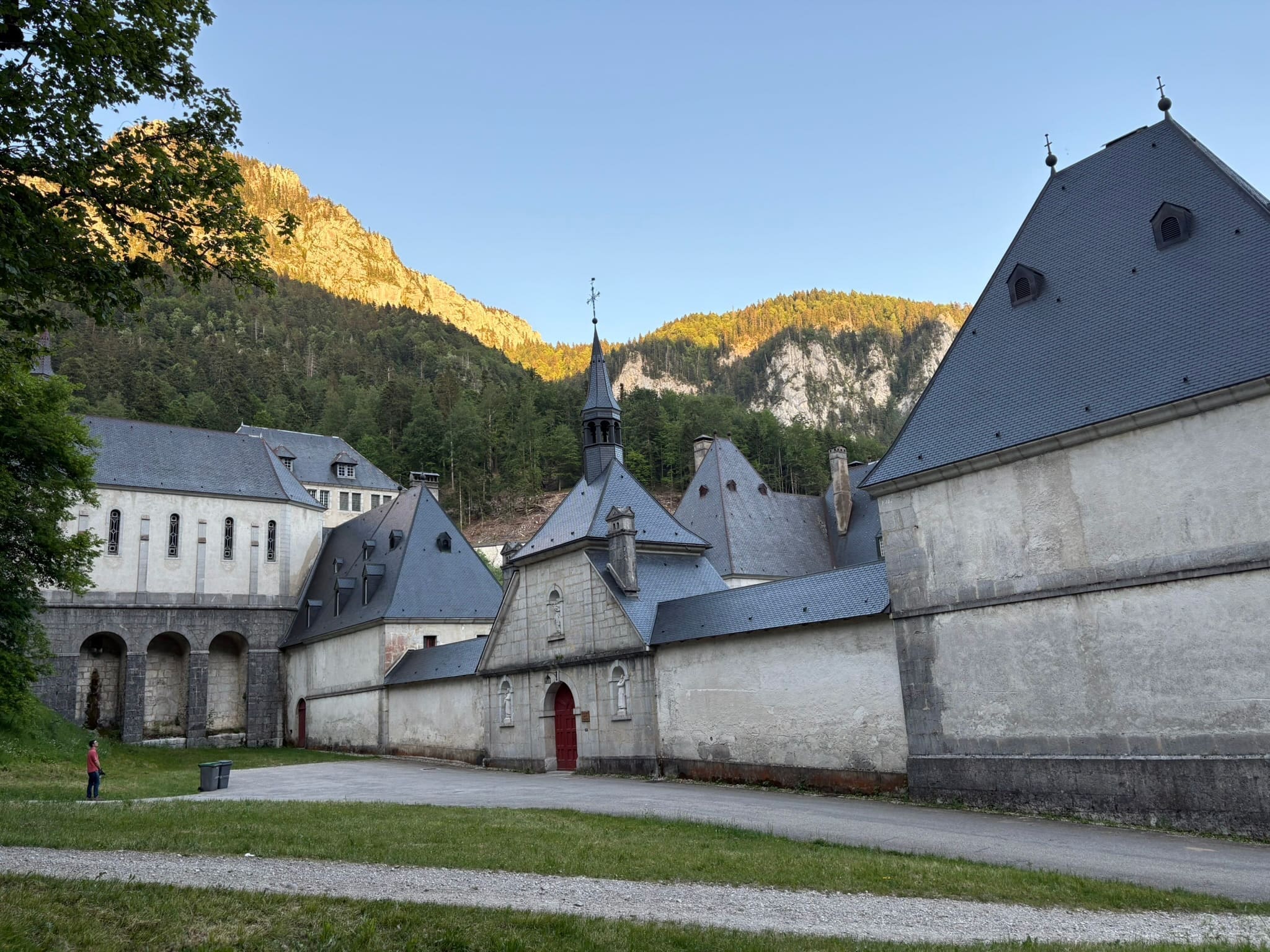
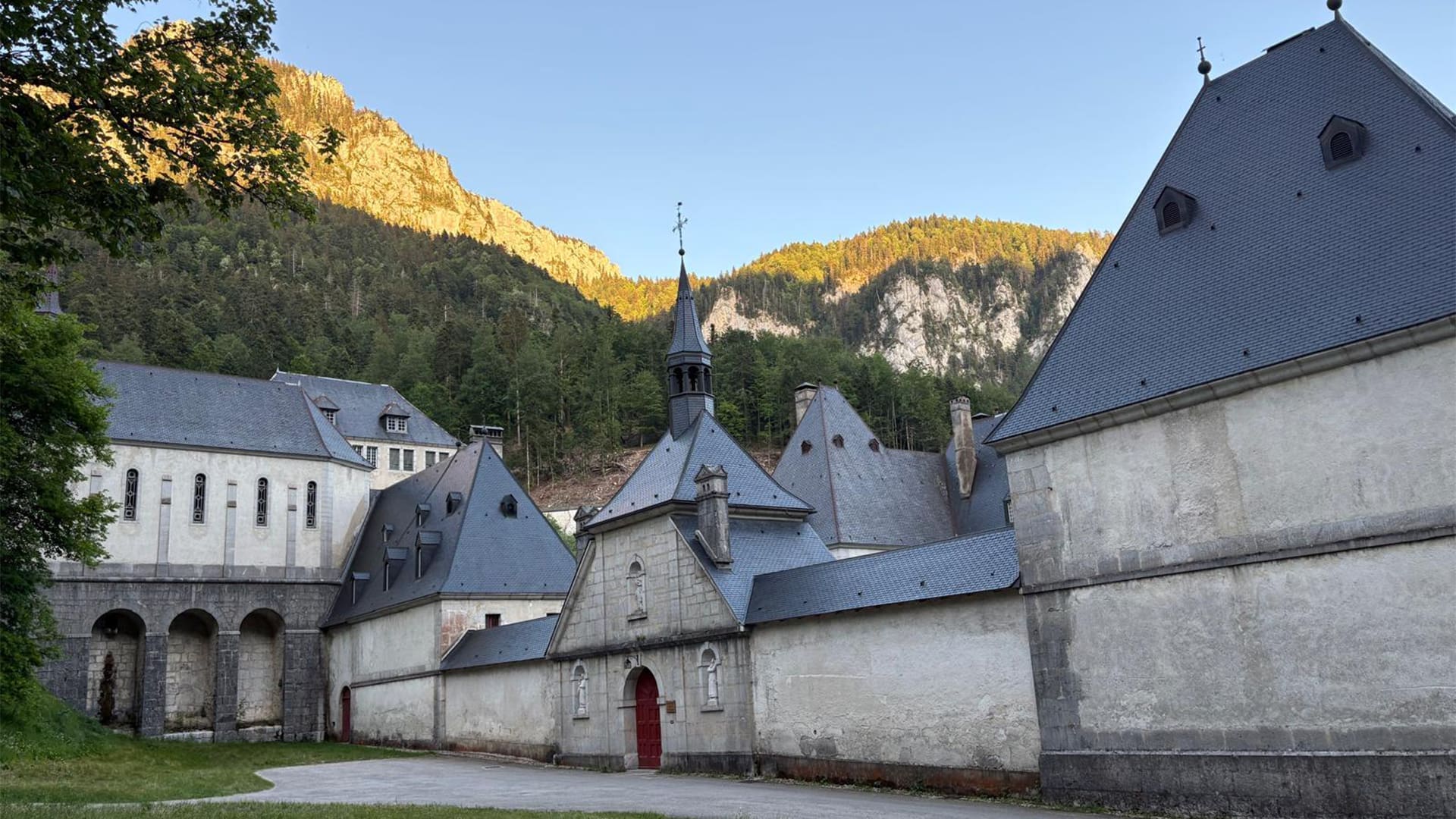
The Grand Chartreuse, a Carthusian monastery located in the mountains north of Grenoble.
The Grand Chartreuse, a Carthusian monastery in the French Alps, was made famous beyond the Christian world by director Philip Gröning in his 2005 documentary Into Great Silence. Carthusians are not Benedictines. Their doors remain closed. Their hospitality is spiritual: they pray for you as they pray for the world. You neither knock nor make a sound. The grounds surrounding the complex are a zone de silence.
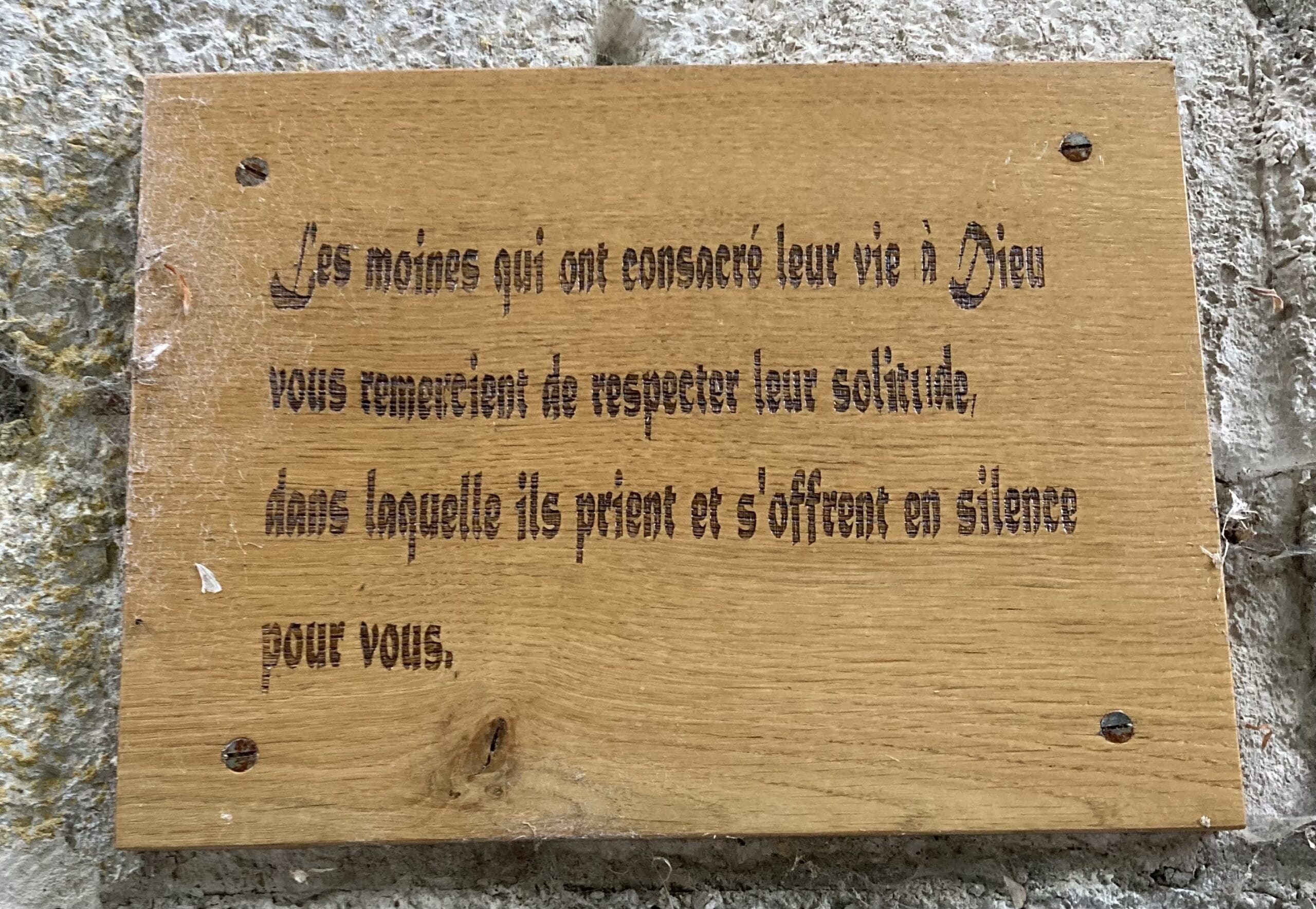
A sign posted on the wall of the monastery.
We walked around the walls; we touched the stones; we joined our prayers to the monks’. Then we parted without a sound.
Does such a visit fall prey to the vices of modern travel? Did we journey to Chartreuse to say we had been there—to touch a wall, snap a pic for evidence, and leave unchanged? In a 2023 essay for The New Yorker called “The Case Against Travel,” Agnes Callard makes just this argument. She says that we look forward to travel in the sense that we anticipate having had an experience and having documented doing so. “One sign that you have a reason to be somewhere,” she writes, “is that you have nothing to prove, and therefore no drive to collect souvenirs, photos, or stories to prove it.” She defines “tourism” as “the kind of travel that aims at the interesting”—and misses.
Callard does not consider pilgrimage in her taxonomy; so far as I can tell, she reduces nearly all travel to tourism and tourism to just one kind of thing. The 2008 article by Catholic theologian William Cavanaugh, to which I alluded above, is a useful rejoinder to this reductive move. There are migrants and there are tourists; there are monks and there are pilgrims. They are not all of them the same.
Yet in the age of the camera and especially of the smartphone, are pilgrims doomed to be tourists? Is documentation the enemy of piety? Is this photo essay a contradiction in terms?
Maybe. One of my group, John, not only took no photos on our trip; he brought no phone of any kind. A few years ago, when he travelled to Jerusalem alone, he likewise brought no phone, smart or otherwise, and took no pictures. What he had were memories. He recounted stories to his wife and children; he did not show them images. Or rather, the only images he had to show were icons. He was determined not to succumb to the spiritual taxidermy of the museum, which is not far from the performative consumerism of the online tourist industry. He would make himself like an ancient pilgrim and live by testimony, not proof preserved on the cloud.
Perhaps John is right. Perhaps he is the best counter-argument to Callard’s brief against travel. Perhaps pilgrimage is best undertaken sans phone, sans photos, sans evidence of any kind besides tokens of the faith that will aid one’s prayer back home.
Perhaps. I am not entirely persuaded, but the ironies of an iPhone outside the walls of Chartreuse are too great to ignore. Pilgrimage is purgation, and maybe what awaits me in future travels is the purging of the need to show others, and even myself, where I went and what I did. We shall see.

A silent walk away from the monastery.
Day 9: Lyon and Paris
We woke up early in the French Alps to a scene that could have been drawn from Terrence Malick’s A Hidden Life. It is hard to believe that real people live here. But Luke had a plane to catch. So we left more quickly than we would have preferred and dropped him off on our way to Lyon.
In Lyon (or Lyons in the older spelling) we had two last places to visit: the Church of Saint John the Baptist and the Church of Saint Irenaeus. Here is the first:
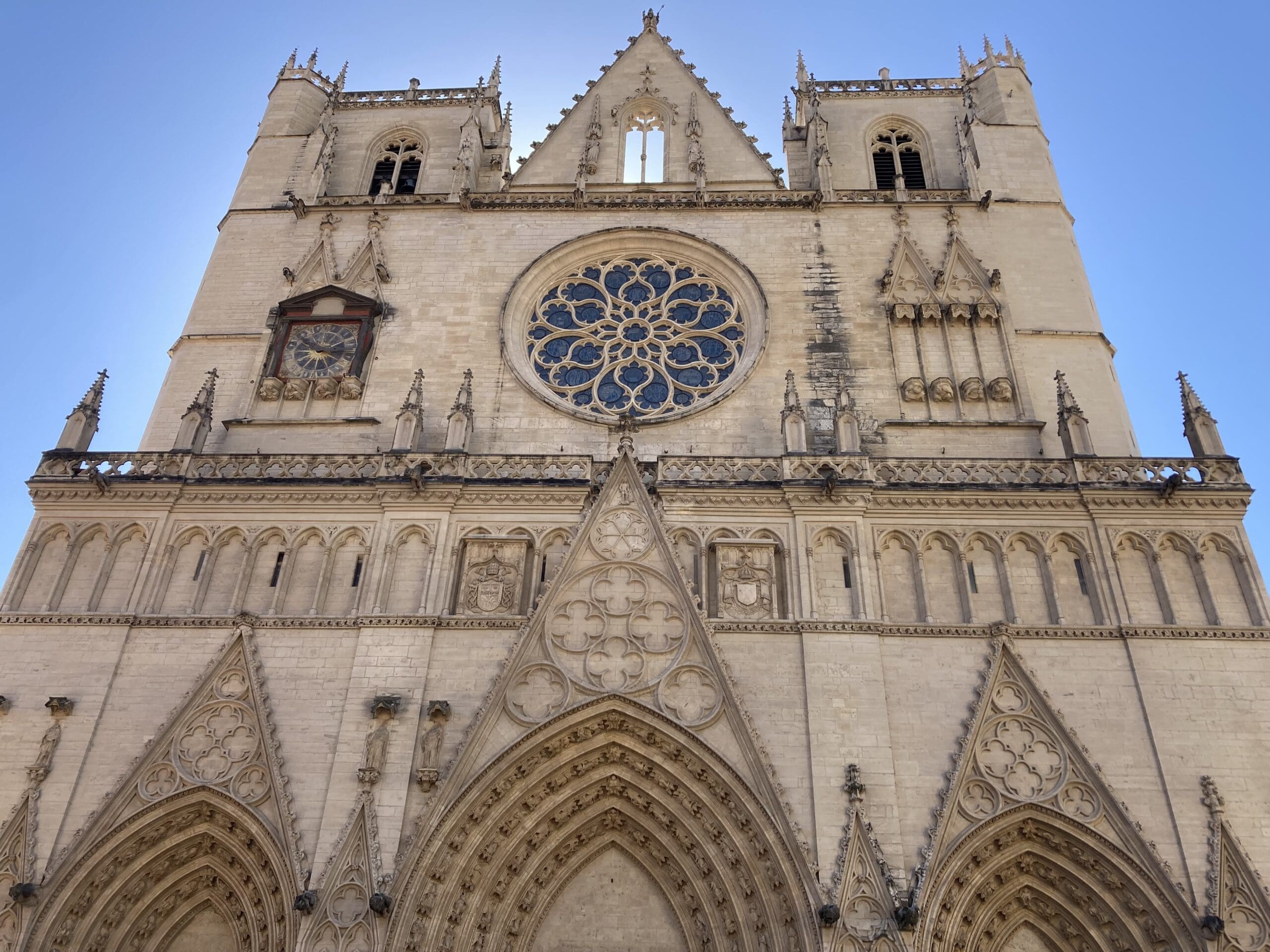
The Cathédrale Saint-Jean-Baptiste de Lyon.
Here is the second:
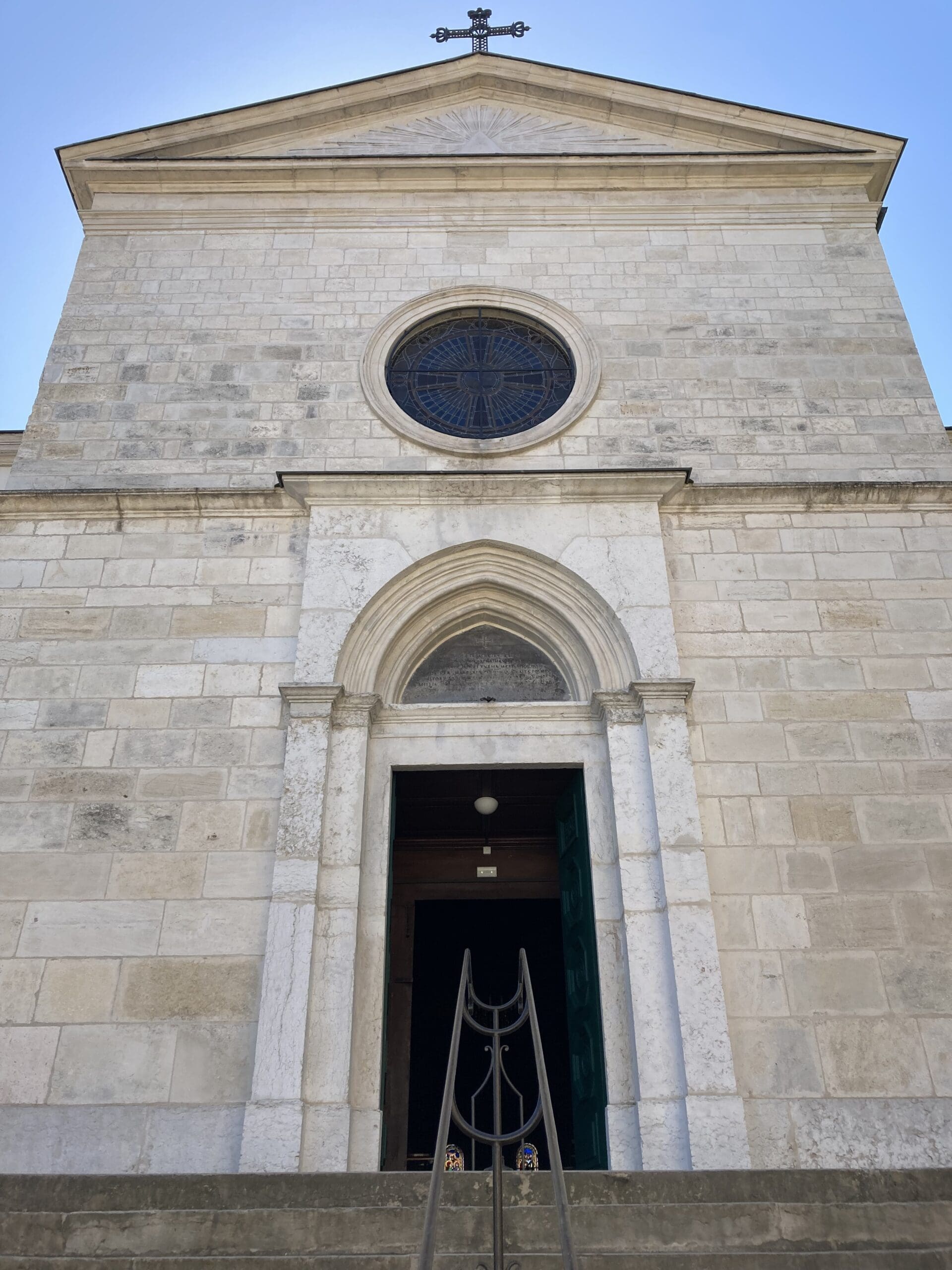
Exterior of the Church of Saint Irenaeus.
The structure dedicated to the great patristic scourge of Marcion and the Gnostics is not especially impressive. It is quite humble. Having fallen into disrepair—not to mention the loss of his relics during the Reformation—it is now in process of being rebuilt and fortified.
As it was in the beginning and will be till the end, the Church to which Saint Irenaeus gave his life—the Church catholic, the one Church of Jesus Christ—is under construction.
This was an apt metaphor on which to conclude the trip. Saint Irenaeus knew Saint Polycarp, an aged martyr, who had learned at the feet of Saint John the apostle. He fought heretics in favour of the goodness of the Creator, the goodness of the creation, and the truth of the incarnation. He defended the Old Testament and the unity of God. Yet for a long season in Christian history his legacy, like the church dedicated to him, was in disarray. By the time we approached the church, however, both his memory and his church had begun to be restored.
As it was in the beginning and will be till the end, the Church to which Saint Irenaeus gave his life—the Church catholic, the one Church of Jesus Christ—is under construction. And as Jesus promised, the gates of hell shall not prevail against it (Matthew 16:18).
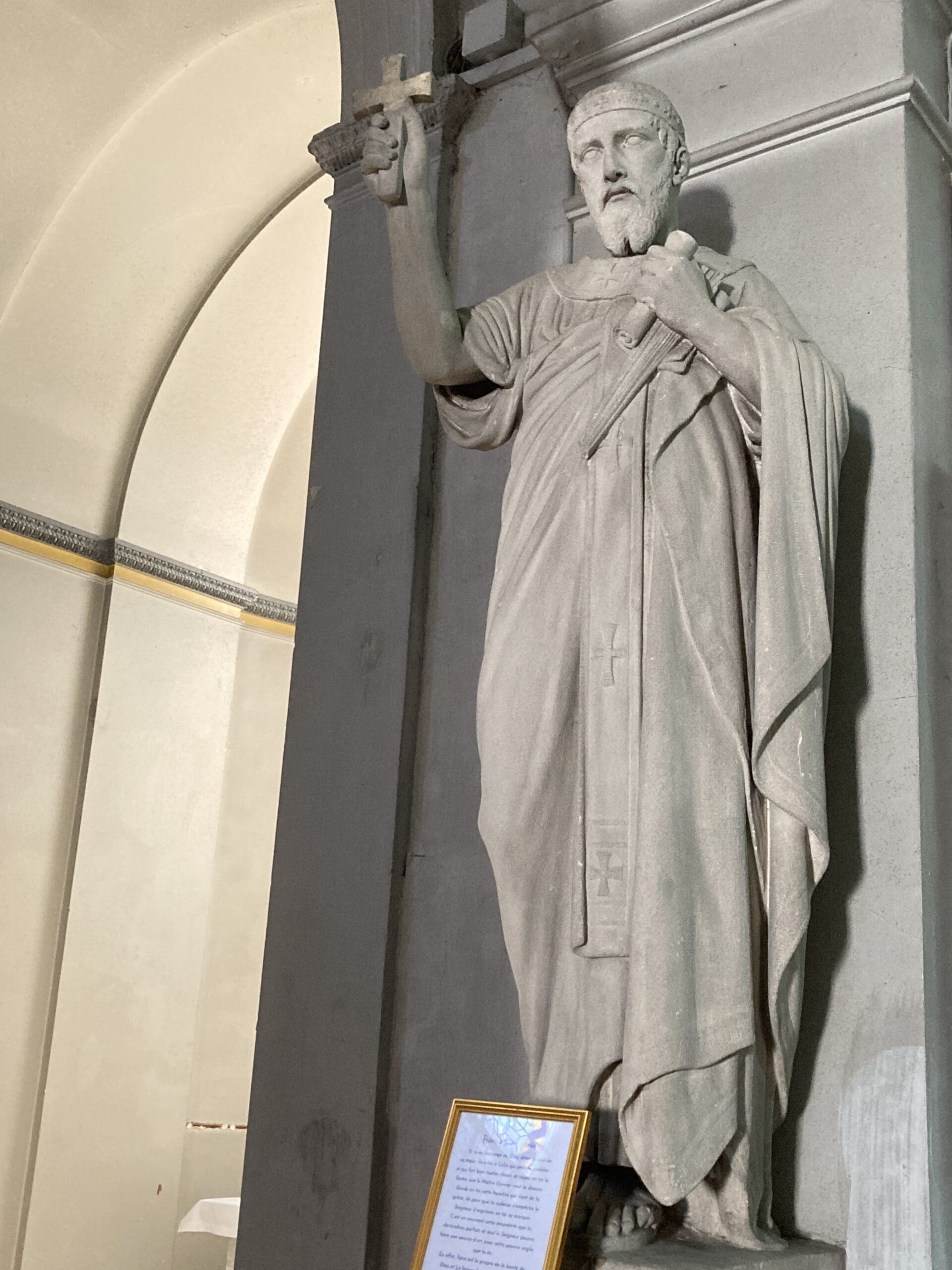
Saint Irenaeus, doctor of the Church.
Having prayed for some measure of the wisdom of this great doctor of the Church, a patron of countless theologians since, we found our car, drove to Paris, and flew home.

