


T
This past May, I marched in the final commencement of Trinity Christian College, a Reformed liberal arts institution where I had taught and researched for two decades.
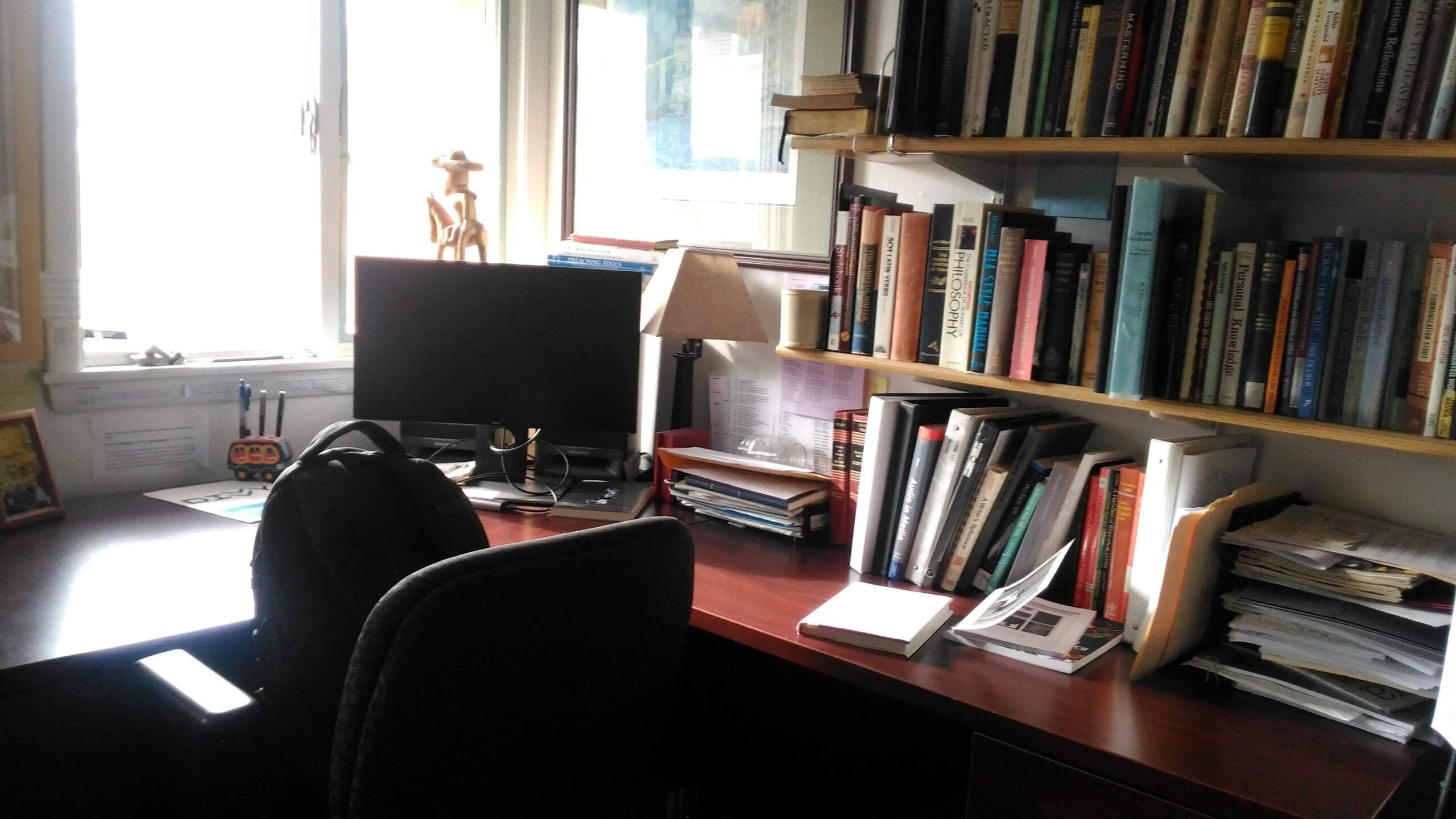
Before the ceremony, I revisited Groot Hall, home of my old office building. It looked less ransacked than I had expected, probably because the professors had been too busy finishing up grades to pack. I made my way down its narrow hallways to the converted dorm room that had been my academic office. I had loved its high ceilings, designed in the 1970s for bunk beds, then converted to a space that welcomed my bookshelves. Standing by my old desk, I could feel again the vocational dignity Trinity had afforded me even while the college’s low enrollments had given it little status in the world of higher education. Yes, many people confused the college with another frail institution about thirty miles to the north, Trinity International University. And, sure, my college’s mascot, the Troll, selected for its alliteration in the 1950s, had been complicated by its internet connotations after the 2010s. Still, Trinity made me stand tall in my vocation. I had always wished to retire from the professoriate as a Troll.
As I surveyed my old office, I felt again the press of all the toil I had done there. When Trinity first hired me, I was an all-but-dissertation newbie. Late at night, after putting the kids to bed, I’d go back to the office to drink coffee and dissertate until the campus was uncannily quiet. But in the years to come, even after I’d achieved tenure, my task list never shortened. The expense reports. The committee correspondence. The student emails. The quiz grading. The data coding. The essay writing. I still found myself returning to the office for late-night rounds of work, often with a child or two for company, bribed with a Frosty and the music of the Be Good Tanyas.
I can’t blame Trinity for my over-attachment to work. I don’t remember Trinity senior leaders ever saying anything like, “Give us all you’ve got because you’re doing it for the Lord.” But what looks like self-induced workaholism from one level looks, from another level, like coping with the resistless speeds of late-modern institutions. Hartmut Rosa explains in Social Acceleration that early moderns built institutions as accelerators to keep up with the terrible speeds of a constantly evolving society: faster technological developments, more blistering proliferations of social change, and increased pacing in everyday life. But, Rosa adds, the faster these institutions seek to move, the less progress they eventually make, a paradox he describes as a “frenetic standstill.” Trinity often felt to me like a kindly, congenial, but frantic treadmill. We were always a small college trying to act like a bigger and faster one. Often the best we could do was to barely move in place.
Is there a way to pursue our academic vocations that feels less like a frenetic standstill and more like care for the fragile complexities of our living-and-dying institutions?
What Happened? Was It Our Fault?
I learned about Trinity’s closure in the fall of 2025 from the vantage point of Calvin University, where I’d recently taken an endowed chair in faith and communication. Although many of my new colleagues had barely heard of Trinity, my previous college’s demise shook Calvin’s campus. The university president spoke movingly in a town hall about the grief that would surely come with Trinity’s death. I also heard rumours that, in backrooms, Calvin’s senior leaders were saying among themselves, “We do not want to be the next Trinity.”
After the closure announcement, a Trinity professor emerita met me for coffee. She slapped down on the table a copy of Trinity’s magazine, featuring a shot of a former college president. The magazine touted the charisma of a leader who’d brought bold changes to the campus community. He’d helped eliminate Wednesday classes, for example, giving students time to research and intern and rest. Under his leadership, the college had also created full tuition transparency, removing all discount rates, a move that promised to lessen student debt, not least among populations of colour.
My friend took a sip of her coffee and shook her head. “What happened?” she asked. “And was it our fault?”
I understood the stunned implications of her first question. It seemed impossible that this lovely, mid-century college with its brick-and-mortar durability, its beautifully diverse population, and its rich confessional heritage could now be passing into non-existence. But my colleague and I could piece together a narrative of the college’s downfall. Ambitious capital expenses in the late 1990s and early 2000s had accumulated heavy debt. The Great Recession and the 2016 election generated populist blowback to the kind of expertise that higher education had for so many years offered the world. Then came donor polarization, a global pandemic, and shrinking student demographics across the Midwest. All these factors conspired to sink the institution, slowly then quickly, into the ground.
But my colleague’s second question was harder to hold. How could the decline of Trinity be our fault as faculty members? Weren’t staff and professors the victims in this scenario? But my friend kept pressing the point. Trinity was a small institution, she noted. We should have known what was going on. We should have asked more questions, taken more responsibility. Why hadn’t we cocked our heads and raised our hands in Faculty Association, for example, when one president kept applying for bridge loans to get us through the summers? Such questions made me squirm. I had to admit that my busy tenure at Trinity looked, from this angle, like stubborn denial of the college’s precarity. My ceaseless task-listing now seemed to have distracted me from indicators of coming collapse and cocooned me in a frenetic standstill.
I had to admit that my busy tenure at Trinity looked, from this angle, like stubborn denial of the college’s precarity.
What I wish I had said to my colleague is that we need a different story to tell about Trinity. Not a story of oblivious overwork, nor a story of scapegoating, but a story that, as Wendell Berry might say, turns on affection.
On graduation night this past May, when I left my old office and headed to Trinity’s commencement ceremony on the Ozinga baseball field, I found my former colleagues behind the stands, already berobed, teetering between tears and laughter. Little groups kept forming and scattering for selfies. When the music began, we all marched in, and I found myself seated between two rather distracted friends: To my right, a colleague was telling me, in eager, low tones, about her new job downtown; to my left, another colleague was trying, mostly successfully, not to check his phone for an incoming job offer. Looking up and down the rows of colleagues, I met the eyes of many people who, after this ceremony, would be indefinitely unemployed. I could guess at the bitter stories they could tell.
Two Institutional Stories We Tell
I heard a few such bitter tales a few weeks after Trinity’s graduation, when I drove to Indianapolis for a Network for Vocation in Undergraduate Education (NetVUE) seminar. Throughout the seminar, the twelve of us each shared a piece of writing in progress. When my turn came and I shared an early draft of this essay, I looked up to find faces around the table marked with grief for their mortal colleges. People were making small sad sounds.
We did a lot of storytelling that week about how things were going in institutions of higher education. I tend to get quiet when people tell stories like this, probably because I enjoy my work enormously and am happy to do it at my university, chaotic as the place can be. But I couldn’t help wondering if my resistance to sharing about Calvin’s struggles might be a return of the naïveté I had practiced during my time at Trinity.
So I did some mapping of the stories I was hearing. I can name two broad types of narratives people tell about their fragile institutions. Let’s call them narratives of reassurance and narratives of affection.
The reassurance narrative has both optimistic and pessimistic variants. One optimistic version of this story tries to re-contextualize the struggling institution, offering the reassurance of historical perspective. For example, I remember hearing one of Trinity’s final presidents telling constituents, just a few years before the college died, that Trinity was “young and hungry.” I remember feeling reassured by the phrasing. Oh, we aren’t failing. We’re just a scrappy start-up. We’ve weathered trouble before and can do so again. I heard variants of the narrative of reassurance even at Trinity’s final commencement when people said things like, “This college will always live on in our hearts.” One problem with this story is that institutions can leverage their reassurances to keep their faculty, staff, and administrators on the treadmill’s frenetic standstill.
But a little counterintuitively, there are other, more pessimistic types of reassurance. By calling out systemic blind spots and failings of leaders, these other stories unmask power abuse. Faculty, trained by years of critical theory, often aim this narrative upward, pointing to failings by the board of trustees or the president or the deans. Sometimes, in turn, leaders aim it faculty-ward, attributing an institution’s ills to the unimaginativeness of a stodgy professoriate who refuse to innovate. This story can offer clarity and even a kind of control. When someone stands in a faculty senate and delivers such a critique, I sometimes feel a sense of savage calm. Just being able to provide an interpretive frame for chaotic institutional experience makes things feel less crazy. Oh, it was the chair’s fault. Now I get it. Like its optimistic obverse, this kind of storytelling promises a reassuring sense of control in the maelstrom. Things feel explicable, if only you have a sufficiently skeptical hermeneutic.
Still, I am fairly suspicious of narratives of reassurance, especially when they zoom in on a hero or a villain. When it comes to learning to live well in mortal institutions, I doubt these stories are much help. They impose a specious orderliness.
What of the second kind of story that we sometimes tell, what I’m calling the narrative of affection? Norman Wirzba’s recent book Love’s Braided Dance suggests that we spend too much time seeking reassurance by asking each other the question “What gives you hope?” Wirzba’s proposed alternative is “What do you love?” It’s a question that reminds me of a moment during Trinity’s final commencement weekend when I went up to a colleague who I’d heard had landed a good job at a bigger university. She looked dispirited even as I congratulated her. When I asked why the long face, she shot back, “It’s not Trinity!” Her rejoinder narrated not the longing for reassurance but the grief and exasperation of genuine affection.
But stories animated by love are hard to tell, and not just because they sound sentimental. The hardest thing, in fact, may be finding the right starting point. Most of our stories about what’s going on in our academic communities begin with an exigency. Colleagues, listen, there’s a crisis! There’s a predicament, there’s an imperfection—and we have to do something. But a narrative of affection begins instead with a declaration of love for goods and gifts that are present apart from any one person’s agency. It’s also difficult to bring a narrative of affection to a compelling climax, because the story resists certainty. It says in effect, “We don’t know how this is going to turn out. We don’t know if this project will last two years or ten years. But here is what we’re called to. Here is what we belong to.” Instead of asking for validation, as stories of reassurance so often do, these stories invite love. When you hear affectionate narratives, you feel like saying, “Here I am.”
Neither we nor our institutions are sovereign, autonomous entities but are creatures enmeshed in systems that both propel and warp us.
A few weeks after Trinity’s demise was announced, I started hearing narratives of affection lived out in the lives of Trinity constituents. Professors kept right on supporting student research. Students kept right on showing up for each other’s grief in theatre spaces and gathered worship and baccalaureate and even on Instagram. My new university offered teach-out plans and took on the onerous task of archiving Trinity’s digital records. Donors answered their phones when Trinity’s leaders called, and they gave generously to eliminate student debts. All sorts of explanations might be brought forward for these actions, but I do think affection is powerfully in the mix.
One line from the graduation’s benediction has stayed with me. The college chaplain Stephen Cartwright exhorted us attendees not to rush off after the ceremony but to savour the moment. Then he added, a little disconcertingly, that “going out was always the plan.” Those six words sounded, at first, like a reference to exiting the stadium. But instead they were naming how places like Trinity are designed with impermanence in view. The visionaries who first launched the college in 1959 knew that it would always be contingent, provisional, mortal. The challenge here is to find a way to live with that mortality.
Keeping Vigil
One way to manage mortality is to assign culpability for failure, thus exchanging the reality of finitude for the clarity of condemnation. That solution was put in question in a novel I read during the last months of Trinity’s life. George Saunders’s Vigil tells how a dying oil mogul named K.J. Boone cannot, until too late, bear to confess his culpability for the environmental crisis. The striking thing about the book is that Boone’s failures are depicted not simply as the deeds of a monster but as “inevitable occurrences.” The man is self-deluded, and no mistake. But Saunders depicts him as tightly constrained by powers much larger than any mortal soul.
Vigil reminded me of a truth important in the Reformed tradition, that neither we nor our institutions are sovereign, autonomous entities but are creatures enmeshed in systems that both propel and warp us. But even so, what we do within and, I want to say, beneath this inevitability defines our creatureliness. And a lot of what we do is storytelling, hence my encouragements to narratives of affection.
When I tell people I’m asking hard questions about how I used to relate to my work at a now expired college, they ask, “But what would you have done any differently?” Their question points to factors not entirely within my control. For all sorts of personal and professional reasons, I was vulnerable and responsive to academic incentives of workaholism. At an institutional level, I can see a similar sense of inevitable occurrence. Sure, Trinity’s leaders chose to take on huge amounts of debt, and, yes, we faculty should have made more of a stink about it. But these decisions probably made a lot of sense in the 1990s and early 2000s, when it seemed like the housing market would never fall and the students would just keep right on coming. To pinpoint culpability misses a larger picture that affection can see.
I notice that beneath Saunders’s writing is a sense of a luminous goodness in the universe, which he (as a Buddhist) is sometimes willing to call grace. I don’t think that grace is something he’s as fluent in as Trinity’s theological tradition would be. But even as an understated reality, that grace is enormously important for faculty and staff and administrators trying to distribute blame and praise for the ups and downs of institutions.
Most of us won’t, like Saunders, write a novel to figure out how to live with the sheer identity-forming power of forces external to ourselves and our institutions. But we can devote more attention and craft to the stories we tell one another about the fragile and fallible institutions we find ourselves in. We can do this in our hallway conversations, sidewalk chats, internal social-media posts, committee meetings, and morning stand-ups, searching together for affection that bears with impermanence. All these are spaces where we work out our sense that “going out was always the plan.” When we’re on the treadmill of academic life, the frenetic standstill feels like it could go on forever. It creates its own temporality, absorbing attention and vitality. But when we see institutions with the lens of affection, we can see them as flickering signals of a life to come.