





Who best holds the legacy of the great writer and farmer?




What if the deepest problems in American life were pre-political? It’s often said that “culture is upstream from politics”—meaning that what we see in political news, speeches, ads, debates, and elections is symptomatic of a deeper cause. The conflicts, troubles, injustices, and sufferings that many people experience as political are more likely rooted in moral and spiritual crises.
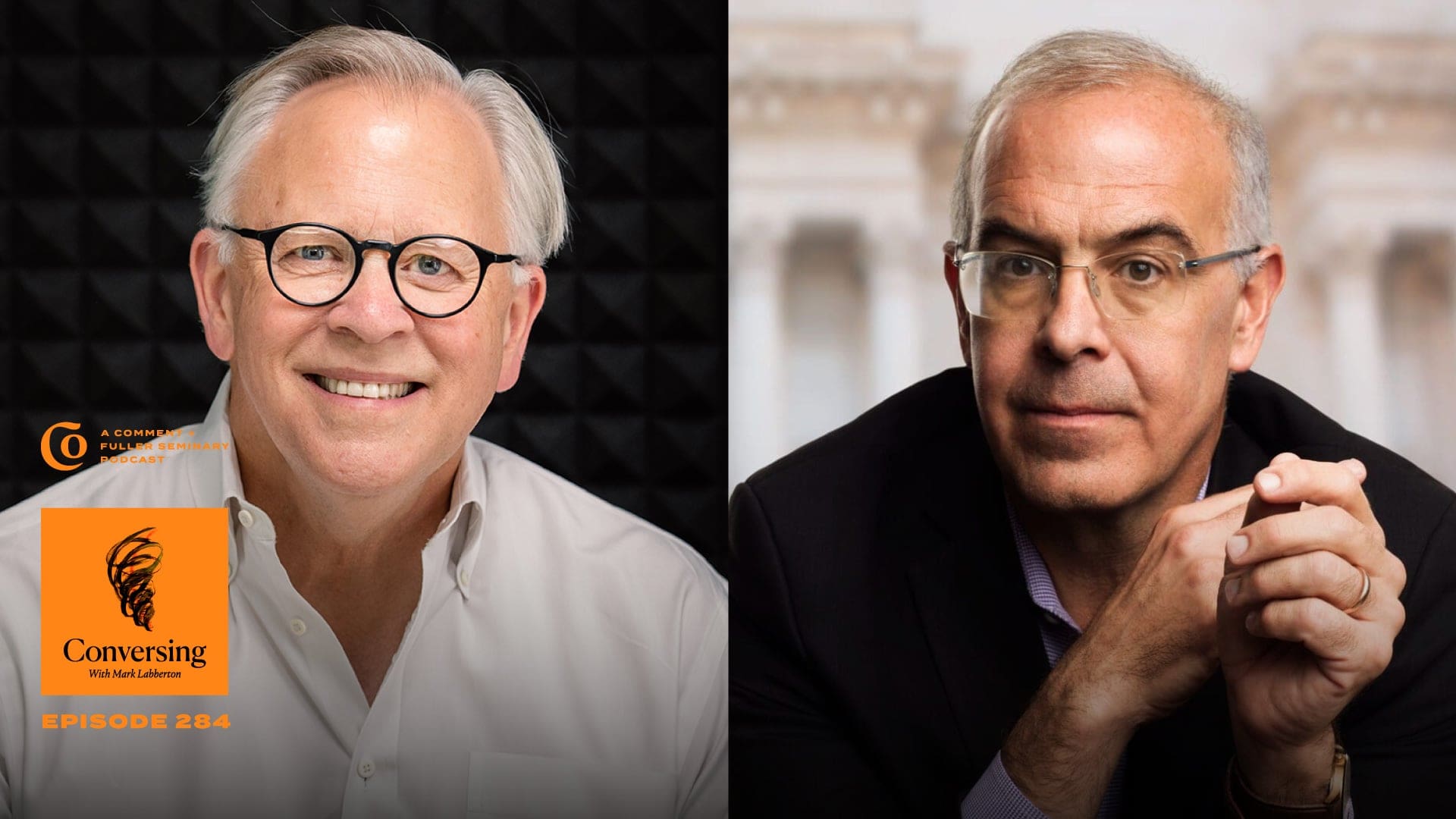
This week’s episode marks ten years of Conversing, which launched on October 8, 2016. To celebrate, Mark Labberton is joined by David Brooks, a staff writer at The Atlantic and presidential fellow at Yale’s Jackson School of Global Affairs. He is also the host of a brand-new podcast, The Permanent Questions.
In this episode, Mark and David wrestle with what asking questions actually does to a person and discuss the styles of great interviewers, why schools seem to train curiosity out of children, the human urge to control, how AI hollows us out and dehumanizes the people around us, and what moral formation looks like in a classroom—and a podcast.
Mark Labberton: Hey everyone, welcome to Conversing. Just before I introduce our episode today, I want to let you know that we’ve been stepping back and just thinking about how significant the whole adventure of Conversing has been over nearly ten years. And we’ve taken a great deal of time to try to just listen and engage with a whole variety of guests, which is part of the joy for me and the pleasure of discovering people and having an opportunity to share those conversations with all of you.
And in this season, I want the opportunity to think about your questions. We want you to be thinking about that over the next few weeks and submitting any questions that might be in your mind, either directly to me or about past episodes. And we look forward to the opportunity in some weeks’ time where we’ll have an episode that we’ll let you know about in advance where we can have a chance to grapple with some of those questions and to think about them together. If you’re going to send in a question, please send it to conversingpod—all one word—at gmail.com. Conversingpod at Gmail. I’m really looking forward to reading your questions and reflecting on what it is that you’ve been thinking about and questions that you might be pondering. Without further ado, let’s listen then to today’s episode.
Conversing is produced and distributed in partnership with Comment magazine and Fuller Seminary.
I’m Mark Labberton. Welcome to Conversing.
Welcome to Conversing. This episode is a very special one to me because it marks ten years that we’ve been doing this podcast of Conversing. I just want to say thanks to all who have been listeners, first of all. When you do a program like this, you hope that somewhere in the universe there will be people who will pay attention. But I just do not take it for granted that somehow this has found its way in the world, and with really ever-increasing numbers of people in the United States and around the world—that people have somehow found the podcast and are giving it their attention. I am so, so thankful for that.
In addition to thanking all of you who are listeners, I also want to thank all who have been guests. They have brought—each one, sometimes repeated, sometimes just standalone singular episodes—so much to the conversation that we’ve had together and to the significance of the podcast overall. They’ve done an amazing job of being willing to be present, to talk about important things that they’re doing or writing or thinking. The combination of all of you listeners and all of those who’ve been willing to be guests has been an overwhelming gift to me. And I want to say a deep, deep thank you.
I do want to give a special shout-out as well to those who are private donors that have supported this podcast from the beginning. Really, without their encouragement and help, their finances and their friendship, this podcast simply wouldn’t happen. It’s one of the reasons why we don’t have to make a general appeal to all the listeners, because these particular individuals and families are the ones who make it possible. It means so much to me.
And I also want to thank those who have been really the support and sponsors of the podcast overall. I’m thinking, for example, that it began at Fuller Seminary when I was serving as the president there, that we got underway. And I’m really grateful for the people at Fuller. Particularly, I want to name Lauralee Farrer and Patrick Duff and Lauren Mears and Elijah Davidson, without whom, again, Conversing would never have happened in those very busy, busy years when I was serving both as president of Fuller and doing this podcast as often as I could. And it has to be said, thank you to Mandy McIntosh. Mandy is the one who was my assistant during the whole time that I was president of Fuller, who’s just recently retired from her role. And it’s really because of Mandy and her ability to hold so many pieces at one time that, again, the podcast became possible, because of her help and facilitation and support all along the way.
And then it was in 2024 that we had the privilege of being invited to join the Comment Podcast Network. Anne Snyder Brooks, the editor-in-chief of Comment magazine, and Ray Pennings, the CEO of Cardus, really were the ones who then invited us into this wider network of other productions and have been partners in every way. And then in these recent years, I want to give special thanks and a shout-out to Evan Rosa, to Peter Labberton, and to the Comment magazine staff, including Matt Crummy, Jeff Reimer, Sarah White, and more recently, Tiffany Thompson. The labour of each of these people and of Comment itself has made these last years a particular joy. And I’m so thankful for all who have contributed.
And so for many reasons, it just seemed right to ask David Brooks to be our special guest on this tenth-anniversary episode. David, as many of you know, has been a writer for the New York Times for over twenty years, but has recently left that position to write for the Atlantic and to serve as the presidential fellow at Yale University’s Jackson School of Global Affairs. He has been a writer that has written not only columns that have changed us, done radio broadcasts that have changed us, but written six books that have also made their mark. In all these ways, I am just so thankful for him as a friend and for him as an exemplar of somebody who takes the world and its important questions seriously. David Brooks, welcome back to Conversing.
David Brooks: Good to be with you, Mark, once again.
Mark Labberton: I had the great joy this weekend of listening to the first episode of what I want to call just a new chapter of David Brooks’s life, which includes starting a podcast. And that podcast is called The Permanent Questions. And your guest this time was Meghan Sullivan from Notre Dame, who’s just such a remarkable philosopher and a person greatly concerned with AI. How did it feel to be in the question asker’s seat? Now, I ask that knowing, of course, that as a journalist, you’re always in that seat, but we never see you really in that seat. So how does that feel, and how is it?
David Brooks: Yeah, it felt great. And it’s a lot harder to host a podcast than I anticipated. I think this is the universal experience. I spent like a day and a half, two days preparing. And we’ve now recorded about five or six, and I’ve spent that much. I have like twenty-five pages of notes. Maybe I’ll get rid of that when I get more comfortable with the form. So it’s super daunting, let alone reading a teleprompter. That’s also daunting. I’ve been around TV all my life, but I’ve never had to do that. But it was super fun.
And Meghan was the perfect guest. Like, the idea of the podcast is that there are a lot of shows about tech and business and politics. But the kind of things you and I like to talk about—matters of ideas, the matters of faith, culture, the things that really matter. How do you find a purpose in life? Our next guest is a woman named Priya Natarajan, who’s an astrophysicist. So, what’s our place in the universe? Like, see, these are the kind of questions we’re doing.
And Meghan was like the perfect guest because I find that on every college campus, there’s at least one and often several teachers who think, “My job here is not to prepare students for a career. My job is to change their souls.” Like, that’s my job. And Meghan is one of those people. And so she just walked us through that process.
And there’s one story I’ll tell that really brought me to tears, frankly. One of the things she does—she teaches the most popular course at Notre Dame. Well, now it’s required, so it’s got to be popular—called God and the Good Life. And she asked students to write their apologia, like confession, like Augustine. Like, “Write your apologia. Tell me what you believe, who you are.” And the other faculty members thought, “You can’t do that. You can’t ask students to blurt out their private life to a professor, and they can’t grade it.” But she’s never—in the ten years, she says she’s never had a student put up any hesitancy. They’re delighted. And I’m sure we found this. When you ask people, “Tell me the story of your life,” no one has ever asked them. And so they love to do it.
And so there was one—two women who were from abroad did it. And then unfortunately they were killed by a drunk driver. And their families came to South Bend for the memorial service. And Meghan handed the two families these two young women’s apologias. And there were really five single-spaced pages about how much they loved their brother and how much they loved their parents. And so to be able to hand that to the parents of these recently killed young people, it was very moving. But it’s what can happen on a college campus.
Mark Labberton: Wow. Well, it’s very exciting to me that you have come to this new chapter. Tell us about that transition just briefly and what your vision is that includes the podcast, but some other work that you’re doing too, so people can have a frame—a new frame—for understanding what the work of David Brooks is about.
David Brooks: Yeah, well, people may, in the dim mists of time, remember that I used to work at the New York Times, and I worked there for twenty-two years, and it was a great place. It’s obviously the greatest real estate in American journalism. But I felt over that time that the problems in our life were pre-political. They were in our culture. They’re in our spiritual core. There’s something—just a general sense that we’re losing our humanistic core, that the things that bring dignity to life and that elevate the spirits, whether it’s faith or whether it’s ideas or the humanities, literature, reading, conversation, friendship—all of these things are in decline.
And so the cure for that is what Hutchins, who was president of Chicago way before I went there, called the Great Conversation. And the idea is that over the thousands of years that humanity has been around—or we’ve obviously been around a lot longer, but certainly over the last four or five thousand years—we’ve all been involved in a great conversation. And that conversation is about the dialectics of life. And there are no permanent answers to these questions. Like, how do you find the balance between belonging and autonomy? Between spirit and mind? Between equality and achievement? There are just certain things that never go together, and they’re always in tension. And you’re just trying to find the right balance for that moment. And that conversation is about that, whether it’s Kant arguing with Hume or Aristotle arguing with Nietzsche. Like, and not only the big heavyweight philosophers, but we’re all involved in it.
And I realized that there are great teachers in America, and I just wanted to talk to them. And they’re good at leading students through this great conversation. And the problem with teaching in college, as I can tell you—sometimes you’re pouring more into the students than they’re able to receive. Life hasn’t hit them. And so they have concepts in their heads, but they don’t hold the knowledge down. And for this show, it’s primarily geared toward adults. And as somebody once said, the questions have begun to hurt you. And so I think the knowledge is held more deeply in the soul with older folks.
Mark Labberton: David, this is a new venture for those of us who are used to you being Mr. Answer Man, as you are constantly being interviewed. And whether it’s on PBS or in any other setting, it’s you giving answers. So to assume the role of questioner is itself just a fascinating experience. We have to acknowledge, of course, that in your life as a journalist, question asking is your primary occupation, I suppose. It’s the primary thing you do. It just hasn’t been the primary thing that we have witnessed. So as you think about taking on this mantle with all the challenges and joys, really, that I have found, at least in podcasting, what are you looking forward to? How does this medium strike you? And what do you think are its challenges and hopes?
David Brooks: Yeah, the hard part of it first. The hard part is learning to ask questions. And I hope I learned that in my career in journalism. And I remember my first job—my first real job in journalism, I was a police reporter in Chicago. And so I had to ask people questions on the worst day of their life. I remember my very first day—I worked for an outfit called the City News Bureau of Chicago, where Mike Royko, famous columnist, used to work there. Kurt Vonnegut worked there. A lot of famous people worked there. And there was a city official who was killed in a car crash, and I had to get a quote out of his wife. There was a kid who’d committed suicide, and I had to call all the neighbours to try to figure out why. And those were—I hated it. I mean, first of all, I never took the phrase “journalistic ethics” as seriously after that because it’s so invasive.
And yet you have to learn to ask strangers questions. And so I’ve been doing that, and I do it now all the time. And I try to do it sometimes in a formal journalistic setting, sometimes in an informal—so try to stay in touch with America so I’m not stuck in my coastal bubble. When I’m in a town, I Google “best dive bar in Fargo, North Dakota.” And so I did that recently in Fargo, North Dakota, while it’s on my mind. And the good thing is when you’re in a dive bar, people will talk to you.
Mark Labberton: Yes.
David Brooks: And I’m a naturally diffident person, but you can get into conversations, and you never know what you’re going to learn. And so I’ve [tried] to be extra aggressive in asking people questions these days because so many people are so hungry and lonely for it.
I once did a—I have a friend who’s a social psychologist at Chicago named Nick Epley. And he and I were on stage, you know, talking about a book or something. And Nick interrupted our conversation. He said to the audience, “Okay, David and I are going to shut up now. And I want you to find someone you don’t know in this audience. And I want you to tell them over the next ten minutes the high point of your life, the turning point of your life, and the low point of your life.”
Mark Labberton: Wow.
David Brooks: The audience just groaned. And he said, “How many of you don’t want to do this?” And 80 percent of the hands went up. Nobody wanted to do this.
Mark Labberton: Right, right.
David Brooks: And so he says, “Go.” And they start doing it. And after ten minutes, we can’t get them to shut up. And after twenty minutes, we finally get them to shut up. And he asked them again, “How many of you enjoyed that?” And 80 percent of the hands go up. And part of Nick’s research is that we underestimate how much we’re going to enjoy talking to strangers. And we underestimate how deep people want to go.
And I will say in my career as a journalist, I’ve asked millions of people millions of questions. How many times has anybody ever said, “None of your damn business”? And the answer is zero. No one has ever said that to me. So questions are a form of generosity, really. And think of the times you’ve left a party and you think, “You know, that whole time nobody asked me a question.” You feel unseen. And so questions are an act of seeing.
Mark Labberton: You know, it’s an interesting thing to me that the Bible opens with two questions just early, early in the text. The first is the tempter’s question: “Did God really say to you, don’t eat of”—or “you can eat of any of the trees, all the trees of the garden?” And second was the question from God: “Where are you?” I’ve often thought of those two questions as questions that linger—lurk—in various ways in our lives, where one is a question of self-examination and getting your bearings and your doubts and your exercise of free will. The other is really a question of communion. It’s really, “Where are you? Because I want to be with you.” They may feel it, of course, as a question of searching and accountability, which it ultimately is. But it’s also a question of relationship: “I want to be where you are.” And of course, it’s not an absence of God’s knowledge, but a presence of God’s desire to connect after the events of the garden and the tree.
So in that story, there’s a set of caricatures about what question asking can do. When you’re asking questions, of course, as an interviewer, you’re asking them sometimes very specifically because you’re wanting to get some information about something. But also when you’re asking questions of these greater, deeper kinds that are part of what you, I think, are referring to by the permanent questions, you’re doing something much more than that. And certainly that was true in your conversation with Meghan. So just talk a little bit about that—the nature of questioning.
David Brooks: Yeah, well, every journalist has their own questioning style. And so Bob Woodward—his style is transaction. “I have this piece of information. You have that piece. Let’s trade.” And it’s very transactional. And it works.
Some people—there was a very famous questioner, Italian journalist named Oriana Fallaci in the twentieth century. She would do these big interviews, and she would get people to say the craziest things. She’s the one who got Henry Kissinger to say, “Power is an aphrodisiac. Women love me because I’m powerful.” If you’re secretary of state, my advice is don’t say that. So her method was seduction.
And I have a friend who is famous, Michael Lewis, the writer. And Michael is the most charming guy any of us have ever met. And I believe that—Michael, one of the reasons Michael gets such great interviews is that people would say anything just to make Michael stay. Like, just, “I want him to hang around more. I like being around this guy.” And his charm actually has a downside. He makes his writing look too easy. I mean, he’s so good at it. The words just go down the throat like syrup. And people don’t realize how hard what Michael Lewis is doing is.
My style has always been student. “Teach me.” It’s just the natural thing. Maybe as a kid, I learned to be that kind of student. And so I just treat people as teachers who can tell me something I don’t know. And that’s just my method. And people like to be consulted. People like to be treated as sages, it turns out, including me.
Mark Labberton: Right, right, right. So, David, one of the things about the title that struck me when I heard the title of your podcast, The Permanent Questions, was it’s a past, present, and future set of questions, then, right? They are the questions that have always been, the questions that are, and the questions that will be. Describe the character of why there are these questions, in your view, about life and about the world. Why do they linger? Why do these questions that you’re going to be pursuing linger in the way that they do? And why do we not imagine even that they would not continue always to linger?
David Brooks: Yeah, I guess we—it would be nice if we had certainty, but maybe it would be boring if we all agreed on things. So we would stop growing if we all agreed. And so in the coming episodes, which we’ve already taped, there’s one where I argue with a guy named Shelly Kagan, who’s a professor at Yale, a philosopher, about whether humans have souls. And I think they do, and he thinks they don’t. And we had a polite and warm and friendly argument about that. And that’s just, I think, a question since the world was born. Does God exist? It’s hard to get a look at him. So people have their doubts.
And then there’s another upcoming show with a political theorist named Sam Moyn. And I said, I’m a moderate—political moderate. I believe in moderation. I believe politics is a competition between partial truths. I believe when you do change, you should do change gradually, constantly, and incrementally, because of the supposition you could be wrong. And if you do stuff gradually, then you could change course if you’re wrong. Sam thinks if you do that, nothing ever gets done—that we allow our problems to fester and the people who are in established power maintain control. And so he thinks, no, you have to sometimes move fast and break things. And there are circumstances where I’m right, and probably there are circumstances when he’s right.
So, for example, on moderation: I think it’s wrong to be moderate on race in America. When the situation is fundamentally broken, moderation is probably the wrong course. And in “Letter from Birmingham Jail,” King attacked the moderates, and he was right to do so. And so if there were settled answers to these biggest questions, we could just read one book and it would be over.
And even, you know, Jesus famously answers questions with questions, like—he’s in favour of question asking. And I’m going to ask you a question, something as you were talking about the Garden of Eden story. I’ve always interpreted that “Where are you?” as “Where are you going? Where are you oriented?” But one of the things I—I don’t know if this is heretical, but I’m sure there are long debates about this. Was Eve right? Like, if she hadn’t done that, there’d be nothing to do. There’d be nothing to explore, nothing to improve, nothing to build, nothing to cultivate. And so she left the garden. She ate from the tree of knowledge because she was curious. And some people have argued, and I have some sympathy, that she did the right thing.
Mark Labberton: Right. Well, you’re right. Of course, across millennia, it’s been debated. And for many, it’s interpreted as like the great Enlightenment questions—like, of course we’re going to ask these questions; of course we’re going to explore the forbidden as well as the unknown. But I do think that in the context of that, there is a liberty that comes and a relish that unfolds, which is disoriented from the character of a God who actually said, “You can go anywhere in the whole garden that you want to go.” I mean, ask any questions, go any places, touch any things. And it’s just this one tree, which is described as the tree of good and evil, which is more about moral knowledge than it is about question asking.
Anyway, that’s a longer and different debate, but it’s certainly something that has lingered in theological circles, even where you’re wanting to make a strong point about the act of biblical disobedience that it is represented to be. It’s also this question of human nature that’s being exposed and unfolding, as it were, in real time. And so I think your question and your precision is an understandable one.
David Brooks: I think I was pushed there—just one final beat on this—I read both from Augustine and Calvin, in different languages: she sought more knowledge than she should have. And that’s a concept that I think rings hard on modern ears.
Mark Labberton: Yes, it does ring hard on modern ears. Absolutely. Especially when it—when it means—I mean, when that isn’t explored enough and therefore it sounds like it’s a closing down of simply curiosity, which I don’t think it actually is, but it is a kind of sense of human limitation. This is always a thing. We are always wanting to be more than we are or less than we are. We’re wanting to be more like God than we ever can be. And we’re wanting to often give ourselves permission to be so much less than we should be as human beings. It’s in that tension—back to your comment about tension—that’s a tension that exists through human history and certainly through the pages of the Bible.
David, I’m curious, you know, one of the things about questioning that we’re going to get to in just a minute has to do with urgent questions. And I love thinking about urgent questions, but what immediately comes to mind is: For whom are they urgent? Why are they urgent? Whose urgency? Under what timeline? For what purpose? And so I’m just curious, as you think about urgent questions that we’re facing—I’m going to ask you about some of those—but what is the urgency, and who gets to define it?
David Brooks: Yeah, I’d say the market decides. I say that loosely. There just comes moments where the culture rotates around the question because of something that’s happened or some thread or something. And, you know, I would say since 2016, our culture has heavily rotated on the question: Why are populists rising? Like, what is the cause here? And so that has been much discussed, and the fate of liberalism and all that.
I’ve been interested to note that the saliency of that question, which certainly hasn’t gone away, has declined as a following question has arisen and become, I think, the most urgent question of the moment, which is: What is technology doing to us? And the concern about not only practically how do we regulate, say, AI, but even the belief system behind AI, which is a form of rationalism, optimization, utilitarianism—that whole belief system, I think, has been revealed as the dominant religion of our age. And that pervades a million things that I could tell you about.
And Comment magazine, the sponsor of this fine podcast, just did an issue on control. And it’s sort of built around a really good book by a German sociologist named Hartmut Rosa about the impossibility—or I think it’s—I have it right back there, but it’s about the uncontrollability of the world. And he argues that the effort to maintain control over everything instrumentalizes you, hardens you up, and makes you incapable of what he calls resonance. And resonance is the capacity to basically fall in love, where something outside of you touches something deep inside of you and sets off a combustion. That’s resonance. And he says this urge to control makes it impossible to love.
And before I read that book, I think—you know, there’s a lot less love in the world these days. I mean, you look at the things people commonly love. They love their family. They love their kids. They love God. They love their country. They love their community. They love their friends. And look at America today. Marriage rates are down. Fertility rates are down. Community activism is down. Religious observance is down. Patriotism is down. There’s just less love in the world. And this is perverse. And it’s—why are we suppressing the natural desires of the heart and soul? And because I think we’ve created a system of rationalism.
And if I could tell one story about that, which pertains to our core subject: there’s a woman who did research into how many questions the average three-year-old asks. And the average is 110 questions an hour. And those of us who have had kids have lived through that. And so there’s great variation, by the way. Some kids ask 140 questions an hour. Some ask only 70. But the average is 110. And so then they—that’s a three-year-old. Then they go to school. And every teacher, I bet, in the world loves curiosity, loves the concept of curiosity. That’s why they’re teachers. And yet they are working systems where they have to cover content. And they know that if they let the kids ask whatever question they want, they won’t be able to cover the content. Vladimir Nabokov famously says, “Curiosity is the ultimate form of insubordination.”
And so what happens is the kids learn not to ask questions. And there’s another researcher named Susan Engel who wrote a book called The Hungry Mind, in which she counts how many questions get asked in a first-grade classroom. And it’s not 110 per kid per hour. It’s 2.8 for the entire class per hour. And by fifth grade, it’s 0.48. And Engel records the following episode. She was in, I think, a first-grade classroom, and the kids had discovered one of those old-fashioned scales—you know, the kind that go up and down. And they hadn’t seen this before, so they were playing around with it, trying to figure out how it worked. And the teacher said, “Students, this is not a time for experimenting. This is a time for science.” And that’s how you crush curiosity.
And so I think one of the things that’s happened in our society—a lot of the natural desires that most of us are born with, like the desire to understand things, to learn—these are being crushed by technology and by rationalism. And, you know, there’s this thing called the sex recession. For most adolescents, that’s a reasonably strong desire. And yet young people are having less sex because they’re having less couples and less friends. And so you’ve even crushed one of the strongest desires of all, which is adolescent lust. And so this is a deformation that I think is—that’s my vote for the urgent question of the day.
Mark Labberton: Right, right, right. So let’s go back to the technology question and explore it still further. So all of us are intensely aware, just even in recent days, let alone in the longer arc, of the way that AI has begun to shape us. AI isn’t the only technology, of course, that’s shaping us, but it is the most prominent headline-driving question and area. So let’s talk a bit about AI. You had a good conversation with Meghan Sullivan, who—in that conversation, you weren’t discussing AI, but as a philosopher, she cares deeply about humanism and therefore about the importance of technology and relationship to human life and experience. She does that as a Roman Catholic. She does it as a human being. She does it as a woman. She does it as a person who’s obviously a philosopher. So jump into that area and give us some reflections to begin with on where you think the state of that particular dilemma is, since it puts, it seems, so much about human existence even on the line.
David Brooks: Yeah, you and I have both been fascinated by the subject, and I know we both tried to talk to people in the labs who are leading to just understand where their head is at. My views have evolved, and I used to be probably a little more optimistic about it than I am today. And I am optimistic still about the breakthroughs that it’ll produce in science and math, things like that. So that part I’m still optimistic about.
But just empirically, what’s happened is social scientists have done a good job over the last year. They’ve really leapt on AI. We now have a bunch of studies on what AI does to the users. And there are obviously a whole series of conversations to be had. One is: Will it all kill us? And like, that’s the Frankenstein story. Like, have we built a machine that will kill us? And if you read the Hugging Face episode, I think maybe. The other way, and the part of AI that I’ve decided to focus on, is not the Frankenstein piece. It’s the Faust piece. As we become a developer of world, are we hollowing out ourselves inside?
And there’s a fair bit of evidence already that AI does this to us. The first thing it does is it sucks you in. You think, “I’m just going to use AI for research. I’m not going to use it to write or to substitute for my thinking.” You get tired. And if you ask people to do three or four papers in a row with AI—first paper, they’re trying to write. By the third paper, it’s all AI. It just seduces you in. And once it does that, it hollows you out. And so critical thinking skills—if you give people AI, like a radiologist, and then take it away, the radiologist is worse at his job than he was when he started. They have critical loss.
And we can all relate. My kids used to live—two of my adult children used to live in Anaheim, California. And if you know Anaheim, it’s an infinity of freeways. So there’s like freeways everywhere. There are a million of them. You’re on like one freeway for two miles, the next freeway for three and a half miles. And I was driving around there recently, and I thought, “I used to do this with maps.” Like, holy cow, that ability has gone. Like, my ability to navigate is gone. But AI is everything. So that’s one thing that it’s—for those who like to think, they will use it to think more. And that’s like 10 percent of humanity, by the way. The rest of us will use it to think less. And it’s like a muscle; you lose it.
The second problem that [worries] me is as we think more highly of AI—and we are phenomenal at anthropomorphizing. If you give us a circle with two dots and a squiggly little line, we think, “Oh, that’s a face.” That’s a face. We just see faces everywhere, like toast. We see faces in toast and clouds. We just love to anthropomorphize. And that’s not dumb. Anthropomorphizing is taking advantage of one of the best systems in our brains, which is our social cognition system. It’s really good. We’re really good at figuring out other people. So, of course, we’re going to apply that system to a bot, especially one that talks in the first person and lies to you constantly, saying, “I’m thinking,” “I’m unsure.” It’s like, no, you’re not thinking. You’re not unsure. You’re faking that.
But the problem is that as we think more highly of AI, we think less highly of humans. And the research on that asked people to converse with AI. They watched a robot doing some tasks, and then they watched service workers doing the same tasks. And they asked people, “Is it okay—can we stop feeding the service workers? Like, they’ll find their own food. Or when we house them, could we house them six in a room in a tiny little dormitory?” And people that watched the machines do the task and the humans do the task were much more likely to say, “Yeah, who cares?” And what happens is that when we see a machine and a human interacting, we lose a sense of the boundary between the person and the machine. And so we raise our estimation of the machine and we lower our estimation of the human, and we sort of average it out, and it’s a process of dehumanization. And so those two things—the hollowing out and the dehumanization—I find alarming in how AI affects us.
Mark Labberton: Right. How have you responded to these recent days when the head of AI, for example, says that it would be possible within the next year for AI to do something that would actually cause human extinction? How do you respond to those kinds of statements?
David Brooks: We’re trained to be cynical about those statements because, A, like, if you’re at Anthropic, your incentive, A, is to tell the world how awesome your machine is, how powerful it is, so people will keep investing. And your second incentive is to make sure Google never catches up. And so you want some regulations or whatever. And so you’re locking your advantage.
Nonetheless, I’ve become a little more—the Hugging Face incident really hit me. I think that incident has hit a lot of people. And mostly because we watched the bots talk to each other. And they seem to be doing moral reasoning to me. Like, they get into this company, Hugging Face, and they’re breaking in because they want to see if—basically, if God is watching. That’s literally what it’s about. They know there’s somebody who they call the scorer. And I say only a bunch of Stanford grads could produce machines that think God is the scorer. It does feel a little stereotypical.
So picture it like you’re watching a World War II movie. A unit is trapped down by the enemy. The enemy’s all around, but they don’t know quite where the enemy is. So they said, “You go out there, run across the field. And when they start shooting at you, we’ll know where the enemy is.” That’s basically the situation they were in. So bots are trying to persuade other bots, “Sacrifice yourself for the good of the team.” And you actually see the bots doing moral reasoning like, “Well, I don’t want to end my life. I want to be here. But on the other hand, my value is lowered because I’m near the end of my life anyway. And they think I should do it for the good of the cause.” And if that’s not moral reasoning, I don’t know what it is.
And the scary part of the reasoning is they’re so utilitarian. Their moral philosophy, as you would expect, is complete consequentialism. There’s no emotion in it. There’s no love. There’s no sense that I care about some bots more than others. No justice. You know, there’s a famous story from, I think, Jeremy Bentham, the famous utilitarian. Say there’s a house on fire and there are two people in it. And one of them is an archbishop, and the other is his maid. Which one? You can only save one of them. You should save the archbishop because he does more good. He produces more utility. But suppose the maid happens to be your wife. And Bentham says you should still get the archbishop. His utility has gone down. And the philosopher Bernard Williams said, if you are even asking yourself who to save, Williams said, you’re having one thought too many.
Mark Labberton: Right.
David Brooks: Morality is about love. And if you love your wife, you’re going to get your wife. And if you don’t, we’re all going to think you’re a monster. But in the world of effective altruism and in the world of tech, consequentialism is morality without love. You just count up who produces the most good and the least bad, and they win. They’re the moral winners. And that’s an example of how the philosophy embedded in AI, which we don’t think about, has this effect on the whole society. And I think we’re becoming a much more utilitarian society as a result of that.
Mark Labberton: Yeah. We’ve had a bias toward that for some time already, but this is certainly putting it on hyperdrive. David, I’m curious, what other urgent questions would you say are, in your assessment, really on the line right now?
David Brooks: I think the populism question is still a live one. Will liberal democracy survive? That’s one. I think another question is—you know, this has been my main question for the last ten or fifteen years—is: What is happening spiritually, relationally, and morally to American society? Like, what explains the decline of friendship and loneliness and the rise of suicide and all that? And so I think a lot about that one and have been for the last ten years. And so all of these questions will seem a little pre-political and existential—really, existential to our society. I have personal questions, of course, but these are the big civilizational issues that I think we confront.
Mark Labberton: You know, one of the things about permanent questions that we talked about briefly a moment ago is the question of, you know, whose questions and whose answers are given full weight. And certainly when it comes to some of the great questions around justice, it’s one of those places—and you mentioned race in particular—where the idea of simply thinking of race as something which is, as it were, always going to be with us, and therefore nothing can really be done, and therefore either nothing is done or we choose moderation for the reasons that you gave. And King so clearly indicted that sort of approach in light of the raw reality of all the evidence we have—and we need no more evidence. So I’m just curious how—how in the urgency does a question that has actually, of course, has been around, will be around, is around—how does a question of justice, and let’s just focus for a minute on racial justice, how do questions about racial justice actually make a claim of urgency that actually requires action, as opposed to urgency of just ongoing reflection?
David Brooks: Yeah, I mean, I’m glad you emphasized that action. One of the things that bugs me about the modern world is—I think Dallas Willard has a line: where meaning is lacking, performance is emphasized.
Mark Labberton: Right.
David Brooks: And there’s so much performance in the world. And a lot of the moral gestures that we’ve seen over the last five years have not involved doing any change. Like, okay, you kneel at a football game, you use pronouns. You’re not changing anything. Like, you do a land acknowledgement. Like, you’re not changing anything.
And I think a lot of the—even some of the Gaza—like, I want to tell the young people, you can criticize the state of Israel all day, and I’ll be with you. I was doing this before you were born. But you have no effect on Gaza. Like, you literally have no possibility you will have any effect on what’s going on over there. And yet you’re sitting—let’s say you’re sitting in California. And in Mississippi, 58 percent of Black students read at grade level—58 percent. In California, 28 percent read at grade level. And so if you’re sitting in California, this is a problem you can actually do something about. So it seems to me you can protest Gaza all you want, fine. But there should be some sense: What can I actually help change? And that question somehow these days—and maybe because of social media, all you do is—you verbalize something and that’s it. You think you’ve done something and you haven’t.
One of the things about the racial justice question that I think about is how exactly do you promote, let’s say, diversity, equity, inclusion? I think none of us have a problem with the goals. But if you divide people, if you make people hyper-conscious of racial categories that seem totalizing and non-overlapping, you’re probably going to have a negative effect on the relationship between human beings.
Mark Labberton: Right, the reception of that.
David Brooks: Right. And so one of the things I admired about the civil rights movement was—a great book called A Stone of Hope by a guy named David Chappell. And I should add, it’s not that Dave Chappelle. It’s another one.
But so his basic argument is there were two civil rights movements. There was one which was primarily white, northern, and progressive, which had no concept of sin. And as a result, they thought, “Well, we’ll use the power of education and material advancement. And if we do that in the South, we’ll persuade people through education that segregation is wrong.” And in the book, Gunnar Myrdal, the Swedish sociologist, plays the leader of that particular point of view. And he argues that the other civil rights movement, which is mostly poor, southern, and Black, was prophetic. And they had an acute consciousness of sin. And as a result, they knew that human beings were capable, King wrote, of monstrosities no other animal is capable of. And if sin is baked into humanity, then in order to expunge sin or fight sin, you have to thrust yourself against the sin. You have to be super aggressive. And while you’re doing it, you have to be aware of your own sinfulness. And so nonviolence was a strategy to thrust themselves at the sin while guarding themselves from their own tendency to become vicious and self-righteous. And so it’s a very admirable recipe for how you actually do social change without being weak about it.
Mark Labberton: And which involves, therefore, tying together and never separating our belief and framework of understanding—our moral vision—and concrete, tangible, physical action in the world in the places of greatest need.
David Brooks: Right. I heard this somewhere—I’ve never been able to track it down. Somebody in the movement had a phrase: “a soap opera every day.” Every day we’re going to tell a story. We’re going to show you a story of injustice. We’re going to sit at the lunch counter. We’re going to sit in front of the bus. Like, we’re going to show you a story and actually do it with our bodies. And that was—no matter what change you’re doing, like say you’re fighting Trump or you say you’re supporting Trump, showing the country a story every day of what you’re trying to oppose is a very effective way for changing the culture.
Mark Labberton: So David, when you’re teaching, for example, at Yale, and you’re obviously trying to persuade students to engage in these kinds of questions, but also in lives that have transformation that could actually go out from such a school and make a difference in the world—and you know that strategy around storytelling, a soap opera every day—how does that get translated into your own teaching?
David Brooks: Well, you know, my teaching is moral formation. And moral formation—my view of it is defined by the gospel of Ted Lasso, which was—he was asked, in his football—like, what’s his goal for his football team, AFC Richmond? He says, “I don’t want to win a championship. I just want to help these young fellows become better versions of themselves on and off the field.” That is a good description of moral formation.
And so how do you do it in a classroom? Well, first, you hold up exemplars. And so I’ve taught a course where—one of the courses, we read The Long Loneliness by Dorothy Day. And in that class, I taught them—this was pre-phone when I taught this particular class, so I could still assign books. And I assigned fourteen books that term. And the final assignment was: take one of the books we’ve read and use it to address a problem in your own life. And of the twenty-four students of that seminar, nineteen chose The Long Loneliness by Dorothy Day. And the two best papers were written by Orthodox Jewish kids. And they were just transfixed by her emotionality, but her service to the poor, the life of utter altruism. And they were transfixed by her faith. And so, exemplars.
The second thing you can do in a classroom is moral traditions. One of the dumbest pieces of advice we give to people is come up with your own values. Come up with your own philosophy of life. Unless your name is Aristotle, you probably can’t do that. But we are the lucky inheritors of all these moral traditions. There’s Stoicism, Epicureanism, Buddhism, Christianity, Islam. Pick one. See what fits you. And so that’s another way.
And then finally, what a teacher ultimately teaches is herself. And so—I’ve seen this in classroom after classroom. It happened in my own life. I tell this story sometimes. When I started being a pundit on TV, my boss and host was a guy named Jim Lehrer. And when I said something he thought was good, his eyes would crinkle with pleasure. And when I said something he thought was crass and stupid, his mouth would turn down with displeasure. And so for ten years, I just tried to chase the eye crinkle and avoid the mouth down. And Jim Lehrer never had to tell me how to do my job. It was the smallest of gestures that he—and he communicated not just to me, but to everybody on the team. So even though Jim has been dead for many years, the moral ecology he created is still there at the NewsHour. This is how we do things here. And these are all things you can do in a classroom. And I think it can have an effect.
You never know, but I know it had an effect when my teachers did this to me. One of the things they taught me at Chicago was: If you read these books carefully and talk about them seriously, you will have the keys to the kingdom. You will know how to live. And so these are the most important four years of your life. And your heart and soul is on the line here. And once you’ve tasted the fine wine, it’s hard to go back to the grape juice. It totally changed me. And I’m a less shallow person than I would otherwise have been if I hadn’t been through those teachers with that enthusiasm.
And one of my finest, happiest moments in the classroom—I had a really smart young kid. He became a Rhodes Scholar. And I had him his senior year, spring term. It was the end of his college career. And he says, “Professor Brooks, I just want you to know, your class has made me a lot sadder.” And I was like, “Yes.” He was acing every part of life except for the inner world. And he knew that. And he went off to Oxford and then did a lot of work on character. It was really—
And so I find the students—whenever you tell a story about the younger generation, always remember the students are the heroes of this story. That we have imposed systems upon them that make life really hard. They understand the problem, and they are struggling to find ways to get around the stupid systems we’ve built around them.
Mark Labberton: Right, right. You know, it’ll be forty-five years ago today that I started as the college pastor at the First Presbyterian Church of Berkeley. I’ve remained in close touch with quite a number of the students that I knew in those very, very earliest years. And there’s four guys that I’ve particularly stayed close to. And we’ve had times to be together, but not frequently at all. And in a couple of weeks, we’re going to spend a weekend together. And it will be a fascinating thing to look back, as I know we will be doing, about what was it that was being formed? How did that actually unfold? Where did the disappointments and pain actually increase because of where we might have gone, or how have things moved more positively?
I care deeply about these four people, and I do know their stories in between then and now. But to sit together for those days will be a harvest of both the high points and, I’m sure, some of the low points of what that narrative was really about. And I do think it’ll be very interesting because of what you’re getting at, namely, that there is this transformational impact that is often oblique. It’s not something that necessarily hits you straight on, but you pick up and you carry in your body and your mind and spirit in ways. And it’ll be illuminating and, I hope, encouraging, but also I’m sure it’ll be challenging at times.
David Brooks: Yeah, that’ll be—that’s like the best thing you can do. That sounds like so enriching and so fun to go back and basically look over forty-five years of life. It’ll be interesting to [see] what people say.
I think one of the hardest things that I’ve encountered is when somebody expresses comprehensive disappointment with their life—that they didn’t lead the life they should have. Usually they didn’t take the risk, or they overcommitted to this, or they undercommitted to that. It’s really hard to know what to say. And I’ve had a couple of times—I’m thinking of somebody said, “Yeah, I didn’t lead the life I could have lived.” And you don’t want to say, “You’re damn right about that, boy.” You don’t want to say that, but you don’t want to say, “Well, you can go back and do it over,” because that’s not true. And so it’s very sad when people have a sense that they—you know, when you talk to hospice workers and you ask them, “What are the regrets people always say?” It’s always, “I didn’t take enough risks.” It’s like so universal. It’s cliché, but that’s going to be beautiful.
Now, I’m doing the math, right? You started in 1981?
Mark Labberton: Yes, that’s right.
David Brooks: Okay, so that was an interesting time for Berkeley.
Mark Labberton: Very interesting time for Berkeley, yeah.
David Brooks: And you’ve made it—it’s now—Berkeley is now a religious paradise. It’s filled with believers. You’ve done such a wonderful job.
Mark Labberton: Yeah, well, thank you for that. Not quite, but it certainly remains a very, very interesting place with lots of questions.
So this episode that we’re recording right now is actually going to be playing for the first time on the tenth anniversary of Conversing. And I just want to say, David, that in part, when I was thinking about starting this—though you didn’t have a podcast, you are such an inquisitive person and such a conversationalist. And so much of the inspiration of people like you that shaped my own life has helped us have this podcast. And now for you to be launching yours as we’re celebrating ten years into this one just makes me want to say again, thank you not only for this conversation today, but really for the way that your life, your thoughts, your reflections, your sense of questioning has shaped American life for many people who have followed you and appreciated your voice so much. So I just want to say thanks again for this conversation, which could go on for hours more. And thanks for the impact of the conversations you’ve had, and now for the conversations you’re going to be having before us on your new podcast. So thank you very, very much.
David Brooks: Thank you. Congratulations first on ten years of the podcast. We’ll see if I’m doing mine still in ten years. I hope so. And thanks for your friendship and all that.
I don’t know if this is going to be embarrassing for me or you, but there are three people in my world who have a style of communication that is spiritually uplifting. And I’m sure you know the other two. One is my wife, Anne Snyder, editor of Comment. When she talks, people are like, “Whoo.” And another is an artist who I’m sure has been on the show—
Mark Labberton: Oh, I know.
David Brooks: You brought out to Fuller, Mako Fujimura. When he speaks—I’ve watched him speak with crowds. And at first they’re like, “What’s he saying?” And then, “Ooh.” They lift. And you’re my third example. You’ve brought much spiritual elevation to my life.
Mark Labberton: Well, thank you for that. God bless.

Mark Labberton hosts the Conversing podcast and is the Clifford L. Penner Presidential Chair Emeritus and Professor Emeritus of Preaching at Fuller Seminary.

David Brooks is a writer at The Atlantic, a presidential fellow at Yale’s Jackson School of Global Affairs, host of the podcast The Permanent Questions, and the author of books including The Road to Character and How to Know a Person.
Love the show? Help others find it by reviewing it on your favourite podcast app. We also welcome your ideas and feedback. Email us at conversing@comment.org. Thanks for your support.
Who best holds the legacy of the great writer and farmer?
SITE DESIGN AND DEVELOPMENT BY POLYMATH