





Why politics is better off if damnation is religion’s job.





How can a Christian humanitarian organization keep Christ at the center of its mission, while working in the world’s most difficult places, with thousands of staff spread across dozens of countries and cultures? Gary Haugen, founder and CEO of International Justice Mission, and Kevin Jenkins, former president and CEO of World Vision International, both understand their organizations to be foundationally Christian, but even in ministries where you would expect spiritual formation to be a center of attention, it takes a work to lead large, global teams, helping them to live up to their mission.
Speaking with Mark Labberton before a live audience at International Justice Mission’s Cornerstone 2026 event, they link missional success to the slow and unglamorous work of spiritual formation at the individual and relational level. Keenly aware of the gap between what Christians (and Christian organizations) say they believe and what they actually do, they consider how the outward work of ministry connects to the inward work of discipleship to Christ—wrestling with the very idea of a “Christian organization.”
Mark Labberton: Welcome, everyone, to Conversing. I’m so glad to be able to share with you a conversation I had recently between Gary Haugen, the founder and CEO of International Justice Mission, and Kevin Jenkins, the former president and CEO of World Vision International. We had the opportunity to be together at an IJM gathering, and it was in the context before a live audience that we had this conversation. You might hear some of the sounds of that audience, and it was a conversation that focused on spiritual formation. Both of these two men understand their organizations to be foundationally Christian organizations, not just in name, but in practice. And a great deal of what they’re discussing has to do with how do you form a community?
In the instance of IJM, you have a staff of approximately 1,400 people. In the instance of World Vision International, you have a staff of approximately 40,000 people. The significance of what spiritual formation means all around the world in so many different religious and political and social contexts is a thick and complicated one. But these two friends and exceptional leaders give us some hints on both their own formation and on the formation of the organizations that they’ve sought to lead.
I know in my own experience, both as a pastor and as a seminary president, that even in organizations that—of course you would expect spiritual formation to be a centre of attention—it is all the more the case that in these two mission organizations, the issues of spiritual formation are both more obviously needed and also potentially much more complicated to accomplish. All this adds to my own interest in the conversation we had and in this very, very important topic. I hope you enjoy it.
This is really a great honour. And I’ve been very excited about this conversation, partly because from the very beginning of getting to know you, Gary, I’ve been very aware of just how deeply the spiritual life is actually the context for everything. And you’ve built a ministry by the grace of God in ways we’re going to explore around spiritual formation, and likewise in World Vision. I mean, the staggering size of World Vision is part of what always captures anybody’s imagination. And the multiplicity of what World Vision needs to be around the world in super complex settings. And your own spiritual lives and your own spiritual leadership in a very complex set of systems and people, where you’re wanting to do this work in the name of Jesus Christ in a way that reflects the character and life of God in all that you’re doing. That’s the preset. But now we want to get into some of the details.
And to do that, I don’t want to start with those organizational stories. I’m more interested in starting first with your own stories. Because while we all live a life of faith and we all have various experiences of life that change and affect how we understand our life in Christ, you’ve particularly experienced it.
It’s worth pausing for a moment just to acknowledge that spiritual formation really came as a language—that name and all of its implications began to emerge around fifty or sixty years ago, where, while it had deeply been part of Roman Catholic traditions and many other traditions, where the sense of what spiritual formation is about has been around from the beginning, there’s also a special sense, at least within Protestantism, that in the last fifty years or so, there’s been a resurgence of concern for spiritual formation.
So the shorthand definition I want to suggest—we’ll explore this further—but at the very least, what spiritual formation means is making progress in a spiritual life. That’s the simplest thing. You’re wanting to be making progress. It’s not just having experiences, but to move deeper into the spiritual life. And in Christian terms, you’re wanting to do that in the name of and in imitation of Jesus Christ. And you’re wanting to do that, furthermore, in the real world, so that it’s not in the preserve of a monastic existence, but really in the public square, where, especially in your two cases, the world is what it is, and you are trying to lead organizations ultimately that take that spiritual formation and embed it. So, for starters, what have been some of the important inflection points in your own spiritual journey?
Gary Haugen: Well, I’ll jump in because of the definition there of progress—spiritual progress, spiritual formation, but it’s progress. So the points that are vivid for me are when I was just so impressed with how unimpressive the progress was.
The first was very vividly in college. I went off to Harvard University, sort of this evangelical Christian who had been really schooled in—I had an authentic relationship with Jesus, but it was very much an emphasis on the right doctrine and the intellectual defence of it, because it’s got to be rational. And then, honestly, at InterVarsity in college, coming across a verse I’d read before about, “By this shall all men know that you are my disciples, if you have love for one another.” Right?
And literally, it occurred to me at some point during—or reflection—that there wasn’t anybody in the world who would identify me as a Christian because of the way I loved other people. Like, that is the—according to Jesus, it’s the thing. That’s, like, the actual thing, it turns out. It turns out. And yes, people would have said, “He’s probably a Christian because he goes to church, because he doesn’t do X and Y and Z,” or whatever. But no one would say that there’s something extraordinarily loving about him. And so that was the first sort of jolt.
And it also resonated with the way, a little bit, my church life had been, I think, as a young person, was hearing a sermon on Sunday that does set the bar of what it’s like to live in the real world like Jesus. And then on—so excited about that, and then Monday or Tuesday, like, it’s clear I’m not gonna hit that bar. And then I go back on Sunday, I ask for forgiveness, or that—I get the inspiring bar set again. And so the progress towards actually—here’s the life Jesus articulates, here’s my actual life—and I didn’t see some progress.
And then by my forties—and that’s IJM, like, ten years in, maybe, or a little—yeah, and honestly felt this just sense of significant plateau. Like—and also being very unimpressed with the plateau. It’s like, okay, this is pretty good. I’m a little more loving, and I’m a nice person. But again, here’s the way Jesus was articulating and living a life in the world, and here’s me.
And the thing that struck me so powerfully, because I was actually—you know, with the Swartzes, who were up here last night, it was actually Jan and I and the kids. When the kids were all very tiny, they let us stay at the place up in Park City, Utah. And I found Dallas Willard’s The Divine Conspiracy, which set out for the first time, oh, look, you can actually practise to become more like that. So you can—just say, “Oh, I want to go run a marathon.” You actually can practise to become the kind of person who could run a marathon.
So it was the first time this insight for me that, oh, I don’t have to be just so discouraged and despair about my lack of progress, or even my plateau—which is a pretty good plateau, but it’s still not approaching that. And there was that breakthrough of, oh, my goodness, my fifties could be better than my forties, and my sixties could be better than my fifties, because I think I could become more like Jesus. That was so hopeful to me.
Mark Labberton: Absolutely. Gosh. Kevin, some examples?
Kevin Jenkins: Great, Gary. Many inflection points in my spiritual journey, you know, right from the beginning. So my wife, Helen, and I surrendered our lives to Jesus about two years into our marriage, in our mid-twenties. And so that was an inflection point. But what was important around that was the people who had introduced us to Jesus and opened that door for us also discipled us. They stayed with us.
And I’ve seen over time now, over the decades, too often we misread Matthew. It doesn’t say, “Go make converts.” It says, “Make disciples.” Or we’re using language now in Practicing the Way—which kind of comes out of Willard’s work, et cetera—of “make apprentices,” which is a word we’re more familiar with these days than “disciples.” So that was a starting point.
But maybe two inflection points. One was—the second-best speech I’ve ever heard in my life was yours on Friday night. But the best speech—
Gary Haugen: Don’t pass so quickly on your second-best one.
Kevin Jenkins: —was Henri Nouwen.
Gary Haugen: Okay. Fair.
Kevin Jenkins: By the way, by the way, it was in a ballroom in Toronto, a few hundred people. And when he finished speaking, no one moved. No one clapped. No one stood up. No one moved for a long time. Yeah.
But he was speaking that night on something he’s written, a book on solitude, community, and ministry. And that became a paradigm for me for my Christian walk. If you ask my children, “What’s your dad’s—how does your dad think about, you know, how he’s doing spiritually?”
And so, solitude: make a space every day for God. And I’m a very disciplined person. But for the first ten years of my Christian life, I could not get a quiet time together on any regular basis. And I was on the board of Young Life Canada, and we were at a retreat. And the speaker said that he had solved this by praying, “God, if you would give me the gift of a spiritual quiet time, I will dedicate an hour a day of my life to you for the rest of my life.” And so I went back to my room and thought, that is such a dangerous prayer. Oh my gosh. But I prayed that prayer. And for the last thirty-three years, going from disciplined Kevin Jenkins not being able to discipline a meaningful quiet time to having a daily, very meaningful quiet time throughout three-plus decades.
So now, in solitude, community—two principles of community are: forgive one another for not being God, and celebrate each other’s lives. Wow. And so I’ve had two accountability groups—one, a group of three other men; one, a group of four other men—that I’ve journeyed with. We have monthly calls, have had monthly calls for thirty years. We’re accountable to each other and for each other. A place for vulnerability. If you journey with someone for thirty years, you’ve seen victories, you’ve seen failures, you’ve cried. You go through it all.
But as a leader, these guys are not impressed with me. They don’t care what my car—they don’t care that I’m president of World Vision or whatever I happen to be at the time. And they’ve known me a long time. They’re mostly interested in my spiritual formation, my journey, right? And I can trust them to not just say nice things to me. Yeah.
And you know, so now the whole idea here is Westerners tend to just want to go to ministry. I don’t—do ministry, but there are building blocks for ministry, right? Solitude and community. And, you know, especially for men—I’m sort of passionate about this—so many men, including Christian men, don’t even have one friend that they can vulnerably say, “I’m really struggling, my marriage is difficult,” or “I’m—whatever, I have these temptations,” whatever it is. Nobody to talk to. And that’s an important building block for spiritual formation and for ministry.
Maybe the last one I’d say is when I got asked if I’d put my name up for World Vision. So I was in business for twenty-five years and got a call from a headhunter asking me, you know, “We’re doing this search for the president of WVI, and do you know anybody in Canada who might be interested?” And then, of course, “Well, would you be interested?” And I paused and I said, “That would really complicate my life.” Just a teensy bit. You know, I have to move, I have everything—at the time I was in private equity, I have to leave a private equity firm, which is designed to not leave.
But that journey of calling and surrender—and especially because I started quite early to feel quite called toward it, and Helen did not. And so that was quite—well, it was interesting, but probably also be accurate to say a challenging dynamic. Ultimately, as Helen was praying and struggling—and I did say to her, “Look, you don’t have to worry about this. I can be obedient. There are three hundred people in this process, three hundred people. I’m going to get knocked out. I’m a business guy who serves on World Vision’s board as a volunteer. I’m going to get knocked out. You know, fifty people will be left.” But anyway, fifty became twenty, became two, became, “Would you take the job?”
Mark Labberton: Congratulations.
Kevin Jenkins: But Helen—just before I was invited to take on the role, in her prayers she felt, not the audible voice of God, but she felt a sense of, “You don’t have to do this. I’m not going to love you or Kevin any more. You already have all of my love. This is not more brownie points for running World Vision or going into the humanitarian world. You already have all of my love.” So, you know, basically, don’t feel any pressure. And it was that that caused her to bless me and say, “Yes, we’re doing this together. Let’s do this.” So that was an inflection point.
Mark Labberton: Wow. You know, I’m struck in both of those stories. There’s so many distinctives but similarities that I think can be gathered up in a shorthand way for the whole life of what spiritual formation involves.
In part, it does—like in your case, Gary, it involves this insight, which is, I’m not really connecting my faith with a life of love in the world that actually is. And that insight then has to be paired with action. So you would still be not spiritually formed, particularly if you had decided to acknowledge that insight but never have become a loving person, or a more loving person, or a person that was actually committed—in the case of IJM—to the whole exercise of love at every level in the hardest of places, right?
So that combination—and everyone experiences their own spiritual journey—but the insight is critical. There is a part of the Christian faith that is absolutely about content: clarity about ideas, truth claims, reality claims, and behaviour claims, right? So that’s part of spiritual formation. But spiritual formation is also about this kind of attunement to the long journey and to learning your own set of practices, right?
That turning point, I can imagine, of praying that daring prayer and then saying that prayer will actually also likewise require action—and not just an affirmation or a confession of faith, but actually an embodiment of faith. That’s always the challenge. That’s it. And part of what World Vision, IJM is doing is trying to embody in the world, in places of great need, exceptional sense of the presence and love of God in relationship to the individual and in relationship to the many. That’s the big journey that you’re on and that we are on.
To me, it’s a super interesting thing to then break that down and ask, so how does it move from the conviction to even the compulsion, maybe even the call, to the actual willingness to do the truth? Because that’s where spiritual formation actually truly happens. I mean, it can happen in the cell—that is, in the private of our lives, in our prayer life. It can happen however God wants it to happen. But very often it happens at that point between what I affirm and what I actually do or don’t do in the world.
So let’s come to these extraordinary responsibilities that each of you have been called to. You came, Gary, with this strong instinct that had already begun to unfold in your own life about the conviction of love. There was this funny story that I’ve told back to Gary many times when we were first getting to know each other. And he would tell me all about the Rwandan genocide investigation. And I was just sort of dumbfounded hearing him describe it and trying to imagine what all of that would have been like. So he tells me he did that. And then he came back, and then he started IJM. And I said, “Wait, wait, wait, no.” See, the story is that—”That sounds like a really good idea, and I want to hear about IJM, but let’s just pause for a moment. It just seems to me that if I had just come back from the Rwandan genocide, I would be in a mental hospital.” And you said, “But that just wouldn’t do any good.” I said, “No, I’m not making the argument that it would do any good. I’m just saying that’s where I would have ended up.”
So there is this amazement that I’ve always had. At that very similar moment, you come back from, you know, one of the twentieth century’s worst nightmares. And then you start IJM. So you’re persisting in the sense that you have to do this. But the spiritual grounding is the most critical ingredient. Here, Rwanda is the most Christian nation in Africa. Ninety-something percent of people identify as Christians. And yet this horror had occurred. So just take us into those early years when you’re figuring out the vision of what does spiritual formation, progress in the faith, look like?
Gary Haugen: Well, what also became manifest to me is the way I can just get busy with activity that’s also kind of really good activity. Right. Earnestly get this picture now of protecting people from violence after seeing all the violence of Rwanda—well, let’s do this thing, let’s build justice club, and let’s go, you know, rescue people and do all those things. And to be able to do that without actually talking to God about it is just an amazing capability I have.
So—and in terms of insight, too, that made such a difference for me, especially from reading Dallas Willard, was this incredibly powerful definition of belief: you believe something when you act as if it’s true. That is a really troublesome claim for a Christian like me who is, “I believe this, and I believe this, and I believe this. I believe, I believe, I believe, I believe it.” Then just pause. Okay, would you act as if that is true?
So you believe all these things about God, and you go off and do this mission that is about God because he’s about justice and stuff. Are you—do you talk to him about it? And, like, no, I don’t. I’m sure I was—there were those desperate prayers and people praying for us, but I just saw—I experienced the way prayerless striving could overcome me, even in a good thing, and even in something that felt a sense of calling from God.
So moving then to—and I had that, you know, World Vision had 40,000 employees around the world or something. I, starting with, like, one, then two, and then, like, six or seven of us. And at that stage, identifying prayerless striving and saying, “Hey, why don’t we stop every day at eleven o’clock and pray? Just so we don’t go a whole day with nothing but prayerless striving.” And that step of saying every day we’re going to stop our work and we’re just going to talk to God about it in super practical ways—that was transformative. Yeah, that’s what comes to mind.
Mark Labberton: So in your case, it’s a startup of four people. Yeah. Let’s stop and pray. You’re kind of having—just after you’ve had coffee together or something, or whatever, however that emerged.
Kevin, in your case, you step into this behemoth of an organization that has a long history, that has already developed its own spiritual life—and/or not, and unevenly—across the globe, in all the complexity of World Vision. And I know that you brought to your time there a conviction that the role of the spiritual life in the work of World Vision needed to be strengthened and developed, but you’re stepping into a rushing river. So how did that vision form for you, and what were the early sensitivities that you developed about how it should unfold?
Kevin Jenkins: Yeah. I mean, at first I just want to say, Gary, it was such a great faith step that you took right at the beginning of IJM to introduce times of silence, times of praying together. I mean, that was inspired. And then to have the courage to say, “Well, we are going to do this.” This is how we put our belief into action.
For me, I start with the identity—my identity and the identity of the organization. So in The Message version of the Bible, the first line of the book of Romans is, “I, Paul, am a devoted slave of Jesus Christ on assignment.” And so I realized that’s my job description. I, Kevin, am a devoted slave, or servant—I’m a devoted servant of Jesus Christ on assignment at World Vision. I, Gary, am on assignment at IJM. On assignment in my podcast, on assignment in my business, on assignment on the school run. Every activity is a kingdom assignment or has a kingdom assignment possibility. Yes.
So that’s a different job description than, oh, I’m running this big complicated thing with lots of opportunities and lots of issues. And the identity of the organization—I mean, to be purposely somewhat provocative, there’s no such thing as a Christian organization. You’re only a Christian organization if your leaders are followers of Jesus and your board members are followers of Jesus. And that’s the underlying—and by the way, all forces are against that. Look at Harvard University. Look at YMCA. Look at—basically, you have to fight for it.
So I went in both with my kingdom assignment and with this sense that if we don’t fight for it, World Vision will lose its Christian identity. How do we keep Jesus at the centre of World Vision? Right.
And then I’d say also—I guess both these things are perspective things. Identity is a perspective, but also worldview. John 15:5: “Apart from me, you can do nothing.” Really. I mean, I don’t think we believe that, mostly. Because, you know, you say, well, I can do some things. I’m moving. And in the humanitarian world, of course, there would be this temptation to just kind of strategize. But I think, you know, implied in that—or at least I’m going to suggest implied in that—is “apart from me, you can do nothing of eternal value.” So you can do stuff. We can bring clean water. We can free someone. But if Jesus isn’t in the midst of it, and isn’t kind of the motivator and implementer, then it’s probably not got eternal value.
And then Ephesians 6:12 says, “Our battle is not against flesh and blood, but against dark powers, evil spiritual forces.” It’s hard to believe that day-to-day, too. Right. Because, you know, we see people putting young girls into slavery of various types. But is this spiritual warfare? And, of course, a lot of activity has to go around legal things and earthly things. Right. Do we really believe that at some level? And by the way, it’s impossible to be in humanitarian work and not believe in evil. Impossible. Right. You realize we are not smart enough to come to battle this. Right.
And so one of the things in our organization that I would always say is, “Do we act like we really believe this stuff? What does our calendar say?” What—you know, even, I mean, even at the level of more personal level—what do our finances say? And so those are starting points for me.
Mark Labberton: Yeah. You know, it’s interesting in both cases, again—there’s, well, there’s great differences in two organizations—there’s this centredness around the connection between Christ at the centre and then the willingness to believe and act as if it’s true, which both of you have. So the connection, again, between belief and action as one thing, rather than sort of belief is primary but action is secondary—that’s a completely non-biblical way of understanding reality.
So as we close this conversation—which could go on for hours, which I would delight in going on for hours—I just wonder if you could take us into some particular moment in your leadership where seeking to nurture spiritual practices, spiritual formation, in the life of your teams was particularly hard, and why it was hard, and how God met you in the process of working that through.
Gary Haugen: I think maybe to your point in our first night, I think that was about credibility of the Christian faith and Christian witness. It is just tested in the hardest times. So we did have this moment when three of our IJM colleagues were murdered in Kenya because they were placing their bodies between those who were being abused by rogue police officers who were abusing others. And as a result of that, they were murdered. And, okay, what do you really believe?
And now, when I received that call—and then Kevin was one of the first people I called—like, what’s going to be important here, Kevin? And he says, “Go be with the team.” And I think also how important just some steadiness is going to be. And so picture yourself going and being with the team. What are you bringing to that? What cleverness? What kind of strategy, whatever? No, it’s going to be either this is the truth and power of a world that is actually ruled by a resurrected Jesus, or it is not. And we live in that or not.
And I think that aspiration that we might actually conduct ourselves in a way in the world’s toughest situations that brings a credible witness and brings life and joy to us as we actually experience that reality—and I think that feels to me like what the invitation from Jesus authentically is.
Mark Labberton: Kevin, why don’t you close us in that way?
Kevin Jenkins: You know, humanitarian work is very difficult. I mean, sort of, who knew it would be so hard to try to do good? But there are forces—there are corrupt governments, there are all sorts of reasons. We’ve heard a lot about a lot of them this weekend. And it can be quite discouraging to be a humanitarian worker. And that’s offset with Jesus saying, “My yoke is easy.” Right.
And so ultimately, to bring the team around—rather than having some construct of our own of what we’re called to do here, let’s make sure we’re staying close, whether it’s developing our strategy or developing particular things that we’re doing in the field. We are doing our kingdom assignment, to go back to what I said a minute ago. Whatever Jesus has called IJM to do, we pray and ask him to reveal that to us and ask him to be with us, and just kind of reframe. We’re not doing the very difficult work of humanitarian. We are unfolding what Jesus has called us to do, in his power, with his easy yoke.
I guess another thing that was a bit of a test for me—there were two tests. One was, would anyone want my job? Do they look at me and go, “Gosh, he’s busy all the time, he travels all the time, he has no margin, he doesn’t love other people”? Or I had one colleague—it was actually Tim Dearborn, a friend of yours—gently said to me, “I don’t know, you should be sending people emails on Sundays. You should be modelling Sabbath.” It was a very—I stopped sending emails on Sundays.
And then the last thing is, one of the markers I felt for a healthy senior team was, are we a team who can be timely truth-tellers with love? So in an organization that’s in a hundred countries, or forty countries, with many different cultures, you know, you’ve got some people who are very forthright, other people who are, well, “I don’t even understand the dynamic in this meeting.” And is this a safe place? Not only to tell the truth, but to tell it on a timely basis. Not, we’re six months into some program and somebody says, “I always knew this wouldn’t work.” You always knew. But also to be culturally sensitive and to create that space that people feel okay to tell the truth, to take a chance: “I’m not even sure this is right, but I’m sensing . . .” So those are some of the things.
Mark Labberton: Wow. You’ve both given us such a great gift this morning. And it’s just, of course, the tip of the iceberg. But your lives are the credible witnesses that we have needed you to be. And I just want to say on behalf of all of us that that credible witness is an embodied Christian faith that actually knows and loves Jesus Christ and actually seeks to do the truth and seek justice in a real world. And I just know all of us want to say thanks to you.

Mark Labberton hosts the Conversing podcast and is the Clifford L. Penner Presidential Chair Emeritus and Professor Emeritus of Preaching at Fuller Seminary.

Gary Haugen is the founder and CEO of International Justice Mission, a former human rights attorney at the U.S. Department of Justice, and the director of the 1994 United Nations investigation in the aftermath of the Rwandan genocide.
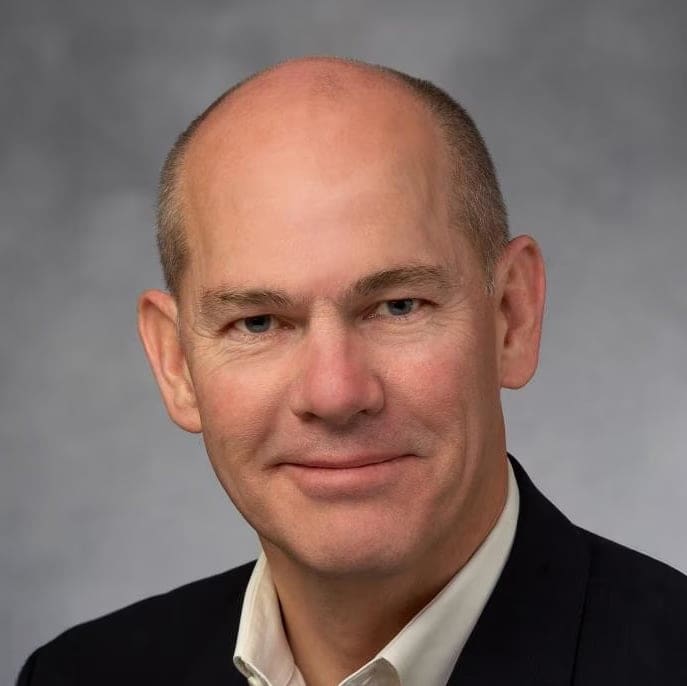
Kevin Jenkins served as president and CEO of World Vision International from 2009 to 2019, after a twenty-five-year business career that included leading Canadian Airlines.
Love the show? Help others find it by reviewing it on your favourite podcast app. We also welcome your ideas and feedback. Email us at conversing@comment.org. Thanks for your support.
Why politics is better off if damnation is religion’s job.
SITE DESIGN AND DEVELOPMENT BY POLYMATH