

T
The Jesus Prayer is “the heart of Orthodoxy.” [Yet] the Uniates also use it; Latins have taken an interest in it; there are Anglicans and Protestants of our day who fervently follow this method of prayer; it is our common patrimony.
—A Monk of the Eastern Church, The Jesus Prayer

Notting Hill. Photo: creativecommons/NoSwanSoFine
There would certainly be no London blue plaque that said, “Here once lived that hallowed ‘monk of the Eastern Church,’ Lev Gillet.” But I figured the former home of the one whom Kallistos Ware called the “urban hermit of London, with the great metropolis as his desert,” was at least worth a visit. I was fully aware that the Fellowship of Saint Alban and Saint Sergius, of which Lev Gillet was the one-time guardian, had sold St. Basil’s House, the fellowship’s London headquarters including its chapel, beneath which was Gillet’s home, in 1994. Perhaps the sale was a good business decision, as London’s Notting Hill neighbourhood is upscale, to say the least. But I wondered if there would be at least some indication that the great experiment in Anglican and Orthodox relations had happened in this place. If London sees fit to honour Jimi Hendrix twice with a blue plaque, and even Priss Fotheringham (c. 1660), the self-professed second-best sex worker in the city, maybe the former residence of Gillet—for whom Jesus was imprisoned in everyone, even in “the sinner, the criminal, the prostitute”—would be lovingly marked as well. So I decided to make the pilgrimage.
But were I to visit the former residence of the author of The Jesus Prayer (a far more practical guide on that subject than the more famous Pilgrim’s Tale), I figured I should start the day properly. So my first stop was to a place where the Jesus Prayer was still in full effect in the heart of contemporary London. I exited the tube in the centre of the city, passed the famous London Stone at 111 Cannon Street, and made my way to St. Mary Aldermary, which somehow survived the blitz. Like so many Anglican churches in London, this one now rents itself out to an Orthodox church, so icons and ripidia (liturgical fans) festoon its high altar, making this sacred place an especially fitting start.

St. Mary Aldermary in the heart of London. Photos by author
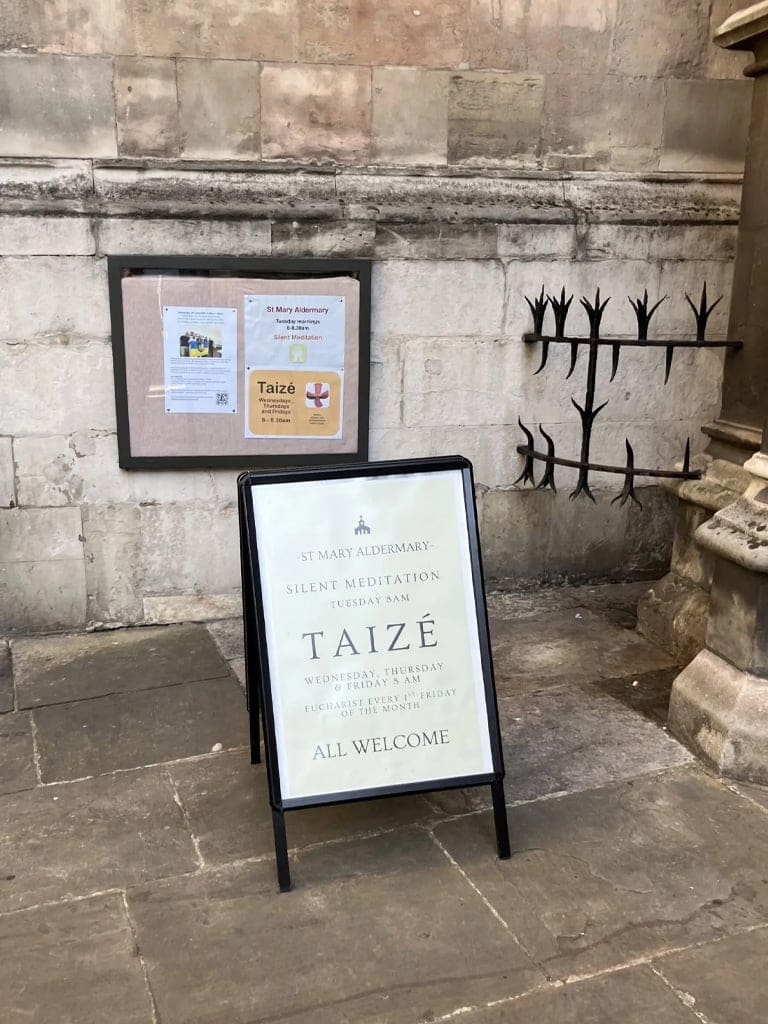
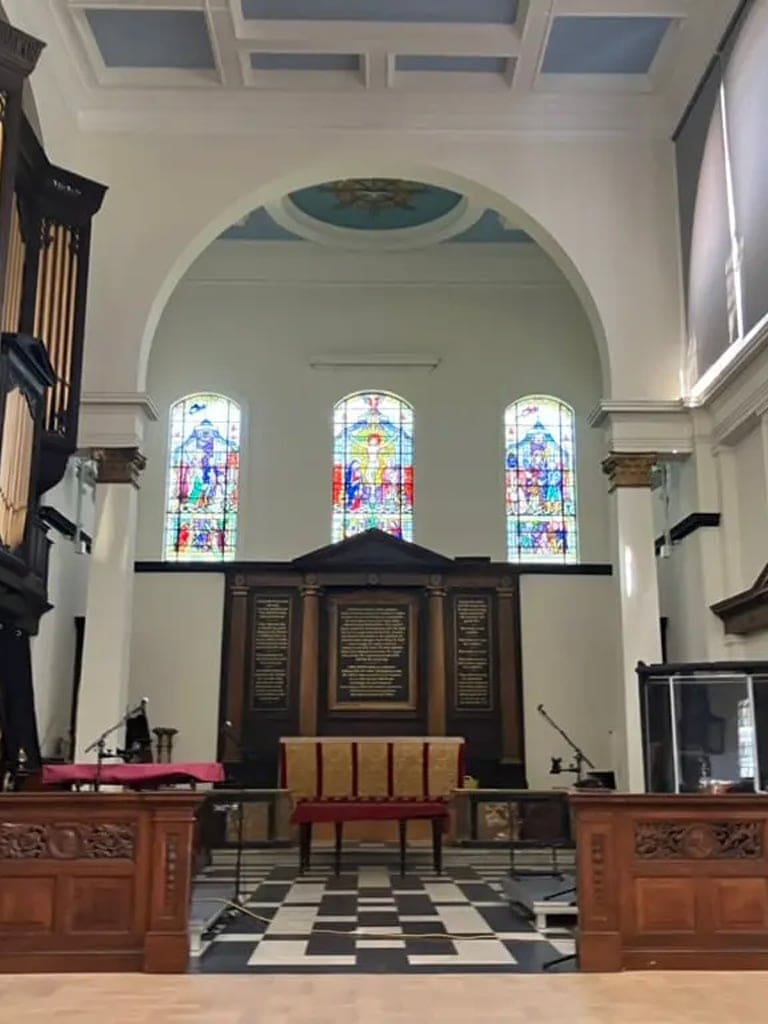
But St. Mary Aldermary remains an Anglican church as well, and there are other, tiny icons on the floor of a side altar. Daily Taizé services are held there, giving me—with the few other Londoners who showed up—a half hour of the Jesus Prayer mixed with periodic chanting before the workday began. Maybe like the London Stone itself—that remainder of the city’s mysterious, ancient foundations—the great city of London is still intact because of prayer sessions like this.

St. Mary Aldermary choir with Orthodox icons and Taizé prayer space just to the south. Photos by author

When the short service finished, it was time to make my ambling way to Gillet’s former home, praying the Jesus Prayer as I went of course. I braced myself for disappointment, for again, there is every reason to think that any sign of Gillet’s memory would be absent. The model of Christian “maturity” that predominates today, and in all ages really, is very much unlike the path he pursued. Gillet’s “fixed aversion for all forms of ecclesiastical aggression and polemics” would no doubt put him at odds with the Orthodox politics of Russia in the present. “As he grew older,” remarks Ware again, Gillet “grew ever more transparently ‘evangelical,’” and everyone knows that ecumenical figures that blur lines like that are usually overshadowed by aggressive voices, ones that embody presumably purer, uncompromising stances that “own” their Christian enemies and thereby stir the unyielding young. Perhaps those who expect pacific voices like Gillet’s to dominate are as realistic as those who think you could occupy a spacious apartment in central London today for £500 per month.
Perhaps those who expect pacific voices like Gillet’s to dominate are as realistic as those who think you could occupy a spacious apartment in central London today for £500 per month.
I made the mistake of taking an above-ground double-decker bus to Gillet’s former neighbourhood. It was jam-packed with teenagers on a field trip, and thick traffic slowed our progress. This gave me ample time to rehearse Gillet’s long-out-of-print biography, so lovingly crafted by the French Orthodox writer Elisabeth Behr-Sigel (1907–2005), who knew Gillet well. She explains that while Gillet was baptized as a French Roman Catholic, he had been drawn to the beauty of Orthodoxy owing to the witness of Russian prisoners during his three years of captivity as a French POW. But staying faithful to his Roman Catholic roots, he took vows in 1919 as a Benedictine monk. Still, the call of Orthodoxy did not go silent. Gillet became involved in the daring early experiment that brought Orthodoxy and Catholicism together at Chevetogne Abbey in Belgium, which still stands today, with its Latin- and Byzantine-rite churches side by side. Moved by the space between these respective liturgies, Gillet took his final monastic vows at a Ukrainian monastery of the Byzantine rite, which took him as far as possible toward Orthodoxy while maintaining communion with Rome.

It was the 1928 papal encyclical Mortalium animos, however, that changed the direction of Gillet’s life. Mortalium animos (Latin for “mind of mortals”) was a hard-line papal crackdown on the ecumenical ferment of the early twentieth century, even a deliberate chastisement of the Lausanne Faith and Order meeting that had happened six months earlier. Having contributed so much to these pulses of Christian unity, Gillet felt “personally disowned” by the encyclical. Though some of his associates were able to stay in Roman Catholicism, Gillet felt that to submit to this particular missive was a sin against his own conscience.
Offended by Roman overreach, he considered becoming a “free believer,” one “detached from all ecclesiastical institutions.” This, after all, is the path taken by most today who are repulsed by certain ecclesial declarations or scandals, and it is an easier path indeed. But Gillet found a different way forward. Thanks to a remarkable community of Russian émigrés in Paris led by Archbishop Vladimir (not the “Dostoeveskyan type,” Gillet described, but quiet and “a man entirely become prayer”), Gillet made an unusual decision. While the famous Russian intellectual Vladimir Solovyov (1853–1900) had in a manner of speaking “converted” to Roman Catholicism while remaining a member of the Orthodox Church, Gillet did the opposite. He “converted” to Orthodoxy, but without renouncing Roman Catholicism. It was less a protest than an attempt to realize in one’s person a future unity. It was “an unknown path” and meant “accepting incomprehension, solitude and summary condemnation.” Gillet’s move would be a devastating blow to the ecumenical communities to which he had contributed, such as Chevetogne, who had expected him to remain Roman Catholic. But he proceeded nonetheless, henceforth being known, as he occasionally chose to sign his books, as “a monk of the Eastern Church.”
The monk of the Eastern Church’s work in Paris put him at the centre of the stream of Orthodox refugees who were fleeing to the city during the Russian Revolution. Sergius Bulgakov, the epoch-defining theologian; Mother Maria Skobstova, the cigarette-smoking, Jew-harbouring martyr who would die at Ravensbrück concentration camp—he knew them well. As the rector of Sainte-Geneviève-de-Paris, he worked toward building an Orthodoxy that was not just Russian but also French.
Circumstances, however, then called Gillet to London. Another ferment of ecumenical possibility had been stirring through the aforementioned Fellowship of Saint Alban and Saint Sergius, founded in 1928, the same year Mortalium animos was issued from Rome. Gillet was astonished, as was Sergius Bulgakov, at the embrace of the Jesus Prayer among the Anglicans he worked with, such as Evelyn Underhill (see my previous column on that topic).
They met at what had become St. Basil’s House in London, the remains of which I was on my way to see. From there Gillet travelled internationally and had plenty of opportunities to be equally disenchanted by the leaders of the Orthodox Church, who were as suspicious of ecumenical advances as was the Church of Rome. After being rebuffed by Orthodox bishops in Damascus, Constantinople, and Jerusalem, the monk of the Eastern Church retreated, like the defeated Peter, to the Sea of Galilee.
And it was there that Gillet, like Peter, encountered the risen Christ anew. Gillet was reticent about describing this lakeside encounter, and it took considerable searching for Behr-Sigel to find the details, but she did dig up some clues. Writing to a friend months after the event, Gillet simply said, “Galilee! . . . There I was expected. I shall not try to tell you what kind of ‘experience’ (I hate that word) I had at Tiberias, on the shores of the lake. It was the culminating point of my life. Oh that lake!” He had encountered Christ, though “it did not take any configuration, any shape, any form [but] was associated in my mind with the person of Jesus.”
The fruits of Gillet’s encounter at Galilee were dramatic and lasting. Gillet knew that ecumenical efforts that were not grafted into formal leadership structures would bear little lasting fruit, but after Galilee he seems to have lost any hope of convincing bishops to make the self-sacrifice required of serious inter-Christian unity. Even so, instead of giving up his ecumenical efforts, he doubled down on them. Throwing himself into attempts to bring Orthodoxy and Anglicanism together in England, he went on retreats with England’s remaining Anglican hermits, and he preached at Anglican churches in Oxford and Guildford. He also devoted himself to the study of Judaism. His ties in Paris began to loosen, and London became his home, the very home that on the upper deck of the crowded bus I was on my way to see.

London was no preference for this international monk. He did not love the city. In fact, Gillet urgently hoped that his encounter with Christ on the Sea of Galilee constituted a call to live in Israel. As he wrote in September 1937:
So it was that Lev Gillet, then forty-four, surrendered himself to the city of London, where he would remain for most of his remaining life. He continued to write, commuting to his office of sorts at the reading room of the British Museum, surely aware that in 1875 the aforementioned Solovyov had encountered Holy Wisdom herself in the very same space. In London, Gillet developed a friendship with Paul Levertoff, a scholar of Hebrew (and father of poet Denise Levertov). Gillet helped mobilize the British to offer support for the Jews during the Second World War. His work with Judaism came to fruition in his book Communion in the Messiah, though Gillet made responsible advances in dialogue with Protestants and with other religions beyond the biblical tradition. Gillet, in Ware’s words again, realized “a universality without relativism” in pursuit of the Christ who “enlightens everyone born into the world” (John 1:5). And confirming Ware’s statement that the monk grew increasingly evangelical, Gillet enjoyed occasionally sharing his faith at Hyde Park’s Speakers’ Corner. He was also in London as German bombs flattened the city during the blitz.

The bus dropped me off at the high-end Bayswater neighbourhood, a short walk from Gillet’s one-time hermitage. My first stop, though, was to London’s massive Greek Orthodox Cathedral of Divine Wisdom, which Gillet would have known well. This building is the very essence of Orthodox establishment in the West, a slice of the Mediterranean in London, complete with exterior palm trees. I stepped inside and admired the architecture and frescoes. The doorway behind a side altar was conspicuously open, and upon entering, I was (understandably) shooed away by a Greek priest. At any rate, I knew that the much humbler chapel to which I was heading was more Gillet’s style. So I pushed onward on foot through the premium bourgeois enclave, weaving my way between professional nannies and dog walkers, my prayer rope in hand.
As I muttered the Jesus Prayer, I wondered what Gillet would say to me, an Anglican so in love with Eastern Orthodoxy. But I don’t really have to wonder, for Behr-Sigel tells us in her biography exactly what Gillet said to such individuals. When Anglicans came to him troubled over whether they should become Orthodox, his counsel was straightforward:
Do not change your Church. You carry your problems in you and with you. You will find them wherever you go. Christ is present in all Churches. Search and you will find. This is what matters most.
Admittedly there is an irony here, for as I have pointed out, Gillet himself changed his church. But it appears he felt that his own situation differed from some of those who came to him for counsel. He felt that his own move “showed himself to be loyal to [the Roman Church] in the name of a superior divine law which she herself recognized.” Still, if those he advised persisted in their desire to become Orthodox, Gillet would direct them to his friend the Orthodox metropolitan Anthony Bloom. But his standard guidance was to maintain fidelity to one’s current location in the body of Christ. None of Gillet’s nimble counsel was the result of confusion or failure of conviction. We might say, rather, that it results from a more, not less, sophisticated and responsible ecclesiology. This is because Gillet believed that, in the words of Nikolai Berdyaev (1874–1948),
the universal Church has not been entirely actualized in the visible historical Church. . . . Beyond the diversities of Christian confession the one universal Church is in process of affirmation, and of this fact we may become aware even while we still remain faithful to our own confession.
Berdyaev’s approach was visualized at the St. Basil’s House chapel where Gillet lived, which I was on my way to see. There were two altars, one for the Orthodox, the other for Anglicans. Sergius Bulgakov demanded that the progress of relations between Orthodox and Anglicans should mean that they “be allowed to take communion from the same chalice.” Gillet, who considered such a move “premature,” mediated between this extreme position and the position of those like Georges Florovsky who were adamantly opposed to it. Knowing intercommunion was as yet impossible, Gillet instead commended “this purely spiritual Last Supper [the Jesus Prayer, where] the name of the Saviour can take place of the bread and wine of the sacrament.”
Do not change your Church. You carry your problems in you and with you. You will find them wherever you go. Christ is present in all Churches. Search and you will find.
Gillet never succumbed to a lowest-common-denominator ecumenism that has caused so many to give up on the movement today. “We cannot believe,” he wrote in The Jesus Prayer, “that divergent interpretations of the Gospel are all equally true or that divided Christians all possess the same measure of light.” But he nevertheless insisted that
Gillet’s foremost rule was a simple one, and it applies to many who are wondering whether they should “switch” confessions today. Instead of changing sides, he advised, we should instead work on our own spiritual life, for “a genuine and intense spiritual life is the shortest and safest way towards re-union.” Reports of those who burn out after “converting” to Orthodoxy or Catholicism seem to vindicate such counsel. Those who have made such moves might have benefited from reading Gillet. Long before the resources we now have for understanding Orthodoxy in English, Gillet’s book Orthodox Spirituality was hugely important. There he dared to say that “on the whole there is one Christian spirituality. . . . The whole teaching of the Latin Fathers may be found in the East, just as the whole teaching of the Greek Fathers may be found in the West.”
At the same time, Gillet lamented that too few Orthodox Christians make the effort to penetrate into “the Lutheran emotion of salvation by grace and into the Calvinising institution of the glory of God.” He pointed out that St. Tikhon of Zadonsk was in fact inspired by the Lutheran pietist Johann Arndt and the Anglican bishop Joseph Hall. It is hard to imagine such things being trumpeted on polemical YouTube channels today.
About a half mile from Gillet’s former home, I neared the yard where he would sit with his prayer rope, a welcome neighbourhood sight. Foolishly, I wondered whether I would be lucky enough to perhaps see remains of the frescoes of the chapel at St. Basil’s House. They were painted by a friend of Sergius Bulgakov, Sister Joanna Reitlinger. Her aim was to turn the “humble chapel into the visible sign of the invisible communion of saints and of the mystical unity, already realized in Christ, of the Eastern and Western Church, as it would be at the end of time.” Accordingly, St. Basil of Caesarea and the Egyptian and Syrian desert fathers and Sergius of Radonezh were mingled with St. Alban, St. Augustine, and St. Patrick. All that survives of this program, to my knowledge, are a few elusive photographs and some portable icons contrasting the onion domes of Orthodoxy behind St. Sergius with Anglican Gothic towers behind St. Alban.
But Gillet’s former home was more than just beautiful paintings. It was a living community, including frequent visits from Joan Ford (who Behr-Sigel calls the very “incarnation of Anglican comprehensiveness”) and Helle Georgiadis (an Orthodox convert to Catholicism). This community was anchored by monastic daily prayer, with the Anglican litany and Orthodox liturgy on Wednesdays and Matins and the Anglican Eucharist on Fridays. The Orthodox liturgy was again offered each Saturday morning, and constant intercessory prayer took place before the reserved Eucharist. Lest this seem insufficiently embracing of global Christianity’s diversity, Gillet made sure in his daily commutes to the British Museum’s reading room to visit neighbourhood Pentecostal churches packed with immigrants.
With only a few blocks left in my pilgrimage, I thought of the retreats that Gillet led in the last season of his life. Behr-Sigel tells us that he was no pushover. It is said that he would never admit latecomers to his sessions. But for those lucky enough to make it, this is the kind of thing he would do with Old Testament texts such as the walls of Jericho:
God, I imagine Gillet would add, is besieging the walls of Christian disunity as well.
Nor did Gillet’s commitment to ecumenism ever dilute his theological acumen. For example, though it is such a tedious modern theological manoeuvre, there is no surrender of divine impassibility in Gillet’s published talks. And yet precisely because of his classical commitments, Gillet is bold enough to put these words on God’s lips in his writing: “I therefore know all suffering more intimately, more deeply than even the sufferer himself. I know ‘vitally’ what each being experiences, yet without it in any way altering My Being.”

It was with this thought that I reached my destination at last. As I approached the address, I saw construction workers. The house, sold in 1994 as I mentioned, was now being flipped again, intensifying the exclusive luxury of whatever first replaced the chapel. I wondered if I had gotten the address wrong, but I triple-checked and I was not mistaken. I had arrived at 52 Ladbroke Grove, the exact address Kallistos Ware names in his preface to Gillet’s The Jesus Prayer. The address was proudly advertised on the construction scaffolding, almost as if to announce a triumph. I realized then there would be no remains of any frescoes, and certainly no blue plaque. The Anglican altar is now a Jacuzzi; the Orthodox frescoes have become the sleek walls of a chef-grade kitchen. Bereft of anywhere to focus the conclusion of my pilgrimage, I was tempted—owing to my own substandard kitchen—to venerate the four prominent icons of urban luxury advertised on the construction banner instead. I suppose it’s fitting in a way. Gentrification is what happened not just to Gillet’s former home but to the kind of ecumenism he once represented as well.

I took the tube back to central London. Trying to manage my disappointment, I opened Gillet’s book The Jesus Prayer again. I noticed freshly how the book avoids controversy. There is good reason that this book helped heal his broken relationship with Chevetogne. I noticed how Gillet sidesteps the trap of any mechanical approaches to Christian meditation. The Jesus Prayer, Gillet explains, is Hasidism for Christians, radiant in an atmosphere of warmth and love. It is the “brakes on our lips and the seal on our hearts.” The aim is “not a constant, literal repetition, but a kind of latent, quiescent presence of the name of Jesus in our hearts. . . . The name is nothing without the Presence.” Then Gillet goes a little over the top, we might say: “We can apply the name to people, books, flowers, to all things we meet, see, or think. The name of Jesus may become a mystical key to the world, an instrument of the hidden offering of everything and everyone, setting the divine seal on the world.” In passages like this, we can see why Behr-Sigel said Gillet was “more at ease with Thérèse of Lisieux and Charles de Foucauld than with Dostoevsky and Soloviev.”
I suppose it’s fitting in a way. Gentrification is what happened not just to Gillet’s former home but to the kind of ecumenism he once represented as well.
Still on the tube, but now deep under the city, surprisingly deep, I remembered Behr-Sigel reporting that in his final days Gillet was severely ill, nearly in a coma. But the afternoon prior to an attack of uremia, he had made a pastoral visit to a Persian family with a severely autistic child. He was moved when the “spastic” child overcame all difficulties and asked for coffee to be provided for the guests. This visit, intensified by Gillet’s illness, led to something of a vision. Gillet described it like this:
That the same author who could articulate the scholarly complexities of the Jesus Prayer tradition could also accommodate such a bizarrely beautiful vision rings with authenticity, at least for me. “We must wake ourselves from our autistic delirium, finally to become men, ‘human being for others,’” Gillet concluded. Perhaps praying the Jesus Prayer while emptying the dishwasher is a far better act of devotion than clocking a perfect twenty daily minutes of selfishly “contemplative” silence.

There was still some time left in the day for one more pilgrimage, so I transferred trains and kept going. I made my way to Holy Trinity Clapham, the origin of the famous “Clapham Sect” of evangelicals, William Wilberforce among them, who helped terminate the English slave trade. It is well to the south of the city, and during the long train ride I kept praying the prayer. As I exited the tube and made my way to the church, I saw scaffolding on the rear of the building. I braced myself for another disappointment: the church in the process of being turned into condominiums perhaps.But it was open, so I stepped inside. I asked some young people, in their mid-twenties, about the scaffolding. They were radiant with the news that so many people were coming to Christ in the so-called Quiet Revival that they were having to expand the historic building. I asked about the inflatable Lay-Z-Spa hot tub in the corner, and they told me it was a makeshift baptismal font to account for the large number of those who were coming to faith. When the church is growing so quickly, I suppose one has to make do.

Hot tub baptismal fonts are not my style. Indeed, under normal circumstances I would have scoffed, retreating into my carefully cultivated ecclesial snobbery, pining for the splendour of higher traditions. But I had been praying the Jesus Prayer all day, which seemed to have short-circuited my instinctual reactions. Evangelicalism, as Bonnie Kristian has so persuasively argued, is easy to lambast but remains worthy of love. If “Christ is present in all Churches,” as Gillet adamantly insisted, he was most certainly in this one. Better a tarp-strewn floor wet from the splashes of a recent baptism than exquisite marble inlay dry from lack of use.
Then I realized that the tub was an answer of sorts to the Jacuzzi that now inhabits what is left of St. Basil’s House. I expect its former resident, Lev Gillet, for whom the Jesus Prayer could “transfigure—without any pantheistic confusion—the whole world into Jesus Christ,” would have been delighted by this unexpected conclusion to my pilgrimage to his home. Perhaps, from his current outpost among the ranks of the saints, he had even arranged for such a terminus himself.

