
I
It’s a strange kind of exile to be cut off from your own language. Growing up, my family’s world was tethered to an Armenian church that, like any other in the diaspora, wove together the social, cultural, and spiritual. One of just two in the Washington, DC, area, it was a place where Armenian immigrants and their children and grandchildren gathered, where traditions were nurtured, and where our mother tongue thrived.
The church ran an Armenian school that taught reading and writing. But after years of lessons that never stuck, I gave up my struggle to master the unique shapes and sounds of the alphabet’s thirty-eight letters. Still, the vernacular language surrounded me in the social life of the parish, while in the liturgy I encountered Armenian in its classical form—a deeper, more ancient register that carried theological weight and mystery. The very sound of Armenian was imbued not only with cultural meaning but also with spiritual resonance, seeping into me and forming a layer of identity beneath my more visible American self.
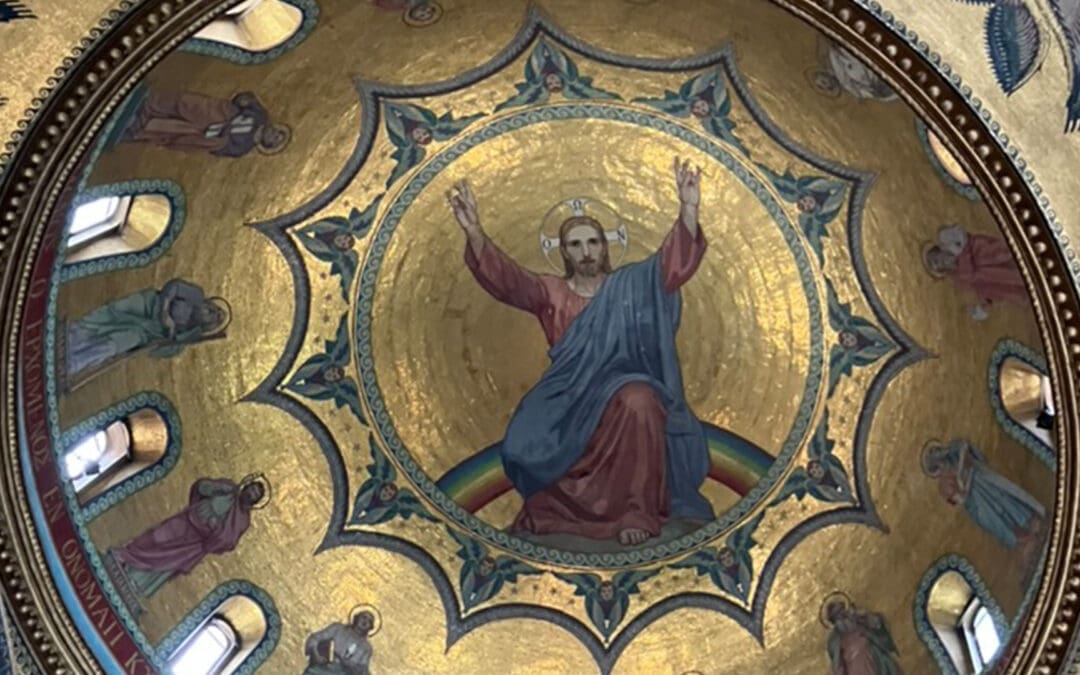
In hindsight, it seems strange that a child as inquisitive as I was never thought to question the church’s rites and rituals. The seeming endlessness of the liturgy made me fidget and drift, yet the aroma of incense, the trembling of candles, and the organ’s majestic hum made a deep impression, even if the meaning of it all was never explained to me. Standing within the congregation—a gathering of solemn adults and restless children obliged by their parents to attend—I sank into the swell of the celebrant’s prayers and blessings, while the deacons’ deep chants rolled over me, hypnotic and incomprehensible. But what most often drew my attention was a letterform inscribed across the altar. In my mind, it was always a five with an exaggerated stem. This single letter, Է, pronounced like the e in “bed,” held the layered enigmas of Armenian language and liturgy.
How could I have known then that I would one day recognize the alphabet as a living, holy presence, beginning with this one letter? I’ve learned since that the Է is a fixture of every Armenian Orthodox altar. Hovering and distinct, the letter crowns the portrait of Mary and the infant Jesus as their loving gazes extend across the gathered faithful. In its lowercase form, it serves as the copula—the connecting word “is,” as in the Armenian phrase “Asdvatz Ser Eh” (God is love). Even in that small way, it asserts being without gender or limitation. It is no longer just grammar; it has been magnified and sanctified, raised to announce the name of God in Exodus 3:14, “I AM” (God is).
As I stand before it now as an adult, I’m drawn by the presence of the self-existent one, the source of all being. At the top of the altar, Է, the seventh letter, glows with theophanic weight, declaring that God dwells here, in the midst of the Eucharist, in the same fire that once shone from the burning bush.
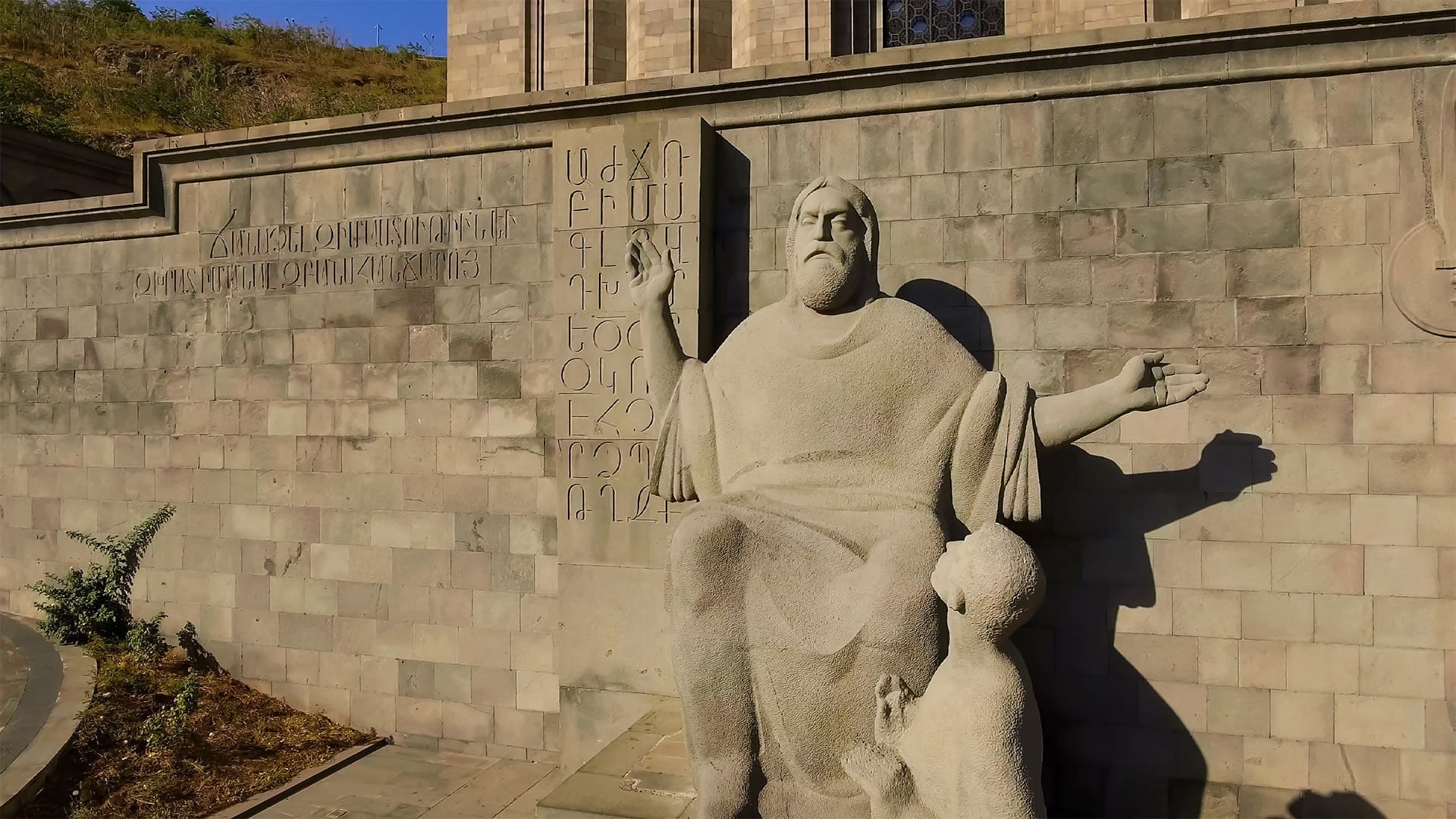
The letter Է did not exist until Mesrop Mashtots—scholar, monk, and later saint—imagined it into being, shaping sound into sign with the alphabet he gave Armenians in 405 CE. Born in the Taron province of Armenia, Mashtots was educated in Greek literature and served both in the military and at court before devoting himself to the church as a missionary. When he later returned to Armenia, he was acutely aware of how remote the Word of God remained for most Armenians, who were confined to largely inaccessible Greek and Syriac texts.
With the support of King Vrampshapuh, the reigning Arsacid monarch who promoted Christianity in Armenia, and Catholicos Sahak, head of the Armenian church, Mashtots set out to solve this problem. His search took him to Edessa in Syria, a major centre of Christian scholarship, but he found that no existing alphabet fit the sounds of Armenian. In Samosata, an important city on the upper Euphrates known for its intellectual life, tradition holds that Mashtots received the letters in a vision from God. He created the original thirty-six letters that matched the spoken language, working with the skilled Greek calligrapher Rufinus. The new script spread quickly, fostering literacy and providing Armenians a common written voice. In the eleventh century, two letters were added, giving us the alphabet in use today.
Mashtots and Sahak then turned to the most important task: translating the Bible. Beginning with the words from Proverbs 1:2, “to know wisdom and instruction, to perceive the words of understanding,” they made the Scriptures accessible to Armenians in their own language for the first time. The invention of the alphabet inaugurated Armenia’s golden age as centres of learning revived and scholars from Alexandria to Rome journeyed to renowned schools, bringing home a wealth of translated and original works that deepened both intellect and faith. The alphabet thus became more than a practical tool. It bound together religion, language, and identity in ways that endure to this day.
The alphabet thus became more than a practical tool. It bound together religion, language, and identity in ways that endure to this day.
Beyond its ecclesiastical patronage, the Armenian alphabet is imbued with unmistakable Christian meaning. Its sequence mirrors the Alpha and the Omega, beginning with God and ending with God. The first letter, Ա (ayb), stands for Astvats, the word for God, while the final letter, Ք (k’eh), stands for Christos, or Christ. The three vertical strokes of the small letter ayb (ա) confess that God is Trinity, while the Ք is modelled on the Chi-Rho, the ancient monogram of Christ that unites his name with the cross.
Each letter also doubles as a number, forming patterns that reflect the order of the calendar and the harmony of the heavens. The simple form of the seventh letter Է, for example, hints at deeper patterns: seven, the number of completion and wholeness, linking together Christ’s seven “I am” statements, his seven last words, and the seven sacraments. The number marks a unified mystery of completion, in which Christ’s self-gift in the Last Supper is fulfilled and made active in the descent of the Spirit, whose seven gifts (wisdom, understanding, counsel, fortitude, knowledge, piety, and fear of the Lord) signify the fullness of that divine life now imparted to the church. Phonetically, it echoes the breathy sound of the Hebrew word ruah, so that in its very pronunciation it suggests the movement of breath that Scripture associates with the Spirit.
Է also embodies the mystery of the Trinity joined to the four corners of the world, drawing on the Christian symbolism of three as the Trinity and four as the created order, which together make seven. In this way, Է is a kind of cipher for the whole of salvation. Spoken aloud, its sound is one with the breath of life. It may be expressed inwardly as a silent prayer, uniting body and soul. Positioned where bread and wine become Christ’s body and blood, it affirms his identity as the incarnate I AM.
The presence of the letter Է on the Armenian altar is thus not only a linguistic mark but part of a wider mystery—a sign of creation’s fullness, raised into the special atmosphere of worship, and an icon of God’s name. Language, liturgy, and theology converge in this single character, and through it the mystery of the Word made flesh appears to the faithful.
The sacred character of Armenian letters extends beyond stone and wood into ink and parchment, appearing in the illuminated manuscripts that helped sustain Armenian devotion and identity through the Middle Ages and beyond. Beginning in the earliest centuries of book production, scribes and illuminators transformed the script into a medium of contemplation.
One of the most distinctive traditions in medieval Armenian religious manuscripts is that of t’rchnagir (Թռչնագիր) or trchnatar (“bird-script” or “bird-letter”), in which letters of the alphabet take wing as fantastical birds painted in bold, luminous hues. The aesthetic appeal of these iridescent, graceful creatures works hand in hand with a call to meditate on the written word. Other decorative motifs developed alongside bird-letters, each forming a clear typology: Mardatars are composed of human figures, while kendanatars and gazanatars use beasts or other creatures to construct the script. Zardatars incorporate intricate geometric or vegetal motifs into the structure of the letter itself. Across all types, the letter is treated like a living form; geometric traces of the pen are replaced with figures, foliage, and patterned designs, making each letter both a sacred sign and a diminutive artwork.
The openings of biblical books provide the most elaborate examples. In many manuscripts, the first word of Genesis or the Gospels appears in letters formed by zoomorphic figures—majuscule initials that take on wings, tails, or hybrid bodies. Margins often include elongated avian figures or hybrid creatures with human heads and bird bodies, further enlivening the page. The scribes who produced these works were known as tsakhkoghs (“flowerers”) because they “blossomed” the letters, turning each linear trace into a complex, living form, much like the Armenian tradition of the tsakhkats khach (“blossomed cross”), which transforms the tree of Christ’s death into a symbol of life.
Medieval Armenian theologians and scribes recognized the spiritual significance of these ornamental letters. The twelfth-century poet and hymnist Catholicos Nerses Snorhali (also known as Nerses IV the Gracious) interpreted birds and other decorative motifs as symbols of history’s divine order, together comprising a visual horizon within which Scripture was to be read. In lushly designed canon tables that map correspondences among the four Gospels, fanciful birds and luxuriant plants are integrated with architectonic motifs. Each page becomes a doorway, inviting the reader to cross from text into sacred cosmos.
The Gladzor Gospels, created between 1300 and 1307 at Gladzor Monastery in Armenia during the era of Mongol rule, now reside at the University of California, Los Angeles, accessible to both scholars and the public. The celebrated manuscript reflects a time when asserting a distinct Armenian Christian identity was especially vital. Composed on fine vellum by two scribes and illuminated by five painters, it combines meticulous text with lavish imagery, including zoomorphic, anthropomorphic, and floral initials as well as marginal ornaments and narrative scenes from Christ’s life.
The letters invite the reader to pause, to contemplate the written word as part of the page’s visual harmony, and to attune the heart before continuing. In this way, they transfigure reading into a contemplative act, binding intellectual engagement with spiritual vision.
Each Gospel opens with an exquisitely designed incipit page, where large gold erkatagir (iron-forged) letters highlight sacred names and the beginnings of passages. Each initial, whether shaped as a bird, human, or curling vine, becomes visual theology. By embodying life, creation, and movement within the very letters of Scripture, they remind the reader that the Word of God is not static but living and active.
Much like the Է inscribed on Armenian altars, these initials draw the mind toward the ineffable Name, inviting meditation on the mystery of God, who reveals himself through both word and image. The letters invite the reader to pause, to contemplate the written word as part of the page’s visual harmony, and to attune the heart before continuing. In this way, they transfigure reading into a contemplative act, binding intellectual engagement with spiritual vision. The ornamental letters of the Gladzor Gospels, like those found in so many Armenian illuminated manuscripts, point to a deeper, mystical dimension within Armenian Christianity.
There’s a long continuum of spiritual correspondence in the mysticism embodied in these letterforms. The interplay of aesthetics and spiritual insight echoes the influence of Pseudo-Dionysius the Areopagite, whose fifth- or sixth-century writings, Corpus Dionysiacum, helped secure a strong mystical foundation for Armenian theology.
In the eighth century, Step’anos Siwnets’i, bishop of Siwnik’, first translated the Corpus Dionysiacum from Greek into Classical Armenian. The ensuing impact of Pseudo-Dionysius’s writings on Armenian Christianity was profound. His apophatic approach to God, emphasis on mystical union, and reflections on hierarchy shaped both theological discourse and spiritual practice. Scholars and monks engaged deeply with his writings and produced scholia and commentaries that became part of monastic curricula. Major Armenian thinkers, including the fourteenth-century theologian Grigor Tat’ewac’i, integrated Dionysian ideas into their writings, and in the seventeenth century Step’anos Lehats’i produced another Armenian version from a Latin copy, ensuring that Pseudo-Dionysius’s mystical theology would continue to inform Armenian thought.
The spirit of Dionysian mysticism carried into the ornamental letters found in Armenian texts, linking theology, liturgy, and the visual arts. For Pseudo-Dionysius, God can only be approached through symbols that reveal by concealing, leading the mind beyond what reason can grasp. The illuminated letters of the Gladzor Gospels embody this principle. Their intricate designs—birds that dissolve into script, vines that entwine around sacred names, human figures woven into words—signal that the text is more than just writing on vellum. The letters point beyond themselves and hold the text in suspension, allowing contemplation to unfold in the space between word and image. They remind the faithful that while the gospel is present and visible, God’s truth ultimately surpasses all forms and concepts. The letterforms emphasize the life and power of the Word while acting as thresholds, captivating the senses and directing the soul into an apophatic encounter with the Divine.
Returning to the Armenian church as an adult with contemplative awareness, I feel myself standing within a current that flows back to the earliest centuries of the church. It’s made tangible in the silver censers swinging through the air, trailing fragrant smoke; in the flabellum, its jingling bells stirring the hush; in the choir intoning ancient hymns composed centuries ago by church fathers. Immersed in these rituals, I recognize mysticism hidden in plain sight. At the intersection of language and liturgy, of the Word and divine image, the Է speaks to me anew—an enigma, the sacred name of God visible to all, as inscrutable and holy as it had been to Moses.
I return to the Armenian alphabet with the wonder of a child, encountering it now in a spiritual way, far beyond what I could have imagined back when I was struggling to simply decode the letters. In tracing its forms, I trace the contours of faith itself, experiencing how the very act of engaging with these letters opens a conduit to the Divine. The Armenian alphabet is a vessel through which God’s presence is made manifest, revealing that the forms of language themselves participate in the sacred, guiding the reader beyond the physical space of altar or book into the ineffable mystery of God.