
I
In my office I keep about twenty children’s books about the story of Noah’s ark. I have a few imaginative riffs on the classic plot. One is told from the perspective of Noah’s wife (she’s the ark’s official bird-keeper), and another is told from the perspective of the animals (they are wary of a crazy man who keeps trying to corral them onto a ship). A few of the books have little gems that make me smile. Peter Spier’s Noah’s Ark, for instance, has vivid illustrations of Noah giving the olive branch to the cow on board. Noah lays the olive branch on the hay in the cow’s manger, the image ringing of Christmastide. Some, like Mary Manz Simon’s Noah Builds a Boat, make me reflect. She imagines Noah’s life almost as a series of fables: Building the ark teaches obedience; living in the ark teaches patience; disembarking from the ark teaches gratitude. And some just make me laugh. Elsie Egermeier’s 1924 children’s Bible, its spine falling apart, calls Noah’s ark the “first house boat.”
Across the variety is a standard plot: Noah builds a boat. Animals board the boat. Rain comes. For the storybooks to be legible as stories about the flood—in order for them to properly be considered accounts of Genesis 6–9 and not simply works of fiction with a main character coincidentally named Noah who fortuitously enjoys sailing and zoology—the books have to hit those beats. Ark. Animals. Rain.
But legibility is a low bar. Outside these big points, the stories’ fidelity to Genesis 6–9 deteriorates quickly. Said another way, every children’s book I have about Noah’s ark is foul, in the oldest sense of that word: The stories are rotten, decayed. If you were to pick up a storybook about Noah’s ark in the children’s section of your local bookstore, you would find a predictable series of pockmarks—places where the narrative used to be but has now been hollowed out, evaded at best and forgotten at worst.
Parts of the Flood Story We Don’t Tell
There are three big, consistent evasions in these Noah stories. The first always has to do with God’s agency in the flood. Genesis 6:5–7 recounts God’s clear intention to flood the earth. Humankind is wicked. God is grieved to his heart. In verse 7 God says, “I will blot out from the earth the human beings I have created—people together with animals and creeping things and birds of the air, for I am sorry that I have made them.” God takes responsibility for the destruction to come. Children’s stories habitually shy away from this point, portraying God with varying degrees of passivity. “One day, when Noah was tending his trees, he heard the voice of God,” reads Patricia Daniels’s 1995 Noah’s Ark. “‘Noah,’ God said, “a great flood is coming. I want you to build a huge boat, an ark.” In this version God proclaims the flood will come but omits that he is its source.
In a Noah’s ark colouring book, God is more radically absent:
A great storm came over all the earth. The storm has more agency than God in this story. It comes of itself, of its own will. God elaborates and clarifies: The storm will last forty days and forty nights. But God is an interpreter. He is the emissary of the flood, not its creator.
Second, children’s versions of the story regularly forget the people who die in the flood—or that people die in the flood at all. Genesis 7, on the contrary, is quite concerned with the dead. Seven verses catalogue the systematic destruction: The waters swell. The mountains are subsumed. All flesh dies in the order it was created. Creation is coming undone—first the birds, then the domestic animals, then the wild animals, then the swarmers, and then the human beings. Then, not to put too fine a point on it, the text records their dying again, this time in the inverse order of their creation—first the human beings, then the animals, then the creepers, then the birds. These verses together work a tight chiasm of death—creation is dead coming, dead going. The death is spun up and then unspools, threading the waters of the flood.
You’ll be hard-pressed to find any children’s book that will give this account. We might understand wanting to shield kids from the destruction, but my point remains: It’s a massive omission. The effect is that God is indirectly characterized as erratic or capricious. If God does not take responsibility for the flood in these stories, one is left to wonder: Why does this story exist? What’s the point? In that 1924 storybook, there’s no mention of the flood having any effect at all. It presents as an inconvenience, of course—Noah has to gather up all those animals—but there’s no purpose. God tells Noah to build an ark, but no reason is given. There’s no account of the world. Nobody dies. The story reads as an arbitrary test of Noah’s faith. There’s no specific significance to the flood. The test could have been a stomach virus, and the narrative arc would have been the same. The story becomes an odyssey, though even that grants too much motive. Odysseus was trying to return home. It’s not clear Noah has one of those anymore.
This brings me to my third point, the third forgetting: The stories do not give a robust account of Genesis 9—of the events after the flood. These events include God’s new world order, God’s covenant, Noah’s drunkenness, and the rainbow. In the new world order, animals will fear Noah and his family. Now humans will eat animals, and now a human life will cost a human life.
The children’s books, not without reason, exclude the drunkenness episode. More significantly, they also fail to accurately portray the relationship between the new covenant and the rainbow, tending to collapse the altar-building scene in 8:20–21 into the giving of the rainbow in 9:13. In chapter 8, Noah builds an altar to the Lord after disembarking from the ark. The Lord smells the pleasing odour and says to himself—not to Noah or Noah’s family—that he will “never again curse the ground because of humankind.” In the children’s literature, this scene is often affixed to the giving of the rainbow. “Because Noah was a good man and had done all these things [sacrificed to the Lord on the altar],” says Mary Manz Simon’s version, “God put a rainbow in the sky as a promise that He would never again send so much rain.” This is not wrong—not exactly. God does set a bow in the clouds, and the bow is a sign of the new covenant. Part of the new covenant is that God will not flood the earth again. But the rainbow is more complicated than that. It’s a reminder, and the reminder is for God. God articulates in Genesis 9:16, “When the bow is in the clouds, I will see it and remember the everlasting covenant between God and every living creature of all flesh that is on the earth.” “The rainbow will jog my memory,” God seems to say, “for I am liable to forget.”
What are the reasons for these evasions? The obvious one is that, without the evasions, it’s an incredibly hard story to narrate to children. Patricia Daniels provides a disclaimer at the beginning of her version—a “note to parents”—stating plainly that the book emphasizes “the care and love that Noah and his family gave to animals. . . . Because young children have a limited ability to think abstractly, the story does not dwell on abstract concepts of wickedness or judgment.” I was a children’s minister for eight years and never felt especially comfortable teaching Genesis 6–9. I claim no moral high ground. I struggled to explain to kids each of these moments in the flood story, just like these authors.
But my struggle, then and now, has a lot to do with me and less to do with kids’ limited ability to think abstractly. Cambridge professor Louise Joy, who studies children’s literature, argues in her book Literature’s Children that what children’s literature characteristically and inevitably does is idealize. Quoting literary critic Peter Hunt, she says that “literary texts for children, ‘perhaps more than any other texts . . . reflect society as it wishes to be, as it wishes to be seen, and as it unconsciously reveals itself to be.’” We give our children our deepest longings—the world as we wish it were, the world we cannot actualize.
The world that the children’s stories about Noah’s ark are trying to proffer is a good one. It’s lovely. I’m moved by many of the illustrations that accompany these stories. The animals get along. Noah and his sons are muscled. The crops take root in the nutrient-rich post-diluvian soil. The rainbow glimmers. Our evil impulses have been successfully stymied. Human hearts were evil, but that’s past tense now. Those defective hearts won’t be passed on, thank God. With his good heart, Noah lives to be 950 years old and extinction has been held at bay—all the species are saved.
We give our children our deepest longings—the world as we wish it were, the world we cannot actualize.
These beautiful pictures and the narratives they support are good distractions. The biblical story is more convoluted. Some of the convolution is literary. Chiasms, like I said above, repeat the same information with variation. Some of it is redactional. Most scholars agree that Genesis 6–9 is a compilation of two flood narratives, and we see evidence of this in some contradictions within the text. Genesis 6:19 recounts God telling Noah to bring two of every kind of animal on board the ark. Later, in 7:2–3, God tells Noah to bring seven pairs of animals. Genesis 7:24 says the flood waters were on the earth for 150 days. Genesis 8:5 suggests the flood waters remained for around ten months. None of these details make or break the narrative, but my point is that the form of the biblical story pushes back against a precise, sequential narrative. Genesis backtracks and halts and revises.
Yet the children’s literature is all about progress. The narratives become strikingly linear, complete with exposition, rising action, climax, falling action, and resolution. They’re committed to a post-diluvian world that is utopic in both its form and its content. Within that kind of narrative framework, of course humanity’s worse impulses can be successfully checked and capped. Humanity can learn a few valuable lessons and receive God’s stamp of approval.
“The best days are ahead of us!” the characters seem to say. “Look at what we’ve built with our own hands! Look at our relevance, our skill, our technology! Not everyone had access to it, but don’t worry—it wasn’t anything personal. It wasn’t about judgment, no matter what that old deity said. It’s about self-actualization!”
It’s a captivating reframing. Apocalypse becomes progress. A set of Noah’s-ark bookends a distant relative gave me at my baby shower a few years ago testify to this mythmaking. “Our story here has just begun / Let your dreams set sail, my little one,” they say in pastel colours carved into the wood of the ark.
I think of those bookends when I click through headlines in my inbox all week long. The UK is trying to manage the development of “human augmentation” technology. The longevity medicine start-up Lonvi Biosciences in China wants to extend the human lifespan to 150 years, saying the goal is “definitely realistic.” Albania appointed the world’s first AI government official; the prime minister had the bot, Diella, join his cabinet as the minister for public procurement. Elon Musk would like to upload his brain to a computer. And perhaps a human colony on Mars will save us. Or a few of us.
These stories communicate a burning, molten, human desire to overcome our weaknesses. It hurts—how badly we want to step off the ark. We want to emerge from the transformative cocoon of our technology and walk down the ramp into a world that no longer bears the limitations of being human. We are trying to outgrow or outpace this narrative in the hope that one day it will no longer be our narrative at all. We are deliberately forgetful along the same exact axes as the children’s book authors. We want to forget God’s agency. We want to forget the human lifespan and the destruction of which we are capable. We want to forget God’s gaze, God’s covenant, and the earth that communicates it to us. But forgetting is just another childish fantasy. Optimization is just amnesia. I read these stories—the children’s books and the news—and get the sense we’re avoiding the limits of our embodiment, which is another way of saying that we’re avoiding our end or our ending. It’s tempting to throw our hands up and say, So what? So what if I want to try to extend my life by another fifty or a hundred years? So what if I want to use AI to manage my life? So what if I want to get on the last rescue boat out of here?
I don’t know whether those questions index a moral failure or a more banal kind of human fear. But I know that our lives are different for having asked them and that, mercifully, God has not declined to answer.
An Eschatology of Forgetting
The narrative I’ve given so far is what we might call an eschatology of forgetting. The story builds and builds and builds and then . . . tilts toward oblivion. In traditional eschatologies, the final moment is one of unveiling, of revelation—the truth is made clear. Every act is recalled and judged. Forgetting is our counter-apocalypse. We attempt to secure our eternal blessedness by evading the reality of who we are. Forgetting is a mercy, we might reason. An unburdening. To be non-specific—to be unbound from the particularities of the stories that once confined us, that once sought to tell us who we were before God and others—is to practice a kind of serene anonymity. We’re all just prior links in some evolutionary chain, forgotten organisms that shaped life’s trajectory, now vanished forms. With names faded, faces blurred—how could God hold mere metamorphic lineage to account?
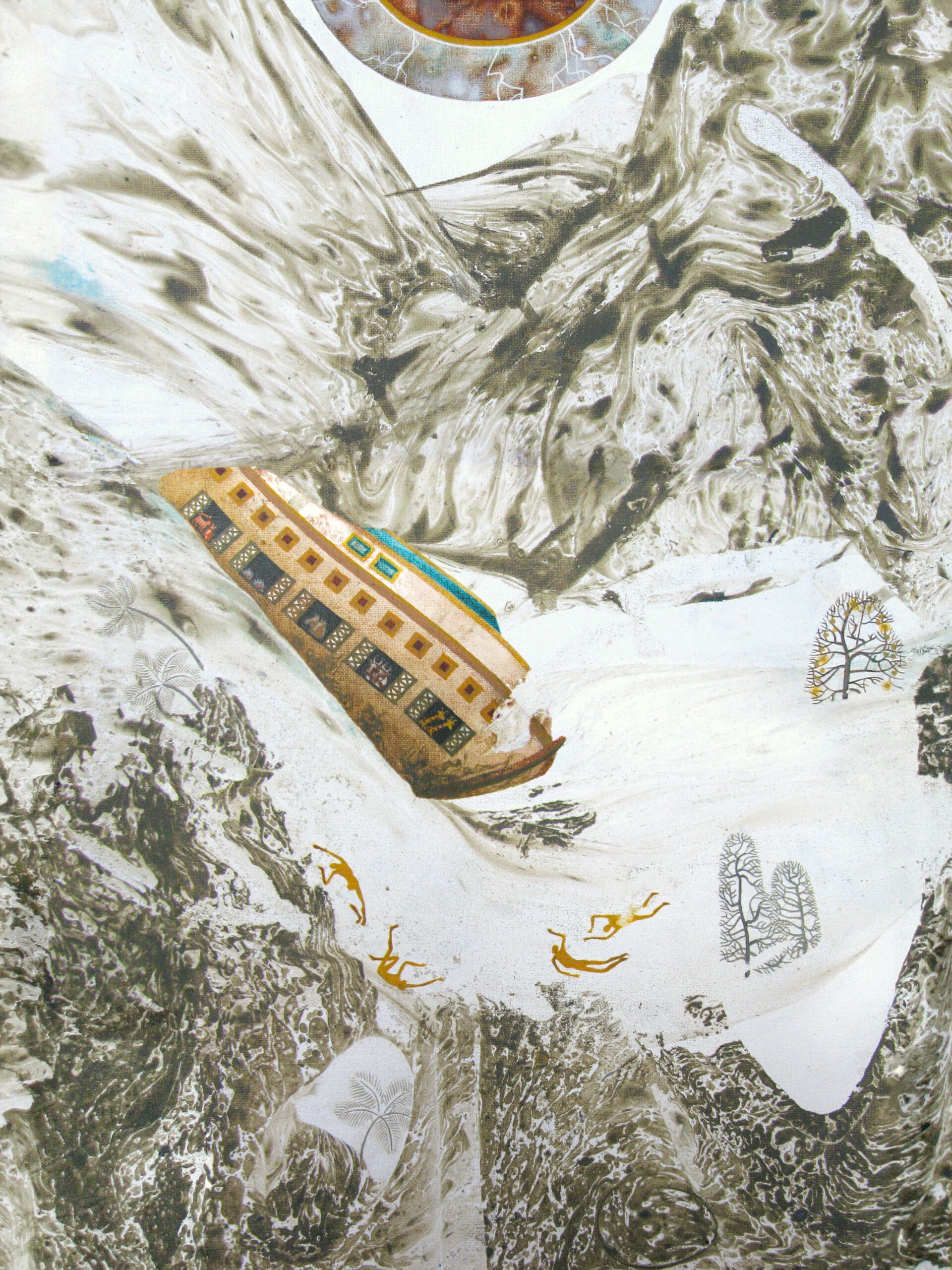
But maybe the Noah stories come by this forgetfulness honestly. There is, of course, an inkling of forgetfulness within the biblical account. I mentioned above that in Genesis 8:20–21 God says the most important part to himself. After Noah makes a sacrifice, God says in his heart, “I will never again curse the ground because of humankind, for the inclination of the human heart is evil from youth.” Noah and his family did not hear God say this, and I suspect they were worse off for it. A few verses later, the biblical text will clarify when God is speaking aloud to Noah and his family, but verse 21 seems to be God’s internal monologue, a moment of realization that God is having privately.
This makes me wonder: When Noah and his family came out of the ark—the backs of their arms brushing against the hide of a cow, their ankles scruffing the armour of an armadillo, their eyes bleary against the sun—did they think, We did it, and leave their worries to rot below the water’s surface? Or did they not want to think about what was below the water’s surface? Did thinking about the decaying bodies make them wonder who God was in the face of extinction? When I think about the decaying bodies, I wonder what it means to be human if we are, in fact, perpetually bent toward wickedness. Why bother going on to populate the earth if there’s no such thing as a fresh start? If we can’t manage our frailty? If we can’t outgrow our moral weakness? If this is as good as it gets?
Genesis 8:21 is usually where the children’s books end, with Noah making a sacrifice and God promising not to flood the earth again. But they omit the middle of verse 21 about the still-evil hearts of humanity. In so doing, the children’s books put us in the exact position of Noah and his family, unaware that so little has really changed for human beings. We left everyone behind, but less for them did not mean more for us. The boat became irrelevant the second we stepped off. The gopher wood will soon rot.
We are what we always were, and even if we have the luxury of insulating ourselves from this knowledge, God will remember it.
And yet there is another trajectory in the story. Genesis insists on memory. Even when we do not or cannot recall who we are, God’s knowledge is greater than ours: We cannot outrun our humanity. Not after new inventions—the world’s biggest boat—give rise to pride. Not after long quests—a months-long circumnavigation—confirm our bravery. Not even after narrow survival of environmental disaster—a flood, a change in climate—validates our anthropocentric ontology. We are what we always were, and even if we have the luxury of insulating ourselves from this knowledge, God will remember it. And so should we—you and I have the gift of Genesis 8:21, even if Noah and his family did not.
There’s a tension within the story, then, between the impulse to forget and the impulse to remember, as if the narrative itself cannot decide where to land the ark. Does it hold tight to the old world, or let it go and move forward? Noah may feel proud of himself when he disembarks, but the flood story ends in Genesis 9 with a satiric fall narrative: a family again in a kind of garden (call it a vineyard) with fruit (call it wine) that changes our capacity for knowledge, an uttered curse, nudity that must be covered, and a banishment.
To forget it is to loosen one’s grasp, in the old Germanic sense of the term—to un-get. To remember, then, is to grasp, and to be remembered is to be grasped, taken up by the hand.
I last heard the story of Noah’s ark read aloud—publicly remembered—at my church’s Easter Vigil. The Episcopal Church’s lectionary has its fair share of omissions in the flood-story reading, not unlike our children’s books. It, too, begins with Noah boarding the ark, excluding God’s decision to flood the earth and his grief over it. It, too, skims over the death of the world and elides God’s observation that humanity is still evil at its core.
Given the day, the omissions seemed particularly shameful to me. The Easter Vigil, of course, shares a few hours with Holy Saturday, the day Christ descended to the realm of the dead to rescue them and bring them into his resurrection. We refer to this event as the “harrowing of hell,” Christ’s great rescue—Christ’s great remembrance. Ancient art depicting this moment has certain genre conventions. Usually the dead are the Old Testament patriarchs—Adam, Abraham, David, Isaiah. Usually the hardware of the gates of hell is smashed at Christ’s feet, Christ’s might on full display. And usually Christ grasps the wrists of the patriarchs to pull them up out of hell, emphasizing the passivity of the dead and the agency of Christ. Their rescue is Christ’s victory alone, unearned and undeserved.
But the church has misremembered something important. It has forgotten that within the biblical canon, the harrowing of hell belongs to the narrative of the flood story. It is the flood story’s epilogue—its postscript, its soteriological resolution. There is not much in the Bible about the harrowing of hell. But 1 Peter is clear. When Christ descended into hell, 1 Peter 3:18–20 tells us, he descended to proclaim rescue to the victims of the Genesis flood:
The eschatological bent of the flood story is memory, for the memory of the Lord is long. In the end, the telos of the flood narrative outlasts even itself. It finds its conclusion a few thousand years later, long after the flood waters had receded and the deceased were seemingly forgotten—and precisely when the forgetting had seemed to be the point. God remembered them, and God remembered them in their specificity. They are still called disobedient, according to Peter. Their humanity was not erased in their death but taken up into the redemptive arc of the cosmos. God’s final act in the flood narrative is not promising to never flood the earth again. It is remembrance.
Not wanting to be human—or wanting to out-manoeuvre our humanity—imperils our salvation. This is why it is important to be “in Christ.” He saves us by remembering us, and so our being saved requires our joining him in his act of remembrance. And what do we need to remember, exactly? That this story about an ancient ark and storm is our truest self-narrative: We cannot save ourselves.