
I
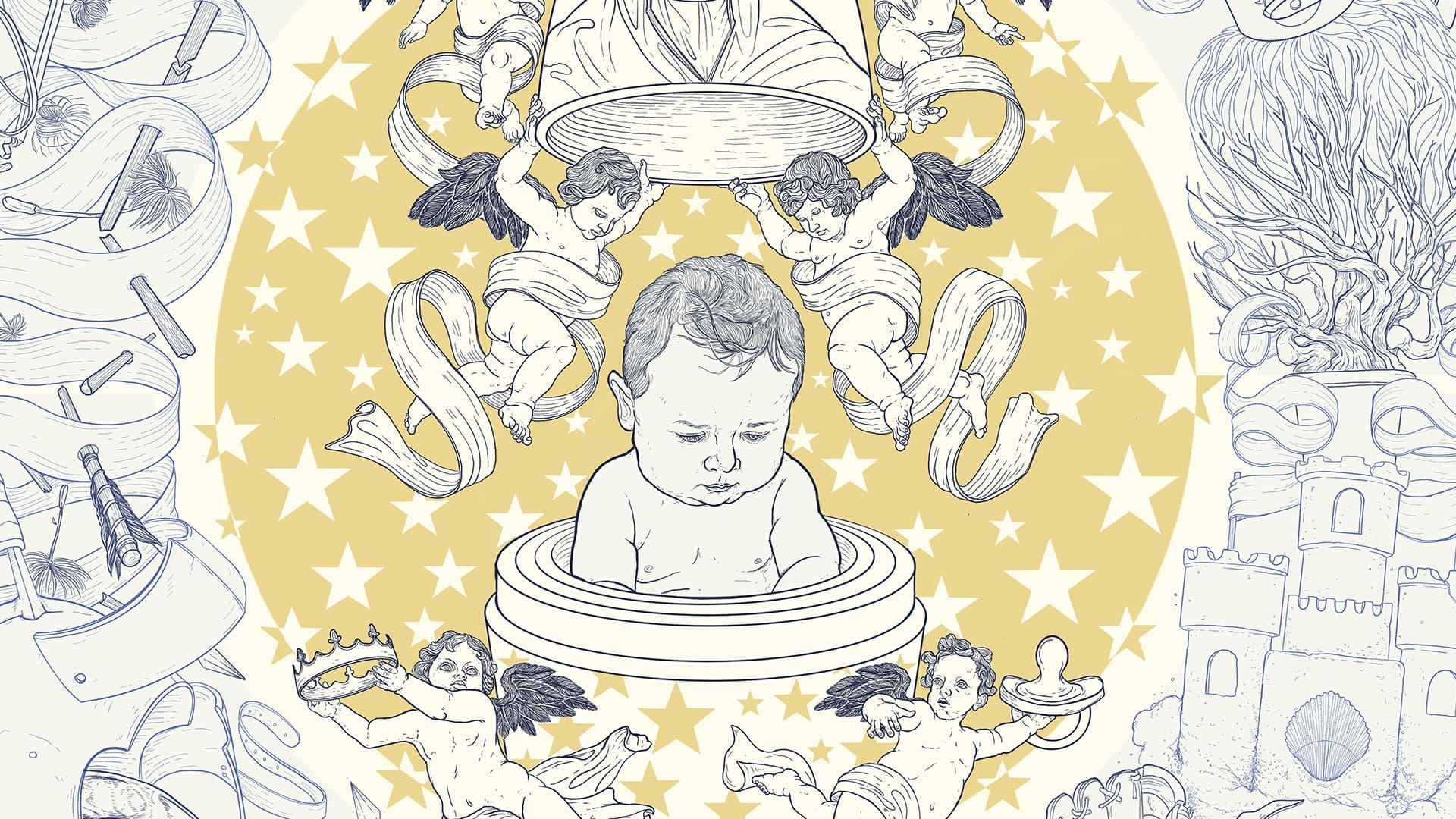
If you were to attend a typical state fair in the 1920s, chances are that alongside the rows of prize-winning turnips, apple pies, and Holsteins you would find a tent of babies and young children. They would invariably be white, scrubbed clean in their Sunday best, and trying to hold still as a nurse in a starched uniform measured their skulls and arm spans. Her job was to determine which squirming toddler was the best squirming toddler—which baby might be crowned the “most scientific baby.”
These “Better Babies” contests, which debuted in 1908 at the Louisiana State Fair and quickly spread across the country, began as an initiative to encourage child welfare, promoting the benefits of hygiene, nutrition, and routine medical care in a time of high infant mortality. There was, however, a darker side to these contests: They were deeply entangled with the country’s flourishing eugenics movement. The magazine Woman’s Home Companion, which sponsored many of the contests, stated in 1913, “Underneath the inviting charm of the idea is a serious scientific purpose—healthy babies, standardized babies, and always, year after year, Better Babies.” The blue-ribbon babies next to the stalls of blue-ribbon sheep and goats pointed unsubtly to the importance of breeding. The precise measurements and complicated point system attested with confidence to standards. Now that we understand the human, the thinking went, we can begin to perfect the human.
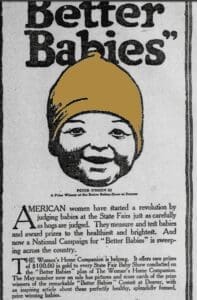
There is, of course, something a bit ridiculous to this whole scene: the “ideal” measurements for girls and boys at each month calculated down to the inch, the doctors with clipboards, the very concept of the most “scientific” baby. There is, too, something comical in the false confidence and the utter inadequacy of a score between one and a hundred to grab hold of even the smallest corner of the personhood of these babies—smiling and blinking and clutching at fingers—much less the personhood of all the babies not represented in those rosy, white rows.
And yet there is also something unsettlingly familiar, something so human in the attempt. We want a world we can measure. We want a world we can master.
Natality: What Being Born Teaches
Throughout her work, the political thinker Hannah Arendt returns continually to the concept of natality. While many philosophers have looked toward death to understand the ways in which mortality shapes the human experience, Arendt’s understanding of the human is instead rooted in the corresponding and no less strange phenomenon of new life—not the persistent human reality of ending but the equally stubborn reality of beginning, the reality that “with each birth something uniquely new comes into the world.”
As Jennifer Banks notes in her book Natality, Arendt’s understanding of birth is “entirely worldly and simultaneously miraculous.” It is the everyday extraordinary reality that each newcomer arrives as a new beginning—someone completely themselves and never seen before. Natality is the good news that “unto us a child is born.”
While epitomized in the image of a newborn baby, natality informs all of life. To be a student of human affairs, for Arendt, is to expect the unexpected. It is to leave open the possibility of the “infinitely improbable.” If death hangs over the human as the inevitable end to the story, then natality insists from beneath that nothing is really known. When we are dealing with the human, Arendt suggests, we are dealing with something that cannot be neatly grasped or predicted. Indeed, the figures Arendt turns to for making sense of reality are not those who carve it up with tidy theorems but figures like Socrates who, with his simple questioning, dissolves certainty into a mess of contradictions, reminding his interlocutors how little they understand of this strange world after all. The politics she looks to is one animated by differences of opinion and perspective that do not resolve into a neat unity.
And yet running alongside this human capacity for new beginnings is the human tendency to crave something far simpler than the uncertainties of natality. We long to retreat from opinion and finitude into the strength, certainty, and control of ideology.
Ideological thinking proposes a shortcut to understanding the world. It provides a simple key that makes sense of everything else, answering life’s riddles so all is clear and predictable. In this way, ideological thinking stands in sharp contrast to natality. Arendt writes, “Ideological thinking orders facts into an absolutely logical procedure which starts from an axiomatically accepted premise, deducing everything else from it; that is, it proceeds with a consistency that exists nowhere in the realm of reality.” The straightforward world of ideology, Arendt insists, is an illusion. Its consistency is a lie. And yet ideology’s falseness furnishes its great appeal. Mastery of the world is a myth, but we are drawn more by the escape from the world, from the “infinity” of its facts and figures.
The concept of the ideal human based on “objective” criteria is nonsensical. It flies in the face of a reality that resists such standardization at every turn. The true appeal, then, of the clipboards with their straightforward and scientific calculations of infant perfection is not that they can capture reality. Of course they cannot. The appeal is that they are safe from reality. The strange indignities and certain uncertainties of birth can no longer interfere.
Ideology: The Desire for Dehumanization
The eugenics movement in North America largely collapsed in the wake of World War II as news of Nazi atrocities began to come to light. Strikingly, what onlookers found in the wreckage of Nazi Germany was not the result of some new perverse ideology but instead something familiar taken with a new deadly seriousness. The implication of a culture that prized “better babies” was a merciless treatment of inevitably worse babies and worthless babies and babies unfit to live. The engine driving totalitarian regimes, writes Arendt, is the “coercive force of logicality”: “You can’t say A without saying B and C and so on, down to the end of the murderous alphabet.” When taken with such seriousness, the inhuman nature of the eugenic vision of human flourishing is laid bare. The attempt to “improve” the human is closer to a desperate escape from the human—a rejection of the unpredictable world of natality in favour of a uniform order.
The attempt to “improve” the human is closer to a desperate escape from the human—a rejection of the unpredictable world of natality in favour of a uniform order.
Such Nazi atrocities and even the overt racism of the Better Babies tent at the state fair can seem quite distant today. Yet the human impulse at their core is as present as ever.
On the one hand, new biotechnology start-ups like Orchid promote technologies that can screen embryos for a wide variety of genetic conditions from blindness to obesity. Emblazoned across Orchid’s website is the company’s simple message: “Have healthy babies.” To this end, prospective parents are offered a report detailing each embryo’s risk of developing autism, cancer, or even Alzheimer’s. Such screening, Orchid’s CEO Noor Siddiqui insists, will be the standard practice of the future as the algorithms to detect genetic risks become more and more successful. After all, who would want their child to suffer?
The vision Siddiqui articulates is one in which the experience of bringing a child into the world, an experience that “for all of history, has just been totally left to chance,” becomes more and more an experience of “confidence and control.” Indeed, a similar genetic screening company, Nucleus, suggests that their technology might be right for those who “want to avoid surprises in the future.”
Of course, these screening technologies, with their sky-high price tags and often dubious scientific claims, may themselves seem rather distant—the domain of the Silicon Valley elite. However, in the past twenty years more rudimentary genetic screening has already become part of standard prenatal care in much of the Western world, alerting expectant parents to risks of Down syndrome and other chromosomal abnormalities. While such information can be valuable, it is not always clear that this technology dedicated to detecting differences is conducive to welcoming differences. In Denmark, for example, more than 95 percent of parents confronted with a prenatal diagnosis of Down syndrome choose to terminate the pregnancy. Since standard genetic screening was introduced in 2004, only twenty-five to thirty-five Danish children have been born with Down syndrome each year.
In a strange way, this desire for control around birth is mirrored in our approaches to death. Since its legalization in 2016, Canada’s Medical Assistance in Dying (MAiD) program has proved unexpectedly successful, growing to be the fifth-leading cause of death in the country. In 2021 the program was expanded to include cases in which suffering may not lead to a “reasonably foreseeable” death. In 2027 the program is set to expand further to cover those whose suffering stems from mental illness. While miles away from Orchid’s smiling young couples starting their families, the flood of MAiD applications points to a similar anxiety—a turning away from the painful and unknown of the human, a retreat into the illusion of mastery.
At the same time, news reports are filled each day with stories of immigration crackdowns and deportations. Unsettled by a world beginning to feel unfamiliar, many seem to long for a nostalgic past of homogeneity, demanding national borders be secured against the stranger. In the United States, the Trump administration has promised to carry out “the largest deportation operation in the history of our country,” and as they attempt to make good on that promise, the stories that emerge are alarming—husbands separated from wives, mothers torn away from their children. The masked agents and midnight raids seem designed to communicate a simple message: You are not welcome here.
In tangible ways across the political spectrum, we find again and again the desire to get natality under control. We want to flee from the messiness of humanity. We want to screen the newcomer at the gate. Whether looking to the future or the past, so often our vision of human flourishing is a narrow one—a vision whose basic premise is a rejection of “all this,” a rejection of all surprises in our future.
It is here that the Christian humanist, perhaps, has something to say.
Unto Us a Child Is Born
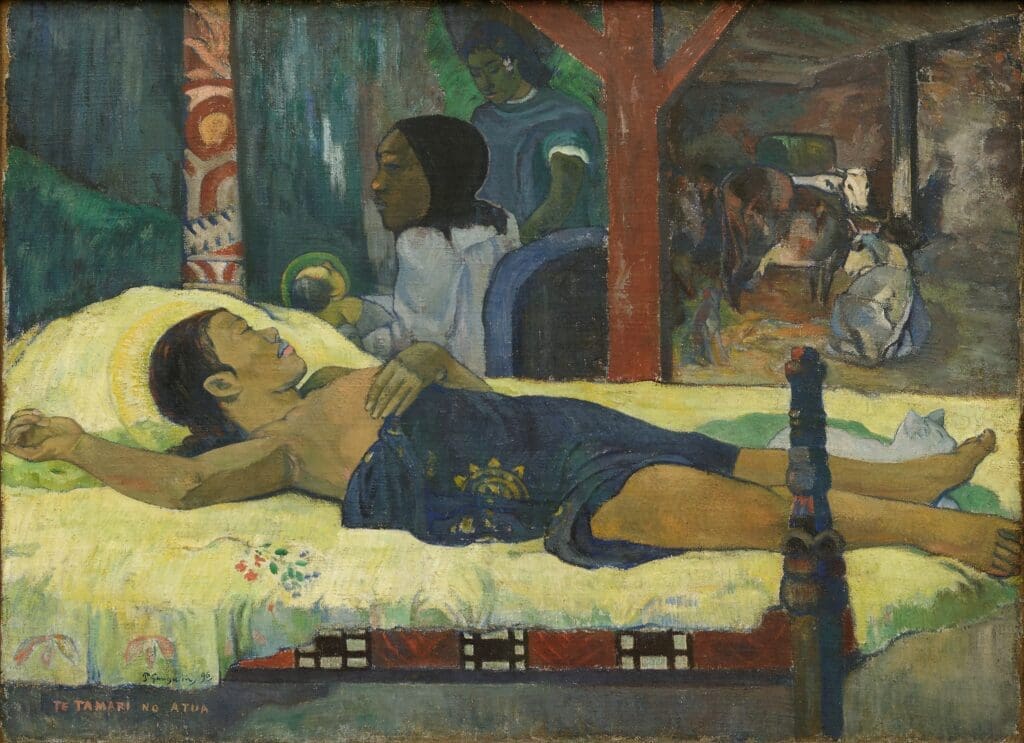
In Christ we glimpse humanity in all its fullness. And yet, in a strange way, there is a sense in which this revelation does not seem to answer our questions, or at least not in any satisfying way. When we turn to Christ as the measure of man, we do not find any measurements. We do not find criteria or a grading sheet. Instead, we find the son of Mary. His own certain height. His own certain laugh. His own childhood memories and childhood friends. His own rocky path through the world. In Christ, God does not just become human; he becomes this human. The strange, good news is that a child is born unto us, as distinct as any other.
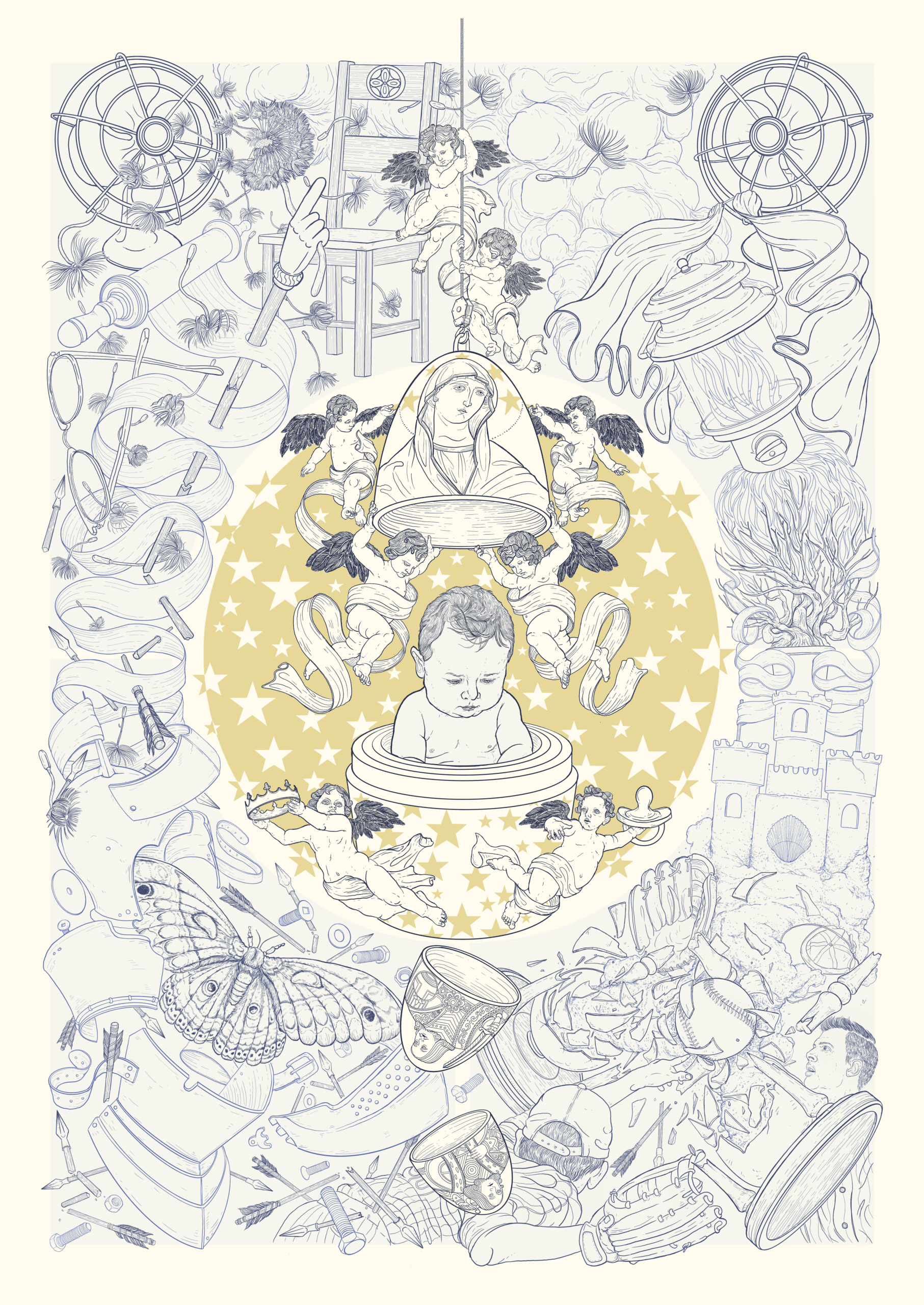
For God to become one of us is to become what Arendt would call a “who”—his own particular person. This concept feels intuitive, yet “who” we are is difficult to get a firm hold of; it resists our attempts to pin it down in language. Arendt writes in The Human Condition,
Who we are is not the facts of our biography, the lists of our accomplishments, or any simple ratio of a five-factor personality test. It is nothing we can polish or even consciously construct.
The Scottish theologian John Duns Scotus (ca. 1265–1308) used the term “haecceity” to capture a similar concept—a non-qualitative property of a substance that differentiates it as an individual. It is not a “whatness” but a “thisness.” For Scotus, there is a “common nature” of humanity. However, this common nature can only ever be found “contracted” by a haecceity. Humanity does exist, but never in the abstract. Always it is expressed in the individual. As Arendt writes, “Plurality is the condition of human action because we are all the same, that is, human, in such a way that nobody is ever the same as anyone else who ever lived, lives, or will live.”
Christ, in his distinctness, cannot serve as the simple “key” to reality that ideology craves. He does not relieve us from paying attention to the world but demands all the more firmly that we look again at each new face, that we turn back to the infinity of facts and figures. He does not so much simplify things as remind us of all the ways in which they cannot be simplified, all the ways in which a simplification would obscure what is most precious. As the poet Christian Wiman writes, “If nature abhors a vacuum, Christ abhors a vagueness. If God is love, Christ is love for this one person, this one place, this one time-bound and time-ravaged self.”
We see this theme again and again in Jesus’s parables. The shepherd leaves his flock of ninety-nine to go looking for the one sheep who is lost. “And when he has found it, he lays it on his shoulders and rejoices” (Luke 15:5). The woman with ten coins who loses one lights her lamp, sweeps the house, and searches until she finds it. And when she does, again there is celebration: “Rejoice with me, for I have found the coin that I had lost” (Luke 15:9).
The son squanders his father’s inheritance and returns home ashamed and beaten by the world. His father sees him “while he was still far off” and is filled with compassion, running to embrace him (Luke 15:20). The son is insistent that he does not deserve his father’s love, but the father is jubilant: “Quickly, bring out a robe—the best one—and put it on him; put a ring on his finger and sandals on his feet. And get the fatted calf and kill it, and let us eat and celebrate, for this son of mine was dead and is alive again; he was lost and is found!” (Luke 15:22–24).
On the one hand, the lost sheep of the parable can be me or you or anyone reading the story. That coin could be any sinner, and we can all see ourselves as the prodigal son. And yet what is so striking in each of these stories is precisely the specificity: not a sheep and a coin and a son, but my lost sheep, the coin that I had lost, and this son of mine.
To be a parent, perhaps, is an education in haecceity. It is a realization that happens all at once, in the instant you are handed a crying baby to bring to your chest: The perfect, blurry image of the child you imagined is replaced with this child, with your child, and there is no going back. But it is also a realization that happens in fits and starts as this child comes into focus day by day—this child who doesn’t sleep through the night, who is sick, who is quick to anger and quick to laugh. This child who doesn’t want to play baseball or read or go to college. The way she worries. The way he talks with his hands. All at once, and then slowly again and again, one realizes that this living, breathing individual is not a pale imitation of some imagined ideal. That generic perfect child could not hold a candle to this one who exists.
When we turn to Christ as the measure of man, we do not find any measurements.
To see our children in this way is not to hold illusions of their perfection. We still have hopes for them. We can be dismayed at their decisions. We suffer with their suffering. However, importantly, these hopes and frustrations are not (at least when we are at our best) the result of a comparison to some abstracted ideal child. We do not want a happy child. We want this child to be happy. The vision of flourishing we have for our children is a particular vision, not one in which the particular disappears into generic perfection. To be a parent is to recognize that the father in the parable who sees his son coming from a long way off, in that moment, feels not like a saint but like the luckiest man in the world.
There is a tendency in recent years, among people of all walks of life and political persuasions, toward despair. It is worth noting, however, that Arendt herself wrote in dark times. A Jewish German intellectual in the years before World War II, she experienced first-hand the horrors of the Holocaust. She came to America as a refugee, and much of her work is, at its core, an attempt to make sense of the world after something that should not have happened has happened. And yet, while it would be a far stretch to call Arendt’s work sunny or optimistic, there is always, running through her thought, a deep and stable undercurrent of hope, a stable undercurrent of amor mundi—love of the world.
To love the world, for Arendt, is not a gauzy act of denial with one’s head in the clouds and ears plugged to suffering. Nor is it a simple rejection of the world in favour of some potential utopia. To love the world is to love this world “as it is, with all the evil and suffering in it.” To love the world is to confront this world. It is to see this world. The great surprise of Arendt’s work is that to see this messy world is to see hope. For this hope is not dependent on a clear path forward. Instead, it is rooted in the very natality that thwarts such easy answers, the very natality that so many visions of the “human” seek to overcome.
In her novel Loved and Missed, Susie Boyt tells the story of Ruth, whose daughter, Eleanor, is addicted to drugs. When Eleanor has a daughter of her own, Lily, it is Ruth who raises her. It is not a feel-good story. Ruth is an unflinching narrator, and often her account is heartbreaking. And yet it is also a story of delight. Amid the bleakness, it is also a testament to the great joy of raising a child.
Near the beginning of the novel, Ruth is with her friends when one of them mentions having seen Eleanor on the street. The conversation is suddenly uncomfortable. The room feels oppressive. Her friends’ pity is unbearable. But then Ruth notes:
There is something so striking in the way this scene swings from the bleak to the glorious, from pity to envy. There is much reason to despair in the world. One need not look far to find stories of great human suffering and great human evil. And yet, even as we mourn, we must be careful that this despair is not rooted in a two-dimensional vision of a restored kingdom whose calculus has no way to account for how a bleary-eyed child stumbling into a lap might change everything. If the work of loving the world is also the work of seeing the world, then we may be surprised at what we find when we put our clipboards down and take seriously the reality that “God so loved the world” means that God so loved this world. And amid all the renewal we long for, this world will not be abandoned.