


I
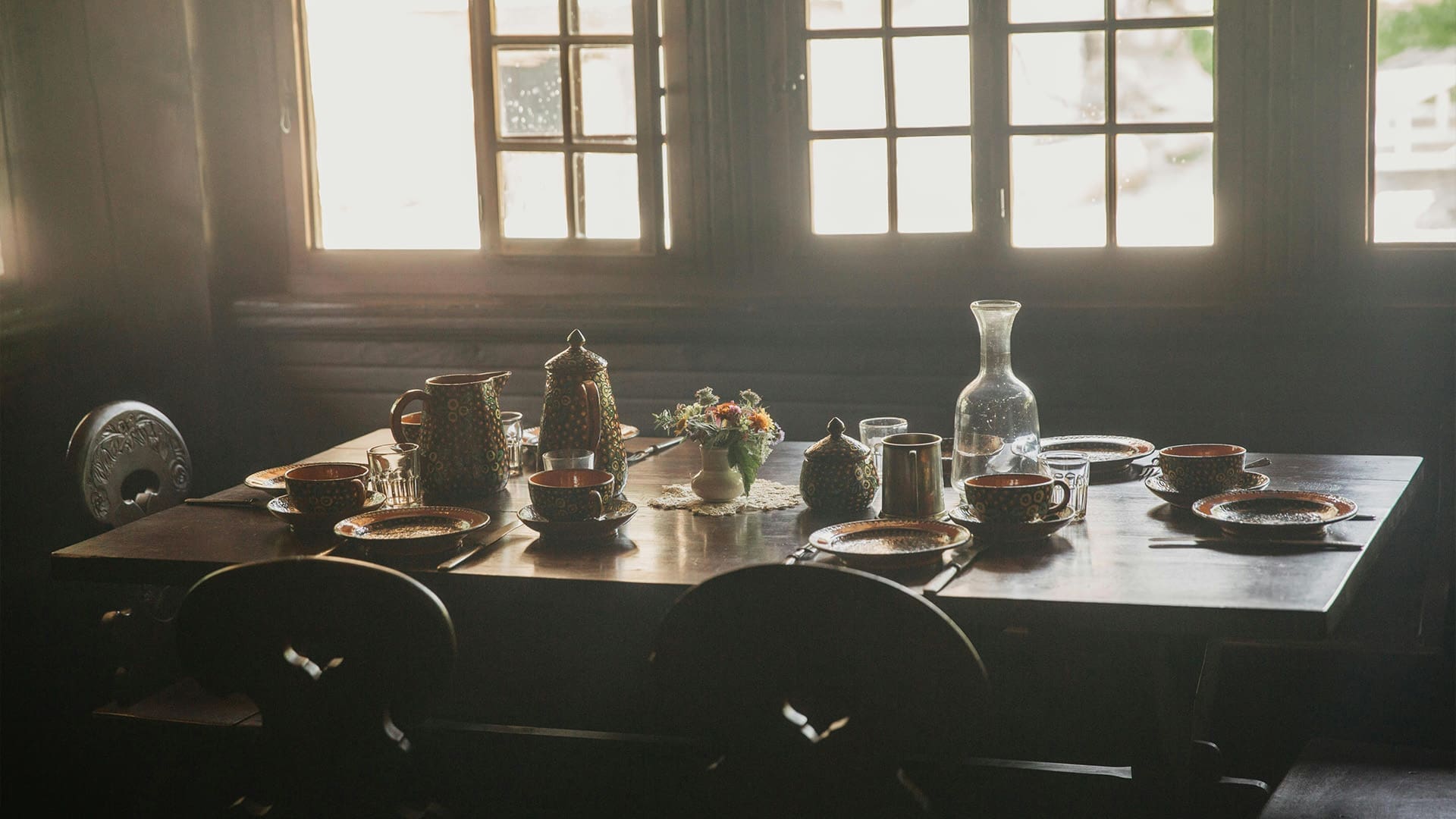
Imagine flipping over your dining table, handing children chalk and, later, a wet rag to wipe it clean. Flip it back over come mealtime for lentil stew, cuts of meat and cheeses, hearty slices of soda bread; for borscht, thick rye, red onion slivers beside a bowl of salt.
I like to imagine this used to happen: the meal served on one side, child’s play on the other. After all, medieval trestle tables were made to easily disassemble, families usually ate in shifts because tables were small, and separate game tables were common but expensive enough to exist only in public places and wealthier homes. Why wouldn’t ordinary families in need of play have used both sides of the wood? I hope that’s the true origin of “board game”—an afternoon snack of tic-tac-toe, a chamomile nightcap and guess this sketch.
I thought often of the word “borders” and the similar-sounding “board” in July 2023 when I joined my friend Anna to visit her country, Ukraine. Because Anna and I are neither heads of state nor military, we could not fly directly into the country during wartime, so we booked flights to and from Czechia, her sister’s adopted-by-marriage country. We then drove across Poland into Ukraine.
During our month-long stay in Lutsk, where some days war hides out of sight (though never out of mind), Anna’s sister, Zorjana, and her nephew, Daniel, visited from Czechia. We took them to Uno, a sunny downtown café. We sat in the big-windowed front room, near the coffee bar, pushing two circle tables together.
Above us, on a ledge, we spotted crayons and colouring pages. Eight-year-old Daniel snagged the copy of Batman. The three adults talked as we coloured in shapes, traded crayons, tasted each other’s drinks, and praised the syrnyky with simmered pears and caramel glaze, speckled in raspberry and almond crumbs.
Not Daniel, though. He forgot all else until he finished and held up Batman in mid-flight and looked down at my page—his American hero and my five petals and nesting bird. I’d been thinking of a photograph Anna had sent me in the early days of war, a mural of a dove. I understood his unspoken question, and we tried to converse across our language divide, another border to cross. “Квітка (Kvitka),” I said, “і птах (i ptakh).” Flower and bird. Then I pointed back at his: “Добре, Даніель (Dobre, Daniel).” Good. He tapped mine and said his favourite English word, “Super.”
What flipped in those moments wasn’t the table but each of us with bright crayons in hand. Daniel went first, from restlessness into concentrated play, and we followed, growing young again. As it’s said, a child shall lead them.
One night Daniel asked to go bowling. We rode the elevator up, above the movie theatre, to the bowling alley just beneath the rooftop restaurant. We occupied two of the six lanes, the only bowlers, our balls skating down the glossy carnauba-waxed plank. Between turns we sat at a narrow rectangle table, sharing pizza and sodas, swivelling in seats. At the end we assembled on the trophy steps, ranked by the pins we’d downed, and snapped a photograph: first, second, third, and picture-taker.
We didn’t flip tables at breakfast either, perched on bar stools at the kitchen counter, though some days we made videos after we’d finished rye and prosciutto sandwiches and cucumber slices or bowls of porridge. Anna would press record on her phone, and we’d talk to our future selves. Once we were here. Once we were this. Even the mention of this and I’m inside their kitchen again, washing dishes in the corner sink, looking out at the garden, speaking the few phrases I know to her mother, Lyuda: як cпалось, Люда (Yak spalos, Lyuda?). How did you sleep? дякую за сніданок (Dyakuyu za snidanok). Thank you for breakfast.
On our last night in Czechia, we went to Anna’s sister’s place once more before departing for the States. Outside beneath a crisp blue sky, we sat for Zorjana’s birthday dinner, the patio table spread with seafood pasta, bread, and wine. The kids sat at a smaller table in the grass near us. After the meal we came inside. Her husband left to drink with friends, saying with a laugh, “I think I’ve earned it.”
Zorjana put the kids to bed, and then we women sat at the kitchen table. “I made these for you,” Zorjana said, offering me a plate of homemade macarons. They were, as everything she did, immaculate, her care and precision and need to do well evidenced in each cookie: its outer crisp and inner softness, its pastel pink, its filling just sweet enough, as if it had come straight from a French patisserie. “They’re not perfect, but they will do.” Her eyes, watching, awaiting my response, her ears a tunnel rooting to the dearest, deep down place.
When we cross borders—places that remind us of divisions, separations—why is it that we find connection at tables, “at board,” as we once said? As I thought so often of borders, that little “a” in its variation, “boarder,” began to snag in me.
“Boarder” entered the common English vernacular in the sixteenth century, when the wealthy paid day labourers with a room and meals, the “board.” Soon, it also meant to pay for such necessities, and new names sprung up: “Boarders” rented rooms with meals included, and “boarding houses” bloomed from roadside to city, serving wayfarers and locals and even their horses. A friend reminds me that Norwegians call table bord and bread brød. While many languages have a variation of bord for table, few still use it, though some have kept a version of brød for bread (Norwegian and Danish, brød; Swedish, bröd; Dutch, brood; and German, brot).
When we cross borders—places that remind us of divisions, separations—why is it that we find connection at tables, “at board,” as we once said?
I hunt the word back further in time and find it surfaces earlier than the sixteenth century, in a Middle English copy of Genesis dating around 1250. Little miracle Isaac turns three, and Abraham throws a feast to celebrate and name him at the table—the birthday borde, the naming place.
In the seventh century, Caedmon, a cowherd and the earliest English poet, writes of Noah leading his wife to the ark-board (earce-bord), the place where she slept and ate those forty days. Given the before and after, she was, in a sense, renamed: ark wife, flood survivor, the original co-priestly blessing now marking her as newest matriarch. A new olive tree was already forming as she spun the sprig in her hand, despite water, water everywhere, despite its having swallowed up all she’d heretofore known. Perhaps she stood sunward on the larboard (bæc-bord), dreaming the large door unsealed and lowered onto dry ground, dreaming her husband saying, Descend, debark, and we will build an altar to the Lord.
Her skin hungered to touch soil and grass, bark and leaf—trees and earth being two things they didn’t pack, apart from saplings and so very many seeds.
These days, it isn’t an ark but a metal plank we walk, entering and exiting, seated atop cushions that float should there be water, though if all goes as we assume it will, we’ll glide through air, some thirty thousand feet over fields and oceans, highways and homes. The travel itself can be a strange portal, something Anna often feels, flying as she has between Europe and the States for university, where I met her, and then for graduate school.
When we board that transatlantic flight to Czechia, the gifts we carry are American treats, whiskey, and soaps, and the gifts we carry back are Ukrainian sweets and pottery, Carpathian wools. Lyuda once visited America, and when she flew home, she cradled seeds and clippings that later blossomed in her garden until her husband Vitalii, unseeing, mowed them down.
In Ukraine, over dried fish and nuts with the family and their red-headed friend Ira, I heard of salo, Eastern European salt-cured pork fat, crossing borders. Sometimes it was confiscated (“Those rich guards, a whole pound”), and sometimes it passed in a fold of wax (“Hid it in my purse and stood beside them while they opened every bag in the trunk”).
My memory carried other things home: ordinary speech in a language of songbirds, the church choir full throating in minor key, Anna and her three friends singing, Lyuda’s roses and strawberries, mountains, and soil so black and generous even a novice can tend saplings and receive wild, abundant harvest in return.
The kernel’s the same, though the spellings and meanings diverge: bord, borde, board. One bord bears a body; one bord offers bread. By it you are or can be fed: the body by meal, the spirit by meeting another. Your body already knows this. The eyes tack down to the plate, up to another’s face. The throat drinks water, swallows someone’s words. The tongue tastes; the mouth’s hollow shapes response.
At table, there’s a stillness and potency, so many seeds of what can be. Say time is the soil, and eyes, ears, and mouths the means of tending. The self we offer is a piled or empty platter.
Because I’d heard Anna fret over the particular meaningful word to say to a person on their birthday, or because we’d already had our last night in Ukraine and spent it speaking what we hoped for one another—victory, justice, and peace for Ukraine, Lyuda’s care for ailing parents, Vitalii’s work, our return to the States and our lives there, my work and Anna’s studies—something in me understood on our final night in Czechia that I was to bless these women.
At table, there’s a stillness and potency, so many seeds of what can be.
I began with Zorjana, a birthday blessing I hoped would stream into the dry valleys her eyes betrayed. I stumbled, unused to speaking such realizable words over another, but I went ahead anyway, and then to Lyuda, then Anna.
They in turn blessed me, showing me what blessings can be. A true seeing, specific enough that the watchman of your soul can notice the clouds shift in the distance. As if a door somewhere has opened and the air carries a faint smell of the welcome, longed-for guest who, just beyond the horizon, nears.
A bord by which you both enter and exit. A board that keeps you in and flood water out. One moment, a bord of laughter, game; the next, a feast and transformational naming. One day a board may carry you out of your own house, flat-backed, chest no longer rising. A board of life—on it you are fed—and a board of death, the place of last breath. Bords that, split, sawed, and sanded, become something else: door frame, ark, ceiling, floor, coffin, crucifix. All thresholds.
A mind splintered by what seems disparate learns its ignorance and admits the surprising convergences, often unwilling to be wholly explained: One bord bears a body that is also bread.
Every Sunday, I kneel for this bread that is also body. I set my elbows on the wooden rail that outlines a bord so broad we can only hint at, by this tiny, arced portion, a rail that knows no boundary of place or time. Here, all meanings converge: wood, plank, and table. Death and life. White wings fill my empty hands with an olive branch of bread and cup. The wafer dissolves on my tongue, the wine vineyards my mouth: a word I can only taste.
I have not earned this by labour, nor have I paid it. Someone called to me on the road: Come, a marriage, a feast, food and drink enough. I came, curious, a child wondering, wanting. I entered. The ceiling curved like an ark. Rain fell outside the windows, while inside our laughter threaded the air with stars and our songs trellised jasmine above us and laced gardenias along the walls.
These days, however many days of rain or war or bord it’s been, however many more to wait, I am inside dark soil, feeling a radiance warm me, call me into its largesse. My spine greens, and I stretch long, crowned and anointed with a new name. I am rising inside, like the seeds neighbouring me. We are given what our bodies can yet bear, love flooding in like dew and tempered light, like bread torn small enough for these weary, hungering mouths.
When I return to them two years later, in 2025, some things haven’t changed—aging parents, ebullient gardens, ingenuity in limitation, gifts passing every which way, cities abuzz as people defy Russian menace and persist in normalcy—despite constant tension and lack of sleep, the nights often splintered by sirens and sometimes missiles one can’t unfeel. Even as I cannot erase that they live in war and I in peace, I will arrive a guest to their table. I will arrive watchful for how the war’s longevity chronicles greater stress on them, but those are stories for another time.
Now’s the time to listen to Lyuda. Anna and I enter the back door again, and she hugs me like her own child and has every mind to tend us across the borders of bodies: “First you eat, then you sleep.” All three of us sit to borscht and bread, the abundant platters of ourselves together again, then disperse to rooms and lay down in that little death. Later, we rise to conversation, gift-giving, tea and cake. Some days, in the weeks ahead, I feel flood water rocking the hull. Other days, Lyuda’s laughter spins an olive sprig.
Board by board by board, we gather to play, to pray, to eat, to speak, to seed and sprout, reaching and being reached. By it, until that death that is now no more than a door, we live and live.

