


F
For fundamentalists in the early twentieth century, being involved in Christian work likely meant being a missionary, an evangelist, or a pastor. While those who did not serve in those areas could still take part in a “higher calling” through soul saving, their everyday work was either subordinated to that end or instrumentalized for the sake of spiritual discipline. It was a period characterized by a “new clericalism” that tended to reduce Christian work to “the ministry.” This background explains why evangelicals have been so eager to hear that their work “matters” to God.
A century later, the Sunday gathering still elevates certain spiritual roles over other forms of work. Meanwhile, the Monday economy of advanced capitalism pressures believers to compartmentalize their faith. Yet evangelicals have good reason to resist the separation of their work and religious lives, given their inherited legacy of whole-life faith commitment. As a result, there has been an “unprecedented explosion” of initiatives to overcome the Sunday-Monday divide. At least one new evangelical faith-and-work organization has been launched every year for the past two decades.
Andrew Lynn’s new book, Saving the Protestant Ethic: Creative Class Evangelicalism and the Crisis of Work, is the definitive sociological account of the evangelical faith-and-work movement in America. He tells the story of how evangelicals sought to overcome the sense of “alienation” brought on by the Sunday-Monday divide. Lynn provides a wide-ranging overview of the movement enriched by vivid accounts of faith-and-work events and in-depth interviews with evangelical leaders. Throughout the book he offers a sophisticated critical analysis guided by a keen moral sense.
Lynn’s study complements David Miller’s 2006 book, God at Work: The History and Promise of the Faith at Work Movement, which traces a similar history but from a broader ecumenical perspective that includes Catholics and mainline Protestants. Miller claims that the integration of faith and work is “a good thing,” arguing that it carries the potential to enrich workers, institutions, and the broader society. He also observes that evangelicals show a consistently higher level of faith-work integration than other religious groups. Lynn picks up on Miller’s research, skillfully narrating how “integration” came to be the leading ideal for evangelicals, while incisively questioning its limits.
For evangelicals, the path toward faith-work integration involved overcoming the fundamentalist work ethic. They had to broaden the understanding of Christian work beyond the narrower focus indicated by the title of a late nineteenth-century sermon, “Soul-Saving Our One Business.” As evangelicals began to occupy leadership positions in other kinds of business during the twentieth century, they constructed an ethic better suited to their working realities. The shift toward seeing all work as mattering to God accelerated not primarily through the influence of religious leaders but through the contributions of successful businesspeople from revivalist and fundamentalist backgrounds, such as Henry Parsons Crowell and R.G. LeTourneau.
From the late twentieth century onward, evangelical faith-and-work leaders have spoken less about culture wars and more about “cultural stewardship.” The shift toward stewardship is motivated in part by evangelicals’ upward social trajectory. This is not surprising given the apparent alignment between evangelical expressions of faith and the individualist, therapeutic, and pragmatic values of capitalism. Many evangelicals now hold professional, knowledge-economy jobs—the “creative class” of the book’s subtitle. These “high-demand,” “identity-intensive” careers tend to weaken workers’ involvement in other social institutions, including the church.
In Lynn’s terms, movement leaders have drawn people from a faith that subordinates work to other ends, such as evangelism or contemplative piety, to a faith that sacralizes work, casting it in conventionally religious terms. But while elite evangelicals have succeeded in finding religious significance in the workplace, in doing so they may have forfeited the ability to subvert given economic arrangements. While they can be committed to standards of excellence within a work environment, they seem to lack external moral leverage. This is the cost of integration.
Movement leaders have drawn people from a faith that subordinates work to other ends, such as evangelism or contemplative piety, to a faith that sacralizes work, casting it in conventionally religious terms.
Although the attempt to sacralize work has been dominant in recent years, the faith-and-work movement is not monolithic. Lynn provides a taxonomy of four “remedial” theologies that address evangelicals’ sense of alienation between faith and work. These theologies are represented by re-commissioners, who see the workplace primarily as a site for evangelism; re-sacralizers, who valorize successful marketplace practices and leaders; re-integrators, who seek wholeness as they carry out work seen to have intrinsic meaning before God; and re-embedders, who seek to reorient their work in light of external faith commitments. In a revealing aside, Lynn identifies re-integrators with a “Lutheran” spiritual egalitarianism and realism regarding social orders, in contrast to re-embedders’ more “Calvinist” approach to societal reform.
How do these expressions of the evangelical work ethic perform? Lynn offers several nuanced critical observations, of which I will highlight three. First, he questions the “subjectivist” tendency in evangelical theologies of work. Many faith-and-work resources encourage people to do whatever work they do “diligently, faithfully, wholeheartedly, reverently, etc.” Movement leader Amy Sherman criticizes this as an “adverbial” approach to work. Lynn observes, “Faith and work theology can then transform a bad job into a ‘good’ job—a job that matters to God—without altering the conditions of that work whatsoever.” Such reasoning was historically used to justify work performed under the conditions of slavery. Lynn pointedly asks what forms of exploitation it overlooks today.
Second, Lynn challenges evangelicals’ neglect of how social structures affect workers differently. The faith-and-work movement’s message, informed by its spiritual egalitarianism, is that “we all are toiling and labouring.” This sounds like solidarity, but it may instead reveal naïveté about the ways that political economies function. The movement is generally led by workers with high levels of autonomy, and declarations of solidarity tend to discount the way that social structures limit “the basic experiences of opportunity and moral agency” of others.
Third, evangelical theologies of work can serve to legitimate, even sacralize, economic structures. “To frame a CEO’s ‘Monday world’ of preparing for quarterly earnings call as part of his or her sacred calling,” Lynn writes, “indirectly consecrates the functions and operations of the respective firm, and likely the structures of corporate capitalism more broadly.” This has knock-on effects for people at all levels. That same executive’s decisions can adversely affect warehouse workers whose “vocation” is overseen by algorithmic control and surveillance. But so it has been ordained.
Lynn’s astute observations about the faith-and-work movement point to several ways in which it can develop in the years ahead. He provides revealing data on patterns of under-representation in the movement, from women and people of colour to trade and service workers. In so doing, he invites leaders to follow through on their claim that all work matters to God. He also suggests that remedial attention to working conditions, not only the subjective experience of work, is of divine concern.
I agree that it is important to differentiate and expand the movement’s understanding of the work “we” do, as well as to think more critically about the role of economic systems. Still, I would argue for selectivity. At times Lynn seems to expect the movement to speak to everything at once. He acknowledges the “radical inclusiveness” of the faith-and-work movement by recounting the story of a dishwasher who was deeply moved to hear his work affirmed as significant to God. Yet instead of letting that success stand, Lynn swiftly notes that the use of “Monday” as a shorthand implies that work is formal, paid labour, which “subtly demotes care work, parenting, and volunteering,” among other unremunerated activities.
But why should the movement not focus on formal, paid labour? As Lynn notes, faith-and-work leaders are already engaged in a two-front battle against pressures, from both church and workplace, that would relegate faith to the household and perhaps community service. It is reasonable, as a tactical decision at least, not to expand the definition of work to every purposeful expenditure of energy. More significantly, defining parenting or volunteering as commensurate forms of “work” can encourage the market’s tendency to overtake moral norms unique to such roles.
Besides, scholars know well how to apply their own principles of selection. Lynn’s study focuses on white Protestants, not black Protestants; it deals with conservative evangelicals, not progressive evangelicals; he primarily interviews thought leaders or movement “elites,” not the workers who use their resources. These understandable choices are largely matters of scholarly discipline and effectiveness, not judgments on the status of groups outside his analysis.
Even so, I would question some of Lynn’s descriptive choices. At key moments he brackets out groups who would complicate his characterization of white evangelicalism as “fundamentally subjectivist and personal.” For example, he deals with progressive white evangelicals on two pages only, mainly as targets of the corporate right. Lynn omits their work in part because they produce little on “work, purpose, and meaningful callings,” which makes for a mismatch with much faith-and-work literature. Yet these leaders are seeking to subvert status quo market arrangements, which is a key criterion for Lynn’s criticism of the evangelicals considered in the study. Is he simply defining the evangelicals who address the problem out of his subject group?
More consequentially, Lynn’s framing of the “communitarian evangelicals”—a label he applies given their invocation of “the common good”—effectively sidelines their contribution. Lynn lists six representative books, three of which are the most frequently cited in the movement, including Every Good Endeavor by Timothy Keller with Katherine Leary Alsdorf. He also highlights the work of Amy Sherman, who had the busiest travel schedule of any leader he interviewed. Nevertheless, they are featured in the book’s final chapter, titled “On Roads Not (Yet) Taken,” alongside dubious initiatives such as dominionism and the prosperity gospel. Although Lynn is appreciative of their contribution, such placement reads as a subtle demotion.
How, in Lynn’s view, can the evangelical work ethic be “saved”? His best hope for the movement is a recovery of ecclesial identity and purpose, with a view to new forms of solidarity with workers. It is through involvement in a church that is “set apart” from contemporary markets that workers can better bring their Christian moral commitments to bear on their workplaces. To that end, Lynn suggests that evangelicals recover the wider history of American Protestant Christianity, from the Puritans, who did not take labour as the “chiefest good,” to the Free Methodists, who supported workers’ movements. His recommendation will resonate with those who follow the revitalization of ecclesial ethics in the work of Stanley Hauerwas. Indeed, he features “sectarian separatists” such as Anabaptists and Quakers in his section on possible future directions for the movement.
How has the church fared at addressing workplace issues to date? Here it is helpful to recall David Miller’s assessment of church- and seminary-based commentary on economic policy. In Miller’s account, ecclesial groups have often presumed the righteousness of certain courses of action: consumer boycotts, institutional divestment, government intervention. Given the influence of liberation theology, they tend to be animated by what Miller calls a “preferential hostility for the corporate world.” He also points out that Catholics and mainline Protestants tend not to speak much about individual purpose or responsibility in the workplace. These are some of the reasons why the evangelical faith-and-work movement proved necessary in the first place. So if the movement is to return to the church, something has got to give.
However, must the primary reference point for the faith-and-work movement be religious? From the outset, Lynn defines the movement as an effort “to ennoble and sacralize work, imbuing it with the same religious significance as conventional religious activity.” Admittedly, the movement often draws on religious imagery, such as when it depicts all workers as “priests.” But if conventional religious activity is the benchmark, then in my view the faith-and-work movement is selling itself short. The faith-and-work movement can do far more than approximate religious practice or function as a “parachurch” entity. We are dealing with a social movement in its own right, with unique opportunities for public engagement.
One of the defining characteristics of the faith-and-work movement is that it respects professional expertise and placement. If a marketplace leader wants to ethically press a given economic arrangement, they would likely be more effective by addressing their peers at work, rather than making the point on the movement’s speaker circuit. Evangelicals who are inspired by the movement may address larger economic issues by publishing in their professional journals, or in a newspaper op-ed. And of course the outcomes of the movement go beyond conference organizing, speaking, and publishing. There are evangelicals whose faith leads them to start a social enterprise, or to implement a variation of stakeholder capitalism. Such initiatives are beyond the bounds of Lynn’s methodology, which is justifiably selective. But I hope that future studies will complement Lynn’s project with new angles on the movement’s effectiveness.
Although I differ on some points, I highly recommend Andrew Lynn’s work. Saving the Protestant Ethic is a first-rate study that will be essential reading for movement leaders and participants. It also serves as an enlightening resource for all who want to better understand America’s largest religious constituency.
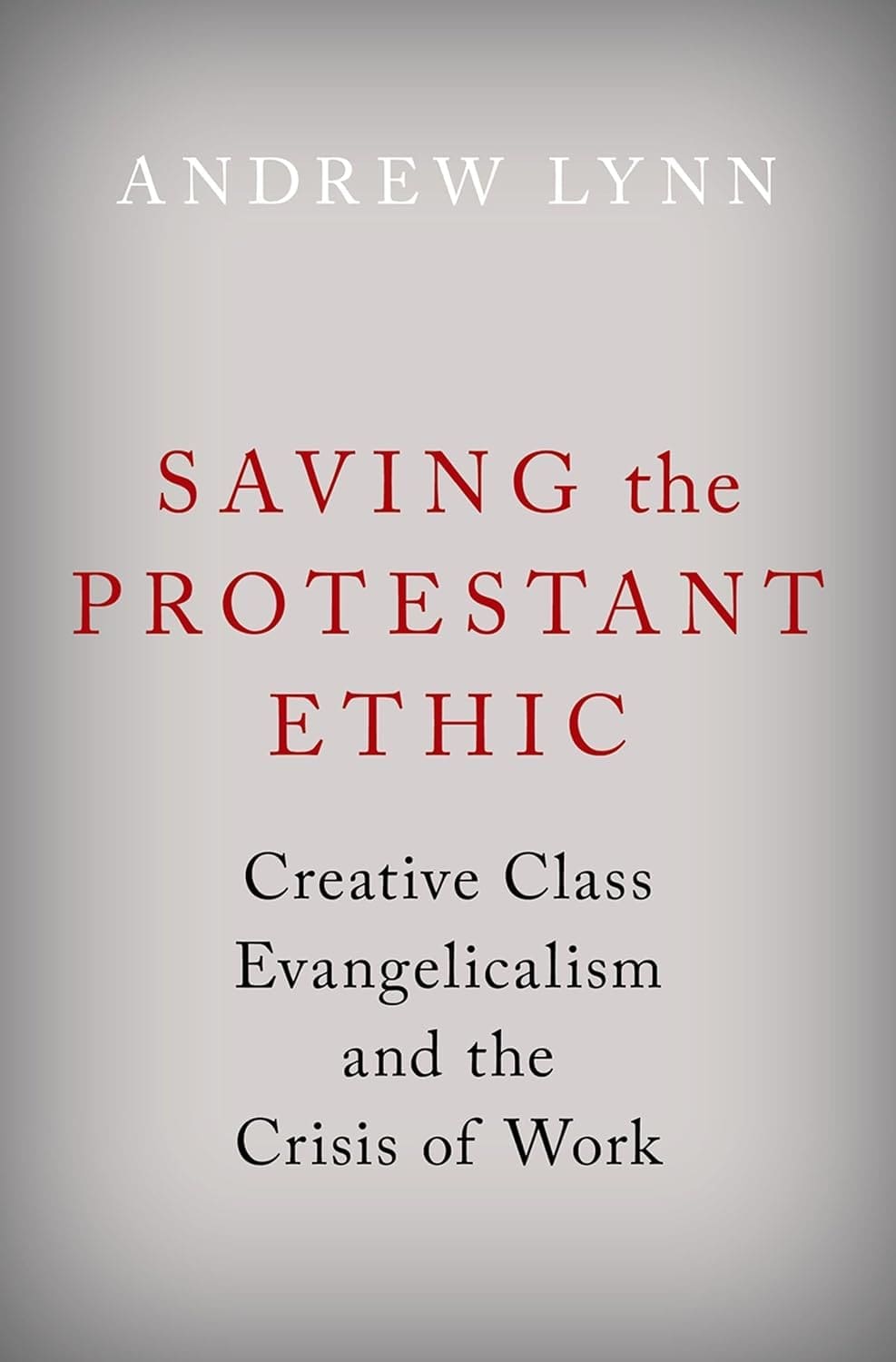
Saving the Protestant Ethic: Creative Class Evangelicalism and the Crisis of Work. Oxford University Press, 2023. 360 pp.