
T
To get my son out of bed for his 5:30 a.m. hockey games in our bleak Canadian midwinter, I have shamelessly resorted to bribery. I make no claims of being a model parent (obviously), but I have gleaned enough wisdom to know that while bribing is no precedent-setting ideal, sometimes a little Machiavellian realism goes a long way. A shrewd parent, like a shrewd prince, knows when to use the proverbial stick and when the carrot.
On this particular morning, the carrot was a Krispy Kreme doughnut. “We’re only getting two original glazed,” I told him, feeling my Protestant ancestors frowning upon such frivolous decadence. We rolled into a drive-through lined with flashy advertisements that corralled our wandering hearts. “Some Cravings Don’t Wait,” one absolved. Another: “Wholesome Goodness Your Whole Family Can Enjoy!” Ugh. My wife and three other children, who were by now just getting out of bed, would likely want their share of this wholesome goodness. So I bought six.
As our minivan traversed the windswept parking lot back to the main road, my son and I did not hesitate to devour our share. “These are a glimpse of the new earth,” I told my son in post–deep-fried-doughnut ecstasy. He rolled his eyes, as he tends to when I slide into my hyperbolic hermeneutic professor mode. Then we glanced down at the four remaining doughnuts. They were good for food and pleasing to the eye. The whole family had not braved this hellishly cold and dark morning, had they? I am not proud of what happened next. Some cravings don’t wait. We each ate one more. They were delicious.
As my grandfather used to say, “In for a penny, in for a pound.” We couldn’t very well go home with only two doughnuts for four people. So we devoured the remaining evidence. But what had mere moments ago brought such intense pleasure now made us feel sick to our stomachs. In under five minutes, we had each consumed over six hundred calories, thirty grams of sugar, and thirty grams of fat. Our nausea was the natural thunderclap to our lightning-bolt consumption. But the nausea went a little deeper too: I knew I had not controlled myself. Something, it seemed, had taken control of me.
Oh, the Humanities!
My dalliance with the doughnuts reminds me of the plight of Odysseus. Sorry, there is that hyperbolic hermeneutic mode again. I should explain. For my day job, I teach a series of courses that introduce university students to some of the most enduring books of the Western tradition. We begin with the Greek epic the Odyssey, transcribed into written verse at some point in the eighth century BC. These “core” courses are descendants of the studia humanitatis, the Renaissance recovery project of a classically inflected program of study designed to form civically and morally minded adults. Such courses immerse young men and women in philosophy, theology, history, and other works of humane letters that are intended to shed ancient light on the present moment. What some of that light illuminates is the perennial tension humans have always felt between our seemingly insatiable appetites—for food and drink, sex and fellowship, shelter and protection—and our abiding happiness. The ancients examined how these very human needs and desires might be restrained or liberated, directed or inhibited, snuffed out or kindled in order to bring peace and order and rest to the body and the body politic.
Unlike some commentators who argue the Greek heroes never change, I’ve always found readings like Daniel Mendelsohn’s An Odyssey: A Father, a Son, and an Epic to be more compelling. Such readings recognize that for Odysseus to restore peace to Ithaca, he will undergo a painful purgation of certain habits—particularly those around self-control—born from ten long years of war. A warrior could survive such a long campaign only by plundering and pillaging surrounding homes and towns. This was necessary and even encouraged; Spartans famously learned how to steal in their military training. Pillage and plunder thus pervade the Odyssey. In fact, while Odysseus has been at war and then lost at sea, his city-state (or polis) of Ithaca is being ransacked by a group of lawless young suitors who consume the absent king’s food and wine with reckless abandon. Such behaviour is an awful reality of almost all wars, even those happening today.
The Ithacans long for a justice that can be realized only when the rightful king returns home. Yet when we finally get to Odysseus in the winding narrative, he is as far from his proper identity as possible. He is both stranger and slave, though it might not seem like this on the surface. He is stranded on the island of the beautiful nymph Calypso, a place where he has everything his mortal body could desire: food and wine in abundance by day and a beautiful woman who always wants him by night. To live like this would be to live like a god, at least a Greek one. Self-control would never be necessary, because presumably every desired object would be at hand. Yet given the chance, Odysseus restrains his bodily appetites (“Not soon enough!” most of my female students are quick to point out), is freed from his bondage through divine intervention, and sets sail for home. Because we are dropped into the action in medias res, we understand how significant this moment of denial is only when we understand the kind of man Odysseus was before.
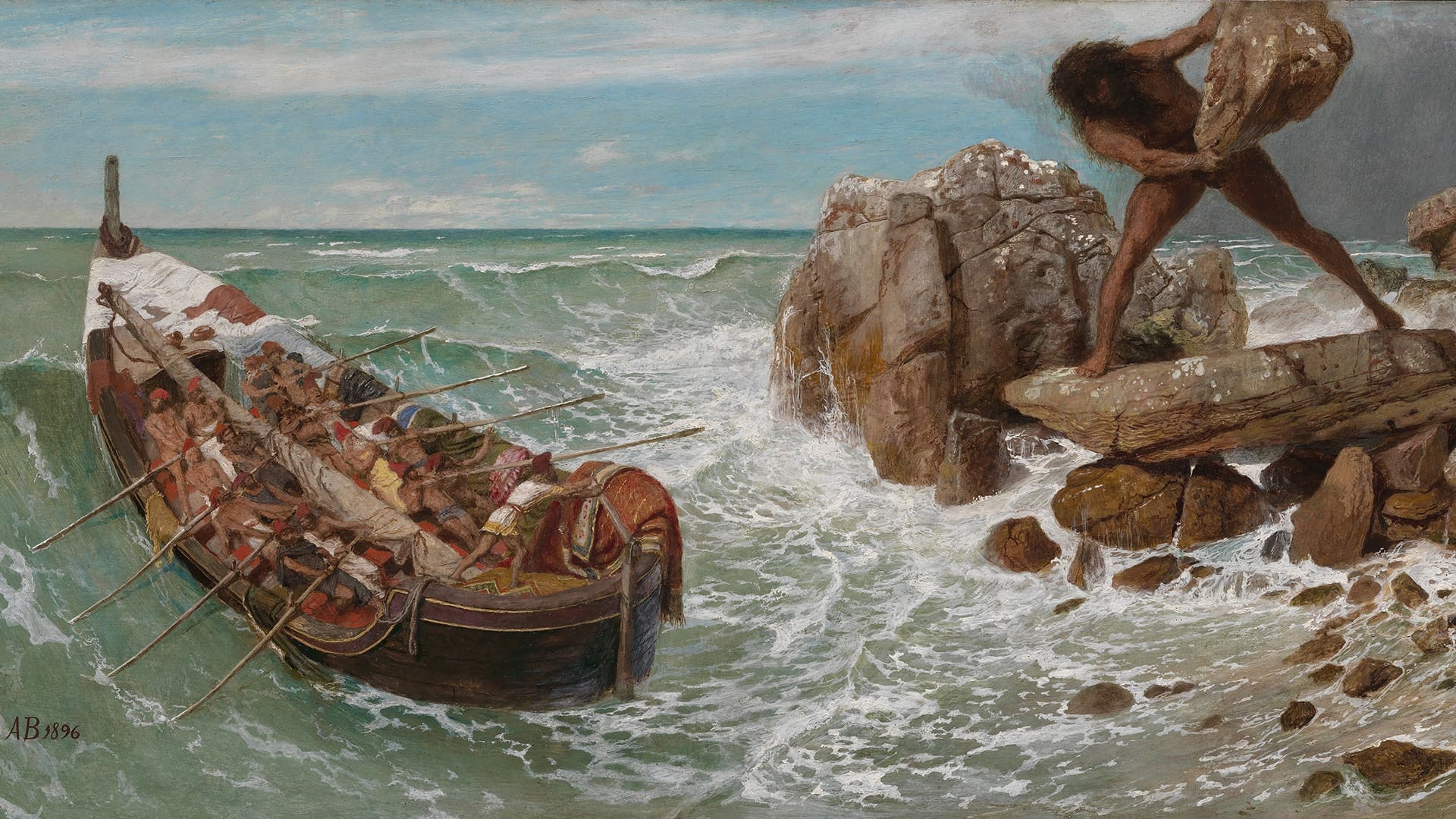
Which is why the poet circles back. When Odysseus later gets a chance to recount his adventures since the Trojan War , we learn that he and his men encountered the cyclops Polyphemus on an island in the Aegean. This son of Poseidon is a “man mountain” with one large eye in the centre of his forehead, a monstrous giant but also humanish in his blindered rationalism. He is a “grim loner” who lives in defiance of the gods and in seclusion from others, and he is terrifyingly strong and terrifyingly violent.
It might be easy to read Polyphemus as an evil foil to our virtuous epic hero. But we must pay closer attention to what the Greeks believed made a monster. When Odysseus and his men first explore the island, Polyphemus is not home. Starving, the men enter the cyclops’s cave and find food in abundance, with cheeses, meats, and milk all carefully packed away. These are clear signs of cultivated, civilized, ordered life. No sooner have the Greek warriors laid eyes on this food than they take it. The attentive Greek listener would have known they were breaking every social custom (or nomos) of hospitality and guest-rite expected in a time of peace. The barbarism starts with Odysseus.
What did we expect? Odysseus and his men are acting out of soldierly instinct. Ten years of plundering has rendered it their way of life. And in plundering the cyclops while he is away from home, Odysseus unwittingly acts just like the lawless young men destroying his own home while he is away. Before we discover the extreme lawlessness of the cyclops (more on that in a moment), we are confronted with the self-justifying, muted first forms that lawlessness always takes in its beginning. A bond exists between Odysseus and the cyclops; their differences are matters of degree, not kind. Humans become monstrous through their blindered perception, their moral myopia.
When the cyclops returns home and sees he has been robbed, he is furious. He traps the men in his lightless cave, and all forms of cultivated life give way to the most savage reckoning. Polyphemus murders and eats some of the men, bashing them violently on the rocks until brain and muscle splatter the ground. The consuming guests are consumed. The cyclops embodies Odysseus’s lack of self-control to the extreme. He chases his meal of cannibalized guests with so much wine that he becomes drunk, violently throwing up engorged human flesh all over his cave. He loses consciousness—literally going out of his mind—and falls into his own filth. The details are intended to be horrifying and stomach-churning. Reading this scene aloud almost always induces a participatory nausea for my students. We viscerally experience Polyphemus as an antitype: He is autonomos, a self-lawed, self-normed creature. He curses the gods just as he tries to live like one, and our last image of him is as a blind, frothing animal.
Given enough time, Odysseus and his men will become like the cyclops—they very well may be on that path already by defying the nomos and making their appetites their masters. Even if they believe they are self-lawed creatures, the consequences of their actions, both individually and communally, almost always suggest otherwise. The remainder of Odysseus’s journey home will be filled with multiple trials that put their self-control to the test. From Circe’s poisoned feast to the Sirens’ song to the final trial of restraining their desire for eating the cattle of Helios—which Odysseus passes while his men fail—Odysseus must learn time and again to restrain his appetites and thus submit to the will of the gods. It is only after he has been humiliated and broken in his wanderings, having failed in his command, with all his men dead or departed, that he chooses to leave the alienated slavery and godlike indulgence Calypso offers. He returns to his true home to live like a true man.
Conditioned to Consume
The classics can only get us so far. At least, German sociologist Hartmut Rosa thinks so. Pushing back against universalizing claims about what it means to be human, he argues in The Uncontrollability of the World that “the way we are related to the world is not determined simply by the fact of our being human, but depends on the social and cultural conditions into which we have been socialized.” We might, like the Homeric poet, want the muses to “sing for our time too,” but their voices are parochial. Humanism at its abstracting worst tends to gloss over the idiosyncratic trees for the generic forest. Where and when you are matter for the type of human you become or aspire to. Your context conditions how you relate to your world. Odysseus, even though he’s framed as an everyman, is conditioned by the Trojan War and broader Greek customs, his social class, and Greek gender expectations. His specific culture forms the habits that become his character. We might learn from Odysseus, but the best humanities students know that the past and present only rhyme. They never repeat.
What amount would ever be enough to face the irreducible uncontrollability of this world?
All this to say: My consumption of too many doughnuts is not the same as Odysseus’s consumption of the cyclops’s cheeses. Self-control in each context must be cultivated within differing conditions. Rosa is especially helpful here, arguing that one of the defining features of our modern world is an accepted acceleration of consumption as a necessary way of individual and social life. “A modern society,” he writes, “is one that can stabilize itself only dynamically,” requiring “constant economic growth, technological acceleration, and cultural innovation.” In the modern world, we are encouraged implicitly and explicitly toward more and more consumption as a way of life. While communities of austerity and thrift still exist, the social imaginary in the West is largely guided by the assumption that shopping will lead to a peaceful, ordered, happy life. Recall President George W. Bush’s famous post-9/11 speech urging Americans to shop and visit Disney World as the most appropriate reaction to the ideological hate of terrorism. Much has changed in our social and political landscape since 2001, but this has not.
A culture that normalizes the acceleration of consumption eradicates the time and space between almost any felt desire and its fulfillment. If you’re not consuming, the economy is not growing. If the GDP is going down, instability ensues and our individual and collective well-being plummets. But there is more complexity in Rosa’s accounting than mere consumerism. The “will to escalation,” he argues, is not solely motivated by a lust for more. It is accompanied by a deep “fear of having less.” Carrot and stick. If we were to slow down or, heaven forbid, stop hustling, grasping, and striving altogether, then we and our offspring would “fall behind” in our share of this good life. Such a totalizing effect of the economy in our experience of life would be foreign to Odysseus and the ancient Greeks, no doubt. Their only corollary to something as totalizing, fickle, or fortuitous would be the Olympian gods. Both require our submission, yet Greek wisdom—like the biblical wisdom of Genesis—discouraged mortals from attempting to be like gods for fear it would dehumanize them. Our modern Homo economicus is encouraged at every turn to first want and then to have as a way of maximizing one’s control over their world.
All cultures are directed by a vision of the good life. But sometimes those visions are mirages. The mantra of our modern times, Rosa observes, is that “our life will be better if we manage to bring more world within our reach.” Even the arguably noble pursuit of money becomes increasingly frenetic. Have enough of it, Rosa muses, and you might even travel to space, where not even gravity will restrain you—at least for a while. Money, as it always has been, is the grease that makes for a frictionless and controllable existence defined by consumption. Yet when “frictionless controller” becomes our “ideal type,” work is reduced to its cash value, freighted by side hustles and dangerously addictive gambling that leave little to no room to say, “I have (had) enough!” What amount would ever be enough to face the irreducible uncontrollability of this world?
It should not surprise us that our digital and political architects want to create as frictionless a plane as possible for consumption, conspicuous or otherwise. “We used to wait,” sang Montreal indie rock band Arcade Fire in 2010. The song’s refrain, “Now our lives are changing fast,” is an apt anthem for what Rosa calls “social acceleration.” Since Arcade Fire sang their haunting eulogy for letter writing and human signatures, modern society has witnessed the emergence and global dominance of AI, Snapchat, bet365, and OnlyFans. The time between a felt need and its satisfaction is now vanishingly narrow; many of our human appetites are no longer inhibited by time and distance but by our bank accounts. Groceries come to our door, if we bother at all to prepare our food rather than having it delivered by DoorDash or Uber Eats. So do our furniture, our clothes, and our books. Driverless cars will soon pick us up and shuttle us about without any exertion of effort. AI girlfriends and boyfriends abound, promising to be up for anything at any time. Chatbots educate, counsel, coach, seduce. Fragmented reels keep our minds hopping through any lull, with instant dopamine hits that soothe us in the instant but then leave us anxious and uneasy.
Maybe that Krispy Kreme ad wasn’t ambitious enough: Today, all cravings don’t wait. Like Polyphemus, many find themselves to be grim loners in a world that encourages unrestrained licence. If economics is still reflective of its etymological Greek root, “law of the household” (oikos nomos), we have made a very different type of home in our modern world: a large-scale version of Calypso’s island, a mirage of delights that hides our bondage, isolation, and estrangement. Still, a law outside our constructed world—the moral law, the natural law— abides. This is why many are ill at ease—dare we say dis-eased—in a culture that encourages us to control everything but ourselves. We cannot seem to completely condition ourselves to feel nothing when we fail to act as we ought.
World Controller or Righteous King?
Published in 1932, Brave New World prophesies the acceleration Rosa cautions against. In our humanities course, we end by looking ahead to the future that Aldous Huxley thought was dawning as the Great War and the Great Depression led many well-intentioned bureaucrats and proto-tech-broligarchs to seek—at all costs—a controllable world that might finally be rid of war and violence, suffering and sickness. In Huxley’s imagining, humans would no longer have to wait for some mythical heaven to descend and put things aright. Under the right economic conditions and technological conditioning, heaven could be a place on earth.
Huxley’s future is so brilliantly terrifying because it is so recognizable, like the cyclops was to Odysseus. My students are quick to realize that even though the novel is nearly a century old, Huxley foresaw many of our current realities: ubiquitous casual sex freed from procreation and responsibility, mindless entertainment and consumption, a default materialism that assumes we are nothing more than chemical pleasure centres, and an accepted obsession with detesting ugliness and dreading aging, with an inability to look at death. The silent wheels of this world are not set in motion by God but by the aptly named “world controllers.” In this world, inhabitants incessantly repeat the mantra “Everyone is happy now.” Or so the lab-grown humanoid clones are conditioned to say ad nauseam.
Yes, even in this manufactured paradise, the nausea persists. “Has any of you ever encountered an insurmountable obstacle?” asks Mustapha Mond, one of the world controllers. “Has any of you been compelled to live through a long time-interval between the consciousness of a desire and its fulfilment?” For the architects of this world, happiness and law are both constructed by humans, for humans. What previous generations might have called “pleasant vices” can now be enjoyed without fear of external punishment. And for any internal uneasiness, any lingering guilt or shame, there are drugs (soma) that anaesthetize one back into the smooth plane of autonomous hedonism. When “John the Savage” enters the new world as a stranger and interrogates Mustapha Mond, John wonders how one can truly realize one’s humanity if there is no external law that requires any form of restraint on desires. “Industrial civilization is only possible when there’s no self-denial,” Mond assures him, assures us. “Self-indulgence up to the very limits imposed by hygiene and economics. Otherwise, the wheel stops turning.”
Huxley understood that a perpetually accelerating society cannot long abide the instability imposed by a morality of self-control. Something—someone—that internally told us “enough” inevitably must “turn against” the wheels of the industrial capitalist machine in its most totalizing forms. In Amusing Ourselves to Death, another seemingly ancient book from 1985, Neil Postman warned us during the height of the Cold War that while the West feared the Orwellian nightmares of 1984, we should have more closely heeded Huxley’s negative utopia: “In 1984, people are controlled by inflicting pain. In Brave New World, they are controlled by inflicting pleasure. Orwell feared that what we fear will ruin us. Huxley feared that what we desire will ruin us.” Two and a half millennia separate Huxley from Homer, but both understood that our inability to save ourselves from ourselves is the sickness at the heart of the human condition. Striving to become gods, we become animals ruled by instinct and appetite. And whether lured by desire with carrots or driven with fear by sticks, such animals are not free but in the thrall of larger, dehumanizing forces that will control them from without because they refuse to be controlled from within.
Many are ill at ease—dare we say dis-eased—in a culture that encourages us to control everything but ourselves.
What is one to do? An unlikely answer might be found in another ancient Greek who inspired Huxley’s vision and criticized Homer’s poetry. When Plato penned his Republic, he imagined an ideal polis, a city-state of the future that might satisfy the deepest human desires for order, peace, and justice. Plato had witnessed his beloved polis, Athens—the seat of democracy and enlightened reason—give itself over to foolish and blindered leaders who put Socrates to death.
Plato believed, as did many ancients, that there is a real connection between the body and the body politic. The well-ordered society must be organized like a well-ordered human. Using the image of a charioteer, Plato illustrates that the self is composed of three parts: appetite, will, and reason, corresponding to the stomach, chest, and head, respectively. The charioteer in Plato’s analogy should be our reason. If reason can control the appetites, the human thrives. This is self-control; one aspect of the self must reign. In a similar way, Plato argues, if a society can be ruled by a head of state who loves what is rational—a philosopher—then the body politic, which is composed of warriors (the chest) and the rest of the polity (the stomach), will thrive. Self-restraint is written into the macrocosm of the polis. Or should be, ideally.
Twenty-first-century readers are realists. We can’t help but see in Plato’s Republic the blueprints for totalitarianism. It’s no secret that Plato, disaffected as he was with Athens, found the highly controlled and authoritarian city-state of Sparta to be a source of inspiration, not scorn. His utopian vision is autocratic in the extreme. I never want my students to ignore the Republic’s most troubling aspects, of which there are many, but I also encourage them to step back and try to hear what Plato is longing for. The entire dialogue begins and ends with an earnest search for justice from a man heartbroken by the city’s unjust murder of his beloved teacher.
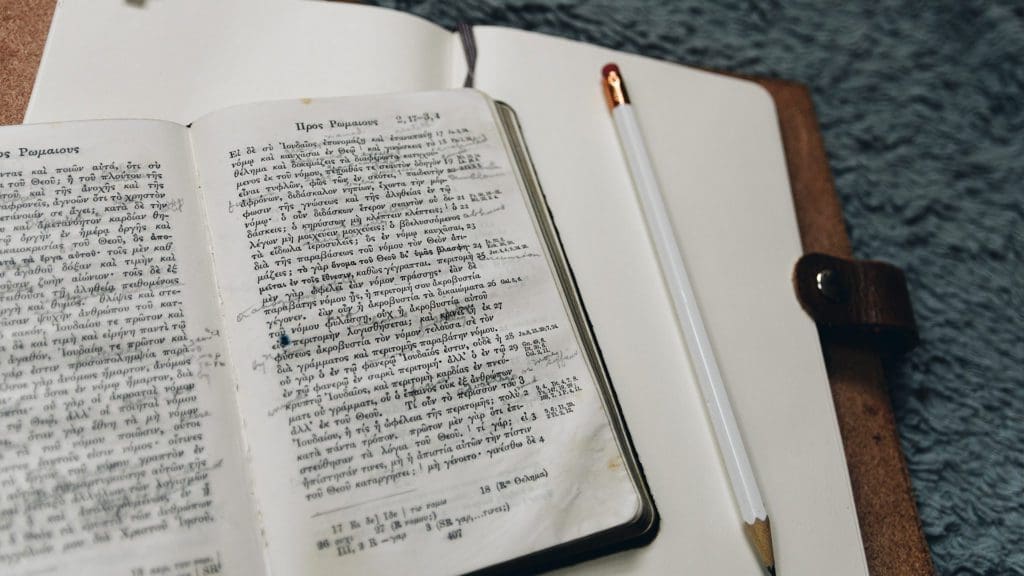
In Greek, Plato’s term for justice is dikaiosyne, and he argues that true happiness will not be found until dikaiosyne undergirds the body politic. Interestingly, when this term is used in the Greek Septuagint and the New Testament, it is often translated as “righteousness,” because in the Greek register it meant more than the blind balancing of scales we tend to associate with justice. Dikaiosyne has connotations of order and moral uprightness, resonating with the more Hebraic term “holiness.” When Paul uses the term (as he will dozens of times in his letters to the ancient church), he equates dikaiosyne with a rightly ordered relationship to God. The philosopher king has encountered capital-R Reality, which for Plato is the summum bonum of the Forms. This encounter so transforms the ruler that he can lead the polis—create laws and execute judgment—perfectly.
The Republic is fittingly utopian, a duplicitous word in the Greek language. It is the “good place” (eu topos) that we yearn for and strive after, but it is also “no place” (ou topos). Plato was likely under no illusion that such ideals would ever be realized. And to our modern ears, the philosopher king can sound like a bureaucratic despot, a tyrannical hegemon or world controller. To be sure, this side of Stalin and Pol Pot, Plato’s belief that the right education might produce the perfect ruler looks wildly naive. His philosopher king terrifies us because he is one of us. But what both Plato and Homer intuited, I hazard, is that there is no justice, no holiness, no good life outside submission to the rule of the rightful king.
I try to get my students to appreciate the ways in which ancient texts reveal an abiding human hunger for the Reality that upholds the cosmos, the polis, the oikos, the self. Plato called it the Forms; his later followers, the Logos. Christians call him the Creator. Plato and Homer (and Huxley) understood that the human is fundamentally sick. But their diagnoses that our sickness is merely ignorance or disordered appetite miss the darker possibility that our condition is even worse than we ever imagined: Our homesickness is unsalvageable.
When the Greco-Roman world is absorbed by Christianity, a new anthropology emerges. From Augustine to Boethius to Aquinas to Dante, the great conversation moves toward a gathering darkness. The heart—my heart—that took a few extra Krispy Kreme doughnuts on a cold Saturday morning is easy to slough off, to justify, to ignore, to retell with a touch of self-deprecating irony. But the light cast by these Christian inheritors, translators, and renovators of the Greco-Roman tradition reveals a self that is almost always hell-bent on putting its disordered loves on the invisible throne that exists within.
If my overindulgence were merely a matter of decorum or foolish unreasonableness, I could be led out of myself into a more virtuous form of life by education or ethics. Cleverness and cunning get Odysseus out of his cave; reason and wisdom, Plato. Perhaps the studia humanitatis might make me and my students better humans. But the Christian tradition reminds us again and again that even in the most seemingly banal choices that serve ourselves, we participate in the quiet, ultimate, ongoing human rebellion against the Creator. Our disease is our desire to live by the lawlessness that is manifested in our unfettered appetites. It’s a fatal diagnosis, a sickness unto death.
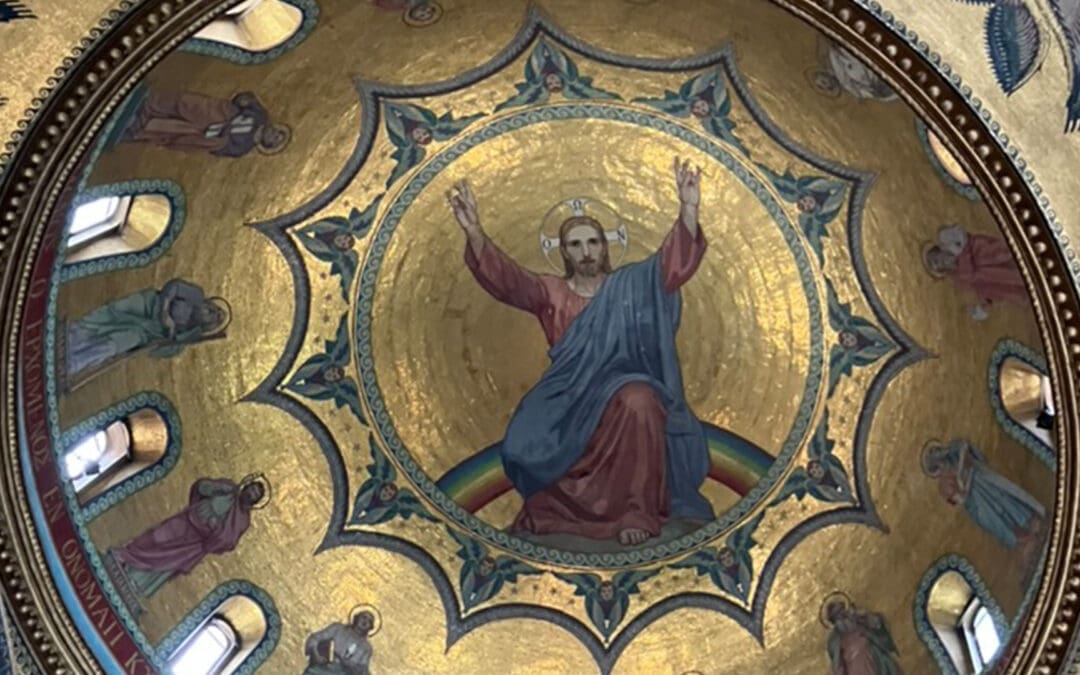
If Christian anthropology tends toward darkness (as it does especially in the strains of my frowning Dutch Calvinist forebears), that is only because it is enveloped by a much greater light, one that no amount of intellectual striving, contemplative practice, carefully curated humanities curricula, or even truly virtuous behaviour will ever create. The good news of the Christian story is that, as deep as the abyss of darkness is, we do not have to will ourselves, educate ourselves, strive, exert, or consume ourselves in the hopes of attaining the peace that comes from holiness. Rather, God, the Father of lights, comes to his creatures with the most tender restraint. He condescends to free us from our self-imposed islands of alienation. He comes as a man to heal the sickness of man.
Self-control, in the Christian story, is a virtue that Paul educates the early church to practice. Yet it remains a gift we could never give ourselves. Christ doesn’t coerce. He doesn’t bribe. He instead invites us to put on self-control like a garment, and he shows us the way. The first temptation he resists becomes a pattern of his holy life. He refuses to turn stones into bread to satiate his extreme hunger, not because bread or appetite is bad but because, in this instance, it would serve the archetype of autonomous rebellion against God. His life after this moment is on the cruciform path by which true justice—true dikaiosyne—is made known and by which tyranny, this-worldly or other, is overthrown.
Even when we feel the nausea of our accelerating appetites longing for all the wrong things in all the wrong ways—a third Krispy Kreme, say—this way of life says all such experiences are the call of the real studia humanitatis to give careful attention. Give attention to Odysseus with his fill of food and wine and sex, still longing for his home. Give attention when we contrive to build, as T.S. Eliot quips, “systems so perfect that no one will need to be good.” Amid the tyranny of our desires, in this great between time before the King returns, we struggle and often fail to feed the right appetites in the right ways. But for those attuned to their experience, even in our disordered state, our dis-ease is a gift. The early church would call it a “consolation” of the fall, one the Creator lovingly uses to corral wayward hearts, nudging the lost to seek his face. Because what else is our shared human sickness but a sign we must learn to read, a sign that signifies our need and hunger for healing, health, wholeness—even holiness—that is the good life for which we were made.