
W
When it comes to spiritual formation, laughter can seem decidedly unserious. It is difficult to imagine admirable figures in church history being anything besides somber—hard to picture, for example, John the Baptist in the desert cracking jokes.
In the Roman world of the New Testament, gravitas was esteemed above levity, and that sentiment continued in much of the Christian tradition. “Lighthearted and heedless of our defects, we do not feel the real sorrows of our souls,” wrote Thomas à Kempis, “but often indulge in empty laughter when we have good reason to weep.” Likewise, chapter seven of St. Benedict’s rule states that “only a fool raises his voice in laughter.”
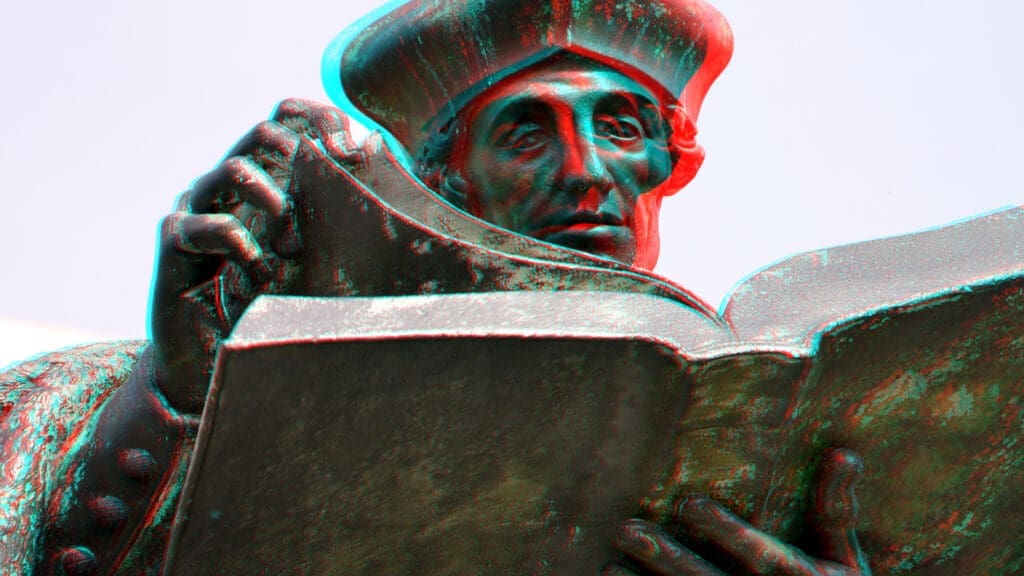
Still, the Christian tradition also includes discussions and demonstrations of the value of laughter. Desiderius Erasmus used humour to satirically critique the church and call it to repentance. G.K. Chesterton touched on humour’s ability to reveal truth when he wrote in Orthodoxy, “Humor can get in under the door while seriousness is still fumbling at the handle.” And we cannot imagine that Frederick Buechner would not have had us laugh.
All these suggest that laughter can be a kind of spiritual litmus test, a formative tool that both cuts and illumines. And the most stringent test is not so much being able to make a joke—or resist making one—as it is to be the subject of one. To patiently and humbly endure being laughed at, even derisively, can be a sign of spiritual maturity that points to the wisdom of the cross.
In Notes from the Underground and The Idiot, the Russian novelist Fyodor Dostoevsky demonstrates this point with two very different characters. One finds everyone else to be a fool and the other is identified as a holy fool. Each is foolish in his own way and each is laughed at by others, but their different relationships with laughter reveal their characters—and our own.
In Notes from the Underground, Dostoevsky introduces one of the most antagonistic narrators in literature, identified only as “the Underground Man.” This complicated character exists on the fringes of nineteenth-century Russian society and tells the reader outright that he is nasty, spiteful, and untrustworthy—an assessment the reader is given ample opportunity to confirm.
Above all, the Underground Man cannot endure being laughed at, a flaw that triggers many unfortunate and painful events. When he was younger, he tells the reader, he had “a sickly dread” of “being ridiculous.” As an adult, he reconnects with some old “friends” at a dinner party, where his being teased leads to his rashly challenging someone to a duel, much to everyone else’s amusement. While the others are “prostrate with laughter,” he begins to pace loudly up and down the room, overwhelmed with embarrassment but too proud to depart, awaiting an apology that does not come. His sensitivity to being thought ridiculous is ironically what makes him ridiculous.
Following the disastrous dinner, the narrator goes to a brothel and tells a prostitute, Liza, that she has a dark future awaiting her, casting himself as something of a potential saviour. But the vision is quickly derailed by his fears. “I did speak with real feeling, and all at once I flushed crimson,” he confesses. “‘What if she were suddenly to burst out laughing, what would I do then?’ That idea drove me to fury. Towards the end of my speech I really was excited, and now my vanity was somehow wounded.”
Liza’s laughter, which never actually comes, would have revealed him as precisely that which he did not want to be: a poor man and a self-absorbed, phony prophet. He recognizes that he is ridiculous as a saviour, but he is desperate not to be seen as such. When Liza later comes to his house, he is embarrassed to be seen in his shabby apartment in his shabby clothes, arguing with his part-time servant, and seeks to humiliate Liza. She realizes his misery and accepts him anyway, even holding him while he sobs. Yet fear of future ridicule and his discomfort with being seen as he is warps the moment of tenderness into a mirror that reflects only his shame. “She was now the heroine, while I was just such a crushed and humiliated creature as she had been before me that night,” he says, and pivots to acting on “a feeling of mastery and possession.”
To patiently and humbly endure being laughed at, even derisively, can be a sign of spiritual maturity that points to the wisdom of the cross.
The Underground Man looks at the world—and himself—with spite and loathing. He finds the incongruity between who he wants to be and who he is excruciating. He wishes to reconcile with others, but he is incapable of such a thing. His pride despite all of this is entirely ridiculous. His fear of being laughed at dominates his interactions with others. And his thoughts are uncannily familiar to us.
Many of us also live in great fear of being laughed at or being seen as ridiculous. In the scale of the universe we are all small, but we are most aware of our smallness and most sensitive to laughter when we feel exposed. A teenager at a new school fears social missteps that elicit unwanted laughter from her peers. A man overhears coworkers snickering about a slipup he made.
Even many of our most loosely tethered anxieties remind us of our fear of looking ridiculous. We have dreams about showing up somewhere naked. We fear public speaking more than we fear death. We are so anxious about looking ridiculous that if we realize we are going in the wrong direction and anyone is around, we will look at a watch or phone to give ourselves an excuse for turning around abruptly.
What we want in these moments of revealing is not harsh mockery but the surprising joy of being loved in our vulnerable state. But can we find and accept such love?
The Underground Man never finds redemption, but in The Idiot, Dostoevsky offers a glimpse of what spiritual maturity can look like in the face of ridicule. As the near polar opposite of the Underground Man, Prince Myshkin is innocent, pure, and kindhearted. From his first arrival in the novel, he is mocked by society because of his ignorance and clumsiness. But unlike the Underground Man, he is unbothered by it. He can even laugh at himself, “somehow even merrily, despite all the apparent embarrassment of his situation.”
If being laughed at reveals something about us that we hoped to hide, then Myshkin does not fear being revealed. His life resembles that of the Christian fools satirically described in Erasmus’s In Praise of Folly, who “waste their estates, neglect injuries, suffer themselves to be cheated, put no difference between friends and enemies, abhor pleasure, are crammed with poverty, watchings, tears, labors, reproaches”—exactly as the Sermon on the Mount would have us live. Myshkin converses with old and young, rich and poor, socially acceptable and unacceptable. He wants to provide for a fallen woman. Myshkin does all this, unrattled by mockery, because he is a type of Christ in the novel.
One character in particular hates him—and it is for his kindness. In an outburst, Ippolit yells at Myshkin: “I don’t need your benefactions, I won’t accept anything from anybody, do you hear, from anybody!” Yet Ippolit is dying of tuberculosis and living in Myshkin’s home at the time. Myshkin is good to Ippolit and to everyone he meets, even those who try to extort or murder him. And his sacrificial way of living ultimately results in him being broken and rejected, reduced to a nearly insensible state.
For what could be more laughable in the eyes of the world than to stay on the path of the Man of Sorrows? Jesus’s death was meant to maximize shame and embarrassment, the worst fate that many of us can imagine. On the cross, he was taunted as the “King of the Jews” as he bore a crown of thorns. Myshkin is similarly laughed at and ill-treated in The Idiot.
Most of us are more like the Underground Man than we are like Myshkin. We would rather laugh than be laughed at. In the wisdom of the world, the one who has the last laugh wins, not the one who is the subject of it. We want to hide what is ridiculous or shameful or inadequate about ourselves, and there is much to hide. We might rather die in our spite than admit what is true about ourselves.
But when we admit our smallness and our lowliness, we also open ourselves to receiving love. In the Magnificat, Mary sings that God “has been mindful of the humble state of his servant” and “he has scattered those who are proud in their inmost thoughts. He has brought down rulers from their thrones but has lifted up the humble.” Jesus tells us that he has come for the sick, not the healthy, asking us to admit our symptoms. He comes to seek and save the lost, not those who never need to ask for directions.
In the Lenten season especially, we are invited to see ourselves in our lowly estate—no better than the Underground Man in his shabby clothes in his shabby apartment—that we might find ourselves covered in Christ’s love.
The fear of being a punchline is directly related to a desire for significance or acceptance; to be laughed at is to be thrown down the ladder, to be marked as excluded. Many of us find it unbearable to be counted among the followers of David, who were distressed, discontented, and indebted (1 Samuel 22:2). We don’t want to associate with the lepers and demoniacs and rough-edged fishermen who were among Jesus’s company. We would rather sit at the right lunch table, never misspeak or trip while walking, and never have our faults publicly revealed. There is so much we will do to avoid being laughed at and so much we will avoid in order to be admired.
But what will we miss if, like the Underground Man, we live in constant fear of being thought ridiculous? We will be unable to accept our lowly estate and God’s love for us. We will never have the chance to give away a fortune, forgive beyond reason, or dance unto the Lord like David. We may avoid a fate like Myshkin’s, but we will have held ourselves back from many things esteemed in the eyes of God.
No one enjoys being laughed at. But bearing ridicule may be the kind of foolishness that is consistent with the cross. If we can allow it, mockery can become a kind of small apocalypse, revealing what society thinks of us, what is truly inside our hearts, and the marrow of our actions both public and private.