
I
“My country, right or wrong,” is a thing that no patriot would think of saying except in a desperate case. It is like saying, “My mother, drunk or sober.”
—G.K. Chesterton (1901)
In 2020 Rod Dreher published Live Not by Lies: A Manual for Christian Dissidents, in which he commends those saints and martyrs who refused to fall in line with the Soviet totalitarian regime. His title comes from Alexandr Solzhenitsyn’s famous tract of the same name, which the Russian novelist published after his 1974 exile from Russia. Drawing lessons from those who experienced oppression under Soviet rule, Dreher argues that Americans are under an analogous threat of “soft totalitarianism” predicated by the Left. Christians and social conservatives need to be on guard against ideologies hostile to their faith purveyed not so much through government coercion as through the “soft” forms of cultural power and influence. Merely going with the flow will no longer suffice. Those who don’t actively resist this soft totalitarianism may “think they follow Jesus, but in fact, they merely admire him,” Dreher writes. “Each of us thinks we wouldn’t be like that. But if we have accepted the lie of our therapeutic culture, which tells us that personal happiness is the greatest good of all, then we will surrender at the first sign of trouble.” Encouraged by this framing, the majority of Dreher’s readers have seen themselves as insurgents against the influential elite.
But things have changed. The Left is in disarray, caught on its heels in the 2024 election and scrambling to regain a semblance of the cultural dominance it wielded for a decade and a half. How does the narrative shift now that the clout is in the hands of conservatives? Could it be that those who accept the lie of therapeutic culture and the progress toward happiness are the ones sitting in the White House or Congress, gathering millions of viewers on YouTube, and controlling the largest social media platforms? Where then is Christian dissidence? What if the “utopian ideology” Dreher warns us about comes not in the cloak of social justice but in the guise of a victorious Christian empire?
Dreher himself is not unaware of these questions. Looking back at his book, he observes that while “Live Not by Lies helped people make sense of what they were experiencing” in the years leading up to 2020, he was shocked in 2025, when on tour for the documentary inspired by his book, to witness parallel forms of totalitarian thinking among his right-wing friends. “I don’t want to live in a right-wing totalitarian world any more than I want to live in a left-wing one,” Dreher writes. “Totalitarian thinking is bad whatever its ideological basis,” and “right-wing people . . . are just as susceptible to the siren song of ideological certainty, and to the temptation of crushing all who stand in their way.”
Dreher is correct that Christian resistance is needed, but perhaps there are good reasons for Christians to resist the version of Christianity currently winning in American politics and claiming the state as its prize.
Church and State: Some Historical Precedents
By conceiving of America as a “Christian” nation, we place ourselves in a bind, one the church has been in for thousands of years.
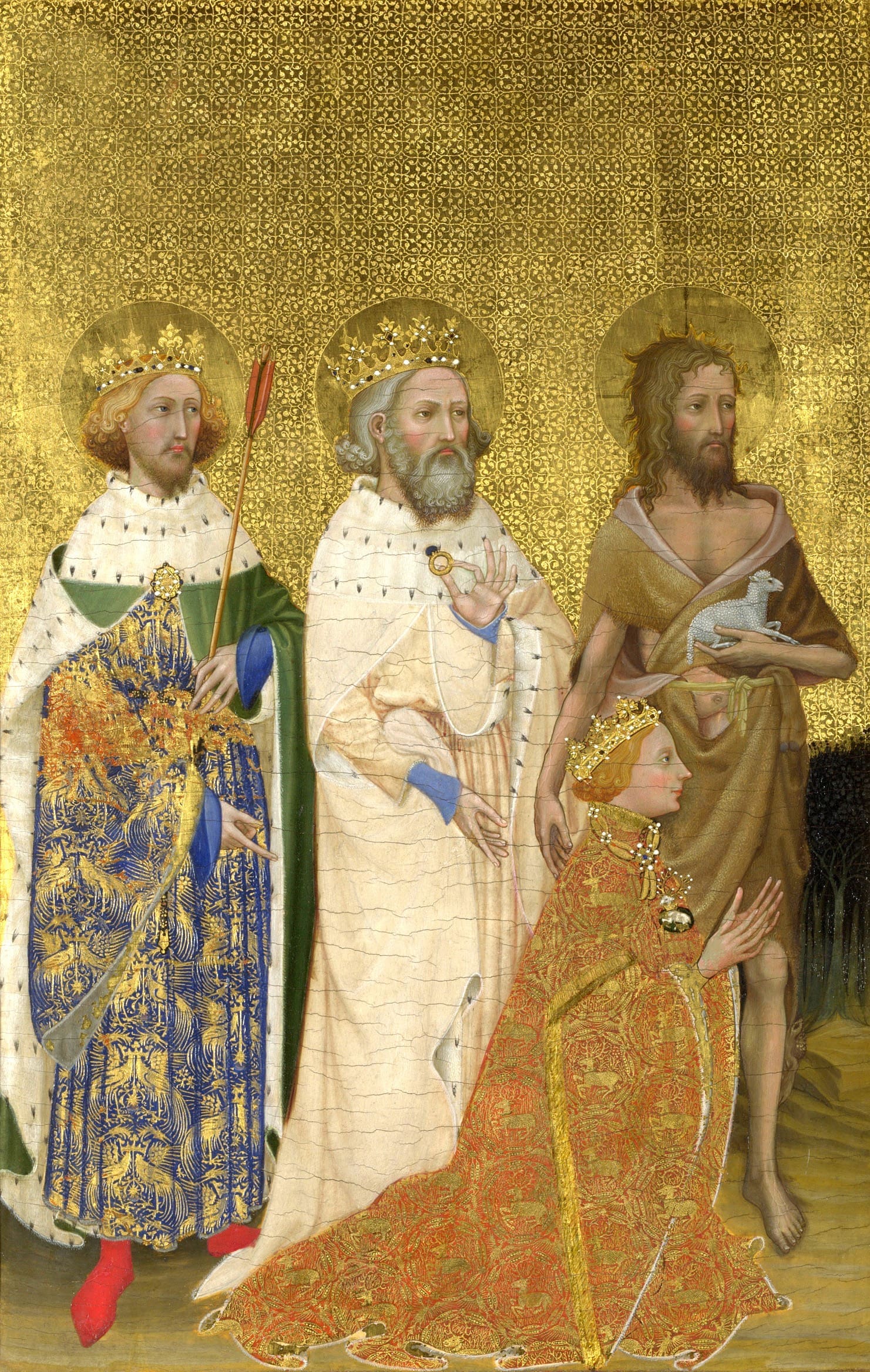
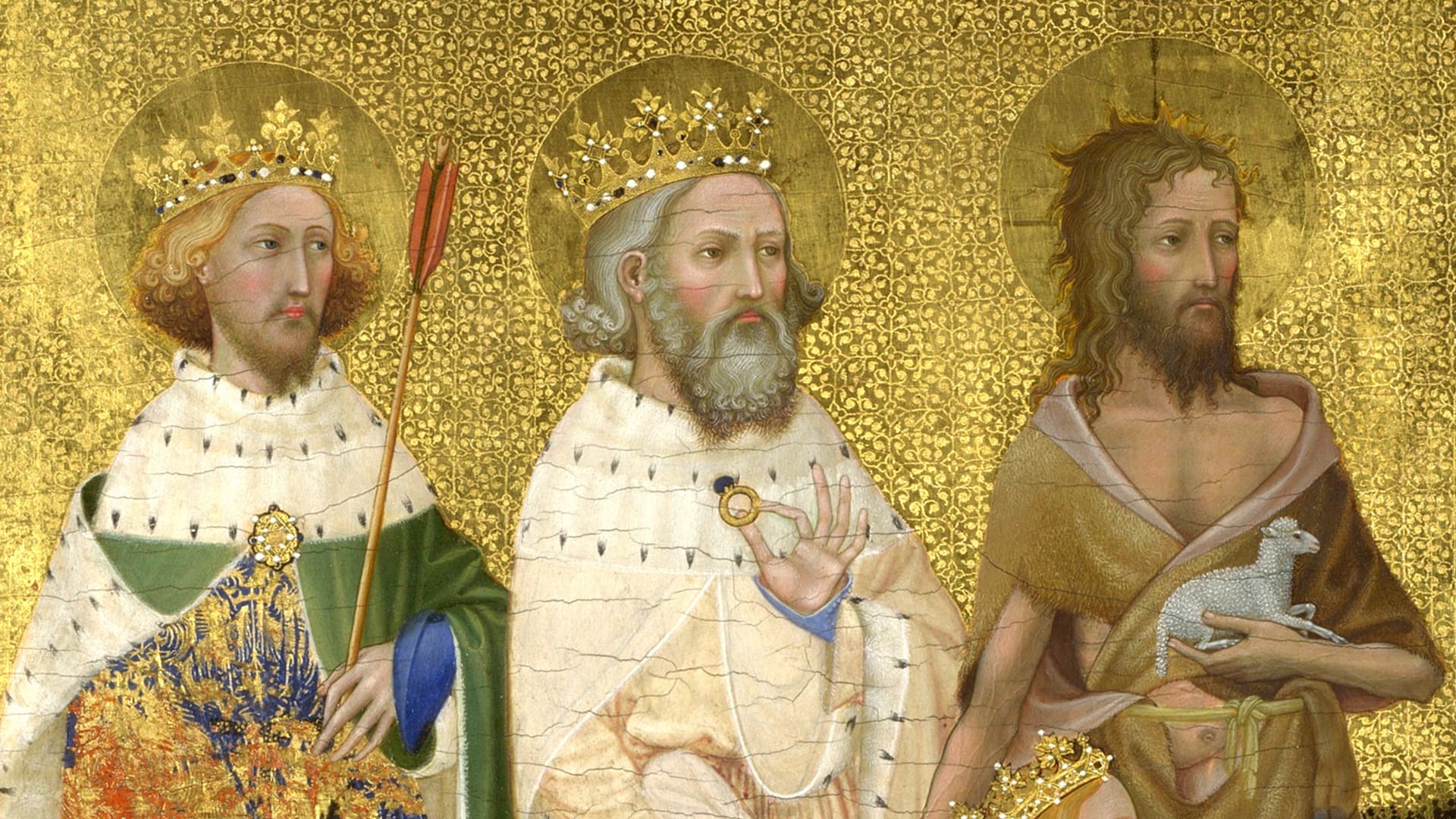
Left panel, “The Wilton Diptych,” artist unknown, circa 1395–99.
A Christian leader must be worldly to exercise temporal rule yet keep in mind the eternal concerns of Christianity to satisfy the expectations of Christian teaching. How does one follow Christ to the cross and also sit on the throne of the empire?
How does a ruler in the world imitate a God who asks us to give up the world? “Give to Caesar what belongs to Caesar,” Jesus commands his disciples in Matthew 22:21. In contrast, what belongs to the church, and more pointedly what belongs to God, is what bears his image—our very selves. The empire is not the church; only one can rule our souls. The track record is not promising. Yet in 2025 in America, many people are certain we will beat the odds—this time it will be different. This time the new Zion will be the Christian utopia. Finally, with the faithful in the seats of the American empire, we will deliver peace on earth and goodwill to all. Such illusions show us the difficulty of mingling the affairs of church and state. A few vignettes will bear this out.
If one wants to be a patriotic American, practice first being a good Christian.
In 313 Emperor Constantine legalized Christianity; suddenly the new religion that had spread by the blood of its martyrs became a label by which one achieved cultural prominence. Whether Constantine acted because of a heartfelt conversion or political pragmatism, historians will continue to debate. But the reality he set in motion changed the nature of the church’s relation to the political structures of the world. Those following the way of Christ went from preparing for death to manoeuvring for positions of power in the new regime. The Roman Empire, which had been antagonistic to Christianity, became, with Constantine and more and more in the generations that followed, a “Christian” empire. Classicist Nadya Williams points out that “cultural Christians were present in the church both before and after legalization of Christianity,” but Christians following the changes Constantine initiated faced a new set of questions: What happens to Christian witness when it is aligned with the reigning ethos of the world? What concessions must be made to maintain control? What battles must be fought “in the name of Jesus” or violence carried out to protect the “Christian” empire?
In the sixteenth century, King Henry VIII declared himself the “supreme head of the Church of England,” ushering in a new political configuration that subsumed the church under the state, an arrangement that lasts to this day. When the king’s tutor Sir Thomas More opposed Henry’s policies, he was beheaded. The play about More’s execution, A Man for All Seasons, is probably not a reliable guide to the complexities of sixteenth-century English ecclesiastical politics, but it illustrates Jesus’s warning in the Gospel of Luke against those who choose power in this world rather than suffering the humiliation of the cross. In the play, More is aghast that one of his former students, Richard, has testified falsely against him in order to receive a promotion to attorney general of Wales. “Why, Richard,” More responds, “it profits a man nothing to give his soul for the whole world. . . . But for Wales?” We are supposed to be, as Dreher advocated in 2020, those willing to die for the cause of Christ, rather than lose our integrity for the goods of the world.
Or, if you look at Russia, a country riddled with problems between the national faith and authoritarian rulers, you see atheism disguised as faith for the placation of the public. As a Christian socialist, the young Dostoevsky believed in the power of his nation to subsume the church, or for the church to incorporate the government, as it were. In either case, church and state become one acting entity saving people from their sins. In The Brothers Karamazov, Dostoevsky attributes the heft of this Christian-nationalist argument to Ivan Karamazov, who voices it in conversation with a group of monks and an atheist scholar named Miusov. Ivan has written an article that starts with Constantine’s move to conflate imperial power with divine authority on earth and draws on it as a model for his own time:
Every earthly State should be, in the end, completely transformed into the Church and should become nothing else but a Church, rejecting every purpose incongruous with the aims of the Church. All this will not degrade it in any way or take from its honor and glory as a great State, nor from the glory of its rulers, but only turns it from a false, still pagan, and mistaken path to the true and rightful path, which alone leads to the eternal goal.
One of the monks in the novel practically shouts “Amen,” though he is imagining these claims as eschatologically—not temporally—fulfilled. When Christ comes again, the young monk thinks, then the state will become worthy of the church. However, Miusov is horrified because he knows the truth: that Ivan is an atheist. Ivan argues for this utopian government in which Christianity rules as a state power not because he believes Christianity to be true but because he believes in the efficacy of Christianity to coerce citizens to behave. From Ivan’s perspective, Christianity is useful for compelling moral action.
The Strange Phenomenon of Cultural Christianity
Twenty-first-century readers of Dostoevsky may already have noted the parallel to another famous atheist, Richard Dawkins, author of The God Delusion, who said recently, “I call myself a cultural Christian. I’m not a believer, but there’s a distinction between being a believing Christian and a cultural Christian.” He even calls his homeland, Britain, a “Christian country.” In this way too, many on the ascendant American right currently aspire to be a “Christian country,” one in which there is cultural capital to be gained by leaning into the pretense of its forgotten values. This Christianity has nothing to do with surrender to the call of the Lord to the point of death; a cultural Christian in Dawkins’s sense picks and chooses what values to live by, and those values may change over the years or even over the days.
What we witness in the move from authentic Christianity to cultural Christianity is the degeneration from virtues to values. One may evaluate at any given moment whether it is valuable to adhere to values: every ethical decision becomes a cost-benefit analysis, considering the return on investment regarding specific actions. Virtues, however, are not an expression of preference; they are written into the natural law. From Plato to Aquinas, philosophers and theologians believed that virtues “were the standards against which behavior could and should be measured,” writes American historian Gertrude Himmelfarb. “These standards were firm even if the behavior of individuals did not always measure up to them. And when conduct fell short of those standards, it was judged in moral terms, as bad, wrong, or evil—not, as is more often the case today, as misguided, undesirable, or (the most recent corruption of our moral vocabulary) ‘inappropriate.’” Himmelfarb wrote this in 1995—thirty years later, we classify “inappropriate” behaviour among our leaders as inconvenient at best. More often we ignore the evil altogether: the scandals, the felonies, the impeachment, the authoritarian misuse of power.
In We Who Wrestle with God, Jordan Peterson, exalted by many Christians as a sort of cultural Christian guru, uplifts the Old Testament for its pragmatism, interpreting it through a lens of cultural progress. Drawing on his expertise in psychology, Peterson reads each Bible story like a lesson. But for believers the stories of Scripture are true revelations of spiritual import, not just instances of psychological archetypes.
Of Jacob’s ladder, Peterson writes that readers discover “the process that is eternally making everything as it should be but is somehow also improving, finding new pathways to higher orders of the true, the beautiful, and the good.” This is no doubt an appealing vision, but if we look closely at Genesis 28, the ladder shows angels not only ascending but also descending. Peterson’s reading is a telling omission. When we look at New Testament revelation, we see a similar dual movement in Christ, who “did not consider equality with God something to be used to his own advantage; rather he made himself nothing, taking the very nature of a servant” (Philippians 2:6–7). God’s descent in the incarnation results in his being “exalted to the highest place” (Philippians 2:9). The ladder itself is not made by Jacob’s hands, but the Lord reveals it to him. Grace intercedes where human agency fails. We are not continually getting better, reaching toward the divine on our own efforts. Peterson’s interpretation of Jacob’s ladder as a vision of human progress is closer to the hermeneutics of Babel than that of Christianity.
Another public figure, Elon Musk, has, like Dawkins, also called himself a cultural Christian. His religion is, in the words of Wall Street Journal reporter Tim Higgins, “Jesus’ teachings with an Old Testament twist.” Musk has called for bravery among Christians in his social media posts. And in an interview with Peterson, Musk claims that “the teachings of Jesus are good and wise.” However, he values these teachings only when they are valuable. If someone is bullying you, don’t turn the other cheek, Musk says. “Punch them in the nose.” For Musk, Christianity’s value is in its utility to increase population and aid progress and expansion.
The Christianity of public figures such as Peterson and Musk reminds me not so much of Christ as of Machiavelli, the Italian author of The Prince, a pragmatic sixteenth-century handbook for how to use religion to win friends and influence people. “Of course, if all men were good,” Machiavelli admits, “this advice would be bad; but since men are wicked and will not keep faith with you, you need not keep faith with them.” Rather, one needs to be a fox and a lion: deceptive and forceful.
The greatest ruler will be the one who pretends to be Christian and secures the backing of the populace, according to Machiavelli. A ruler does not need to possess character or virtue, but “should seem to be compassionate, trustworthy, sympathetic, honest, religious. . . . At the same time [the ruler] should be constantly prepared, so that, if these become liabilities, you are trained and ready to become their opposites.” Machiavelli redefines virtue—which for pagans like Aristotle meant human excellencies of character such as courage, prudence, temperance, and justice—as skill and strength. For Machiavelli, one has virtue when one knows what works. Perhaps an ancestor of today’s cultural Christians, Machiavelli advises rulers to use virtues but discard them when they become a hindrance.
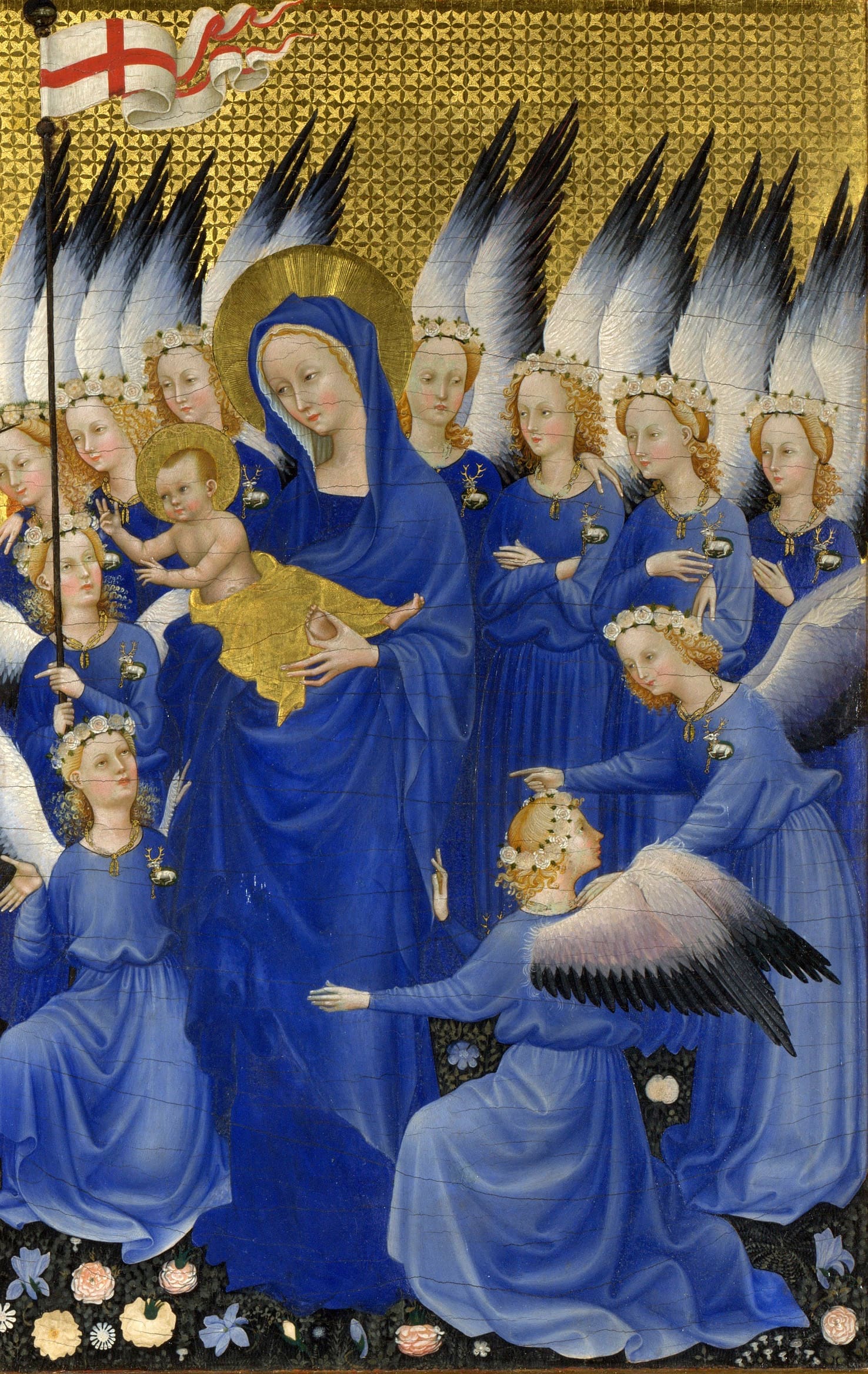
Right Panel, “The Wilton Diptych,” artist unknown, circa 1395–99.
None of this is to say that one cannot be a patriotic citizen and a Christian. But among these cultural Christians, identity and citizenry are lodged first in culture and only second in Christianity. Writing to a former student, C.S. Lewis cautions against such faulty prioritizations: “Put first things first and we get second things thrown in: put second things first & we lose both first and second things.” In other words, if one wants to be a patriotic American, practice first being a good Christian. Jesus himself warned his disciples about this reality: “Instead, desire first and foremost God’s kingdom and God’s righteousness, and all these things will be given to you as well” (Matthew 6:33). When an American citizen prioritizes patriotism before the life of authentic discipleship, she can be neither a good patriot nor a good Christian; she will unintentionally become a despot and idol worshipper. Cultural Christianity distorts the order between God’s kingdom and the temporal kingdom.
“Content Thyself to Be Obscurely Good”
If we are to be the Christian dissidents that Dreher encourages readers to be in Live Not by Lies, we must correctly identify the persecutors, regardless of who is in power. In his 2023 book Revelation for the Rest of Us: A Prophetic Call to Follow Jesus as a Dissident Disciple, Scot McKnight and Cody Matchett write how the strange final book of the New Testament was meant not as direct prophetic allegory but as a spiritual drama that casts the world empire (or state) against the faithful way of Jesus. As the empires of Egypt and Babylon and Rome appear in the history of the Bible as the antagonists to God’s people, so John, the author of Revelation, uses “Babylon” as a metaphor for the persecutor. John encouraged the early Christians “to recognize Babylon, to speak up and to speak out, and to stand firm in the way of the Lamb.” McKnight and Matchett describe the characteristics of Babylon in list format: “Royalty, idolatry, opulence, murder, status, arrogance, power, military might, . . . and economic exploitation. . . . Gathers under her power the kings of the earth, the merchants of the world, and sea captains. Serves as a timeless metaphor for empire and injustices and idolatries.” For the disciple John, Babylon was the Roman Empire. For Americans, could the use of Christianity for the ends of national politics be a Babylonian idol infiltrating our state?
It’s difficult to be good and be in power, though not impossible. One must be content to “be obscurely good.”
McKnight and Matchett clarify that Babylon is always there in church history; it cannot be lined up with one power or nation or political party. “If one’s allegiance is to a party, if one thinks one’s party is truly Christian,” McKnight and Matchett caution readers, “one has cut off one’s sisters and brothers.” To make the state Christian or to pronounce that the church belongs to a particular political party would be to separate oneself from all the other Christians who disagree or who interpret politics differently. Those who follow Jesus Christ transcend boundaries carved by the world—tribes, nations, and tongues.
In the Gospel of Mark, Jesus counsels his disciples against becoming like the rulers of Gentiles, who “lord [power] over” others and “exercise authority over them” (Mark 10:42). “Not so with you,” Jesus tells them. McKnight and Matchett suggest this should be the Christian dissident’s motto: “Not so with you!” “Instead, whoever wants to become great among you,” Jesus says, “must be your servant and whoever wants to be first must be slave of all” (Mark 10:43–44). In More’s Utopia the sixteenth-century martyr quips, “Anyone who campaigns for public office becomes disqualified for holding any office at all.” Power is seductive, and it warps those who seek it. The only way to overcome power’s allure is to be a servant.
At Valley Forge, George Washington hosted a production of Joseph Addison’s 1713 tragedy Cato, a play about the first-century-BC Roman senator who defied the tyranny of Julius Caesar. When Caesar won against Cato’s battalion, the senator committed suicide rather than witness Caesar’s rise to power over Rome. This example of piety, self-sacrifice, and protest against power inspired Washington to return to his farm at Mount Vernon after the American Revolution, as well as to bow out of a third term in the office of the president. “Content thyself to be obscurely good,” Cato says in the play. “When vice prevails, and impious men bear sway, the post of honor is a private station.” It’s difficult to be good and be in power, though not impossible. One must be content to “be obscurely good.” If the rest of the world values vice, then the good person must choose not to be their king.
We have thrown our allegiance more often to the state than to the church. We may even have done this out of our own goodwill and desire for good things. We are eager to see the fruit of our action in our lifetime, and we want goodness to triumph over evil; these are all beautiful desires. But the reality is that we cannot know the timing or ways of the God who is to deliver them. “‘For I know the plans I have for you,’ declares the Lord, ‘plans to prosper you and not to harm you, plans to give you hope and a future’” (Jeremiah 29:11). We Christians are fond of citing this verse while forgetting that Jeremiah wrote this uplifting passage before Babylon conquered God’s people and took them into captivity for seventy years.
While the virtuous ones may be asked to serve, they must be willing to follow Christ to the cross if needed, to relinquish power rather than injure their integrity. Supposedly, when King George III asked painter Benjamin West about George Washington’s plans after the war, he could not believe the answer. “They say he will return to his farm,” West told the king. “If he does that,” the vainglorious monarch scoffed, “he will be the greatest man in the world.” It may be helpful to remember that America was founded by such people of virtue. People who cared more for their integrity than for the allurements of power. People who would rather tend their own gardens than lose their souls for the sake of the world. They were not all heroes, and we should not look back over our shoulder nostalgically at their lives. However, Washington’s example in refusing a crown is proof that the way of Babylon is not the way it always has to be. Virtue could be possible again. But it might require us to give up our lives to save our souls.