
D
David Foster Wallace’s magnificently unnerving story “The Soul Is Not a Smithy” asks the reader to jump, frequently and abruptly, between several fictional planes as an unnamed first-person narrator, now grown, looks back at events from his formative years. At the centre of his recollections is the day a substitute civics teacher at R.B. Hayes Primary School snapped, began behaving erratically, and was shot by police in front of the narrator and three other children. The narrative moves in the jerky, quicksilver, hard-to-follow way that memory and cognition sometimes do, smudging the lines between inner and outer worlds, memory and experience, imagination and actuality. Perhaps one thing alone remains constant on every fictional plane, from the comic-strip storylines the narrator imaginatively projects onto a classroom window while daydreaming as a child to his digressive asides about his and the other kids’ home lives and what will become of them each later in life—namely, haunting images of adults in one form or another of freefall, whether owing to substance abuse, unemployment or underemployment, or generational trauma. Each adult posits a terrible answer to Langston Hughes’s question about what happens to dreams deferred—which is that children born to wounded, sinful, or hopeless parents suffer profoundly and unfairly from finding only absence or violence where there should be care.
One such image from “The Soul Is Not a Smithy,” a recurring nightmare about a father’s workplace, floated into my mind recently when I thought about how awkwardly and unpleasantly the words “institution” and “authority” land on contemporary ears:
Is this what Americans think of when they think of institutions? Certainly not all Americans about all institutions. And not in precisely those terms. But deep down, on a level below consciousness, something not too far from this scene has seeped into our cultural imagination—a sense of institutions as things that stifle, oppress, depersonalize, and trap.
But that’s hardly the only story or the truest one we can tell about institutions. Families, schools, churches, governments, markets, and other associations are essential structures of human society. Like all God’s gifts, they can be warped by sin in a fallen world. Like all God’s gifts, they can be reclaimed for the kingdom of Christ. So let’s not settle for the myopic standards of the present day. To view institutions as exclusively instruments of oppression and captivity would be like thinking of all apples as merely occasions of sin, all wives as nothing more than human shields to take the blame, and God as a fearsome avenger whom it’s best to hide from should he ever walk past you in the cool of night. In other words, it would be to give the devil far more than his due.
Creation and . . .
Instead, let’s go back in time, to the opening words of Genesis and to an expanded meditation on them by one of the church fathers. Not, however, all the way back to the very beginning, meaning the one described in John’s Gospel: “In the beginning was the Word, and the Word was with God, and the Word was God.” My grasp on trinitarian theology is admittedly weak, but reason alone tells me that the Trinity is not an institution, since the Latin root instituo means “to set up, to establish, to found,” and the three persons of the Trinity, being co-eternal, had no need for setting up, establishing, or founding. It is only when creatures arrive on the scene that institutions and authority spring into being too.
The Bible’s account of creation in Genesis 1:1 is brief but, as is so often the case with Scripture, compact: “In the beginning God created the heavens and the earth.” Quite a lot is packed invisibly into this one sentence. According to tradition, the first fall—Lucifer’s in heaven—occurs before the creation of the physical world. It occurs, indeed, because of the impending creation of the physical world. It occurs in the space between the words “heavens” and “and,” when God reveals to the angels his plan for the incarnate Word: God made man and born of woman. Lucifer, the brightest angel, is incensed at the thought of rendering homage and obedience to human persons, who are lower in the created order than pure spirits. Non serviam, he says. I will not serve. The battle in heaven, owing to the nature of angelic intelligence, is over in an instant. Lucifer and those angels who rose up with him in indignant pride—roughly a third of them, again according to tradition—are immediately cast down into a hell newly created to contain them.
In the physical realm to which God the Father and God the Son then turn their loving attention, things do not move nearly so quickly. Our universe unfolds slowly, in geologic time. Eons pass before the course of human history is even begun, and myriad generations separate the events of the Old Testament from those of the New Testament. Even now God patiently permits the universe and its inhabitants to move at our own, sometimes glacial speed. Although we human beings resist grace a good deal of the time, perhaps even most of it, we rarely meet with anything like the instantaneous divine retribution that Lucifer encountered. Lot’s wife, who was turned into a pillar of salt straightaway for her disobedience, may be the exception that proves the rule. More often, the course of human affairs is like what Jesus describes in the Sermon on the Mount, in which a providential Father withholds judgment while supplying all our needs: “He makes his sun rise on the evil and on the good, and sends rain on the righteous and on the unrighteous” (Matthew 5:45). Jesus calls us, in that same sermon, to do likewise.
At one extreme, then, we have Lucifer, who bolts upward for an instant—pridefully insisting on his own self-sufficiency and superiority, even in relation to God—and is then cast down. At the other extreme, we have the Second Person of the Trinity, who, humbly submitting to the will of the Father, freely relinquishes his prerogative as Son and descends to a human level to seek out and serve the little and the lost, descending as low as Sheol to find them and labouring until the end of time.
Hierarchies Celestial
In between we have those angels who fell and those who did not. Angels are arranged, tradition holds, in nine ranked choirs. Their first chronicler, an anonymous monk who signed his works as Dionysius (the judge converted by St. Paul at the Areopagus in Acts 17:34) even though he lived roughly five centuries after St. Paul was martyred, laid out the distinctions of each choir in his treatise The Celestial Hierarchy. What matters for our purposes are not the specific categories of angels but rather what Dionysius has to say about hierarchy itself.
The wisdom preserved by tradition, I would suggest, presents us with templates that can be useful in understanding how contemporary institutions are working for or against God’s will in the present day.
Even a very patient reader may at this point be forgiven for wondering how much longer we are going to spend explicating the empty space between two words of Scripture, or what on earth speculative theology has to do with schools, offices, churches, homes, and other concrete particulars of life in a liberal democracy. The wisdom preserved by tradition, I would suggest, presents us with templates that can be useful in understanding how contemporary institutions are working for or against God’s will in the present day. The first war in heaven has lessons that remain relevant to the “mystery of lawlessness” in our own time (2 Thessalonians 2:7). (As for me and my house, we will move slowly and mend things.) Likewise, the first peace—that is, the concord assented to and maintained by those angels who did not rebel—can provide balm for some of the wounds plaguing our culture today, a splint to set aright what has been fractured.
The first thing to note about Dionysius’s theology is its focus on verticality. He was the first to use the word “hierarchy.” Because “hier-” and “higher” are homonyms in English, I’ve long associated hierarchy with a sense of looking up. The Greek root words—hieros, meaning “sacred,” and arkhēs, meaning “ruler”—make clearer that what we are meant to look up at is specifically God, the Hierarch. For Dionysius, the celestial hierarchy stretches from the seraphim at the top, who are nearest to God, to the (regular old) angels at the bottom, who serve as messengers to and guardians of human beings. On earth, more of the same, from bishops at the top to demoniacs at the bottom. To modern North American sensibilities, such stark social verticality is jarring. Neither men nor angels, in Dionysius’s telling, are created equal. Instead, each rank is distinguished by particular gifts and particular tasks. What created beings at every level do share, however, is dependence on those directly above them and responsibility for those directly below them.
Down through this elaborate chain of being, God’s light flows. This light is not only intellectual knowledge but also wisdom, care, love, and encouragement. It is every sustaining thing we need to become “divinized”—that is, to become more like God to approach him worthily and enjoy genuine friendship and adoption as his daughters and sons. Down through the ranks God’s truth and goodness flow, from the fiery seraphim to the wise cherubim, all the way down to a mother reading to the small child on her lap. Each creature is given precisely as much light as he or she needs and is prepared to receive: a proper “share of the divine is apportioned to each in accordance with merit.” This is done out of kindness as well as for reasons of practicality: the level of contemplation befitting a seraph would incinerate a toddler. Out of kindness, too, this light sometimes provides discipline and correction so we can grow closer to God.
The instruction and formation given by members at each level of the hierarchy to the level below it make visible and perceptible what is always invisibly the case: that there is a loving God whose power extends to and through all things and all creatures, but who respects our free will enough to remain imperceptible until we invite him in. Those above us, by teaching and caring for us, reveal to us what angels revealed to others—happily to Mary and Joseph, unhappily to Pharaoh and King Nebuchadnezzar—millennia ago: “that there is a concerned and authoritative Providence and Lordship over all things.”
When all goes well, members of a hierarchy turn toward those above them with obedience, respect for authority, and a readiness to receive instruction and direction. They hold their peers in high regard. Once they have received a full measure of “divine splendor” from above, they “can then pass on this light generously and in accordance with God’s will to beings further down the scale.” Perfection consists of this last step, of becoming “fellow workmen for God.” Superiors must act with charity and generosity toward their inferiors. They ought to be so “ungrudging” in passing along the gifts they have received that “they raise their inferiors to become, so far as possible, their rivals.” To be surpassed by those who come after us ought to provoke nothing but delight.
In this way, the hierarchy permits the Creator to reach ever further down and further out in anticipation of the “divine joy caused by the finding of the lost,” while his creatures together lift themselves and one another slowly and fitfully upward as they prepare for greater union with God.
Hierarchies Infernal
When all does not go well, we get something more like whatever force is increasingly governing institutions today—an insidious system of organization and belief that is woollier and harder to name than hierarchy but that we may at least safely say is neither centred on God nor designed primarily to bring us closer to him.
This system is difficult to pin down, not least because almost anything one might say about it can rightly be countered in the next breath. (Dionysius in The Divine Names: “Evil things are not immobile and eternally unchanging but indeterminate, indefinite, and bearing themselves differently in different things.”) This system is also vertical, although it would be quick to downplay or deny this fact. This system insists on the primacy of equality, despite evidence of mounting inequalities in almost every aspect of our common lives and even in the face of ineradicable distinctions. Ineradicable distinctions embarrass this system terribly. Professions of creedal faith, respect for cultural inheritances, and the exercise of rightful authority and human judgment embarrass it too. Even faces and names can be enough to provoke discomfort. This system does not want to look you in the eye.
What does not embarrass this system, what seems to suit it just fine: artificial intelligence, algorithms, surveillance, all metrics or forms of assessment that purport to be objective and neutral (that is, evacuated of any fallible human judgment), and, when push comes to shove, brute force.
In this system, chatbots are always here to help you, but people are harder to find. Schoolchildren are reliably tested but less reliably taught. Credentialing is viewed as essential. Catechizing is mentioned only rarely, if at all. In this system, lines of accountability and responsibility have become hopelessly tangled, and important things have stopped flowing down through the ranks. Things like wisdom, faith, and practical and moral knowledge. Things like political power, purchasing power, and property too, if the median ages of US homebuyers and recent US presidents are anything to go by. Because it is very difficult to determine precisely who is responsible for these invisible logjams, accountability and redress are hard to come by.
In this system, superiors—the haves, whether in terms of years, dollars, or power—seem to be afraid that sunshine and rain might soon dry up forever, that what we have now is all we may ever have, that resources are becoming too scarce and too valuable to share. To exercise the kind of authority or guidance that would in ages past have been accepted as their particular duty or privilege—a certain noblesse oblige—would be to risk losing some of what they have accumulated, or, worse, to acknowledge that they are indeed at an inequitable advantage. Complacency or embarrassment, or perhaps both, keeps many haves quiet on this subject.
Although the have-nots had no choice in when they were born—too late to find a spouse before internet dating and internet pornography had altered relations between men and women; too late to refinance at rock-bottom mortgage rates during Covid; too late not to have to compete with iPhones for their mothers’ attention as infants—they are basically left to fend for themselves.
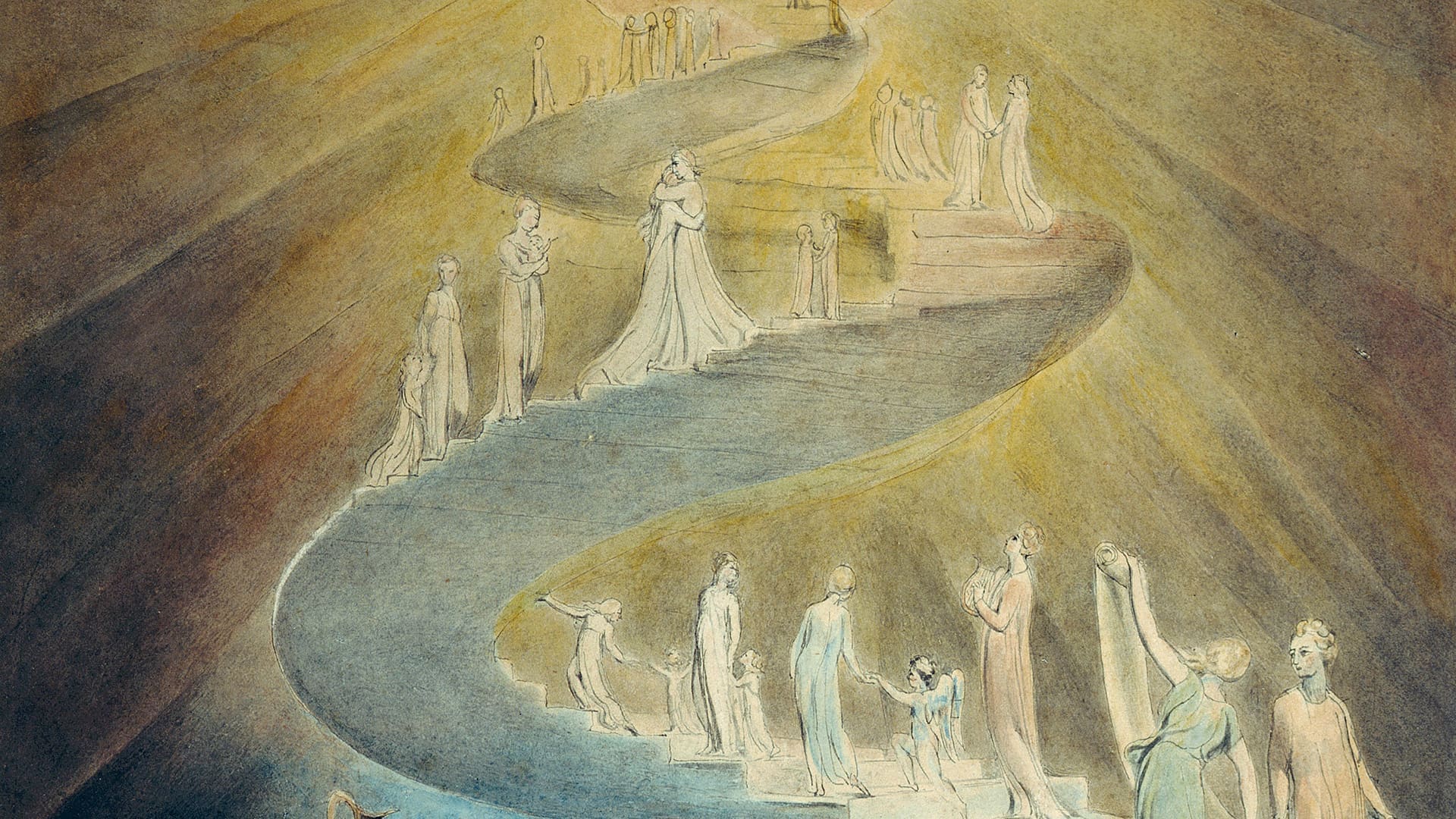
This system has no use for Jacob’s vision on the road from Beersheba to Haran: “And he dreamed that there was a ladder set up on the earth, the top of it reaching to heaven; and the angels of God were ascending and descending on it” (Genesis 28:12). The angels’ message—the message that both the celestial and the ecclesial hierarchies Dionysius describes were established to spread—is and has always been: God loves you.
The angels’ message—the message that both the celestial and the ecclesial hierarchies Dionysius describes were established to spread—is and has always been: God loves you.
Now the ladder is pulled up, and daily existence for many people has started to feel an awful lot like that fluorescent-lit fishbowl of office desks in “The Soul Is Not a Smithy”: a life sentence to perform rote work under dehumanizing conditions, with no exit in sight. What rough beast sits athwart this system I couldn’t say for sure, but it must be something much closer to Huītzilōpōchtli, the bloodthirsty Aztec god of sun and war, or Molech, who made children pass through the fire, than to God the Father, who fed his people with bread from heaven and brought forth water from a stone in the desert, and to God the Son, whose deep and abiding love for little ones is recorded in all three Synoptic Gospels. Its message I leave up to the reader to discern. Perhaps: You’re on your own.
A Small and Simple Order
On a weekday morning in early June, I and a dozen others had the opportunity to visit a Cistercian monastery nestled among dairy farms in southern Wisconsin. It was, in retrospect, the opposite of the claustrophobic setting of “The Soul Is Not a Smithy,” with all those trapped and inattentive parents and their trapped and traumatized children. Cloistered nuns take a vow of stability, which means they voluntarily live within the bounds of their enclosure, leaving only for necessary trips like shoe shopping (“because feet are what they are,” the mother superior quipped) and doctors’ appointments. Only a small crucifix above the altar and a single image of the Blessed Virgin Mary adorned the church. On the morning we visited, the sanctuary was filled with sunlight that was so pure it seemed white and that drew sharp, clean lines on the ceiling and walls. For a small plot of land deliberately kept separate from the world, it all felt remarkably expansive and free.
Though Cistercians normally keep silent during the day, our hosts were congenial and funny. They radiated a joyful integrity. No daydreaming or dereliction of duty for these women, who rise before the sun each morning to keep vigil for the Lord and to pray for the whole world. “God doesn’t need any of us,” the mother superior mused. “He’s God. But he chooses to need mothers and fathers. He chooses to need doctors. And he chooses to need contemplative religious to pray for people. It tells you something.” She didn’t tell us what.
The mother superior did, however, admit that she had prepared no remarks in advance and quickly asked the Holy Spirit to guide our conversation before opening up the floor to questions. When my turn came, I asked what she thought was the greatest problem facing society today; in my mind I saw deepening and rancorous divides in the body politic, global warming, school shootings, wars, fentanyl, suicides, and other deaths of despair all looming like giant storm clouds. After a pause, Sister Anne sidestepped the darkness without and zeroed in on the darkness within. “What’s needed in our world are God-centred people,” she began. “I think the whole pagan world recognized Mother Teresa was a saint. The problem is that we don’t have enough people who want to be holy.” Acknowledging the severity of the world’s brokenness, she continued, “We can’t undo that mess. God can. And he’s going to use human instruments to do it.”
So let us have heart. This life isn’t a rat race or a trap. It’s a vineyard, and we are each invited to be co-labourers with God. The surest way forward for Christians will be little, local, and guided by love. And we have it on good authority that any effort we make to pass on the gifts we have received from God, though it may never be logged on a spreadsheet or featured in an annual report, will not be forgotten: “Whoever gives even a cup of cold water to one of these little ones in the name of a disciple—truly I tell you, none of these will lose their reward” (Matthew 10:42).