


T
The Bible begins and ends with rivers. Streams water the ground of the Garden of Eden, and a river runs through the center of the new Jerusalem. And in between, river crossings and immersions mark the journey of God’s people. The ancient authors knew that water is as precious as God’s gift of life. We can’t have one without the other.
Today, as drought and misuse devastate many western streams, we are coming to see how right they were. Sobering reports outline the catastrophic decline of the Colorado River, water source for forty million Americans. Debates rage about the viability of the Snake River dams that are decimating one of the world’s most pristine salmon fisheries. The final twenty-five miles of California’s Kern River, fed by majestic Mount Whitney, now exist as nothing but an arid riverbed.
My story also begins with a river. The Spokane. Not a remarkable river by most accounts. Flowing a meager 111 miles, it lacks the importance of the Colorado. And unlike the Snake, where a few salmon still migrate back to their spawning grounds in the mountains, the Spokane’s population was completely eradicated in 1939 when construction of the Grand Coulee Dam blocked their route. But the Spokane enchanted me as a child and still does today. Growing up along its banks instilled within me a sense of wonder I haven’t outgrown. I’m only now coming to realize the formative power the Spokane exerted on my young soul.
The fish proved hard to find. But God was right there.
Since moving back to Spokane as an adult, I’ve made a point of rekindling my boyish love for rivers. I did what many of us did during the confines of COVID—I found excuses to get outside. For me this meant dusting off (literally) the fly-fishing rod and reel my grandfather gifted me as a child. And I’ve come to learn that fly-fishing can form habits of patience, stillness, presence, perseverance.
But for me fly-fishing has been more than merely formative. It’s been sacramental. Perhaps it’s a stretch to see “no clear line between religion and fly-fishing,” as Norman Maclean famously suggests in the opening line of A River Runs Through It. Yet the art of fly-fishing immersed me in the tangibility of God’s grace.
Where and Who We Are
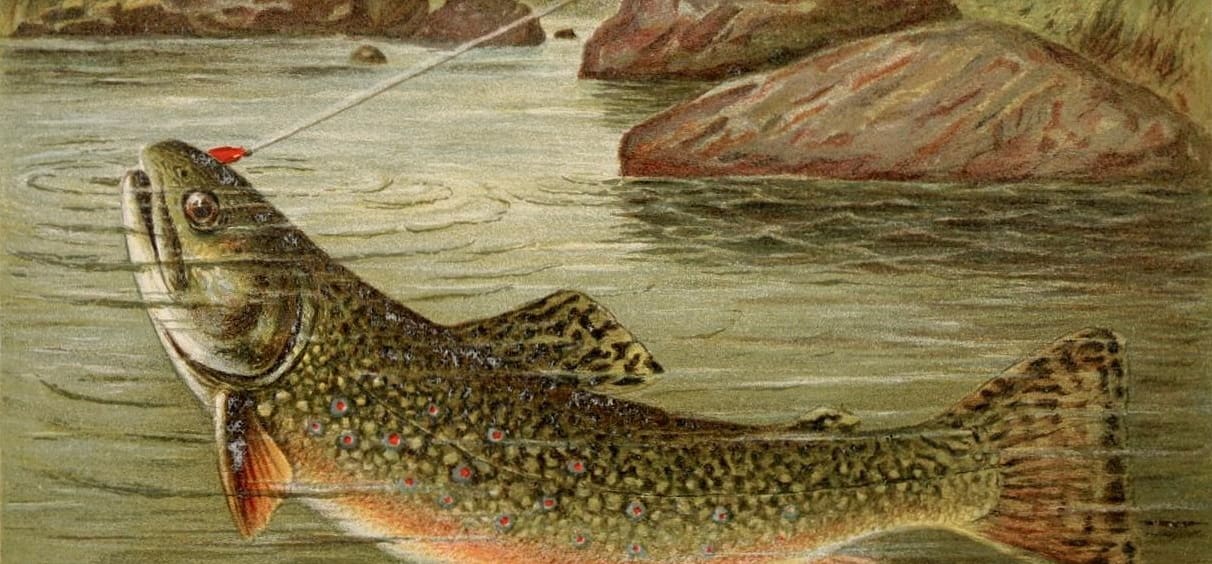
I realized this one morning as my pursuit of the native redband rainbow trout left me knee-deep in the swift waters of the Spokane River. As I paused between casts to take in the moment it struck me that what I was feeling against my legs—the steady flow of water moving from sky to mountain to stream to sea—was a life-sustaining force. I recalled Aldo Leopold’s narration of the “odyssey of an atom” on its oceanward journey. I saw in that moment that I stood at the midpoint of upstream and downstream—both of which extend into unknown times before and beyond my life. Standing in the river, my story is never wholly my own. Feeling the flow of water forced my imagination to expand. I couldn’t think of myself without thinking of all the other interconnected things.
Being a theologian, I also thought of the apostle Paul. If all things were created in Christ and in Christ all things hold together (Colossians 1:15–17), perhaps I was encountering Jesus in this river. The fish proved hard to find. But God was right there.
This realization has shaped my theological imagination in two important ways.
First, it taught me where I am. When I grabbed my rod that morning, I thought I was going out to be in nature. But I was wrong. I wasn’t in nature. I was a part of creation. Norman Wirzba gives language to this vital distinction: “To say that our world is ‘creation’ rather than a ‘corpse,’ a ‘material mechanism,’ or a ‘natural resource’ means that we need to see it . . . [as] the material manifestation of God’s love operating within it.” That morning I found myself immersed not merely in water molecules careening toward the sea but in the love of God that animates, orders, and sustains all things.
Second, it taught me who I am. The water swirling around my legs gave the sensation of being entangled with the river. In the water, there are no buffered selves. This opened my eyes to what Vine Deloria Jr. calls the “creatureness of all creation.” I was not merely in creation. I am creation. I’m no less a creature than the elusive redband trout lurking (so I’m told) in those deep pools. I’m no less a creature than the caddis flies dancing around my head. I’m no less a creature than the cool water on my legs and the gravity faithfully pulling it downstream.
And I’m no less a creature than the countless humans who, since time immemorial, have drawn their life from this river. Before Europeans moved in, this land’s native inhabitants survived almost solely on salmon. Some estimate the fish constituted a staggering 70 percent of an average diet. Dried and smoked, fish caught during the fall run could sustain a community through the year.
Many historians believe the Spokane tribes would welcome neighbouring tribes to share in the bounty. The gift was not theirs to hoard. During the annual salmon migration, tribes from surrounding regions would make their pilgrimage to the sacred falls of the Spokane River to receive the Creator’s gifts. It appears the tribes also knew how to say “enough,” for they met their needs without diminishing supply. Or perhaps it suffices to say they saw salmon as a gift, not a resource. God’s gifts of creation are indeed abundant, especially when we have the eyes to see it.
Creation and Desecration
We humans are creators too. I can’t help but think of those many experts who brought the Grand Coulee Dam into existence. In one fell swoop, they upended an entire way of life. Oral traditions among local indigenous communities recount the apocalyptic shift from pre- to post-dam life. Margo Hill, a member of the Spokane Tribe and a speaker of the native Salish language, recounts her great-grandmother’s cry upon being informed of the good news that her house would now have light bulbs: “But what will I feed my children?”
Christian theology—if it indeed holds a doctrine of creation—must acknowledge the benefits of our culture making, while still finding ways to feel the trauma our creations have wrought. Dams are useful. They take water and gravity and transform them into usable energy. They take a rapid-filled river and transform it into a series of easily navigable lakes. Cheap electricity and cheap shipping costs help the economy function. Life is indeed easier with light bulbs and barges. But the more we use the river for modern conveniences, the less salmon can use it for their life-sustaining migration. Dilemmas like this have no easy answers. If nothing else, the conversation forces us to grapple with the value of efficiency compared to the value of a salmon—a conversation that might compel us to ask if we even know what the word “value” means in the first place.
The scope of our environmental crisis extends far beyond rivers. The litany of its devastations hardly needs rehearsing. Some—ocean acidification, biodiversity loss, soil depletion—often fall beyond the limits of our vision and thus the limits of our imagination. Others press more heavily on us. I think of the 370-square-mile aquifer that feeds the Spokane River. It’s an amazing creature in its own right, deposited thirteen thousand years ago by the famous glacial floods that marked the transition from the Pleistocene to the Holocene epoch. The aquifer also feeds the half-million residents of this region. Turns out, these residents are creators too. Like God in Genesis 1, they deem it good when the earth puts forth vegetation—bentgrass and bluegrass in particular. The problem is that the love for green lawns collides with the brute reality of our dry summer climate. Some vegetation doesn’t belong here. The way beyond the impasse, we assume, lies in the aquifer buried beneath us.
Which presents another dilemma. How do we compare the value of a green lawn to the value of a healthy river? In my watershed, it’s becoming increasingly obvious we must make a choice. It’ll be one or the other. While the Spokane River is partly fed by snowmelt and runoff, like any other river, it’s also filled by clean, cool aquifer water emerging from the ground. Unlike runoff, which can become as warm as the sun makes it, aquifer water hovers consistently around fifty degrees, even during hot summer months. Without its cooling effect, trout would not survive. When human residents draw water from the aquifer—which they increasingly do during the summer at reckless rates—they diminish its ability to supply the river. During recent summers, the river’s maximum flow rarely reaches 1,200 cubic feet per second. A century ago, the river’s lowest flows were higher than that.
When I step into the river, I am stepping into a manifestation of the divine love that holds all things together. But I am also stepping into a devastation—often unseen and unfelt—that our creations and our poorly ordered loves have wrought.
Now What?
In most essays on Christian environmentalism, this is the place where you’d expect an impassioned plea to get to work, to make things better, to save the planet. I’m a fly-fisher, so I’m not an optimist. Anyone who chases a creature nicknamed “the fish of a thousand casts” believes more in failure than in success. I won’t give you an impassioned plea.
I would invite us to see, rather, that at the heart of our environmental crisis lies a human crisis. We treat the world as something other than creation, and we imagine ourselves to be something more than creatures. We’ve forgotten where we are and who we are.
Jedediah Purdy suggests “there are some kinds of problems that people can’t solve unless people change first.” I think he’s on to something. We need to be healed. Which is what Christians mean when they talk about finding salvation in Jesus. The apostle Paul again has wisdom to share. He suggests that when anyone is in Christ, there is a new creation (2 Corinthians 5:17). Given the nature of the crisis lying at the heart of our ecological moment, I would offer a timelier paraphrase: if anyone is in Christ, they must become a creature again.
We treat the world as something other than creation, and we imagine ourselves to be something more than creatures. We’ve forgotten where we are and who we are.
Humans have always been sinners and so have always needed salvation. Today, given the geomorphic dimensions our sin has assumed, the earth needs salvation too. Or at least our rivers do. Which I guess is just another way of saying we do. For the sake of all creatures, we must recover our creatureliness. If in Christ our creatureliness is renewed, we must now “work out” our salvation (Philippians 2:12) by developing habits of mind that would allow us to put on our creaturely form.
Here the academic in me wants to pause to qualify my use of “we” in the previous paragraph. Even if all humans share in Adam’s sinful nature, all don’t possess the same power or imagination necessary to perform this sin in world-destroying ways. Although we all, like the humans in the garden, chafe at our limits, only some of us suffer from what Willie Jennings refers to as the “colonial mutilation of our creatureliness.” It is particular humans, not humanity as such, who bear responsibility for environmental decay, just as certain residents, not all residents, are draining the aquifer flowing beneath me. This distinction may sound like a sophisticated form of finger pointing, but it actually holds a sliver of good news. Because the problem doesn’t lie with the human family as a whole but with certain members within the family, we know different ways of being human are possible. Our creatureliness has been mutilated, but it can be relearned.
Fly-fishing has immersed me in this learning. I believe it is a spiritual practice, one that draws me deeper into the material world of creation. It has aroused within me a desire to relearn what Rowan Williams calls “the art of creaturely life.” I’ll admit, of course, that you don’t need to be a fly-fisher to learn this art. You don’t even need to be outdoorsy. You just need to be a creature. Since you are a creature, you can be certain your life is entangled in the web of God’s life-sustaining love. You can be certain your life—contingent and finite as it is—depends on God’s precious gifts, water chief among them.
If we can learn to cherish this gift, we’ll be on our way to learning to live wisely within the limits of our creaturely form. Cherishing the gift of water—as with any good gift that comes from above—is a context-specific practice. To do so, you must learn to feel the texture of your place. For me, this means finding beauty in the native landscape rather than the imported fantasy of a green lawn. It means volunteering Saturday mornings to pick up trash deposited along our riverbanks. It means routinely immersing myself in the sacramental flows emerging from the aquifer. I can’t tell you exactly what these rhythms will look like in your watershed. But you should learn them.
Lest this sound like the plea I promised not to give, I would hasten to add that the art of creaturely life is not instrumental. We don’t live this way because doing so will save the planet. We live this way because we are creatures, not the Creator, and thus the planet is not ours to save. As we learn to embody within our creaturely lives the love that animates all things, we become living witnesses to our real hope: only the grace that sustains all things can save all things.
Because I’m a fly-fisher, I’m especially eager for this salvation to arrive. The prophet Ezekiel shares a vision of a river flowing from beneath the threshold of the temple: “Fisherman will stand beside it,” he proclaims. And “they will catch many kinds of fish” (Ezekiel 47:10). Come, Lord Jesus. Ezekiel goes on to suggest this river will heal the earth and its inhabitants. Which is to say, this river contains grace. Which is to say, it’s a river. I don’t know what river flows through your land. But I suspect you’ll find healing in its waters.