A
As I approached the austere, western end of Antoni Gaudí’s masterpiece, the Basílica i Temple Expiatori de la Sagrada Família, in Barcelona for the first time in April 1999, I was struck immediately by two sets of golden words in the sculpted Catalan text quoting St. John’s Passion. The words leap from the doors of Josep Maria Subirachs’s Passion façade: I què és la veritat? . . . Jesús de Natzaret, Rei dels Jueus, “And what is truth? . . . Jesus of Nazareth, King of the Jews.” The first portion is drawn from Pilate’s question to Jesus in John 18:38. In the biblical text, he does not receive a response to his question, for he asks the wrong question. The answer to the right question—Who is truth?—is standing before him: Jesus of Nazareth, King of the Jews (John 19:19).
Pilate’s question stands as a leitmotif for two thousand years of human experience. It is the question that, in some version, lingers in every human heart and mind: What is truth? Where do I find truth? Who is true? As simple as it sounds, the church has always insisted on the same answer: In what is probably the greatest encyclical letter of his long pontificate, Veritatis Splendor, St. John Paul II declares that “the decisive answer to every one of man’s questions, his religious and moral questions in particular, is given by Jesus Christ, or rather is Jesus Christ himself.” Increasingly today, many are asking the right question in the face of being told lies that they are no longer willing to countenance—and the most unlikely (or perhaps likely) thing is taking place: Christian revival.
This revival is an explicit recognition of our alienation from the divine and by extension from the image of God that defines the human person. Our false pursuits have led us, as they always do, into that most inhuman, yet so common, passion of ours: fashioning idols. There is the idol of my body: I can own it; I can change it; I can rename it; I can destroy it at will. There is the idol of my mind: I can know all things; I can experience all things; I can control all things. And finally, there is the idol of my soul: I can save the world; I can save others; I can save myself. We are convinced that the ideologies we have fashioned—materialism, hedonism, consumerism, relativism, transgenderism, wokeism—are there to order our sense of meaning with their respective creeds, liturgies, sacred texts, and mantras and their heresies, which we must reject.
As with all idols, these ideologies fail to give us truth and the fullness of meaning we seek. Our desire to understand ourselves, to understand the world in which we live and how it came to be, remains unsatisfied. In the end, nihilism sets in and we are bereft and lonely. We then return to a cycle of self-gratification and further consumption to fill the lonely spaces. This hyper-individualism is not liberating but fundamentally isolating as it precludes community, founded on our shared humanity. Deprived of community, we cannot find meaning. The things we sought provide no great revelation of truth, no lasting joy.
As people wash up on the empty shores of postmodernity, their desire for meaning remains, and they are profoundly disaffected by their wanderings.
Yet, amid this great miasma of meaninglessness and isolation in which we seem to be utterly anchorless, we find a light. Truth breaks through. He is revealed in the places where he has always been: in creation, in both natural beauty and human-authored beauty; in the goodness of people; in the love of friends; and in the authority of Scripture and the living tradition of the church in which he is continually revealed. In the past decade, we have seen and are continuing to see truly remarkable shifts that confound the secular orthodoxy that as societies modernize and become more secular, religion and religious creeds and practices decline and become less important. And as people wash up on the empty shores of postmodernity, their desire for meaning remains, and they are profoundly disaffected by their wanderings.
The Quiet Revival
In North America and Europe, this disaffection seems to be disproportionately manifested among young adults aged eighteen to thirty-five. A spring 2025 study by the Bible Society in the UK calls this phenomenon the quiet revival. CEO Paul Williams concludes in his foreword to the study that “the past few decades have witnessed a widespread empirical falsification of the secularization thesis, mainly because in all parts of the world except Western Europe the world has become more, not less religious. This report suggests that even this outlier may not remain so for much longer.” The conclusions of the report present a serious challenge to the idea that Christianity will continue to inexorably decline to the ultimate triumph of secularism. The report draws on two large, representative samples of Britons: a 2018 sample of 19,101 adults in England and Wales and a 2024 sample of 13,146 adults with a 1 percent margin of error at a 99 percent confidence level. Among the significant conclusions are the following:
- Thirty-three percent of adult churchgoers in England and Wales are aged eighteen to thirty-four.
- Twenty-one percent of men aged eighteen to twenty-four are regular churchgoers, compared to 12 percent of women the same age.
- In 2018, 28 percent of those surveyed believed in God. This jumped to 45 percent in 2024.
- Seventy-five percent of churchgoers surveyed agreed with the statement “my life feels meaningful,” compared to 49 percent of non-churchgoers. For the eighteen-to-thirty-four cohort these figures were 80 percent and 52 percent.
- In 2018, Anglicans made up 41 percent of all churchgoers. This dropped to 34 percent in 2024. At the same time, the percentage of Catholics among churchgoers increased from 23 percent to 31 percent. Among the eighteen-to-twenty-four cohort of churchgoers, 20 percent are Anglican, 41 percent Catholic.
The growth of Catholicism in Britain is striking. Further evidence of this trend is found in those being baptized and received into the Catholic Church. This past Easter, 500 new Catholics were received into the church at Westminster Cathedral, half of whom were catechumens, the not yet baptized in any Christian tradition. This was a 25 percent increase from 2024. Likewise, in the Diocese of Southwark (also in London) 450 people entered the Catholic Church this Easter—the highest number in a decade. Across the UK, especially in Catholic parishes administered by the more traditional religious communities such as the Oratorians and the Priestly Fraternity of St. Peter, priests are noting the numerous young men drawn to Catholicism. Is this the Jordan Peterson “take your life seriously” factor, or the impact of social media? Perhaps, but the draw seems to be something greater. Quoted in the Catholic Herald, Fr. Daniel Seward of the York Oratory concludes, “There is a sense of moral chaos and lack of meaning in today’s society. If people can find something that makes sense, provides meaning, and also gives community, which the Catholic Church does, they are going to be attracted to this, and I think this is particularly true for young men.”
The case of the rapid growth of Catholicism in Britain is mirrored in other highly secularized countries, including France and Canada. In France this Easter, 10,384 adults were baptized into the Catholic Church, representing an astounding 45 percent increase over 2024. Of those, 42 percent were young adults aged eighteen to twenty-five. The number of adolescents baptized into the Catholic Church across France increased by 33 percent over 2024. Astoundingly, between 2015 and 2025 there has been a 160 percent increase in the number of catechumens in France: 3,900 to 10,391. In Canada, 400 adults were baptized on Easter Day 2025 in the Catholic Diocese of Calgary, well above its five-year average. In British Columbia, one parish in Nanaimo has seen its average Sunday attendance increase from 650 worshippers to 1,100 between 2024 and 2025. At the same parish on one day in April 2024, several priests made themselves available for confession and 225 people showed up and received absolution.
Empirical Realities, First-Hand Experience
This empirical background undergirds my own experience as a Catholic cleric, specifically a Ukrainian Greek Catholic deacon. I have seen this revival first-hand, and I can tell you that it is indeed happening mainly among young adults, especially among men who seek authenticity, discipline, beauty, truth, and genuine human community. They have felt the keen lack of these things in their lives, and the substitutes on offer have proved to be lifeless and life-denying. As Psalm 115 says, “Their idols are silver and gold, the work of men’s hands. They have mouths, but do not speak; eyes, but do not see. . . . Those who make them are like them; so are all who trust in them.” Through the eyes of the world, these young people’s entrance into the deep waters of apostolic Christianity is nonsensical: Why would you want to limit your freedom to embrace a stifling tradition that always tells you no? But they have experienced the moral chaos of a freedom that is solely about the freedom to be free—a tautology if there ever was one. Instead, they have rediscovered the ancient truth that freedom is about disciplining yourself, taming your passions so you can be truly free to pursue what is good, true, and beautiful. This perennial reality is more attractive now than ever. In rejecting the idols of postmodernism, young adults are reordering their desires toward two interconnected realities: authenticity and tradition.
Five years ago, after a presentation and discussion I led on the high Christology of the central part of the Nicene Creed, a young man came up to me and said, “I have a lot of questions.” In our ensuing conversations, I found out that he had been baptized a Catholic but not raised one. A self-described atheist from his mid-teens, he had spent the four years of his humanities undergraduate degree reading Plato, Aristotle, and Aquinas. He had connected a lot of dots, but his searching had also prompted many questions. He found himself sitting one Sunday in a United Church congregation in Ottawa, then attending Anglican worship for many months, but neither of them quite satisfied. And now, here he was, asking me how he could come back to the Catholic Church. “You just need to go to confession, receive sacramental absolution, and then you can receive the Holy Eucharist,” I told him. “That’s it?” was his somewhat incredulous reply. “Yup, that’s it,” I said.
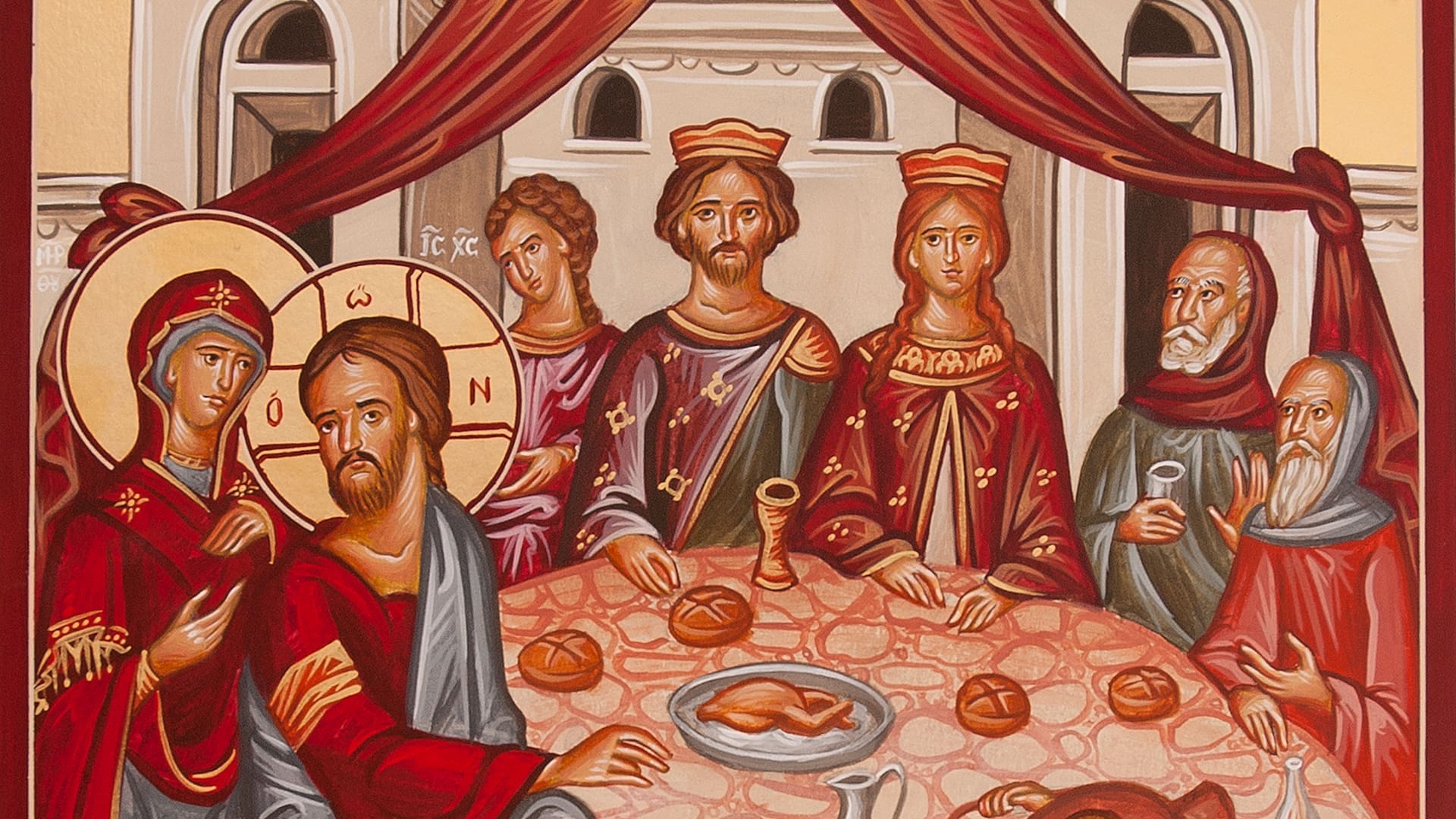
A couple of years later, having become deeply integrated into the daily liturgical life of the Byzantine rite, he was preparing to marry his fiancée, herself a deeply faithful Greek Catholic. In the Eastern Christian understanding, couples are literally crowned in marriage. They receive crowns as king and queen not only of a new domestic church but also as martyrs willing to die to self and live for the other. This is, to be sure, probably the least postmodern thing they could do. At the time I asked him, “Why did you come back to the Catholic faith you were baptized into?” His reply was stark in its simplicity: “Because it’s the truth, and I wanted the truth.”
The church triumphant cannot become the church triumphalist.
For those longing for the truth, it arrests them when they find it. It stops them in their tracks by its lack of dependence on them. It exists in and of itself. Christ himself is the truth, and he exists and is entirely self-sufficient because he is God. For those who desire authenticity, something that conforms to what they know deeply to be true and worthy of their trust, they find it in him and in his church.
We often define tradition, based on the Latin root traditio, as what is transmitted, handed over, or passed down, including beliefs and practices. But traditio has another meaning: surrender. I would assert that a related word is the Greek word doulos, meaning “slave” or “servant,” such as in the Greek name Christodoulos, meaning a servant or even slave of Christ. The young adults who are flocking to Catholicism, and also to Orthodoxy, are starving for something that is ancient, stable, unchanging, profound, beautiful, and true. And when they find it in tradition, they are happy to surrender to it, to be its servant, but not in some blind, coerced way. Rather, they want to exercise their free will to be bound by something that is both transcendent and immanent so they might be free. They want to be free to be anchored. They want to be bound so they might plumb the depths of a tradition that goes back to Pentecost, that has produced great saints—a holy tradition. This holy tradition, especially as it is expressed in the liturgical and devotional life of the church, captivates them, and they yield to it. It is not surprising, then, that the young adults who are filling Catholic churches are filling those that have a traditional liturgy. Whether it is the Byzantine Divine Liturgy or the traditional Latin Mass, they are drawn into its mystery and beauty, and they wish to remain there for as long and as often as they can.
A young man from a Roman Catholic background who was growing in his faith through a Catholic campus missionary movement came one day to our Byzantine-rite church in Ottawa with some friends. He stayed. He eventually asked whether he could be an altar server during not just the Sunday Divine Liturgy but also Saturday evening Vespers, and at every festal liturgy. As a priest friend of mine is fond of saying, “He has the look,” meaning that the person is amazed by the beauty of the liturgy and has been drawn in. Seeing “the look” in this zealous student, I said to him that it was beautiful to see how much he loves the liturgy and then asked him why that was. He replied that at university they are told that they can do anything, that they can achieve anything, that they are the authors of their own future, that they can change the world. Yet in the liturgy he came to realize that it’s not about him; it’s about Jesus Christ. Christ is the focus. The student’s next comment struck me for its profundity: “In serving the liturgy I’m free.”
In liturgy we are most fully ourselves as human beings. Here as servants of Christ we enter into that mystical reality that reveals the essence of our human vocation: to worship. Yes, we are Homo sapiens, literally “wise man,” yet we are also Homo adorans, Homo glorificans, worshipping or glorifying man. We are the only part of God’s creation that willingly worships God as our highest vocation. Trees, horses, trout, and duck-billed platypuses glorify God just by being what they are. As my young friend and thousands like him have come to realize, to become a wise human being one must be a worshipping and glorifying human being, putting God first, others second, and ourselves a distant third.
There Are No Laurels
This revival, as providential as it is, brings with it certain challenges. There are no laurels to rest on. It is no occasion to succumb to the temptation of pride and vainglory, boasting that we always knew we had the fullness of truth and thank God “those people” figured it out. The church triumphant cannot become the church triumphalist. We must, rather, rejoice humbly and with gratitude that the power of the gospel imbued with the Holy Spirit has drawn these young adults to Christ. In drawing them to himself he has blessed them with a zeal for truth, yet like any such desire it must be tempered and ordered. The zeal of the revert or convert to Catholicism must be tested and refined in the crucibles of discipline and prayer. Many of those drawn to traditional forms of the Catholic faith, especially traditional liturgy, are tempted to believe they are living a truly Catholic life, while those who attend a stripped-down Novus Ordo Mass with praise and worship songs are inferior. They have not understood Christ’s parable of the publican and Pharisee in the temple, which must be central to our spiritual life. “God be merciful to me, a sinner.”
Likewise, those zealous for the church must be zealous for all the Catholic Church teaches, not just what they think it should teach. Some growing parishes find that their young adults and especially young men are being drawn, often online, to purportedly faithful Catholic teachers who are nevertheless decidedly out of step with magisterial teaching. Some young adults, both converts and cradle Catholics, embrace old antisemitic tropes, such as Christ not actually being a faithful Jew, or sedevacantist ideas that there has been no legitimate pope or apostolic teaching since Pope Pius XII. This is a problem of both poor formation and poor discipline. Priests and catechists must enroll new Catholics into ongoing intellectual, spiritual, and liturgical formation so they might learn to live a coherent Catholic life in all aspects. Regular spiritual direction is essential for developing a daily prayer rule, acquiring the virtues and battling the passions, and daily encountering and growing in that Truth whom they have long sought and to whom they are now joined.
To be truly free we have to deny ourselves and our belief that we can fashion truth. Only then can we fully encounter the fullness of Truth. To freely plumb the depths of Truth, one has to be bound to it. And what glorious binds they are.