
O
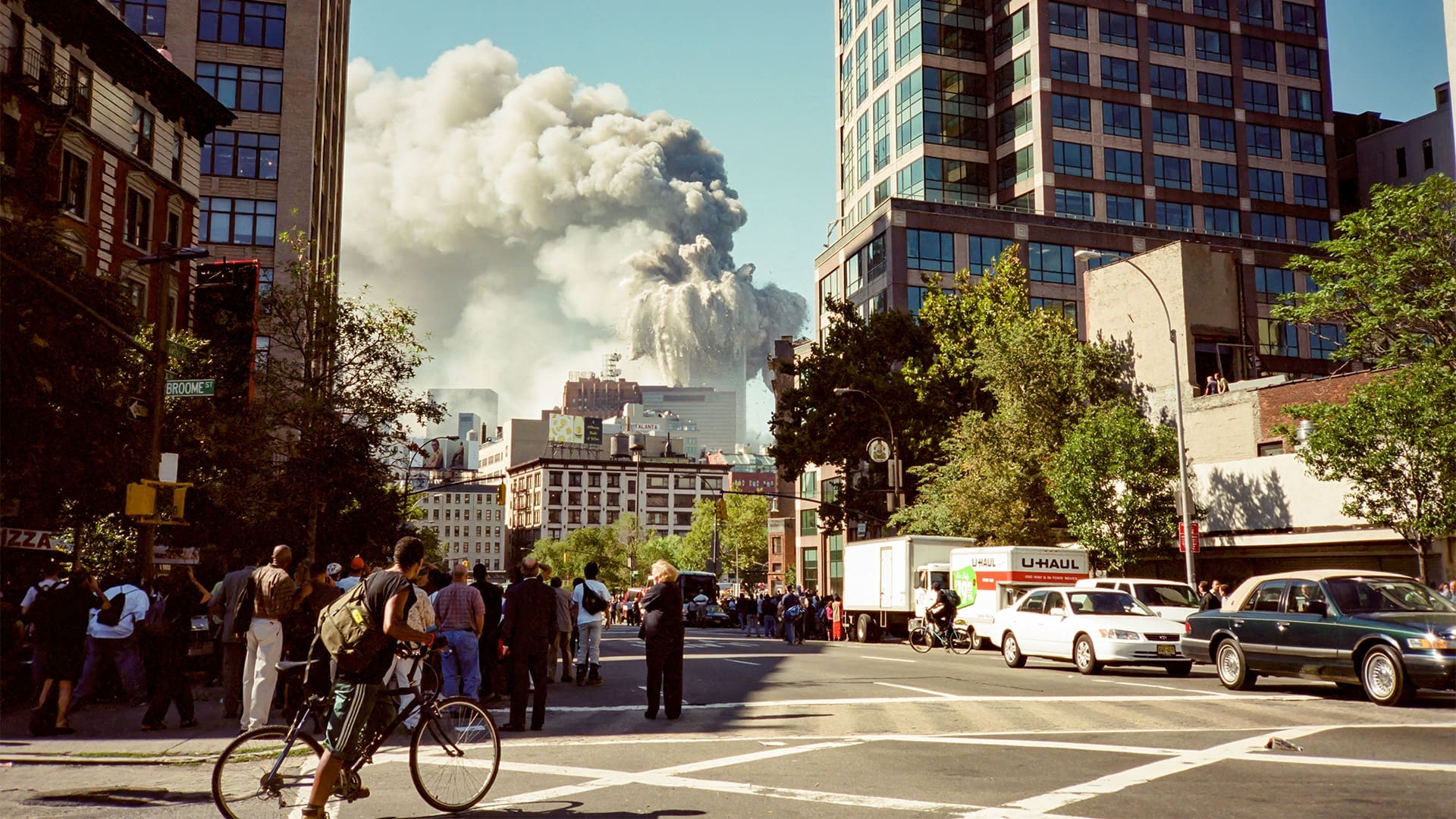
On September 11, 2001, my husband and I stood on our balcony just six blocks from the World Trade Center, watching smoke billow from the North Tower. Then, with a deafening roar, a jet tore overhead and crashed into the South Tower. We bolted—twenty-four flights down, me barefoot in pajamas, lugging our portly Boston terrier—racing toward Battery Park in blind desperation. When the towers collapsed, Brian and I prayed the Lord’s Prayer, calling on our childhood faith in a desperate cry for God’s mercy. Engulfed in a choking dust cloud, we were trapped in a toxic snow globe until an impromptu boat evacuation pulled us to safety.
Because our apartment was so close to Ground Zero, we couch-surfed, unable to return home and unsure of what to do next. We were told we could return less than two weeks later even though closed streets, collapsed subways, and shuttered businesses reminded us daily of the attacks. Worse, remains were still being discovered, while piles of debris stood almost right outside our lobby’s front door. Fires smouldered until mid-December. Rebuilding seemed impossible.
In the months that followed, I wiped ash from our floors and furniture daily, even as I struggled with survivor’s guilt. How had I escaped unharmed that morning when almost three thousand others had not? What if I had decided to walk the dog in the World Trade Center Plaza that morning, as I often did? What if Brian’s job interview inside the towers was scheduled for that day instead of later that month? I carried those questions into prayer, aching for answers.
Twenty-four years later, I believe survival was not the end of the story but a reprieve. My ongoing health struggles remind me that one day my name could join the list of casualties that began that morning. Yet even as my body weakens, I cling to the truth that my life rests in God’s hands.
I am less at peace with the uncertainties swirling around the government funds that were supposed to help take care of people like me. I also wrestle with my country’s promises. Will America “never forget” the survivors who now live with 9/11’s consequences?
Today, the World Trade Center site teems with life: a memorial and museum, a restored subway station, a thriving mall, street fairs beside the Oculus, the Perelman Performing Arts Center, and the rebuilt St. Nicholas Church. Restaurants, shops, and offices are packed. I take pride in that revival because when Brian and I returned, it was still a crime scene. We stayed because we believed presence itself was an act of defiance. We stayed because we believed God had a purpose and a plan for us.
During a 2019 seminar I attended, it felt validating to hear actor and activist Jon Stewart affirm our decision. “Did you feel the vibrancy on the street?” he asked a crowd of people who had lived, worked, or gone to school in the area after the 9/11 attacks. “Did you see the families, people walking their dogs and going to restaurants? Because that wouldn’t have happened without the courage of the survivors and the students who stayed here and didn’t allow this terrible act to drive them from their homes. Your presence stabilized a chaotic time.”
However, he said, that resilience came at a cost. That cost was becoming increasingly evident every year as more and more cancers and life-threatening illnesses were diagnosed among those who had been affected by the 9/11 attacks. “You’ve earned our respect, our attention—but also your own health care.
My ongoing health struggles remind me that one day my name could join the list of casualties that began that morning.
Stewart and many others have spent much of the past two decades urging the federal government to care for the many thousands of people who helped the country overcome the worst terrorist attack ever perpetrated on US soil. Nearly twice as many people have died from 9/11-related illnesses as died on the day of the attacks, and more than forty thousand people are experiencing lingering health issues. Victims can be found in every single state of the US and in Puerto Rico. What happened in New York City is now, twenty-four years later, solidly the entire country’s problem.
Many Americans are aware that a 9/11 fund exists to offer aid to those who qualify and need it. Fewer realize that Congress did not rush to create such a fund shortly after the attacks—it was established only after years of pressure from first responders, health-care providers, and advocates like Stewart. Fewer still realize that the aid has been placed in real jeopardy this year by the Trump administration’s budget and staffing cuts. The fight to ensure the US government will fulfill its promises to 9/11 survivors continues in earnest.
Like many people, I knew only the barest outlines of government efforts to care for 9/11 survivors, until I was diagnosed with cancer in February. At that point, my past began dictating my present in a fresh way.
Within days of the 9/11 attacks, the Environmental Protection Agency declared that the air in downtown Manhattan was “safe.” On September 21, our landlord emailed to say our building was “fully operational” and urged us to return.
Though we suspected that national and city officials were pushing for a swift return to serve their own agenda—especially to reopen the New York Stock Exchange—we were anxious to go home. We needed normalcy. We moved back on September 23, and it wasn’t long before students returned to class and office workers returned to jobs in our neighbourhood, although it was a long way from “clean.”
At the time, none of us fully realized that the crumbling towers had created one of the worst environmental disasters in US history, releasing particles of jet fuel, asbestos, cement, glass, and other deadly substances. Everyone within a radius that morning was exposed to this toxic soup, and cleanup efforts from “the pile” re-contaminated the entire district every day.
Since 9/11, I’ve suffered from several health issues, including an almost fatal bout with Covid in March 2020. In February I was diagnosed with uterine cancer, which has led to several surgeries, so I reached out to a law firm that specializes in aiding people with 9/11-related illnesses. Representatives from the firm, Barasch & McGarry, told me that uterine cancer had been officially linked to World Trade Center toxins in 2023, potentially qualifying me to receive health-care compensation from the federal government.
However, just being qualified for the funding did not mean I would receive it, they told me. That’s because both the funding and the staffing for the 9/11 programs have been severely undermined under the Trump administration. Those cuts have exacerbated problems that have been festering for years. While it has done just enough to allow most of the country to believe 9/11 survivors are being taken care of, in reality Congress has been putting Band-Aids over a festering wound for a long time. Fortunately, a determined group of battle-worn advocates refuse to be silenced or sidelined.
The history of funding for 9/11 victims is long and complex. Three weeks after the attacks, the Air Transportation Safety and System Stabilization Act offered payouts to survivors and to victims’ families if they would forego lawsuits over the airport security failures that allowed the hijackings. This initial effort evolved into the Victim Compensation Fund (VCF).
Access to the VCF was eventually expanded to assist widows of fallen firefighters and rescue workers who became ill while searching for colleagues in the rubble. But that fund closed in 2003, leaving anyone who got sick afterward to manage their health battles on their own. With no official support, many first responders and others died without care or compensation because of illnesses related to their work in or around the collapsed towers.
A 2021 documentary, Dust: The Lingering Legacy of 9/11, records the fate of many who became ill in the immediate aftermath of the attacks. Marvin Bethea was covered with the dust while working as a paramedic that day. He suffered a stroke five weeks later and continued to suffer serious health problems until his death in 2022. In the film, Bethea’s wife says, “I just assumed as a member of the public, that the government was taking care of all the 9/11 first responders and people that were affected by it. And it really isn’t true.”
In the years after the VCF was officially closed, a wave of cancers was documented among first responders and among the 50,000 students, 300,000 office workers, and 25,000 residents who lived and breathed the toxic dust in Lower Manhattan after the attacks. Doctors eventually began linking these cancers to the toxins released on 9/11.
Attorney Michael Barasch, who had been coated in debris while fleeing his office blocks on 9/11, lost staff to illness and was later diagnosed with prostate cancer himself. He and others fought to reopen the VCF, believing that the government should care for citizens whose 9/11-related illnesses were diagnosed later.
A major turning point came in 2006 after the death of thirty-four-year-old NYPD officer James Zadroga, who had spent hundreds of hours in the recovery efforts at Ground Zero. Zadroga was a healthy nonsmoker before 9/11, and an autopsy revealed that his lungs were filled with asbestos, lead, and glass—making him the first NYPD officer whose death was officially linked to exposure from “the pile.” His case led to the federal 2010 Zadroga Act, which established the World Trade Center Health Program (WTCHP) and reopened the VCF.
Originally designed to cover a limited list of illnesses, the program’s funding was set to expire after just five years, but its scope kept growing as doctors began seeing more diseases that could be linked to 9/11 exposure. With the funds facing constant threats of expiration, advocates such as Barasch, Stewart, John Feal, and others continued to lobby Congress to renew the program. On multiple occasions, gravely ill firefighters—some in wheelchairs, others dragging oxygen tanks—made urgent trips to Washington, DC, pleading with Congress to keep the lifeline alive.
A heated battle took place on Capitol Hill in 2019 to extend and fully fund the VCF. Footage in Dust captures Stewart’s emotional testimony before Congress as he blasted the lawmakers for forcing 9/11 heroes to continually fight for the care they had been promised. One firefighter bluntly asks, “Why does this bill have an expiration date to begin with?”
Congress has been putting Band-Aids over a festering wound for a long time.
The advocates won, and the VCF was extended through 2090—a near-miraculous victory after years of heartbreak and resistance. “The firefighters lifted the 9/11 community on their shoulders and carried it home,” Stewart says through tears in the documentary. “And I’ll always be so proud to have been associated with it.”
Unfortunately, the victory was short-lived. Although the VCF was extended through 2090, funding was not fully secured for the WTCHP. DOGE cuts scuttled a pending deal to include long-term funding, and the WTCHP was not included in the One Big Beautiful Bill signed by Trump in July 2025. The WTCHP and the VCF work hand in hand—if one suffers, both are weakened.
In addition, under the Trump administration, WTCHP staffing has been slashed, resulting in halted enrollments, delayed cancer care, and suspended research. Key medical staff and scientists were abruptly terminated, and the program has been operating on a bare-bones level. In this kind of chaos, survivors like me may lose access to vital services—just when we need them most. For cancer patients, delays can mean the difference between stage 3 and stage 4.
This should be a bipartisan issue that concerns all Americans. Cancer certainly doesn’t care whether someone is a Democrat or Republican, and it doesn’t care if that person is living in New York or Florida or Wyoming. New York lawmakers, including Senators Chuck Schumer and Kirsten Gillibrand, have condemned recent cuts to the WTCHP funding and staffing as a dangerous and disgraceful betrayal.
Stewart said the cuts could mean some 9/11 victims are “being punished for getting cancer later than other people.” Barasch was even more direct: “This is a national emergency. Cancer isn’t going to magically stop. If this isn’t reversed, 9/11 responders and survivors will die—needlessly.”
Bridget Gormley created the Dust documentary in memory of her father, Bill Gormley, a firefighter who died in 2017 from one of the sixty-nine cancers now linked to 9/11 toxin exposure. In the film, Bill Gormley’s sister says, “9/11 is every day for us. It never ends.”
It hasn’t for thousands of people across the US. And it hasn’t for me.
From time to time, I still wrestle with our decision to stay. But we didn’t remain just to prove New York’s toughness. We stayed because we believed light shines brightest in the darkest places. For me, that conviction came straight from Christ’s words in Matthew, calling us to be a city on a hill. Our presence wasn’t only civic defiance—it was spiritual testimony.
Now, on the twenty-fourth anniversary of 9/11, I know I’ll hear many promises that we will “never forget.” For me, that vow has meant sharing my testimony—how my faith was rebuilt in the ashes of that day. I’ve learned that “never forget” must also mean never forgetting the God who carried us through the fire. Though my body is weaker, my faith is steadier. Though I carry scars, I also carry hope. The dust that once suffocated me has become an altar—where I lay down my pain and remember that God’s presence was there in the darkness, and is still here now.
But remembrance cannot stop at ceremonies, memorials, or flags at half-staff. To “never forget” is also to never forget the human cost that unfolded that day and is still unfolding. It is to see, and fight for, the ones who survived that day but are still living—and dying—with its consequences more than two decades later.
“Never forget” cannot stay a slogan. It has to be a charge.