
W
When I was a child in the 1970s, my parents told me what thousands of other Jewish children of that era heard: “If you get lost, look for a house with a mezuzah and ask for help.”
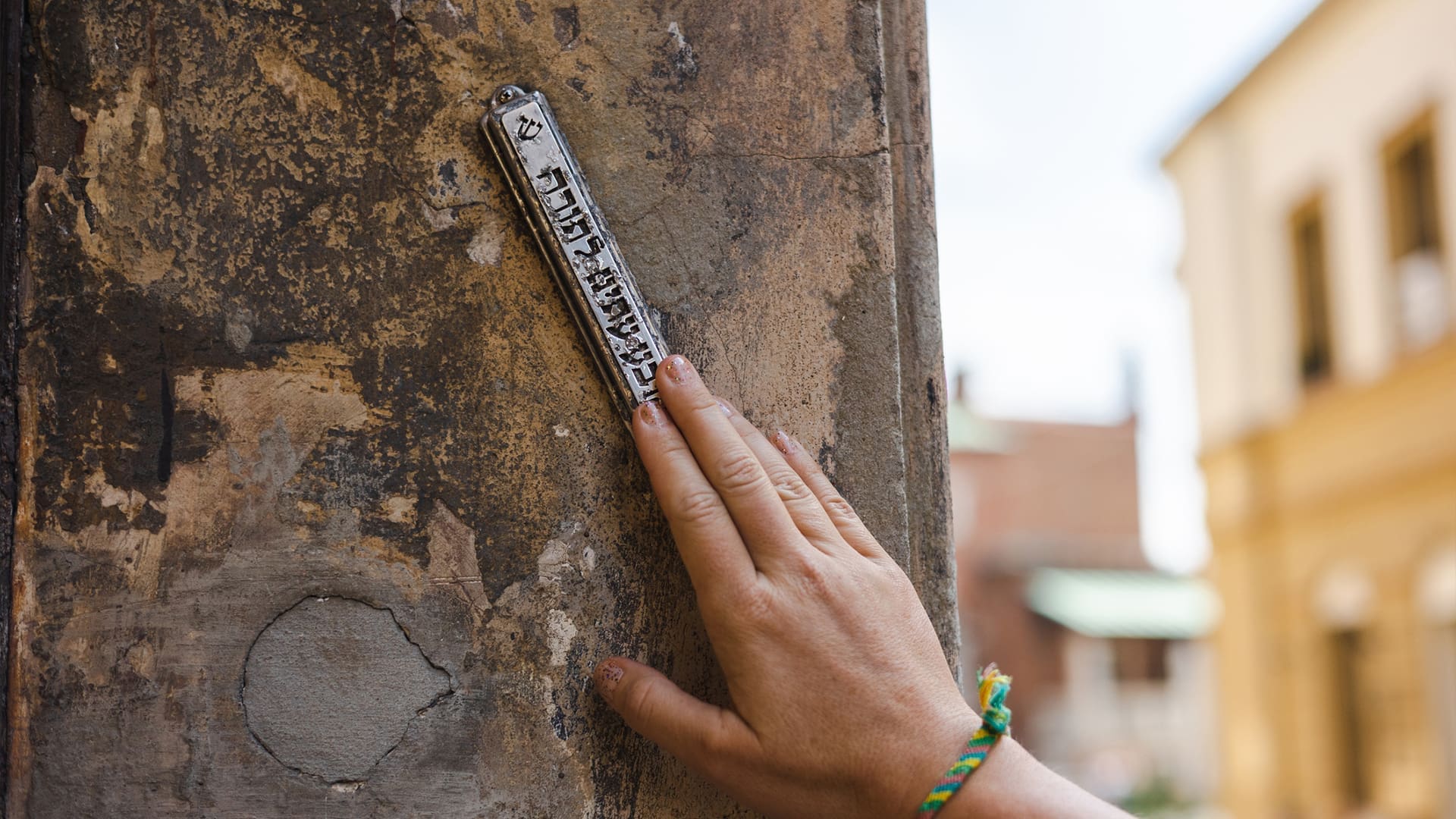
They were referring to the little case, containing a portion of Torah, affixed to the doorways of Jewish homes. For Jews, the mezuzah—based on the biblical command in Deuteronomy 6:9—is an outward marker of identity. It says one of “us” lives here, so this place is safe.
The common usage of mezuzah, however, is a mistranslation. In biblical Hebrew, the word refers not to the case with the scroll but to the doorpost itself. In Exodus 12:7, on the night before the tenth plague in Egypt, Moses instructs the people to mark their doorposts (mezuzot) with the blood of the Paschal lamb to protect their children from the angel of death. This is the first ritual moment when the rabble becomes a nation—the origin of the security I felt when coming across a mezuzah as I roamed the neighbourhood.
The mezuzah is the renewal moment for Abrahamic election. Yet, as the Torah demonstrates, the election it signifies can easily twist to legitimize self-defence, morph into prejudice or enmity, and curdle over time into supremacy. The needs of a particular community come to demand the elimination of abomination, and, eventually, the primal need for belonging inverts morality. Egyptian children die, Pharaoh’s army drowns, and the Israelites sing and dance. This is dominionism.
The Passover seder addresses this risk of dominionism in the section where Jews recount the list of plagues. The ritual requires that ten drops of wine be removed from a full cup to demonstrate that we cannot fully rejoice while enemies suffer. A comment attached to the story, featured prominently in most retellings, describes the angels celebrating as the Egyptians drown in the sea, until God rebukes them: “My children are dying, my children are dying.”
This is the theology of imago Dei, fundamental to Judaism and almost all religious traditions. It highlights the innate connection humans feel for other humans, including our enemies. Even if the Torah narrative needed dominionism to prove God’s absolute victory over Egyptian idolatry, subsequent generations retelling the story could not tolerate the atrocity unmitigated.
Imago Dei pulls against election’s slide into dangerous, extremist, dominionist ends. Once one imagines the humanity of the enemy, dominionism subsides. The transcendent bond establishes a floor for human behaviour and a ceiling for human aspiration. Between what we cannot do without offending Divinity and what we aspire for in our relations with the Most High, we establish terms of a covenant with fellow children of God.
The United States established this covenant in the Declaration of Independence’s transformative statement that “all men are created equal.” But even as Thomas Jefferson penned our founding words, dominionism’s ugly reach contaminated the parchment. The same document calls human beings “savages,” and its writers built their lives on chattel slavery. The ideals of European Enlightenment spread on waves of worldwide plunder, etched in the bricks made by American slavery. If all men were created equal, then some humans simply weren’t men. God’s image could not be insulted if it was not embedded in them to begin with.
Thus Jefferson could write his famous words and go home to rape Sally Hemings. Emma Lazarus could proclaim worldwide welcome while Congress passed the Chinese Exclusion Act. The US could work to save the world from fascism while imprisoning its own citizens in concentration camps. Brown v. Board of Education could happen during Operation Wetback. Our version of election—the elevation of imago Dei that makes us special as Americans—has always been intertwined with dominionism.
The Bible teaches in its first chapters that while we might be created in God’s image, we nonetheless kill, maim, enslave, and abuse each other. We have not stopped doing so. The United States, and much of the world, is locked into what appears to be an endless cycle of one-term incumbents partly because dominionism is on the march. Every election is existential, and every defeat demands dancing on the enemy’s grave. As we watch the gleeful cruelty of the Trump 2.0 administration—whether it is talk of traumatizing federal workers; the embrace of dehumanizing language about women, immigrants, or trans children; the encouraged viciousness of ICE; the desire of the Department of War to recklessly use AI on autonomous weapons; or the impulsive and unauthorized use of military force around the world—the question is how to pull the country out of its dominionist trajectory and toward imago Dei.
Unfortunately, dominionism cannot be defeated with more dominionism, for to attack it is to prove its need. Hydra-like, it grows from the energy thrown against it. Neither can one counter dominionism by attacking the feeling of belonging at its centre; Hillary Clinton tried, and people made “deplorable” T-shirts. That is because dominionism is an extreme form of divine election, and in the United States this rhymes with our national narrative of aspiration. The dominionist believes she stands for the national good, against opponents who threaten destruction. A counter-dominionism just proves the point.
The only way to defeat dominionism is to strengthen a theology of imago Dei that draws the public away from the dangerous desire to consider oneself elected over an enemy deserving domination. Strategists of nonviolence throughout history have done exactly that, dramatizing dominionism’s evil by choosing the most basic and universal human behaviours—marching to make salt, asking to sit at a lunch counter, or seeking to sanctify love through marriage—because these things elevate God’s image within the human. Opposition to such fundamental needs exposes dominionism’s willingness to insult that image.
That these successful movements against dominionism emerged after World War II is no accident. The twentieth century’s astounding level of carnage transformed humanity’s imagination by illustrating the extreme danger of dominionist thinking. When piles of corpses surpassed Himalayan scale, and Hiroshima demonstrated the potential for even greater death, who could ignore or justify such degradation of God’s children?
Dominionism cannot be defeated with more dominionism, for to attack it is to prove its need. Hydra-like, it grows from the energy thrown against it.
Under a post-war memory cloud, humanity moved toward greater overall equality. However imperfectly, poverty declined, economic development spread, democracies sprouted, human rights ascended. Imago Dei was on the countermarch.
Today, that march has become a limp. Those of us who believe in liberalism largely take imago Dei for granted. We lack the communal rituals and historical memory to see the revelatory concept for what it is. In my own branch of the Jewish world, the Reform movement, nearly every article, sermon, and public statement includes mention of human creation b’tzelem Elohim, the Hebrew used in Genesis 1:27: “And God created man in his image, in the image of God he created him, male and female he created them.” But this morass of overuse creates sloppy understanding, and imago Dei lacks dominionism’s potency.
We are living less in a theological crisis and more in a theological collapse, because what should be the revelatory bedrock has become an optional add-on. In late January, after the peak of the ICE crisis in Minneapolis, Peter Wehner argued in The Atlantic that “what has to precede depolarization is resolute defiance of attempts to violate America’s core ideals.” We need to stop thinking about bridging the crevasse separating partisans and start demanding that “all men are created equal” be prerequisite to all other debates. Yes to defiance. But how?
Imago Dei’s weakness as political platform stems from two enormous cognitive problems. First, since we cannot fully grasp the image of an unknowable, ineffable, eternal God, we can hardly understand how that Presence exists in humans. Second, even if, on faith, we fully accept God’s Presence, the implications of that Presence are infinite. This is the flaw that my favourite Jewish theologian, Emmanuel Levinas, underscores when he says that to gaze into a human face is to both glimpse eternity and take the other’s life into one’s hands. God’s Presence, if taken to its logical extension, is paralyzing.
Layer on top of these challenges the asymmetry of dominionism’s strength. Imago Dei is expressed as moral conviction in one’s character and appears outwardly in action through restraint. By contrast, dominionism appears decisive, animated, muscular, and effective—especially so when channelled into devices supercharged for attention addiction and the amplification of mass terror.
As Americans have sorted geographically and technologically into echo chambers and like-minded cultural silos, we have lost the skill of seeing God in those with whom we differ. To build a robust political theology of imago Dei will require what Martin Luther King Jr. once called dramatization: cognitive encounter with the truth of God in the other. The power of this experience can be deep, soulful, and transformative—powerful enough to arrest dominionism’s asymmetric cultural strength. And this encounter happens where we began: at the mezuzah.
The Torah mentions the word “mezuzah” only one other time: Exodus 21:2–6, in the long list of laws following the Ten Commandments. There, we find instructions for the slave who refuses to go free. In a precarious moment of extreme power imbalance, a person willing to forever forgo liberty grants another person god-like power over his life (and presumably the lives of his wife and children). It is an endorsement of absolute dominion of the master over the slave. In such cases, Moses instructs: “He shall be brought to the door or to the mezuzah and his master shall pierce his ear with an awl; and he shall then remain his slave for life.”
On its surface, this act seems to desecrate imago Dei by establishing a state of permanent domination between one human and another. But at the doorpost, in this ritual between the two men, the Torah seeks to prevent that desecration while still acknowledging the reality of power imbalance in the ancient labour system. The law describes the world as it is, but the ritual describes the world as it ought to be. The procedure is a spiritual practice intended not for purely religious purposes but to help sustain the rules of the political order. The permanent slave status threatens imago Dei’s place in that order by allowing dominion between people. So the ritual acts as a civic pedagogy, with four elements to prevent the desecration of God’s image in humanity.
First, note the intimacy of the act. This is imago Dei’s first requirement. We counteract the cognitive impossibility of imagining God by physically encountering the body and presence of another human being, what Levinas calls the power of the face. To build a robust politics of imago Dei in our time, we will have to establish vast networks of embodied experience. For example, the immense power of technology must be used against the companies whose algorithms seek to keep us locked into screens, and be used instead to facilitate physical encounter. It is the difference between messages broadcast for virality on X and the organizing that happens through Signal groups. Imago Dei thrives when we sense the totality of other human beings.
Second, note the historical resonance of the act. Rashi, the greatest of all Jewish commentators, argues that the text wants to connect the moment to Exodus 12, bringing together the two mezuzah references. The power imbalance is enacted in the very spot where the Israelites once splashed the blood of separation and salvation, and where generations of Jews will later affix an excerpted scroll of Torah. The resonances create a rich web of contextuality. In our political society, imago Dei must be cultivated through the specificity of storytelling, the power of ritual, and the wisdom of history and tradition found in religion.
In our political society, imago Dei must be cultivated through the specificity of storytelling, the power of ritual, and the wisdom of history and tradition found in religion.
Third, the two individuals confront their power imbalance at the entryway of the home. Gateways, like citizenship, are often potent weapons to exclude outsiders and privilege insiders. But this is not a private act hidden away, nor is it entirely a public act separated from the security of an interior space. On the threshold between private and public, the power imbalance between slave and master rests in a larger communal framework and structure of accountability. Here, citizenship demands certain limits on the empowered party, established in a place for all to see. This teaches us that imago Dei will thrive as political philosophy when our entryways confer as much obligation as privilege.
Lastly, mezuzah is permanent. Each passage through the doorway, including a brief touch or glimpse at the mezuzah scroll, the nail mark of the piercing, and perhaps even the stain of blood on the wood, becomes a reminder of the act. A commitment to imago Dei must be cultivated as a lifelong pursuit. We must stop assuming imago Dei is the default background of modern life and start creating regular reminders of its critical importance and power.
Many a thinker has argued for the resurgence of religion and congregations as key vertebrae in the civic backbone of American democracy. I am a congregational rabbi, so I am biased toward my institutional situation. I have spent the better part of a decade creating tools and seeking ways for congregations to revive civic culture. I have seen the benefits internally in healthier governance, reduced toxicity, and improved working conditions (not a small factor in a world where the clergy pipeline is a trickle). I have theorized the benefits externally as I imagine congregants, formed by a healthy civic culture, bringing those habits into the larger world.
But I have found that the vast majority of clergy and congregational leaders lack awareness of their institution’s potential to reinforce imago Dei in civic culture. The topic of civic stewardship is not taught in seminary, encouraged at lay-leader conferences, written into curricula, or included in liturgical innovation. In my work at the intersection of faith and democracy, I am often the only congregational clergyperson present. In fact, for a variety of structural reasons, leaders of national faith organizations and denominations are incentivized by philanthropy to disempower local congregations. Meanwhile, houses of worship often stubbornly protect their identity as spiritual bubbles outside secular culture, preferring to keep conversation of public civic behaviour away from the congregation.
When congregations do engage civically through voter forums, meetings with elected officials, community-organizing actions, advocacy breakfasts, prophetic preaching, or protest promotion, these actions frequently ignore, sidestep, or even degrade true civic character or culture. A theology of imago Dei—which helps form civic character, sets boundaries for civic behaviour, and fortifies civic norms—is cast aside in favour of a particular political agenda. Religious leaders regularly invoke God’s image in service to a policy while showing contempt and disgust for opponents of that policy.
Nevertheless, imago Dei still sits at the centre of almost all authentic Western theological traditions. Commitment to religious integrity requires an unwavering elevation of this aspect of belief, even if we cannot achieve Levinas’s level of infinite obligation to the other. Congregations, as the retail, theologically particular, locally rooted purveyors of religion, are supposed to connect individuals to those traditions. It is precisely through the embodied encounter with other humans, all yearning for transcendent meaning, that we can open the self to the presence of God in our fellow human.
In other words, we discover the most powerful love through the messy, hilarious, honest, awkward experiences we have with each other. Congregations take the normal spark of love we find in social interactions—the laughter of friends, the reassurance of a bedside hospital visit, the light of a student’s sudden understanding, the satisfaction of sharing a successful project—and place that experience into theological context. The little actions one does become part of a covenantal story stretching back to spiritual ancestors who received revelation and stretching forward to spiritual descendants who will one day come to the future redemption.
That is why congregations matter. The love that exposes and highlights imago Dei flourishes primarily within an institutional container capable of fostering and celebrating its presence. The four lessons of mezuzah—embodiment, connection to story, public/private scaffolding, and re-encounter over time—are core pillars of congregational life. For religious leaders, connecting these features of religion to the formation of civic character, the health of civic culture, and the survival of liberal democracy may be a paradigm shift or a leap of imagination, like using the ritual space of mezuzah to cement the expectations of labour servitude.
Fortunately, congregational religion, lived out in local communities everywhere, already enables the lessons of mezuzah and has the structure necessary to build a robust political theology of imago Dei. Through a commitment to a stronger democracy and improved civic culture, we may transform perceptions of religion and help bring more people to faith. We may ourselves come to embody the mezuzah, pointing all those made in God’s image back to our heart’s home.