

There’s a needle many pastors have spent the last decade trying to thread. Speak to the moment and you’re called partisan. Stay above it and you’re called silent. Speak prophetically and you’re accused of politics; refuse politics and you’re accused of abandoning the prophetic.
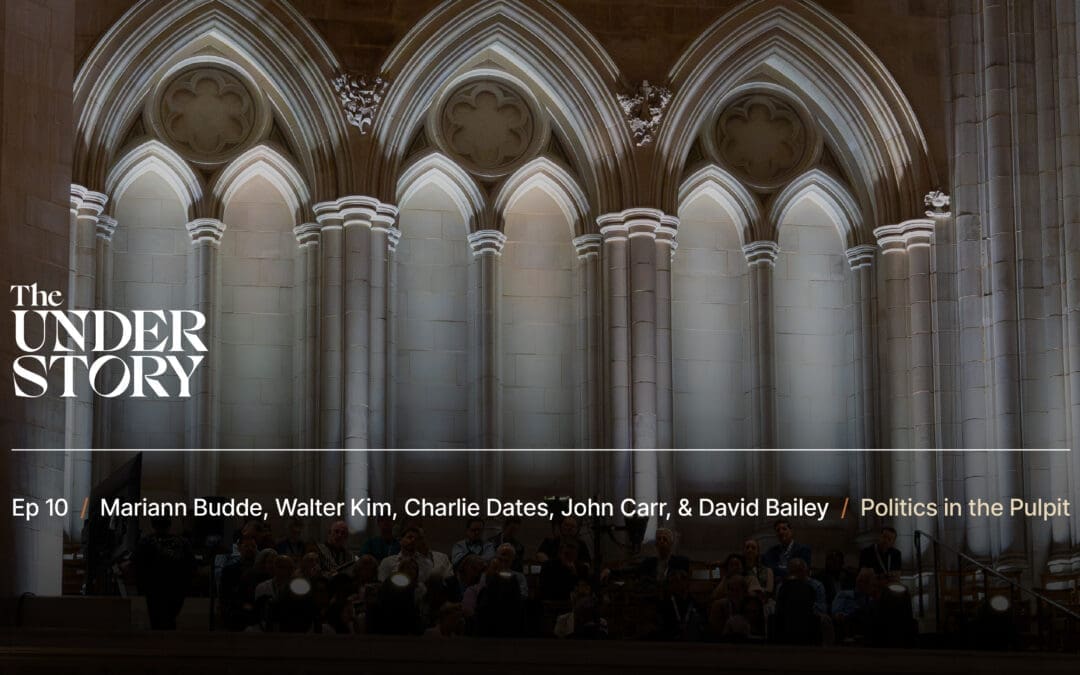
On the second day of the Understory festival, four leaders from four distinct Christian traditions sat down to consider that question. From the West Balcony of the National Cathedral, they gathered within sight of the very pulpit where, a little over a year earlier, Bishop Mariann Budde had addressed newly inaugurated President Trump in a sermon heard around the world.
Back at the cathedral in the context of the Understory, Budde joined Charlie Dates of the Black Church, Walter Kim from evangelical Protestantism, and John Carr from the Catholic tradition. Long-time Comment friend David Bailey—pastor, reconciler, and founder of Arrabon—guided the conversation.
Their task wasn’t to settle what pastors should say about politics but to recover an older map—one that recent years have too often flattened into the politics of red versus blue. How does a preacher distinguish biblical conviction from cultural conditioning? How does the church speak to power without becoming its chaplain, or refuse quietism without becoming partisan?
What emerged wasn’t a debate over who had the right political posture so much as a glimpse of the church’s own richness: four ecclesial imaginations, each shaped by a different history and carrying a distinct inheritance about preaching, conscience, public witness, and the vocation of the pastor.
