I
In the fall of 2022, for the first time in nearly two decades, I found myself walking into a job interview. At almost fifty years old, and for reasons I only barely understood, I sat nervously on a couch in the middle of an empty restaurant waiting for the job interviewer to arrive.
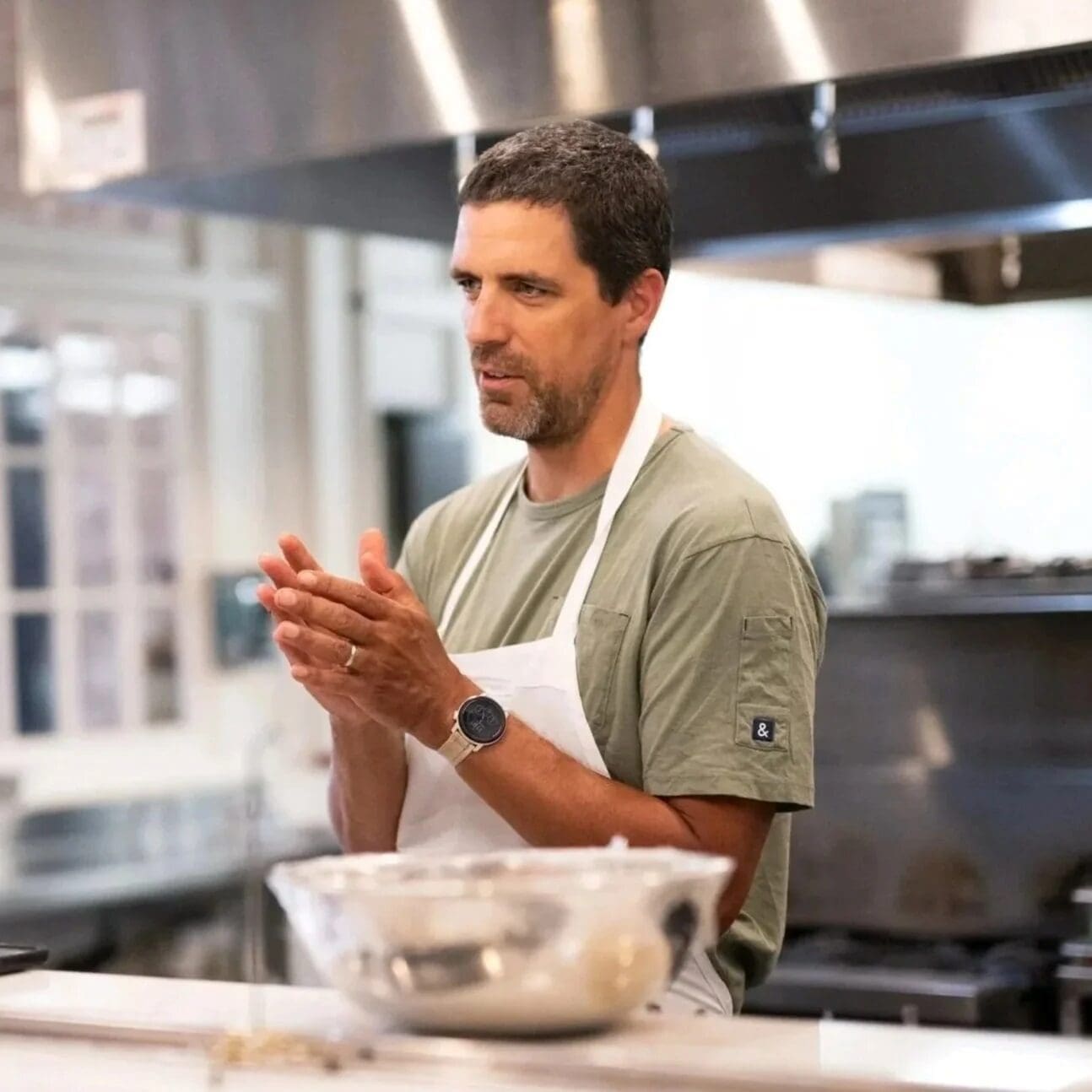
The interviewer was chef Tucker Yoder, and the job was a cook position at his newly opened, much-anticipated restaurant, Broadcloth. Tucker is one of the most talented chefs in the mid-Atlantic as well as one of the most unpretentious—a rare combination. Perhaps just as rare, his food is both highly technical and broadly accessible. Given these things, as I waited, I was excited about the prospect of having a spot in his kitchen. I also felt like I was going to barf.
True to his reputation, Tucker came walking out of the kitchen in cargo shorts, rope sandals, and a T-shirt, carrying two freshly made espressos. Setting the coffees on a low table in front of the couch, he shook my hand, sat down, and began the most casual interview imaginable. We talked about our lives, cooking, the best meals we’d ever had, inspiring chefs, and his vision for the restaurant. We talked about what he needed from the position and the weekly rhythms of the kitchen. After half an hour, I was all in. Well, almost all in.
As the interview wrapped up, he asked me if I had any final questions. “Actually, yes,” I said. “I’m not sure how to say it, but . . . is this by any chance a diva kitchen?” Noting his puzzled expression, I clarified: “I mean, for example, what role do screaming, psychological torture, and public humiliation play in your kitchen?”
After taking a moment to register what I’d said, he laughed out loud, raising his hands in protest. “Listen,” he said, “I’ve worked for all the divas, and I know that type of kitchen. That’s not what we do here. One of the main reasons I started this place was to do something different than that.” Okay, so now I was all in. Sensing as much, he asked if I could start the following week. I said yes, we shook hands, and he gathered up the empty espresso cups. As he walked back to the kitchen, he said, “Bring your knives.”
Reflecting on that conversation now, it strikes me that not once, in all my other experiences of formal interviews—for greenskeeper, bag boy, tree farm worker, PhD student, pastor—did it occur to me to inquire about verbal and psychological abuse. (In retrospect, this may have been short-sighted.) Why, then, when it came to cooking, was I nauseated with this concern?
The reason is that this is often how kitchens, especially famous kitchens run by men, actually operate. We’ve heard the stories of psychos like Marco Pierre White and Charlie Trotter or seen the videos or read the mea culpas of reformed man-babies like David Chang or Gordon Ramsay. I had personally read enough chef biographies, watched enough food shows, and heard enough stories from chef friends like Jock Zonfrillo to know that this most nourishing of arts can attract some of the world’s most vampiric people.
The year of my interview with Broadcloth also happened to be the year in which a film called The Menu and a show called The Bear thrust the toxicity of the kitchen into the centre of our collective imagination. For those psychologically fortunate enough not to see it, The Menu tells of how the wildly talented chef Julian Slowik invites a curated group of guests to his remote island restaurant, Hawthorn, to consume an elaborate menu and, in the end, be consumed themselves. The Bear, which aired its fifth season this past summer, tells the story of another wildly talented chef, Carmen Berzatto, who returns to Chicago from the dizzying world of Michelin stars to salvage his dead brother’s small neighbourhood sandwich shop, The Original Beef of Chicagoland.
On the surface, the two are very different. The Menu is cold, remote, controlled—a progressively darkening comedy-horror that leads the viewer course by course more deeply into the surreal. The Bear, by contrast, is a heated, out-of-control, intimate show that transforms the viewer into a member of a dysfunctional family, an unwilling participant in its stress, pain, and anger. Yet in important ways they are the same: Each anchors its story in the kitchen and at the table and is centred on the psychoses of a brilliant chef. Each is filled with a cast of characters struggling in their own ways to navigate their lives. And most importantly, each confronts the viewer with a question: How are we to live in a world that refuses our control?
Like the characters in The Menu and The Bear, we, too, find ourselves confronted by the inescapable realities of fragility, loneliness, tumult, and disorientation. We, too, bear the weight of the question of how to live in a world that refuses our control.
Like the characters in The Menu and The Bear, we, too, find ourselves confronted by the inescapable realities of fragility, loneliness, tumult, and disorientation. We, too, bear the weight of the question of how to live in a world that refuses our control. In the end, The Menu and The Bear offer us different answers to that question and, in this, confront us with an important choice.
Modernity on Endless Loop
When I was entering the world of cultural, theological, and sociological scholarship nearly thirty years ago, one of the first words I learned was “modernity.” It was always uttered in tones at once expansive and vaguely conspiratorial. I heard it in sermons and read it on book covers. I took notes on it in lectures and argued about it in university pubs. No matter the question, it seemed, modernity was the answer.
But what exactly is modernity? Initially, I deployed the term rather vaguely, as a synonym for anything I thought C.S. Lewis wouldn’t approve—modern art, modern music, modern haircuts. Over time, however, I began to realize that modernity was much broader than this, best understood not as a series of cultural artifacts but as an entire cultural order.
Some describe modernity as an epistemological order, as a diminishment of revelation and a triumph of reason and romanticism in knowing. Others define it as an anthropological order that places neither nature nor nature’s God but the individual self at the centre of all things. Still others depict it as a rationalized, bureaucratized, and globalized institutional order that alters the shape and substance of organized community. And then there’s the view that considers modernity to be some complex integration of each of these, a comprehensive new world that fashions, and thus explains, virtually every aspect of contemporary existence.
At different times and for different reasons, I have found each of these views and their many derivatives useful in understanding the origin, development, institutional configuration, and impact of modernity on the lives we lead and the lives that lead us. All these years later, a great deal of that scholarship still shapes the way that I understand the world around me. Even so, I confess that a great deal of this scholarship has always struck me as a bit schematic—intellectually compelling but affectively remote. While I could see the framework, I never really felt seen by it. To see what I mean, does a question like “But what exactly is modernity?” make your heart race? I didn’t think so.
That changed for me when I encountered the work of Hartmut Rosa sometime in 2019. Like many theorists of modernity, Rosa explores its central themes: rationalization, technology, instrumentalization, alienation, and so on. But unlike others, he names the pathology at the heart of modernity in a way that I immediately and viscerally understood. That pathology is the need for control. In his 2018 work The Uncontrollability of the World, Rosa puts it this way: “The driving cultural force of that form of life we call ‘modern’ is the idea, the hope and the desire, that we can make the world controllable.” This, he suggests, is a sort of unifying existential urge common to each of the various epistemological, anthropological, and technologized revolutions embedded in what we call modernity.
This urge for control is also at the heart of much of our personal and collective misery within modernity. “It is only in encountering the uncontrollable that we really experience the world,” writes Rosa. “Only then do we feel touched, moved, alive. A world that is fully known, in which everything has been planned and mastered, would be a dead world.” For Rosa, our search for lives of control can never satisfy, because life and control walk opposite paths.
Hope. Desire. Feel. Touched. Moved. Alive. These are the kind of emotionally—even spiritually—inflected words that I had been looking for. Rather than offering clinical observations of the structural dynamics of the modern world, Rosa points beyond these things to the unrequited hunger at their heart, not saying less than other theorists but, in the spirit of Augustine, Rainer Maria Rilke, Simone Weil, and Ernst Bloch, somehow saying more.
Rosa is disconcertingly clear that our drive for control can never bring about the lives for which we long but only lead us to a form of deadness. The paradox at the heart of his diagnosis is that the project of control produces the opposite of what it seeks. But Rosa’s vision is not a tragic one; he doesn’t leave us locked in some Tantalean standoff between longing and longing unfulfilled. Instead, he offers an alternative way of inhabiting the world that he describes as resonance—a relationship to the world predicated not on control but on encounter, in which we reach toward the world and the world reaches back. This is more than a metaphor. It is an entire way of being, at once epistemological, psychological, and technological, which views the self and the world as alive and capable of reciprocal address.
This is precisely what the control project abhors. The controlled world is an unresponsive world, and the person who controls it has made themselves unreachable by it. The way out of modernity’s absurdist escape room is not—as the tech bros and wellness gurus want us to believe—the re-entrenchment of control through endless self-mastery and technological innovation but the renunciation of control in favour of relationship. In this respect, Rosa’s work is not an analysis but an invitation to choose between two ways of inhabiting the world: control or communion. This choice leads us, as all important things do, back to the kitchen.
Controlling the Chaos
It makes sense why the makers of The Menu and The Bear would situate their meditations on control in the context of a professional kitchen—aspirationally, at least, one of the most high-control environments in contemporary cultural life. This was not always so. For many years, Western professional cooking in pubs, taverns, and inns was notorious for being a darkly riotous undertaking characterized by heat, violence, drunkenness, and filth, barely a half step removed from piracy.
One of the main contributors to this chaos was structural. In the years following the French Revolution of 1789, commercial kitchens much as we know them now began to emerge for the first time, a development largely driven by the displaced household cooks of recently beheaded aristocrats. Still, for most of the next century, commercial kitchens continued to operate on the system inherited from those large domestic kitchens. This system was largely defined by a “one cook, one dish” principle, in which a single cook was responsible for every aspect of a given dish. In domestic kitchens, even those serving large households, this approach was sufficient for the task at hand. Menus were predictable, and guest lists were relatively small. However, as the rudiments of restaurant culture began to emerge, the old model began to falter under the crushing demands of commercial scale. Descriptions of these early kitchens portray an utterly chaotic scene in the kitchen: cooks competing for ingredients, counter space, and ovens; dishes coming to the table at different times and temperatures; and all of this taking place in what were typically tiny basement rooms that felt much like ovens themselves. One can understand the violence and the drink.
In the late nineteenth century, as Western industries were transformed by the rationalizing forces of the industrial age, the kitchen was transformed as well. In the culinary world, this transformation was largely driven by French chef Auguste Escoffier. Responding to the newly emergent class of wealthy and globally connected industrialists, Escoffier, with business partner César Ritz, created what we now know as the luxury hotel and restaurant experience. Given that luxury typically does not include chaos, violence, or filth (with the possible exception of Coachella), this new experience required a radical reconception not just of the guest experience but of the hidden processes that enable it. Thus, one of Escoffier’s most important contributions to the development of modern cuisine was born: la brigade de cuisine, the kitchen brigade.
In deliberate distinction from the “one cook, one dish” approach, Escoffier’s brigade system made each cook—and the station they support—responsible not for a dish but for a specialized portion of its preparation. The garde-manger handles cold food preparation, the poissonier works with fish, the saucier makes sauces and sautés, the rotisseur roasts and braises meats, and the pâtissier bakes pastries and breads. The chef de partie oversees those working on one of these particular stations, and the sous-chef, the second in command, oversees the chefs de partie. The sous-chef, in turn, reports to the chef de cuisine, who manages the entire kitchen. As the name suggests, Escoffier’s inspiration for the brigade system was the highly ordered and collaborative labour of military units, the goal of which was temporal efficiency, technical specialization, cooperative labour, and precise, repeatable output.
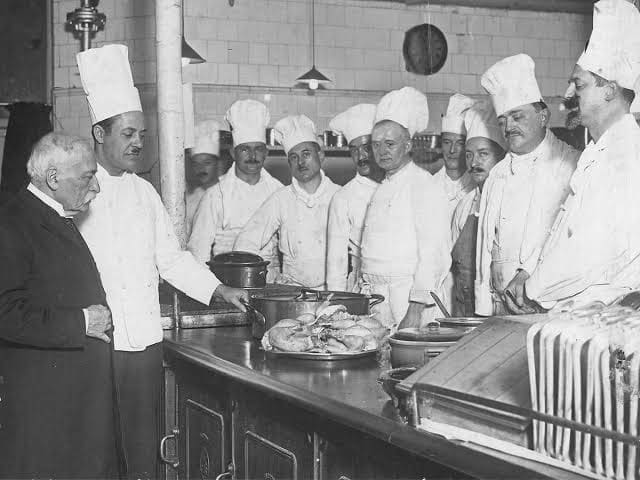
For Escoffier, as for many who followed him, this structure and vision of mise en place was not simply a practical commitment but a philosophical, even moral, one. It reflected a belief that the precondition for excellence is the elimination of disorder through the establishment of control. In many ways, this belief was vindicated by its fruit. Escoffier’s brigade system revolutionized commercial cooking, set the global standard for fine dining, and created the conditions for the extraordinary culinary achievements of our own time. Anytime we sit in a clean restaurant, enjoy fine ingredients consistently prepared, and receive unobtrusive attention from dignified staff, we have Escoffier to thank.
Yet if we have learned anything from life in the world modernity made, it is that all hierarchical structures, especially those built around the vision of a central leader, can shelter abuse. Likewise, we have learned that all rationalized processes, especially those built around an increasingly specialized division of labour, make it easy to forget the meaning of the whole. We have learned, in short, that a vision of life predicated on the attainment of control can get, well, weird.
Welcome to Hawthorn
The danger of control—not just in a kitchen but in life—is the central theme of The Menu. From one perspective, chef Julian Slowik (Ralph Fiennes) is a pristine distillation of Escoffier’s vision. His kitchen is perfect: its location is serene; its workspaces are clean, spacious, and orderly; its tools are the best available; its workers are talented, disciplined, and devoted to their craft. Its ingredients are fresh, local, and abundant, and its food is, technically speaking, flawless. On the surface, Slowick’s kitchen is the apotheosis of the culinary achievements enabled by Escoffier’s brigade.

But Slowik is also the embodiment of Rosa’s nightmare. He has achieved total mastery over his kitchen, his staff, his food, and—with a single exception—his guests. Within the confines of Hawthorn, no ingredient, recipe, temperature, serving plate, schedule, or human being is allowed to exist outside the parameters of his will. In this respect, Hawthorn is not merely a restaurant but a hermetic laboratory of control, an inescapable island fortress ruled by der Wille zur Macht. At Hawthorn, the only acceptable words are “Yes, chef.”
The central conflict of the story comes in the form of an unanticipated guest named Margot (Anya Taylor-Joy), who, as is clear from the film’s opening, refuses to be controlled. Having sat through a multi-course ordeal of ever-increasing horror, she finally stands up, claps her hands (the sign Slowik himself uses to command attention), and, in what Joseph Campbell would call the film’s “ordeal,” utters the one word that Slowik cannot abide: No. Facing the chef directly, she slowly and deliberately says, “I don’t like your food and would like to send it back.” Then, in the face of his condescending protestations, she says, “You’ve taken the joy out of eating. Every dish you’ve served tonight has been some intellectual exercise rather than something you’d want to sit and enjoy. When I eat your food, it tastes like it was made with no love. . . . You cook with obsession, not love. Even your hot dishes are cold.”
The drive for control does not lead to a richer relationship with the self, with others, or with the world, but to the disfigurement and, ultimately, the death of each.
Margot articulates the central Rosan paradox of modernity: The drive for control does not lead to a richer relationship with the self, with others, or with the world, but to the disfigurement and, ultimately, the death of each. Slowik has so thoroughly brought the world under his control that it now exists only as an extension of his identity, a concept in his mind, and a lifeless artifice cooling on his plate. Margot’s words, though spoken in indignation, are also an invitation to another way; but in the end Slowik is unable to hear it. His inner life is dead. For him, the kitchen, meant to be the very source of life, has instead become a tomb.
Why Don’t We All Go Around and Say What We’re Afraid Of?
If The Menu is about what happens to a person when they achieve perfect control, then The Bear is about what happens when the illusion of control collapses entirely and what that collapse makes unexpectedly possible for those who live beyond it.
When Carmen Berzatto (Jeremy Allen White) arrives at The Original Beef of Chicagoland, the collapse has already begun. He is a Michelin-starred chef who has cooked in the most demanding kitchens in the world, and he bears the habits of that world with him: the rigid hierarchy, the crushing expectations, the endless self-sacrifice, the psychological disassociation, and the desperate fear of the moment when everything spins out of control. But in the world of The Original Beef, everything is already out of control: The restaurant is in debt, the kitchen is in disrepair, the vendors are in revolt, the staff is traumatized, and his brother, Michael, dead by his own hand, is in the ground.
In response to this, Carmen’s first instinct is to regain a sense of control through the imposition of will. Appealing to Escoffier, he announces to his thoroughly unimpressed staff his intention to institute a brigade system and to run The Original Beef like a professional kitchen. Still grieving Michael’s death and sensing their own loss of control, the staff actively rebel by rejecting his menu, sabotaging his process, refusing his uniform, and, in pointed mockery of his request, answering his commands nonsensically with “Yes, Jeff.”
Against expectations, The Bear is not some cheap culinary reprise of The Bad News Bears, nor is it the story of a brilliant chef transforming a broken kitchen through his uncanny genius. It is, rather, a story of a broken person in a community of broken persons slowly coming to terms with how the tools that have fuelled his success in other kitchens—control, precision, and command—are not only ineffective but also destructive to the kitchen and the life he now has. Carmen and his community learn the mortifying lesson that the only path toward the life for which they long is marked not by greater control but by its release; by the pursuit of communion; and through open conflict, painful failures, fragile vulnerability, and the repeated risks of love.
One of the most beautiful, if legitimately stressful, assertions of The Bear is that the path to communion is never an easy one. Its long takes of the kitchen are excruciating to watch: chaotic, volatile, immature, visceral. The anxiety and screaming are incessant. The swearing is prodigious, the relational damage lasting. Though communion comes, it comes only in fits and starts, and never without cost.
While this halting movement toward communion takes form within and across many episodes, my favourite moment comes in season 4, episode 7, aptly named “Bears,” which takes place at a wedding. Every character—many of whom are in complex or broken relationships with one another—is reluctantly in attendance. In one scene, they realize that the bride’s beloved seven-year-old daughter, Eva, is terrified of the stepfather-daughter dance and is hiding under the reception’s large banquet table. Over the course of the episode, each character makes their way under the table as well, until everyone is there together. Under the table, there are multiple cross-currents of awkwardness and conflict. Yet in order to help Eva feel less alone, they decide to do what true control abhors and true communion requires: talk about their fears. Closed spaces, spiders, losing people they love, large dogs, losing creativity, failure, betrayal—as each one names their fear, they help young Eva not only name her own fear but also know that she is not alone in it.
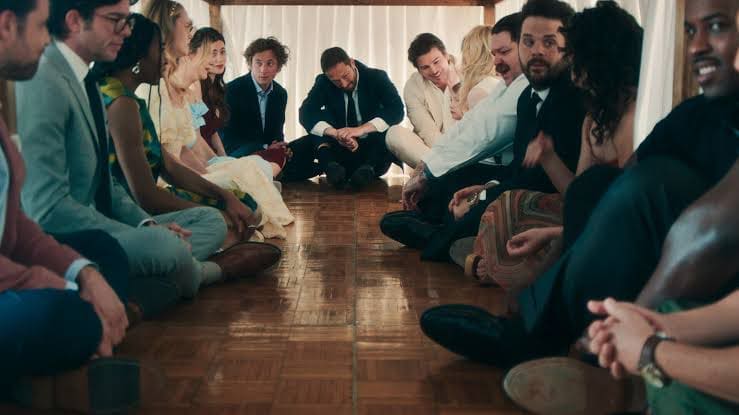
As the wise have surely discerned, this is the Rosan moment of transformation. Under a table, standing at a distance from each other gives way to sitting together in a circle. Self-protection gives way to vulnerability. Evasion gives way to disclosure. Resistance gives way to resonance, so that the kitchen, the table, becomes a place not of control but of communion.
Yes, Chef
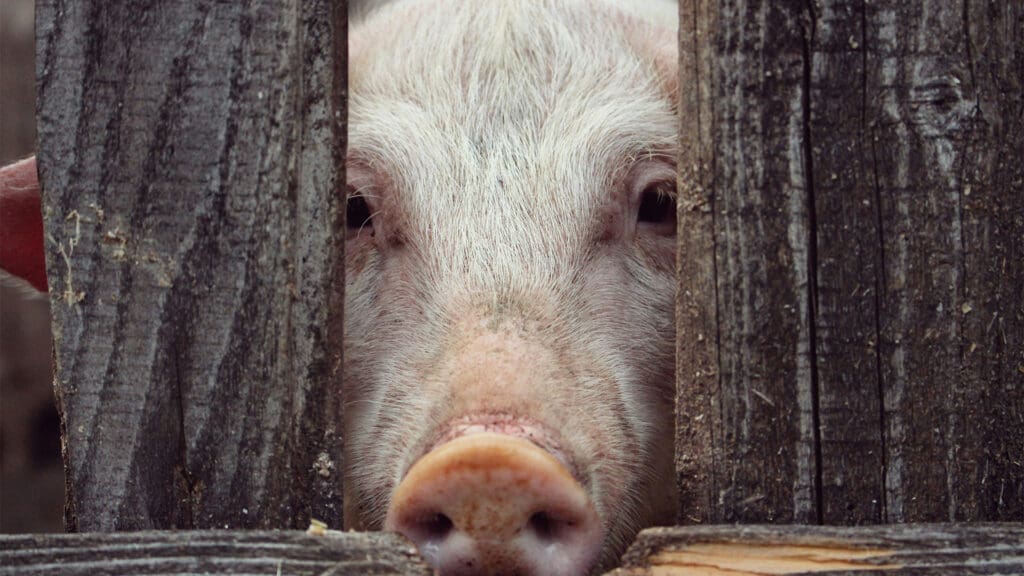
When I showed up to Broadcloth for my first shift, I was immediately thrown into the proverbial deep end. I had no sooner put on an apron, unwrapped my knives, and reported for duty than I was standing before an enormous side of pork, face included, receiving instructions on how to break it down into usable cuts. That done, I chopped onions, picked herbs, smoked mushrooms, brined chickens, trimmed tuna, made sauces, and prepared our mise en place for service. Then came service, a five-hour adrenal sprint from the walk-in to the grill, from the oven to the pass, the whole suffused with overflowing customer orders and calm but firm calls of “Hands, please” and responses of “Heard!” Then, at last, came the cleaning: storing food, emptying grease, wiping counters, mopping floors, and getting the kitchen set to do it all again the next day.
It was exhausting, meticulous work, and I’m not sure I had ever been happier. True to his reputation, Tucker runs his kitchen with exacting standards, technical precision, creative intensity, and little margin for error, as a full restaurant with a sixteen-course tasting menu requires. And true to his word, these standards, this intensity, are in service to something larger. The purpose of the kitchen was not, as I had feared, the ego of the chef or even the perfection of the food. It was to nourish the guest, to honour the fleeting evening, and to bear witness to a life that is at once sensuous and sacred.
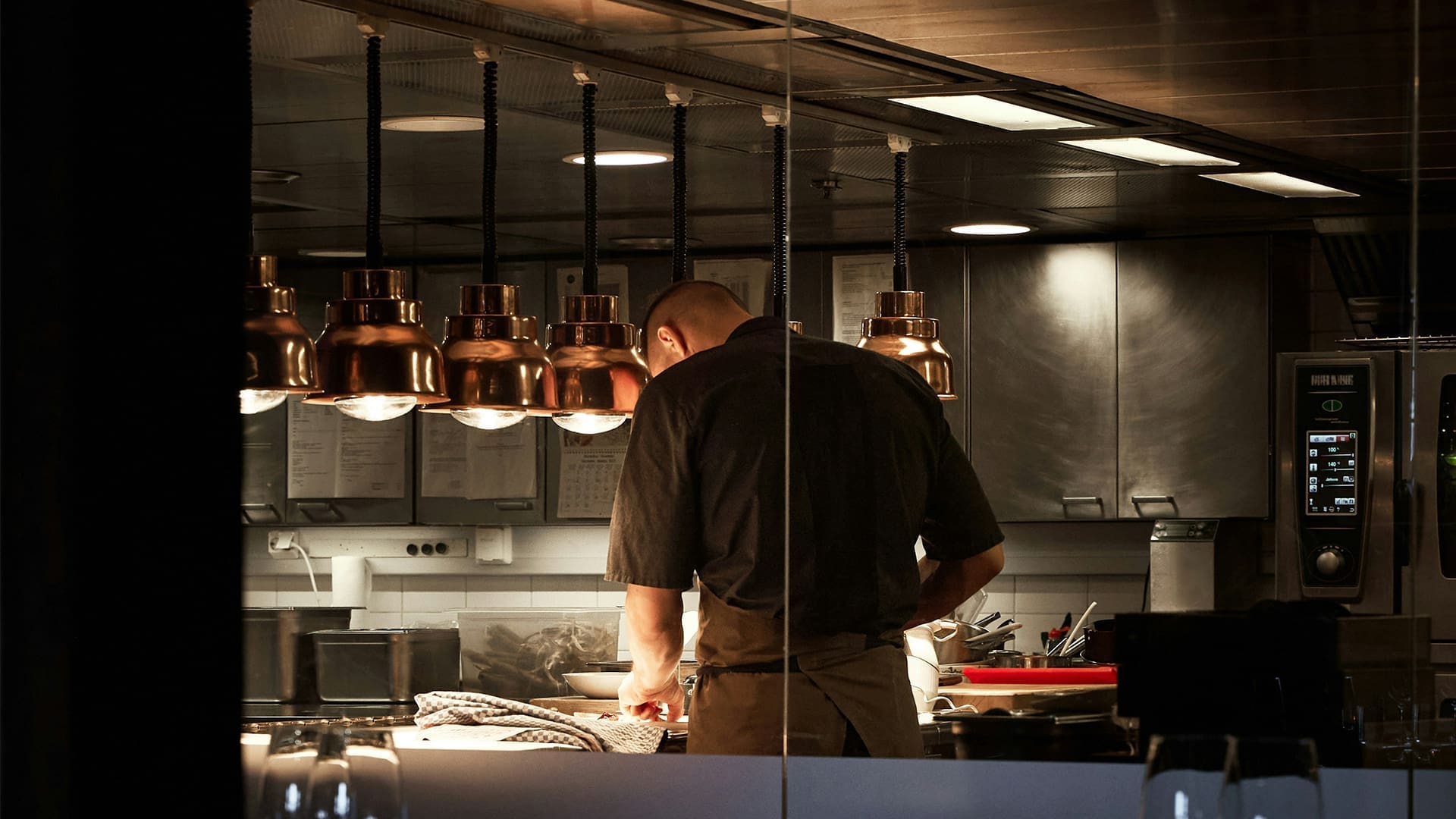
Through the windows of our open kitchen, I could see the people at our tables: the thin young woman and her husband celebrating a year of being cancer-free; the out-of-town parents visiting their children at the university; the elderly couple sitting on the same side of the booth, quietly perusing the wine list; the writer with his notebook at the bar. Each of these came to us in the cold dark of an autumn night, seeking not a performance of clinical perfection but an expression of creative and attentive care. As I watched them pause quietly over a bite, offer to share their food, raise their glasses, peek flush-faced into the kitchen and express their thanks, and step into the night holding hands, I knew that, at our tables, they had found what they sought.
I’ve been at enough tables to know that this is rarer than it sounds, rarer than it should be. Slowik, with his thirst for control, is everywhere around us and frequently within us. Because of this, the choice that Rosa offers, and that The Menu and The Bear dramatize, is ever before us: whether to seek to master the world or to live humbly and reciprocally within it; whether to seek control or to find communion.
On that first night at Broadcloth, I saw the beauty of the latter: a surprising dish, a lingering table, an eruption of laughter, and the miracle of shining eyes. As I finished my staff cocktail, wearily untied my apron, and rolled up my knives, Tucker looked up from his seat at the bar where he was checking soccer scores on his computer and, calling me by my nickname, said, “Blade, great service tonight. You want to do this again tomorrow?” Weary though I was, happily and without a moment’s hesitation, I said, “Yes, chef.”