


E
Every holiday season the same op-ed appears on your home page of record. Some variation of “Don’t Talk Politics at Christmas Dinner” or “Navigating Generational Differences This Holiday Season” or “How to Neither Condone nor Provoke Your MAGA Uncle.” Alternating takes on how you should, or should not, acknowledge your intra-familial divides during the season of otherwise abiding Peace. Always written from a high-minded perspective but with little regard for the truth, which is that communication strategies don’t work on family. With family, your common ground is your shared history. For the present and future, you mostly just hope for the best.
These columns are insipid and deeply unhelpful. I skip them in search of a holiday cocktail recipe or an annual top-ten list. (In my experience movies are a more promising means of quality family time than table talk.)
So it was with some embarrassment that I found myself, last year, in the ill-famed position of dinner-table crank vis-à-vis a family member. She, my sister: progressive, single, idealistic but fair-minded, settled in middle-aged independence. And me: slightly younger than her, conservatively disposed, family-oriented and therefore tired, clear-eyed in judgment, I think, but prone to generalization because it saves me effort. And two (or more) glasses of wine into my dinner.
“Every successful store in this city is a chain,” she said. That was the offending remark. Probably true in general, which as I have indicated is my preferred level of detail. In general, yes, the commercial makeup of my city is overwhelmingly bland franchises each made in imitation of the other. Even our most successful and homegrown independent cafés eventually bend toward that universal, clean, placeless aesthetic.
But the truth of the statement was not my concern. It was the sentiment. Here was my sister—a paragon of education and culture, visiting from her cosmopolitan city apartment. Spending Christmas in my detached home, my car-centric middle-class neighbourhood, my sprawling city. And seated now at my crowded dining table, which is the family hub every Christmas. At the heart of her musing—implied, at least it seemed to me—was an accusation of greed. My life is quaint, multicultural mom-and-pop shops, she was saying, and yours is gaudy, big-box parking-scapes.
The criticism of suburbia is a favourite pastime of young adults who have relocated to big cities for post-secondary education. It’s a tired and elitist sentiment, but one with which I am sympathetic. I prefer quaint to gaudy as much as any urbanist. But the obvious truth of her observation implied a shortcoming in my value system. She was looking down her nose at me. My family wanted more space in order to have more stuff, so we sacrificed nobler goods like historic character and local flavour in favour of two cars and an affordable drive-thru culture. My very way of life was being challenged. She was straw-manning my lifestyle and judging my values at the same time. So much in one passing observation!
So, I went on the defensive.
Margins are small; business owners do what they must.
You know, our local economy is driven by private dollars, not public ones.
We produce things of real value, not just diplomas and real-estate bubbles!
Your trendy city has a huge daycare waitlist!
The cost of living! [me gesticulating]
As a litigator I can ad hoc rationalize with the best. Moral justification is an instinct that comes more naturally than it should. But my family was taken aback by my defensiveness. Your sister is casually contemplating small-business economics. Why are you attacking her? In retrospect (read: after the wine), I was also taken aback. What I had conceived as gentle pushback came out as mildly heated argument. And calibrated to my bookish family’s scale of communication, mildly heated constitutes a blow-up.
Why did I need to justify myself in response to a fair observation? Over Christmas Eve dinner? On that silent night, when all is calm and bright?
I sat my wife down for a debrief and relayed my remorse. Before each Christmas we pray that our home will be a source of peace and truth for visiting relatives. In this way, we think, our little family will be an inspiration to all. And every year this grand plan backfires with spectacular irony. The only actual source of chaos at Christmas is, consistently, us: our broken dishes, our baking mishaps, our yelling children, our yelling at our children, our trying to do too much with too little time . . . our family. We are the dutiful ones, and once again, we are the gong show.
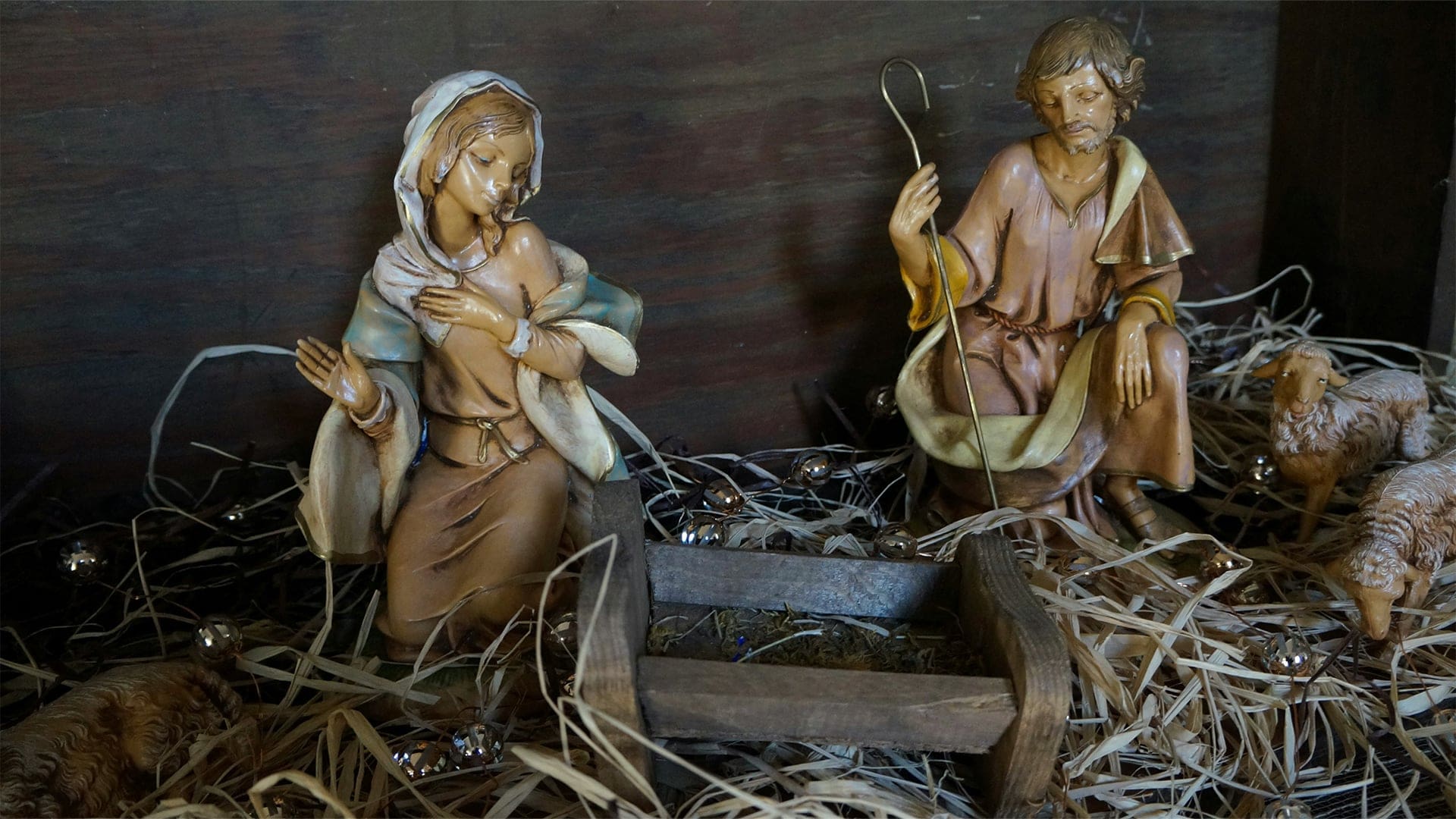
Obedience without humility is like a Nativity scene without a baby. An awful lot of effort, even beauty, but empty where it matters most.
My wife, sensing a rare confluence of discouragement and self-examination in me, and with a sweet pointedness only she can exhibit, told me to pray the Litany of Humility. “The fact that your wife is suggesting it to you makes it even more humbling if you do it.” She all but winked.
A litany is a prayer of penitence and petition. Its characteristic repetition serves as a meditation on one’s shortcomings and an appeal to God for help. First acknowledgement, then surrender, and, eventually, formation. At least that’s the goal. I am not humble; the Lord is humble; the Lord make me humble.
I wasn’t sure what this had to do with the economics of urban planning. But I did as my wife suggested.
From the desire of being esteemed, deliver me, oh Jesus.
From the desire of being loved, deliver me, oh Jesus.
From the desire of being extolled, deliver me, oh Jesus.
I prayed this litany a few times as Advent turned to Christmas. The snow fell harder and the cold got colder, the plastic baby was placed in the manger, and every candle on the wreath was lit. I kept praying. And eventually, I noticed a pattern within myself.
A pattern of mild road rage.
I am a very good driver. I’ve never had an at-fault accident. I occasionally remind my wife of this. But a sequence of low-speed incidents occurred over Christmas week—the kind that damage nothing but egos and are characterized mostly by drivers honking and muttering with grumpy indignance.
None of these were my fault. I know this because, after each one, I assured myself of my rightness.
Dude’s got a lane. There are two lanes! What’s his problem?
That’s a yield, not a merge, I think. He needs to pay attention. That’s on him.
I’m pretty sure there are two lanes anyway. It’s hard to tell with all the snow, but he probably had his own lane.
After three such incidents, and a few days of consciously trying to displace imagined argument with prayer, I wondered whether this defensiveness was something of a habit. The litany revealed why I so often meet mild disagreement with vehement self-assurance. Because I must be esteemed, I must be approved, I must not be wronged, I must not be suspected.
From the fear of being ridiculed, deliver me, oh Jesus.
From the fear of being wronged, deliver me, oh Jesus.
From the fear of being suspected, deliver me, oh Jesus.
Did I mention I am an impeccable driver? If anyone wrongs me, they must be set right. I am a husband and father of good judgment and aesthetic taste. If anyone suspects otherwise, they must be corrected. They must not get the wrong idea about me. They must not get the wrong idea about the God whose love I represent. I must stand up for the both of us!
My self-justification, I have started to see, is both persistent and ugly. And there is a reason it floats to the surface this time of year: It is tethered to my sincere wish to share God’s love with my family. Preach the gospel, goes the popularly mis-attributed platitude, and use words if necessary. Don’t tell me that God is love—show me. I don’t know whether this mindset is a bit too idealistic or just nonsense entirely. But it has ingrained itself into that dark corner of my psyche where hope meets pride.
Like so many, I have long resolved not to talk religion or politics at the family table. Instead I’ve taken on the mantle of being the Truth to my family. The self-appointed light in the darkness. A perfect plan, for a perfect person. For everybody else: guaranteed to produce feelings of defensive inadequacy.
At Christmas we celebrate that one young family on whom the mantle of truth actually did rest. Mary and Joseph were appointed not by their own self-confidence but by an angel. My obedience is rooted in pride; theirs, in deep mystery.
As we approached Epiphany, plastic magi wandering slowly toward plastic baby Jesus, my wife reminded me that Mary did not merely obey. She also made no effort to justify herself. Mary: young, unwed, and pregnant, who was certainly misunderstood and certainly suspect. Defying the expectations of her entire community, to say nothing of her own.
That others may be esteemed more than I, Jesus, grant me the grace to desire it.
That in the opinion of the world, others may increase and I may decrease, Jesus, grant me the grace to desire it.
That others may be chosen and I set aside, Jesus, grant me the grace to desire it.
Obedience without humility is like a Nativity scene without a baby. An awful lot of effort, even beauty, but empty where it matters most. My response to my sister on Christmas Eve was not about what is true or what is good. It was about whether I am above suspicion. As it turns out, like everybody else around the table, I am not.
Maybe your family buries grievances during holidays, or maybe those grievances sit right there on the surface between the cranberry sauce and too much wine. Whichever it is, don’t presume to be the source of anyone else’s peace. The job of light in the darkness has been filled. Do what’s right, love your family, and stop talking. Humble yourself. Put the baby in the manger, adore him, and be quiet.
That the Lord might speak as he wills, to you and to your family.

