
Being in the room is not the same as being there.

Why are we still “kicking the hornet’s nest”? The last time Mark Labberton interviewed Daniel Zoughbie (UC Berkeley/UCSF) for his expertise on international diplomacy in the Middle East, there was not yet an Iran war. Regardless of your geographical distance, this war is imminently important as it escalates and impacts not just Iran but the entire Middle East and the entire world economy.
Taking seriously both the significance and validity of Israel as a nation and the need for appropriate and just treatment of all Jews, Christians, and Muslims during a time of rising anti-Semitism and Islamophobia, this conversation comes at a volatile moment, pregnant with violence and chaos in American foreign policy.
Starting the timeline at the 2018 US exit from the “Iran nuclear deal” (the Joint Comprehensive Plan of Action) Zoughbie discusses a variety of interconnected issues, including the role of Middle Eastern geography such as the Strait of Hormuz and the Bab el-Mandab (“Gate of Tears”), the proliferation cascade a Saudi Arabian nuclear program could set off, and the difference between tactical brilliance and strategic vision.
Together, they also consider hopes for improvement, looking at Gerald Ford’s unpopular but effective ultimatum that forced Egypt and Israel to talk; the Olmert-Abbas negotiations that almost reached a two-state solution; the role of Christianity in politics; the danger of national pride; wisdom from antiquity in Herodotus, Croesus, and Cyrus the Great; and a definition of greatness that has nothing to do with force.
Mark Labberton: It’s a great gift today to welcome Dr. Daniel Zoughbie as our guest on Conversing. The conversation that we’re about to have is a conversation that’s going to turn around issues and questions of the Iran war. It seemed right that we should do an interview like this in part as a follow-up to Daniel’s earlier conversation when he had just published his book, Kicking the Hornet’s Nest: U.S. Foreign Policy in the Middle East from Truman to Trump. And even more poignantly, because of the fact that at the time that we did that first interview, we were not yet at war. And now what could potentially have been avoided, what has certainly turned out to be a hole-digging exercise, now consumes the headlines most days.
It’s right for us on Conversing to take this reality, which may be geographically distant from us, but is eminently important because of the significance of the way the war has already escalated to be more of a Middle Eastern war than just an Iran war.
As a Christian, I take very seriously the significance and validity of Israel as a nation, the need for appropriate and just treatment of Jews, of Christians, of Muslims throughout the Middle East and throughout the world. We live at a time when there is only escalating, dramatically escalating, anti-Semitism and Islamophobia, both of which are destructive to any possibilities of meaningful conversation and engagement. It’s fraught. It’s complicated. It means that many of the terms in a conversation like the one that we’re about to have are affected by how we hear and understand all of the competing interests, voices, and the competing weaponry, frankly, of so many different people and actors in the Middle East.
We know that almost any term that we might use—the two-state solution, naming groups, Hamas, Hezbollah, Houthis, people who are certainly seen as terrorists in many places throughout the Middle East—these are all terms that are so important, but they’re also . . . not neutral. And they are heavily loaded based on the position that we may occupy in the world, whether it’s from the US, in the Middle East, or elsewhere. And it complicates the picture of how to understand and hear a conversation like we’re going to be having with Daniel.
This is exactly why we’re having such a conversation. At this volatile moment, pregnant with so much violence and so much randomness in American foreign policy, it just seems especially important to be able to turn to an expert who thinks daily, deeply about these various issues and does so as a thoughtful scholar and genuine Christian. That’s the gift of having Daniel today.
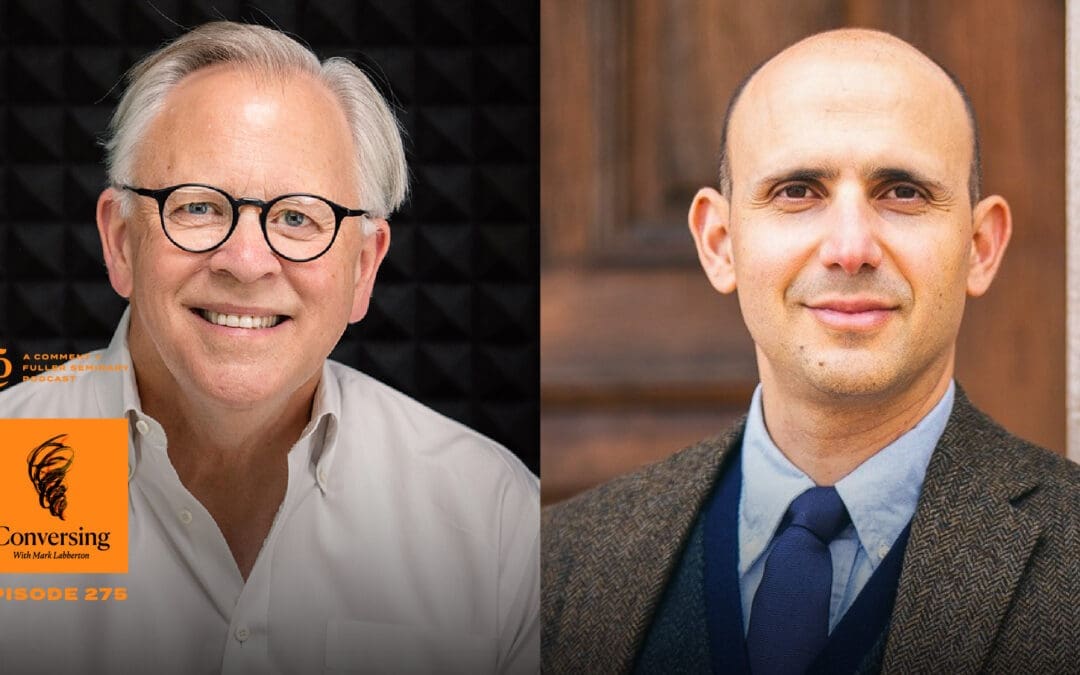
Daniel Zoughbie is a complex systems scientist, a historian, and an expert on presidential decision-making. He’s the associate project scientist at UC Berkeley’s Institute of International Studies, a faculty affiliate of the UCSF and UCB Center for Global Health Delivery, Diplomacy, and Economics, and principal investigator of the Middle East and North Africa Diplomacy, Development, and Defense Initiative.
Daniel Zoughbie, it’s so great to have you back on Conversing.
Daniel Zoughbie: It’s really a pleasure to be here. Thank you for having me.
Mark Labberton: You know, when we spoke last, it was when we were talking together about your book, which had only recently come out then, which was called Kicking the Hornet’s Nest. And we had a very rich conversation as you went through all the presidents who had shaped American foreign policy toward the Middle East over each of their presidencies, and your book carefully enumerating the issues and the challenges, the contributions or the failures of each administration. It was an extremely rich conversation.
Today, we find ourselves in a very different circumstance than when we spoke then, because it’s since that time that the current Iran war is fully underway in all of the fits and starts and complexities that it’s had. Let’s just start at 2018. Give us the shape of what you think has happened that’s brought us to this particular moment with the Iran war.
Daniel Zoughbie: I think that’s a really important question. It’s really not to just look at things in isolation as to what’s happening now, but to really go back in time and to take full stock of the historical trajectory.
So in 2018, the United States basically ripped up the JCPOA, or the Joint Comprehensive Plan of Action, a 2015 non-proliferation arms control agreement, which is widely known as the Iranian nuclear deal, which in my opinion was one of the most magnificent achievements in the history of American foreign policy. And it was really an international effort involving Iran and the P5 plus one and the European Union to freeze Iran’s nuclear program and to make sure that it comes under global safeguards.
And the P5 plus one is the group of six world powers, the five permanent UN Security Council members—US, UK, Russia, China, France—and then the plus is Germany. And they are the ones who negotiated what is called the Joint Comprehensive Plan of Action that limited Iran’s nuclear program and put it under international oversight.
There were many things wrong with this agreement, if one was looking for perfection. It did not deal with the issue of Hamas, Hezbollah, the Houthis, and the sort of malign behaviour of Iran throughout the region. It did not deal with other aspects of Iran’s conventional military activities, such as their missile program. But from the perspective of global security, there was really nothing more important than making sure that Iran did not become another nuclear power in the region. And it was doing a very, very good job of doing that.
Iran did not have very highly enriched uranium. The JCPOA was working to introduce international inspections on the ground. Very importantly, it was involving the major nuclear powers in the world to put constraints on Iran’s nuclear activities. And by the way, it makes perfect sense that China and Russia, who are located geographically very close to Iran, would not want another nuclear power in addition to Pakistan, India, and Israel in this volatile region that controls so much of the world’s energy production.
Exiting that agreement was a really, really big blunder because we did not have anything else to fall back on. The Iranians pointed to this and said, “Look, we can’t trust your word.” And immediately they started to do what everybody knew they would do. They started to really engage in expanding and accelerating their nuclear program. For example, we’re now contemplating bombing someplace called Pickaxe Mountain, Natanz. Well, this facility didn’t exist when the JCPOA was in operation.
And so since that period, Iran has accelerated their program to the point that we know that they have stockpiled about 400-something kilograms of highly enriched uranium at 60 percent. The Hiroshima bombs, just for context, were at 80 percent. And after the JCPOA was exited, we know from the IAEA that they detected in 2023 enrichment particles at somewhere in the ballpark of 83.7 percent. So this is a very, very troubling set of developments.
And I would put the next kind of milestone as the 2025 bombing of Iran, because what that did is it basically ended international oversight on the ground of the program. Sure, we have satellites and can take pictures from the air, but there were actual inspectors on the ground in 2025 when that bombing happened, which supposedly obliterated the program. It did not. That ended. And we actually have absolutely no idea what’s going on right now.
And then fast forward to 2026, where we are now. Well, we’ve sort of run out of targets to bomb in the country. I mean, we’re bombing everything that we can and have been bombing everything that we can. And it’s just not working. Iran has discovered not only that they have this nuclear program, which is incredibly powerful, but they’ve discovered that they have this power to shut off the world’s economy. And theoretically, they knew they could do something, but now it’s actually been proven as a concept that they can just issue threats, insurance will be removed from ships, and nothing is going to move through the strait.
Mark Labberton: It’s really an extraordinary circumstance, and so much of it seems to me to be driven by decisions that the United States has made more than by the cavalier actions of Iran. I’m not an Iran defender at all. And certainly the volatility and the genuine danger to the world of Iran having nuclear arms is a very, very significant threat. And I agree, at least from my point of view, with the assessment of the ending of the Iran agreement in 2018.
What seems to happen is, as a matter of this administration’s foreign policy, that often something is simply stripped away without anything else to really take its place except the potential of military threat. That seems to be the fundamental premise. So when people say, for example, that this is, in their view—and at least I’ll own, in my view—an unnecessary war, unpack what that means and why, if you agree with that, why you would see it as having been unnecessary.
Daniel Zoughbie: Well, I think the word “unnecessary” is absolutely the appropriate term. And I might just add another term: unjust. War is really supposed to be a last resort.
The question here is, what is the objective of American national security? The objective of American national security, I would think in this scenario, is that we do not want another nation to have nuclear weapons, especially in this volatile region. And we do not want to start a nuclear proliferation cascade where Saudi Arabia, Turkey, maybe Egypt suddenly want to start their own nuclear activities. And secondly, we have economic interests. It’s not in our interest to have the global economy move into a depression.
And so the question is, working back from that goal, are there other things that could have been done and could still be done to achieve those goals? It’s much harder now, I will be the first to say, to achieve those two goals, because we are really, really in a deep hole.
But what we should have done, first of all, we should not have removed ourselves from the JCPOA in 2018. We did not have another option. And if you do not have another option, then you do not take a reasonably good option off the table.
The second thing we should have done is we should have leveraged the international community again, notably the nuclear powers that I mentioned, China, Russia, India, and Pakistan. Now, your listeners would be forgiven for wondering why I would think that China and Russia especially would play ball with us. And the point I would make is they will help Iran to the extent that it weakens the United States. I mean, certainly one could imagine why Russia would want to weaken the United States, or China. But at the same time, China and Iran are trading partners, but China does not want Iran to control, you know, basically the oil that they depend on, and to be a nuclear power, you know, controlling this part of the world.
. . . bad relationship with Iran not many decades ago. In fact, they used to be called the lesser Satan. The Soviet Union used to be called that. So Russia does not want, on its border, to have another nuclear power. I mean, would we want Mexico or Canada, with whom we have good relationships—would we want them to become nuclear powers this close to the American homeland? So I think they have a very big incentive not to want that.
India has had its own tensions with Iran. Pakistan has had its own tensions with Iran. Both of them are nuclear powers. And again, they would not want Iran to become a nuclear power. In addition, all the countries I mentioned have economic leverage over Iran. China buys enormous amounts of oil from the Islamic Republic.
So if we were looking at this from a very sort of strategic point of view and saying, war is a last resort, let’s exhaust all other options, then we would be looking towards those four countries that I named, plus all the Europeans, plus anyone else we can get to the table, to try to get Iran to sort of suspend their nuclear weapons program.
And I would apply the same logic to the Strait of Hormuz. How do we get this strait open? Well, again, you have to look to the rest of the world who needs this strait to be open, including China. One could argue that maybe Russia has a slight interest in keeping it closed because their oil prices are going upwards. But the basic logic of sort of looking at the world and saying, we need to engage and work with other countries to solve really big problems that could affect all of us, is the basic point. And unless we do that, then we’ll always try to turn every problem into a nail, right? And we’ll use our hammer to deal with that problem. And that’s exactly why we’re in this mess in the first place.
Mark Labberton: . . . gets deeper and deeper and deeper. And then surprising things happen, like, for example, in the week that we’re recording this, the apparent offer of some kind of nuclear agreement with Saudi Arabia, which then got quickly qualified to be something that was discussable only if they normalized relations with Israel, for example, which is surely the only way you could imagine such a thing.
But it also feels completely counterintuitive to me to think that at this moment that we would be supporting a nuclear program development in Saudi Arabia when we’re trying to end the one in Iran, when Israel is still made only more vulnerable by all of that. But secondly, there’s a sense that Saudi Arabia is such an unstable partner to us. And I say that because of feeling as though the economics that are behind the scene in things with Saudi Arabia, and friendships between people like Jared Kushner and the leader of Saudi Arabia, play a role in this, which feels so non-nationalistic in a healthy sense, so non-stabilized by the weight of Saudi Arabia, but more by the precariousness of these relationships.
Daniel Zoughbie: Yes. I mean, I think this is a very astute observation. It was sort of puzzling why the United States would offer Saudi Arabia basically some sort of a nuclear program.
First of all, we have to understand that many of the nuclear programs in the world have started as so-called, quote unquote, civilian programs. Secondly, Saudi Arabia has said publicly—MBS has said publicly—that if Iran gets a nuclear weapon, that Saudi Arabia will for sure seek a nuclear weapon. So there’s some intent stated there. And thirdly, this sends the signal that proliferation is something that we might allow. I mean, if Saudi Arabia gets a nuclear weapon, why not Turkey? Turkey is very advanced scientifically. They have a very, very powerful military. Even Egypt, as I mentioned before, they could seek a nuclear weapon. All these countries are not the most stable countries in the world. Why on earth would we want to spread more and more nuclear expertise, enrichment capabilities, to this region?
There’s a few other points that are raised by this, which is just, as you said, it was, in a sense, walked back the next day because, oh, this deal is coupled to the requirement that Israel has to be recognized. So it just seems like it’s not really happening as a matter of well-thought-out policy. It’s just sort of reactionary, knee-jerk reactions. Like, how can we stick it to the Iranians? Oh, we can give Saudi Arabia next door some nuclear technology. This is not a way to run a railroad, much less a country.
I think the final point I’d make about Saudi Arabia is that what we already have in existence is, in effect, you could call it a Sunni NATO. Saudi Arabia has signed a defence pact with Islamabad, and they have nuclear weapons, and the Saudis helped them to develop their nuclear weapons. It’s long been rumoured, it’s pretty clear, that Pakistanis have sort of kept a nuclear weapon on the shelf for the Saudis. And so we already have an intensification of nuclear activity in the Middle East. And what we want to do, what we should want to do as one of our highest objectives, is to totally freeze that. We do not want further nuclearization of the Middle East region. This is a bad idea.
And if I could just add one quick footnote why it’s a bad idea. When Syria’s Assad started to develop his nuclear program, it was alleged that this was a North Korean design that he was following for the nuclear reactor. And the Israelis, of course, took it out. We should remember that a few years later, Assad’s regime and Syria fell into civil war. ISIS nearly took over that exact location where the nuclear activities were. And ultimately, Assad was kicked out of power. And now we have a former ISIS commander who has allegedly reformed his ways in charge of the country. So this is not a part of the world that we want more and more nuclear technology, more nuclear know-how, more nuclear enrichment activities.
Mark Labberton: Daniel, you mentioned a moment ago the waterways. And I think it’s somewhat clear how this has unfolded, but I think it would be helpful to have you distill each of the waterways and the history that’s led us now to this moment when Iran, as you say, by implication—there’d always been this threat that Iran could potentially try to gum up in some way Hormuz. But now we’re in a very changed circumstance because they’ve proven the capacity they have to be able to do this. And now the Red Sea has also been added to the picture. So fill that out for us, please.
Daniel Zoughbie: I would say, you know, I’ve seen CIA documents that have been declassified going back to, you know, 1984, where, you know, there’s this document explaining that, you know, the Iranians are going to use North Korean mines to, you know, put them in the Strait of Hormuz. And, you know, if we deploy these boats, we can sweep away the mines. But it’s been known for many, many years that this is what will happen if there is a war, that the Iranians are going to use this and they’re going to try to close it, whether it’s with mines or by other means.
You know, Leon Panetta, who I had the good fortune of interviewing, has said publicly that when they did their studies, they determined that the only way that they were going to be able to stop the Hormuz Straits from being closed was by using ground forces, a territory that is the equivalent of essentially fifty miles inland, and they would have to just secure that enormous strip of land in order to prevent that.
With that being said, at the same time, for the Iranians and the Islamic Republic in particular, this was still something that it was a theoretical concept, right? It’s one thing to know that you have a card to play, but to actually play it successfully, that’s a big difference. And so the Iranians did not know prior to this just how powerful they were from a geostrategic perspective. And so the foolishness of this war is that it really handed them that proof of concept. So now they have these two cards to play, the Strait of Hormuz, or the Straits of Hormuz, as some people call it, and the nuclear program.
And just kind of so your listeners can kind of understand what’s happening here. If you look at the Gulf, the Persian Gulf, sometimes called the Arab Gulf, depending on who you ask, you’ll see that the major oil producing countries are kind of in this closed gulf. And the only way out is through this narrow kind of passageway, which we call the Strait of Hormuz. And it’s about twenty-one miles wide. But because it’s shallow in many parts of it, the shipping lanes are only really two miles wide each. So it really is a choke point, really and truly. And it’s acted as a vital shipping waterway, not for tens of years, hundreds of years, but for thousands of years. I mean, spices, pearls, you name it, has gone through this place. So if you cut that off, you are cutting off a fifth of the world’s energy. You’re cutting off vital fertilizers that are needed to feed people. It’s a really, really, really big deal.
Now, if you compound this with the fact that, again, looking at the map, if you kind of move over to the left and you look at Yemen, Yemen is basically controlled by the Houthis, who are loyal to the Islamic Republic. And they have significant capabilities. They have a very large fighting force. And they are positioned—on one side, you have Somalia and what’s now called Somaliland. And then on the other side, you have . . . And so now the Houthis have the ability to control the other shipping traffic that would normally go through the Red Sea into the Suez Canal, and not just oil, but pretty much anything. And so this is kind of a third major thing that they can do to really disrupt the economy.
So even if we’re able to kind of be somewhat successful . . . the Strait of Hormuz, we still have to deal with the Red Sea and, in particular, a waterway called the Bab el-Mandab, which means “Gate of Tears,” appropriately named the Gate of Tears. So this is a very important sort of geographical area. And American foreign policy in this administration has just totally underestimated the Iranians’ capabilities.
Mark Labberton: So meanwhile, there’s Israel and there’s Gaza. And there’s all of the things that we’ve already been deeply concerned about over recent years and the activity that has been so decimating to Israel’s sense of self, and the power plays of what’s going on with Netanyahu and so forth. And the expansion still of Israel into anything that was meaningfully relevant to some kind of appropriate agreements over time with Palestinians who are, of course, not only in Gaza, but also in the West Bank, suffering so much, not just from past, but really from ongoing things that are happening that are destroying people’s lives—and the acute vulnerability and the defensiveness of Netanyahu and the virulence of its military policies under Netanyahu’s leadership.
So it just strikes me that these are all things that exist simultaneously in this part of the world. And while in a way it has a familiar ring, like more trouble in the Middle East, from my point of view, it feels like it’s in one of its most volatile, precarious seasons, at least even since 1948. There’s been other very vulnerable moments. I’m not suggesting that. But this is like a cluster bomb of things that are all happening at the same time. Am I right in seeing it that way, or am I over-inflating what is really happening?
Daniel Zoughbie: Oh, I think you’re 100 percent correct. I mean, sure, we could look at 1948. We could, you know, look at 1967, 1973. But in terms of the earthquake that is happening right now, in terms of the stakes, in terms of the nuclear activities, in terms of the risk to the global economy, I mean, I think this is definitely something that is unprecedented.
As far as Israel is concerned, like the United States right now, this is the blind leading the blind, sort of a situation, and both are in a ditch and both keep digging. Israel believes that because they have accomplished, admittedly, truly exceptional tactical intelligence wins—figuring out that this person is in this safe house and eliminating him, that sort of stuff; blowing up pagers throughout Beirut, figuring out how to get the explosives in people’s pagers—that sort of stuff is really giving many people in Israel false confidence. When in reality, Israel does not have a strategic vision for how it will not only survive, but flourish in the world.
You know, one of the mottos, informal mottos, of the Mossad is “By way”—it’s from the Bible, from, I believe, Proverbs—”by way of deception, you will make war.” And so I like to say, well, yes, as long as you’re not deceiving yourself. And, you know, the other motto is, also from the Bible, “without a vision, the people perish.” And I would say that Israel does not have that strategic vision for how it’s going to live in a place that does not require that they constantly live by the sword. Because as both the Old Testament and the New Testament suggests, the one who lives by the sword perishes by the sword. It does not turn out well.
And what Netanyahu is doing is, first of all, there’s this idea that ultimately a two-state solution is not a viable alternative, meaning that they want to basically take over the West Bank, perhaps other areas. They’re encroaching into Gaza as we speak. And that is not a great idea if you have a vision for Israel as a democratic and Jewish state, which, ostensibly, that’s the point. And so it’s not sustainable from that perspective.
But also, I mean, we’ve read in recent weeks and months about just how, frankly, nutty some of the ideas that have been hatched by American and Israeli intelligence. I mean, the whole idea of taking Ahmadinejad, who was the former president of Iran, and he was widely condemned for propagating anti-Semitic tropes around the world—and the idea that you’re going to take this guy and you’re going to make him your stooge in Iran after you get rid of the Ayatollah and these other guys. I mean, could you think of a worse candidate to run Iran than Ahmadinejad? And so this is just an example of how I feel that not only isn’t there a vision, but it almost feels like they are intentionally trying to shoot themselves in the foot. So that’s kind of how I feel about not only Israel by itself, but Israel and its relationship to kind of the United States during this crucial period. It really is the blind leading the blind.
Mark Labberton: So I know you are not a crystal ball, nor do you claim to know, quote, the mind of God about how all of this is going to go. I know that I’m not alone in feeling as though we’re in a downward spiral, that in fact it’s an acute downward spiral, and that there are reasons based on our national leadership as much as the leadership of other countries that makes imagining some kind of resolution or a way forward—let’s call it a constructive way forward—as a hard thing to actually calibrate because it feels so unlikely. But if you had some degree of realism about it and you were trying to imagine constructive steps that could be taken, not just by us, but by, as you say, have said several times, these other countries that have implications and a stake in the affairs of the Middle East, what are you hoping might be pathways that are going to be chosen?
Daniel Zoughbie: I think to answer that question, what I would really like to do is kind of rely on a little bit of history to kind of give us some guidance.
So first of all, I worry greatly that the downward spiral that you just described could lead us to a very dangerous situation. If we look at 1967, I think that most people who are familiar with the war between Israel and its surrounding Arab enemies, Egypt, Syria, and so on, would remember it as the Six-Day War. I think the former director of Israeli intelligence described it as a few-hour war, indicating that this was sort of an easy thing, it wasn’t a big deal. But we now know that this really was quite a big deal, that the United States, the Soviet Union, Israel, all had nuclear weapons and all were making preparations to use them. It was a real bona fide security crisis. In addition, Egypt, another major player—they had Nazis in the country, they had chemical weapons, weapons of mass destruction among all parties, you know, willing and able to use them. This is really not a great situation.
And so when I look at the current situation, I don’t just assume, oh, these leaders are so intelligent or so restrained that they are not going to use weapons of mass destruction. I actually think that there is a danger that because the situation is becoming more and more desperate, that there is the possibility—I don’t want to say it’s an enormous possibility, but it is something we need to think about—that somebody could use an unconventional weapon. And that is very concerning to me.
Now, if we also look at history to look for a little bit of light at the end of the tunnel, again, I would just push forward in history to the mid-seventies and highlight Gerald Ford, who out of all the presidents I looked at in my book, it’s Gerald Ford, with respect to the Middle East, who really gets it right.
What does he do? He sees a situation where the Egyptians, who, like the Iranians today, are the sworn mortal enemy of Israel. Nasser was described as Hitler on the Nile, like Saddam Hussein. He was described as Hitler on the Euphrates. Ahmadinejad, by the way, was described as some kind of a reincarnation of the Nazi ideology. But the point is that the Egyptians were not viewed as sort of kind of mild-mannered and we can work with them. No, they had just engaged in two major wars, in 1967 and 1973, against Israel. And yet Ford could see that Sadat was serious about making peace and that the Israelis in this case were not taking him seriously.
He didn’t just say, okay, guys, time to prepare for another war. We’re going to send covert shipments of all sorts of military equipment and we’re going to prepare for another route. Instead, he put enormous pressure on the Israelis and basically gave them what I would describe as an ultimatum: talk to the Egyptians or your relationship with the United States is going to fundamentally change. And what this did was it forced the Israelis and the Egyptians to talk. There was an interim sort of understanding. And this ultimately leads to the 1979 peace between Egypt and Israel that Carter, President Carter, got over the line. And I think that takes remarkable courage to be in that position as an American president, unelected, and to just basically say, this isn’t good for me politically, but I’m going to do the right thing.
And as I was studying Gerald Ford, I learned a few interesting things about him. I think it was in 1977. He gave a speech at Gordon-Conwell Seminary, which I think is somehow a sister seminary of Fuller. You’re probably very familiar with it. And his son was graduating. He was a seminarian, his son, and he was graduating. He gave the commencement speech and he said something very interesting in that speech. He said, when I took the oath of office, I put my hand on the Bible. And I put my hand on the book of Proverbs, in which it says, “Trust in the Lord with all thine heart and lean not on thine own understanding.”
And it just occurred to me that he was somebody who was actively aware of the problem of pride, the same problems that the ancient Greeks identified, hubris. And he understood that. He was not somebody who could just rely on his own smarts. He was a smart guy. He went to Yale Law School. But he understood there were limits, that he needed to rely on other forces to help him make wise decisions.
And I feel like the current atmosphere in Washington is really about me, mine, and more. For us to really have a change in our foreign policy, to have a more enlightened foreign policy, we really need to think beyond ourselves as a country, as politicians. And we have to think about how can we mobilize the rest of the world to find common interests in a way that can diffuse this situation before it really does spiral out of control.
Mark Labberton: We hear and read about plans to potentially give testosterone shots to American military people as a way of maximizing their lethality. And it’s the inverse of humility, but it’s also the inverse of anything like what you’ve just said, because the whole assumption is that the resolution can only be about force and dominance, not in any way about some kind of even effective communication, let alone mutuality and understanding.
There’s all kinds of reasons largely outside anything we could discuss at the moment here. But when I hear that, I think both what a betrayal that is to the best instincts of our government and the best instincts that I would want to hold America accountable to, but also, from a Christian point of view, for me, it’s because the gospel that I understand that’s revealed in Jesus is a gospel of peacemaking, of humility, of self-sacrifice, which I know has been negated greatly by the religious right and that what we need is more power, not more Jesus. And I would say what we need is more Jesus in the world in general, but what we need as a cultural matter, as well as a human matter, as well as a specifically Christian matter, is this evidence of humility. There’s many things and many ways in which I think the American church is betraying its Christian identities. Not that America is a Christian nation, but meaning within America, there are plenty of Christians who are, for me, betraying their Christian identities by relying on things that are so unlike anything that I would recognize as being God’s vision and purpose.
So I guess I’m just curious, as we close, I know that your work is academic, that it’s professional, that it’s analytical, that it’s rational, that it’s looking at the cold facts of what’s really happening. But where in all of this kind of a thing does the processing for you personally of the crisis of the Middle East and your faith interact? How does that unfold for you?
Daniel Zoughbie: You know, one of the things that is so troubling about this sort of, I would say, obsession with masculinity—you know, we’re going to give people shots to increase the testosterone—is it just goes against every sort of ethical principle, everything we want to teach our children about what it means to be good citizens, good people, good Americans.
One of the most troubling things for me was watching the group of pastors congregating in the Oval Office . . . the American people. And it just sort of felt that this was an invocation of sort of divine assistance in this war, which, as I’ve just indicated, is clearly an unjust and I believe unnecessary war. And I think you and the Pope were in pretty good company speaking out publicly against this sort of behaviour.
You know, I think back further to other theologians who I admire, the great Reinhold Niebuhr, who is one of the founding fathers of the modern field of international relations. And his entire corpus of work was about the toxicity of pride and about national pride and in particular Christian nationalism, such as the sort of . . . that was witnessed, you know, in the lead-up to the Second World War. I think about Karl Barth and his Epistle to the Romans, that sought to really, you know, that famous work in which he really seeks to separate the idea that divine authority can be sort of somehow equated with a sort of human or nationalist perspective.
And, you know, kind of going back further, you know, I was reading Herodotus recently, and I just found it very interesting, his take on Cyrus the Great and this incident in which King Croesus decides to go to the Oracle of Delphi, and he hears what he wants to hear. The oracle says, “You will destroy a great empire if you cross the river and attack the Persians.” Of course, it was his own empire that was destroyed.
But there’s really an interesting twist to this story, and I think it’s really useful to spend some time on it, which is that despite the fact that he attacked King Cyrus, the Persians, the king, after defeating Croesus, instead of killing him on the funeral pyre, he sort of discovers kind of, I would say, his deeper humanity, and spares his life and makes him an advisor in his court.
And Croesus says something very, very interesting. He says, “No man is so foolish as to desire war more than peace. For in peace, sons bury their fathers, but in war, fathers bury their sons. But I must believe that heaven willed all this so to be.”
. . . discovers his humanity as well through this process. And I think it’s very interesting that both the secular kind of sources, Herodotus, and the Old Testament consider Cyrus the Great to be a great person. I mean, you’ll have to tell me if I’m wrong here. I think the Old Testament even refers to him as a messianic figure, a messiah, an anointed one.
And I think it is because—whether everything Herodotus says about him is accurate or not is aside from the point, but the thrust of the story is that greatness is not about testosterone shots. It’s about being able to show mercy. It’s about being able to see the humanity in others, even your enemy. And ultimately, you know, what I would call Herodotus’s paradox, which is that the mightiest of the mighty turns an enemy into a friend.
Mark Labberton: It’s an amazing place to end our conversation and a tremendous challenge to all of us, because in our own particular ways, there are ways we can act. And I can’t leave the conversation without that as our final question. Given what you just said, which I think is a very rich interpretation of those texts, what would you encourage people who are listening to this to do?
Daniel Zoughbie: I think one of the most important things that I would encourage your listeners, if they come from a Christian background, Jewish background, is to really think about the interconnected nature of the regional war that is sweeping the Middle East right now.
I think we talked, you know, we talked about stop digging if you’re in a hole. And I think one of the most important things that the United States should do right now is to realize that the path to Tehran runs through Jerusalem, meaning that the Israeli-Palestinian conflict, which has been festering since 1948, if not before, gives fuel for the Islamic Republic. It’s the reason why groups like Hamas, Hezbollah, the Houthis actually exist. They are resistance movements against Israel. And I think recognizing that dealing with the problem of Iran actually starts with addressing the Israeli-Palestinian conflict is a really important thing to do.
And, you know, in the United States, we have sort of, I would say, a subset of American Christianity—let’s say a sort of right-wing subset of American Christianity—that sort of regards, you know, the front page of the newspaper as sort of reading that into whatever biblical prophecies. And I just personally feel that is a very sort of dangerous road to go down. And that is really not what one wants to hitch their wagon to.
I think instead, really focusing on the principles of justice and fairness here, that we have two groups of people, the Palestinian people, the Jewish people, they both want to express their self-determination on the same piece of land. We know the formula that works. Prime Minister of Israel Ehud Olmert and Mahmoud Abbas had extensive negotiations, and they nearly agreed. They were pretty much both on the same page in terms of what needed to happen to get two states on the same land. It’s sort of a known formula. And that is really what I would hope your listeners, regardless of their religious orientation, that they really do what they can to support that, that they talk to their congressmen, that they write letters, and they really say we need a two-state solution, because that will take a lot of the fuel for the fire off the table.
During our last conversation, I gave the example of citizen diplomacy. I think I described the American University of Beirut, which was started as a Protestant college. It’s one of the greatest colleges in the Middle East, if not the greatest. And it’s one of the best colleges in the world. It’s a fantastic place. There’s other institutions, like the American University in Cairo. And in fact, when I was giving a talk, one of my audience members in Sonoma came up to me after and said, you know, “That was my family. My family helped to start the American University.” And that sort of really hit home to me, because it sort of was not just a kind of, you know, theoretical thing for me. Like, yeah, I know who the people are who founded this place, but a real person was actually coming to me and taking pride in the fact that her family had gotten a little bit outside of their comfort zone and went to the Middle East and done something really, really important and consequential that has lived on and survived through many different wars.
I think the potential for doing that in today’s digital world is even greater, because we have the ability to talk over Zoom, over Teams. We have the ability to create software apps. We have the ability to develop educational programs. Your audience has a number of gifts that I think could be shared with the people of the Middle East. And unfortunately, I think many people in the Middle East have a view of America as kind of being hostile to them. And I think it’s very important, if nothing else, that your audience reaches out to people in the United States from Middle Eastern backgrounds, from Iranian backgrounds, to let them know that they’re loved, they’re welcomed in this country, and that anything that they can do to sort of break down those barriers of insularity, of hatred, and to really be a shining city on the hill that many of us have been taught that our country is.
Mark Labberton: Daniel, it is a great gift to have you again today. Thank you for the gift of time and for the wisdom and insight that you’ve shared.
Daniel Zoughbie: Thank you so much. It’s my pleasure.
Mark Labberton hosts the Conversing podcast and is the Clifford L. Penner Presidential Chair Emeritus and Professor Emeritus of Preaching at Fuller Seminary.
Daniel E. Zoughbie is a complex-systems scientist, diplomatic historian, and expert on presidential decision-making at UC Berkeley and UCSF, and the author of Kicking the Hornet’s Nest: U.S. Foreign Policy in the Middle East from Truman to Trump.
Love the show? Help others find it by reviewing it on your favourite podcast app. We also welcome your ideas and feedback. Email us at conversing@comment.org. Thanks for your support.