





An interview with Toronto psychotherapist and theologian Glenn McCullough.




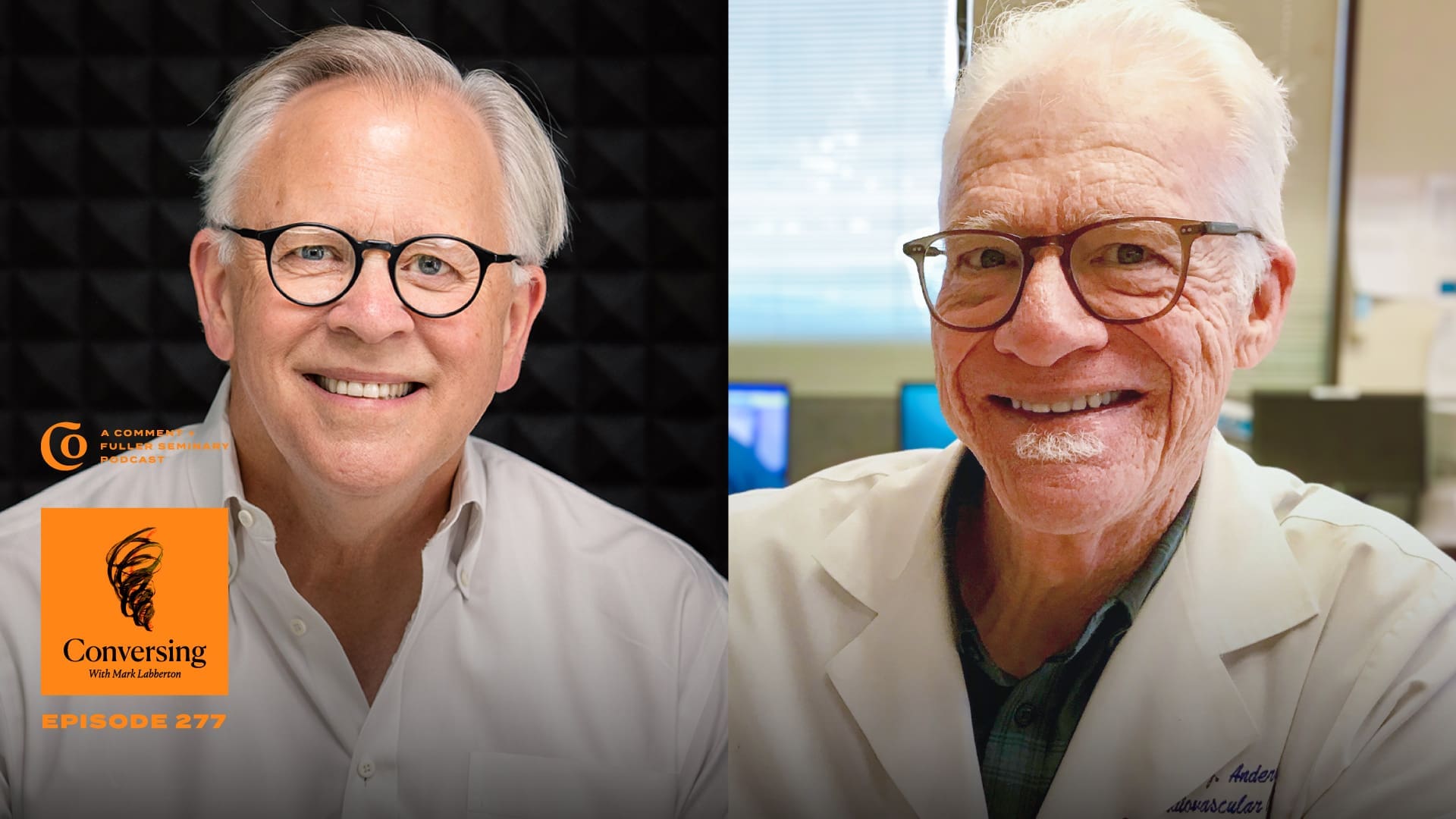
Mark Labberton discusses matters of the heart with his close friend Dr. David Anderson, a cardiologist of four decades who trained at Johns Hopkins and helped launch one of the first interventional cardiology programs in San Francisco. Anderson reflects on the medical science of cardiology, the profound life-saving medical advances over the past forty years, heart disease versus coronary artery disease, how the brain and the heart communicate, and what happens during a heart attack. In the second half of their conversation, they move from physiology to spirituality of the heart: Pharaoh’s hardened heart, “out of the heart the mouth speaks,” and the human need to find somewhere to locate the self.
Mark Labberton: Today’s conversation is going to be an opportunity to explore matters of the heart. By that, I mean both the physical heart, the biological heart that beats in our chest, but also some of the extenuating implications of heart that, as we all know, shows up in metaphor and imagery throughout life and literature of every kind. And the great gift today is to be able to do this with my beloved friend, David Anderson. Dr. David Anderson is a cardiologist and someone who did his training both at Stanford University as an undergraduate and at Johns Hopkins University School of Medicine. He’s been a cardiologist for decades and has fairly recently retired.
This is an opportunity to talk to somebody that has great personal and specifically heart knowledge that has been a great gift to me. In my family’s gene pool lies all kinds of evidence of troubling heart issues that have come to multiple generations. So I’ve always been particularly heart aware. And the fact that Dave is a heart specialist and such a good friend and a kind of “go for it, doctor”—like, not somebody who’s going to be passive about things. I carried in my wallet for many years a card that said under any medical emergency, contact my wife. But secondly, contact David Anderson, because whether this has to do with the heart or whether it has to do with something else, I want Dave on the case. So to have the chance for this conversation today is really a particularly great joy. Dave, welcome to Conversing. It’s great to have you.
David Anderson: Thank you, Mark. It’s so good to be here.
Mark Labberton: You know, we who are having this conversation and everyone who’s listening to it has at least one thing in common. We all have beating hearts. And that is a fact of life, a fact of our biology. But it’s also a mystery and a wonder to me as somebody who has stood outside the medical practice, but has very much spent in a way, just as you have, but differently, my whole life in matters of the heart. And so today we get to jump first into the biology of the heart and the things that really we want to understand about how it physically works and what its challenges and issues are. And then eventually we will come around to some of the broader issues that using heart language has obviously taken in our culture.
So let’s just begin a little bit first with your own background. Why did you go into medicine? And then eventually, why did you go into cardiology?
David Anderson: Well, Mark, you know, in looking back on my career, which has been very rewarding and has allowed me to do many, many different things, it was really providential that I got into medicine. I didn’t plan on it when I went to Stanford. My roommate was a pre-med, and I thought, well, maybe I should start there. I can always spin off. And I ended up pre-med, and I’m sad to say I never really questioned that adequately, as I should. In God’s hands, I did okay, got into medical school.
And then again, providentially, I took an elective early on, doing autopsies, happened to do an autopsy on a high schooler who died in the parking lot, had a known heart condition, was cared for by one of the major cardiologists at Johns Hopkins. And so he wanted to be very involved with the autopsy and what we found and discuss it. And he mentored me. And I became sort of a mascot in medical school to the cardiology department and stayed on at Hopkins to do my residency. And it was sort of assumed that, yeah, Dave’s a cardiologist. He’ll be a cardiologist. And it all kind of unfolded like that.
Mark Labberton: Once a cardiologist, always a cardiologist, something like that. You know, years ago, I had the opportunity to meet somebody who had been a surgical resident for six years under this premier doctor at USC. And he was describing to me at the end of his six-year period of residency what it was like to learn and work hand in glove, literally, with this person who he had so admired, and learn every gesture and every nuance of how this man did his work and how he, as a surgeon, was wanting to become a surgeon of the same kind of calibre. Was that characteristic of your residency, or was it different than that in cardiology?
David Anderson: It was different. I think that’s sort of an old-timey surgical story of the great chief resident or attending that you just idolized. I had several people on the road that all had their place in my development, but not one person.
Mark Labberton: Right, right. So as you were falling into this cardiology, there must have been moments along the way where your imagination or your curiosity was particularly provoked by what you were seeing about the heart and discovering and learning about the heart. Can you describe any of those things that seemed in those early years to just grab your interest enough that you could imagine making a whole career of it?
David Anderson: Yes. Well, I think that it was a transition point. I was at a transition point due to my age in which cardiologists went from internists interested in the heart to specific practitioners that were actually intervening in the heart. Starting out in my training, it was a matter of inserting catheters to measure pressures and the like, and then moving into my fellowship in which it was the dawn of the age of interventional cardiology.
And I think it was also a time in which imaging blossomed, echocardiography—we could see the heart. I remember the day that I saw the heart beating in the body for the first time. I was a senior resident, and it was an astounding thing to see and very clarifying in the case of this person that had been transferred to Hopkins. So all those things moved together. I also—I also felt the excitement of being with someone that was gravely ill. And so spending a lot of time in the intensive care unit, in the emergency room, that was something that appealed to me.
Mark Labberton: So interventional medicine is a category that comes into existence at basically the same time as you’re doing your training and moving into your life career. Describe that. You’ve named some of the elements of it, but what was that pivot, and why did it happen at that moment? What had led up to that capacity, and what was then triggering it?
David Anderson: Yes. Well, I tell the story when I was a senior resident, a senior member of the Hopkins clinical faculty was admitted with a massive heart attack, which meant that there was an obstruction in the coronary artery going down the front wall of the heart. And at that point in time, we really didn’t know that that was what was going on. We didn’t really know what caused a heart attack in 1979, precisely. And with the eminent cardiologists ringed around his bed all that night, I watched him go on to have a major heart attack.
Two springs later, I was in my training in San Francisco, and I was involved in helping the faculty member begin the process of a program of interventional cardiology in which this newfangled thing, coronary angioplasty, was being tried out. I remember my attending saying, well, I don’t know what’s going to come of this, but why don’t you help Tom do this? And so that’s how I spent my time, an extra year that I took to do that.
And one night a patient that we had done an angiogram on the morning before all of a sudden occluded that artery, and we took him to the cath lab now knowing that we could put in a catheter and peck around and open that artery. Because in the interim, what we had discovered—was not we, but the academy—through a study that was done in Oregon, where coronary angiography was done on people in the setting of a heart attack, which was something that was not done in 1979 or any time before, and they discovered that, lo and behold, it was caused by a focal thrombotic obstruction of a blood vessel. And from that point, medicines were given to open up the arteries, but they weren’t quite as efficient as actually directly intervening on the artery.
And so that patient in 1983, or spring of ’83, writhing in chest pain, writhing in the cath lab, 15 minutes later, was pain-free and joking with the staff as we wheeled him back to the coronary care unit.
Mark Labberton: Unbelievable.
David Anderson: An entirely different thing in the course of three years.
Mark Labberton: So let’s go back in my own history and connect it into this timeline that you’ve just described. So my dad had his first heart attack in 1974. So none of what you just described would have been available. He sustained life, gratefully, for that time. But then he went on to have three sets of bypasses over the next 15 years, about. All of that technology of the bypasses was not existent at the time that he would have had his heart attack. Is that right?
David Anderson: No. Bypass surgery had begun.
Mark Labberton: That had begun.
David Anderson: Yes. But that was an elective situation.
Mark Labberton: Yes.
David Anderson: You came to the doctor with maybe some heart malfunction.
Mark Labberton: Yes.
David Anderson: Or chest pain.
Mark Labberton: Yes.
David Anderson: You had an elective coronary angiogram, which identified the vessels that were obstructed. And then you had surgery.
Mark Labberton: Got it.
David Anderson: It was not considered safe to do an angiogram in the setting of a heart attack. It was felt that that was fraught with risk for arrhythmias and the like. So that is the key point, that that could be done in the setting of a heart attack. And that was in the late ’70s.
Mark Labberton: Right, live theatre, to say the least.
David Anderson: Yes, absolutely.
Mark Labberton: So as it unfolds then, let’s just hear a little bit about the combination of both advances in understanding the character of the heart and advances in technology that allowed you to do things in light of the increased understanding of the heart. It’s both about the blood and its circulation, but it’s also about the electrical system of the heart, which I want to come to again in a minute. And just describe now what’s happening on those two fronts. What are we understanding more about the heart at that time? And then what are we understanding about how the technology is being created to do these interventions that you’re describing?
David Anderson: Well, I think when people describe heart disease, I think for the most part, they’re describing coronary artery disease. They’re not really describing heart disease. They’re describing the disease in the arteries that supply the heart with blood.
Mark Labberton: Got it.
David Anderson: And it’s their obstruction that causes heart attack and malfunction. And I would say—yes, the technology to meet that challenge was burgeoning, but also long before, 15 years before, the NIH was focusing on high blood pressure, smoking cessation, the lipid theory of atherosclerosis, a whole host of things that were looking at preventing getting to this point where there was an obstruction that needed to be fixed. And so as we tell this story about the technology, ongoing is this ever-increasing understanding of preventive medicine.
And I will just say that when I first started, I would do an angioplasty on someone, and then one vessel, two years later on another vessel, etc. By the time I got mid-career, when people were now really not smoking anymore and taking care of their cholesterol and their blood pressure, and we had the medicines to do that, often I would fix somebody’s artery and we’d never have to deal with another thing again. So that’s an important aspect to this.
Mark Labberton: Right, right. Wow, wow, wow, wow. So there’s artery disease, and then there is actual disease of the muscle itself, either caused by insufficient blood supply or caused by diseases of the muscles itself.
David Anderson: And when I first began in cardiology, if your heart was damaged, imagining that the heart could actually improve its function was like imagining someone could grow back a new arm. We had no understanding of the plasticity of the heart. And with the proper understanding of why it was malfunctioning, it could actually return to almost near normal function. That’s something that began probably 25 years ago and has become more and more a part of the joys of cardiology and seeing people improve and stabilize.
Mark Labberton: Wow. Now, how is all that related to one of the great curiosities of the heart, which is that while some animals have heart tissue that will regenerate, there’s nothing that’s particularly regenerative about the heart tissue itself. And therefore, this kind of plasticity exists, but not this regenerative capacity. So, you know, we can think of other organs of the body, the liver as an example, which could in a way regenerate its tissue. But what makes the heart so—not only is the primary vital organ of the body, but it’s also one that isn’t going to self-regenerate. The work that you’re discovering about the plasticity of the heart, how does that become apparent in a way that would not have been apparent earlier? And does that relate to the matter of the tissue?
David Anderson: Yes, yeah. What was discovered is that once a portion of the heart is damaged, that sets a cascade of reactions which are in themselves toxic and increase—decrease whatever function is remaining and areas that were previously healthy and maybe not affected at all by the heart attack. And what’s going on here is the system was designed such that if you had a reduced cardiac output, that was because—
Mark Labberton: That means your heart is just less functional, productive.
David Anderson: Well, it means that you’re not producing as much. You’re not producing your normal four or five litres per minute, or your body is demanding that.
Mark Labberton: Right.
David Anderson: But you can’t deliver that.
Mark Labberton: Got it.
David Anderson: Unless you do some adaptations.
Mark Labberton: Right.
David Anderson: And those adaptations are the things that become maladaptive. Because the system was designed to counter a low cardiac output caused by dehydration, acute blood loss. It was designed just to keep you going.
Mark Labberton: Yes, right.
David Anderson: Four or five days in which you could restore your blood volume, find some water, crawl into a cave, make some blood. It wasn’t designed for reduced cardiac output over weeks and months and years. So those acute adaptive mechanisms, adrenaline primarily, in fact caused damage to the heart. And so made borderline areas become completely malfunctional, and normal areas eventually malfunction. And so it was discovered that if you blocked the effect of adrenaline on the heart through what’s called beta blockers, the heart would recover. And it was a miraculous—
Mark Labberton: And when was that discovered, about when?
David Anderson: That was—well, people were thinking about this. The Scandinavians had some wonderful studies as far back as the 1980s. And I can clearly remember when we first were applying this and seeing this in our patients and kind of running into my partner’s office, which was next door, and say, this is incredible. This patient had an ejection fraction. We talk about ejection fraction. That means that at each cycle, that’s how much blood within the chamber is ejected out to the body. That’s about 50 to 60 percent. So I was talking about a patient that maybe had an ejection fraction of 35 percent, and now they’re at 45 percent, which is totally compatible with a normal life.
Mark Labberton: Wow.
David Anderson: Very exciting.
Mark Labberton: That must have been thrilling.
David Anderson: It was.
Mark Labberton: Right. Gosh. So let’s just go over some basic statistics about the wonderment that I have, at least, of the heart, that as I understand it—correct me if I’m wrong—that most of the cells that we have that will develop into a full human heart begin to be apparent as early as like five or six weeks into gestation. Is that about right?
David Anderson: You know, I’m not a neonatologist, and I don’t know exactly when the heartbeat occurs, but it is very early.
Mark Labberton: Yes, right.
David Anderson: And it is one of the earliest organ developments.
Mark Labberton: Right. So then over an average lifetime, approximately, how many times would the heart beat?
David Anderson: Oh, let’s just say on the average, you’re beating 70 beats a minute.
Mark Labberton: Right.
David Anderson: And you’re pumping about 70 ccs of blood with each cycle. So you’re pumping about four to six litres of blood a minute.
Mark Labberton: How much blood is in the body?
David Anderson: About four to six litres. So you’re exchanging or pumping your entire blood volume every minute. And if you’re an athlete—well, let’s just say you or me exercising, we go up to 10 to 15 litres per minute.
Mark Labberton: Wow.
David Anderson: And if you’re a highly trained athlete, you can go to 25 to 40 litres.
Mark Labberton: Wow.
David Anderson: Remembering that a litre is about 3.8—there are 3.8 litres in a gallon.
Mark Labberton: Yes. Just to get an idea of what we’re talking about. So a little more than a gallon every minute. Wow.
David Anderson: And another thing that’s been discovered is, yes, it’s pumping, but its beautiful design is such that when it relaxes, it’s sucking. I had a physiology professor that was very denigrating of the heart. And to him, the heart was just carrying along the blood that it received from this wonderful system of veins and the system of returning the blood to the body. So he wasn’t as interested in the heart’s systolic or pumping function. He was interested in its acceptance of the volume being handed to it. And in fact, that’s been a whole other new and interesting aspect to understanding how the heart works—the function of the heart as it relaxes and accepts blood, and the malfunction of relaxation, which can cause as much problem as the pumping part.
Mark Labberton: Of course, one of the distinctive things about the heart is, unlike other muscles, it doesn’t have a time to rest. When it gets insufficient blood supply, it can’t just say, whoa, I’m going to stop here. It asks you to slow down because it starts hurting. And maybe things will go back into balance, but it can’t stop and preserve itself, retain its integrity. It goes on trying to beat, trying to produce blood, and therefore that’s the damage that’s ongoing in states of, say, a heart attack or insufficient blood supply. It’s doing its best to handle the demand that’s asked of it.
I think I’ve read that in a normal lifetime, the heart would beat something like 2.5 billion times. Whether that’s the actual number, I’m not really the expert. But in any case, we’ll call it an extraordinary number of times, whatever the right number is.
So to keep that ongoing work of the heart underway involves a lot of things in the heart itself and in the body. But one of the things that I think has also changed that is related to some of the stuff you’ve already said is really the electrical system of the heart. So can you just comment a bit on how the distinctive electrical system of the heart is both related to the brain and also distinct from the brain? If I’m crudely understanding, that there’s a debate that goes on about the relationship with the brain and the heart, but that the heart has, in a certain way, its own mind in its way of existing.
David Anderson: Well, yeah, I don’t think there’s really a debate. I mean, I think that’s part of the intrigue of the heart, that it is inside us, but in some ways it’s apart from us. It’s responding to environmental things that we’re not really even aware of. And the way it does this is that there is a centre in the heart that accepts all sorts of information from the brain, but also hormonal information, adrenaline, these types of things, signals to slow it down. And then from that centre, then through a specialized pathway, the electrical activity goes over the heart and incites the underlying contractile apparatus to do the squeezing.
So it is responding to the environment apart from you. It is also generating all these beats without you thinking about it. And so that is obviously a very important aspect, because otherwise it would sit there doing nothing.
Mark Labberton: Right, right. Which it’s committed to not doing.
David Anderson: Right, right. And in fact, when there’s disease of this centre, as we would call it, your heart will gradually slow down. And if it ceases to function, in most cases—or a lot of cases—other centres lower down in the heart will say, whoa, I didn’t get a signal here, I better start generating one myself. And so we do have people that ultimately are treated with a pacemaker who will come in with a very slow heart rate generated within the heart itself through its own intrinsic mechanism of beating.
Mark Labberton: These are just among the things that I find the most extraordinary about the heart, because it’s both kind of finest detail and then it’s relentlessness, it’s endurance, it’s resilience in the face of all of the things that life and the environment throw at it. And it’s constantly adjusting. So how does the brain and the heart interact? How do those two things come together?
David Anderson: Well, there are direct connections so that states of anxiety can make your heart beat faster. But it isn’t left to consciousness. The body’s smarter than that. It doesn’t want to be flitting about too fast or going too slow. It’s not going to rely on you for the appropriate heart rate. Thank you very much.
Mark Labberton: Yes.
David Anderson: Yeah. It has its own sense of what you need and therefore provides according to that need.
Mark Labberton: So these are some of the reasons, I think, why the heart also begins to have—even with greater and greater scientific understanding, so that your ability to just say what you just said can be acknowledged—and it names, it seems to me, anatomically, biologically, physically, whatever the right sets of words are, it points to what makes the heart such an intriguing part of our life system, right? And even though science may have only in recent centuries, let’s say, or even decades, been able to, in a refined way, describe what you just said, it’s also the case that there’s something about the body’s knowledge of that, it seems to me, that exists, which is partly why we could comfortably go to sleep, for example. I mean, it’s partly the mystery of the autonomic system in general.
But there’s something about the heart because we do feel it in our bodies, which we don’t feel other organs on the whole. We certainly don’t feel it in an activity-oriented way. We might have pains in various parts of the body, of course, but that sense of the relentless beat and presence of the heart monitoring us, keeping us, protecting us. This is where it starts, I think, to slide into that intuition that has been true across history and across cultures and across religion, across geography, across every strata of society. This sense that the heart is really a physical organ that has metaphysical implications, or this is the way that we’ve lived with it across religions again and around the world.
I think it’s some of these dynamics, this kind of mystery in your body without any knowledge of cardiology at all, that you’re just aware that your heart is something that’s happening in your chest. It’s attached to the heart metaphorically in ways that may not be actually related to the heart, but other parts of that intuition are actually related to the heart. Is that a fair way of describing it?
David Anderson: Well, yeah. I think through history, it’s central.
Mark Labberton: Yes.
David Anderson: But it’s alive.
Mark Labberton: Yes.
David Anderson: In a way that the ancients were well aware of. They didn’t understand the circulatory system, but they understood that it was moving. And it was felt that that was where the warmth of the body was generated. And I think that even the most primitive person, when they have a skipped heartbeat, it gets their attention. So I think the heart gets our attention in the way that other organs do not.
And I think it’s this sense of detachment of the heart from us, but yet its centrality, that has led people to posit the soul or the will or the passions or almost anything that you would think was—the real you, the inner you, that’s where it is. It’s in the heart. That’s where God wants to write his laws on. And Jeremiah is aware of his heart pounding and beating as God’s telling him what’s going to happen to Israel. He describes that: the walls of my heart clanging in. I think there’s that awareness of what’s going on.
Mark Labberton: Right, right. It’s such a powerful thing that throughout religious traditions, and specifically in this context throughout the Christian religion, both Old and New Testaments alike, the heart is so frequently referred to. And it is—when it’s referred to, is referred to as something that is primary, just in the way you’ve beautifully described. And in that context, it’s also the place where good and difficulty resides. It’s not just the best of ourselves. It’s the everything of ourselves.
David Anderson: Right.
Mark Labberton: And, you know, God hardened Pharaoh’s heart.
David Anderson: Yes, right.
Mark Labberton: What’s that about?
David Anderson: Yes, what is that about?
Mark Labberton: And likewise, when Jesus says that it’s not what comes out of our lips that matters, but much more what comes out of the heart that actually matters. And that those kind of dynamics are the things that make us both hypersensitive about our own selves, right? There’s something about that that I think helps develop self-consciousness even. That I am self-conscious partly because I feel an animating organ doing its work, and I am—I’m experiencing it throughout my body, its implications and the implications of my own actions and the environment that I may be in. So here you are, a cardiovascular surgeon, and you’re—
David Anderson: Can I just—
Mark Labberton: Yes, please.
David Anderson: Add one thing to that. I think that it bespeaks of the fact that there is such a place that we need to posit all this.
Mark Labberton: Yes, yes.
David Anderson: That, you know, Pascal says, the heart has its reasons.
Mark Labberton: Right, right.
David Anderson: It is mankind’s sense that there is something within him—
Mark Labberton: Yes.
David Anderson: —her—
Mark Labberton: Yes.
David Anderson: —that is central and is them. Call it a soul, call it what you want, but it’s something, and I need it. Or I need a place to put this.
Mark Labberton: Yes, right, right.
David Anderson: You know, so it’s the heart. Maybe now it’s the mind, I don’t know. But it begs the question: is there something more to us that we constantly need to have such a place to call the home of this thing that is us?
Mark Labberton: Right. Right. And so you end up having, in our moment, AI agents who do not have a heart, that do not have a heart. And in the context of that, you can in any time and place and circumstance access an AI agent, but there is no life there. There is data there. There’s information there. There’s a growing sense of cognitive function that is seemingly beginning to be more than simply an input of other data, but some kind of self-awareness, not yet consciousness from what I’m understanding. And yet our consciousness is so tied to our sense of our heart that it’s part of our own existence. I know that I’m here partly because I feel my heart beating.
That’s just a very remarkable thing physically, but then it’s also remarkable because the place that you’re going to describe, that place that we know we have within us, is something that my heart is not your heart, that I never think I could rely on your heart. I could depend on your heart functioning if my heart is in trouble—thanks for being a cardiovascular surgeon—to rescue my heart, but I could never borrow your heart. I could benefit from your heart, but I can’t exchange it in that way. Here I’m bracketing out heart transplants, which is not what I’m specifically referring to. I’m just meaning that we can give one another a great deal, and we can give one another even this metaphorical heart, but we can’t do it anatomically.
And to me, that’s part of this exchange of self in human communion where we have a syncopation that puts our hearts in communion with one another, right? I mean, part of friendship, part of intimate connections with another person is this sense of a sharing of the heart that has occurred in some sort of way. And I just wonder, as a cardiovascular specialist, I’m just wondering, you’re touching this organ and you know that its implications are so much more than physical, but you’re actually working on the physical character of it. Just describe something about that dynamic. I mean, I’m not there. I couldn’t do and don’t do that work, of course, but do those coexist simultaneously, or are they like sections of your brain that you’re working on—really just the physiology of it at the time that you’re doing the technical biological work, and you otherwise think about the wider implications of heart? Or do they somehow coexist in you as a heart-mind person at that very moment?
David Anderson: Well, Mark, I think that gets to the provider.
Mark Labberton: Yes.
David Anderson: His or herself.
Mark Labberton: Yes.
David Anderson: I think that certainly in the moment, I’m not contemplating these metaphysical ideas. I feel—nor do I feel that God is guiding my hand. I feel supported by God. I feel, you know, I feel God in a general way in my practice. But what I would say is that clearly there are different circumstances. I mean, if I’m working on a patient, or with a patient doing a procedure, who I’ve known for five years, or I’ve even known for a week, but we’ve gone through a whole journey together—clearly, there’s a different feeling as I’m working that adds to the import to me versus maybe somebody that I met 10 minutes ago in the emergency room. I don’t really know them at all. I’m dealing with the task at hand.
In terms of that heart-to-heart connection, certainly there’s a general feeling towards that person, even if I haven’t met them hardly at all. I’m just stepping in. But I really enjoyed the aspect to my practice in which there was that communion with my patients and my colleagues, for that matter, and for the team.
Mark Labberton: Yes, I’m sure.
David Anderson: Us working together.
Mark Labberton: Right. It all was—right. There’s a pulling together of minds and hearts in a surgical room like that. Or at least that’s what I’m imagining the experience is like.
David Anderson: Yeah, yeah. Especially if it’s, you know, a team of people that you’ve worked with and depended on for many months, many years.
Mark Labberton: Right.
David Anderson: You kind of—you know each other, and it’s a good feeling. You know, when it’s two in the morning and you roll into the emergency room and there’s a sick patient and already two of your staff are there setting things up, and you look them in the eye and you don’t have to say a word because you just know, they know what they’re doing. And shout out to Summit Medical Center.
Mark Labberton: Exactly.
David Anderson: Yes. Great team there.
Mark Labberton: Oh my gosh. To be in a competent team who’s doing—who knows what needs to be known and can actually do what needs to be done, and then you’re doing it together as a team, is an exquisite human experience. I mean, that’s just a remarkable, remarkable thing.
David Anderson: Yeah, and we all treasure it.
Mark Labberton: Right, right. So what are the mysteries on the horizon of heart research that are going on, that are being explored, that in the way that, say, going back in the 40 years or more that you’ve described this incredible transformation in the understanding of the heart—are there things on the horizon that you think might become next breakthroughs, or even breakthrough areas? I’m not asking you to predict the future, but just what would you point to as the areas where this same kind of ongoing development might increase still further how we understand and treat the heart?
David Anderson: Well, I think I grew up in an era, my practice life was in an era, that I always described as a technologic era. We had technologic solutions for so many problems. And those were further and further refined as time went on. Stents, little drills, specialized pacemakers, defibrillators—technologic solutions. And I think we’re now entering an era of understanding in which there will be a more molecular-based understanding of problems, certainly in the area of atherosclerosis. And what is at the bottom of atherosclerosis?
Mark Labberton: Right. Why don’t you describe that?
David Anderson: Atherosclerosis, I would describe as, it’s like having a pimple inside your artery. You have this lining of your arteries called the endothelium that mitigates the relationship between the flowing blood and the surrounding wall. And if there are toxins in the bloodstream, high levels of insulin, high levels of lipids, inflammation, then that wall can be damaged. And when it’s damaged, it starts taking up elements from the bloodstream, and a little thing develops—call it a pimple—and it grows. Maybe it stops growing, becomes calcified, starts growing again, and gradually increases in size. It can—and the elements within it spurt out into the blood vessel, initiating a blood clot, which plugs up the artery. That’s an acute heart attack, which can occur when there’s hardly any obstruction at all to begin with. So that’s why people can be struck with a heart attack when they had no idea that they had a blockage. Because it takes about 70 percent obstruction. There’s so much redundancy in the system. It has to get up to 70 percent before you can actually feel it.
Mark Labberton: Wow, 70 percent. That’s amazing.
David Anderson: Yeah, there’s that much redundancy in the system. So I think further understanding of the pathophysiology of atherosclerosis and its prevention—and therefore its prevention because of the understanding—will be a major growing edge. And then, of course, people are working on—you mentioned regeneration—they’re working on stem cells. Can stem cells be positioned in areas of the heart that have been damaged and therefore regenerate portions, walls of the heart? Can we understand what happens in cardiomyopathies when the whole muscle becomes—and not functional? What’s the actual pathophysiology of that? I think these are all areas, again, molecular biology kind of areas, that will be the—as in oncology, will be the aha moments going forward.
Mark Labberton: Right, right. It is amazing to me to see the speed that you’ve described during this technological period that your practice has grown and developed over the decades. And this molecular work, how does it tie into what’s also being done in molecular work around DNA in general? Can you comment on that?
David Anderson: Well, I think it’s understanding a subset of heart diseases that are genetically based.
Mark Labberton: Yes, yes.
David Anderson: And understanding what the precise problem is, mutation, if you will.
Mark Labberton: Right.
David Anderson: But also just understanding how it all works and applying counters to when it’s not working properly.
Mark Labberton: Right, right. So one of the phrases that has sometimes been used in the 20th century, I think, and still gets referred to sometimes in the 21st, is this sense that we have a ghost inside the machine. And this goes back to what we were talking about in terms of the use of the heart as a centre of metaphorical identification of where we think the real self is in us, and whether that’s a living soul—by which I’m not meaning something anatomical, I’m just really meaning more a core sense of being that we hold.
When you are as close to the heart as you’ve been, and you share, as we do together, a deep Christian faith, how does that sense of human soul and biology interact? I know that we talk about them distinctly and rightly so, but at the same time they are functioning—coming back to that theme, there’s a kind of intertwineness. So I guess I’m wondering, does a person who is a cardiologist have a different sense of the body in a profoundly different way than a surgeon of some other organs of the body? Or is that just a projection onto all of this that doesn’t really transfer into how you actually carry on your life as a cardiologist?
David Anderson: I think that’s a projection. Yeah. I think that clearly you are put into situations of acute emergency and death. And so you’re thrown into situations in which somebody has died.
Mark Labberton: Yes.
David Anderson: Or is on the verge of death.
Mark Labberton: Yes.
David Anderson: Or somebody that has an illness that maybe not acutely, but down the road.
Mark Labberton: Yes.
David Anderson: So I think that you are dealing—and you’re dealing with the organ that’s the proximate cause of this.
Mark Labberton: Yes, right.
David Anderson: Much like an oncologist, for example. So there is that opportunity to be there for the patient.
Mark Labberton: Right, right. And their family.
David Anderson: And their family, and their family. But I don’t think—I never carried a special reverence for my organ, if you will. But I do think that more and more people are encountering, as we get to the limits of our knowledge, whether you’re an astrophysicist or you’re a neurobiologist or you’re a molecular biologist, you keep digging, digging, digging, and it’s an asymptote. You get closer and closer, but yet there’s still something else there. And there’s sort of this uncertainty principle operative that you can’t even measure it.
Mark Labberton: Right, right, right. And you have respect and awe for that.
David Anderson: Yeah.
Mark Labberton: So one of the aspects of this that we haven’t yet discussed is the matter of the care that a cardiologist can extend to both the patient and the family. And one of the more profound things that I’ve heard you say, in a certain setting where you were part of a panel and someone asked you a question in which you said—the question was, what do you find difficult, especially when you have to give really bad news to a family? And it may be someone’s impending death or the severity of their disease or whatever it might be. And I remember you saying that one of the things that you’re aware of that you say to yourself is that I’m not the one with that particular medical condition at that moment.
I love that response. I loved it for many reasons. Part of it was the utter clarity of, I can do my job in this painful place because I’m not the one who is the patient. It felt to me like it was the very capacity that then releases you to bring all of your very best skills and knowledge to that particular task, which is both medical and human and spiritual. So describe what the caring for the hearts of family who are attending to the heart patient—how those interact, and how you as a physician try to walk that inner connection that’s so vividly present when you’re in the hospital.
David Anderson: Well, you know, I know you’ve mentioned before me making that statement. I wasn’t sure it landed well when I made it to this group, because it does suggest a certain lack of empathy, to me at least.
Mark Labberton: Right.
David Anderson: But I didn’t mean it in that sense.
Mark Labberton: No, I didn’t hear it that way.
David Anderson: I meant it in a sense that, like you said, I could marshal everything I needed, either emotionally or physically, and have a little degree of separation from the patient in such that I wasn’t going to dissolve in a puddle of emotion over either agitation or tears. Not that I haven’t cried with patients before—that’s certainly the case. I think that it gets back to a human being, right? And being a Christian, frankly, and, um, allow yourself to be affected—
Mark Labberton: Right.
David Anderson: —but not incapacitated.
Mark Labberton: Right, right.
David Anderson: And, you know, I would always try to make some sort of connection with the patient that I could call forth in a crisis. That that person would feel that we had connected over an aspect of our personal histories that I had kind of dug out, that we had a similar history. Maybe a place where we were born.
Mark Labberton: Right. Some connection.
David Anderson: Some connection that in that moment I could draw upon. Not that I’m going to relay an anecdote from that moment, but that I was connected to them. Sometimes it was over our Christian faith.
Mark Labberton: Right.
David Anderson: And certainly I was always sensitive to not wanting to proselytize, for sure.
Mark Labberton: Right.
David Anderson: But I wanted them to know that I was open to spiritual things.
Mark Labberton: Right.
David Anderson: And that if it did happen in these probes, I did find out that they were a believer or a person interested in spiritual things, certainly that gave me licence to call upon that.
Mark Labberton: Right, right, yeah. I just know that, having been as a pastor, as well as in my own personal story, present in so many moments when doctors are delivering really difficult news, that way that that is delivered is so central to the capacity of the family to receive even the hardest news, right? I mean, most people are prepared for hard news in life—not just so they like the hard news that comes, but everyone gradually becomes familiar with the fact that life involves hard news. So you want, if the news is hard, you want to know it, because you don’t want to be left in a mystery.
But I’ve certainly been in rooms and I have received sometimes a complete absence of that connection. It’s just like they’re announcing an equation. They walk into the room and say, you know, X equals Y. Glad I could stop by. And they walk out of the room. There’s just no human connection.
But when the person with the knowledge and the presence and the actual contact with the body—and in this case, the heart—comes out into a waiting room where family are anticipating some kind of news, and can actually enter that space as a human being and as a doctor and as a compassionate person, and if it’s so, as a Christian with Christian people, that can be an extraordinarily powerful—life, like, life-changing moments happen in those sometimes maybe only five- or ten-minute exchanges, but they live with people for the rest of their lives. I remember exactly when that doctor walked into our room and said these things, that was part of the healing process, even in anticipation of what might be the eventual death of the person that we’re talking about, right? It can still be a healing element. That to me is another way of talking about matters of the heart, that takes—you want the biology, and you want the full range of human being to be brought to it as well.
David Anderson: Well, you know, Mark, I think—I’m glad you brought that up, because I really, at any opportunity, like to get out the message that medicine is a noble profession.
Mark Labberton: Yes.
David Anderson: And I think that it allows a person to really be a human being.
Mark Labberton: Yes.
David Anderson: In a way that other professions, as they are, just don’t allow you. Within five minutes, somebody is telling you something that they’ve never told anybody else. And I think as young people consider what kind of a career they want, and you hear things about how medicine’s practised now and it’s not [about the patient’s] well-being, you know, that is not true. It might be a little more difficult. But you can still have that kind of impact. You can still make that kind of time. You can still be you. And so I think it’s very much worth considering in all the health professions. My wife is an echocardiography technician, and she would elicit wonderful things from the patients and care for them so during the tests that she was giving.
On a lighter note, I would say that sometimes it’s very funny. Patients that I have known for years and years, they would come in maybe with their son or something, and they would say, well, Dr. Anderson, I remember when you said this, you know. And they would come out with a statement that I would never have made in a million years. It’s just not something that was part of my vocabulary. You know, like, you said I’d be dead in three years and look at me now, you know. And I just know I never said that, you know, in that way. But that is part of the family lore. And maybe there’s a cousin standing behind and they’re all nodding their head like, you know, in the family, Dr. Anderson said he’d be dead in three years, and now it’s ten years later. That happened more than once.
Mark Labberton: Yes, yes, yes. Well, as a pastor, I’ve had plenty of people tell me back things that I apparently said that I don’t recognize either. So I do have some empathy for that.
I do wonder, as we come to the close of our conversation, Dave, if you were wanting to, again, just on the most practical level, give us your best advice for anybody who’s listening to this who may, for themselves or people that they love, have concerns about the heart. What are the things that they should be attending to? Like, give us the top three or four checklist of things that are the right behaviours.
David Anderson: First of all, know yourself. That is, it’s not a time to be fatalistic because your father had a heart attack in his fifties or your brother just had a heart attack. It’s a time to be proactive.
Mark Labberton: Right.
David Anderson: Make sure that you have regular checks of your cholesterol. Make sure that your doctor is providing guideline-directed therapy such that your cholesterol level, your blood pressure level are appropriate. Try to maintain an appropriate body weight so you don’t get into diabetes, because diabetes is a very difficult thing to manage, even in this day and age. So I would say those were the big things.
And then, if you have any kind of—if you’re of an age where you could be having heart disease, maybe you’ve had a long history of high cholesterol and it’s been on and off on therapy, and you begin to notice a pain when you’re exercising someplace between your chin and your belly button, and it’s oppressive kind of pain, maybe have some shortness of breath with it. And importantly, it’s occurring doing something that, gee, last week you did without any problem like that. And let’s say that happens two days in a row. That’s a time to call the doctor and say, what is this? Should we evaluate this? Don’t spend months trying to figure it out for yourself.
Mark Labberton: Right, right. Well, I’m so grateful that you’re my friend. I’m so grateful that you’re a cardiologist. I’m so grateful for years of attention that you’ve given to my heart and to getting me to other specialists as well. So far, I haven’t had any acute moments, but I’m definitely attentive to the possibility because of the history of our family.
And I just want to say thank you again for all of those things, and for the patients that you’ve served, the patients you’ve been able to save, the farewells that you’ve had to also endure, and for the work that medicine brings to the world—which I think both you and I in this particular moment in history in America would want to underscore the importance of science, and the science that you’ve described today is just a very, very important part of why that’s so evidently true. Thank you for the conversation, and for the discoveries that I continue to make about what the heart is really about.
David Anderson: Mark, thank you so much. It’s been an incredible honour to be across from you talking like this. Of course, we’ve had many such conversations in a social mode, but this is a great honour for me.

Mark Labberton hosts the Conversing podcast and is the Clifford L. Penner Presidential Chair Emeritus and Professor Emeritus of Preaching at Fuller Seminary.
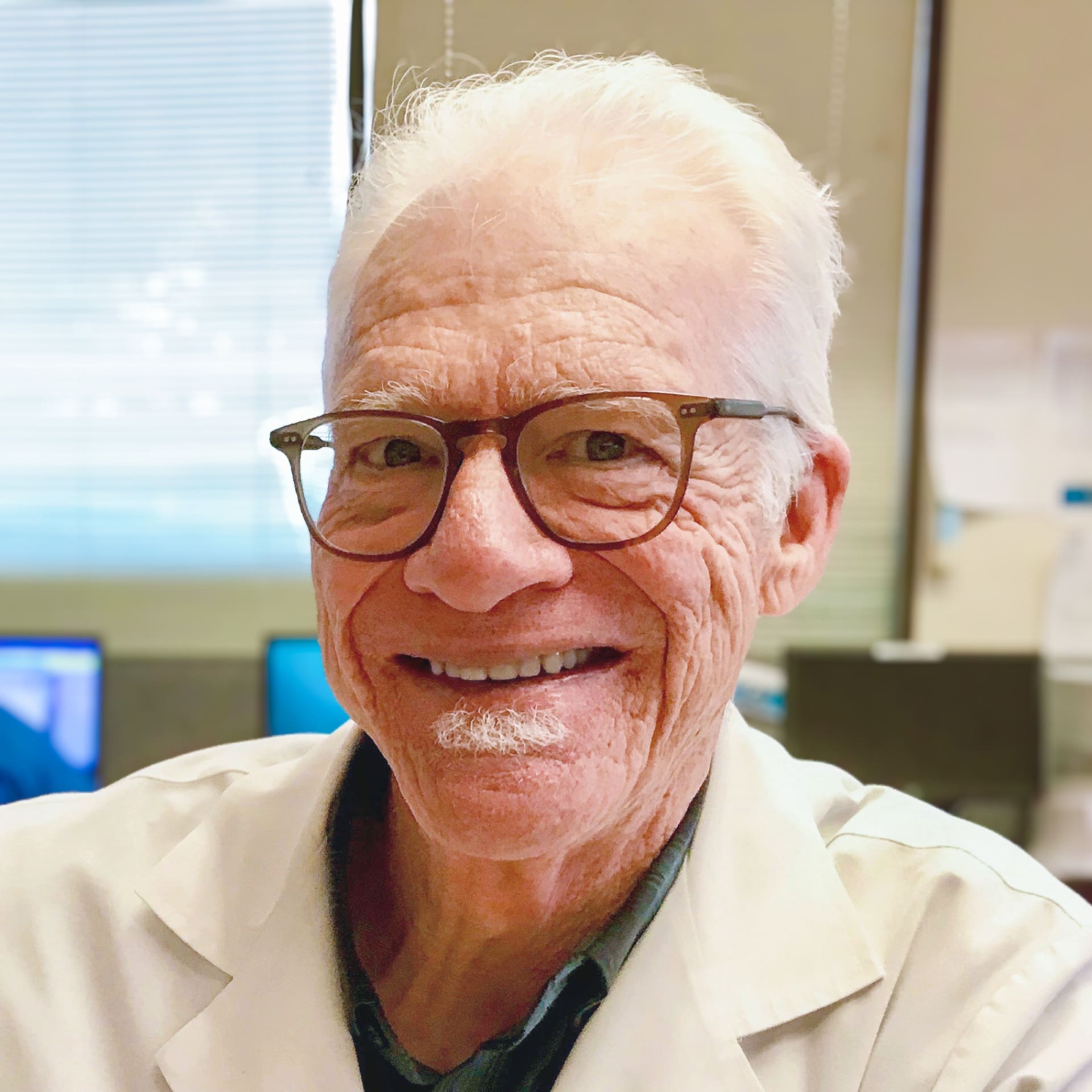
David Anderson is a cardiologist who practiced for more than four decades before retiring. He studied at Stanford as an undergraduate and earned his medical degree at Johns Hopkins University School of Medicine.
Love the show? Help others find it by reviewing it on your favourite podcast app. We also welcome your ideas and feedback. Email us at conversing@comment.org. Thanks for your support.
An interview with Toronto psychotherapist and theologian Glenn McCullough.
SITE DESIGN AND DEVELOPMENT BY POLYMATH