

D
Descartes and Kant threw their own influential dreams and dreamers into the pit, so to speak, like Joseph, which is precisely where Freud later found them. . . . But Freud and Jung were not so much innovators as inheritors of a lineage of dream therapy.
—Glenn McCullough
Despite the threat posed by Big Pharma, a residual materialism that denies the soul, and chatbots that risk rendering analysts unnecessary, something beautiful is happening in the field of psychology. If one had to pick a word for it, that word might be retrieval. Iain McGilchrist’s two-volume masterpiece sees promise for the recovery of a holistic approach to the brain not in future technical advances but in the older Haudenosaunee thought of this continent. And in Magic and Melancholia: Recovering the Soul After Modernity, L.C. McCormack finds the same thing in the wild recesses of alchemy and Christian Neoplatonism, suggesting that “the past enjoyed more success in the psychic-corporeal sphere, and modernity, far less.”
But among the most promising of such retrievals came last year from University of Toronto psychotherapist and theologian Glenn McCullough, in Jacob Boehme and the Spiritual Roots of Psychotherapy. Like both McGilchrist and McCormack, McCullough finds ancient resources for combatting present mental illness. But in Jacob Boehme (1575–1624, also spelled Böhme), a Lutheran mystic whose influence weaves a golden thread through John Milton, William Law, Samuel Taylor Coleridge, and Martin Buber, he might have made the most promising recovery of all. Moreover, Freud was expressly indebted to Boehme, as was his successor Carl Jung (though Jung did not entirely acknowledge the debt). Seeing that the imagery of dreams is at the heart of anything flying under the banner of Material Mysticism, I was thrilled that Glenn agreed to an interview.


Matthew Milliner: First off, Glenn, as I said when I met you, no one has any business knowing as much as you do about these respective fields. You fuse a mastery of psychology and theology without the weak leg in one or the other field that bedevils most people who make the attempt. I know you studied with the late great Jim Loder (whom I’ve written on here) at Princeton Theological Seminary, and that it was a personal catastrophe that drew you into these depths. Could you please say some more about those elements of your formation?

Glenn McCullough: Well, it was Jim Loder’s Spirit-infused approach to psychology in The Transforming Moment that brought me to Princeton Seminary. I read that book just before I applied to the Master of Divinity program. The other thing that brought me was a tragedy in my own family—a car accident that took the lives of three close family members. In a kind of bewildered state of grief and searching, I felt a call to wrestle with the faith I’d been raised in, and seminary seemed like a good place to do that. I did have some big academic questions about the relationship between science and religion, but it was more a deep personal quest to find something that would speak to the tragedy my family and I had just suffered.
I read a lot of theology at Princeton, but ultimately it was in my senior thesis on Dostoevsky and Kierkegaard, with Jim Loder and Ellen Charry, that I began to see real possibilities for a wedding of psychology and theology. Jeff Stout at Princeton was also very helpful for opening up the tradition of American pragmatism and showing me how the sciences and humanities could hold together with religious thought.
Finally, though, these intellectual answers weren’t enough, and after leaving seminary I fell into a deep depression, in which I began having some very vivid dreams—the kind of dreams that seem more real than waking life, lit by a purer light. I remember waking up from one of those dreams and looking in the Yellow Pages under “Jungian therapists” (I’d heard they worked with dreams), and I found one name listed. That began a journey with dreams that has continued for twenty-five years. In my first few sessions, my therapist was able to show me that dreams are not only extremely precise in their symbolism but wildly insightful. Every symbol and event in a dream counts—there’s nothing random about them. From there I was hooked. It was really my dreams that led me to my doctoral work and eventually to writing this book.
MM: And yet we need guides when we tackle our dreams, and you see one of those guides in the misunderstood Lutheran mystic Jacob Boehme. Before we go on, let’s tackle the matter of Boehme’s orthodoxy. Those influenced by Cyril O’Regan have come to view Boehme as something of a gnostic. Likewise, a new book by Michael Horton (published since yours appeared) gives Boehme a similar theological critique from a Reformed angle. While respecting such readings, you draw on new resources to read Boehme within the mainstream Christian tradition. In particular, you claim he is innocent of the Hegelian mistake of projecting evil into God, and you don’t make that error yourself either. While Hegel attempted (in Cecelia Muratori’s phrasing) to translate Boehme into “conceptual clarity,” to “liberate the mystic from . . . barbarousness,” you seem much more content for Boehme to operate as both mystic and poet. You point out (alongside his biographer Andrew Weeks) that Boehme was vindicated of heresy in Dresden, which was in effect the Lutheran Vatican. Could you please elaborate on that?
GM: Yes, I really think Boehme’s heterodoxy has been overstated in both his day and ours. Partly it depends on which of Boehme’s texts you’re reading. Most scholars read him via his first work, The Aurora, which he was not at all satisfied with. It was a big jumble of ideas that he circulated personally to some friends. When the local Lutheran pastor got a hold of it, he threw a little temper tantrum and convinced the city council to censor it and forbid Boehme from writing again. In my book, I concentrated on the Mysterium Magnum, which is Boehme’s last, longest, most mature, and least studied work. Boehme’s writing is much more organized in the Mysterium, and much more exegetical. And you’re right that Boehme was warmly welcomed by the Lutheran consistory in Dresden in the final year of his life (1624). Whether they pronounced him fully orthodox we don’t know, but it’s clear that they didn’t imprison him or censor him.
I’m intrigued by O’Regan’s take on Boehme because he’s a very interesting and a very careful scholar, but I think he’s really taking aim at the “totalizing” aspect of Hegel—Hegel’s attempt to form an all-encompassing system. Totalizing systems easily become totalitarian. Now it’s true that Hegel learned a lot from Boehme, but I don’t see Boehme as anywhere close to Hegel’s totalizing tendency. I might read Hegel more as a pragmatist, the way Robert Brandom does. An earlier version of O’Regan’s thesis can be found in Eric Voegelin, whom I really like, and Voegelin notes “the warning of Jacob Boehme, in his Mysterium Magnum, against precisely the type of magia that Hegel was to pursue.”
By magia Voegelin means magic. Boehme talks a fair bit about magic, which can be either dark magic, which tends to aggrandize the ego and the personal will, or sacred magic, in the service of God’s will of love and healing. Early modern science and medicine were bound up with magic. So, for example, a technological creation like a nuclear weapon would be, for Boehme, a dark magical creation used to control, dominate, and kill. An act of sacred magic would be an imaginative creation that incarnates love and healing. For Boehme, God’s creation of the cosmos is a magical act, first in the eternal imagination of God—which for Boehme is the biblical Sophia/Wisdom—and then in material reality. Likewise, our dreams are magical. They create things in the imagination that can later become manifest, depending on how we work with them. So Voegelin thinks that parts of Hegel’s system are forms of dark magic that ultimately lead to control and domination. History, I think, has borne this out. But I agree with Voegelin that Boehme escapes this charge.
O’Regan calls Boehme a gnostic, and he’s not the first to do so, but the word “gnostic” is both loaded and contested. It’s sometimes used to denote a “secret” knowledge that comes through intuition with a curious sense of authority. But the word is also used to impute heresy, as Irenaeus used it in the second century. It’s tricky because, in the early church, there seem to be both orthodox and heterodox forms of gnosis. Clement of Alexandria, for example, called his ideal Christian a “true gnostic,” and in 1 Corinthians Paul speaks of a “secret and hidden Wisdom of God, decreed before the ages,” which is spoken only to the “mature,” and which is not understood by the powerful and violent rulers of the age (1 Corinthians 2:6–7). The Corinthians, apparently, were not spiritually mature enough to receive this Wisdom, so Paul just gave them the basics—the “milk, not the solid food” of Wisdom (3:1–3). The “milk” seems to be the basic teaching of Christ and the crucifixion. But the “meat” seems to be something deeper and more mysterious, something to do with the “mind of Christ” revealed by the Spirit, which of course is not at odds with basic Christian teaching. Anyway, however you read this passage, my point is that the idea of gnosis is not, in itself, heterodox.
Paul is of course drawing on the figure of Wisdom/Sophia in the Hebrew Bible, an eternal feminine being who was the “first of God’s works” (Proverbs 8:22), “created before all things” (Sirach 1:4). This was the Wisdom that came to Solomon, in a dream no less (1 Kings 3–4), whereby “he composed three thousand proverbs, and his songs numbered a thousand and five” (4:32). Solomon’s gift of Wisdom also involved the natural world: “He would speak of trees, from the cedar that is in Lebanon to the hyssop that grows in the wall; he would speak of animals, and birds, and reptiles, and fish” (4:33). In the book of Wisdom (which was part of Boehme’s Luther Bible but which has unfortunately been removed from many Protestant Bibles today) Wisdom includes “both what is secret and what is manifest” in both the natural world and in the “thoughts of human beings” (Wisdom 7:12–22). Boehme was well acquainted with all these passages. And it’s this idea of what is secret and manifest in the human soul that causes Boehme to speak of the hidden part of the soul, which is the precursor to Freud’s unconscious mind.
So Boehme believed, along with the Hebrew Bible and the Pauline letters, that God does grant gnosis about the hidden things of Sophia/Wisdom. And Boehme claimed he had an illumination in which the figure of Sophia was revealed to him. He was sitting in his house one day in 1600 when a beam of sunlight zapped him in the eye and sent him into some kind of ecstasy. He says, “I saw and knew more in a quarter of an hour than if I had been many years in the universities.” What was revealed to Boehme was Sophia—the imagination of God—and her seven “qualities” or “drives” (Treibe, the same word Freud would later use). Here he was following Proverbs 9:1: “Wisdom has built her house; she has hewn her seven pillars.” For Boehme—and here he is basically following a tradition going back to Augustine and beyond—the seven drives are the seven impulses in the seven days of creation in Genesis 1, which continually infuse the cosmos and the soul. Boehme also saw these seven qualities in the seven spirits of Revelation. Sophia’s seven pillars are like bookends framing the whole of Scripture. Boehme claimed that his illumination allowed him to see these seven impulses at work in the world and in the soul, and this is the main topic of all his writings.
It seems that the seven-branched menorah was important to the early church, because we find it right at the beginning of John’s vision in Revelation 1:12. And of course it was in the original tabernacle and temple (Exodus 25:31–34). Biblical scholar Margaret Barker has some intriguing suggestions about a tradition of Wisdom/Chokmah/Sophia going back to the First Temple, but I’m not a biblical scholar so I can’t say too much about it. It certainly seems to make a lot of the pieces fit, especially books like Hebrews and Revelation.
O’Regan calls Boehme a gnostic in the heretical sense, but I really don’t see this as accurate. Boehme’s gnosis of Sophia is thoroughly biblical, and in fact it’s like a key that gives a narrative coherence to the Bible. It’s also Christocentric. And it doesn’t have any of the matter-vilifying or body-vilifying dualism that we see in the heretical Gnostics of the first and second centuries, who were themselves a very diverse bunch. In fact, Boehme’s theology is one of the most nature-positive and body-positive in the whole Christian tradition, in my opinion. He’s really a kind of nature mystic—a deep ecologist and a depth psychologist. Sean McGrath picks this up in his excellent book Thinking Nature. And for Boehme, sanctification is really about the body. It’s about becoming aware of our spiritual body of light, bestowed by grace, that infuses the physical body. Our luminous bodies are connected by invisible threads to all our relations in the ecosystems of earth, and even with the stars and planets of heaven. Sophia as the imagination of God gives us a deeply interconnected cosmos. And again, for Boehme, Sophia is the seven days of creation as they first appear in the eternal imagination of God. She is not the creator of a demiurge or of archons as we find in the heterodox gnostic myths of the early centuries.
I think before we call Boehme a heretic, we need to understand what he was saying, and this is where things get tricky because he’s very hard to read, especially for the more rationally minded. O’Regan calls his writing “a coagulated cyclone of language, a form or nonform of linguistic implosion that repels and excludes.” He says Boehme is “simply one of the most difficult reads in the history of Christian thought.” This always makes me smile. He’s not wrong! Even the great Bernard McGinn, in his multi-volume History of Western Christian Mysticism, finds Boehme quite repetitive and convoluted.
I don’t think I could have made sense of Boehme unless I had spent a few years looking at my own dreams and getting acquainted with the “logic” of the dream world. Freud called the dream world “primary process” thinking, which undergirds the secondary process of everyday thought. Dreams tend to think in images and symbols rather than words. They’re artistic and mythological. They create an entire theatrical performance every time your ego sleeps, whether you remember it or not. I think dreams have a lot to do with the right brain hemisphere described by Iain McGilchrist, and its holistic mode of attending to the world. Dreams also reveal the many dynamics of the soul that the ego, in all its frantic business, has missed or repressed during the day.
So I think what’s new in Boehme’s work is that he translates theology into this primary process of dream thinking. Instead of the language-based logic of discursive theology, he offers the image-based logic that we find in dreams. He thinks in images. And the images he uses are all biblical. He’s really getting back into the narrative of the Bible and the mythos of the text, which is another extension of Luther, as Gustaf Aulén notes in Christus Victor. You could even make comparisons with Hans Frei and the Yale post-liberal school. For Boehme, the myth-logic of the biblical text has a lot to do with the eco-logic of creation and the psyche-logic of the soul. He always keeps these three in view—text, creation, and soul—and each one has both a hidden and a revealed quality.
My book looks mainly at Boehme’s map of the soul, and the dynamics of soul-body development and transformation. I argue that Boehme really originated the map of the soul that was inherited by Freud and Jung three hundred years later. In particular, Boehme originated the concept of an unconscious part of the soul that is defined by drives—a psychodynamic soul.
MM: Your Augustinian readings are equally interesting to your takes on Boehme in this book. In your reading, Wisdom is—even for Augustine—not a rogue agent in the Trinity but safely embedded as “the first of his works” (Proverbs 8:22) as she is in Scripture. There is no need in your read, it seems to me, to suggest she is a fourth member of the Trinity or anything like that. But how does this lost biblical dimension of God, and of our psyches, play out practically in our lives?
GM: I included Augustine in the book because he is just such a huge influence on the West, and he defined so much of what Catholics and Protestants believe. But people forget that Augustine had a well-developed Sophiology that is very prominent in his work. Augustine distinguished between Christ as eternal uncreated Wisdom and Sophia as eternal created Wisdom. So we have two distinct beings here. People forget this! He doesn’t just assimilate the figure of Wisdom to Christ. For Augustine, as later for Boehme, Sophia is her own being who represents the seven days of creation as they are first created in eternity, before time. These seven eternal archetypes then function as a kind of blueprint and a constant support for creation in time and materiality. And because these seven pillars of Sophia are archetypes, they also structure human development and historical development. They are continually at work, influencing the soul, the created order, and the unfolding of history. And this is very close to what Boehme will later say.
Boehme didn’t read Augustine directly, as far as we know, but he inherited this tradition of Sophiology that was defined by Augustine, a tradition that has been downplayed by Augustine scholars and most theologians. Once you see this, you can’t unsee it. In the Confessions, for example, the famous vision at Ostia with Monica in book 9 is a very sensual vision of Sophia: “We touched her slightly with the whole beat of the heart.” And then the grand finale of the Confessions, books 11 to 13, is really an extended unveiling of Sophia—an allegorical and theological reading of the seven days of creation.
So Augustine ends one of the most famous books in Western history with an extended meditation on Sophia and her seven archetypes, but it’s as if everyone has forgotten about it! And then when Boehme does it, we think it’s something quite radical or new. And of course Augustine is Christocentric and trinitarian and, you know, orthodox right up the wazoo, but he has this massive place for Sophia, and nobody seems to notice. It’s as if the whole Western church, both Catholic and Protestant, just forgot about her and erased her. We had to wait for the Russian Orthodox theologians, like Sergei Bulgakov, to rediscover Sophia for us. And of course Bulgakov, Vladimir Solovyov, and Pavel Florensky were reading Boehme.
Augustine also defined many of the categories of the mystical and contemplative traditions of the West, and here Sophia is also very important and often overlooked. The word contemplatio (or theoria in Greek) evokes the idea of the mind as a mirror, mirroring God. And this is exactly how Sophia is described: “She is a reflection of eternal light, a spotless mirror of the working of God” (Wisdom 7:26). So we are supposed to emulate Sophia by stilling our minds to make the mirror clear and reflective. This is why Augustine distinguishes, in book 12 of The Trinity, between Wisdom (sapientia) as a calm, receptive, and contemplative form of cognition, and knowledge (scientia) as an active and administrative form of cognition. For Augustine, Wisdom is the higher form. We need Wisdom if knowledge is going to find its proper place. But in today’s world we’re just bombarded by a torrent of knowledge—doomscrolling knowledge—but who has time for the stillness that might open us to Sophia? Boehme makes a similar distinction between Vernunft (knowledge or reason) and Verstand (Wisdom or understanding).
In the book I also argue that imagination, or what Augustine called spiritual vision (visio spiritualis), was a very important category for him. This is the imaginal realm of dreams and visions. But down through the ages the Western church became increasingly suspicious and dismissive of dreams and visions, mostly because they were so difficult to interpret. Most mystical theologians would direct people to ignore or move past their dreams and visions, to get to the higher realm of imageless ecstasy, or what Augustine called visio intellectualis. Jerome even introduced a mistranslation into the Latin Vulgate that prohibited the interpretation of dreams, and this verse was quoted again and again by mystical theologians down through the ages, even though we have so many dreams in the Bible that are inspired by God.
But Augustine himself, as I note in the book, was actually quite positive about dreams and visions. This is another aspect of Augustine that the West has overlooked. In this sense, Boehme is again rejuvenating and revivifying an overlooked aspect of the Augustinian tradition that was suppressed during the medieval period. Sophia and dreams go hand in hand.
MM: The charts in your book, like the charts in G.C. Tympas’s study on Jung and Maximus, do an incredible amount of work. I reproduce one of them below, and in it you show that while Jung’s process of development surpasses Freud’s, Boehme’s surpasses Jung’s, offering the added dimension of contemplative prayer beyond the realm of images. In particular I love the question mark in Jung’s trajectory, which shows that Jung had little room for contemplative prayer, something Boehme (as in The Supersensual Life) certainly made room for. Can you expand on this snapshot of the book?
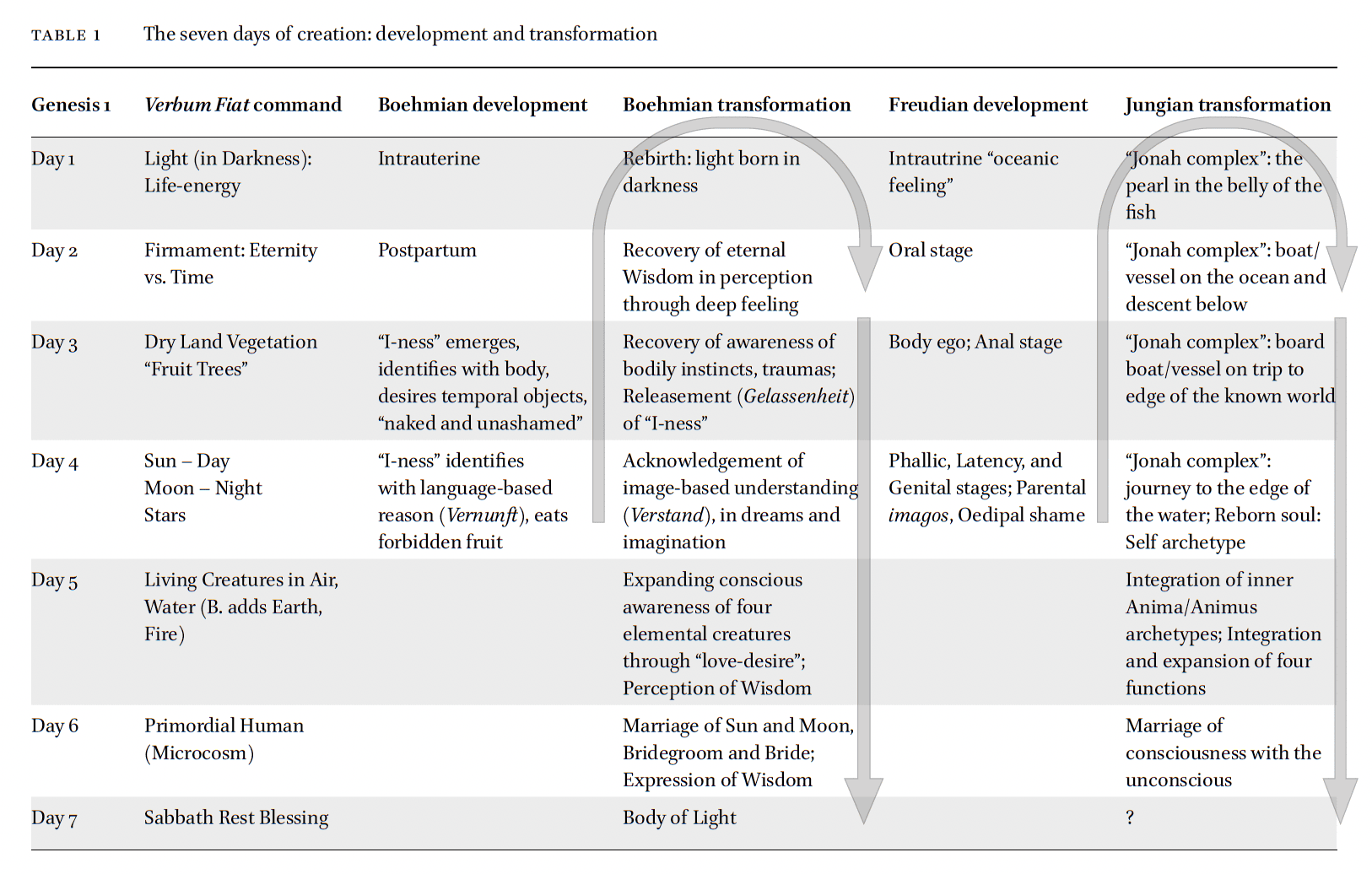
GM: Yes, it’s all there in the charts, but it takes quite a few chapters in the book to unpack them, so it’s a little complicated. I don’t know if I can explain it all here, but I’ll try. This chart shows that the developmental stages of Freud and Jung, which they were so famous for, can be situated within the larger boundary of Boehme’s Sophiology, derived from his reading of Genesis 1. The general idea here is that when we’re born, the ego is very porous and open, if we even have an ego. Freud guessed that, originally, the ego “includes everything,” meaning that infants don’t initially distinguish between themselves and the world around them. There’s no subject-object split. They don’t even identify with their body as a kind of envelope or limit of the ego.
A famous mystical poet, Romain Rolland, wrote to Freud to challenge his understanding of religion, and Rolland spoke very beautifully about this “oceanic feeling,” a feeling of limitless connectedness with the whole of creation, which Rolland thought was the true root and essence of religiosity—an experience rather than a tenet of faith. Freud said that he couldn’t detect this feeling in himself, but he gave it some credence by suggesting that it might come from the infant’s experience of the unbounded ego. And, of course, all of us were at one time floating in the warm protected silence of the womb. But as we grow, and as the ego’s boundaries harden, we’re cut off from this feeling of limitless connectedness. We may even lose the feeling of connectedness to God’s presence. As the ego hardens, we get thrown out of the Garden, so to speak.
In therapy Freud noticed that clients often regressed to more infantile states. We become childlike, for better or worse. These kinds of regression also happen naturally in everyday life—for example, when we fall in love, or when we’re seeking comfort. We end up curled in a fetal position on the couch sipping hot cocoa, and you can see this as an attempt to recover the womblike feeling. These kinds of regression often involve an opening of ego boundaries. In therapy we might also regress as we revisit childhood wounds and traumas, and discover the child parts of ourselves that were frozen and split off by these traumas. So Freud didn’t mind regression up to a point, because he saw that it could be a natural healing process in therapy. But he generally hoped that clients would move beyond these infantile states and become more healthy adults. The regressive longing for a parent figure was a big part of Freud’s Oedipus complex.
Now, Jung realized that, in his clients’ dreams, the regressive longing for the mother sometimes went all the way back to the mother’s womb, as if the client unconsciously wanted to go back into the womb and be reborn. We actually get this idea in Jesus’s conversation with Nicodemus about being “born again.” Nicodemus takes this literally, but Jesus interprets it symbolically with the two great symbols that are there in the Beginning, before creation—water and wind/breath/Spirit. So when Jung saw this womb symbolism in his clients’ dreams, he wondered if the Oedipus complex was regressing even further back and turning into a “Jonah and the whale” complex. Jung took this as a sign that, in some clients, the ego wanted to be reconfigured and reborn. And this was in fact what Jung himself experienced in his own confrontation with the unconscious, as you can see in the Red Book. It’s as if the ego regresses so that it can be reconfigured and reborn in a new form. A kind of death and resurrection of the ego.
In the process of this regression and rebirth, we are forced to confront not only traumatic memories and experiences, which are typically stored in our body in complex ways, but we are also forced to confront our bodily instincts and the way that these instincts like hunger, sex, aggression, anxiety, and possessiveness have been distorted or become unbalanced. We have to wrestle with the ways that these bodily instincts have gotten in the way of our quest for love and belonging, our quest to feel loved and worthy of love. So much of this is unconscious and buried in our body, but it emerges in therapy as we revisit the past and as our dreams emerge.
For Boehme, this whole developmental journey is described symbolically in the seven days of creation. Day one is an intrauterine phase of development, but as the infant is born on day two, it enters the world of time and sequence, and it begins to lose that feeling of limitless and timeless existence. A firmament develops on day two between the waters of eternity above and the waters of time below, and the infant begins to lose that oceanic feeling of eternal connectedness, although it recovers it in the warmth of feeding and sleep and the mother’s body. For Boehme, the dry land on day three symbolizes the child’s development of an ego or “I-ness” and the ego’s identification with the body, which Freud called a “body ego.” On day four the division between sun and moon represents a divide between the language-based reason (Vernunft) of daytime thinking and the image-based Wisdom of nocturnal dreams and imagination (Verstand). The ego identifies with daytime cognition and leaves dream thinking for the unconscious. So each day in the developmental sequence is really a shrinking of the ego as it protects itself and limits itself to a thin slice of possible awareness, of both itself and God. The journey of regression and rebirth then returns to these earlier states to reclaim what the ego has lost.
The journey of rebirth begins as we attend to our dreams, like Joseph in the Genesis account. Boehme in the third part of the Mysterium Magnum takes Joseph as a model of the new human realized in Jesus Christ. By opening up the dream world, we uncover the imaginative part of our soul that participates in Sophia, the imagination of God. And by attending to our dreams we uncover the past traumas and bodily drives that can be transformed and reconfigured. Ultimately Boehme is aiming at an expansion of conscious awareness, and a wedding of knowledge and Wisdom—a marriage of language-based thought with image-based thought. This expansion of consciousness opens us to more direct experiences of the presence of God.
MM: The overriding motif of your book is the story of Joseph in Genesis. Modernity threw this “dreamer” into the pit, and you argue for a recovery of the capacity to analyze dreams today. This was a breakthrough for you, and I imagine it might be one for others as well. You write, “This inner world of living creatures as it appears in dreams represents unlived life within the soul—life that the ego’s narrow reality tunnel has neglected, and thus failed to assimilate into consciousness.” My guide in this respect has been the lost world of Christian Jungians, especially John Sanford and Morton Kelsey, who certainly caution that many of our dreams should remain unlived. Where would you suggest we go to recover the biblical mandate to be conversant with what happens in our dreams?
GM: I love Kelsey and Sanford! They are both excellent guides to a biblically based, Christian-Jungian approach to dream interpretation. Sanford’s Dreams: God’s Forgotten Language is a classic, and it’s likely the best introductory guide. Kelsey’s God, Dreams, and Revelation offers a detailed scholarly overview of the history of dreams and their interpretation in Christianity, over some two thousand years. It’s really true, though, that dreams are a forgotten language, especially in the West. Aside from a small group of Jungians and a smaller group of post-Freudians, we have a very hard time hearing their messages. Sophia has been neglected in our theology, and it shows.
It’s also very difficult to interpret your own dreams. I still have trouble with that, and I’ve been looking at dreams for a long time. Dreams show us our blind spots, the parts of ourselves we don’t want to look at. We would much rather project these parts of ourselves on the people around us than look at our own soul—we see the speck in our neighbour’s eye. So looking at dreams is partly a process of confession and truth telling. You have to be honest with yourself. And in the process we generally discover that many of the parts of us that we repressed or degraded actually have a lot to offer. There’s a common motif in dreams of helpful animals. Sometimes they seem ferocious at first, but as we learn to respect them, they generally become helpful. Often these are split-off bits of instinct that want to work with us and get to know us.
For Boehme, the big theme here is that transformation in our inner world generally causes transformation in the outer world, both in our perception of the outer world and in our ability to create harmony and balance in the cosmos. This is a big Renaissance theme—the correspondence between the microcosm of our soul-body and the macrocosm of the cosmos. We also find it in the Bible in terms of Christ as the cosmic centre, in whom “all things hold together.” Once we find that centre of harmony, the presence of Christ within us, it tends to affect things around us. But the trick is to actually experience that inner centre of peace and balance, and for me, that was the most important thing I found in my dreams.
MM: Okay, Glenn, I’m going to have to shut off the firehose now because this is all almost too much for me to take in. You’ve revolutionized Augustine studies, identified the Lutheran source of the best Orthodox theologians, and re-narrated the origin of psychoanalysis all within the boundaries of classic trinitarian thought. As if that were not enough, now you’re challenging me to drop the intellectual games and take up the work of prayerfully attending to my dreams and grounding myself more deeply in the presence of Christ. Which is to say, there is a lifetime of work represented by this magnificent publication, and I am deeply grateful for your elucidating it so clearly here. Thank you!