

N
No despair of ours can alter the reality of things.
—Thomas Merton
I am profoundly distrustful of the “pure gifts of the gods.” You pay very dearly for them.
—Carl Jung
I am going to seduce her and lead her into the desert and speak to her heart.
—Hosea 2:14
Never take the south road to Chaco Canyon. No one gave me that advice, though, so I did. It’s what Google Maps told me to do when approaching, as was I, from Santa Fe. The road was blocked by a series of watery ditches owing to recent thunderstorms. The driver of the only other vehicle I saw—a well-equipped Ford F-150—laughed at me and my dinky rental Hyundai as he passed me from the opposite direction. This was an omen. I navigated the first ditch successfully. On the second and third ditch I barely made it. But the fourth one got me. I spun my wheels for about ten minutes, but the car was as immobile as one of the New Mexico buttes that surrounded me. The uninhabited desert stretched mercilessly in all directions. In Death Comes for the Archbishop, Willa Cather says the landscape I looked out on has the appearance “of incompleteness; as if, with all the materials for world-making assembled, the Creator had desisted, gone away and left everything on the point of being brought together.” The wilderness writer Edward Abbey agrees: “The desert says nothing. . . . [It] lies there like the bare skeleton of Being, spare, sparse, austere, utterly worthless, inviting not love but contemplation.”
I did not then curse the car contraption as Abbey counsels, following his advice to exit the vehicle and “crawl, on hands and knees, over the sandstone and through the thornbrush and cactus” until I bled, enabling my over-civilized eyes to see something for once. As I awaited my rescue, I did not go fully primal, rejoicing that I was finally off the grid. Expect no account of how the climate’s intensity released my concealed trauma, no sudden realization that the Christianity I have long embraced has repressed my deepest libidinal truths. I am not about to recount how the desert’s “non-duality” blew my residually Cartesian mind; nor did the desert teach me that I and the cosmic Christ are already fully synonymous, and therefore my surface desires are really his. I did not strip as theologian Belden Lane did in his movingly described encounter in the same perilous landscape, “because it just seemed the right thing to do.” None of this happened, because the desert shattered me decades ago and I have not forgotten its lessons. Perhaps that is why she released me. The wheels of the Hyundai finally gained some traction. I rolled my way in to Chaco, wipers sloshing a soupy mixture of mud and blue fluid over the windshield, the rest of the vehicle caked in desert dirt.
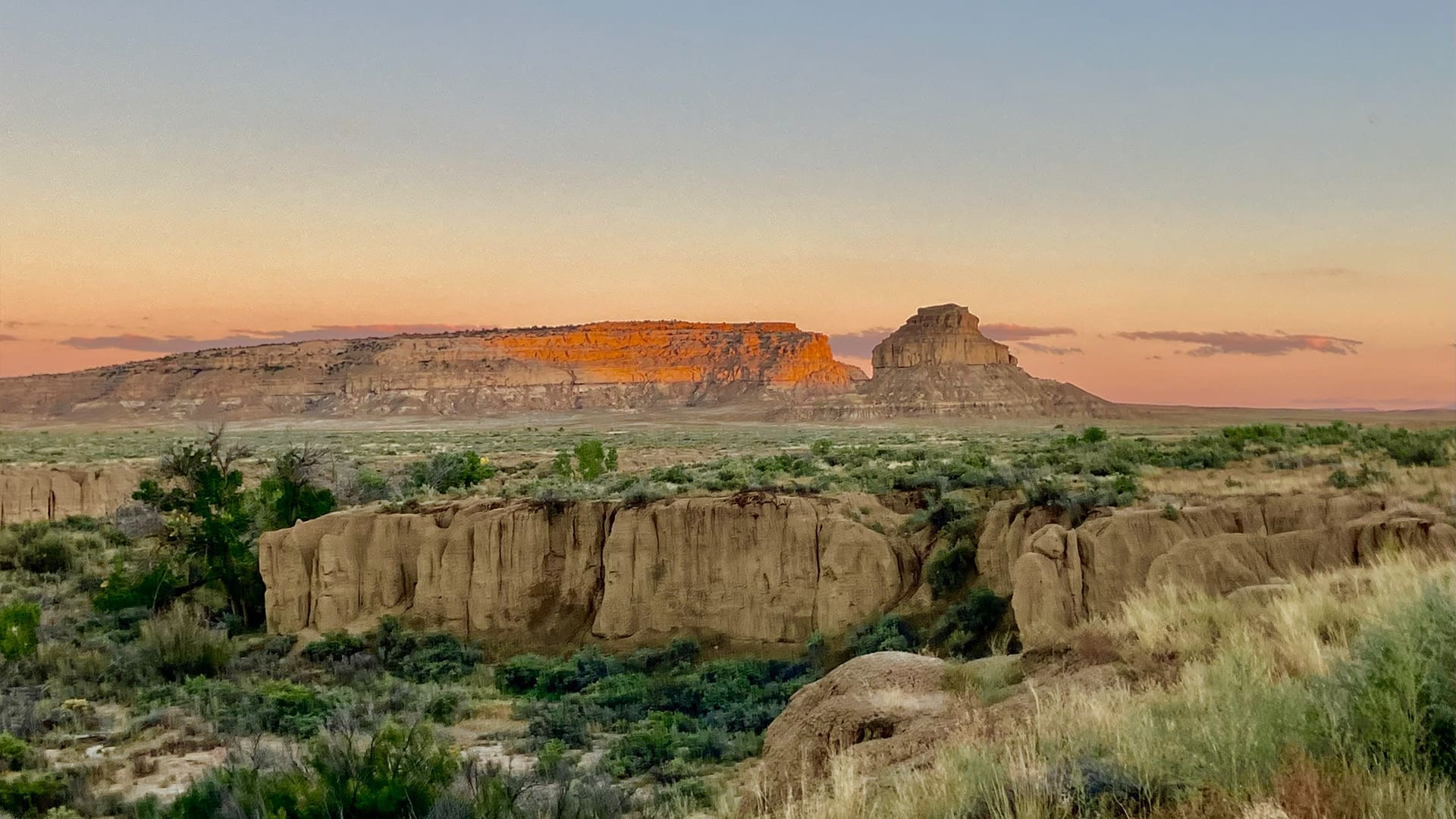
Not too far from New Mexico’s Chaco Canyon, Colorado’s cliff-dwelling site of Mesa Verde is choked with tour busses, a restaurant where managers anxiously tally their online reviews, and even a luxury hotel equipped with Keurigs in each “grand kiva room.” But not Chaco; at least not yet. On my visit the site was nearly deserted, though my solitude was disrupted by one other visitor. He looked at my car and panicked that he wouldn’t be able to get out himself. I said I had taken the south road, and he laughed. “Never take the south road,” he told me with an avuncular flair. “It’s maintained by the Navajo. Your rescue fee would have started at a thousand dollars.” Grateful for what I was spared, I eyed my surroundings. It was evening, and the canyon was catching the sun’s slow descent, which worked on the orange and red rocks like a highlighter streaked across a page of already very interesting text.
As the ancient Greeks looked with awe on the Minoans, whom they mythologized with stories about Atlantis, so do the contemporary Pueblo, as well as the Zuni and Hopi, look on the ancient culture of Chaco Canyon today. Chaco was the heart of the Ancestral Pueblo civilization, the centre of a vast trading and pilgrimage network. During solstices and equinoxes, many thousands heeded its mysterious call. We do not know the nature of the ceremonies that took place here, but the scale of what remains suggests they were immense. I entered the ruins and tried to imagine them filled with dancers decked with macaw feathers from the distant south, shells from the western ocean, and turquoise from the heart of the earth itself. Even so, there are no hearths at Chaco, and only a few hundred burials. It was more of a destination resort than a permanent residence. All the food was imported.
Chaco Canyon was an occupiable Stonehenge, only vastly larger.
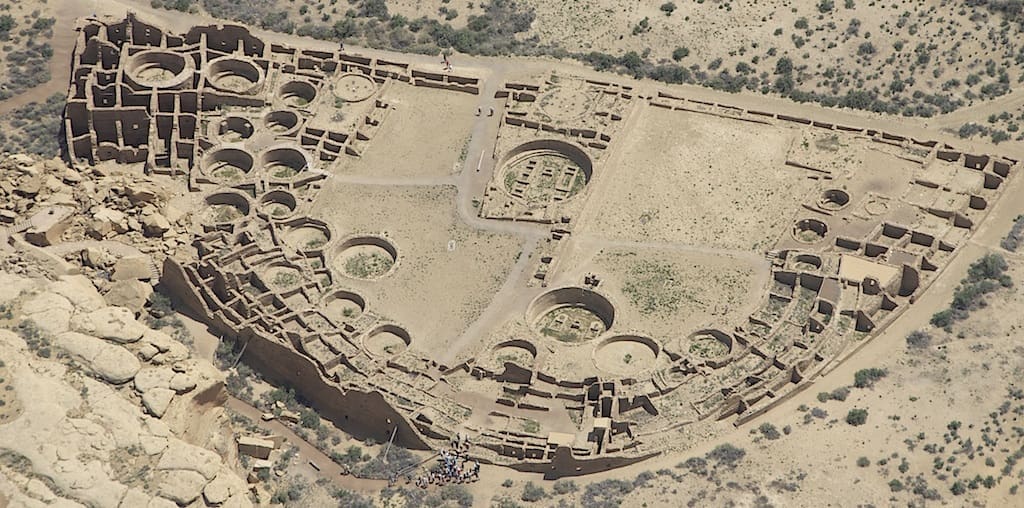
Each of the multi-storied pueblos, constructed with timber hauled from more than fifty miles away, are centred on massive kivas, profound circular descents into the ground. All this was in perfect alignment not only with the sun but also with the eighteen-and-a-half-year cycle of the rising moon. Chaco Canyon was an occupiable Stonehenge, only vastly larger. It’s central building, Pueblo Bonito, covers three acres and was as big as the Colosseum. This central building, moreover, was itself in deliberate alignment with other structures up to fifteen miles away, buildings that also corresponded to lunar and solar cycles. As one modern Hopi elder puts it, echoing the Lord’s Prayer, Chaco Canyon was an attempt to “integrate heaven and earth.”
We have no written records as to what happened at Chaco Canyon, but the Hopi word for the hole at the base of a kiva is sipapu, which means “the place of emergence.” The pilgrimages, we can speculate, were perhaps a return to this ancestral ground zero, maybe even a quest for humility. In Book of the Hopi, the Anglo writer Frank Waters may have artificially fused Hopi spirituality with Buddhism, but Indigenous Southwestern culture’s more natural, actual partner has long been Christianity. “Ironically,” writes the Choctaw theologian Steven Charleston, “the most traditional Hopi demonstrate the most Christian values—not the distorted values of seventeenth century friars or nineteenth century missionaries, but the ancient values of the gospel.” And kivas were “command centers, the place where Hopi spiritual technicians kept the power of their radiant vision in alignment.”
Most scholars today, however, whether Indian or not, believe that the power there fell out of alignment. Chaco’s quest for humility failed. The site was abruptly abandoned sometime in the twelfth century, possibly due to drought, political conflict, or both. Kathleen DuVal reports on modern Native Americans who tell us that at Chaco “wizards had misled some leaders, who became corrupt and hoarded wealth and power.” A Diné (Navajo) version of the story says a malevolent force named “the Great Gambler” enticed people into constructing the imposing structures of Chaco until they finally rebelled. Like Cahokia in what is now Illinois, Chaco Canyon may be an illustration of the famous dictum that absolute power corrupts absolutely, a universal, not just European, truth, even if it was first articulated in those words by Lord Acton. The smaller Pueblo societies, Mesa Verde among them, that followed Chaco were more egalitarian, less domineering. In other words, Indigenous people did not need to wait for Columbus to have something to resist.
As I surveyed the ruins, a ranger spotted me and cautiously approached. He told me that many people who come here want to be alone, but he sheepishly asked if I wanted a tour. I said I did, and he showed me everything, including the pictographs that may represent the supernova of 1054, when the night sky would have been lit for weeks. Like Cahokia, this centre of Indigenous civilization may have been inaugurated by this celestial event.
As the sun set further, the kind ranger and I overlooked all the kiva descents, which visitors are not allowed to enter. But I went in anyway, at least in my memory. The ranger left me at one of the largest kivas, and I got a good look down. I thought back to my own descent in the desert, almost thirty years ago now, when I was as subject to hostile forces as some of the ancestral Pueblo may have been to the pitiless Gambler.
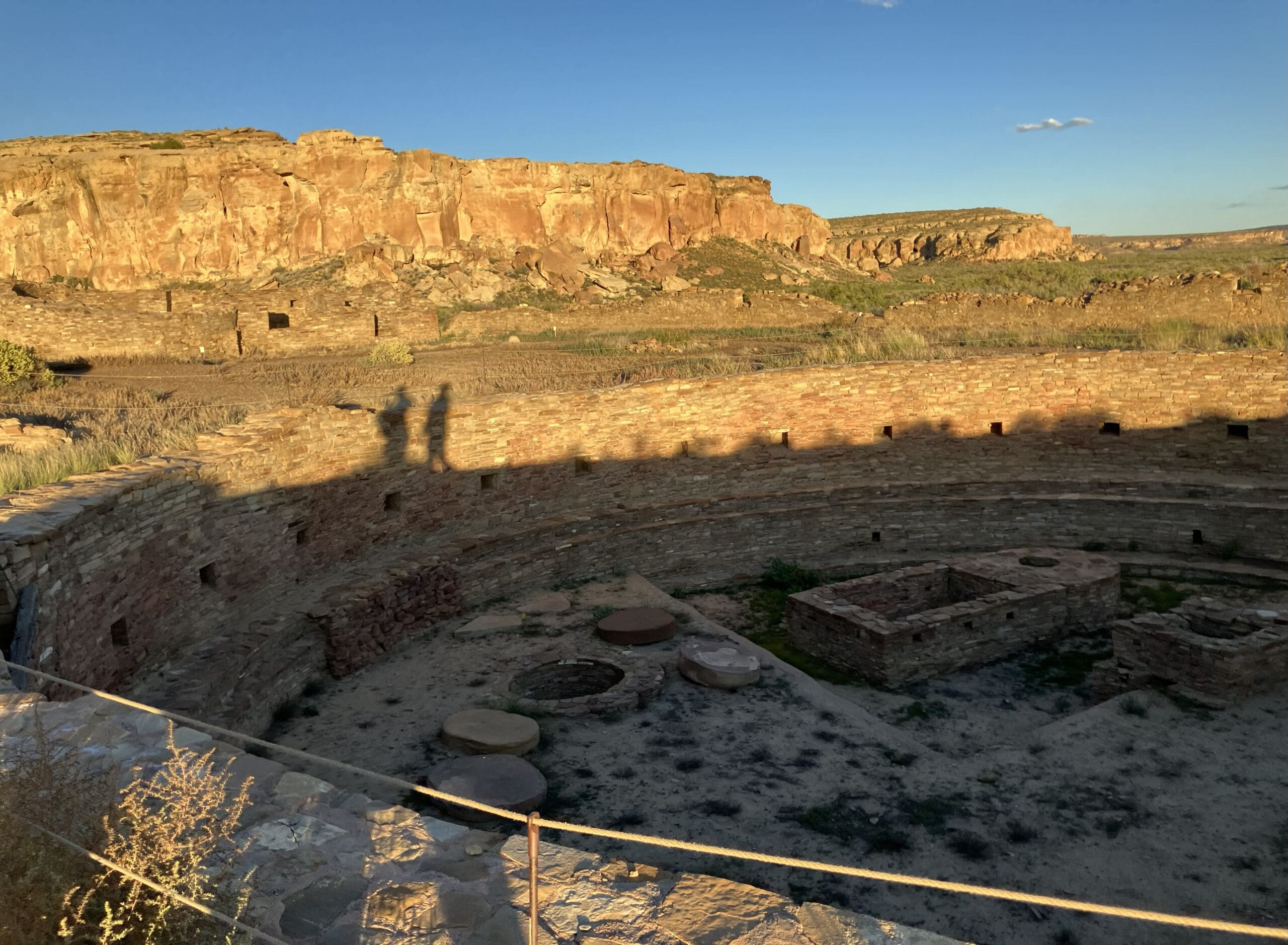
One of the main kivas at Chaco Canyon. Photo: author.
We were undergraduates who made our way to a campground not far from here on a spring break trip to Utah. It was so long ago we used road maps to get there. As our vehicle approached, one of us told an old Native story about the skin-walkers, sinister beings in Diné mythology who can transform themselves into animals. Skin-walkers are in effect evil sorcerers, perhaps the kind of beings responsible for the downfall of Chaco. The Diné are reluctant to discuss this lore with outsiders, for the very reason so well illustrated by our irreverent group. It was as if we were following the script of a slasher flick, setting up our comeuppance. One of us, if I recall correctly, even openly taunted the presumed beings.
But my own stupidity on that trip outstripped even that. “Almighty and most merciful Father,” reads the daily confession in the Book of Common Prayer, “we have followed too much the devices and desires of our own hearts.” I was a curly haired cocktail of curiosity and insouciance. Half of me was shaped by the evangelicalism that had taught me the gospel, and the other half was enticed by the counterculture, which seemed to me the only cure to the bland and barren aesthetic of evangelicalism, which had left my senses cold. When the church lacks colour and smell, the tie-dye and incense of head shops prove alluring. The Christian college I went to, where students signed a behavioural contract we then called “the pledge,” largely protected me from such temptations, but not here in the desert. As we made our way to the campground, we ran into some serene stoners, blissfully unencumbered by religion.
When the church lacks colour and smell, the tie-dye and incense of head shops prove alluring.
As my companions moved on to set up camp, I continued the conversation with the chatty potheads. One long-haired member of their party, his eyes witlessly beaming, held up a nugget of neon green weed and tempted me with a feckless, overstretched grin. “Nature’s the best place to smoke it,” he declared. How I hated that I was encumbered by the others in my group, whom I then returned to, bidding a reluctant farewell to the carefree cannabisseurs. Hours later I worked up the courage to join them. Night had fallen, however, and the happy people I had met were gone. I entered a campfire circle of to see a less kind-looking pack of strangers, but they too were more than willing to share some of their recreational fare.
I still don’t know what they gave me. I was already somewhat experienced in the pharmaceutic arts, which back then—long before ganjaprenueurs had blanketed the nation with oafish billboards—took a considerable amount of risk and initiative to get. I was proud to have recently graduated from pot to mushrooms. I used the psychedelic drugs I could obtain to untie what I considered to be psychological knots, and initially at least they seemed to help. My aim was never recreational but singularly “spiritual,” an aim that I now realize was far more, not less, dangerous than using drugs for enjoyment. “We have done those things which we ought not to have done,” continues the prayer book, “and apart from your grace, there is no health in us.”
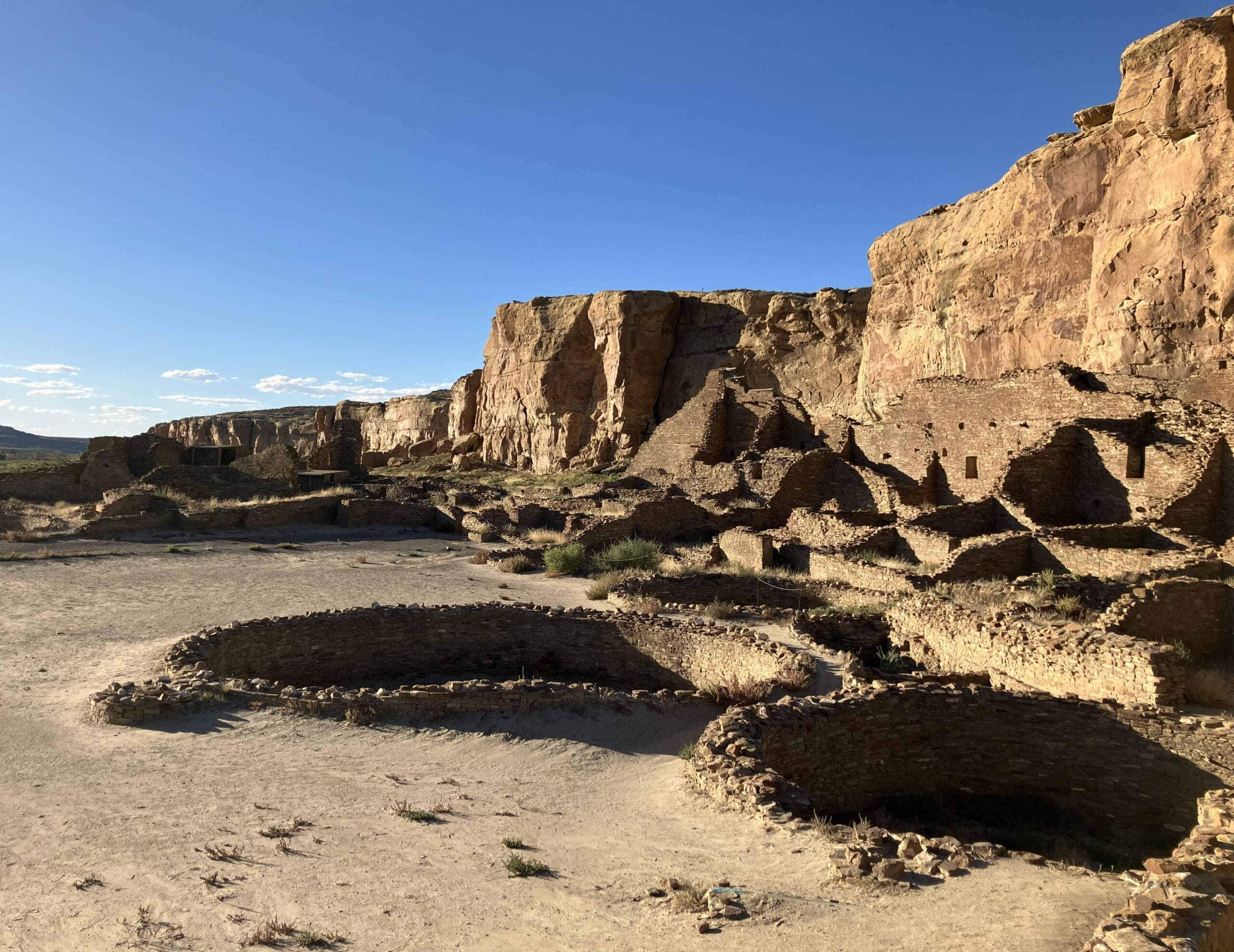
Two of the smaller kivas at Chaco. Photo: author.
Not long after I ingested whatever they gave me, I looked at the campfire and the play of light began to play with my mind. The fire took on anamorphic forms that were coming to menacing life. Repelled by the flames, I sensed a presence behind me that was in no way benign. Afraid of both the fire in front of me and the darkness behind me, I made the mistake of exiting the circle and slipping into the desert alone. As I lost my grip on physical reality, a different clasp tightened around my heart. Psychic pain began to engulf me, and soon it was such that I would have preferred the physical kind.
I found words to describe what I encountered years later when taking a seminary course that studied the work of the professor James Loder (1931–2001). Loder’s own life had been dramatically transformed by a near fatal car accident, and the impact he had on Princeton Theological Seminary’s campus after his brush with death was the stuff of legend. His lectures were so intense, his Christian spirituality so undeniably vibrant, some at this largely Presbyterian school even said he had “regressed to Methodism.” But Loder had arrived at this new depth in part through a confrontation with what he called “the void.”
In his book The Transforming Moment, Loder explains that the void is the “goal of evil. . . . God created everything out of nothing, but evil [i.e., the void] seeks to return everything to nothing.” This void “has many faces, such as absence, loss, shame, guilt, hatred, loneliness, and the demonic. The void is more vast than death, but death is the definitive metaphor; ‘nothing’ in itself is ultimately unthinkable, but death, shrouding all our lived ‘worlds,’ gives us our clearest picture of nothing.”
There in the desert, in the darkness, I was face to face—if it can be said to have a face—with the void.
The drugs did not generate the void any more than a dog whistle generates an attacking rottweiler. I know this because I had summoned the very same void as a child all on my own. I had what are now classified as “night terrors” when I was around twelve years old. I called forth these terrors honestly, which is to say, I thought my way into them rationally. It started when, on my bed in the dark, I began to entertain the idea of eternity as duration. As I went down that rational pathway, my soul and heart recoiled at the idea that such a duration might not necessarily be good. Instead, I sensed my posthumous existence might not end even if I wanted it to, even if I desperately wanted it to. My mind may have opened the doorway to this horrifying prospect, but what I encountered behind that doorway—I knew with certainty—was real. I knew it to be a discovery, not my invention, precisely because I so much wished it were my invention.
The drugs did not generate the void any more than a dog whistle generates an attacking rottweiler.
On the first few such occasions, I hurled myself into my parents’ bedroom to explain my agony, and I remember thinking how utterly ineffectual any consolation they offered was compared to what I was up against. After all, my parents were up against what I had summoned as well, even if they were unaware (or had once been aware and had somehow forgotten). The void was coming for them as well, or at least it would be waiting for them when they died. It would be waiting for all of us. I even thought to myself that it might be kind to spare them such terrible news. Why bother spreading this anti-gospel that was true whether we realized it or not? It, whatever it was, was indifferent to rational argument for or against it. It was as indifferent to comforting words (“don’t think so much, darling”) or the classification of psychologists (parasomnia) as a Category 5 hurricane is indifferent to the tattered sail of a schooner.
To call these “night terrors” is a pathetic attempt to harness a force before which I was helpless. They had nothing to do with sleep anyway; they happened because of thinking, while I was perfectly awake. Even if a better label could be found, it would do no good. Is the Latin classification for a grizzly bear, Ursus arctos horribilis, any help in the face of an attack? Every night I knew that these terrors were only a few steps of reason away. The void almost beckoned me to return to it. Even if I trained myself to no longer think such thoughts, or perhaps obtained a medication that blocked the rational pathway, the truth I had discerned about eternity as duration would still be there. I could seal or ignore the door in any way I pleased, but what was behind it would always be there, waiting.
The only way to defuse the situation would have been for someone to walk down the rational path with me, to open the door and deal with the problem. This the Catholic priest my mother took me to was sadly unable to do. All I remember is that this elderly, bald, corpulent man offered no help either to me or to my mother, confirming her worst suspicions about routine religion and inaugurating my own. The poor priest, God help him, seemed a bit distracted. I received no word of assurance, I was not given the message of delivering grace, nor was I told of the triumph of the cross over the pitiless force to which I had been so unhappily introduced.
And now somewhere in the desert of Utah, the agonizing void that I had found through the process of my own reason in the darkness was with me again. As a child it had touched me; now its impersonal presence—which was in fact more of a presence in reverse—embraced me in a waking nightmare to which I was perfectly alert. At least cartoon villains smile when seizing their victims. But this thing, whatever it was, suffocated me indifferently. As it did so, it seemed almost bored.
At one point I managed to claw my way to one of my camping companions. I remember begging him to pray for me. I took advantage of our mutual biblical literacy, telling him that just like Christ at Gethsemane desperately needed the prayers of his companions, so I needed prayers from him right now. Maybe I didn’t communicate this with sufficient urgency, or perhaps he was embarrassed for or of me, because he wandered away. So it was just me, my tortured psyche, the void, and a few friends “taking [their] rest” (Matthew 26:45). The agonies of separation from God, from all goodness, beauty, and light, proved to be bottomless. Everything I feared as a child about eternity was being empirically confirmed.
I wonder if it was the starlight that saved me. I found my way to my sleeping bag and looked up at the stars, whose infinitely distant light somehow promised assistance. I don’t think at this point in my college education I had read anything about the ancient idea that stars were associated with angels; but it doesn’t matter, because this became an experience more than a historical idea. It seemed as if one of the stars spiralled downward to help. I am not suggesting I saw some angelic being. It was instead as if the being or angel had business of its own to accomplish that my recognition could do little to either facilitate or thwart. But some kind of aid arrived when I was on the brink of asphyxiation, even extinction, and I eventually slept.
I woke before the sunrise and looked around my campsite, surprised that I was alive. I found my bag and picked up the book I had chosen to take on this journey, Thomas Merton’s New Seeds of Contemplation. Library paperback edition in hand, I made my way to a massive nearby boulder. As I approached, the sun rose behind it, a presence as welcome as the starlight the night before. I felt like Adam on the first morning of the world. I found I could pray again. I dipped into Merton’s book and found in it the spiritual seriousness that could speak to the agonies I had experienced, and could also articulate the relief.
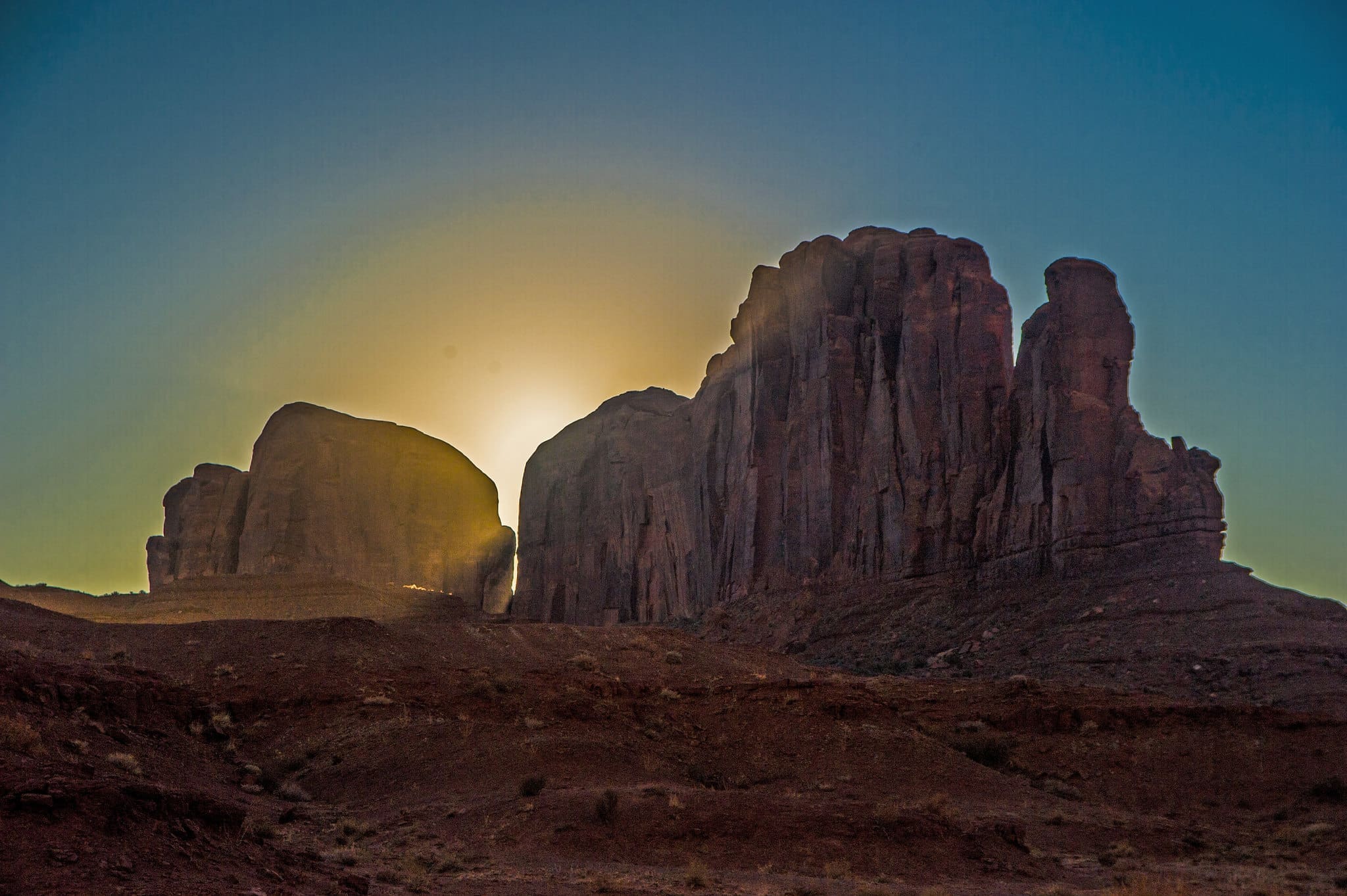
I do not understand how Merton ever came into my orbit of influence. It was evangelicalism that lifted me from the ineffectual manifestations of Catholicism that I had grown up with. Evangelicals were the ones with the patience to walk down the rational pathway with me and open the door. I learned of the God who is mightier than the forces that threatened me, the God whose punctured hands had punctured the void. The evangelicals who brought me to faith pointed me to the nearby Good News Bible Bookstore, where I found, and devoured, books by A.W. Tozer, John Stott, and Watchman Nee alongside praise-and-worship cassettes and what we called contemporary Christian music. Did that place really sell Merton, including one of his most daring, late books, Rain and the Rhinoceros? Somehow that book ended up on my reading list, which infused my evangelicalism with an undeniable edge. I knew I needed more of Merton, which is why I picked up New Seeds on this journey to the Southwest, which is why Merton was there to greet me after the worst night of my life.
I could take in only a few pages of New Seeds that morning, but it led to a lifetime of reading him. It was Father Louis (Merton’s monastic name) who counselled me to do what his fellow priest in my neighbourhood Catholic parish could not: “Face despair. Wage war on it through the Cross unceasingly.” The void I encountered now sees my confidence in Christ and has obediently retreated. Though I might have received such counsel from any number of Christian writers, it was Merton who gave me a further answer to the reasoning process that had incapacitated me as a child. What I was doing when conceiving the afterlife as hopeless duration was taking my present experience of time and projecting it onto eternity. The answer was to reverse the process and allow the fullness of time in eternity to gracefully envelop the present. As Merton puts it, “Eternity is a seed of fire whose sudden roots break barriers that keep my heart from being an abyss.”
The void I encountered now sees my confidence in Christ and has obediently retreated.
Rehearsing that horrible night in my mind, I sometimes imagine myself returning from that agonizing desert darkness, with Christ, back to the campfire, whose anamorphic forms no longer frighten. As St. John of the Cross says,
O living flame of love
That tenderly wounds my soul
In its deepest center! Since
Now you are not oppressive,
Now Consummate! if it be your will.
I am tempted to say I have almost befriended the void as an acorn “befriends” the soil that appears to annihilate it. It is not that I have made some kind of pact with non-being. Evil is obviously to be avoided, and the hell I entered should never be courted. But much good still came from my despair. Loder himself says that eventually this “primal absence,” this dread, almost becomes bearable: “Indeed it is even gracious because it haunts the self-sufficiency of the ego with constant reminders of its conflicted origins, calling it back again and again into communion with the Face that endures, the Face of God.”
In his last book, The Climate of Monastic Prayer, Merton makes a similar point:
The biblical texts used throughout the liturgy, particularly those from the Psalms and the Prophets, portray in the strongest terms man’s dread and anguish in separation from God, and man’s desperate need of grace and salvation. . . . Unless the Christian participates to some degree in the dread, the sense of loss, the anguish, the dereliction and the destitution of the Crucified, he cannot really enter into the mystery of the liturgy. He can neither understand the rites and prayers, nor appreciate the sacramental signs and enter deeply into the grace they mediate.
What has been so hard for me to see is that, all along, the dread may even have been something of a gift.
It is precisely the function of dread to break down this glass house of false interiority and to deliver man from it. It is dread, and dread alone, that drives a man out of this private sanctuary in which his solitude becomes horrible to himself without God. But without dread, without the disquieting capacity to see and to repudiate the idolatry of devout ideas and imaginings, man would remain content with himself and with this “inner life” in meditation. . . . Without dread, the Christian cannot be delivered from the smug self-assurance of the devout ones who know all the answers in advance.
Maybe that was one of the reasons I had run off to the desert with my friends, or the reason I was attracted to the faux spirituality of what was left of the sixties counterculture in the nineties. I had detected that smug self-assurance, a dreadful dreadlessness, in the routine Mass and confirmation rites at the Catholic parish I grew up in, and now I detected it in the evangelicalism I was surrounded with, and in myself. The answers were too easy, and the deepest questions went unplumbed. But the maw of dread annihilates such conceit: “If there remains any vestige of self that can be aware of itself as ‘having arrived’ and having ‘attained possession,’ then it can be sure of the return of the old dread, the old night, the old nothingness, until all self-sufficiency and self-complacency are destroyed.”
The hell that I experienced in the desert has now been replaced with a different kind of hell—namely, the twelfth-century Cistercian Isaac of Stella’s “hell of mercy.” In inferno sumus, sed misericordiae, non irae (We are in a hell of mercy, not wrath). Merton, from whom I got this quotation, says that in this hell we fully experience our nothingness,
but in a spirit of repentance and surrender to God with desire to accept and do his will, not in a spirit of diffuse hatred, disgust and rebellion even though these may be felt at times on the superficial level of emotion. It is in this “hell of mercy” that in finally relaxing our determined grasp of our empty self, we find ourselves lost and liberated in the infinite fullness of God’s love. We escape from the cage of emptiness, despair, dread and sin into the infinite space and freedom of grace and mercy.
To cast this in the terms of Chaco Canyon, maybe my problem that night was that I tried to claw my way out of the psychological kiva into which I had descended, instead of confidently resting at the sipapu, listening to what Jacinto—Archbishop Latour’s Indian guide in Death Comes for the Archbishop—could hear through a crack in the floor of a desert cave: “The sound of a great underground river, flowing through a resounding cavern. . . . Not a rushing noise, but the sound of a great flood moving with majesty and power.” Or as the psalmist puts it, “I wait for the Lord; my whole being waits” (Psalm 130:5).
No wonder, when the descendants of the Ancestral Pueblo encountered the gospel, they connected those kivas—against the protestations of the missionaries—to the church. Ancient peoples had far more direct experience with the void than I have, and they knew what assistance looked like when it came to them, as did I. Many of them accepted, and still accept, that assistance despite the ineffectual way by which it came to them, through a church that frequently reflected more the cruelty of the Gambler than the love of Christ. The Spanish missionaries, sometimes using forced Indian labour, “built for their own satisfaction, perhaps, rather than according to the needs of the Indians,” laments Archbishop Latour in Cather’s novel. Jesus, writes Charleston, “is not the white man’s god, but a Native healer.” Still, I am grateful that the same Jesus has healed this white man, whose ancestors fought the Indians of what we now call the Southwest.
Decades after my experience in Utah, I was in India visiting Buddhist sites and was offered powerful marijuana by my impromptu guide, who was taking me to a few pilgrimage spots on his moped. He claimed he was a Christian and said that this particular strain, having germinated in the hallowed terrain where Siddhartha Gautama attained nirvana, was remarkably good for facilitating meditation. For a moment I wondered whether this was a providential chance to settle the score in some way, to show that I could endure the pleasure of drugs without being psychologically destroyed. I was on the other side of the world, after all, and who would possibly know? But the occasion was less an opportunity than a test. Intuitively I knew that to open myself in that way again might be to surrender myself to the void, this time perhaps without a serendipitous starlit rescue. Christ has vanquished evil, of course; but it can still wreak immeasurable havoc if I deliberately remove myself from his protection. And so I cheerfully refused. “Grant, O most merciful Father, for his sake,” concludes the prayer of confession, “that we may now live a godly, righteous, and sober life.”
So concluded my reminiscence above the kiva at Chaco Canyon. It was dark now, and I made my way out of Chaco in my filthy rental car, through the more reliable north road. I saw a glowing orb on the horizon, and pulled over, concerned that I might have somehow entered Area 51. I then realized it was the moon—a supermoon in fact, the closest the lunar orbit gets to the earth’s. Soon a dagger of light from that rising moon would illuminate the edge of a spiral circle carved into the Ancestral Pueblo observatory at Chaco that we now call Fajada Butte.
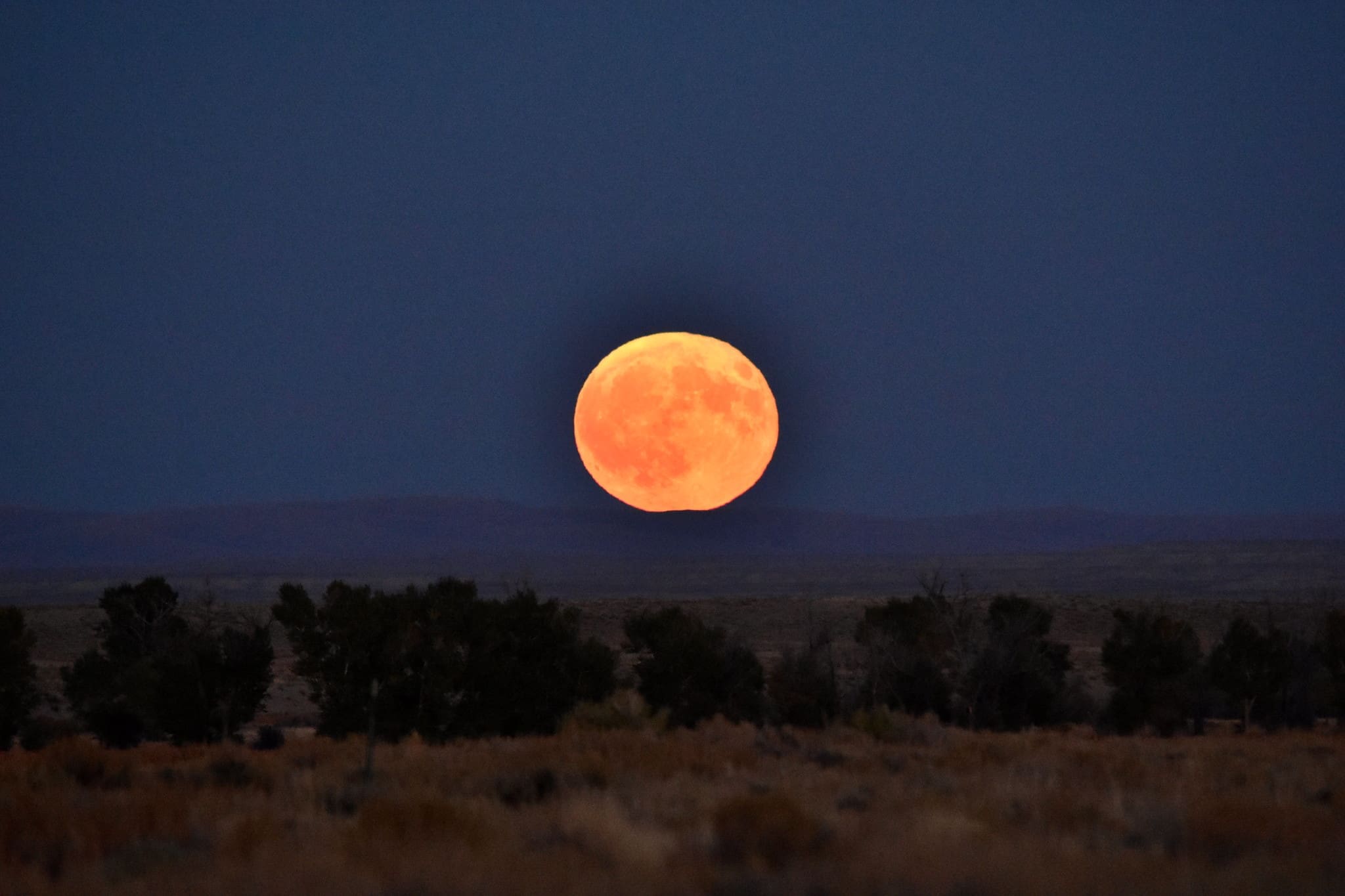
I got out of the car like Ed Abbey counselled I should. I greeted the moon like the sister that she is, as some of the Ancestral Pueblo must have, knowing such astral bodies are good, and no doubt intuiting that there was something, perhaps someone, beyond them infinitely more attractive than the void. It turns out this was a harvest moon as well, which is fitting for insights like the ones Merton has led me to, which are normally harvested in the fullness of mid-life. I drove on rejoicing, listening to Diné tribal songs on the radio and praising Christ.
Nearing Santa Fe on my return journey, I saw that the aspens in the Sangre de Cristo mountains that overshadow the city were yellowing. Their colour was like the gleam of eternity bursting into time. In the green of my life, hunted by the void, I was unable to make any of these connections. But as Merton puts it in Thoughts in Solitude,
As soon as a man is fully disposed to be alone with God . . . at that moment he sees that though he seems to be in the middle of his journey, he has already arrived at the end. For the life of grace on earth is the beginning of the life of glory. Although he is a traveler in time, he has opened his eyes, for a moment, in eternity.
Christ has reconciled me to the nothingness that nearly destroyed me. It is for good reason that the ancient “Jesus Sutras” of the Church of the East name him the “Lord of the Primordial Void.” Merton taught me that “we must live by the strength of an apparent emptiness that is always truly empty and yet never fails to support us at every moment.” Evangelicalism taught me that the name of this strange strength is Christ. The door I was terrified to have discovered as a child is now permanently open, and I see through it a Face that shines. “Even the darkness is not dark to you,” wrote the psalmist. “The night is bright as the day, for darkness is as light with you.”


