
W
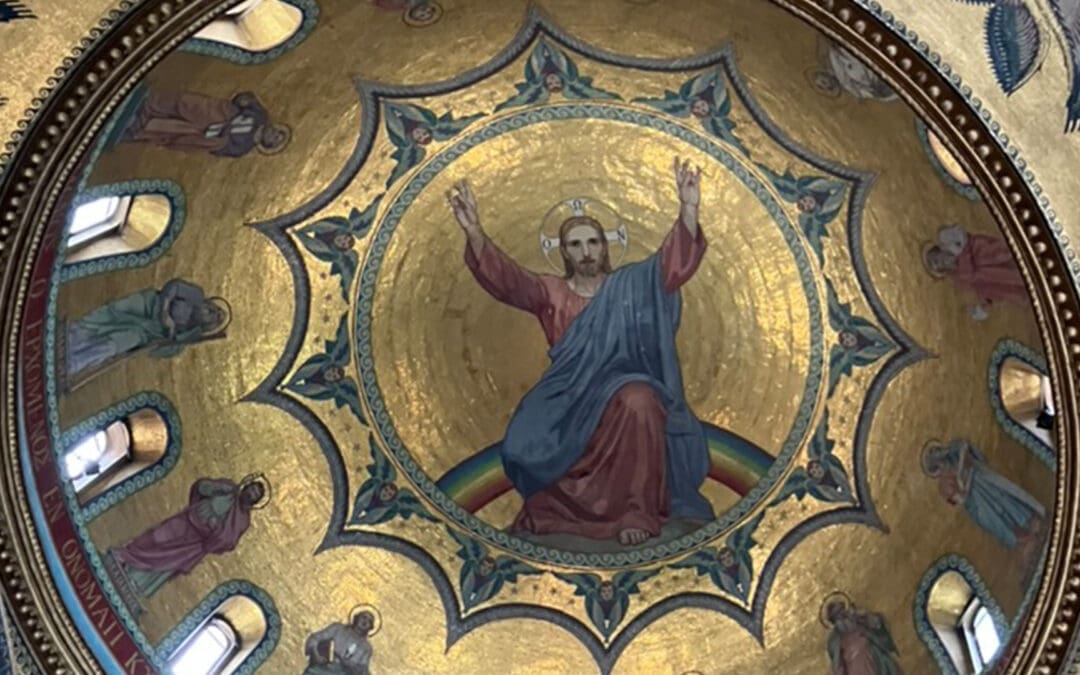
What one person, living or dead, is the most important moral figure in our culture? Our most potent human symbol of right and wrong? A century ago, for most people in Europe and North America, the answer would have been easy: Jesus Christ. But for most of my lifetime, we’ve had a different answer. Our most potent moral figure today isn’t Jesus. It’s Adolf Hitler. In our relativist, pluralist age, he is our one fixed reference point: the yardstick by which we know what is evil.
Maybe we still believe Jesus is good—but not with the fervour and conviction with which we believe Nazism is evil. Crosses and crucifixes have lost most of their cultural power. But there is no visual image in our culture that packs a heftier punch than a swastika.
To understand the postwar age, our own age, we need to realize this: it is the age of Hitler. For decades, the man with the toothbrush mustache has dominated our moral imaginations. And for good reason. If one human being is to stand as our representative of evil, I challenge anyone to find a better candidate. But swapping out a positive exemplar, who shows us what goodness is and what we should love, for a negative one, who shows us what evil is and what we should hate, comes at a cost.
And more to the point: Our long-lived moral consensus, built around the fact that we hate the Nazis, is starting to unravel. So the question is not just why our societies flipped from a Christian value system to an anti-Nazi value system. It’s where we’re going to go next. Which, of course, is what our culture wars are all about.
It happened for good reasons. Christianity’s moral authority had already been decaying for centuries when, in the wake of World War I, most Christians in the democracies fixated on one great evil: the defining, existential threat of Communism. They weren’t wrong about the atrocities of the Soviet Union, but it meant that when new nationalist movements began to spring up in Italy, Germany, Spain, and elsewhere, most Christians found it easy to overlook the violent cruelty and see only potential allies against the Bolsheviks.
This was not just some ghastly mistake. It was a serious, authentic Christian judgment. Some Christians actively supported fascism. But many more, who on balance disliked brash warmongering, reckoned that they could not be too picky about their allies. Perhaps it was a moment for a leader who was a little crude and thuggish, someone not tied down by scruples and niceties, who could do the things Christians’ consciences would not permit but which their guts told them were necessary. Defend the family. Round up the Communists. Put the Jews back in their place.
Not all Christians succumbed to that siren voice; but enough did, and too many more were paralyzed into inactivity even as it became more and more plain that they had fixated on the wrong nightmare. Evelyn Waugh, the English Catholic novelist, said that for him the moment the world at last made sense again was when Hitler and Stalin made their pact in August 1939. Only then, finally, was it possible to say wholeheartedly that Hitler was a villain too. Which was true, but it was far, far too late.
So the war against Hitler was not going to be what Winston Churchill tried to call it: a war for Christian civilization. A new American coinage that President Roosevelt picked up suited the times better: “Judeo-Christian civilization.” That framing was a very obvious rebuke to the Nazis’ murderous obsession with Jews and Judaism, but it was also a deliberate gesture toward universalism, joining all of America’s main religious groups in a shared cause. Soon enough the western Allies were calling it the “world war”: the war for the world. Roosevelt declared America was fighting for fundamental freedoms, including freedom of worship, “everywhere in the world.” The Allies came to call themselves the “United Nations,” and after their victory they gave that name to the new organization founded to govern the peace in the name of all humanity. Next to that vision, “Christian civilization” felt miserly and parochial.
To understand the postwar age, our own age, we need to realize this: it is the age of Hitler.
To be sure, in the 1950s the churches in America and in free Europe tried to reclaim their moral authority as the leaders of the democratic centre-right. But some of the most serious and earnest Christians of the age—people like Martin Luther King Jr. and Dorothy Day in the United States or Trevor Huddleston and John Robinson in Britain—knew that while they had sailed past the iceberg, the old order had still been damaged below the waterline and was listing dangerously.
They concluded—in their different ways—that the churchly, Christian vision was still far too small: that what was needed was a universal coalition of humanity against all the dehumanizing evils of the age. In the process, they might need—as the wartime prophet Dietrich Bonhoeffer had foretold—to shrug off “religion” like a worn and tattered garment. In the 1960s, a great many Christian and formerly Christian radicals did exactly that, and they set in motion a decisive secularizing turn that we are all still living with. But if religion, our traditional arbiter of right and wrong, was to be discarded, what should replace it?
In February 1943, the American troop ship Dorchester was torpedoed off the Canadian coast. Four military chaplains—two Protestants, a Catholic, and a Jew—were aboard. According to survivors’ accounts, the chaplains worked together to hurry men into lifeboats, then distributed life jackets. When the life jackets ran out, they gave their own to four young soldiers. They then joined hands, singing and praying together as the ship sank. Reportedly, all four were reciting the Shema, the Jewish affirmation of God’s oneness, as the waters took them. The “Four Chaplains” were swiftly commemorated as symbols of America’s war for universal freedoms.
Every time I tell that story to a lecture audience, I struggle to get through it without a catch in my throat. Since I usually try to cultivate the cynicism and detachment expected of a professor, this is embarrassing. I have to tell myself firmly not to be sentimental. But for me, and not just for me, that story and others like it from World War II have a visceral power that nothing else quite matches.

In particular, I find to my disquiet that the narrative of heroic self-sacrifice at the heart of my own Christian faith simply does not have the same grip on me. Throughout the Christian centuries the story of Christ’s passion often has had that effect. A great many Christians have found themselves emotionally transported or shattered by the passion narratives. But in our own age, even for many of us who still identify as Christians, that emotional immediacy is simply not there, or is accessible only through conscious devotional effort.
Plenty of us still believe in our religions, but often not with the same intuitive immediacy and blithe faith with which we believe in our culture’s true religion: World War II. The French novelist Laurent Binet calls it our Trojan War: “a landmark, a reference, a source of inexhaustible stories, a collection of epics and tragedies.” It is all that, but it is also our Paradise Lost, our epic of meanings and values, dominated by its endlessly fascinating central villain. It is the basis for our most fundamental convictions about what is good and what is evil.
The best symbol of this is the matter of human rights. When I speak to teenage audiences about this subject, I sometimes ask them whether they have human rights. Naturally, they all insist they do. I then ask them how they know this—and they flounder. Usually someone will tentatively invoke the law; but when I press them on that, they discover that they believe human rights are natural, fundamental, inviolable, not something that legislators can give or take away. Really, I shouldn’t ask it; it is an unfair question.
Thomas Jefferson famously believed that the existence of these universal rights is “self-evident.” Which is manifestly wrong: A great many people in a great many periods of history (and today) have not believed in them. Jefferson’s contemporary Jeremy Bentham reckoned that the notion of natural human rights was “nonsense on stilts,” mere philosophical wishful thinking. It now looks as if he was half right: It is indeed on stilts—that is, it does not rest on any secure or stable logical arguments. But that does not make it nonsense.
In other words, ever since Bentham, philosophers have been trying to point out that “human rights” is an idea that makes no sense, at least without the God whom even Jefferson had to invoke to back it up. Their argument is watertight, but apparently it makes no difference. Jefferson’s dubious claim has come true. Now, in the post-Nazi era, in the age of Hitler, we really do hold the existence of human rights and human equality to be self-evident. We can’t, intellectually, prove it to be true; but that doesn’t matter, because we feel that it is true. For now.
Why do we believe human beings have rights? Even asking the question feels uncomfortable, almost blasphemous. The most honest response is that we simply do believe, down to our core, that human beings have rights, regardless of whether it can be proved. That deep, intuitive conviction feels like an answer. In fact, it is the question.

The closest we can come to an actual answer is the one advanced by the United Nations’ Universal Declaration of Human Rights in 1948. Having asserted, pragmatically, that human rights are “the foundation of freedom, justice and peace in the world,” it then explains that
In other words, it is all about World War II. In 1948, how could it have been about anything else? We acquired our intuitive conviction that humans have rights not from argument but from experience: the experience of exceptionally “barbarous acts,” and the claim that the “common people” of the whole world have united around the desire for Roosevelt’s four freedoms.
Dig deep enough beneath most of our modern moral convictions, and especially our conviction that we are all equal in rights and dignities, and you will find the memory of World War II at the bottom of them, still raw, bleeding, and refusing to let you dig any further. Insisting that you look at the evils of the Nazis, and saying, “If you want a reason to believe what you believe, this is enough.”
And so we have turned that war into our modern mythology. We endlessly retell it: The movies, novels, documentaries keep coming. (Consider the contrast between our hugely rich, varied, morally vivid narratives of World War II and our few, bleak, monotonous narratives of World War I.) Nor is it confined to retelling the war itself. Once you have found, in Nazism, a symbol of absolute evil, it is just too compelling and too useful to ignore. From the 1970s, we can see how movies that had nothing to do with World War II started using Nazis as villains. The “Illinois Nazi Party” in The Blues Brothers (1980) is utterly gratuitous, but what better counterpoint could there be to that film’s anarchic racial inclusivity? And then there are the Indiana Jones movies—specifically those of 1981, 1989, and 2023, in which the villains are Nazis. The values of our age are summed up by Dr. Jones in The Last Crusade (1989): “Nazis! I hate these guys!”
By then anyone trying to exercise authority over anyone else was liable to be called a Nazi or a fascist. In the shadow of the Holocaust, calling a punctuation pedant a “grammar nazi” might seem unforgivably crass, but it is inevitable. Nazis come as readily to our minds as did Satan to the minds of medieval Christians. A symbol of absolute evil is too useful to be left reverently in a corner. If hypocrisy is the tribute vice pays to virtue, trivialization is the tribute flippancy pays to earnest moral conviction.
Meanwhile, World War II’s moral lessons were being transposed into completely mythological form. The pioneer of this was the twentieth century’s bestselling work of fiction: J.R.R. Tolkien’s The Lord of the Rings. Tolkien was an early and passionate opponent of Nazism, but he was also a veteran of the Battle of the Somme, and he knew that the war against Hitler was, like any war, “ultimately an evil job.” The Allies had justice on their side, but he saw that they were fighting with almost as much ruthless brutality as their enemies and were ready, as he told his son in 1944, to defeat Sauron with the Ring. So he wrote a novel that told the story of a different world war, one that was fought the right way: a struggle against a dehumanizing tyrant in which the heroes, despite great temptations, destroy the power to impose tyranny, rather than use that power to defend themselves.
As Tolkien knew perfectly well, as a political vision this was a fantasy more unbelievable than any elf or wizard. That is why he wrote it as a myth. If we are to use the memory of World War II to reset our moral compasses, then we need purified versions of it, not the ugly reality. And we’ve been doing that ever since. In Star Wars, the Dark Lord has storm troopers and jackbooted interrogators, blasts whole peoples into nothingness, and is defeated by plucky farm boys in planes. In the Harry Potter novels and films, the Dark Lord pursues a racialized supremacy, giving his followers a name—the Death Eaters—and symbols that evoke the SS. You see the same vision in one of the most compelling creations of the British 1960s: the Daleks, villains of the television series Doctor Who, miniature tanks whose relentless desire for “extermination” reveals them to be wrecks of life entombed in metal and hate.
Our myth is that we live in a secular age based on self-evident truths such as human rights. In fact, we live in the age of Hitler, and our religion is World War II.
These are the myths on which generations of us have been raised, and we are eager to keep retelling them to ourselves and our children: This is what evil looks like—even though evils rarely appear in such plain dress.
So if we ask why Christianity went into retreat in the West from the early 1960s on, there is almost a simple answer: Christianity’s one crucial and virtually uncontested function in Western societies had suddenly failed. Whatever else Christianity had become by then, it was still our store of value. Believers and unbelievers alike accepted the authority of Jesus’s ethics as reflexively as we accept the notion of human rights now. But once a new set of values was in place—once a new lodestone had reset our moral compass, so that what had pointed toward Jesus now pointed away from Hitler—the adjustment of our coordinates made the old maps redundant. And so they were abandoned, or simply and quietly fell out of use.
Some of us still hold our Christian faith, mixed with the anti-Nazi values of our age. Perhaps we even tell ourselves that our faith is fundamental, and that the agreement of our religious with our secular values is a happy coincidence. And perhaps we worry that we live in hopelessly divided societies, fractured into irreconcilable pluralities. We are slow to recognize that we do share a deep, strong, and pervasive moral consensus—slow, because of the proverbial inability of fish to know what water is. Our myth is that we live in a secular age based on self-evident truths such as human rights. In fact, we live in the age of Hitler, and our religion is World War II.
Or it was. Because now, unmistakably, the ground is once again shifting beneath our feet.
When I first started talking about this subject, I sometimes needed to persuade skeptical audiences that these long-standing certainties were giving way. That, on the political right, the taboos against anything redolent of fascism were fading: that across the democratic world, populist and nativist politicians from Viktor Orbán and Marine le Pen to Jair Bolsonaro and Donald Trump have crossed lines that were supposed to be uncrossable and paid no political price, a pattern so widespread and systematic that we have to recognize those individuals as symptoms, not causes. And that meanwhile, on the left, the moral centrality of the Nazis was being displaced by new reference points for evil: imperialism, slavery, apartheid, even the state of Israel. (And with sickening inevitability, both sides were demonizing Jews.)
I don’t need to make that case anymore. Does anyone really believe that the last ten years are a blip and that the old, comfortable postwar moral consensus is coming back?
And, comforting as it was, do we really want it to? Is it the best we can do? A moral vision which tells us what we hate but not what we love? Which asserts that evil is ultimately personified in a strutting villain, and that the only way to deal with it is with force? A moral system in which one of the worst offences is appeasement? That was the knee-jerk conviction that gave us the pointless slaughter of the second Iraq war and that came within a whisker of vaporizing us all during the Cuban missile crisis. And do we want to settle for a set of moral priorities that makes us hypersensitive to one specific variant of evil, leaving us curiously blind to others? In the 1920s and 1930s we were so fixated on Communism we were blindsided by something even worse creeping up behind us. We could easily make the same mistake again.
It’s true that right now, in the moment of flux, the moment of maximum uncertainty—caught in the no-man’s land between our old moral norms and whatever our new ones will be—this can all seem pretty scary. That’s how we get a culture war: or, better, a values war. On one side, a brittle version of human rights gets taken up by secular progressives, who defend freedom of speech by insisting ever more rigidly on what can and cannot be said, singing their old songs louder and louder while waiting and hoping for the madness to pass (but it won’t). On the other side, a resurgent conservatism that isn’t really conservative rediscovers the intoxicating power of identity politics and reaches back into the Christian tradition and other deep-rooted religious and national value systems looking, not for serious moral renewal, but for sticks with which to hit the other side. So we have a shrill, panicky parody of anti-Nazi values versus a crude, weaponized parody of traditional values. And both sides end up animated chiefly by their fear and loathing of each other, and producing leaders whose main value is their ability to rile up the other side.
It doesn’t sound even faintly sustainable. The good news is: it’s not.
Plainly, we need both. In this century we will face things like climate breakdown, economic and demographic turmoil, and artificial intelligence, to say nothing of old-fashioned nuclear weapons. The values we learned from World War II will be essential for confronting these evils. If you’re one of the conservatives and traditionalists who is impatient with this endless obsession with the Nazis, well, fair enough, but the point is not to forget the moral lessons that World War II and the Nazi genocide taught us, the lessons we encoded in the modern system of human rights. We learned those lessons the hard way, and paid a heavy price. Best not to have to go through that one again.
But the good news for conservatives is that you don’t need to fight your culture war on the other side’s terms. You don’t need to offer them the kind of opposition they crave, showing that you’ve learned nothing and forgotten nothing. You have a better option, because you have something they don’t. Your traditions have far more to them than thou-shalt-nots. Of course they do; otherwise you would never have embraced them yourself. You don’t need to browbeat people. You can seduce them. Your traditions—and I am thinking especially of religious traditions here, but not only of them—have depth, flourishing, satisfaction, clarity, peace, and joy to offer. The problem with post-Nazi values is not that they are wrong but that they are insufficient: thin, grey gruel compared to the taste, colour, and richness of our rooted traditions. Ours is a culture that knows only what it hates. You can show it something worth loving. Can’t you?
We have a shrill, panicky parody of anti-Nazi values versus a crude, weaponized parody of traditional values.
And if you’re one of the progressives who wants to hold on to the anti-Nazi value system and all the hard lessons we’ve learned from it, then, absolutely, you should and you must. But again, it’s not enough. There are reasons why your cause has felt like it has been on the back foot for so many years: It has become miserably unambitious. The traditionally anti-Nazi political establishments have become the true conservatives of our time, the people who argue that the world as it stands is about as good as it gets, barring a little managerial fine-tuning that somehow never seems to seep out very far. It almost seems, sometimes, that progressives are actually hoping for some disaster serious enough to shock those frivolous populists out of their delusions and bring them back sorrowfully to the sensible centre. But Covid didn’t do it, the Ukraine war didn’t do it, the financial crisis didn’t do it. If all our anti-Nazi values have to offer is technocracy, some moral scolding, and the hope of incrementally increased rations someday, can we be surprised if much of the world decides it wants to try some other paths?
So progressives need some other resources: Our deeper cultural traditions, religious traditions, philosophical traditions. Things that show us what to love as well as what to hate. Whatever the future might hold for us, it is not a universalized metropolitan utopia of the kind visionary progressives have imagined and reimagined from Aldous Huxley to Star Trek. Human identities, particularities, traditions, and spiritualities are not going to fade away or become superficial quirks in a secular metropolitan soup. The abstraction humanity consists only of specific human beings with specific inheritances. Most of those inheritances have more than enough both to nourish us and to shame us. We do not need to be defined by them, but we had better not run away from them—or they will catch us and eat us. If, instead, we make peace with them and tame them, we may find that they offer us some of the resources we need. And whatever we ourselves think, like it or not, these identities matter profoundly to most of humanity, even those of us who kid ourselves that our sophisticated and modern ways are above such things. Our options are to get the best we can out of those identities or to relinquish control over them, and ultimately of us all, to the trolls. There is not a third way.
Put it like this: Our anti-Nazi values are great at separating the world into the black and white of good and evil. If we’re sophisticated, we might think about shades of grey instead. But it’s those deeper traditions that show us full colour. With their help, we can see beauty instead of just passing judgment. I’m not saying swallow them whole. That would be impossible anyway: They’re too diverse. But make them part of the conversation. They have things to offer. In particular, those deeper traditions teach some of the virtues that we will most need in order to navigate this century, and which our anti-Nazi values conspicuously lack: humility, repentance, and forgiveness.
So how do you win the culture war? It’s a race. Who will reach this synthesis first? Who will outflank the other side and seize their territory? The anti-Nazi progressive secularists could do it. For them, the trick will be not only to respect but actually and sincerely to draw on the Christian and other deep, textured, rooted traditions. That will not only breathe fresh life into their own movement; it will give the lie to the populists who claim they are defending ancient identities against vacuous secularist wreckers. But the religious and traditionalist culture warriors might beat them to it. For them, the way to win is to fully and honestly own the anti-Nazi heritage—with all its freedoms, scruples, and responsibilities, all of which are profoundly compatible with the older, rooted traditions but which do have new and pointed lessons of their own to add. That way, they will purge the poison in their own ranks and find that they have arrived at a place where the vast majority of us are ready to be on their side.
Truly, I don’t believe I care who gets there first.