


V
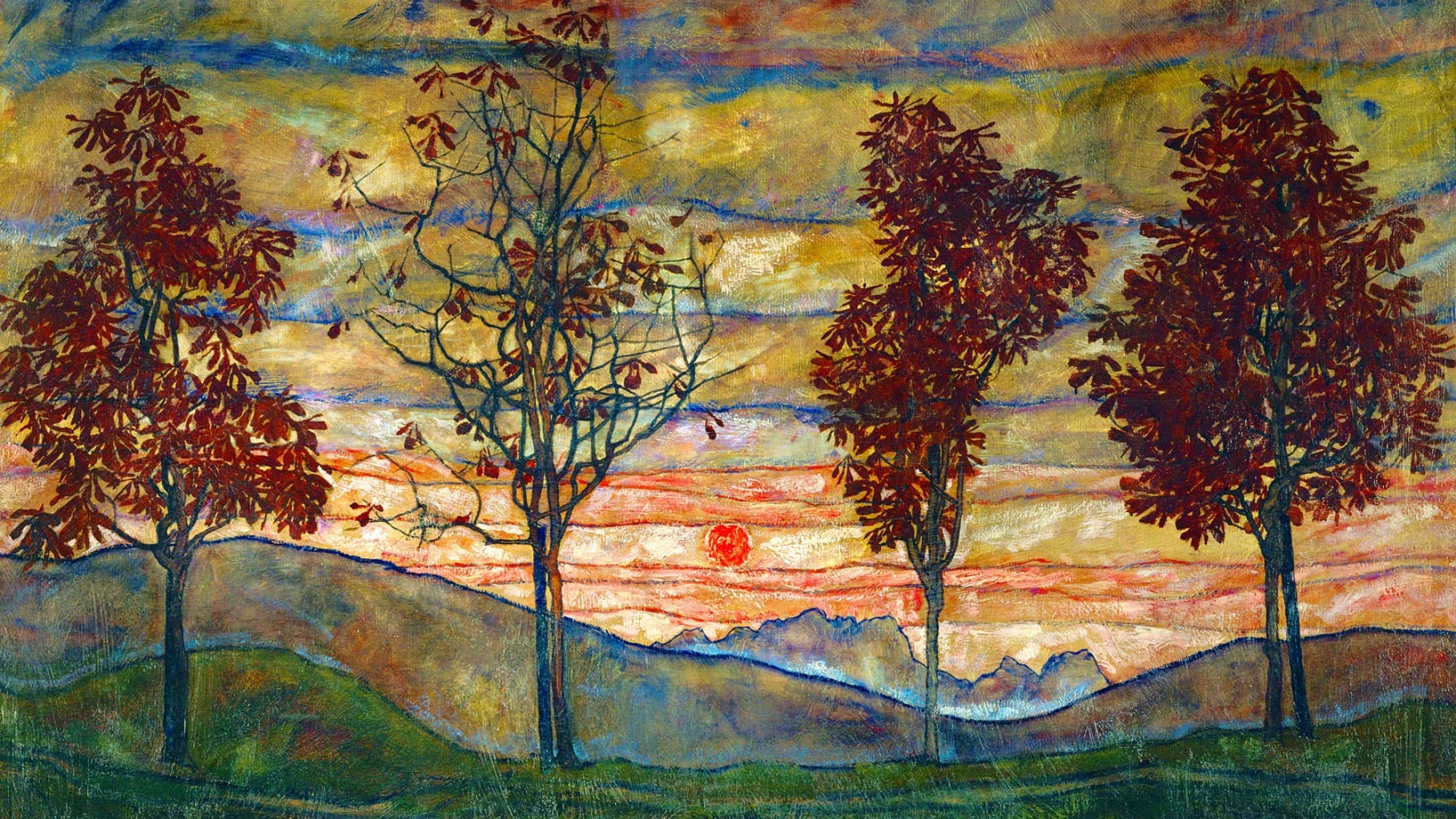
Visit enough Alcoholics Anonymous meetings and you’ll likely hear the story about a young artist in recovery who was commissioned to paint a large forest mural. For months, the mural unfolded with striking originality, as though each tree had its own story to tell—one old and gnarled, one angled aggressively toward a patch of sky, another scarred by lightning, another pockmarked by wood-boring beetles. One day, the artist’s sponsor—a more experienced, sober member—stopped by to check on his progress. “You’ve been drinking, haven’t you?” his sponsor asked. The artist was stunned because he hadn’t told a soul. “How did you know?” he asked. “Well,” said his sponsor, “the last five trees you painted all look the same.”
This piece of AA folklore illustrates the connection between alcoholism and spiritual blindness. It suggests that addiction—to alcohol or any other substance or process—produces a deadening sameness, draining the colour from the world. But why? Is this just an unfortunate side effect?
Actually, it’s kind of the point. People become addicted for all sorts of reasons; there is no uniform cause. There is, however, a uniform effect: the point of addiction is to manufacture a predictable and insulated user experience. Specific drugs or behaviours are addictive only insofar as they can induce the monotony that the old sponsor observed in his sponsee’s mural. No drug or behaviour is addictive unless it can make all the trees look alike. This is why almost no one gets addicted to psychedelics. They do not provide the kind of “artificial sameness” that Stanton Peele calls “the keynote of addictive experience.” On mushrooms, you just never know what the trees will look like.
This contradicts a popular myth that addicted persons are thrill seekers gone to seed, as though the problem that addiction helps us overcome is the tedium of daily life and what addicted persons crave is more colour, more vitality, more surprise. The opposite is true. What we addicted persons crave is a psychic home, a secure and predictable internal space to which we can easily retreat when reality is too much.
Trying to make sense of the opioid addiction that would eventually contribute to his death, actor Matthew Perry observed, “Reality is an acquired taste, and I never acquired it.” What makes reality hard to digest is not that it’s too dull or predictable but that it’s not dull and predictable enough. No doubt, many addictions begin with feverish nights, fast friends, and novel highs, but it is not an accident that they end in so many variations on a single theme: same liquor store, same brand of booze, same room, same shades drawn, same couch, alone, day after indistinguishable day until rock bottom, or worse.
In other words, addiction is very much about control. It is about managing the internal landscape. It is about escape from a reality that feels unsafe into a more tractable subjective experience. It is about taking the edge off, levelling experience out and making it predictable, measurable, coherent. It is about quieting the relentless voices of regret, fear, and self-loathing, anesthetizing the daily pain of rejection and shame. It is often about controlling the psychic side effects of traumas both acknowledged and unacknowledged.
The brutal paradox is that we lose control over exactly what promised to give us control in the first place.
I have characterized addiction as a type of self-medication for psychic distress, and it is at least that. This diagnosis, however, prompts questions. By all accounts, we modern folks are dramatically more addicted than our predecessors. But people have always had to face strong emotions like fear and shame; they have always needed to find ways to cope with their trauma. Why has addiction become the preferred response of our age? What is it about modernity that makes addiction such a compelling method of control?
Modernity is supposed to be marked by the aspiration to make the world more manageable, and there can be little question that we have succeeded. In comparison to our premodern forbears, we hold vastly more control over every material dimension of our lives: health, agriculture, structures and infrastructures, communication, travel, and energy, to name a few. We are by almost any metric the most in-control people who have ever lived. One might think that as the world became more predictable and pliable, there would be less from which we feel a need to escape. However, the opposite appears to be true.
Addiction might just be the final frontier of control. We have subdued the natural landscape, and addiction is our quest to subdue the psychic one. On this telling, we moderns are prone to addiction mainly because we believe it is our right to control every aspect of reality.
Addicted persons are a peculiar kind of unwitting modern prophet, an embodied critique of the quest for total control and the social world it has bequeathed.
Another possibility—compatible with the first—is that our quest to dominate and control the external world has paradoxically made our internal worlds more unpredictable and incoherent. In Addiction and Virtue, I argue that modern subjectivity is characterized by an arbitrariness and fragmentation that would have been unimaginable to a medieval peasant who could from birth take for granted what was to be his lifelong home, social role, community, and God. By contrast, we moderns bear the crushing responsibility of choosing whom we will be, where we will live, what we will do, and whom or what we will worship. We have what William Cope Moyers calls “the disease of Too Many Options.”
How paradoxical that our effort to exert mastery over nearly every aspect of our outer lives should generate a countervailing inability to control our inner lives. This, I believe, is what the crisis of addiction indicates about the challenge of modernity. Addicted persons are a peculiar kind of unwitting modern prophet, an embodied critique of the quest for total control and the social world it has bequeathed. The explosion of major addiction, drug overdoses, and related deaths of despair is the canary in the modern coal mine, telling us that something is not working.
Prophets do not merely foretell doom, however. They are also bearers of wisdom. Their example points a way forward, albeit one that demands repentance. To those who have eyes to see, their lives should confront us with the worry that our modern aspiration for control is a fool’s errand. But what, exactly, is the nature of the error?
To return to our medieval peasant, he would have certainly agreed that he exercised little control over his own life, but he would have never thought his life was uncontrolled or uncontrollable. The peasant would have seen his life, the lives of his family and community members, and indeed the entire world as subject to providential control. Unpredictable from his limited perspective and beyond his own limited understanding, yes. Uncontrolled and uncontrollable, no.
But then, in a rallying cry for the Enlightenment, philosopher Immanuel Kant came along to recast our lowly peasant’s submission to the ways of providence as pitiful immaturity, writing, “Enlightenment is man’s emergence from his self-imposed nonage. Nonage is the inability to use one’s own understanding without another’s guidance.” In other words: Grow up and take control of your own life. “The motto of the enlightenment,” says Kant, is to “have the courage to use your own understanding.” Autonomy is in; submission to authority and providence is out. For the supposedly enlightened, entrusting your life to control by anyone other than yourself is cowardice.
We can frame the experiment of modernity, then, not as the shift from an acceptance of the intrinsic uncontrollability of the world to a demand for mastery and control but as the imperative that control be transferred from some power beyond the self to the self alone. Addicted persons, in this view, are telling us that the experiment is not going well and recalling us to an older way. Perhaps the mistake was not so much to think that our lives were controllable as it was to think that we could be the ones to successfully control them.
It is commonly observed that only the first of the twelve steps of Alcoholics Anonymous even mentions alcohol: “We admitted we were powerless over alcohol—that our lives had become unmanageable.” The next two steps reveal what the program is really about:
2. [We] came to believe that a Power greater than ourselves could restore us to sanity.
3. [We] made a decision to turn our will and our lives over to the care of God as we understood him.
This reversal of the modern mandate would make Kant squirm. Note that the addict who is new to recovery is not admonished merely to accept the uncontrollability of her life. She is challenged to believe that some power greater than herself is in control, and to surrender her life to that power.
Lots of newcomers to AA struggle with the word “believe” in step two because, for all kinds of reasons, many of them quite justified, they do not find themselves believing in God. Without fail, such skepticism is brushed aside by the veterans. The standard advice goes something like this: “Look, you can’t stop drinking, but here is a room full of people who have. For now, believe in us. We’re a power beyond yourself that just might be great enough to help you stop drinking.” What the veterans do not say, what I have never heard, is: “You don’t really have to turn your life over to anyone or anything else so long as you admit that you can’t manage it yourself.” The crucial transformation demanded by AA is not merely the relinquishing of control but the ceding of control to some power beyond the self.
In my experience, the majority of AA skeptics who follow this path wake up one day believing fervently in a loving and personal God. Even if they remain atheists, though, all long-term members of AA are big on the shift from autonomy to dependence. “I can’t, we can” is the mantra.
From a nontheistic perspective, it’s difficult to explain the power of the shift—maybe it has to do with our evolutionary biology as clan animals. But from a theistic perspective, it is not in the least surprising to discover that we cannot find our way into flourishing and peaceable lives by our own power. According to the biblical story, we were created for friendship with God and one another. If that story is true, then our flourishing requires profound interdependence with others.
Perhaps the mistake was not so much to think that our lives were controllable as it was to think that we could be the ones to successfully control them.
The biblical story also tells us that this unsuccessful quest for independence and autonomy is as old as Adam and Eve, suggesting that modernity did not so much invent autonomy as attempt to turn it into a virtue. Apparently, it is a deeply human thing to want to be like God, running the show. And apparently, when that doesn’t work, rather than admit that we can’t make sense of our lives without God, we will enslave ourselves to pretty much anything that promises to rescue us from the terrifying precarity of depending on someone else. “O, for the fleshpots of Egypt!” cry the Israelites on the heels of their miraculous liberation from Pharaoh. Wandering the wilderness with no one to turn to but God and one another is a bracing affair. We have always been suckers for bondage.
AA and other twelve-step recovery programs offer premodern—indeed, Abrahamic—wisdom for our modern obsession with control. Alongside the black church, I take the twelve-step recovery movement to be one of the two uniquely American wisdom traditions. When I hear Christians lamenting the long delay of revival in our time, I sometimes wonder whether they are looking in the wrong places. People are being saved from bondage daily in spartan rooms across this land, turning control of their lives over to a power greater than themselves, praying for the serenity to accept the things they cannot change. The core of that wisdom is that you cannot relinquish control except by giving it to someone else, and you cannot give it to someone else except by working a program.
It might seem that the way to relinquish our demand for control and predictability is to eschew all routine and ritual, throw caution to the wind, and set out headlong into life’s wilderness without a compass. But nothing could be more foolish if the wisdom of AA is to be trusted. The goal is not to live out of control but to cede control to another, to others. And this is done by way of a program of rituals and routines, daily embodied acts so mundane as to be almost comic. “If you want to get sober,” a veteran might say to a newcomer, “the best thing you can do is stay after every meeting to help put the coffee cart away.” Your insight, your understanding, your spiritual experiences—none of these matters as much to your sobriety as taking responsibility for the coffee cart. “Ninety meetings in ninety days” is the most common advice to newcomers, suggesting that your salvation has as much to do with where your butt is as where your heart is.
The call is not to spontaneity and novelty but to routines and practices that (re)train us on how to stay in our bodies, stay with our feelings, and stay connected to others with whom vulnerability is not only allowed but expected. There is a kind of magic, or grace, to just showing up. Not that an AA meeting or coffee with your sponsor is constant enchantment. Far from it. The point is to learn to show up daily even though you know beforehand that Daryl will drone on past his allotted time and Cindy will go into extensive detail about her cat’s health and Mike will pontificate like the self-appointed guru of AA and the coffee will be awful. You keep coming anyway. And then someone shares something that changes the way you go through the day. Or someone’s struggle is so raw and heartbreaking that you hardly see how they can go on, and hearing it strangely helps you go on, with astonished gratitude that you are part of this crazy band of misfits. You learn to be patient, to endure until the beauty breaks in.
Sometimes it is alleged that AA is just a crutch, a replacement drug. That hasn’t been my experience. There’s too much pain, awkwardness, and friction for AA to act as a surrogate addiction. Instead, AA is a dojo for learning how to live sober, how to commit, sit still, and wait for the grace. AA is extended training in acquiring a taste for reality.
For most of us who struggle, that taste for reality is not acquired by way of thought or reflection. You can’t get there by having a theory about addiction or modernity or the meaning of life or (ahem) reading an essay about recovery. Insight is important, but it’s not enough. I should know. I wrote a well-regarded book on addiction and travel the country speaking about it, yet none of my intellectualization did much to help me recover from my own addiction. It also did little to help me see how much my own addiction was about controlling my pain and managing my trauma.
I used to think that being addicted to nicotine was so harmless and invisible in my life that a twelve-step program wouldn’t apply to me. I also used to think that a childhood of navigating multiple broken marriages had little to do with my addictive patterns. It wasn’t until I got married and my wife voiced frustration with my incapacity for interdependence and emotional presence (and caught me in what I considered to be little white lies about my nicotine use) that I started to realize something was amiss. Nicotine had long been a safe harbor, and navigating the frightening, unfamiliar seas of marriage made me depend on it even more. After I tried and failed to quit a few more times, my wife offered a suggestion: “You’ve written a book about why AA works. Why don’t you go for yourself?” So I did.
At the first meeting, I introduced myself and said that although I was “only” addicted to nicotine, I still felt that I would be helped by what they were doing, if they would have me. After the meeting, a couple of folks hinted that they thought I was likely an alcoholic in denial, and another joked that he wished he had my addiction. But within a week, I felt at home, and by the second or third week, I had a sponsor.
Things started to change for me then. As I began to show up and clean the coffee cart and work the steps, my experience of reality began to shift. I felt my emotions more intensely and frequently, and I learned to sit with them longer. Tears came more readily, as did laughter. A lump-in-your-throat surge of gratitude started rising out of nowhere. I began to actually invite the Spirit to surprise me and give me the courage to respond with faith. And I discovered that, if you keep coming back, the trees start to look different again.


