


In a Ukrainian basement, a child asks, “Is our home still there?”





We live in a culture obsessed with productivity, efficiency, speed, and success. But after all the triumph of technological advance, it may still be that the defining condition of our time is not merely acceleration but alienation, marked particularly by the absence of what acceleration destroys: resonance. Coined by German sociologist Hartmut Rosa, “resonance” is the experience of addressing and being addressed by the world—touched, moved, and changed by a two-way relationship rather than one-sided control and consumption.
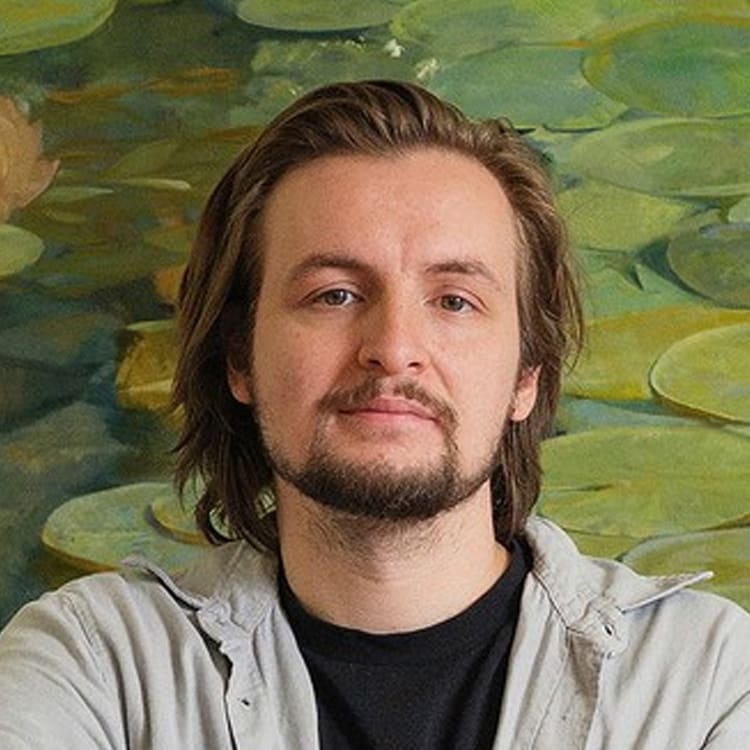
Steven Lawson and Manuel Dürr ask what daily, weekly, and seasonal rhythms restore resonance—not as retreat from the world but preparation to enter it. Lawson is Founder of Monk Manual, a daily formation system for peaceful being and purposeful doing. Dürr is a Swiss painter in Biel; his fourteen-painting Via Crucis was inaugurated in St. Peter’s Basilica, February 2026.
This episode was recorded at the Virginia Mae Center at the Washington National Cathedral, on day two of the 2026 Understory Festival hosted by Comment Magazine.
Tiffany Thompson: Welcome to The Understory podcast. I’m Tiffany Thompson, the executive editor of Comment magazine.
We live in a culture obsessed with productivity, efficiency, speed, and success. But after all the triumph of technological advance, it may still be that the defining condition of our time is not merely acceleration, but alienation, marked particularly by the absence of what acceleration destroys: resonance.
Coined by German sociologist Hartmut Rosa, resonance refers to the experience of addressing and being addressed by the world—touched, moved, and changed by an abiding two-way relationship rather than a one-sided effort at control and consumption. In this conversation, Steven Lawson and Manuel Dürr share their histories with creativity, attention, and presence, asking what daily, weekly, and seasonal rhythms can restore resonance, not as a retreat from the world, but as preparation to enter it with the full capacity to be changed by what we find there.
Steven Lawson is the founder of Monk Manual, a daily formation system for work that instills peaceful being and purposeful doing, inspired by the wisdom and communal practice of monks, informed by contemporary psychological research. Manuel Andreas Dürr is a Swiss painter based in Biel, where he keeps a studio with his wife, Anja, inside a community gathered around the Jahu Church. In February 2026, his fourteen-painting Via Crucis was inaugurated in St. Peter’s Basilica for the four hundredth anniversary of its consecration, chosen unanimously from more than one thousand anonymous submissions across eighty countries.
In an honest and probing conversation about the realities of time, efficiency, and productivity, Lawson and Dürr ask difficult questions about why we work at all. They suggest interruption is not the enemy of productivity, but can be the fresh breeze that keeps a creative from calcifying. And they explore a radical acceptance of our finitude and need for relationship and rest. The conversation closes with practical and poignant anecdotes about the importance of sleep, slowing down, seeking work that integrates our intellectual, emotional, and motivational lives rather than compartmentalizing them.
This episode was recorded at the Virginia Mae Center at the Washington National Cathedral on day two of the 2026 Understory Festival, hosted by Comment magazine.
Steven Lawson: My name is Steven Lawson. I’m going to introduce a co-host with me today. But my own background, for those of you who aren’t familiar—I started a company about eight years ago called The Monk Manual. And really the background of that was I had actually been working in largely ministry settings, but in pretty high-capacity ministry settings, which is a very interesting… double play of sorts, right? Because if you’re in a ministry setting, there’s this feeling of like, well, I should probably be doing more, right? Like whenever you’re doing something and your heart’s in it, it doesn’t have to be ministry. It could even be a nonprofit or any sort of work of that nature, being a parent. There can always be a feeling like there’s more that can be done and should be done.
And what ended up happening was I got really into productivity, just like this general movement towards trying to do more and more and more—more efficient, in a sense, approach my life like a giant game of Tetris. How do I fit everything in? How do I get ruthlessly dedicated to moving things forward? And frankly, I was rewarded for that. I was promoted very quickly in pretty much all the roles that I’ve operated in because I was very much dialed in. But truthfully, during that time, I was also remarkably disconnected from myself. It was as if I had suppressed my own humanness. I’d suppressed my being to be a doing, right? It was like I was operating life like I was a machine, like I was myself in an assembly line trying to churn out more widgets.
And it was on a particular night that I had this experience of… or a reckoning of sorts, where I recognized that, ironically, the thing that I was looking for in productivity was peace. And it was producing the exact opposite effect. And now there was a confluence of a lot of factors of what was going on in my life during that time. But one of the big things that happened was a friend of mine sent me a paper. He was getting his doctorate at Notre Dame at the time, and it was a paper that was about how monasticism was a form of spiritual technology—that it was something that was created at a particular time and place and has lived on for a long period of time, but it was a form of spiritual technology really for a person’s becoming, as if it was specifically engineered intentionally for the becoming of the individual, for the flourishing of the individual. And I saw that there were patterns in the East and the West that really rhymed with each other and that really inspired my imagination, both on a personal level but also on a cultural level.
That led me to create this company called The Monk Manual, but throughout this time, over the past eight years, these questions have pervaded me around what is it to live a really meaningful life, and what is it to live a truly potent life? Not a productive life, but a life that’s rooted in something deeper, and that deeper being something that is inherently within us, that’s tied to our own inherent essence. What I mean by that is that in an industrial frame, the way we relate to time in ourselves is if we are a commodity, interacting with other commodities, trying to churn out more commodities. But that is a very deflating way to experience life. And what I would like to argue, and I think what we’re going to be exploring today, is that that actually is not what leads to the greatest level of creativity. And I don’t mean creativity as in painting, although I do have a brilliant painter who’s joining us today, who I will introduce in a second. It doesn’t mean that.
And it can be a fallacy for us to think that this idea of rhythms or space or living with more maybe intentionality or even more of a disposition of openness, of trying to receive, that in some way will actually get in the way of our own effectiveness. But what I have found in the work that I’ve done and the work I do coaching many entrepreneurs is that that’s not how it actually works. Time is a very, very strange thing. Unlike money, where you can go and look at a bank account and say, I have this much, time doesn’t work that way. For us, we just wake up every day with this perception that there’s more time until there’s not. But we have this feeling of it both being extremely finite and also somewhat infinite, which is a very strange thing for us to get a hold on.
And so what I want to propose today as we walk around this topic… is that there is maybe a different way for us to imagine how our lives can be. I know many of you in this room are participating in very large works. Maybe you feel a lot of responsibility. Maybe you feel like, in a certain sense, like you’re Atlas that has to hold up the sky. And what I’d suggest is that whenever we feel like we’re Atlas, that’s a very strong signal that something is off.
Today… our dialogue is acceleration, resonance, and a rule of life for individuals and organizations. And I want to start because I think one of the core ideas that comes up in this space is this idea of rhythms.
Rhythms are part of how the world was created. We all live natural rhythms. Every day we wake up, we go to bed. We have yearly rhythms. We have weekly rhythms. We have rhythms with our families. We have all these rhythms. And what I want to do is start with a really simple rhythm. A really formative rhythm for me that I picked up in high school. I went to a Lasallian school, if anyone’s familiar with that. And I didn’t actually realize this until today, when I was preparing for this, how much this was really formative for me. So I’d like to just start with the way that we would start all of our classes when I was going through this Lasallian school. And it’s a very, very simple prayer. And it goes something like this.
Let us remember that we’re in the holy presence of God.
It’s very simple.
When I was reading the description for our time together today—something that can be, I think, just naturally very attractive to us. I was talking to Manuel about this. It’s like you go to an airport, right? And what do you see? You see all these books about ten ways to build new habits or ten ways to get your life back, or it’s so mechanical, right? This is all downstream of our anthropology of thinking of ourselves not as organic things, not like you would look at a garden, but like you would look at a big piece of machinery where everything’s just these little pieces that fit together and you just need to figure out how to consume more faster to output more faster. Enter into this looking for very easy, quick answers.
And what I want to suggest is actually the way of living that leads to the greatest fruitfulness is not necessarily easier. It is simple, but it’s not easier. It requires formation, for example, is not an easy work. It takes far more than just treating someone like a thing to imprint something on, or to fit people into boxes or molds. It’s much easier to have an organization that has rigid rules around particular things that, in a sense, tries to subvert their telos to a larger telos rather than integrating the teloses of the parts.
So rather than focusing—and we will have some time for dialogue with everyone here, and I think during that time we’ll be able to source some of the… questions you may have, because I would argue that actually the solutions or the applications are very specific because every situation is specific and every person is specific. There are principles, but there’s not one size fits all. Again, that’s a very industrial way of thinking about it. So rather than doing that, what I want to do is spend the time walking around some of the deeper principles.
Because, how do I put this? If you have a home and there’s a crack in the wall and you try to plaster over that crack in the wall, and then you come back two weeks later and you see that crack has reappeared, and then you plaster over it again and you come back two weeks later and that crack has reappeared—that’s not a crack in the wall problem. That’s a foundation problem. And many of our problems that we try to just solve because we want to move quickly. We want to resolve. We don’t want to stay in the tension. Tension can be creative. We try to spackle over the thing or ask someone to say, hey, can you just tell me how to spackle over this thing?
I also realize this might be a lot in a certain sense, but what I want to do is go a little bit deeper. And I encourage you, rather than looking at this as an abstract thing—for the rest of eternity, you will have spent this hour doing this. For the rest of eternity. So if you can, try to really engage it and think about what is it that’s being said to me, not by me. If you’re someone of faith, make it by God. If you’re not someone of faith, make it the universe or make it some sort of synchronicity. I don’t know. But regardless, try to personalize this. Don’t let these be abstract questions. Let them be personal questions.
So I want to introduce my friend Manuel, who we just met a couple weeks ago. Anne introduced us, and I implicitly trust Anne with pretty much everything. She’s an incredible weaver. And the two of us live—most of my life has actually lived in more of a, I guess you could say like a corporate setting. No, it’s not corporate, but it’s more of like a business environment. And Manuel, he’s a painter, but he’s not just a painter. He’s actually got a very, very interesting story and background and context upon which he’s bringing in. And it’s not going to rhyme with all of your context, but I think that what I can speak through in theory, or in part in theory, Manuel is living in practice in a very particular way, just like we all live in a very particular way.
So, why don’t you maybe just give a brief… for yourself. Um, you—and I’ll just say this: there is an article in Comment magazine that you all received, that’s an interview with Manuel, so if you’d like to go deeper you can do that as well.
Manuel Andreas Dürr: Yeah, so it’s beautiful to be here. I’m from Switzerland. That’s the, well, center of Europe. We’ve heard a lot of not so—or mixed—things about Western Europe today as well. And so it’s great for me to be in America, because for my dad, America, or the American, let’s say, spirit, like optimism, really helped him to get out of, I would say, a very, very bad situation.
So our family history is, we come from a poorer part of town, which for Swiss, it’s not poor, poor, but compared with other places, it’s a bad place. And so my dad… can be some sort of European sadness a little bit. We would defend it as a tragic sensibility, which is very important, and there’s a lot to be said for that, but it’s also kind of like a cultural depressed spirit can be.
And American optimism and the open roads and the plains of Idaho or whatever, that gives like a space to… for some Europeans, which my dad was one. So putting on country boots or, like, boots and listening to country music helped him to get out of, I don’t know, like a sadness. And for me it was always clear that I have to go to New York as soon as I can, once I’m serious about becoming a painter, because I always wanted to become a painter. And for me the big step was not to go to New York specifically, because in abstraction I think to go to New York, that always seemed to be the right move.
Switzerland is kind of a rich place, but people are a bit stingy with their money. A lot of money is hidden. So for artists, it’s not the best place to be, actually. So America is the place to go, and that would have made sense, I think. That would have fit well with a family motif of this optimism. We can do it. Let’s get it going.
But at the very same time, we are rooted very deeply in a community. And I’m ashamed to admit, I never really actually thought through the implications. I actually had to make the decision to actually go to New York or not. And at that point, I only realized that it’s either my design, what makes sense for me, or my community. The two are not really compatible. And so at that point, it became clear to me that actually I was never serious about that plan, because that community was much more fundamental to me.
But I think the good news about… whole story is that God—excuse the naked Christian, I cannot tell the same story with the universe or synchronicity, or maybe someone else can, but for me it’s God—who can do something out of a life that’s… someone who’s done everything wrong strategically. So, well, I just say that because for me, to be a painter made no sense and really was something I just kind of fought through, financed by my wife, who’s a kindergarten teacher. And that only worked for a while. And I said, just let’s try it as long as it’s possible.
And now, just to give a small example, for me, it’s a big example, of course, of how God or the universe can open doors that happen on a different logic, or like on a different, as part of a different story—which maybe we can just, that’s something to discuss then. I would think it’s even the more interesting story. The story that we kind of tumble into can be much more interesting than the story that we design ourselves. I would say our own designs are less interesting than God’s designs.
So for me, what happened is, I just, this last year, could paint the fourteen stations of the cross for St. Peter’s and the Vatican. So for some reason, the Vatican or St. Peter’s is the only church in the world that didn’t have fourteen stations of the cross, which is bizarre. And so for the four hundredth anniversary, they had like a big commission—not commission, a competition. And I was entered into the competition by a friend. And it’s funny, because that friend had many ideas for me to help me promote the painting and all that, and I always kind of thought his ideas suck a little bit, but this was like the fifth idea that I had shut down. And so I said, well, it can’t hurt, let’s do it. And then in the end, for some reason, it ended up being like that.
And so now, of course, my life is quite different in many ways. But the thing is, I think it never would have happened had I stuck to my own strategies. And so if I want to make a case for an attitude of, in a sense, waiting and listening rather than—to say it in the language of the conference—rather than speaking and designing and scheming and doing strategy and all that, that can be much richer. And I think that God is working in hidden stories, that our life then can be, if we have the guts to wait for long enough, our life can then be part of, I think, a better story than my own story might have been. That’s a biographical starting point.
Steven Lawson: Perfect. And one thing I’ll add as a piece of context that might be helpful is Manuel lives in a community of sorts that’s dedicated to not just maybe optimizing around the good of the individual, but the good of the whole. And also the openness and permeability of the members across parts. Which actually is a place I’d love to start with, because… interesting. I alluded to this, but I used to be someone who was very, very bought in to an industrial way of thinking about things. And I’m not saying that this is akin to an industrial way, but I mean, I would be reading Harvard Business Review all the time. I’d be reading all the business things. I read all the productivity books. I was just very, very big into mechanically engineering something to produce outcomes that I thought would be what were best.
And as part of that, there’s a natural secondary effect that ends up creating a sort of context where not only do other individuals, but sometimes life itself becomes a threat against one’s own aims. The idea that’s coming to mind, for example, is say someone—and you see this, where maybe a person is so… This is kind of a classic archetypical pattern. Maybe someone’s so invested in their work that they wake up when they’re late sixties, seventies, maybe it’s even in their fifties, and realize like, oh, I’ve missed a large portion of something. Or my relationship is kind of just a transactional named thing. Like there’s actually no longer living relationships either in my life or in my family. And the reason is because relationships themselves interrupt us. Relationships are inherently inconvenient through the lens of being productive, through the lens of getting things done.
And it was striking because when I had this call with Manuel the first time, he said something along the lines of, like, it’s very important for you to allow interruptibility, which I think for most people would just be very annoying. For most of us, we optimize—or I can say for myself, I certainly optimize my life around it not being interruptible. And I’d love you to speak to that. Or why is that actually even a value that you hold?
Manuel Andreas Dürr: Well, it is actually quite tough. I have a lot of frustration in my life because of the way we set it up. So my studio is in the middle of our community, which is great on paper, but in reality it just means… if I get three hours of uninterrupted work, it’s a very good day. My kids run around as well in the same place. It’s a beautiful small village of different things, but it’s also very, very exhausting. But I think it’s exhausting exactly at the points in time when I think I’m in charge in quite the wrong way.
And I think some improvisational sense of life, some openness to being surprised, so interruption not as a negative thing but as a positive thing. And if I also, as C.S. Lewis says, if I don’t succumb to the illusion that I own my own time, then actually I think that’s the way to go. I think actually to be interrupted is very, very important because we calcify in our methods. And I think everyone, especially Western people, are very prone to calcifying in their specific ways of doing things, and strategies are part of that. And then if I have the diet of the airport literature you mentioned, I think that only reinforces that I find out a private way of doing things. And I think we need public transit of ideas.
And I just think a community is always—I’m aware this sounds maybe a bit socialist, communist or something. I don’t mean it at all like that. I’m just aware that in America, you know, the cultural milieu might be slightly different, but I don’t mean it in a socialist way. But I do think that a community, or like, especially Christian communities in the sense that they’re comprised of people that are completely the opposite of me. So these are not people that we chose because they’re all artists or they all agree on certain ideas. They’re actually people that, well, historically, there’s some, it has to do with Jesus mostly. People want to be of that community worshiping him. So it’s around the church, the community, but other than that, there’s not really much uniting these people that we are committed to.
And I think that’s actually awesome. I think it’s actually very great to constantly have to justify your own lifestyle to people who think completely different. So many of my friends are like insurance salesmen and bankers, which are not the kind of people that I would intuitively just hang out with maybe. Who knows? I do hang out with them a lot because that’s the way we set up our community. But I actually really love their pragmatism. I tend to be a bit of a romantic maybe, a bit of a wasteful dreamer or something. And I really love that some people really look at the world in a very different way. And that also gives me hope that the world is richer and more complex, and also more perspectives are operative. And I’m actually glad that I have other perspectives in my life constantly nagging me with their ideas, which I then have to shoot down or fight. But actually, they also shape me while I’m opposed to them, in a wholesome way, of course.
So I really think that it’s very important not to drink our own Kool-Aid. Is that an American thing? Like, what’s American? Kool-Aid. I think it’s very important not to trust ourselves too much and trust our own design, because I don’t think that most people can design a very, very good strategy for their life, because life is just too complicated, too unforeseen, and no one really knows what’s happening tomorrow. And no one even knows what’s really happening today or right now.
And so I think it’s very important to, well, one would be, I think, to have other people interrupt you and to open your life to feedback of others and kind of an interruptibility relationship. But also I think it has to do with God. It’s very much the same thing. I think in my experience, God’s time plan is frustratingly slow most often. And I just can witness that I’ve found that to be true, that God’s doors might open slower and in unexpected places. But looking back, they are much better than my own very bad ideas, which seem good and great to me and very wise and very well thought through and all that. And in hindsight, I see they really weren’t, kind of because my, I don’t know, 1.5 kilograms—you don’t have kilograms, right? Whatever that is. How much is that? Just under two pounds of gray matter. Really, it doesn’t get a grip on the actual world very well.
So just from that business or literature advisory, literature kind of perspective, I would make the case that we should not trust the twelve steps or the twenty rules or the… seven whatevers. And all these optimization things, I think they really always reduce us to a caricature of the world and then our own methods, which we’re already prone to absolutizing and looking through them. And so suddenly every, you know, the hammer nail thing, everything becomes a nail. And in my case, everything becomes a Picasso distortion or something. And I think that’s really, really important not to trap or get trapped by our own methods.
Steven Lawson: I had a business coach who coached me at one point. And every once in a while—and I’m sure you’ve all had this in your life, where maybe it’s a teacher or a mentor—they say one thing and it kind of goes into this like mental Rolodex of, here’s the fifteen lines that have really been foundational for me. And one of the things that this woman said was, you have to be really careful not to become good at building the business you don’t want.
And what can sometimes happen is we get so focused on optimizing that we actually don’t ask the question of, what are we optimizing for? Or is this actually aligned with what I even want? I was telling someone at lunch today, I had an experience at a previous job that I had where I ran a relatively large project, and there was an individual who was a peer of sorts, and casually in this conversation said something to me along the lines of, you know, you’re just not very good at project management. And I remember in my ego thinking, who does this guy think he is? And also, I’ll show him, I’m going to go and become the only certified person in project management in this building. And I started going to pursue it for, I probably spent around forty hours over the next few months, just kind of at night, this and that. Until a certain point I realized I actually don’t care about project management at all. I don’t want to be a project manager. I don’t know why I’m even doing this.
And what can be tricky is for us, when we lock ourselves into frames of how things should be, we don’t leave ourselves open to what could be. And that sounds a bit almost like a Tony Robbins line or something, right? It’s easy to go and take these as platitudes or some form of idealism. But if I could go really, really, really, really down to the roots—if you want to talk about rhythm, if you want to talk about space, if you want to talk about resonance, you’re ultimately on a certain level talking about time and experience of time.
And ultimately, the way we actually even think about time, I would argue, is not really how time works for us. Time management, I would argue, is not really true to what’s really going on. If you really want to think about time management, it’s really attention management. Because right now you can be here, and 50 percent of your attention could be here, and 50 percent could be somewhere else. So just even thinking of like, okay, well, I’m here for an hour, therefore that’s what this is, that’s not true.
Maybe you’ve had this experience. I certainly have. There’s times where I’m with my kids, and I am beholding them. And there is a deep level of resonance. I am receiving something, and they were receiving something from me. And there are other times where I’m with my kids and I am not with my kids. I don’t know where I am. I might be in the past. I might be in the future. I might be thinking about an email I need to send, whatever it might be. We all have these pressures of life that impose upon us.
But I wanted to offer that particular piece around the attention because one of the disservices that we have in our current time is this idea that there’s this commodity of time that we just move around, and we forget about the experiential aspect of being human, which is so important. And we could stop there and say, okay, well, the experiential part of being human, great. I need to slow down. I need to go and be more present with people. I think most people want that. But there’s another part of us that likely might reject that, because we might think, hey, well, that sounds great. Maybe someday in the future, if I have a lot of money or all these projects get done or I get to retire, I can do that. But it’s a thing that’s in the future because we recognize where there’s a sense we have that we can’t actually afford to be in the present, to be able to receive what the present brings us, almost in a naked way.
We abstract. This is such a huge thing. Most of our encounter with reality is not actually an encounter with reality, but an encounter with our images of reality and abstractions of reality in our own head. If you stop by, the Monk Manual has a little Nave Nook, and one of the things that’s on this poster is this idea of signal, that God is always speaking. I love the idea of signal. I love the idea of signal and noise. When I was a kid, one of my favorite things to do was Where’s Waldo? Which is essentially just a visual signal. And I would go through and I would look for the various things. And I believe that our commissioning—and yes, this is as Christians, but I would also argue that this is what leads to human flourishing—is to pay attention to the signal in our lives.
There’s never been so much noise. Many of us live lives like we’re in a Las Vegas casino with all the bells and bings and lights. It’s so frenetic. It’s so loud. In The Screwtape Letters, there’s an incredible passage about how there’s a senior demon who’s counseling a younger demon and saying, you don’t need to be tempting this person. That’s not what you need to do. You just need to make it so loud that they can’t hear the voice of God.
Now, I operate from an assumption that God is actually always speaking. Always. Sometimes we have to relearn how to hear that. It’s a sort of interior spiritual sense, just like we have these exterior senses. I would actually argue that we have interior senses, and they’re quite similar. But sometimes those might be numbed, or we may have actually cut ourselves off from those senses, that we haven’t really paid attention to them. That’s a long arc, just to get back to a principal point, which is, especially if you’re Christian, who is God? Is it you, or is it God? Because if it’s God, then you have to have humility. You cannot believe that you have more intelligence than the God of the universe. That is absurd.
I want to bring it back to you, Manuel. Because one of the things that you brought up—and I remember because we were talking yesterday, and you brought this up. But I remember when we were talking, I wrote when we had our conversation, when things stood out to me, I would put it in all caps. And this idea of epistemic humility. Which I think there’s a particular flavoring which you’ve already touched on. But part of what I think, like part of the meta project almost of like what—I don’t actually think what you’re doing is a project. I think what you’re doing is you’re trying to live in a way that’s integral, with integrity of sorts. It’s not really a project. And at the core of that is a deep sense of humility. And it feels wrong for me to be like, oh, and therefore, if you’re humble, you’re going to go and have your paintings in St. Peter’s. Because that then, again, turns things into some sort of utilitarian game that breaks relationship. So maybe if you could just share a little bit about this concept of humility and how it manifests. Because it seems like such a central value.
Manuel Andreas Dürr: Yeah, that’s right. For me… one very strange or very upsetting dynamic that happened in the last couple of years with the rise of AI and all that was that suddenly life started to feel like a race against—what exactly? But somehow everyone against everyone. People are starting to talk about early adopters, you know, breakers and shakers or whatever. And suddenly it’s, or even the stock market functions very similarly. It’s basically, I need to be smarter than everyone else, I need to be ahead of everyone else and all that.
And I think just what you alluded to with time, spending all our energies thinking about the future, which we actually really do not know as much about as we think—I think that keeps us from staying in the present. And the present is the only place where we do have additional resources, bodily resources. Like actual hopes and dreams and all that are fine. But in the present, we do have a body and we do have people next to each other. We can have conversations. So I think a lot of fear also comes from projecting oneself into the future, where one is only an abstract spirit, basically, just a thought. And we don’t have additional resources to deal with the problems. In the future, we only have it right now.
But I think to actually be in the present takes humility, because it’s an acknowledgement that I don’t see the bigger picture, actually. It’s about trusting that what needs to be done and can be done can be done right now. I think I’m trying to cultivate that as my main mode of operating. I actually don’t know so much about the future and I need to withstand the seduction of being constantly thinking about the future and my place in it. My place is actually right now in the present. And I think a lot of very important things are happening in the present that we really miss because we constantly plan ahead.
And there’s one famous business guy in Switzerland. He’s like, him and his three kids all made it independently to some billions, quite successful people. And he was once asked, what’s his secret to success? And he just said, everyone wants to have a big plan and they never do the steps that are the small steps right now. And so his principle was, don’t think about the big plan, just do what’s right today. And I think—so of course, that’s the business advice, so that maybe goes a little bit against. But I think what’s good about that is rather than to understand the whole world, I think it’s better to listen to the moment right now. That means also listening to other people. And it’s about, as soon as I understand that I don’t understand most things and approach the world from a certain standpoint of humility, I think a lot of resources opened them up to me.
So I don’t want to make that sound like another optimization thing, but it’s really the truth. The world is really rich and everyone here is very rich. But if I come to this conference thinking about who could I meet, who could open the door or something, or basically that I, you know, these are Americans, I have my Swiss perspective, which is somehow superior or something, as everyone seems to think about their particular perspective—I think that’s just very bad, and I miss a lot of things that I could have in my life.
But it does take constant discipline, I think, to get back to the present and make a biblical analogy to only gather the manna of the day and not the manna for the next day. And not knowing whether there will be manna next week, but actually trusting there will be, but that’s the problem for next week. So I hope this doesn’t sound too much like I’m—so I spend a lot of my… So I have a business as well. So I’m self-employed, but I also have a business with ten people. And so I do spend a lot of my time planning and strategizing and all that. But I do think it’s really—there’s a mode of thinking that’s very… it’s seductive and it’s destructive, because it suddenly puts me in charge of the world. Because when I’m designing and scheming, I do kind of start to think that I really… you know, this person’s going to think that when I say that, and this is going to happen with that and this, and suddenly I’m in a different mode.
And I think the better mode is to actually realize I don’t know so much about the world. The listening mode is much better than the watching mode, or like the eye as a symbol of how to engage the world, which can then create a grid from which to construct and deconstruct the whole world. I think the ear is a much better metaphor. I love it, called the whole cathedral, basically, like the ear cavity. I think that’s a beautiful image. If the church or if our lives could become huge ear cavities—I’m not sure if it’s a beautiful image, but it’s a good one. I think then they can see a certain resonance, and then suddenly a lot more goes into that than with… we had combined your schemes and my schemes and even all the schemes that we could bring together. I think the more the better from one perspective, but actually there needs to be one principle thing, which is that basically how the actual world is happening, and I would say that as a Christian, how God is providentially shaping history—that should be the driving force of our lives.
And in that sense, I think I only mentioned the Vatican thing because for me it was just such a surprising, loving thing from God, that he would open the door that basically I closed to myself, I think, more or less. I just want to say that I do think that God does open pathways if we have the guts to trust him and not to open the doors ourselves too much. But you’re right, of course. I don’t want to suggest that this is a better way of getting ahead or something, that that would defeat the purpose. Because basically I think we’re all called to die, right? We’re all called to—we’re promised that we will be crucified, basically. That’s the Christian life, at least. Not the universe, maybe.
So that’s basically what I’m looking for. I don’t know if I managed that very well, but the community helps me remind myself of the haughty principles that I tried to live by. But they’re actually not that haughty. They’re just very practical. Just pray every morning. Don’t scream at the kids. Don’t push people that want to look at my paintings in the middle of me creating them. Don’t push them away, and actually explain what you try to do. So it’s very, very small things, but I think I’m trying to do that every day.
Steven Lawson: In a moment—no, you’re great. In a moment, in a moment where what I want to actually do, I know there’s a lot of wisdom in this room. And what I’d like to do is just open it for a sort of like Q&A dialogue sort of thing with those in attendance. But I do want to address one piece, because I know some of you may have come in based on the title itself of this concept of acceleration and actually have very practical, realistic questions, meaning you’re hearing what we’re saying and there’s nothing that you’re disagreeing with, but there actually is a gap of saying like, yes, but how? Or yes, but like, is that feasible? What I would suggest—and it would take, maybe actually if it comes up at the Q&A, I will spend a little bit of time on it.
I would strongly suggest that operating in such a way where you’re slowing down and you’re allowing a sort of emergence does not end up—it does not end up actually inhibiting missional growth. In fact, often it liberates it. Part of what happens is with acceleration, if you think about driving on the highway at sixty miles per hour versus two hundred miles per hour, you’re much, much, much more likely to miss a sign. You’re much, much more likely to not enjoy it and to feel stressed out the entire time. When you move at a particular speed, you tend to actually have a lot more waste in your life, meaning you tend to be grasping at more things.
And actually, even on a physiological level, as speed increases and we feel like the pressure is increasing, for many of us, we end up becoming less discerning. We move into a mode where what we optimize around is what is concrete. It’s the reason why we open up our email and we want to show some sense of progress. Add to that the fact that the most important things are usually the things that we’re going to be most likely to procrastinate on. Because we move away from things that scare us. It could be a conversation with a spouse. It could be a conversation with an employee. It could be a conversation with God. It could be a project. We move away from those things and instead we often actually find a lot of things to distract us. Things that we can measure that give us an illusion of progress. Because as long as we can see all the widgets coming out, then we know that something is working.
But the kingdom doesn’t really work that way. There’s a reason why the kingdom uses organic, garden-like imagery. There’s a reason why there’s images of trees and fruitfulness and not some sort of mechanized—it’s not an engineering problem. I believe strongly that the gospel doesn’t spread in an industrial way that’s built primarily off of numbers and programs. Not that those things are wrong, but that they can become something that loses the spirit of the thing. That actually how it tends to work is just like how a tree grows in a forest where it drops its fruit and moves from one person to the next, to the next, to the next. Now that’s not always going to be through the gospel specifically. That might be through a particular creative endeavor, but I think that God works in very quiet ways behind the scenes.
But there are specific things that are really important if you are trying to think about rhythm or practical things to incorporate into your life. One of the most primary ones is to slow down. And that is so easy to say. And actually, there’s nothing new, I’m sure, for any of you when you hear that. But it’s one thing to hear it and it’s another thing to actually try it and pay attention to how difficult it is.
Take a time. Maybe in the next week and you return back. This is a great time to try it because likely you’re off for a few days. You’re going to have work piled up. Try on Monday. Notice when pressure comes up. When you’re operating from pressure. Pressure is often linked to fear. So notice when fear is the energy that’s driving your action. We can do the exact same action through an energy of fear or the exact same action through an energy of love. I think ultimately where we find our greatest fulfillment is when all of our action is driven by love, and that we try to transmute as much of the fear that comes up as possible. Fear is never going to go away, but we can become intentional about it.
So I just named a particular practice, but you can build in rhythms of coming back to oneself around these things, whether that’s an hourly practice, whether that’s something you do on a weekly basis, trying to intentionally build in specifically rhythms of reflection. If you think about it, it’s very clever how God’s designed us. I love to think about the fact that everything that’s created was created by God, and God’s actually really intentional. Everything reveals an aspect of God, including time, including the fact that we didn’t have to exist in a way where we’re in this journey of ongoing becoming, where it goes sun up, sun down, every day, every day. But we’re actually living through a sort of almost evolutionary personal process. In iteration, it’s this potential that’s coming to bear. I think that’s the invitation of life, is to live into that potential that was already created there.
One of the most profound practices I think we can have, and I recommend doing this on a daily, weekly, monthly basis, whether it’s on your own or with a team, is just building in rhythms of reflection. If you think about when you’re a kid, you’re taking in and observing all the things around you. I think we’ve all been trying to figure out what is the best way to live from the day we were born. What is the right way to do this for me? Like, what is right? What is true? What is good? What is beautiful? And we look to other people and we try and make sense. And the degree to which we reflect upon what’s actually going on and what actually makes sense, we iterate, we change our models.
And frankly, I don’t want to get too abstract here, but we often will focus on behavior, but our behavior, it’s very… if you want to fix a river that’s poisoned, you don’t start at the bottom of the river. You go to where the poison is and you start there. And often we start with the behavior and we’re like, how do we build a certain discipline or how do we do this or that? And we get in these shame cycles of why is this not working? But our behavior really does flow out of—it flows out of where we’re giving our attention, the decisions we’re making, but all of those things are actually flowing out of our beliefs. Our beliefs inform what we value, and we move towards the things we value. It sounds abstract, but it’s so fundamental.
You’ll notice that, quite literally, people build their lives around their beliefs. Your life is built around your beliefs. And on some level, if you want your life to change, on a behavioral level, your beliefs have to change. And that doesn’t always mean some sort of doctrinal change. That doesn’t mean a political belief change. Often, the most poignant, because it’s so personal, is the personal belief. It’s understanding things about oneself, paying attention to what’s really going on for me. Where am I feeling unrest? Where am I at my best? What is God saying to me in this season of my life?
Every time that you’ve been growing throughout your life, it is tethered to a sort of iteration of bringing in some new understanding of a thing that then allows you to approach things in a different way. So if you’re going to think about what is a rhythm or a way to go and improve really anything, that’s the master key. In many ways, it’s reflection. Because any problem—first, what has to happen before any problem is addressed is awareness of the problem. And when you’re moving really fast, the first thing you lose is awareness. You just feel the pain or the disconnection, whatever that might be.
And I want to say one more thing. And then I want to open it up here. I’m a very big believer in two things that have to do with institutions and teams, businesses. The first is that they’re not real things, meaning it’s a collection of people who have agreed to a particular story around a particular thing. I’m not trying to make a metaphysical claim. What I’m trying to say is for practical purposes, if you’re running X organization, you have this name. It might be on a billboard. There might be a Nave Nook. There might be this. There might be business cards you have with your name on it. But really, it’s a collection of a bunch of people who have agreed, we’re going to all show up and do this thing, with lots of other commitments in place around that, including who gets paid this, who gets paid that. It’s just a very robust set of social contracts, in a sense.
The second is that institutions and organizations function very similar to a human person. So if you think of a person who’s very productive, externally, they might be getting a lot done, but internally, they might feel almost spiritually sick. Organizations can be like that too. There’s organizations that have a culture of burnout, which actually, the symptoms are very closely mirrored to a person who’s having burnout. It’s not going to show up exactly the same. But I think that that can be a very helpful way of understanding things, because what works for the human individual tends to work in the same way for an organization. It is more complex for an organization. Because an organization is more complex. Relationships are complex.
But there are these points of insight that we can gather when we learn to reflect and really pay attention to what’s going on and pay attention particularly to health. Because I really am a believer in that a healthy tree produces fruit. It doesn’t need to turn up the assembly line belt. It produces what it’s here to produce based on the season, which we didn’t really touch on, but that’s also a big thing, right? There is seasonality. There are times where it’s actually not appropriate for us to try and force an outcome. But we’ll leave that for another day.
Okay, do we want to open up for some questions here?
Audience Member: Thank you so much. You actually validated something that I live my life by. It’s a saying that says, when you embrace the wisdom of uncertainty, your life will be blessed with possibility and creativity. I’ve never heard anybody else validate that, so thank you for doing that today. My question is really practical. What are your views on sleep, the hours of the day, and how you allocate them? What’s more valuable, one versus the other, and where does sleep play a role?
Manuel Andreas Dürr: So I think it’s very important. I was a huge victim of the idea of we can sleep when we die in heaven, blah, blah, blah. And I think that’s even from a purely strategic standpoint a very bad idea. But I think more than that, I think it’s a philosophical problem as well if we don’t sleep. Because sleeping—I mean, God might have a reason, had a reason why most, like half our life, we basically lie down, don’t do anything, can’t defend ourselves. I think there’s a basic humility that even emperors have to lay down, take off their crown and get into pajamas and lie for eight hours or something.
I think that’s very important to remember, that that’s most of our life. And when we come to the world as babies, we can’t help ourselves. When we’re very old and dementia sets in, something similar happens again. There’s only a very, very short time in life where we can have the illusion of being in control. And I think it’s very important to enjoy that we’re not in control, because that then puts us in a different mindset. And that’s a good excuse for sleeping in, maybe, or sleeping in as a philosophical act. But I think that there’s actually something to that.
Yeah, I think, so I hope I don’t sound—or I hope I don’t confirm stereotypes about Europeans, that Europeans are lazy. Maybe we are a little bit. And I do admire the American optimism. I really think that’s actually something that the world needs. I think the idea that you can just go to Africa, build a hospital funded with American private money, I think that’s really, really great. And I think a lot of blessing comes from that spirit. But I also think that, yeah, sleeping is also a form of humility, and we should embrace that we’re sleeping helpless creatures that need each other and need God in the end. I think that’s important.
Steven Lawson: I think on one hand it’s funny because what’s coming to mind is the story of Jesus just sleeping in the boat. You know, you would think that if he was really—if I was in those shoes, I would certainly feel like that would be irresponsible, maybe even, you know. But clearly that’s not the case.
I struggled with sleep. I don’t physiologically struggle with sleep, but it’s really tempting. A lot of people struggle with this. It’s really tempting to just push and just be like, I don’t really need that much sleep. Kind of almost get in a habit where you create a sort of debt where it’s like you’re borrowing from tomorrow’s energy the night before. I used to get in a pattern where I do a lot of late night work. So if I would be—honestly, it’s like if I was feeling almost like anxious about a thing and I wanted to get something done, I would just stay up and I would just be like, oh, I get done. And I’m like, okay, loop’s closed. And I go to bed and I’d be super tired in the morning.
And I’ve gotten a lot better with that. I think part of it is, you know, this is kind of personal, but I’ve recognized like everyone has their own traumas and difficulties and wounds and different things. And I think for me, I think I had a natural proclivity for this. I think this is how I was made, but I also think it was exacerbated by particular experiences I had. But there was a period of my life where I was very much in my head, to the degree that I wasn’t very in tune with my body at all. So the way I was feeling, I wouldn’t even know. It was almost like I was just moving it forward.
And that actually happens. It’s probably something many people in this room are afflicted by, because many people here are quite successful or very intellectual in particular, right? And we’re all informed—I don’t want to get into too much of it, but like Descartes and the Cartesian split, it’s like we can operate as if we’re just like a mind and forget that we have an actual body. I sometimes use this metaphor of like a rider and a horse. Like our mind is the rider, but the horse is our body. If the horse doesn’t want to move, like we’re going to have a really hard time.
And actually most recently, this is something that’s probably been the most convincing for me. I was already convinced because I saw in the experience of my life that actually was making me less effective. What would happen is if I was tired, I would generally be a lot harsher with people. I would make worse decisions. I would procrastinate more. Again, it’s a very strange like sleight of hand trick we do with ourselves, because we think to ourselves like, oh, I don’t need sleep, but it actually costs us a lot more.
And I know a lot of people have said things about this, but something I just realized in the last few weeks, because I’m strange in that I like looking at these things from a lot of different angles. So I’ve been doing a lot of research into like neuropsychology and just like the different chemical constructions and how things work. And there’s a chemical called adenosine which can build up throughout the day that gets cleared out during REM. And if you’re someone who wants to be convinced on why sleep is actually like truly essential, just look up the dynamics of that and it’ll be pretty convincing.
We’re made—it’s also funny, you know, the thing is with monks, today, like, the idea of a monk is like very, very strange to us. Like, in general, they seem alien, whether it’s Eastern monks, Western monks, they seem very strange and foreign. But actually, monks live more similarly to how humans traditionally have always lived. It’s not—we never, prior to the eighties, you weren’t bringing a laptop home. You weren’t even—you didn’t even have a home computer. It might have even been later than that. But at a certain point, okay, the sun’s down. Like, maybe you can go and read or sing some parlor songs or whatever it might be. But that wasn’t actually even a thing.
So each generation is kind of normalized a sort of increased acceleration and expectation of denial, I think, of one’s own limits. And I do think that we have a culture of hubris, like a sort of culture that denies our finiteness or denies our—it’s not so much arrogance from, it’s like existential arrogance or something. It’s not so much like I’m better than this person. It’s a denial of just how finite we really are. We see all the potentialities, probably more than ever before. And that does, I think, also create this sense of needing to move forward. But we have these physical realities that we can deny them, but that’s not how we were made. That’s not even a theological claim, that’s just a physiological one.
Audience Member: Hi there. Steven, I have a question for you. So earlier you mentioned the importance of integrating the telos of different parts of our lives. And I like what you said with the analogy of the highway about how you’re driving fast, acceleration. I think this tension between integration and compartmentalization, I see it a lot on my day-to-day, whether it be work-wise or creatively. I’m curious what you have to say about the tension between that. I think compartmentalization sometimes can be something we think is useful to be able to speed up. I can take this part of my heart or part of my story or part of my life and put it in a box to go be optimizing my speed on this facet of my life. But I really agree with you on the importance of integrating the telos of all the parts of our lives and that that’s truly what richness looks like. So I’m just curious as to your thoughts between integration and compartmentalization.
Steven Lawson: This isn’t a direct response. I will give a more direct response. But this is another one of those things I encountered once that really left an impression on me. And that is that there’s certain things about ourselves we would say to anyone, we would tell anyone. There’s other things about ourselves that we would only tell to our friends. There’s other things that we would only tell to our closest friends, and then there’s still other things about ourselves we’ll only share with ourselves. The most important category are the things that we won’t allow ourselves to share with ourselves that we already know.
So I think from an integration standpoint, one thing is sometimes actually the acceleration is a tactic for us to just not have to feel what’s actually going on. It’s as long as we can keep moving, as long as we can keep moving, as long as we can keep moving, we don’t actually have to face the problem. And I don’t know if there’s a hard and fast rule that I could give that’s like, here’s how you exactly know that. I do think a lot of it is a discernment.
Over time, you know, I think even when I was first getting into the space around time, I would even look at it probably more in like a mechanical way. Towards later, at this point, a lot of it is honestly discernment. It’s like just paying attention as much as possible and trying to just be honest about it. Because there’s going to be certain circumstances where it’s like, look, yeah, here’s an example. This morning, I have this Nave Nook, and there’s so many things that went wrong with it. It’s no one’s fault except my own. In the past, I would actually kind of get stressed about it. And I was like, all right, I guess it is what it is. And I’ve kind of compartmentalized it, and I’m like, it is what it is. And I think that’s actually appropriate. But there’s other things where that can be used as a sort of avoidance technique.
Something that can be a helpful heuristic of sorts is fear tends to manifest for us just like it does like a fight, flight, or freeze, or fawn. So anytime that we notice ourselves avoiding, trying to control something that’s not in our control, trying to maybe say yes when we mean no, those sorts of things, those are really what we have to pay attention to. But the exact way to navigate it, I think it depends. I think you use the language listening, yeah? Yeah, I think it’s a listening. Like there’s something about that term, listening, that I think is really, really important. Like an active listening process. Because there’s a lot going on. Like if you really slow down, pay attention. There’s a lot going on at any given time.
All right. I think that’s a wrap. Thank you all.

The Understory festival is a civic and spiritual gathering to rehumanize our common life in a time of cultural fragility. Love the podcast? Help others find it by reviewing it on your favourite podcast app. We also welcome your ideas and feedback. Email us at podcasts@comment.org. Thanks for your support.
In a Ukrainian basement, a child asks, “Is our home still there?”
SITE DESIGN AND DEVELOPMENT BY POLYMATH