



T
Persons attempting to explain, interpret, explicate, analyze, deconstruct, or otherwise “understand” this book will be exiled to a desert island in the company only of other explainers.
These were the first words I ever read by Wendell Berry. My wife Vanessa and I were far from home and trying to make a new community from scratch in Ottawa. We were newly married. We knew no one. We were navigating graduate school (for me) and ER shifts (for her). We were as poor as church mice. We were happy.
These lines hung above the entrance, as it were, to Berry’s novel Jayber Crow and, as far as I was concerned, anything I read by him after. It was an “Abandon all hope ye who enter” kind of warning to smarmy academics. To my people, I thought glumly (even though my participation in this community was only aspirational at this point). But there’s also almost nothing an “explainer” wants more than a challenge. Knowing absolutely zilch about this novel or its author except those lines, Berry’s old-fashioned-sounding first name, and the strategic place this book occupied in relation to my workload, I signed up to lead a class seminar. The course was designed around the influence of Dante’s Divine Comedy on novelists and poets in the twentieth century. Our instructor was the inimitable Dr. Manganiello who, on a bit of a last-minute lark I later found out, added the Kentucky writer to a course that mostly trafficked in early twentieth-century giants like Joyce and Eliot, Pound and Woolf, and various Dante-loving Inklings like Lewis, Tolkien, Sayers, and Williams.
After wandering through the cerebral worlds of The Waste Land and Ulysses, the fantasy realms of Middle-earth and Narnia, and the bizarro nooks and crannies of Charles Williams’s idiosyncratic imagination, stumbling into Wendell Berry’s quiet Port William felt like coming home. I exhaled. I could not put Jayber Crow down. When I got to the end, I was deeply moved. Devastated really, in a way that no book, especially in my academic life, had ever done. I wept. Later, at the pub with some of my new grad-school friends, I tried to contain how much I loved the novel. Vocal admiration for almost anything was something, I had already learned, that graduate students muted, if they ever even experienced it. Detached indifference was the proper “mode” for discussing anything in our seminars. Passion for one’s subject was rewarded with knowing, blasé glances that the emotional speaker was a rube.
Nevertheless, I attempted, poorly, to explain to my newfound community my admiration for Berry’s depiction of this lonely bachelor and his farming community, which was so much like mine in southern Ontario. Jayber Crow bumbles through life, failing in academia, failing in the ministry, not sure what he wants until almost accidentally he becomes a small-town barber. He makes a few friends, grows old, commits to the life of a place, and learns to see its beauty. But his life is far from lonely. It is shaped by his deep love for Mattie Chatham.
“But they never get married,” I tried to explain before a classmate, also ahead in our readings, interjected. “Come on. Jayber’s just a sexually frustrated creep. He wants to get laid, but Mattie’s just a kid, right? Kinda pervy if you ask me.”
It was like he had carelessly tossed a rock through a stained-glass window. My face must have communicated as much because the table burst out laughing. I wasn’t sure how to navigate this. I was married (and looked about fifteen at the time) at a table of single grad students, most of the men smoking and bearded. I was a conservative Christian among many who found such views to be somewhere between interesting and downright crazy. I was someone from the kind of working community that Berry so beautifully captured among twentysomethings who seemingly had never known a non-urban existence.
I dug in. “It’s not pervy at all! She’s . . . she’s the Beatrice to his Dante,” I said earnestly. I was pretty earnest in those days (okay, I still am). They graciously changed the subject. But I don’t think I won the argument that night. Even after my seminar, which looked at the nature of fidelity and love between Jayber and Mattie, I didn’t convince anyone. And I’m not sure such “arguments” about literature can be won. They need to be lived out.
Perhaps that was what was behind Berry’s challenging, enigmatic, cantankerous warning. Don’t think you understand my book, Doug, because you can talk about it in the foreign tongue of academia. You understand a book when you learn to stand under it—or, better, to stand by it. Far from our old homes, from our pastors and parents and friends, my wife and I received Berry’s writing—more of which I would devour in the course of that year—as a providential epistle to us, a young couple learning how to depend on each other in a strange place, moving forward into the unknown future, discerning the longer arc of our shared lives and where and how we would make a home in this world.
After graduate school, Vanessa and I took an opportunity to, respectively, practice nursing and teach in Tanzania for half a year. Alongside my clothes, I packed a Bible, Augustine’s Confessions, a few other books I forget now, and Berry’s landmark collection of essays The Unsettling of America. We were now farther than ever from home, feeling the thrill of new experiences and opportunities outside the constraints of academia and anything familiar. But it soon became clear to us, as exciting as all this was, that we were not really known there. We were still happy together, but we were lonely. We wanted to be nearer to home, to our people. I don’t know whether it was entirely Wendell Berry’s influence, but after that time away, we started to make real plans about where we would try to settle down. While we remained open to whatever possibilities even existed upon our return, our goal was to be within driving distance of our parents and (most of) our siblings, so we gave ourselves a five-hour radius from both our parents.
Tired of academia, I found teaching work in a lovely rural school only an hour from both our parents and within minutes of my alma mater, where I contracted to teach English literature courses as an adjunct. Vanessa found work in a nearby hospital. We bought our first home in Hamilton, joined a church, and started making new friends and reconnecting with some old ones. We were thrilled. Before I left Ottawa, I had asked Dr. Manganiello what he thought of PhD programs and, channelling Berry, he said only that I should neither do it nor avoid it based on a hoped-for outcome (i.e., job) I knew nothing about. You must love the work for the work, he told me. And that work is hard, and lonely, and will be completed only if you have an intellectual itch you just need to scratch. I did not have that itch.
Berry loved this world and saw the beauty of what it had been and could still be.
Teaching grades eight through twelve at the rural school and freshman English at the university, I shared Berry’s poems, essays, and novels whenever I could, encoding them into my course reading lists and thrusting them into the hands of keeners during office hours. And I watched as many students (and even a few parents!) came to love Berry’s writing. He gave a voice to their rural, small-town experiences. There was no disdain or embarrassment in that voice. He gave honour and dignity—sometimes, sure, as critics have so often pointed out, with romantic abandon—to real people. He reminded them of the fleeting beauties of a human life centred on community and shared attention to good, hard work. Berry loved this world and saw the beauty of what it had been and could still be.
In 2011, my identical twin brother Dave, who had moved to Texas, was coming back home for a visit. Usually he flew, but he asked if I would mind meeting him in Dallas and we’d journey together by car. It would be a pilgrimage of sorts. As twins, we share a lot of interests. Berry was one of them. The two of us regularly talked on the phone in those days, and amid our wide-ranging conversations we’d inevitably compare our thoughts on a Berry essay or story. “Do you think the Boomers vs. Stickers is a fair breakdown?” “Can a place become an idol?” “What about communities where you don’t quite fit in? Or even want to?” The questions were often laced with anxieties we both felt—Dave’s as someone who had left and not returned, and mine as someone who was near enough to home to pat myself on the back for “sticking” but who in no real way felt like a “member” of my old hometown. If Berry could grow such deep roots in the place of his origins, why couldn’t we?
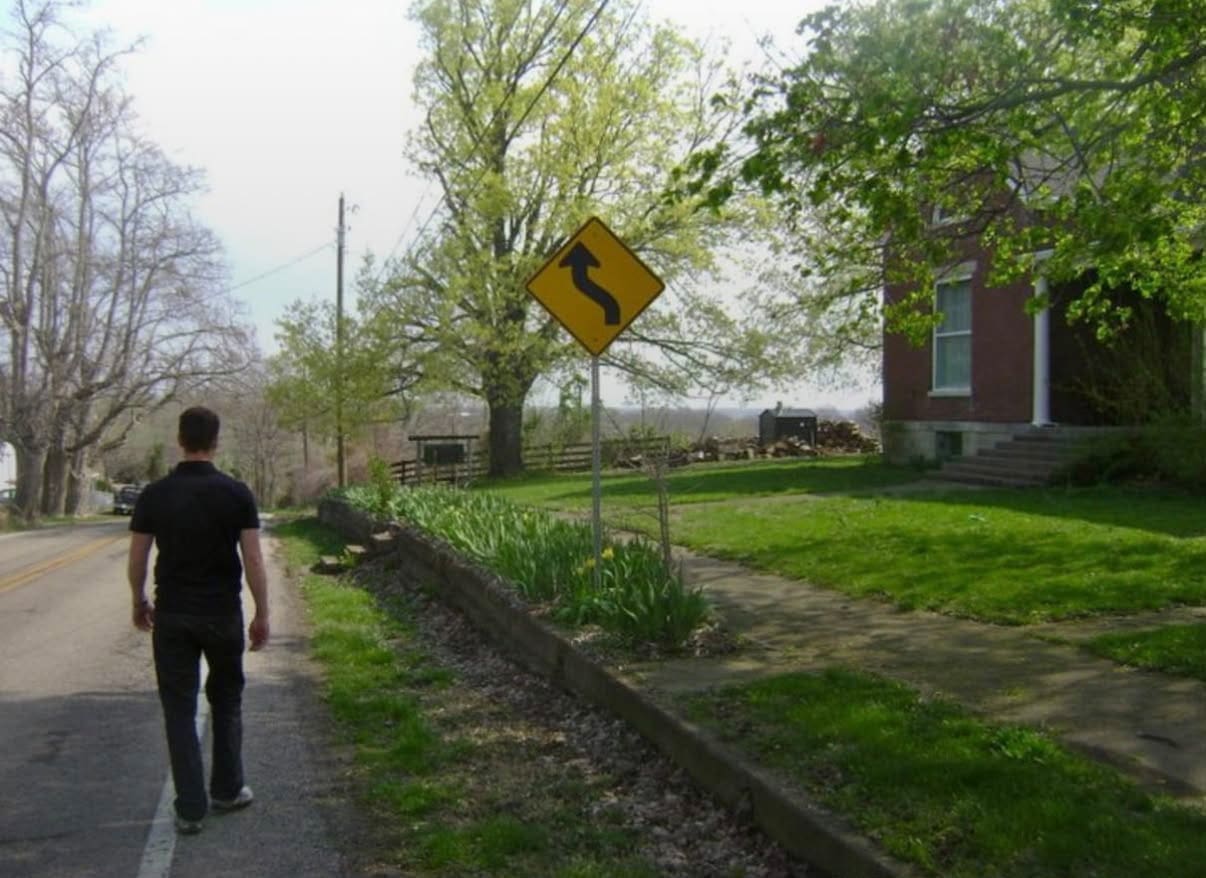
On a lark, Dave and I decided to make a detour through Port Royal, Kentucky. We plugged “Port Royal, Henry County” into our GPS (this was before the days of Google Maps) and on a Sunday morning found ourselves on a literary pilgrimage driving through the farms and rolling hills of Berry’s home country. We were exhilarated to be in this landscape we both felt we knew from our reading. I think—but I’m honestly not entirely sure—that we even read aloud from some of Berry’s Sabbath poems (yep: still earnest). And then we saw it. The “long-legged house” Berry had so famously written about. It was his writing shed, a small, rectangular box on stilts overlooking a stand of trees that descended a sharp ravine, at the bottom of which the Kentucky River meanders. A white truck was parked outside. Smoke was coming from the chimney. We slowly drove by and imagined Berry writing some of his Sabbath poems at that very moment. We drove by two more times. We imagined Berry calling the police. We laughed.
Should we knock? We determined that we would maybe regret knocking, and annoying this man we both admired, more than not knocking. We talked ourselves out of it. We chickened out. Heading back into the town for a last pass through Port Royal, we came upon a church. The sign informed us that its service would begin soon. If we couldn’t “run into” (read: successfully stalk) Berry, perhaps going to church in Port Royal would still make a good story. We trundled into a sanctuary sparsely populated by grey-haired locals, who gave us sidelong, curious glances. It was not the kind of place tourists just happened upon. As we made for the exit after the service, a familiar-looking woman who had been playing the piano accompaniment welcomed us. With a big smile she quickly discerned that the two travel-weary young men in front of her most likely “happened upon” Port Royal because of “my Wendell!” She was Tanya Berry, Wendell’s wife.
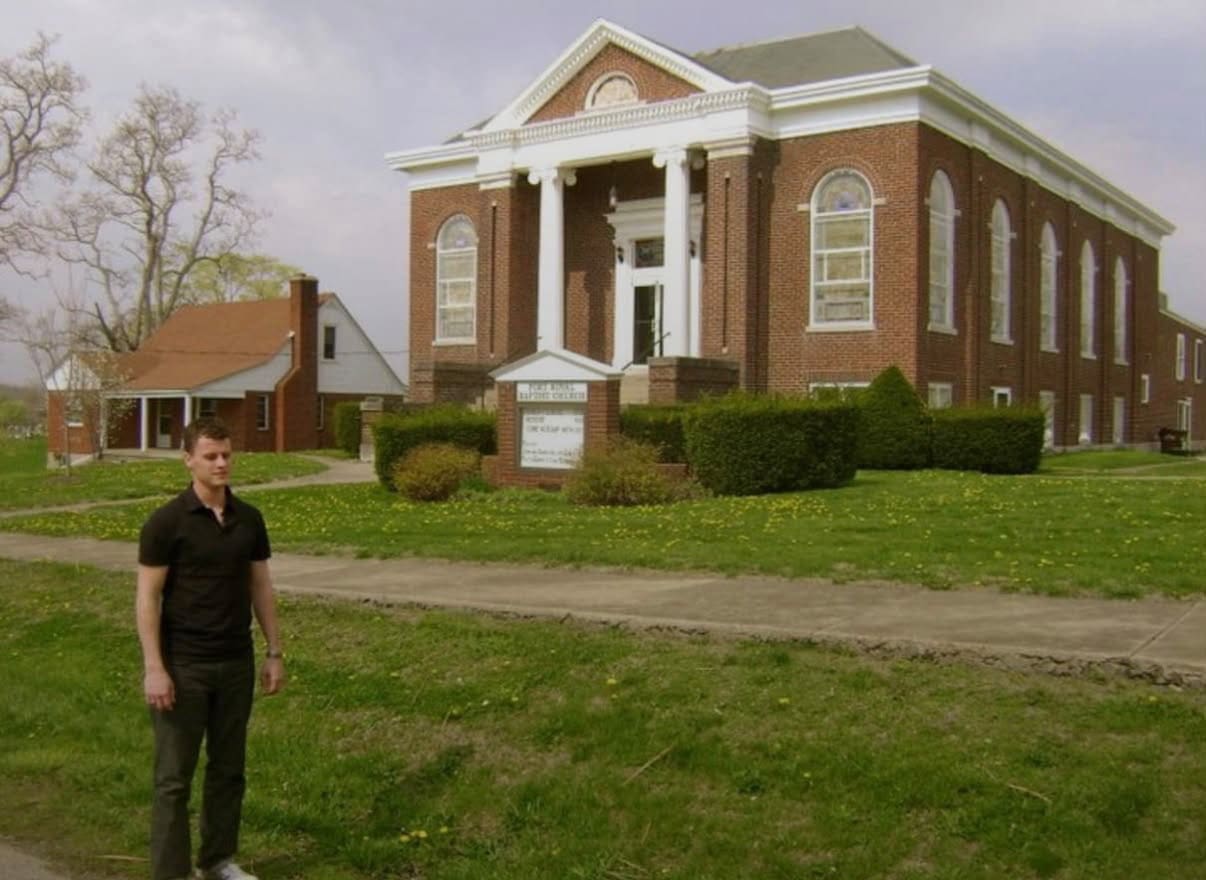
Tanya told us that she would have loved to have us for lunch but Wendell was preparing some notes for a talk he was giving at a state park nearby. We thanked her, expressed our gratitude to her and her husband for their work, then left. After an hour or so in the car, we saw a sign for the state park she had mentioned. As twins do, we only looked at each other and had the exact same thought. Last chance.
The state park, we learned after exiting the interstate and parking, was tens of thousands of acres. If he even was here, he could be anywhere. We had an icicle’s chance in hell of “bumping into” Berry out here in the wild. We laughed and decided, finally, to head home. And then the white truck from outside the long-legged house pulled up right beside our car.
Berry stepped out. We introduced ourselves. With a great big, warm smile he said, “Well, if you can, why don’t you two boys spend the afternoon with me and the Louisville students? We’re having lunch together, and I’m sure they can make up two more plates for both of you!” So that’s exactly what we did. We spent all Sunday afternoon listening to Berry read from his poetry, argue that the university needed to do more about local knowledge and cultivating a love of local places, and take questions. Then we drove straight through the night, and without a wink of sleep I showered, got my lessons, and taught my full 8:30-to-5:00 day. I think the Berry buzz got me through.
This was over fifteen years ago now, and already then Berry was objectively an elderly man. But nothing in his spirit suggested it. All afternoon he was sharp and eloquent and had a passionate fire behind what he said that was not the affectation of an influencer but the conviction of a man who lived the truths he spoke of. He stood by his words that flowed out from the life he was living. He was such a real presence. When we left, it occurred to us that Berry might be gone any day, and we were grateful for the afternoon we got to share with him. Little did we know he would live another fifteen years and write an incredible amount in that span.
I know. Everyone has their Wendell Berry story. And I know, too, most who write about Berry have much better stories than mine. Men and women who knew him personally for years or exchanged correspondence with him over decades. After our time together, I sent Berry a copy of Canadian writer Alistair MacLeod’s short story collection The Lost Salt Gift of Blood as a “guest gift” for the hospitality he had shown my brother and me. In it I wrote a short letter about what his work had meant to me. Berry never responded. I was torn up about it at the time. I’m not even sure he received the collection or my letter.
All that to say, we were not close. Nevertheless, Berry shaped the arc of my life. After our meeting, I doubled down on reading his work alongside so many other writers interested in ecology and faith. I finally had an intellectual itch I needed to scratch. While I had felt exhausted and aimless after my master’s degree, I suddenly felt alive to how real and important literature could be in helping us perceive and reimagine the creation and all its tragedies graced with a hope-filled, comedic light. I got my doctorate (locally!), spending years writing about Berry and environmental literature. I now, thank God, have a tenure-track job at a university (my alma mater, Redeemer) that truly cares about local environmental issues and local knowledge. I teach a Berry novel, Hannah Coulter, at the start of every contemporary American literature course in my schedule, and it’s almost always the majority’s favourite novel. Over the years, I’ve heard countless stories of my students reading it together with their parents and reconnecting because of it.
As someone who became, somewhat reluctantly, a professional “explainer,” I feel least qualified to weigh in on the ways in which Berry’s stories mean anything.
But many of the members of my community who are not in academia also love Berry’s ideas. Electricians and contractors, architects and police officers, backyard gardeners and wannabe homesteaders, schoolteachers and pastors and librarians—all of them find a kinship with Berry that I, too, had found. But they have found him more than just interesting; they have altered their lives because of him. I have friends who, after encountering Berry’s work, completely changed their definitions of success and ambition, fitting them into a different set of formal constraints. Some moved back home. Some bought houses with their parents. Others started community gardens downtown. It is impossible to track, but I wonder just how many people have materially changed their lives in small or major ways because of an encounter with something Berry wrote. In some ways, as someone who became, somewhat reluctantly, a professional “explainer,” I feel least qualified to weigh in on the ways in which Berry’s stories mean anything. It is those who feel no pressure to write about Berry, but only to live well in the time and place they are given, who provide the surest measure of Berry’s influence.
Rereading Jayber Crow for the umpteenth time, I am struck again by his warning. It’s been twenty years since I first read it. Oddly enough, I no longer hear the cranky voice I imagined back then. But I do see the crinkled crow’s feet and twinkling eyes of the novelist and poet who nearly became a ward of the academy. Like Mark Twain warning away the contemplative, aloof, intellectual classes from Huckleberry Finn—“Persons attempting to find a motive in this narrative will be prosecuted; persons attempting to find a moral in it will be banished; persons attempting to find a plot in it will be shot”—Berry’s humour holds no condescendingly ironic sneer. His humour is born not from detached disdain but from a deeper love of attachment. Twain also knew that real wisdom required seeing the world like a child but never being childish. This was Twain’s hope. I think Berry shared it.
While authors like Berry and Twain banish the critics out of a sense of literary mischievousness, there’s also a beautiful, critical reason for such banishment. In Real Presences, the critic George Steiner engages in a Plato-like thought experiment but turns it on its head. He imagines an ideal society in which not the poets but all the “explainers” of the poets are cast out. The best interpreters, deconstructors, explicators, he argues, are artists. Art is the only criticism we need. Don’t talk about something; make something as a creative response. When I look back and think about the legacy of Berry in my life and in the lives of so many others, it occurs to me that perhaps the real “critics” of Berry’s work are the people who altered their lives as a creative response to what he helped them see. What if the real critics include every person who has started a garden, inquired where their food came from and ate differently, considered the call to the fidelity of marriage or friendship, reimagined a future in which their ambition was tethered to family or community obligation, or reordered their loves against the grain of the cultural consensus? This is beyond Steiner’s point, but I don’t know of many other writers—or maybe any—whose body of work more influenced the way in which people decided to live than Berry’s.
Outside all the very good critical think pieces and reflections and in memoriams of the chattering classes, it is the unlettered (note: not the illiterate) who hold Berry’s legacy in their lives. These are the ones who, even as we rightfully mourn his absence, continue to re-member him, making his words an ongoing and very real presence across America, and around the world.


