
I
In recent years, commentators have puzzled over the steady trickle of young people converting to Catholicism. The explanations tend to circle familiar ground: a hunger for community, a drift toward traditionalism, a vague dissatisfaction with secular culture. Clever as those analyses can be, they often miss the thing itself. They measure the church by its social utility instead of its sacramental reality. To borrow from Augustine, they ask what use religion might serve, while overlooking the restless heart that finally comes to rest in God.
What strikes me most is how clumsy our categories are for describing what actually compels someone to kneel, profess belief, and reorient the whole of their inner life. Catholicism is not reducible to community or ideology. It is, as Thomas Merton puts it, “life itself, alive at its source.” To convert is not to sign on to a platform; it is to be seized by a reality you did not invent and cannot manage.
I did not set out to be seized. My path began in the most ordinary way—just after college, when I was teaching in a small public school in New Bedford, Massachusetts.
Like many young adults, I first tried to anchor myself in the tradition I had inherited. I went back to the Episcopal church of my childhood, hoping to recover the stability and belonging I remembered from Sundays as a kid. But the sermons hovered in abstraction, their confidence felt muted, and the sharp edges of Christian faith had been dulled into something that sounded like a half-hearted sales pitch for a time-share in the afterlife.
It was an Orthodox Jewish friend who first nudged me in another direction. “If you’re serious about faith,” he told me, “there are really only two paths in America that demand everything of you: Judaism and Catholicism.” Since I wasn’t Jewish, and they weren’t seeking out new members, I looked around for the nearest daily Mass. Soon I was sitting in the back of a monastery chapel in downtown New Bedford during my weekday lunch break.
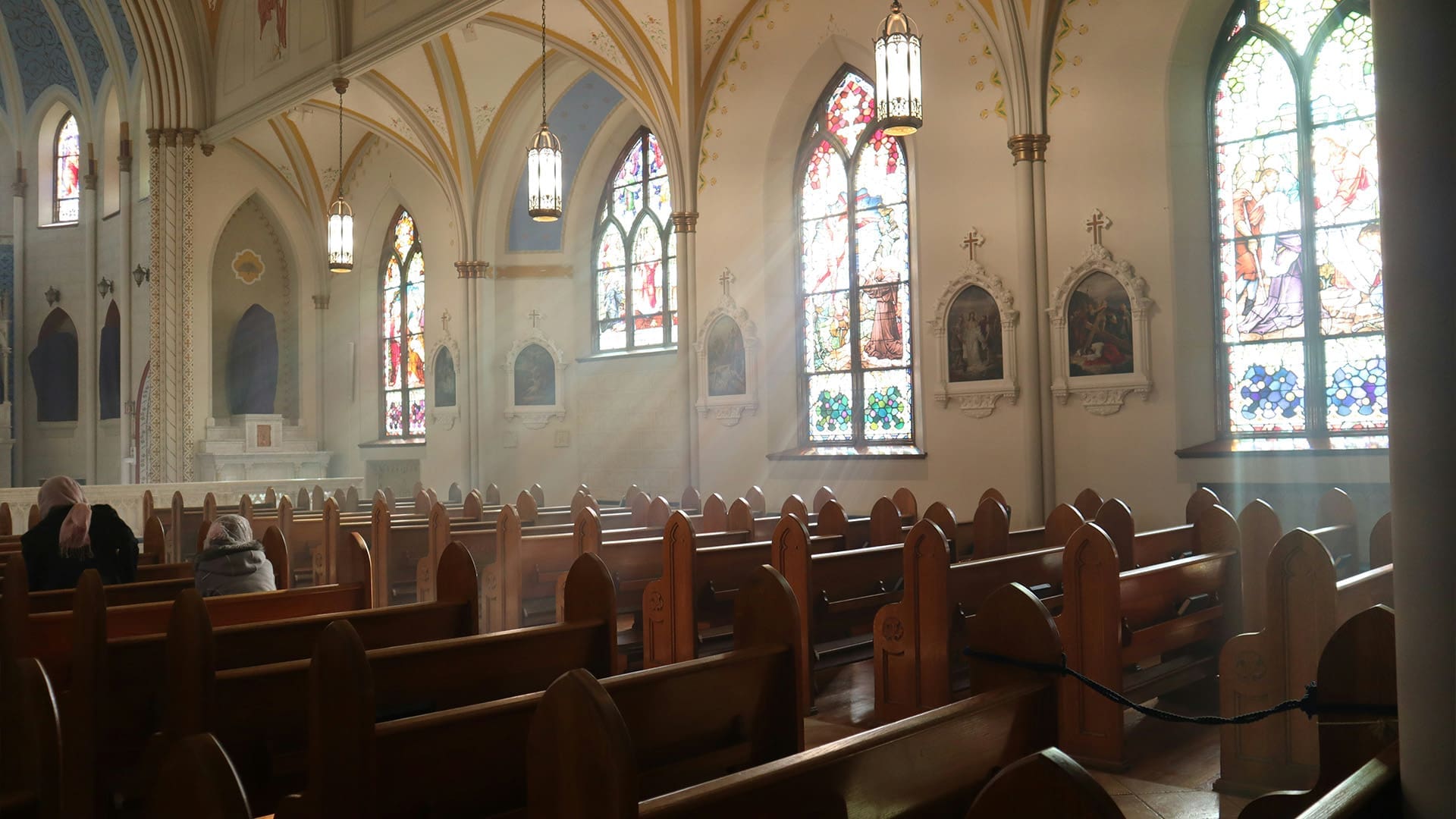
I had always imagined Catholicism to be baroque—gilded altars, incense curling toward vaulted rafters. Instead, I found myself in a dark, linoleum-floored room with a low ceiling, a single priest, and two other worshippers, one apparently asleep. The readings were short, the homily barely two minutes, and then came the Eucharist. In that moment I saw with a clarity that startled me that this faith was not about ornament or spectacle but about encounter—the renewal of Christ’s sacrifice, made present in a simple ritual of bread and wine.
This faith was not about ornament or spectacle but about encounter.
Merton, who became a kind of spiritual companion to me in the coming months, observes that “the deepest of all is the ground of our being, where we are in God and God in us.” That was what I glimpsed: not a community engineered to flatter my aesthetic tastes but a tradition quietly renewing itself century after century, indifferent to my preferences, indifferent even to its frequently drab surroundings. It felt fitting that such an out-of-the-way place should be where I first truly encountered Christ.
Later, when I entered the Rite of Christian Initiation of Adults (RCIA) in Cambridge, I discovered I wasn’t alone. Other young people—many of them as surprised and awkward as I was—were wrestling with the same questions.
But conversion never happens in a vacuum. To become Catholic today is to be immediately entangled in politics. I realized I wasn’t just an individual convert but part of a larger movement, a statistic. Maybe because I came in as an outsider, though, much of the discourse about “young men converting” strikes me as misguided.
I’ve noticed three misconceptions in particular—two from the left, one from the right—that fail to capture what is going on.
The first, from the left, is that we convert chiefly for community, as if the church were simply filling a social void created by neo-liberal atomization rather than answering a theological question. Yes, community matters. But it was always secondary to me, more like the fortune cookie after the meal. The first draw was the truth itself. As Merton writes, “We are not at peace with others because we are not at peace with ourselves, and we are not at peace with ourselves because we are not at peace with God.”
That kind of peace cannot be found in a softball league or a running club. Friendship and parish life are real goods, and I don’t want to diminish their role in sustaining a life of faith. But they sustain only after the fact. The animating cause of conversion is belief in a revealed truth.
The second misconception, common on the political left, is that the church is actively recruiting disoriented young men. Yes, figures like Bishop Barron and Father Mike Schmitz have built big platforms. But what struck me in those early days was precisely the opposite: the church was simply there, unchanged, unhurried. “The world promises you comfort,” Pope Benedict once said. “But you were not made for comfort. You were made for greatness.” The church does not bend to accommodate me. It asks me to bend, to be reshaped into something greater than myself.
The third misconception comes from the right: the notion that Catholicism is, or ought to be, a vehicle for conservative politics. But the church is older than the American experiment and will outlast our two-party system. It insists on both caring for the poor and protecting the family, both welcoming the stranger and preserving moral truth. As I was told repeatedly during RCIA, Catholicism is a religion of both-and, not either-or.
The Mass I attend is not about political victories or defeats. It is about encountering Christ made present on the altar. Catholicism is not a partisan project; it is a sacramental reality.
These misconceptions obscure the deeper truth: people are converting not because Catholicism flatters their politics or furnishes them with a friend group but because they believe it is true.
Still, it’s hard to explain what belief feels like. Friends ask me with a kind of skepticism: Do you really believe all this? When you kneel, are you really praying to God? Do you really believe in God? These questions assume belief is a switch you flip on or off. But faith, I’ve found, does not require a priori intellectual certainty. It is an act of profession: saying I believe until, slowly, you discover that you do.
In the early months, I knew only that I was encountering something that felt true, even if I hadn’t made peace with it. And I still don’t walk around in perfect serenity. Many converts feel the fire cool after the first year, and I’ve been no exception. In the trenches of adult life, it takes all our energy just to get to Sunday Mass—and my wife and I live across the street from our church.
Conversion is not arrival but turning, again and again, toward God—even through dryness and doubt.
I see now that Catholicism never promised me perpetual bliss. One of my RCIA priests told a story about a new convert who, a few years after his reception into the church, said to him, “Father, the fire is gone. I don’t feel as connected to God anymore, and I’m wracked with doubts. Did I make a mistake?” The priest smiled. “Congratulations—you are a Catholic.”
That paradox is the heart of it. Conversion is not arrival but turning, again and again, toward God—even through dryness and doubt. Merton writes that “we are not converted only once in our lives but many times, and this endless series of conversions is the very process of spiritual life.” Every conversion is equal parts discovery and disorientation—the Latin convertere meaning “to turn around.”
To live as a Catholic is not to bask in a permanent blaze of ecstasy. It is to kneel even when you feel foolish, to pray even when you suspect no one is listening, to keep seeking. Over time, the contours of God begin to emerge, faintly at first, but unmistakably. Like a magic lantern or a photo negative, he is the space surrounding your prayers, defined by the contours of your life but never in immediate view.
I remember one night in Cambridge, walking home from Mass, when I stopped suddenly on the sidewalk. I had just begun receiving the Eucharist, and I felt the person of Christ with arms outstretched rising from within my chest. For the first time I understood, viscerally, that in consuming the Eucharist I was carrying divinity within me, but that this consumption was also revealing something that had been there all along. The moment was overwhelming, unrepeatable. I have not felt it again.
Most Catholics, I suspect, have one or two such moments in a lifetime, if at all. But that is not the point. As Thomas à Kempis cautions, “Seek not the consolations of God, but the God of consolations.” The point is the rhythm of turning, seeking, kneeling. Like a single baseball game in a long season, the meaning of ritual is only clear within the larger whole.
Catholicism does not offer a truth that cancels mystery. It offers the possibility that the mystery itself might be true. And in that mystery—half doubt, half devotion, restless and searching—we stumble into the adventure that is a life of faith.