
I
In a season of desperation, invoked by the compounding interest of living on credit cards after graduation, I took a job as a caretaker for a young man living with spinal muscular atrophy. He could speak softly and swallow bits of food, but his body allowed him no other movement.
I didn’t dislike the work so much as I disliked not having options and the minimum wage that I was paid. Still, we became friends. Our days were necessarily slow. I was there to roll him from one side to another in his early morning sleep, to bathe and dress him, to spoon tiny morsels into his mouth and watch carefully that he swallowed.
I bathed him every morning. He’d lie in the bed while I undressed him, all pale skin across bone, with legs twisted into acute angles, arms contorted. I thought of a Giacometti figure, with the negative space constricting around him as though aiming to compress him to the point of erasure. Sometimes I would look at him and feel myself wanting to flail against claustrophobia, desperate for deep breaths and open windows.
The shower was the size of a walk-in closet, and I’d set him in what looked like a resort poolside chair, blue and plastic. I learned to take off my shoes and socks and roll up my pants, as though I were wading into water, as I’d take my place beside him. I’d scrub and rinse him, pulling an arm to reach behind, tugging a leg this way and that. His limbs would drip while I gathered a towel, the drain gurgling and steam rising around us, the air incensed with soap.
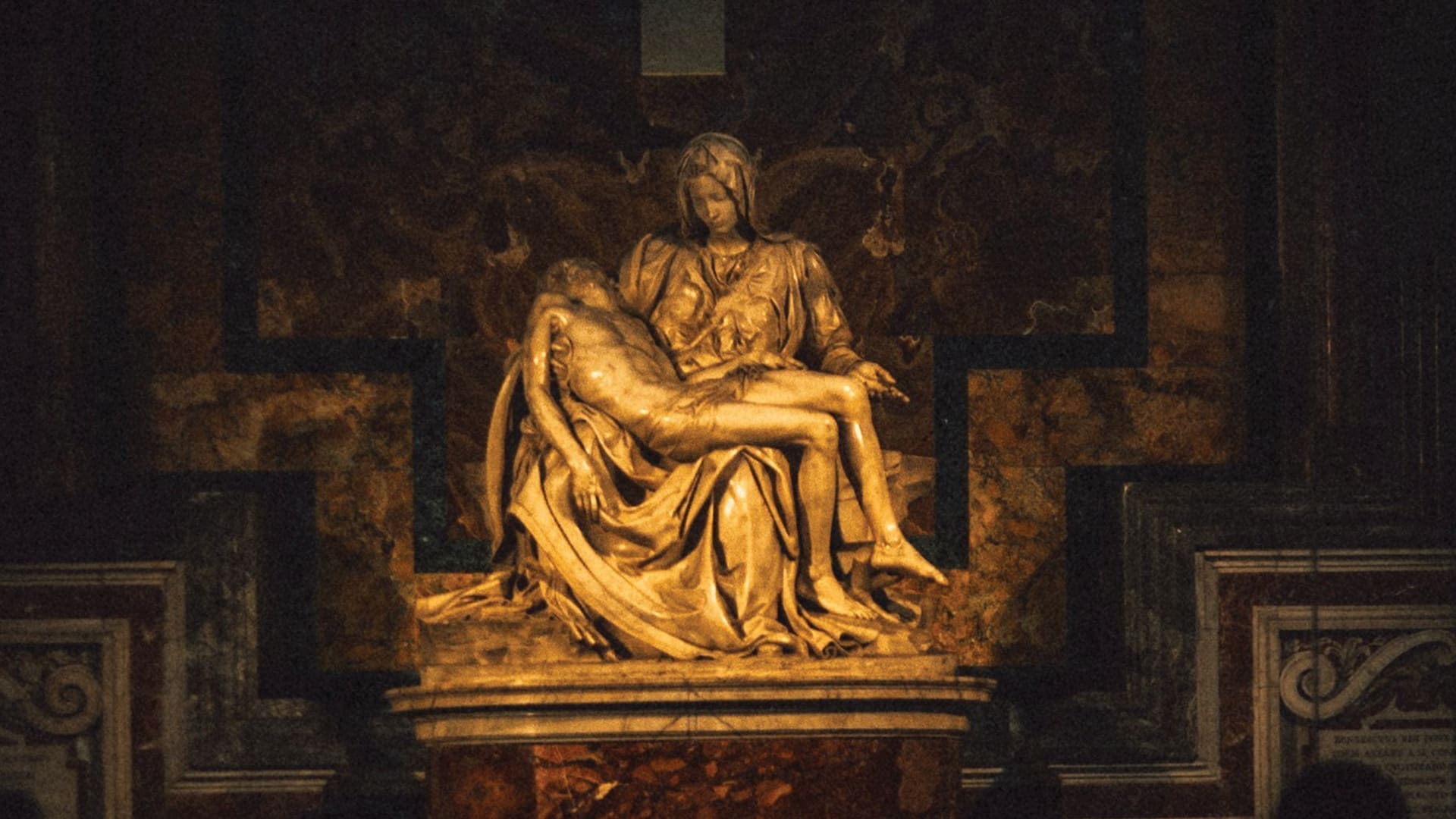
One day, I wrapped him up and scooped him into my arms as usual to carry him to the bed where I’d dress him. But that morning as we left the bathroom, I raised my head to see our shadow on the wall in front. The light behind us was rendering us as a silhouetted Pietà: I, the grieving Mary, and him, the mortally wounded Christ. I felt my throat constrict the way it does when one tries not to weep.
Unbeknownst to me, this shadowy Pietà had borne witness to our routine every morning as I grumbled in silence over my financial plight. The Italian word pietà translates as “pity” or “compassion.” Most days, wading through my own frustration, I had little of either.
I knew the sculpture by Michelangelo well, by which I mean I could have offered a lecture on its historical significance and the implications of its compositional structure. But one can articulate the physics of riding a bicycle without ever knowing the experience of speeding down a hill with the wind whooshing by.
In a very real sense, I had never seen the Pietà until that morning, when its silhouette was staring back at me.
Art in our time is desperate to be necessary, and it is necessary, but not for the reasons it imagines. Many people now see art as the visualization of an idea that could have been conveyed by more direct means. Art is a message, this understanding assumes, and much contemporary art imagines that its relevance lies either in announcing the correct political and social messages or in being a means by which the artist expresses the murmurings of their inner self.
In these renderings, art is also coy. It is why people enter a gallery and immediately ask what the artist is trying to say, what it all means. If one is savvy enough to decode the symbols and work out the equations, the thinking goes, one can be a connoisseur.
But how can one articulate, with anything resembling precision, what happens when the Pietà gazes back at us in our shadow? How does the light across certain architecture form lumps in the throat? How is it that paintings can help us grieve or that a poet’s stanza can return us to ourselves?
One evening, I wandered into a dark gallery and stood in front of three large screens playing simultaneous films. In the centre film, a woman sat in a straight-backed chair, one hand cupping the other in her lap. She sat on a low porch, and beyond the porch was a field, feathery with dandelions gone to seed. The sun was low, and everything in its path was trailed by long shadows.
The film’s slow, jumpy frames rendered fluid movements halting. Two hands held a white ceramic pitcher over the woman’s head. She raised her head back, eyes closed, as the pitcher lowered, water gathering at the spout like a glassy solid. The water began to fall toward the woman’s closed eyes, breaking over her head and only then turning supple. It ran in streams down her neck and shoulders. Then the pitcher dripped empty.
On the screen to the right, patchwork quilts draped themselves over a clothesline and moved in arrhythmic nudges from an unseen breeze. The screen to the left showed a man unbuckling leather straps and lifting, with the same stuttering movements, the saddle from the back of a brown horse, motes of slow dust lifting off into the early evening.
The gallery was dark except for the irregular light from the films. I was sitting alone, shoulders hunched, my face buried in my palms, trying to compose myself. These films were not being coy or shouting their meaning to me—which is not to say that they were bereft of meaning. They were inviting me to look, along with them, at the parts of life for which explanatory language falters.
The installation of the three simultaneous films stilled my body and slowed my breathing. What I was seeing felt urgent even before I knew what it was that I was seeing: the films and a constellation of resonances emerging from them. It was the baptism imagery, yes, but that it was makeshift—a pitcher and a porch—was an epiphany all the more poignant for being unremarkable.
It was the quilts on the line, dignified in their commonness, but it was also the sense of the hands and care that made them. It was the way that long use had frayed their edges and turned time into something tangible. It was the way the unsaddling at the day’s end looked like a yolk being lifted. It was the way the films’ slow frames seemed only to inch their way into the future—life happening, but slowed and with space around it, as though the present and the memory of it were occurring simultaneously. The gravity of the films lay in things for which I am not sure there are words—or if there are words, I have not yet found them.
The films worked the way metaphors do, when the most direct means of seeing is to point at a likeness.
Jacques Maritain, the French philosopher and Christian humanist, believed that there was an integrity to a work of art irrespective of its ostensible message or propagandistic voice, and that this integrity, this meaning, will always be in excess of anything that one can say about the work. While an art historian’s critical assessment might be a helpful entryway for the viewer, such an assessment could never totalize the piece. It would be like writing a critical essay to explain the smell of a newborn’s head, or to find the singular meaning of the last time you hugged your grandmother. These things have meaning, but their meaning exists in ways different than didactic language has the capacity to pinpoint.
For reasons that elude me, the films reminded me of my mother giving plasma to buy groceries for her young children, and I wanted to put the blood back inside her. The films worked the way metaphors do, when the most direct means of seeing is to point at a likeness. It was as though my own memories and aspirations flickered in front of me, ones I didn’t recognize until I saw them.
The films were less a comfort than a challenge to reconsider what might be possible, how we all might be made new.
What’s not new is our impulse for reductionism and explanation when it comes to art. Robert Hughes, the eminent and cantankerous art historian, identifies in Culture of Complaint a growing insistence on the arts as a political messaging system.
Hughes, writing in 1993, does not deny that art has always had political implications: think Goya, Hogarth, or Picasso. What he asserts is that in late modernism the arts increasingly offered conceptually thin works that took political messaging as their starting point and encoded these messages in elaborate and aestheticized ways. Artists, desiring to explain away what they could not explain, resorted to artworks that were an illustration of what they already knew. A viewer, upon successfully decoding and verbalizing these obvious assertions in a work of art, might then delight in what Hughes calls the “warm glow of being included in the discourse of the art world.”
Lionel Trilling offered a similar diagnosis forty years before Hughes, and more recently, writing on Maritain, theologian Rowan Williams notes that contemporary art tends toward undue infusions of emotionalism and intellectualism. Williams asserts that in a culture that overvalues the rational and functional, “the notion of gratuitous beauty becomes deeply problematic.” In such a culture, a work of art is judged only by how well it stimulates “specific feelings or by its capacity to state what is in the artist’s mind.”
But our knowing is never absolute, nor is it arbitrary. We may see through a glass darkly, but we still see. Human knowledge, as Williams affirms, always begins in the middle of things. We receive the grace of revelation in a shadow on the wall. There is no objective viewpoint, free of context, to be had. Any question we ask, from wherever it is we are standing, always arises from within the very life that we are inquiring after. We are “always already” addressed.
And this is where the arts are necessary. When we reach the edge of what our rational and descriptive words can say and do, we are not left to descend alone into absurdist irrationality, or groundless flights of unthinking whimsy, or even deep feeling. Rather, we can engage in a different epistemological register.
We know some things empirically, in the mouth and the mind, and we know other things elsewhere in the body: in the gut and at the centre of our bones and through senses that don’t have names. There at the edge of what we know objectively and what we can say, we employ metaphors and visual form—the world held within a poet’s carefully crafted stanza.
These are decidedly not a shy proxy for what could have been said but was not. Art is less a means of expressing oneself or illustrating what is already known and more a means of inquiry, in which the artist begins in deficit and works and makes toward greater clarity. The most generative art is more like a mind thinking than a mouth asserting; one’s hands in their making can sometimes be more articulate than one’s speech. In this way, art can be disclosive, elucidating things that couldn’t be discovered by any other means.
Life and art do not imitate one another but are in dialogue, with each illuminating the other: the Pietà embedded in my shadow, challenging me to see more clearly; the films showing me memories of things that haven’t yet happened. Our vision is limited, hemmed in by our finitude and fallibility and all the clunky pain of being human, and sometimes it takes a long time to see what is in front of us.
Art can help with that seeing. It can remind us that hope is not naïveté, that cynicism isn’t sophistication. Newness is possible. Baptism happens everywhere.