


W
When I first arrived at the mountainside community of L’Abri, I prided myself on being one who could approach difference with good intention. I was a postgraduate student at the University of Edinburgh, and I was in Switzerland to experientially research what I had formulated as a practice of encounter: the moment when the differences of the “other,” someone who is religiously, politically, or culturally different, brush up—often uncomfortably—against one’s own identity. But during my three weeks at L’Abri, I wrestled with the nuances surrounding my long-held beliefs about the positive outcomes of pluralism.
L’Abri which translates to “the shelter,” was founded in the 1950s by Edith and Francis Schaeffer and operates as a respite for study, embodied labour, and relationship. The community describes itself as a place where “honest questions” are met with “honest answers” and where meeting differences is central to the framing of one’s participation. With one particular gentleman, I got into heated debates about Pastor Mark Driscoll, ordination, and to what degree Christians can have explicit aims in politics. I sometimes steamrolled conversations, turned my tongue into a razor to end a discussion, and became priggish about my credentials. Occasionally, we agreed along a sliver of a thread only to part with conflicting conclusions.
Our conversations were not held in isolation; in many ways they were informed and shaped by the cultural pulse of recent years. Globalization and the internet have exponentially increased exposure to difference and brought tremendous benefits to modern society while unleashing a backlash of toxic polarization and tribalism. These seismic shifts have in turn opened a sinkhole within Christianity between those who accept pluralism as a given and those who feel called to inculcate Christian mores as the predominant system in government and culture.
To live in a pluralistic society means that encounter is baked into daily experiences with near and distant neighbours, but as my encounter at L’Abri proved, it can’t be accomplished in the abstract—it must be practiced in granular human-to-human exchanges. At the friction point between a theological vision for engaging difference and how that is experienced in real life, I was discomforted to discover how profound differences could leave me squirming under my own idealization. The sinkhole dividing Christianity was deeper than I had wanted to admit.
The work of pluralism is hard. How exactly are we supposed to live into a social and communal vision that goes against the grain of our tribal instincts? And how might a practical theology help us arrive at a point of transformation?
In Miroslav Volf’s Exclusion and Embrace, written during the Yugoslav Wars (1991–2001), the concept of embrace across differences is eschatological. From his perspective as a Croatian and Christian, Volf addresses the chasm between the religious and ethnic violence, which cost the lives of 130,000–140,000 people, and his hope for lasting reconciliation. He does so by providing a theological framework for Christians to understand their identity in relation to the other.
Volf’s phenomenology of embrace describes how the self first opens its arms, then waits with arms open, embraces the other, and finally releases the other. This sequence is his metaphor for a final reconciliation, when perpetrators and victims close the cycle of enmity with their very bodies. It is an enactment of total embrace and reconciliation made possible through Christ. For Volf, however, complete reconciliation is achieved only after final truth and justice are reached, a reality inhibited by the present shadows of our attachment to memories of past grievances and our inability to bring about perfect justice.
But if the reconciliation I long for cannot be fully experienced on this side of the eschaton, then how close can those of us who have irreconcilable differences get to an embrace in the interim?
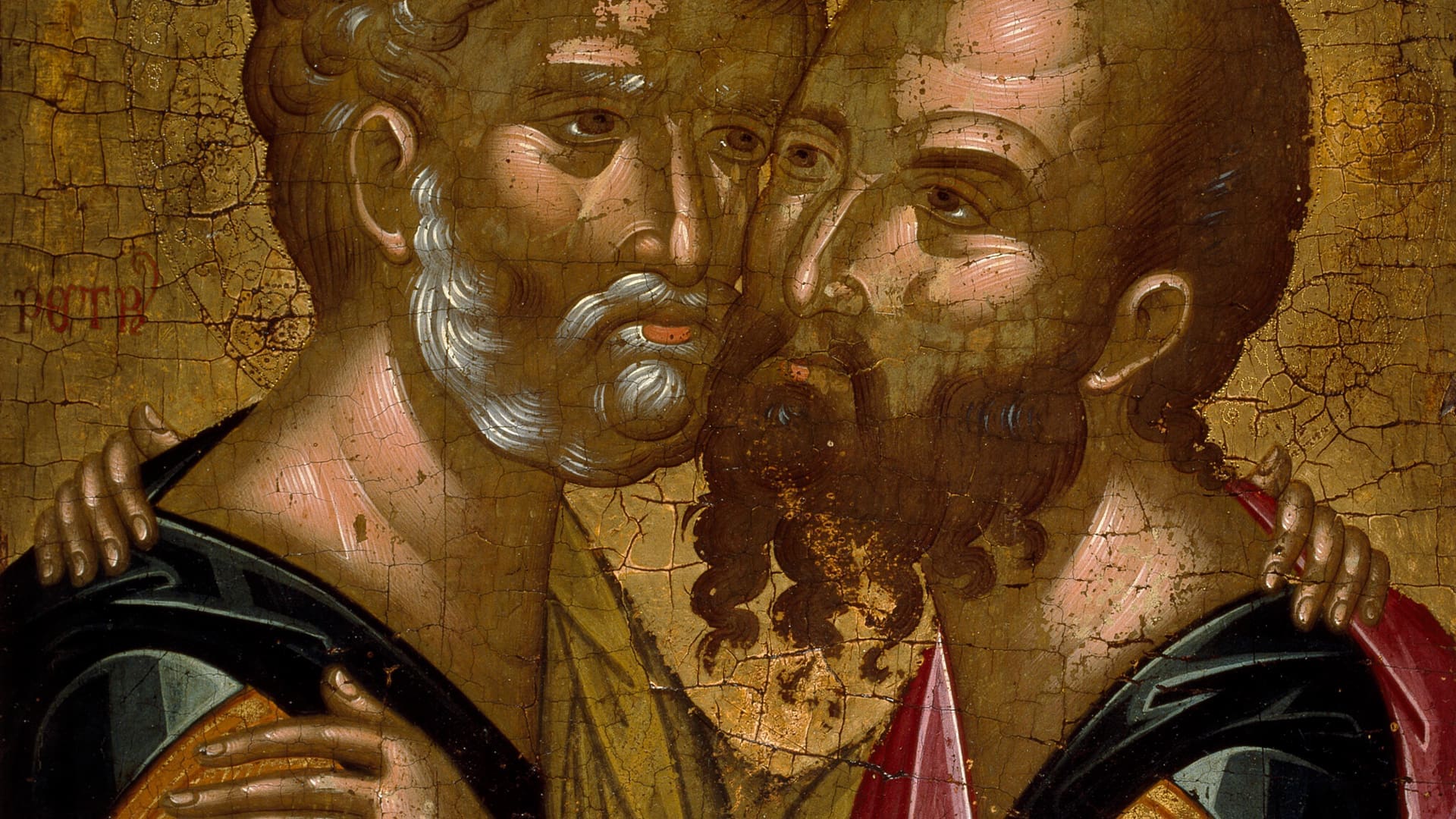
The image of embrace is powerful. Hugs release oxytocin, dopamine, and serotonin in the brain—the love and “feel good” hormones—and are an embodied exchange of warmth. I yearn in my very bones for this type of complete and intimate reconciliation for divisions of all types. I long for a lasting, healing embrace at both macro and micro levels, including the war in the Middle East, the disunity between Christian traditions, American politics, and conflict experienced in personal relationships. Idealistic as it may sound, my imagination becomes filled with millions of hugs: Israelis and Palestinians, Catholics and Protestants, Republicans and Democrats, fathers and sons.
But if the reconciliation I long for cannot be fully experienced on this side of the eschaton, then how close can those of us who have irreconcilable differences get to an embrace in the interim? Further, the differences many of us experience are not on the level of war crimes, as it was for Volf. Our days are filled with differences representative of the topics and issues dividing our culture today—differences that might exist between you and your neighbour down the street. Building on Volf’s work, then, I propose that Christians are called to practice a cyclical process of encounter, a movement between three actions: (1) standing confidently, (2) opening one’s arms, and (3) patiently waiting for a complete embrace.
Movement One: Stand Confidently
Look inward. Sort through the complexity of your own identity. Find Christ at the centre with the aid of the Holy Spirit. Then direct your gaze outward to the other with feet planted firmly.
Volf writes that we need to readjust or distance ourselves from our identity in order to begin the process of repentance, forgiveness, and reconciliation with the other. Though his instinctual call as a Croatian to readjust and distance is understandable, research has shown that we need to become more of ourselves before we encounter the other. When we move deeper into our identity, we uncover that many pieces make up the whole of who we are. I am not merely American; I have a multiplicity of sources of my identity, including my family, friends, religion, hobbies, and past experiences.
This process of discovering ourselves results in a cross-cutting identity, which effectively reduces prejudice and decreases polarizing tendencies. Complexity limits our ability to create highly sorted, tribal identities, and it makes it more difficult to view the other as a stereotype. Only then can we move toward the process of encounter with confidence in our identity, accepting the complexity of who we are in relation to a complex other.
Theologian Cecelia Clegg, who has worked on reconciliation in Northern Ireland, similarly writes in Explorations in Reconciliation that acceptance and expression of difference “in strong, positive terms” gives people the “space to be themselves, and an affirmation that their identity is respected, before attempting to make any connections of commonality. People need to be standing in a secure place in terms of their own identity before they can risk making space for meaningful connection with the other.” Such a posture allows for the moment of encounter to occur without distance or diminishment of the self or the other—the fullness of diversity is retained without threat or need for full agreement.
Since identity formation primes us to meet the other, encounter thus begins in silence, where we first meet the fragmentation and division within. Roles, titles, past mistakes, future aspirations, relationships, and group membership swirl and churn the conception of self. Awareness of our own complex identity, and our confident acceptance of it rather than our anxiety or fear, prepares us for our encounter with God.
Through this encounter, the pieces of our selves are held together and unified by the realization that we are made in the image of God. Necessarily, this revelation directs our attention outward to the image of God in the other and grounds the self in a confident stance toward complexity. We can then bring this confidence to encounters with proximate neighbours (direct community members) and distant neighbours (a universalizing concern for humanity).
During Easter week, in the middle of my postgraduate research and a few months before I journeyed to L’Abri, I arrived at Taizé, an ecumenical monastic community in France, with the hope of observing how encounter is practiced there. As just one among fifteen hundred young pilgrims in attendance, I discovered that, even with the right intention, the task of encounter can quickly shake one’s confident stance.
I met people from Germany, Lithuania, Italy, Switzerland, and the United Kingdom who were Protestants, Catholics, atheists, and agnostics. In my smaller sharing group of ten, the participants included Catholic interfaith universalists, a non-religious person who went by they/them pronouns, and a traditionally conservative Catholic. I was the only overly earnest American and the only one in my small group who was at Taizé for the first time.
Even though I had gone to Taizé with the expectation that I would encounter a wide swath of differences, I was taken aback by an encounter with one of the women in my group. I had felt admiration toward her, as she was about to be ordained in the German Lutheran church. But later in the week, she shared that she had previously been in polyamorous relationships—and remained open to the concept of them—and was about to go on a tarot card–reading retreat.
My instinctual reaction was twofold: I wanted to respond in fear and exclusion, dismissing her with “Well, guess we aren’t in the same Christian tribe, goodbye.” At the same time, I had the impulse to respond affirmatively and capitulate to her views with “Well, guess I now agree with polyamory and tarot cards.” Either response would have led to an abandonment of my confident stance in my own complex identity and beliefs, undercutting my strength and courage. So, instead, I listened with curiosity to her perspective on polyamory and non-judgmentally offered my own. That was all; we maintained our respective stances and reached no resolution.
Encounter begins in silence, where we first meet the fragmentation and division within.
Olivier Clément, an Orthodox theologian, observed this phenomenon among the young pilgrims at Taizé, writing that they “are attracted [to Taizé] because, while the sense of the universal is there, at the same time the identity of each person is preserved. Nobody is asked to renounce their nationality or church; on the contrary, by these differences people are expected to enrich each other and learn to accept each other; and so young Christians are able to experience unity in diversity.”
Christians are called to move deeply into their internal fragmentation and complexity so that they can confidently encounter the complexity of the other. Instead of desiring to control the outcome of an encounter—whether through affirmation, assimilation, conversion, or persuasion—we can ask: Who am I as I stand before the other, and who is this complex person before me? Prior to evangelism, judgment, embrace, or even reconciliation is the unshakable belief in the image of God and the superabundant love of God for oneself and for the other. This is where we must plant our feet and stand.
However, it is uncomfortable to confidentially adopt a stance of complexity and curiosity, as I learned at Taizé. The discomfort lingers in open-endedness and in the inability to resolve differences—the stretch and wait of the second movement.
Movement Two: Open Your Arms
Once a confident stance has been assumed, open your arms. Vulnerably, uncomfortably, stretch your arms wide open.
I cannot persuade someone to choose to stand with arms open, waiting with their full self displayed before the full self of the other. I have noticed my own arms growing taut as I stretch them wide, wider than easy answers to questions about differences in politics or religion or culture. My arms threaten to snap closed, to simply leave behind my own convictions or to shut out, shun, or shame the differences of the other.
Volf writes that the reciprocal participation of the other is not guaranteed; the individual must have the will to welcome the other. Willing, then waiting, is challenging. To remain fixed to the spot with arms open is vulnerable; my self is flayed open. I might remain there alone, unmet or ignored by the other. As a Christian, I believe this posture of waiting is one I am called to maintain from now until I die—no matter the difficulty or scenario. It is an embodied practice, coursing through my outstretched arms, of an eschatological hope in forgiveness and a final reconciliation.
If the other also chooses to plant their feet and open their arms, then a space is created. Together we arrive as our full selves, granting permission to each other to be complex human beings. When approached without fear, difference becomes an opportunity to reassert the image of God and the dignity of every individual as primary—which reminds us of the profound, abundant love of God for all people.
I experienced the intricacies of this collaborative undertaking when I visited a silent monastery for five days, after my time at Taizé and right before I journeyed to L’Abri. There, I volunteered alongside a trans woman. While I have a few past acquaintances who are transgender, I know relatively little about the transgender experience.
I wondered whether encounter occurred in our shared silences, the shared work, or the few words exchanged, partially inhibited by language differences. But unlike my interactions with the German Lutheran woman, the silence became both barrier and mediator. There was no way for me to plumb the depths of this particular other’s story in order to understand their beliefs, decisions, or sources of identity. We were submitted to merely being. All I could know was that this person I shared silence with was made in the image of God, who loves them as much as I am loved, in totality, unconditionally. This was encounter at its most basic: arms extended, a space held open.
I found it difficult. I wanted to adjudicate my beliefs and judgments in relation to the other, but I could not. The silence simply forbade it. And the prayer services four times a day exacted something more—I had to see this person as neighbour, co-labourer, sharer of the silence, fellow worshipper. Did we worship the same God? I was not granted the right to know. I realized how entitled I had become. I had expected an account: What do you believe? Why do you believe it?
In some instances, encounter begins and ends here. Arms open, a wide space still between. But what permeates that space is a solid, steady affirmation of human dignity and love.
Movement Three: Patiently Wait
Wait with arms open. Hold open the space with the other, together. Reach for embrace with all your might—even as the effort strains at the muscles of your arms, your back.
Social psychology research on intergroup contact theory shows that prejudices are reduced when those from diverse or opposing groups meet and interact. Both the research on cross-cutting identities and intergroup contact theory demonstrate that there is real value to encouraging encounters of all types.
Whether your neighbour is wearing a MAGA hat, waving an LGBTQ flag, or wearing a headscarf (whoever the “other” might be to you), seeing them as made in the image of God suppresses instinctual judgments and assumptions about who they are and what they believe. Most often, this is where we stand and wait, with limited control or resolutions to bridging these differences, at least on this side of the eschaton. This lesson must be lived and practiced—repeatedly—and then, when it is least expected, resonance breaks through, shimmering with the joys and hopes of a future embrace.
The fourth conviction in Comment’s manifesto states, “We believe in the transformative power of encounter—encountering reality, encountering those unlike us. . . . We believe in the deeper truths that can be discovered when different life experiences and distinct sources of wisdom are gathered around one table.” But how we arrive at a positive point of transformation—let alone do the work of gathering people around a table—is a demanding practice.
I left L’Abri transformed, chastened by the limits of my own ideals bumping up against my continual need for grace. As I was making my rounds to say goodbye, I attempted to reopen my arms once again to my sparring partner, the gentleman I mentioned at the opening. I told him I hoped he felt his perspective was valued and respected, and I meant it.
Glimpses of a final embrace, a final reconciliation, pierce our attempts at taking steps toward the other. Encounter, then, is a joyful, loving act.
We shared an earthly, imperfect embrace. We did not reach a final agreement on the topics we debated, nor did we fully resolve the emotions brooding under the surface—but these did not preclude the embrace. It was, in a sense, a transformative encounter, where a final reconciliation on the other side of the eschaton was briefly glimpsed, despite our human limitations to accomplish it in the here and now.
After my season of doubt about the limits of pluralism and whether we can make any progress toward bridging our divides, I have come to believe, along with Volf, that even if I wait alone, I must remain confident in my pose, take the risk, and sacrifice my comfort. It is a commitment to working toward a total embrace and a reconciliation that will one day be made complete.
“Rebuilding today means recognizing that, precisely from the plurality of voices and visions . . . a bright possibility emerges,” writes Pope Leo XIV in his first encyclical. “Within this shared task, Christians discover their unique role of guiding actions toward God so that, in his light, pluralism does not dissipate into disorder, but instead . . . becomes the space in which humanity rediscovers its solid foundations and its final end.”
Leo concludes with the image of the new Jerusalem “coming down out of heaven from God” as “a gift for all humanity.” This vision of grace, he writes, is “an invitation for us Christians to work together in order to foster a peaceful, just and dignified life in community within today’s ‘cities.’”
In taking up this work, I picture my arms open, and the arms of the other open too, as we make eye contact over the preserved space we are creating through our exposed and reaching arms. Glimpses of a final embrace, a final reconciliation, pierce our attempts at taking steps toward the other. Encounter, then, is a joyful, loving act. It is the joy of curiosity and surprise—the feeling of being seen and loved when it is least expected.
I want to offer a special thank-you to the Cultura Fellowship for providing the resources for me to spend time at L’Abri in September of 2025 to write, pray, and discern. I also want to give a hearty thanks to all those at L’Abri who welcomed me and helped me pull the threads on these difficult questions.

