
M
My mother’s liver has failed to move fluid out of her body, so it puffs up around the organs in her abdomen. My brother and I lie on either side of her in bed, brooding over her blown-up belly and how it seems oddly attached to her aged frame and wrinkling face.
Before our eyes, she has gradually transformed into an amalgamation of unexpected parts. Her mind—which has been zapped, cut, and medicated and is now swelling under the pressure of an ever-growing, cancerous tumour—seems to operate in a state of childlike candor and simplicity. Something about the frontal lobe and inhibition makes her bluntly ask waitresses if her meal is going to make her fat, sing “Jingle Bells” loudly and incessantly in busy hotel elevators, and shrug when asked if she’s gained five pounds. Her mind sometimes seems a sturdy five years old—spry with sass, ever-oscillating between states of keen curiosity and curt lack of interest, and reliant on daily naps. Her stomach rises like a pregnant cloud of flesh, but her papery, splotched skin and bulbous joints reveal her real age of fifty-eight. She lies between us, watching HGTV reruns of Flip or Flop, a patchwork quilt of miracle parts.
My brother asks me if I ever imagine that she’s preparing to give birth in another life. As if, somehow, the dome of her abdomen is an omen hinting at new life beyond. I answer honestly: “Yes, all the time.”
I look at the swell of her belly and have an odd inkling that something else is brewing in there, ready to break free. As though, in preparing her for death, we are somehow mysteriously preparing her for life.
My mother possessed a feverishly religious mind when my siblings and I were growing up. Car rides to school were filled with talk about the content of her dreams, about prayer, about saints, about near-death experiences and the end times. She lived within a sort of mythic, prophetic interpretation of the world that I now see as an expression of her creative proclivities, kaleidoscopic inner life, and tendency toward mysticism.
At the time, though, her impulses were both baffling and annoying to my siblings and me. They snuffed out all sorts of possibilities. For example, I could not wear snake-print heels to prom (this might have been God’s real intervention) because they conjured images of that first flirt of a serpent. She chuckled amusedly when she found me drinking my first beer, but I remember feeling a skittering sting of dread when she discovered I’d tinkered with tarot cards.
Her religious proclivity led her to purchase and stockpile tubs of freeze-dried food and powdered milk to store in our pantry in case of the apocalypse. My parents eventually gave away the stash when we moved across the country, but my mother always seemed both disappointed and puzzled that we never got to use them. Part of her refused the notion that her purchase was reasonless, meaningless. She pondered what unrevealed purpose was percolating under her nose.
My aunt told me that my mother had been like this since childhood, always seeming to traffic through a direct line to God. When the winds of San Angelo, Texas, would whip at the windows of their shared room, my mother would jolt out of sleep in the wide black of night and rocket out of bed proclaiming, “Jesus!”—as if, at the sound of his name, he would appear and calm the storm.
Out of the blue, like a night’s obstruction light, a simple prayer had flickered open inside of her: “Lord, thank you for the pain that brings forth new life.”
One of these invocations took place on my birth cot. My mother had refused an epidural (a typical move for her, to hound down intensity just for the sake of it) and was now regretting it. She told stories like this both bashfully and with a glimmer of pride, or awe. Aside from us, her stories were the most precious things she had.
“I did not know how I was going to do it, how I was going to push another time,” she said. I can imagine her eyes turned sternly to the ceiling, muttering, “God,” in a voice half-plea, half-threat. Then, out of the blue, like a night’s obstruction light, a simple prayer had flickered open inside of her: “Lord, thank you for the pain that brings forth new life.” She said that, as she invoked that praise, as she held those words in her mouth, the excruciating gnawing would mute. She prayed, pushing back on the pangs of pain, and out came little infant me.
In her poem “Station,” Maria Hummel writes about sickness, about tending to it, its lightness and dark, its loss and illumination, the blood blooming joy. Hummel is perfectly present to her child, to the world, to the dark tunnels that flicker in and out. And she is open—open as a black ring case, open as the dark, as a hole: “I hold you like a hole holds light.”
The word “open” in this poem is always in proximity to the words “black” or “dark.” I would wager that these anomalous blobs of darkness are death, the unknown, the incomprehensibility of a terminally sick child. But something glimmers in them: gold rings, a smile that is the shade of light, their voices yelling, Tunnel! Light finds a way to bloom in them, or perhaps is innate to them—a deep, ancient substrate of obsidian shimmer, a melanoid mirror winking back toward us.
Nature is violent, things eat each other, we perish, and it sucks, not to mention the many species of totally avoidable injustice we afflict on one another senselessly, ceaselessly. But I am curious, like Hummel, about how we alchemize pain once it has landed on us, chosen our doors like the Passover angel—how we reap the meat of it without sacralizing suffering. If we even get to choose. I’m curious about how love seems to emerge from our hurt and transfigures it, opening it up to something larger, dousing it in some mysterious element so that radiance simmers off of it like steam.
My mother is lying in a different cot now, one that two young men came to set up a few days earlier when we had first gotten the sense that things were happening, quickly. We sponge up water from Evian bottles (because she swore she could taste a difference) and place it on the shrivels of her lips.
I am in bed next to her again, staring at her hand folded over mine. It is deep into the evening of my twenty-second birthday. I am memorizing the colour of her skin, how the dark room deepens it into a warm, honey tan; how light hits the little cells of her flesh webbed by threads of wrinkles; how her green veins seem like they are going somewhere, reaching for something. The warm light of a lamp sings in the corner. I look for something I cannot name in its ring of light, search the pool of amber for a presence, and almost feel it.
I say the only prayer that has never failed to turn something in me, whisper it against her head: “Most merciful Jesus.” It burns into me, eats at the thick of my heart the way chlorophyll gets seared by autumn’s quick fires. “Most merciful, compassionate, loving, tender Christ, you are faithful in all things.” I enter the wound. I enter the wound. I enter until I find her there, and I hold her.
Love sustains life. Lisel Mueller writes in her poem “In the Thriving Season” of how her late mother’s love for her powers her own love for her first child, transforming the pain of her mother’s loss into life and healing the silence. Throughout the poem, little conversions keep transmuting loss into new life: the small annunciations of babble, part and parcel of her child’s body, emanate and heal; the marrow of the life of the woods “spreads revolution”; a bud begins to flower open. Life is built to cycle love onward, outward.
Yet Mueller’s poem is haunted by death: “I can believe birth is fathered / by death.” What are we to make of the blunt intrusion of that heavy word “death,” or the word “fathered,” incised into a poem so glowing with maternal love?
Death happened, stupidly. Love allowed it in (because love embraces) and, in its creative way, made life out of it. Death and love are the odd, unwedded couple that parent life. And that’s why life is a bastard.
In those last few months, I attended to my mother—made her meals, wheeled her through the mottled green of summer foliage—and all of that sharp, directed, attentive energy bred something vital in me. Like my mother’s mind gripping the words of her prayer-praise on the birth cot until she embraced, and then metamorphosed, her pain into promise. It seemed to poke a hole in what was once known as reality—and all the world, all of love and all of Christ, poured through.
The year before my mom passed, I would often come home from a lecture to a package placed on my bed by a roommate. I would open it up to some cheesy shirt with a glittery, screen-printed image of a butterfly and a Bible verse scrawled around it. I would add it to the little army of accumulated butterfly art and cards, jewelry and knick-knacks. Or I would walk into the living room and find my mother shooing away her scared thoughts by repeating, “Blue butterflies, blue butterflies, blue butterflies.” I would kneel by the curve of her supplicant body, wrapped in pajamas that looked made for a baby—pastel and patterned—and hold the cool of her gnarled hand, find her eyes to tell her, “It’s okay.”
All things are dying and rising, labouring and being laboured forth.
It is difficult for me to communicate straightforwardly here. I am mulling around mystery, trying to steal a sense of words from a murky murmur I eavesdrop on. But I suppose this is the theological claim I am making: Christ died, so he dwells with us in death and through that process and his resurrection makes light and life out of it. To be clear, it is about transformation and not transaction, connection not correction. Not my mom’s death in exchange for life, but my mom’s life in death.
If all things suffer and perish, the crucifixion assures us that God’s presence persists in suffering. He unties our suffering in his heart and then surprises us by releasing it into life. The sense of regenerative movement I intuit in the heart of Christ and in the crucifixion is one that I also find squirming through the world. With Christ as a reference, a mysterious promise that is also a starting point (the first and the last), I glean that the death of all things is pointed toward an iteration of more light and life. Resurrection. The pain that brings forth life. Tunnel!
All things are dying and rising, labouring and being laboured forth. Cells apoptose and regenerate; decay forms fodder for the earth; stars collapse and bleed the elements that make for human life. All instances are funeral hymns and budding, fluttering infants’ mews. And in all of it, I get the sense, the sheen, of Christ.
I think of the image of Divine Mercy that adorned our house—on fridge magnets and coffee-stained prayer cards, in a frame over my parents’ bed—that mingling of God-glow and crucifixion-red spilling and shining. The gaze and grain of heat, the sense of bosom and breath leaking large and undelineated. Pain, new life. Blood and light.
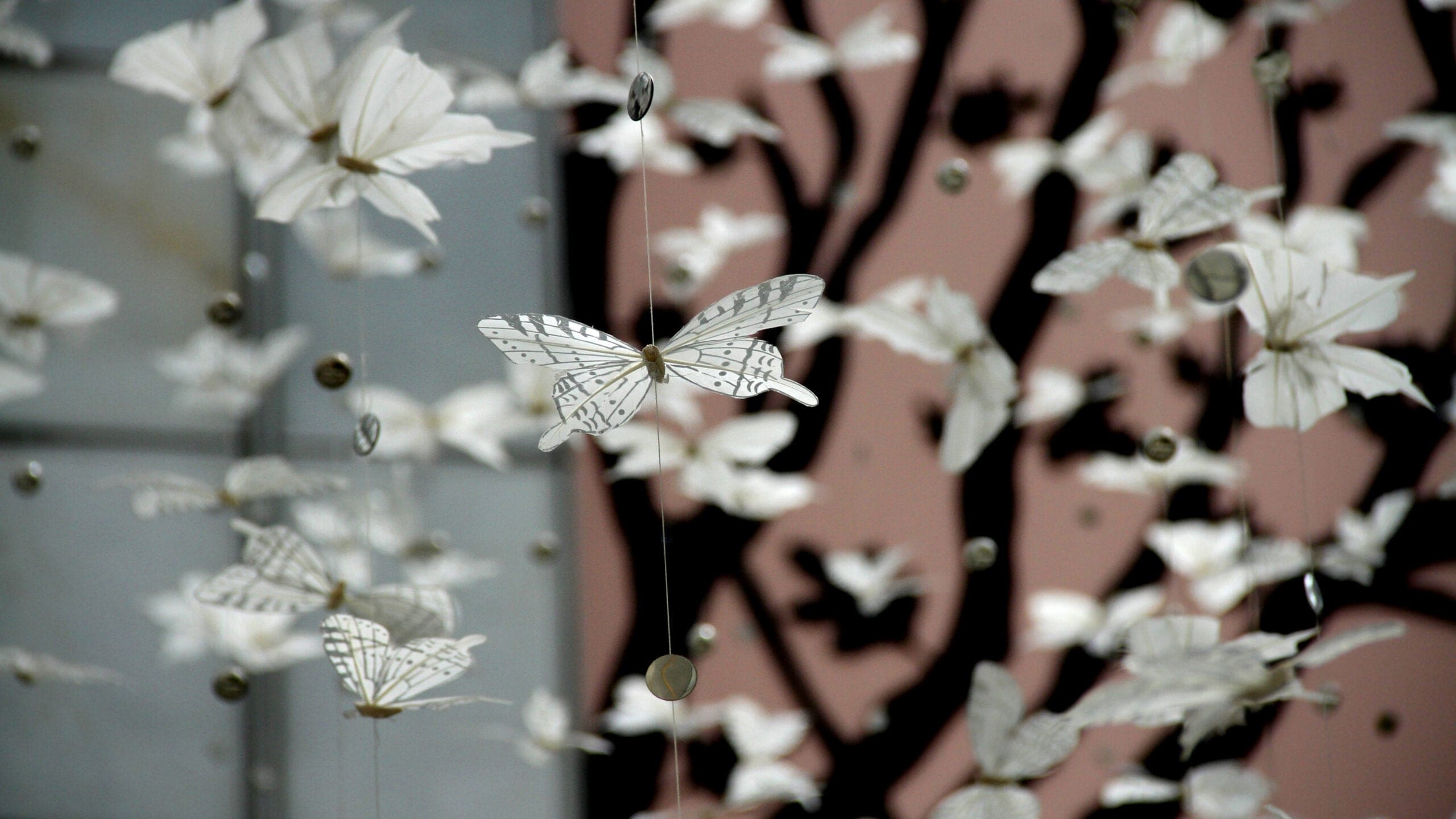
My mother, so sure of the renewal of life, requested that we play “Celebration” by Kool & the Gang at her funeral. Our Lady of Peace Catholic Church said this was against their policy, or creed, or whatever, for which my sister and I thanked God and the Holy Father profusely. We adorned the funeral reception with garlands of paper butterflies, that fragile symbol of resurrection and transformation. They floated in the breeze, hung from trees. The tissue-paper wings peeked out of bouquets.
My mother’s celebration of life felt like a surreal recital of a badly written movie. I had flown in from Connecticut, abruptly cut out of the flurry of divinity-school orientation to lug myself through the mud of sleeplessness. I remember my father cutting in to correct the priest in the middle of the service because the priest had misread something in the eulogy. I can remember a person whom I had never met weeping loudly, devastatingly, while we scattered her ashes, and my brother’s irreverent, gothic friend Seth jumping in our pool at the reception.
It was impossible to have a family event, even a tragic one, without some odd, comic quality. But it was beautiful, and my mother would have delighted in its awkward surprises, always on the side of audacity. “So weird,” she would have said with her nose wrinkled, performing a mock scoff that concealed a smile.
I remember when the church bell tolled while the priest was saying some final word meant to seal her spirit to God’s. Dramatic, like the rooster confirming Peter’s fears and fate. Like the tomb and the temple curtains cleaved at the moment of Christ’s death.
I recall feeling like the bell was tolling inside me, the yawning gong-voice of God breaking open—and within that sense, a vague undercurrent, a deep, operatic contralto trebling some inner-ear, the throttle of God’s throat caverning sound in me. It felt like a montage of all time and all memory had been pressed into an instant, like a sonic time-lapse of life forming and fading on earth. Like the subterranean sound of a woman giving birth and an infant wailing.
It could have been stress or sleeplessness, but I reflect on it now as a sound that seemed to waft right off the cross: an emanation of both death and life, blood and light, an enfleshing of God to earth-stuff. Perfect love and perfect loss.