
Surely the fate of human beings is like that of the animals; the same fate awaits them both: As one dies, so dies the other. All have the same breath.
—Ecclesiastes 3:19
I
It was nostalgia, tinged with curiosity, that recently led me to brave the long, perilous crawl of LA traffic to the Natural History Museum of Los Angeles County, where I had once brought my children when they were young. The exhibition on display, Reframing Dioramas: The Art of Preserving Wilderness, was celebrating the centennial of the institution’s dioramas.
Occupying four spacious galleries over two floors, the collection is organized into two North American mammal halls, an African mammal hall, and a restored hall, newly opened since its closure in the 1980s, which presents archival photographs, documents, and objects that trace the history and legacy of the museum’s dioramas.
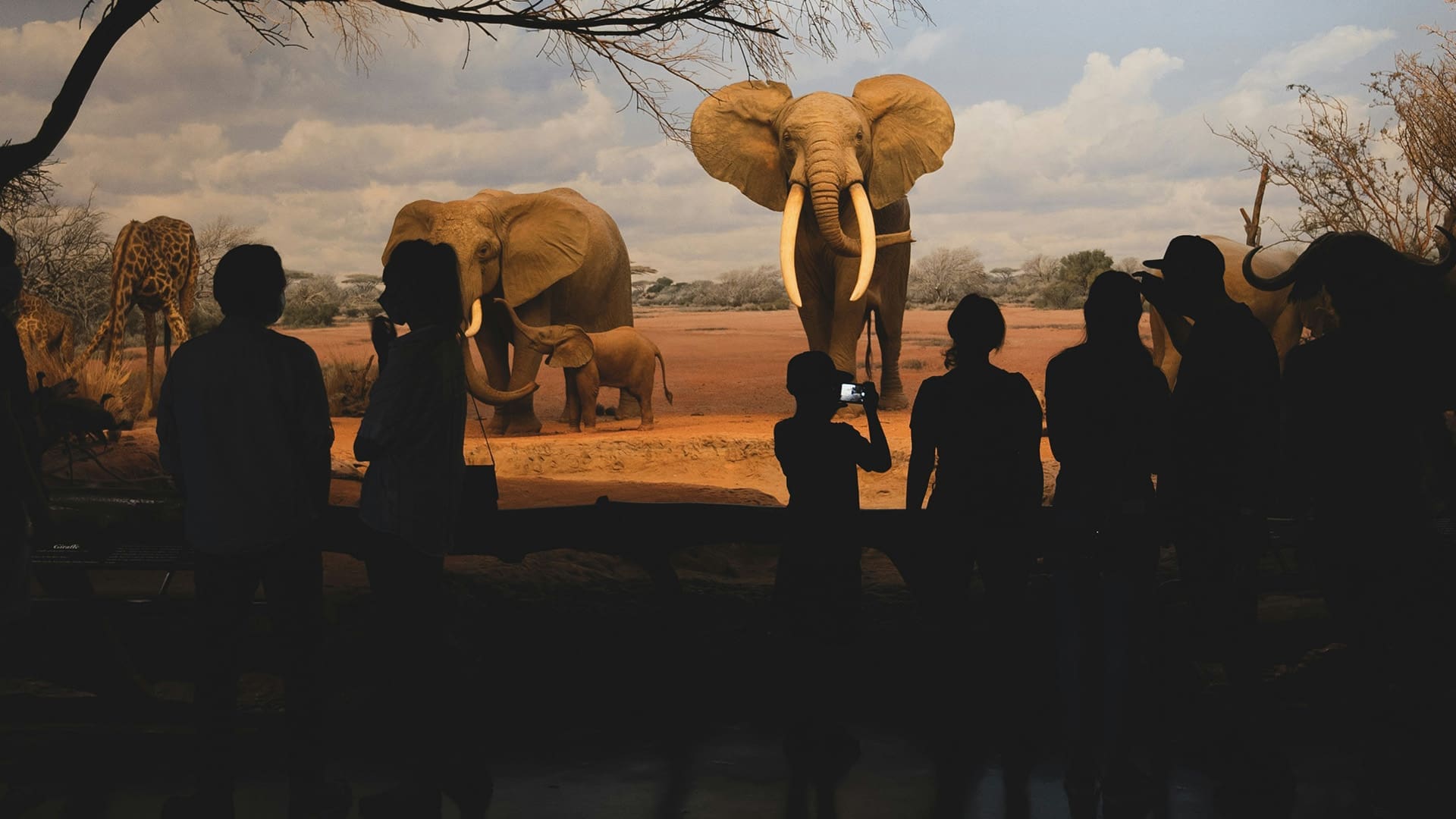
The galleries contain over seventy-five intricately constructed habitats, from the frozen expanse of the Arctic to the dense canopy of tropical rainforests. The spaces unfold like a sequence of great wooden cabinets, each containing a recessed, glass-fronted display softly illuminated from within. Taxidermied animals, sculpted foliage, and painted landscapes on curved walls blend seamlessly in their representations of specific ecosystems beside informational panels that mark their locations on a map.
Roaming about these cool, hushed spaces, I felt suspended in time. The scenes before me evoked a strange mix of wonder and melancholy. There was something uncanny in the subtle tension they held between life and death, between presence and absence. Their idyllic qualities were as unsettling as they were enchanting. It occurred to me that the power of these models of nature lay not just in their beauty or craftsmanship but in how they disclose the fracture within us: a yearning for communion with the natural world and the uncomfortable knowledge that we have fallen far from it.
With animal skins stretched over sculpted forms and fixed in dynamic poses, the dioramas depict scenes that would be difficult, if not impossible, to witness in the wild. Forests, prairies, marshes, and deserts appear under subtly shifting effects of light that elicit changing seasons and times of day. Beyond their surface realism, each display highlights the interdependence of creature and habitat.
Yet they also portray nature as it might exist untouched by human hands—a world blissfully unaware of us. The illusion is immersive, but the glass (or artificial rocks and branches behind railings, like those in the largest dioramas that open onto the ends of halls) reminds us of our separation from nature. Like the flaming sword barring the way back into Eden, this barrier seals off a life we cannot enter: a pair of grizzly bears lumbering along an untamed forest edge, a small pack of grey wolves howling on a snowy mountaintop, beavers shaping a streambank into a thriving home. We’re lured toward the threshold of intimacy with nature but never allowed to cross it.
Standing on the other side of the glass, self-conscious of this distance, I took in the minute details of each creature and its surroundings. At times, it was difficult to believe I was looking at objects crafted by human hands. The animals looked so real, so full of potential energy, that I half-expected one to shift its weight or lift its head. Their mute stillness held me in the uneasy space between object and being, and I began pondering what bridges that threshold.
Before there were habitat dioramas, before there were even zoos, there were royal menageries. Animals from far-off lands were displayed as living trophies of conquest. Louis XIV built his at Versailles in 1664, arranging exotic animals in a star-shaped pavilion so guests could gaze upon nature like some courtly ornament. Across the Channel, the kings of England kept their own menagerie at the Tower of London, where lions paced in gloomy pits and an unlucky polar bear was once chained beside the Thames to fish for its supper. In Prague, Emperor Rudolf II filled his royal estates with a dreamlike array of camels, lynxes, pelicans, and a melancholic dodo, as if Noah’s ark had drifted off course and run aground in Bohemia. These collections had little to do with science or learning. They were evidence of a sovereign’s reach over land and sea.
The modern diorama transforms the royal menagerie’s desire to possess and display the world into a cooler form of representation. What was once a spectacle of imperial power becomes an ecological elegy, where nature appears serenely ordered. The diorama inherits the menagerie’s framed vision of nature but reshapes it through the language of science and preservation. Yet an older logic still lingers: like the menagerie, the diorama presents a world made safe to look at. The difference is that this peace is achieved through death rather than control. The fundamental structure remains: a framed world arranged for the viewer’s gaze but transfigured through modern aesthetics. No longer a theatre of domination, the diorama is a stage for wonder. And what once proclaimed human power now discloses human loss.
The habitat diorama emerged during the nineteenth century in a period of intense scientific curiosity and expanding empire, when museums sought to display the richness of nature for audiences who were unlikely to ever visit the remote and far-off locations being featured. Evolving into their familiar modern form through the innovations of the polymath Carl Akeley, their design and construction required a fusion of art and science. Ecological research provided the framework, while taxidermists, painters, and sculptors applied their skills to create immersive tableaux. The results were not merely imitations of the natural world but a form of aesthetic mediation by which creation became newly visible.
The power of these models of nature lay in how they disclose the fracture within us: a yearning for communion with the natural world and the uncomfortable knowledge that we have fallen far from it.
When I visited, the diorama exhibition in Los Angeles featured sixteen new installations, bringing this aesthetic dimension to the foreground—a resonance heightened in the context of a city-wide celebration of art. The historical dioramas were set alongside newly commissioned art by the three-artist team of RFX1 (Jason Chang), Joel Fernando, and Yesenia Prieto. It also featured art by Saul Becker and Lauren Schoth, whose installations probe the diorama’s hybrid nature, expose its entanglements with histories of extraction and display, examine how dioramas visualize scientific knowledge, and rethink how institutions present living systems.
The show subtly shifted how I see dioramas. Viewed through the lens of art, the diorama exceeds its original purpose as a tool for educating the public in life science and enters an aesthetic register, where composition, lighting, perspective, and the creative use of materials come to the fore. I could feel the expressive force of art emerging behind each window, producing a distinct set of effects: liminality, as though standing between worlds; paradox, as lifelike beauty fashioned from death; ambiguity that resists easy interpretation; and new ways of seeing that loosen habitual perception.
As tableaux, dioramas participate in a long art-historical tradition in which a scene is staged for the purpose of encouraging contemplation. Their affinity with memento mori is especially striking. This Latin phrase, meaning “remember that you must die,” comes from the book of Ecclesiastes and applies to a genre of painting that became popular in sixteenth-century Europe, related to or built on foundations like vanitas still lifes, medieval cadaver tombs, Baroque altarpieces, and tableaux vivants.
Classical memento mori juxtaposed beauty and death: a gleaming skull placed among fresh flowers, a bubble on the verge of bursting, newly rotten fruit. The artists behind these symbolic compositions were preoccupied with the fleeting nature of life, painting them not to promote morbidity but to sharpen awareness of what is precious and transient. Born of exacting study of the natural world, the paintings were situated at the convergence point of artistic imagination, scientific inquiry, and spiritual reflection.
The diorama continues this logic with an ecological inflection. In place of skulls, we’re given taxidermied animals; in place of wilting flowers, a static ecosystem; in place of a warning about human mortality, a confrontation with the mortality of creatures and habitats. And because nature is distilled and held in a single arranged view, its beauty becomes newly perceptible in the exactness of detail, the harmony of forms, and the mystery of a world momentarily suspended. These are secular icons of Eden, visions in which no creature suffers, no harm befalls the earth, and each element sits in ordered relation to the whole.
The diorama’s beauty evokes a world at peace. Yet its lifelessness is a subtle reminder of how far we are from that peace. Thus, as a simulacrum, perfectly ordered yet fully artificial, the diorama is a form of revelation. It exposes the gap between the world we have and the world God intended.
Living in an era that so often reduces things to their market value, it’s no surprise that we fail to perceive the created world as sacred. The values and material goods of commodity culture, ranging across media, lifestyle, technology, leisure, and even the ways we construct identity, offer counterfeit forms of awe so we don’t have to feel the grief, vulnerability, or dependence true ecological awareness requires. It keeps our attention fixed on surfaces, so we never have to confront the depth of our alienation from the living world. Its spectacles act as a buffer, anesthetizing us with distraction, shrinking the world to our own desires and anxieties.
But in those dark, cavernous halls of the Natural History Museum, I could sense a quiet mourning behind the illusions of vitality. Only gradually did I recognize what my eyes had been searching for: the breath that would have completed the illusion of life, the animating gift that binds the created order. The ruach that, if possessed, would move muscle, stir fur, and link us in a shared pulse of life. I recalled Genesis 2, where humanity is formed from the soil, enlivened by God’s breath, placed in a garden, and invited into communion with earth, creature, and Creator. In that garden, creation was not assembled for the human gaze; it was co-extensive with the human, sharing the ruach as part of the living whole.
The Christian mystical tradition often speaks of creation as suffused with the divine breath. St. Basil taught that the Spirit “fills all things” and holds the world in motion. St. Maximus the Confessor described creation as a single breathing organism, knit together by the Logos and quickened by the Spirit’s fire. Hildegard of Bingen called this vitality viriditas, the greening force of God that pulses through every creature, binding earth, air, and flesh in a shimmering web of life. And the desert father Isaac the Syrian saw in every living thing a spark of God’s presence, writing that a heart truly alive to God cannot help but ache with tenderness for “every creature . . . even for reptiles.”
Against this backdrop, the absence of breath becomes more than an uncanny detail; it becomes a sign of broken communion between humans and the more-than-human world. It was the dioramas’ extreme verisimilitude that drew my attention to this absence of breath, but the animals’ vacant stares amplified the strangeness. Alongside the evocation of paradise, I was reminded of another set of biblical images: the idols of Psalm 135 (“They have mouths, but cannot speak, eyes, but cannot see”) and Ezekiel’s valley of dry bones. Bodies awaiting breath, a world preserved yet lifeless.
I’ve come to think of the diorama as a visible record of what commodity culture conceals to keep us focused on consumption, things like absence and extinction, or the grief of a wounded creation. In the hyperreal presentation of things that are fundamentally dead, the diorama underscores the gap between representation and reality, a gap the everyday simulations of consumer culture obscure. The use of actual skins, which bear traces of life, contributes to the eerie, almost haunting quality of each scene. To stand before them is to confront not only the specter of environmental devastation but also the deeper spiritual rupture that has estranged us from the world God made. This realization made me see, with no little irony, that although the diorama is itself a simulacrum, it exposes truths that the glittering spectacles of our culture routinely hide.
The diorama’s beauty evokes a world at peace. Yet its lifelessness is a subtle reminder of how far we are from that peace.
The Hebrew prophets teach that renewal begins not in denial but in truth, in the movement from exile to lament to restoration. Jeremiah and the psalmists refuse to look away from desolation; they name the pain and, in doing so, open the heart to God’s healing. The diorama, in its stillness, invites a similar spiritual posture: to stand before what is wounded without turning away.
The Christian tradition has long understood sin not only as moral failure but as the breaking of relationships between humans, creation, and God. Our environmental crisis can thus be seen as an “ecological sin,” a relational rupture, born of domination and forgetfulness. The proper response to this truth is not despair but repentance: to acknowledge our complicity, to mourn what has been lost, and to seek renewed communion with the living world. In this way, lament becomes the first act of hope.
When I was a child, from time to time we took a short drive across the Potomac River into Washington, DC, to visit the Smithsonian’s National Museum of Natural History—the kind of outing with family and friends that never disappointed.
The dinosaurs were the main attraction for kids, of course: the fierce, towering allosaurus and Hatcher the triceratops. But the African bush elephant in the rotunda was unforgettable, a monument to life itself. Beyond it, the museum opened into a dizzying array of creatures and objects, including a life-size model of a blue whale hanging over visitors’ heads, meteorites, glass cases of shimmering gems, and the Hope Diamond glowing in its chamber like captured lightning.
More than once, I imagined crafting a wild habitat of my own, a small world for the creatures I loved, though I never worked out where, or by what magic, it could exist. Years passed. Childhood obsessions dissolved into adulthood, and I forgot about that private dream.
Ultimately, the wonder we experience in natural history museums, before beauty intertwined with strangeness, arises from a kind of memory that stretches far before our childhoods, a faint recognition of Eden and a longing for harmony that has not been extinguished.
This longing has ecotheological force. Wonder turns the viewer outward toward creation’s vulnerability, inviting gratitude for creaturely life, lament for ecological loss, and a sense of renewed responsibility. At first glance, it seems to offer an image of how creation was meant to be. Its stillness—and the absence of breath the stillness underscores—is a call to steward environments that are wounded, fragile, and dependent on our care. From this awareness flow practices of reconnection: attentive presence to living ecosystems, commitments to conservation and habitat restoration, simpler patterns of life, and Sabbath-like rhythms that allow the land itself to breathe.
In this way, a diorama can awaken our desire for a world truly alive—breathing, flourishing, whole—with the force to summon us into the healing work creation now requires. It can reorient us away from spectacle toward a deeper knowing, if we resolve to linger in the space of mourning. With a little time and resolve to let its quiet spell settle over us, the diorama’s aesthetic dimension can gradually assert itself, moving the display past mere documentation into a different mode of truth-telling. It can become a visual parable that traces the arc of our story, moving us from the innocence of Edenic harmony to the sorrow of exile to the eschatological hope of restoration.