
In a Ukrainian basement, a child asks, “Is our home still there?”

“It is not just that God has a heart for justice,” says Sharon Cohn Wu (International Justice Mission), “it is that it is inextricably his character and cannot be otherwise, and that it is so perfectly married with mercy and grace that we somehow survive.”
Sharon Cohn Wu has served for more than twenty years with IJM, where she is now regional president of North America. A lawyer (JD, Harvard Law), she has spent her career calling for “loud justice”—that is, visible, swift, community-wide accountability—using the criminal justice system and political will to help IJM achieve its mission to increase freedom and safety for the most vulnerable. She’s a key voice in pursuing IJM’s stated goal: protection for 300 million people across 46 jurisdictions by 2030, and freedom for more than a million.
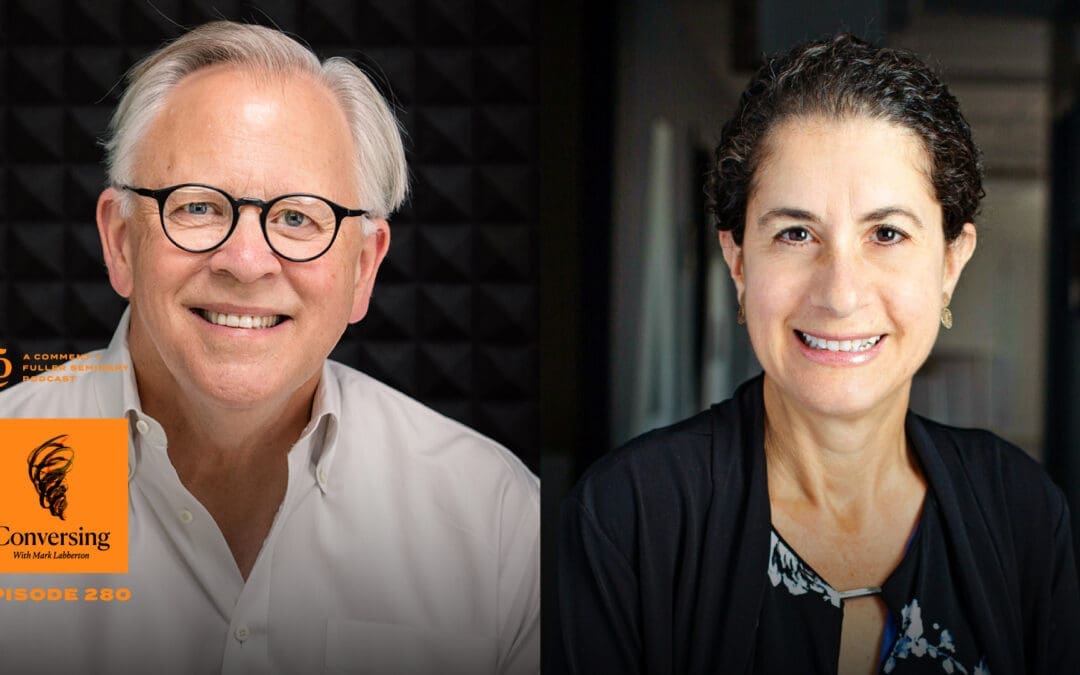
With Mark Labberton, she reflects on her calling as a lawyer to stand between vulnerable people and those who would crush them; why we need systems to seek and secure justice for the most vulnerable to violence; the economics of vulnerability and the predators who exploit it; how public accountability changes expectations and what society will tolerate; and what decades of looking at the worst of human behavior have done to Cohn Wu’s emotional, moral, and spiritual life.
Mark Labberton: I’m so thankful to welcome all of you to Conversing. Thank you for joining us. Today we have the great privilege and joy of welcoming Sharon Cohn Wu, who is the regional president for North America of International Justice Mission. Sharon’s work over the years in IJM has encompassed really each of the stages of IJM’s own development, from early casework in helping people find freedom from bonded labour or human slavery in some kind of trafficking that had occurred, all the way to the development of what is now an established piece of their work that she’s been leading, called the Justice System Strengthening projects that IJM has undertaken. She is now the principal advisor on a project they’re calling Violence Against Women and Children. Her work has been extraordinary, and her spirit, her mind, her exceptional compassion and empathy—these are all things which have enabled her to be one of the primary contributors and leaders of International Justice Mission for all of these years.
Because I have been active with International Justice Mission from near its start, and currently serve on IJM’s board, I’m closely connected to the work of IJM and with great gratitude for Sharon in particular and the way that her contributions to IJM have made such a difference.
Sharon Cohn Wu, it is such a joy and pleasure to have you on Conversing today. Thank you for joining us.
Sharon Cohn Wu: Thank you for having me, Mark. It’s great to be here.
Mark Labberton: You know, I can look back on the very first time that I heard you speak, which was at an IJM prayer gathering, and it was stunning to me. I remember thinking, I think I would be willing to drive anywhere to hear her speak again, because it was so powerful to me.
And I want to start here, because in a way, as we both know, communication of a complex and difficult thing like the ministry of IJM, which is this very complex, large global movement—but at the time that we met, it was just this very small, early, early period in IJM’s life, where the projection of its future, that it is now far, far surpassed what could have been imagined at the beginning, takes hold. So the story of how you came to IJM, how the IJM story could unfold, was really powerful. And it was in that complexity that your clarity, your passion, your track record, your on-the-groundness really, really left an imprint on me. And it’s now been a legacy of decades that we have known one another, to my great joy and thanksgiving.
And I’m just eager for people to get acquainted with you and to know more of your story, and with it, the IJM story. So why don’t you take us back to what you were doing just before you joined International Justice Mission, why you became an attorney, and then why human rights work ended up becoming the work that you were most drawn into.
Sharon Cohn Wu: Thanks, Mark. And I’m just so encouraged to hear from you, because I think you’ve been so much of the lifeblood of hope and encouragement to IJM first, for now a couple of decades. And so it’s a real joy to kind of share the joy together in it.
Yeah, I became a lawyer, I guess, in some two reasons. Maybe one was I like to argue, and it’s very hard to find a profession that considers that a win. And so, as my father would probably tell you, that was a good move. I come from a family of lawyers and judges and a few rabbis and some teachers. And I think the idea of the law as a heavy instrument that could be used—and of course it could be used for bad, but it had so much extraordinary power to be used for good.
I had, right after university, worked for the Justice Department, in the Criminal Division of the US Department of Justice. And my mentor there really encouraged me to pursue law as a mechanism for protecting the most vulnerable. And that deeply appealed to my sense of justice. And so I went to law school, and then went into corporate law for a number of years, actually, partly because of the inglorious debt that you often accrue in kind of youth law school, but also to learn about the practice of law when clients of great importance and resourcing demand excellence. So it was a great workshop, actually, in learning skills of the practice of law and why it mattered.
But then someone from my law school sent me a copy of this book by Gary Haugen called Good News About Injustice. And he was gathering a couple people for lunch to hear about this little organization he had started. And I read this book and it was a clarion moment of, ah, this is what I hoped but never actually dreamed was possible. I mean, it was the shaping of it—really was the use of law to stand in between people who were at risk from being crushed and those who wanted to crush them, every single day. It hasn’t changed a single day in twenty-five years.
Mark Labberton: Wow. Wow, wow, wow. Well, I remember encountering Gary and hearing about IJM in those very early years, and being aware that this was surely something that was carving a path that was still opening up. It was like almost a field of work that was being discovered in a certain way. It’s not that people were wholly blind to the realities of human trafficking or labour or human slavery. But it was a sense that putting together pieces for rescue at that stage, particularly, and also accountability for the perpetrators, was like a whole new field. Now it feels as though it’s very established, and IJM is a big part of why that has come to be true.
But I do think the early days must have been quite amazing. If you were to have imagined yourself at that very early stage, casting a long vision of what you thought IJM might be, what do you think at that stage you would have said?
Sharon Cohn Wu: I think it was so shocking, genuinely shocking, when a single person was pulled out of slavery in those days, that we really did stop work and gather and give a word of thanks when it happened. That was the amazing miracle of it in the moment.
And I think if I—I sometimes, because it’s great that you use the word imagination, but I sometimes think about my own lack of imagination, because I can tell you with certainty, I did not imagine that it would be possible. Not only that we would do thousands and thousands of cases, but that we would see millions of people protected and hundreds of thousands brought to freedom, right? It was a great year if a few dozen people who had been slaves were no longer slaves, girls who I had seen and met in the brothel were no longer there, a single perpetrator convicted of a crime. That was a phenomenal year that everybody in the org would have said it was absolutely time worth spent and the best year of their working life. And that was just true year after year after year.
So it wasn’t until many years later that we began to see these patterns that—that stoked the imagination of what actually was possible to do at scale and meaningfully across whole communities and areas is unbelievable.
Mark Labberton: How far into the nearly thirty years did that kind of light bulb begin to really appear? Would it be like somewhere in the first decade, or was it even a little bit later than that?
Sharon Cohn Wu: It was in the first decade. And what happened was, we were in Southeast Asia. We had been doing work on commercial sexual exploitation and these girls who were found in the brothels. And then over time, the investigators and the people that they worked with couldn’t find any other children in the brothels. And we weren’t sure why. And so we did a three-week or more summary investigation to determine, and really found no—no children in that area, and determined that something had happened, was a combination of the government simply declaring it was not to be so, and the police taking action against those who were doing it, that really created an environment where it was unacceptable and therefore did not happen. And there were no longer children there.
And I remember at the time thinking, well, well, this is—this is interesting. We can do thousands and thousands and thousands of cases and we would never be big enough to address all of the cases of violence that we were seeing. What really had to happen was that the partner of great strength and exclusive power, which is the police and the courts—exclusive power in a state that actually functions—what needed to happen was that their job was done well, consistently and persuasively and swiftly, such that criminals didn’t take that action anymore.
So that was the real pivot. And I would say that was about . . . years in, where we began to see, oh, we could do this together, faster, stronger, more effectively, and to greater impact.
Mark Labberton: Yes, yes, yes, yes. You know, I remember in the first decade talking with Gary about the need for IJM to work systemically and not just on cases. But he rightly said, that may be true, and we—if that’s going to be true, we will come to that. But we need first to really actually understand what’s truly happening on the ground, because we don’t really even have a map of, how does this—or these, not just this, but how did these injustices actually unfold? And where are the breaks in the system that allow this to escape the law, to escape criminal justice, to escape the eye of the church, et cetera, et cetera? And it took that work.
And I just—I’m saying this in part to people who are listening, who may themselves have their own particularly great burden or idea of what change requires. And I just want to say, in that first decade, it was a period of actually doing the work and trying in every way simply to figure it out. Like, let’s figure out the case that we’re working on, but then let’s also look at the patterns.
As you began to see those patterns and then began to think systemically, what were some of the earliest patterns that you would say emerged that you realized, okay, what we’re seeing in all of these different places, different countries, different contexts—what were the main levers of institutional, structural, systemic problems that needed to be addressed?
Sharon Cohn Wu: Yeah, I think the work of relationship between the system work and the casework, and why that’s a reinforcing system and has to be, at least for the work that we’re doing, is ever evident.
So I think one of the things that becomes clear in casework—and in casework, what you’re trying to do is bring to government officials this evidence that makes indisputable a crime under local law is being committed, right? You just want to make it so there’s not an ambiguity, that these are the elements of the crime and this is what’s taking place, and now there’s the opportunity, indeed the obligation, to act, right? So that’s what the casework does.
And without it, I think what happens is, you—there’s a temptation for all of us, I think, to paint with way too broad a brush, right? It’s partly just like our own laziness, right? Like, you want to paint and say, oh, the system is so corrupt it won’t work, or there isn’t enough resourcing for the system. Now, there’s pieces of that, almost inevitably, that are true. But you actually need to paint with a much thinner brush, which requires, painfully, the intricacy of the work of actually running the cases and understanding, where does it fall through? What is the reason that the police don’t give the proper evidence to the prosecutor to make the case work? What’s the reason that the survivor of this terrible violence isn’t given the care that she needs, even though under law it’s available to her? Like, why is that happening? And why is that happening consistently?
And so broadly speaking, I think you find it’s a lack of capacity. So there’s something about the performance of what we call the public justice system, which is really the police, the prosecutors, the courts, and the social service providers of the government. So the public justice system—it’s a lack of capacity. And then it’s often also a lack of political will. There just isn’t the determination that it’d be another way. And you need to work on both of those things. And so we find, I would say everywhere, an opportunity to partner with the government to strengthen both of those pieces.
Mark Labberton: Yes, yes. It’s really breathtaking to me, again, as a person who’s led organizations of different sizes and who tries to think as broadly as possible, but also in great detail about the work of any given organization I may have led. It was a thing of beauty, actually, excruciating beauty, often at the cost of what it took for IJM in those early years to figure the puzzle out. But it was a wonderment to see how the finer the detail, the clearer you got to the pattern. So by seeing it in that much more granular way, rather than the big brush way that you’re describing, then you suddenly realize how that fine-toothed, fine line drawing is actually buried in the appearance of this avalanche of impossibility. But it gets changed when you actually see what it is that’s feeding and allowing the injustice to continue.
Sharon Cohn Wu: That’s a great—I think that’s a great framing. If you take, for example, the police, which are often the first place of intersection in criminal activity, right? One of the examples is the need—and what we found effective—was the creation of these special units, right? So sometimes you can create a targeted unit that’s responsible, let’s say, for anti-human trafficking, and you can help create the political space that allows them to operate effectively.
So partly you’re bringing in resources to make sure that they’re trained up in the capacity, because you can critique law enforcement, and there’s much valid critique of certain activities of law enforcement. But it is also possible that if you haven’t been trained, that you don’t know how to do certain things, like secure a location, like to make sure that the evidence is preserved properly, like to make sure all the exit areas are covered when you’re trying to do an intervention. It’s possible that it’s also that.
But you can create a help if the police will create a special unit. Put someone of goodwill and authority in charge. They can build something that works effectively, even in a system that overall does not work. And what you’ll find, what we found, is they will thank us for helping to create that political space for them, because they can actually be effective. Most people like to succeed at their jobs. And so when you see the success and the survivors who are freed, police officers everywhere in the globe that I’ve worked also rejoice and are celebrating that good act that they were able to contribute to, and generally will do more of it.
Mark Labberton: Right, right. One of the things that, again, at the beginning was true but has now been dramatically changed, is the number of people who are citizens of the places where this work is being done. They are from countries in which they’re located. Currently, we’re focusing on a little more than forty different places, and they all have their particular nuances. But it’s also the case that there’s this beauty of seeing a pattern, even across nations, even though they have different issues on the ground in the most particular way, that the pattern gives you, I think, and IJM, a capacity to lean more and more and more on these indigenous leaders who are from these places.
So at the beginning, it would have been largely a North American staff doing work in a foreign place. But fairly quickly, it began to become more and more and more, and is now, with all of its 1,300 employees, is overwhelmingly an organization with national leaders in place who are doing and leading the work.
Talk to us about that transition, because that’s another critical piece of this. It wasn’t just a Western to the rest kind of picture, a classic sort of mission paradigm of the nineteenth and early twentieth centuries. But it’s really a work being done by people in these countries. Talk about how that also has affected IJM.
Sharon Cohn Wu: Well, Mark, I work with the most extraordinary human beings in the world, and that’s always been true. I will say law in particular is based in jurisdiction, right? So from the early days, the lawyers had to be members of the local bar to be allowed to practice. So we always had local lawyers and local folks helping with investigations and aftercare.
But you’re right in terms of the most senior leadership now in all of the offices. It reflects, I think, that we all from each other caught the contagion of what was possible together. So where there were places where one needed to strengthen the other, let’s say, of some creative ways to do a particular task, like a particular type of investigation that required technical capacities that weren’t yet available in place, or a legal mechanism that actually hadn’t been introduced in an area that was helpful—sure, we strengthened one another. But I think it was—I think hope is as contagious as despair, in that sense, because now the leaders of local communities who both have obviously far superior local knowledge and understanding of context, but also have a far greater passion than a person from somewhere outside the community has for the demand that there be justice in their community, and the staying power to ensure that it’s so.
I mean, that’s both the power of the staff of IJM, but also the partners that we work with around the globe, right? Because it’s their family, their community that’s impacted. So you see both the innovation of their ideas, but also the determination and strength of, like, it will succeed here because this is where we live. And so it’s much stronger and wiser for that. But you’re right, that it was a process over time, and sort of catching it from one another, both as to what was possible but also the precision of how you might go about doing it, right?
Mark Labberton: You just used a very striking phrase, that hope is as contagious as despair. I think one of the things about IJM that has been so stunning to many, many, many, many people is the appearance of a kind of concrete hope that we’re not used to. Frankly, I mean, there’s been so many times in the history of the Christian church and its concern for people at the margins and in places of great struggle and pain and difficulty where people have shown up and made a difference. I’m not in any way suggesting that that hasn’t been true. That has been true long term. But in something that feels like an invisible crime, a hidden reality of evil that just destroys people’s lives, to think that there’s a way into that reality with the right constellation of factors that can actually bring about release from bondage, and accountability of the perpetrators, and the building of functioning public justice systems—so this becomes a crime that doesn’t happen nearly as often to begin with, as a result of all of those things being aligned. That’s an extraordinary demonstration of hope.
I’m curious, just dwelling on that phrase that you just used. How has hope carried you, and how has it also been most severely challenged for you in these years?
Sharon Cohn Wu: I think I was first maybe encouraged in hope probably by two survivors in Southeast Asia, who in the very early days—I probably knew and engaged hundreds of survivors in these cases. But these two young women, I had been involved in their case and their rescue, and they used to be the ones to encourage me, which I don’t know what that says for how I must have looked when I engaged them. But they would say, you have to keep going. You have to keep going, Auntie. Like, it’s going to be great.
And I think I drew, as many of us would say in the early days, drew hope from the incredible stories of overcoming that we would see in the lives of survivors, and also of people in communities that had known great suffering. But I’m also, you know, a lawyer at my core, and very reliant on facts and data and evidence. And I will say that the measuring of these programs that demonstrate reduction in the amount of violence, that it actually is possible to stop, and that outside people will check your math and do the review and study themselves of, did this program work, and come back and say yes, in nine for nine cases and studies, it did measurably reduce the amount of that violence. That’s the hope that stays with me when there is awful in the midst of it, because that’s also true.
Right. And so I’d say it is the survivors, the staff, and then the data itself that says there’s nothing inevitable about this type of violence. The disaster that is upon the world and the amount of violence suffered is not something that can’t be stopped. And to find that we now know how to stop it is incredibly hopeful, incredibly hopeful.
Mark Labberton: It’s really—it’s just such a story of the unexpected happening, and happening so concretely and so truly. It’s really breathtaking.
Explain a bit more about how the movement of IJM has taken not just from rescue and accountability, but then to systemic, or the building of sustainable and successful public justice systems, but also add to it this opposition to—to not specific acts per se, but to an unaccountable violence against women and children, which IJM has taken up and which you are one of the most significant leaders in IJM in responding to. That’s now something that’s like a pervasive cultural reality. It’s not just a specific instantiation of some particular crime. But it’s the presence of a whole atmosphere. And it is the particular details as well. It’s that whole picture. Tell us where that is, how that came into view, and how you’re seeing the work unfold.
Sharon Cohn Wu: Yeah. And it is true that the first demonstration projects we had were in the cases of slavery and trafficking, were able to show measurable decrease in the amount of that type of crime. Violence against women and children, you know, Mark, is so prevalent as to be overwhelming in virtually everywhere in the world. And it is a different type of crime.
And when you speak of hope and despair, it is an interesting thing to tie onto this, because even those who work on this crime and doing great work on this crime, I think, despair of the relevance of the justice system to be any sort of positive contribution to ending violence against women and children. And there’s good reason for that, because it’s very difficult to come forward having been a victim of abuse. It’s very difficult on children. It’s very difficult on women. There are lots of additional implications in terms of economic implications, to come against the breadwinner of the family, or dissolution of families. And then there’s the treatment within the justice system.
So often the very best providers are trying to help on the side of providing services for women, much needed services, and doing prevention and education programs for families and communities, also much needed. But this space that’s missing is this idea that the police, prosecutors, and courts can serve as an instrument of that great demand that this violence stop.
And so what we found is, we need consistent and loud justice. Loud meaning the whole community knows that someone was held accountable for this crime against this small child. That everybody knows that this man has a restraining order against him because of what he has done. And justice being visible and loud and often and swift changes a community. And we’re just beginning to see that, right?
And so I’d say I’m super excited about this area of work, because I think both that it will work, but also that the implications of that for hundreds of millions of vulnerable people is so enormous. That we’re trying to address it in bite-sized ways to see which of these strategies work. How can the community be involved? What’s the way to make it loud? Who are the leaders that need to be involved? What’s the paradigm within the justice system that provides the most protective mechanisms for vulnerable women? So we’re trying it out bit by bit. But I would say the horizon line for that, the opportunity for that, is larger than even I can currently hold in my mind.
Mark Labberton: Sharon, give people a picture, again, of the goals that IJM’s currently holding in this area, because they are astounding, and they are aggressive, and they are seeking to do something that really has never happened before in human history. It’s really quite a remarkable thing.
Sharon Cohn Wu: What we are setting out to do, Mark, is by 2030, have provided protection for 300 million people over forty-six jurisdictions, and provide freedom for over a million. Three hundred million protected. One million free.
And the only reason that I think that’s doable or even conceivable beyond, you know—in one, on the one hand, it’s quite ridiculous. And on the other hand, what we are seeing, both in what’s currently been achieved and the scale and the leveraged opportunities that we are finding, makes it entirely possible to do. So those things are both held in that same tension, where I think we have found and sort of stumbled upon this extraordinary recipe for justice that makes plausible, if not actually predictable, the protection of 300 million people from terrible violence over the next four years.
Mark Labberton: It does leave me breathless and staggered by these numbers, as familiar as I am with them and as committed as I am, as part of the board of IJM, to the accomplishment of these very goals. It is because of this combination again that IJM so rather extraordinarily to me mastered, which is this combination between the detail and the circumference of it all. Like, let’s zero all the way into the particular case. But then out of that case, we find the whole pattern. And then we address the person and we address the system and the habit.
In this case, as opposed to simply building public justice systems, really what’s happening is the building of public justice systems, which then can serve the writing of the right laws, the writing of the right kind of training and capacity. But you’re trying to do something more diffuse than the public justice systems, which is a cultural shift. Because a lot of these crimes happen because the cultures tolerate their frequency and their hiddenness.
So what’s amazing is you start with the caseload that IJM began with. Then you move to, there’s a system or a set of systems within any given context which are broken. We need to help those become vital and sustainable. And now we’re going to address the issues of culture in which all of that is held.
And, you know, it’s breathtaking when you hear the phrase that culture eats strategy for breakfast, to say that we’re now in IJM trying to affect culture, knowing that the strategy can be engulfed by culture, even as we’re trying to do this. What—what is it in this case now? Does hope change in its markers, or is it really the same thing just carried out with a greater capacity?
Sharon Cohn Wu: Well, one of the things I think over twenty-five years that’s been made evident—and maybe this is just life lessons that already people already know—is that reality wins. And so in this sense, in this sense, a couple of ways. One is in the casework. Like, there is nothing more, more clear about what’s not working in the public justice system as running a bunch of cases through it and seeing the places they trip over the carpet every time. Like, that is a great way to understand. Oh, it might have intended to work like this, but reality in terms of what a person’s experience is—I remember the woman walking, you know, walks through the night to the police station in Guatemala to lodge a complaint that her child had been a victim of sexual assault. Like, you can see the pieces in her case where it all fell apart. And you could take it as a one-off if you hadn’t seen over and over again the places where it did not work, right? And it helps you design the solution for what could work.
But on the culture side, in some ways, it’s also about—it’s just about reality. Like, the reason people don’t report to the police is because they are rational actors who have experienced over and over and over again that going to the police either makes their situation no better or actually materially worse. And so I think what you do is you just change the facts on the ground, like actually make the cases work. Identify the sympathetic captain who actually cares and can order his men to do what is needed to do to succeed in the case. And then let everybody know, from the media, this captain is fantastic at his job, to the citizens, this captain is fantastic at his job. And you will create space where people feel they can actually come forward and see what has happened to them.
So, yes, there is—there’s certainly things about culture and a place where it’s overpowering. This crime is so endemic that it’s almost—it’s, it’s in them. It seems inseparable from the culture. But it just—my experience is, if you can create a picture of the alternative, which we all desire, people will run to fill the space of the alternative.
The other piece that’s so critical for that is that survivors are the best rebuttal to this idea that it can never change, it can never be different, it’s just the way things are. They are the retort to that sense of hopelessness and apathy in a community. And they’ve been the strongest force of change, I think, that we’ve seen. So in that sense, reality, not strategy, is what changes culture. And when the reality on the ground about how public justice systems work becomes reliable, that’s something people know about the world that they live in, then culture will respond to that.
Mark Labberton: And I think maybe this is part of the magic and providence of God in the work of IJM, which is this—in the reality of the thing itself as opposed to an idea about the thing. So, so culture might eat strategy for breakfast, but it can’t eat reality. That’s not—no longer true. And over time, as you were saying, that it’s loud, it’s forceful, it’s publicly known, it’s being carried out—suddenly it’s like the world is being changed in front of people, and culture then gradually becomes attuned to that. We’re in a new day, a different moment, a different kind of season.
Sharon Cohn Wu: And it’s visible, and survivors are going around communities in Ghana and say, don’t do it. They’re not taking your child for—they’re taking your child to be a forced servant on the lake. Don’t send your child. This is a better way to get a schooling option. Provide the alternative.
I’m of the belief that—we’re all complicated people, but people want the very best for their family, and they want their children to be able to go to school, and they want them to have future and opportunity. The vulnerabilities of lack and absence of resources are real and create crushing need. But there are people who, with intention, exploit those vulnerabilities for their own good. And then it just requires other people to respond to that and make that less likely, less possible, less effective.
Mark Labberton: So again, looking back on IJM’s history, you have this early case study that causes people to be released by your good efforts of IJM. And then that perpetrators are held accountable. Then you have the building of an increasingly expansive building of public sustainable justice systems that are in the hands of the national setting and location. Then you see the culture change that’s going to come as a result of that, which is in part the implications of a functioning justice system, which then affects a different sort of response to the crimes.
Now, another piece of this, which I know is beyond IJM’s purview strictly, but is on our horizon, is really the economic context in which poverty itself becomes such a breeding ground for the opportunism of violence against women and children and others. Just—while it is not IJM’s specific work to address the economic issues, it is in our mind. How do you hold that when you think of it as a surrounding backdrop of so much of what we’re encountering?
Sharon Cohn Wu: It’s a great question, Mark, because it is the vulnerability that is often created, or at least exacerbated, by great economic need, hardship, deprivation of services and others, that create an environment for which a criminal can exploit those vulnerabilities. And so we are ever mindful of it. And it is in these communities of great need that we do our work.
Two things come to mind. One is a shared sense with you of just the need for tremendous more help to come to communities which are in such a need, to which there’s just a great invitation for more work of development and securing resources for vulnerable communities. That being clear, and also just making it less likely that in addition to that suffering will come the violence that comes from predatory people who come into those spaces.
Because we—if you just take forced labour and sexual exploitation, we’ve been in places where we don’t see a lot of that, and don’t do work in places where we see it widely spread. And so there’s a reason for that. And some of the reason for that is the communities that have built up an intolerance to that type of crime. They simply won’t permit it in their communities. So the same level of poverty and need may exist there. But these particular crimes—if you take, for example, the sale of very small children—don’t take place there, because it’s just, the community will not permit it to be so.
You also see that in places, I think—and I think this is proving out, and Gary talks about this a bit in The Locust Effect—is where you see a good deal of development work has a hard time to be successful and take root if violence is left. For example, of course, I think you’ve heard of stories where good parents, mothers, will not send their children to school, because to walk to school is to fall prey to predators along the way who will sexually abuse children on their way to school. So they don’t send their girl children to school. Or a widow who’s trying to hold on to what she has and take care of her crops, be in danger of starvation if the violence is unchecked against her, of people who can just throw her off. The law is meant to stand in between that kind of predatory behaviour.
Mark Labberton: That is a really helpful filling out of the picture, and the force again of culture and cultural resistance itself becoming a norm that will not allow some of these crimes to flourish, whereas in other cases that will hasn’t yet been developed, partly because there isn’t any protection available, and therefore there’s impunity to any who might be perpetrators.
When you look at the—at the big picture, you stand back, and now in light of the audacity of what IJM’s vision is—this release into freedom of a million more people and legal protection for 300 million, with the hope that in a few years after that, it will actually be 500 million that will have this kind of legal protection—when you sometimes, I hope, allow yourself to fantasize about that moment, and with all of the insufficiencies that it will inevitably have, and no system’s perfect and blah, blah, blah, blah, blah, but really revolutionary change will have happened. Does IJM have a future beyond that? Does it just keep doing this? Or what would your, not necessarily your vision, but what would your hope be at that point for what might somehow kick into gear?
Sharon Cohn Wu: Well, one, I hope that the demonstration of it, and 500 million people being protected, will make so persuasive, such as it’s undeniable, that it’ll catch hold and not be IJM at all, in fact, but that model was taken by massive agencies and international organizations and the like and just spread everywhere.
In fact, I was somewhere, and person was asking, let’s take this to this national government and just give them the model. Let’s give them the model. Because people working in development, the idea that something works and is hopeful and is scalable is so transformative. That I think if we hit this, what I hope is for that message to be so loud and broad and persuasive and indisputable as to silence the cynic in us all and just say, let’s go, right? Like that. So that’s my goal. Put IJM aside for a second and just say, that would be the wonderful thing—of, let us not have grown, like, too patient with the suffering of others. And let’s just go and, like, run fast and get—get it done.
So that’s, I would say, the first thing, that it becomes so massive as to be unstoppable and just becomes the reflexive act of people of goodwill in systems all over the globe, such that it be. And it becomes improved and improved and improved and faster and easier and cheaper and all of those things.
I’m not terribly worried that IJM will run out of things that need to be done. And so I think we are working on particular types of justice. Honestly, if we succeed in what I hope we will on violence against women and children, we will be overwhelmed with the opportunity before us to see that in place after place. And it will be a game changer for, well, more than 50 percent of the world that are women, but also for children and communities. And it will be an extraordinary endeavour.
And then, of course, there are just other injustices that are yet to be tackled. And then the sad reality also that criminals are also thinking, what’s my next play? And so it’s not unopposed, right? And so in that, you’ve got the transnational crimes and the tech-enabled crimes and all of those things that need responses that adapt as the crimes adapt. And it’s a good fight, Mark. Like, it’s a good and great fight to be in. And so we’ll, you know, in that day, we’ll fight that fight.
Mark Labberton: Amen. So in the last three years, Sharon, you’ve been particularly overseeing everything to do with the North American effort to develop IJM, to educate the church, to educate other people, to use and develop the right kind of base in the US so that IJM’s work around the world can flourish. And I’m just curious, as you now look back on these first three years, what have you learned about the people in the US that are being drawn to really engage IJM? What may be true? Are there generalities that can be spoken of, or is it just every individual’s unique story? Tell us how you see that.
Sharon Cohn Wu: I think the through line we can see here is my lack of imagination, perhaps. But it was also—I did not imagine how transformed I would be by getting to engage supporters and investors in North America that are in this good fight. I mean that in the sense of extraordinary character, stewardship, faith, and determination that equalled in ardour our colleagues in the field, right?
So it is, I think, what is imagined when God speaks of the community of believers, this idea that you bring what you have and bring that. And so I have seen in the people I have engaged in the US, in Canada, just an unequalled passion to do their part and build a community here that will enable the community there to get justice. And in that is the beauty, I think, of what God has intended when he says, you know, we are all one body. Really, in very much not the, you know—in the literal sense that you can see it, particularly in that this could not happen without this, but also that we are actually doing it together in a way that is indisputable.
And so I have loved the community of the last three years. I have been changed by the community. The seriousness of their engagement with the faith, the creativity of their love, the determination and discipline and desire to invite others—it has been as transformative as the work in the field, and I am grateful for.
Mark Labberton: One of the earlier experiences I had with IJM was at something that was called the Global Prayer Gathering. And many of you who might be listening to this may even have attended a prayer gathering or are aware that they exist. They have been in suspension for a few years, and now in 2027 they’re coming back, the 6th through 8th, in Washington, DC. IJM is going to be hosting another Global Prayer Gathering. And I can’t encourage any of you listening strongly enough to come to the prayer gathering in Washington, DC. It is a life-transforming experience. And it is a prayer gathering to pray for the work of IJM and for the spiritual empowerment that’s necessary to undergird and keep and guard and protect and direct, enable IJM’s work to thrive. And so I just really would encourage all of you to come and to consider being there for what I know is going to be a very, very significant time.
Sharon, let’s close with one final question. And that is, over the years, IJM has really distinguished itself as a place of spiritual formation. It’s seen that as one of IJM’s most fundamental commitments, believing that you simply can’t do this impossible or nearly impossible work without the undergirding power of God. How has your journey with IJM developed you spiritually? And where are you now spiritually in a way that maybe wasn’t as true over twenty years ago when you first started?
Sharon Cohn Wu: I think one of the things that IJM does is it removes the option of the easy answer in faith, because we do stare at the very worst that humans can do to one another and do to the smallest and most vulnerable among us. And so there is no—I leave the, I guess, questions of why does suffering happen to wiser people. I think what I hold on to is that it most certainly does, and that we are invited to contribute to the response to that and to do our best to lend our part to end it.
I think the other thing is, I have learned—in the early days, let’s say I might have accidentally over-indexed on rage from time to time. And there were a couple of cases I’m sure my colleagues could share more about that. And I think the thing that has corrected that, or maybe if not corrected it, mitigated it some, was this absolute certainty that God cared more about the injustice that we were seeing than I did, than I ever could. And that all he had done was share a tiny bit of his concern with me and with our team to get us moving towards that suffering and to do our part to contribute to its end. But that it was simply not possible—it just wasn’t possible for me to care or be concerned or be angry enough about the rape of that child than God, who had imagined her, fashioned her, seen her as she was born, and known her intimately every moment of her life, was.
And that truth has helped me, I think, because it has helped me to pray more that the fear of the Lord would fall on those who were considering such terrible evil, rather than the rage. It’s still a propulsive force, no less propulsive, but I think healthier on the soul.
The other thing in this—over a long answer, Mark—is I think the community of people who can hold one another up in times of great difficulty is among the greatest testimonies to what God says about community, and also the practical support for when you fall.
Nothing of what I have seen makes me look at the Scriptures and find them less true. To the contrary, it screams out at you of what the world is, what should not be, and what we are called to do about it. So I can only say that my faith is more precious and the absolute anchor of my life, because IJM and other things in life have demonstrated that the anchor will hold, that whatever comes against it, that anchor of who God is and the unchanging nature of his goodness remains, and that it is not just that God has a heart for justice, it is that it is inextricably his character and cannot be otherwise. And that it is so perfectly married with mercy and grace that we somehow survive.
But we should not be fooled. And this is why I think you and I are both fans of Abraham Joshua Heschel and his book The Prophets. In the chapter he has on justice, it just forces you, almost throws you back in your chair, to read what the—who the prophets, what they are saying about the character of God, and what an offence against him first is any act of injustice.
Mark Labberton: Right. Sharon, you have always been a gift to me and to IJM. And I can’t thank you enough for this conversation. Thank you for your willingness to talk, and for all that you’re doing and that you’re being as well.
Sharon Cohn Wu: Thank you, Mark. I really appreciate you. And this time, thank you.
Mark Labberton hosts the Conversing podcast and is the Clifford L. Penner Presidential Chair Emeritus and Professor Emeritus of Preaching at Fuller Seminary.
Sharon Cohn Wu is regional president of North America for International Justice Mission, where she pioneered the organization’s Justice System Strengthening projects.
Love the show? Help others find it by reviewing it on your favourite podcast app. We also welcome your ideas and feedback. Email us at conversing@comment.org. Thanks for your support.