
Being in the room is not the same as being there.

There’s a needle many pastors have spent the last decade trying to thread. Speak to the moment and you’re called partisan. Stay above it and you’re called silent. Speak prophetically and you’re accused of politics; refuse politics and you’re accused of abandoning the prophetic.
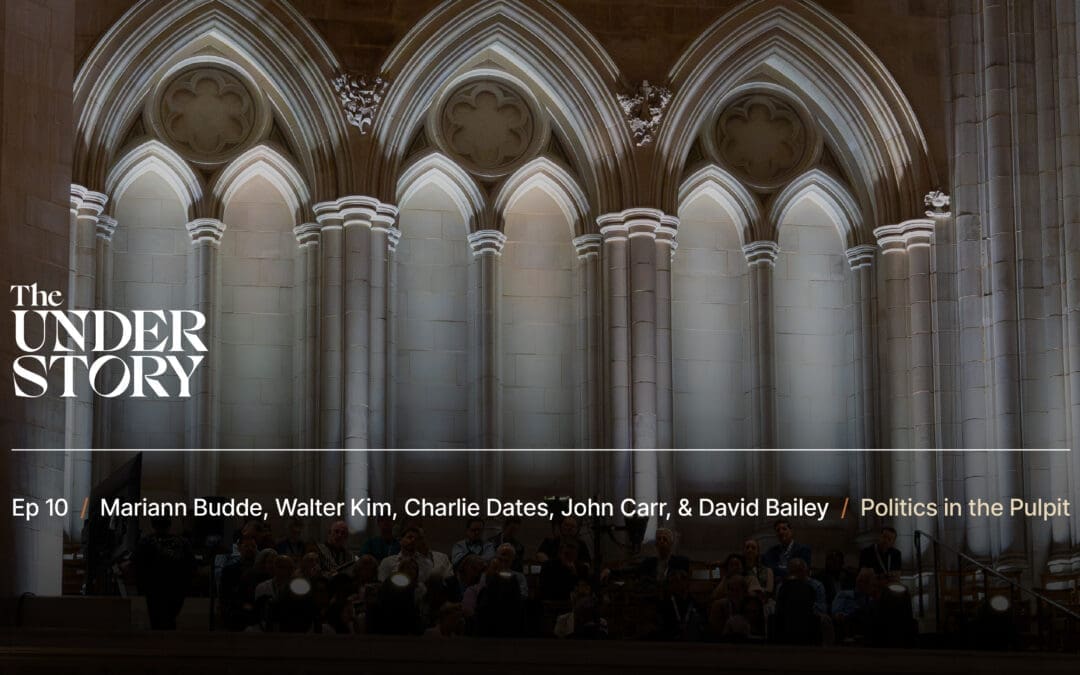
On the second day of the Understory festival, four leaders from four distinct Christian traditions sat down to consider that question. From the West Balcony of the National Cathedral, they gathered within sight of the very pulpit where, a little over a year earlier, Bishop Mariann Budde had addressed newly inaugurated President Trump in a sermon heard around the world.
Back at the cathedral in the context of the Understory, Budde joined Charlie Dates of the Black Church, Walter Kim from evangelical Protestantism, and John Carr from the Catholic tradition. Long-time Comment friend David Bailey—pastor, reconciler, and founder of Arrabon—guided the conversation.
Their task wasn’t to settle what pastors should say about politics but to recover an older map—one that recent years have too often flattened into the politics of red versus blue. How does a preacher distinguish biblical conviction from cultural conditioning? How does the church speak to power without becoming its chaplain, or refuse quietism without becoming partisan?
What emerged wasn’t a debate over who had the right political posture so much as a glimpse of the church’s own richness: four ecclesial imaginations, each shaped by a different history and carrying a distinct inheritance about preaching, conscience, public witness, and the vocation of the pastor.
Anne Snyder: From Comment magazine, welcome to The Understory, where the future quietly takes root. I’m Anne Snyder.
Walter Kim: This is not just an evangelical problem. This is a human problem, because this is a problem that happened long before any of us were around. It happened in the first century. Politics will always seek to invade and fill the vacuum of meaning.
Mariann Budde: I owe them my best honest perspective and enough space that if they disagree, they’re not disagreeing with God.
Charlie Dates: So I have to be in conversations prior to preaching with parts of the body that don’t look like me and think like me, and humbly submit myself so that I’m bringing a more robust, rounded-out reflection to the pulpit.
Anne Snyder: There’s a needle many pastors have spent the last decade trying to thread. Speak to the moment and you’re called partisan. Stay above it and you’re called silent. Speak prophetically and you’re accused of politics. Refuse politics and you’re accused of abandoning the prophetic.
It’s a bind, especially in a culture where our political vocabulary has become so totalizing that we struggle to imagine any language of public responsibility that isn’t immediately sorted into red and blue. I thought the Understory might be a mischievously ideal place to probe and reawaken some of the ecclesial cartography that has been, in more recent years, forgotten.
On the second day of the festival, while more than fifty breakout sessions unfolded throughout the National Cathedral, one room carried an added layer of history. The West Balcony overlooked and was in view of the very pulpit where, just over a year earlier, Bishop Mariann Budde had addressed newly inaugurated President Trump in a homily heard round the world. It became the setting for a conversation among four Christian leaders from four distinct traditions: Bishop Budde, Pastor Charlie Dates, Dr. Walter Kim, and John Carr, moderated by my friend David Bailey—pastor, reconciler, and founder of Arrabon.
Their task wasn’t to settle what pastors should say about politics. It was to ask an older and deeper question. How do different Christian traditions understand the relationship between the pulpit and the public square? How does a preacher distinguish biblical conviction from cultural conditioning? How does the church speak prophetically without becoming ideological, and pastorally without becoming timid?
One of the joys of assembling this conversation was watching each tradition keep its own accent. Charlie Dates speaks from the Black Church, Walter Kim from evangelical Protestantism, Bishop Budde from the Episcopal Church, and John Carr from the Catholic social tradition. What emerged wasn’t a debate over who had the right political posture so much as a glimpse of the church’s own internal richness. Different ecclesial imaginations, each carrying distinct instincts about preaching, conscience, public witness, and the distinct vocational responsibilities of the pastor.
Recorded live at the Understory Festival, here’s David Bailey with Bishop Mariann Budde, the Reverend Charlie Dates, Dr. Walter Kim, and John Carr.
David Bailey: So we are living in a moment where the stakes feel profound and deeply consequential. Communities are crying out for justice, and public life feels strained, volatile, and even often unmoored. And the church is caught in a tension, trying to bear faithful witness in a world where even faithfulness itself is contested.
So congregations do not come to church neutral. They come carrying grief, anger, hope, fear, and deeply held convictions about what is right and what is at stake. Some come longing to hear their beliefs affirmed, to confirm tribal identities, and to feel a sense of moral clarity in a disoriented time. Others come seeking guidance, longing to be formed into people who can live faithfully, love deeply, and act justly. And often, these two longings sit side by side in the same pew. Pastors and spiritual leaders feel this tension, and I hear about it every single week.
This conversation has actually taken place steps away from where Dr. Martin Luther King Jr. preached his final Sunday sermon before he was assassinated. And that moment stands both as witness and as warning. It reminds us that faithful preaching in the public square has always carried risk, cost, and consequences.
My name is David Bailey. I serve as the founder and chief vision officer of Arrabon. It’s a spiritual formation ministry that equips Christ followers to pursue reconciliation, healing, and shalom in their communities. But what’s more important in this next hour is that I will be the Magic Johnson of this preaching dream team.
So all the way to my far left is my friend, and his bio: the Reverend Dr. Charlie Dates serves as senior pastor of Progressive and Salem Baptist Churches in Chicago. A dynamic preacher, scholar, and civic leader, he is known for proclaiming the gospel with clarity, conviction, and hope. Dr. Dates is the founder of the Black Boy Literacy Campaign, Spend in the Black Commerce Corridor, and the Progressive Center for Counseling and Justice. He serves as co-chair of the Preaching Institute at Wheaton College’s Billy Graham Center. And he has a book that he’s debuting called What Hath Justice to Do with Righteousness? that will be released this spring, 2026.
Another friend, the Reverend Dr. Walter Kim, serves as the president of the National Association of Evangelicals. He previously served as a pastor at Boston’s historic Park Street Church and at churches in Vancouver, Canada, and in Charlottesville, Virginia, as well as campus chaplain for Yale University. He preaches, writes, and engages in collaborative leadership to connect the Bible to intellectual and cultural issues of the day. He serves as—on the board of Christianity Today and World Relief. And Walter received his PhD in Near Eastern Languages and Civilizations from Harvard University.
Bishop Mariann Budde serves as the spiritual leader for congregations and Episcopal schools in the District of Columbia and four Maryland counties that comprise the Episcopal Diocese of Washington. She also serves as the chair of the Protestant Episcopal Cathedral Foundation, which stewards the ministries of the Washington National Cathedral, which we are sitting in, and the cathedral schools. Her sermons have been published in several books and journals, and she’s the author of Gathering Up the Fragments: Preaching as Spiritual Practice; Receiving Jesus: The Way of Love; and How We Learn to Be Brave: Decisive Moments in Life and Faith. And that book has actually been adapted into a youth adult book, young adult book, and a picture book for young children that’s actually going to be released this July. And I’ve just been so privileged to get to know such a humble spirit and really looking forward to hearing words from our sister, Bishop Mariann Budde.
And then John Carr, a delightful brother, is the founder of the Initiative on Catholic Social Thought and Public Life at Georgetown University. He previously served as director of justice and peace efforts at the United States Conference of Catholic Bishops for more than twenty years. He is the author of “Preaching and Catholic Social Teaching” in A Handbook for Catholic Preaching, published by Liturgical Press. He was also a presenter at several dozen week-long Preaching the Just Word workshops for Catholic priests.
And leading us in prayer and song is Dr. Awet Andemicael, musician and theologian. Dr. Awet Andemicael is associate dean for Marquand Chapel and lecturer in theology at the Yale Institute of Sacred Music and Yale Divinity School. Her theological research focuses on two areas: constructive engagement with early Christian thought, especially in the political theology of Irenaeus of Lyon. And she also writes on music and theology. An award-winning concert soprano, she has performed across North America, Europe, Asia, and Africa. Dr. Andemicael holds degrees from Yale University, the University of Notre Dame, UC Irvine, and Harvard University.
I told y’all this was the dream team of preaching. So I want to open up just with some opening thoughts. Just from your experience, what is the most difficult tensions pastors and congregations are facing right now when it comes to politics in the pulpit? How does your tradition understand faithful public witness, and what is the role of the church in the public square? And so we’ll just have everybody take a shot at answering that question. Charlie, you want to start off first?
Charlie Dates: Good afternoon. Let me first begin by thanking you, David, for the invitation to join such an all-star cast. I’m the least of my brothers and sisters here today, and so I’m honored to be here, and honored to be here with all of you.
I hail from the richest preaching tradition in Western civilization, the Black preaching tradition. And it is because, in my opinion, from the inception of this nation until now, the African American pulpit has had to stand betwixt and between the sin of slavery and the slavery of sin. We have never been able to divorce righteousness from justice.
So the trajectory of our preaching tradition, and where I stand, is one in which I think that the big tension is actually parsing justice over politics. I don’t even know that politics is the big motivator. I think justice is the big motivator. And the challenge with that is that justice cuts both ways. It does not respect party affiliation. It does not respect economics. It is completely from the mind of God. And so sometimes I can—we can sound like people from either party, depending upon what text we are preaching and what matter, what issue arises. So that can create friends and enemies within the same congregation, and even among preachers of our ilk.
But I think that’s the greatest opportunity. I think what our nation needs right now is a pulpit that is unafraid to speak courageously on matters of justice, regardless of what person or politic or political group it confronts. It’s a great opportunity to do so.
David Bailey: Walter.
Walter Kim: If you ever have the gift of hearing this person preach, you will be profoundly blessed. So it’s a masterclass of preaching to sit under your pulpit.
Likewise, I want to thank you for the opportunity to be a part of this conversation. I think of the current challenge as like an iceberg. There’s the small visible part that captures and commands attention, but really the substance of the issue is the much larger part submerged underneath, and that’s the really dangerous part.
What you see at the tip of the iceberg is the kind of political polarization that rends churches, that requires pastors—if you don’t take a stance, you’re neglecting your duty as a pastor. If you do take a stance, you’re infringing beyond the duty of a pastor. You can’t win. And then when you take a stance, oh, that’s not biblical enough. Or where are you getting that? And then there’s all this impugning of motives and character as well as affiliation. It almost feels like it’s a no-win situation. That’s the stuff that comes into your inbox on Monday.
But the deeper, more submerged issue that I think is a far dangerous—more dangerous issue—is one that I call the problems of believe, behave, and belong. In other words, submerged under this are deep issues at what is forming your theological worldview. What is it that you actually believe? Who is forming that? Is it the scripture, or is it social media? Is it the major cable companies that are feeding and forming you? And that belief system is incredibly consequential.
There’s also the behavior. What kind of people are you becoming? Are we losing the sense of character that should shape our civic engagement? And then there’s, of course, the belonging, this kind of separation. We see this geographically in the separation of zip codes. You can almost buy by zip code. People are self-sorting. That’s also true by churches. Many churches are becoming self-sorting churches because we no longer have the capacity to belong to people and belong with people who don’t think just like us, right?
And so that, I think, is the deeper struggle. As pastors are working through the surface issues of the iceberg, the stuff that comes in in your inbox, further reflection leads you to say, no, there’s something much more consequential that could sink the Titanic.
David Bailey: Mariann, how about you?
Mariann Budde: Thank you. Hello, everyone. Welcome to the cathedral. Very glad you’re here, glad to be with you.
Let me come at it from a slightly different place. This is a sacramental tradition, the Episcopal Church, which means that I am bound as a preacher to consider the context of the worship service and the arc of that service and the way the scriptural texts are given to us according to the liturgical seasons. Now, it doesn’t mean that I have to stick—it’s not that I’m preaching Bible study, but there is a grounding in what is given to a preacher.
I’ve also been persuaded in my own life that there’s a difference between speaking and being right about something and being heard, you know, connecting. And so I think a lot about the people, the very specific people that I have the privilege of addressing, and whom no one else in that space gets fifteen, twenty minutes of uninterrupted speech, right? So that’s a real trust that’s been given to me as a preacher. And so I try to consider—
When you were talking about the under part, I was thinking about all the things that go into what is spoken when we rise to the platform or the pulpit. All of the thinking, all the praying, the studying, the pondering, taking into account what’s happening in a given moment, and then addressing a particular people. And it varies.
I’m a bishop now, and so I don’t speak to the same congregation every week like I used to as a congregational priest. I’m speaking in a different context. And every once in a while, I have to think about the wider context of our country. It’s not as often as you’d think. I mean, most of my Sundays, I’m talking to congregations that may not be much bigger than this group gathered here. So it’s just, it’s varied. But it’s my responsibility to offer something that might be received as good news. And then also what we need to hear as it surfaces from the text and the spirit in our lives.
So I don’t know about you guys, but every week I’m sweating bullets, right? Because this is—it’s not for—I mean, if you preachers here, you know what I’m talking about. It’s not something you pull out of your ear, but comes from a pretty vulnerable place of connection of all of those things.
David Bailey: John?
John Carr: I’m also honored to be a part of this impressive gathering and humbled to be a part of this dialogue with these wonderful preachers.
David mentioned that we’re at the place where Dr. King gave his last sermon. We don’t have to look back that far to see a wonderful example of politics in the pulpit. On that altar, at that pulpit, Bishop Budde, not eighteen months ago, invited our newly elected president and vice president to serve in support of human dignity with honesty and humility. And then she asked them—and then she asked him to have mercy on those who were scared, especially immigrants. It was faithful. It was respectful. It was courageous. It was a great example of what we’re talking about today.
I am not a preacher. I’m not a cleric. I don’t give homilies. I listen to them. And what you’re going to get is about fifty years of pent-up feeling about this. But I do work at the intersection of faith and politics at the bishops’ conference and now at Georgetown. And I think I’m here because I bring a Catholic perspective.
And I think the Catholics bring a lot. We’re not known for our terrific preaching. The one thing we have going for is we’re usually short. And that’s a good thing in my parish. But I once heard an evangelical preacher say to a group of Catholics, we preach with more fire than you do, but you think more clearly than we do. You’ve been thinking about things a longer time. So I think we have a lot to learn about preaching. We also have something to contribute.
David asks, where are we? We’re not where we want to be. I’ll speak personally. I feel like I’m stuck in an endless Lent. I know Easter has come. I know Pentecost is here, and it still feels like we’re lost. The polarization, the anger, the—the use of religion as a faith, rather, of politics as another religion, with its own principles and idols and rules that gives identity and belonging to people who should find it in the church. We’re at war and nobody authorized it. It doesn’t appear that many people support it. And sometimes it feels like we’re at war in our own communities. I was telling the bishop, I grew up in South Minneapolis and visited there. We’re imprisoning our immigrant neighbors, and we’re killing people who stand with them. So it feels like the war came home.
So when things are tough, we go back to basics. You asked, what is the role of the church? It’s what it always is: what Jesus said in his hometown synagogue, to bring good news to the poor, liberty to captives, new sight to the blind, and set the downtrodden free. He called us to serve the least of these, the hungry, the homeless, the thirsty. He called us to be salt and light and leaven in our own world.
What does faithfulness require now, as a layman? I offer five thoughts, quick thoughts. We need our preachers, our leaders in the church, to be faithful, not ideological—to take our strength from the scriptures and from our teaching, not from the political categories of our day. We need them to be principled and not judgmental. We have to stand up for human dignity, for solidarity. But we ought to be willing to work with people who don’t share all our principles to advance the common good. And sometimes we just shake our finger. We need to be civil, but not silent or not quiet. We ought to demonstrate respect, but we should not fail to proclaim the good news, even in hard times. And we should be engaged, but not used. We ought to be in relationship with our public officials, but we shouldn’t be props for them. We need to engage to share our principles, our experience, not as parts of photo ops. We should be done with pictures of preachers praying over the president of either party.
So as a layman, as a Catholic, those are my thoughts about where we are and what we can do.
David Bailey: Thank you so much. Thank you. You know, when Anne and I kind of curated this time, we were really intentional to try to get folks from various traditions. So this is a conversation that we rarely get a chance to have.
And so in this time, this round of questions, I would love for you to kind of share from your tradition both the gifts, the charisms that your tradition is bringing, but then also maybe some of the limitations or the unique challenges that is happening out of your tradition. And I think this is a great conversation for us to have overall, to be able to listen and to hear, to be able to glean as we try to glean for our context. And so we could just maybe go down the line again one more time. Charlie, would you want to start off with—talk about your tradition?
Charlie Dates: I’d like to hear about theirs first, but I will start.
So again, I hail from the African American preaching tradition, which in general has a very high view of Scripture and a high view of Christ. That is to say that we have taken preaching the Bible seriously. One of the tools that was handed to me prior to going to seminary from my pastor was that the gospel comforts the afflicted and afflicts the comfortable. That there is a holy discontent that the preacher has to carry to the pulpit, knowing, in other words, that the marginalized, the broken, the poor, those we just heard spoken about in Jesus’ commission in his hometown, sit among our pews.
Listen, we would do ourselves a high disservice if we acted like the experience of Black Americans is the same as every other people group in America. I pastor largely African American communities in Chicago. My friend Walter has been there to see some of the work we’re doing. Right now we’re building a hundred homes in a completely divested, poor community. We’ve got twenty-one of them up in the ground right now. This summer, we’re taking in our four hundredth boy—Black boy, first through third grade—trying to get him at the third grade reading level, because he doesn’t have a fighting chance if he doesn’t understand how to read after third grade. We are doing our best to comfort the afflicted.
At the same time, the other edge of that sword afflicts the comfortable. Our people are outraged at the gutting of the Voting Rights Act. My oldest brother is the first person in my family to be born in the United States with the basic rights that everybody else had. Think about that. He’s the first one in our family to be able to have the right to vote guaranteed. Well, so we thought when he was born—the right to buy housing, the right to education in that regard.
That now—those basic human dignities for African American people were won through the giants of our pulpits, including the one in whose shadow we stand today. And so I don’t have a choice, quite frankly, but to see the wielding of the gospel as a message that will comfort our people, but will also speak a discomforting truth, like Bishop did on that brave day, to a world that desperately needs to hear it.
David Bailey: Walter, I mean, even representing evangelicals, this is really interesting, because the evangelical is a—has become a political project. But then if you say something out of certain types of political orthodoxy, then you’re in trouble for being too political. So just share a little bit about both the gift and the challenge that you’re experiencing.
Walter Kim: Thank you. I think it’s important to note that evangelicalism really should be noted as evangelicalisms. There are multiple streams that feed into that, right? I’m the son of a refugee and immigrant parents who came to America in the sixties, and I was born in New York. So I’m not within the subculture of evangelicalism of any sort, other than the sort that has represented a sort of proclamation of the good news of Jesus Christ that comes in word and deed. Many of these evangelical organizations were in South Korea, helping to put the country back together again after multiple wars. And in fact, I came to discover that the National Association of Evangelicals were one of those organizations seeking to express the good news of Jesus Christ.
So when you think of evangelicalisms, within the NAE, there are forty-five different denominations—charismatic, Pentecostal, Presbyterians, Methodists, Wesleyans, you name it, multiple stripes. But what holds us together? When I think of the term “evangelical,” I refer back to Brother John here and his comment of citing the good news in Luke chapter 4. Proclamation to the poor, sight for the blind, release for the prisoner, and favor to those who are oppressed. You know, the term “evangelical” comes from the term euangelion, which is the Greek word for good news. So it should be good news people. But good news people, not just in personal salvation, but in public transformation.
So if you humor me for a moment, I’m going to give you a little history lesson. In the ancient world, when the Gospel of Mark began this way—this is the beginning of the good news of Jesus Christ, the Son of God—why did it begin that way? Well, scholars discovered, archaeologists discovered, in this city called Priene in modern Turkey—the city of Priene had a central market square where they discovered an inscription, which they now call the—the Priene calendar inscription. It was an inscription to change the calendar used in Asia Minor to begin the year with the birth of Caesar Augustus. And there’s a portion of that calendar that reads this way.
In Caesar, the gods gave a gift to humanity, the human consummation of perfection, to be a benefactor to humans, to end wars, to bring prosperity. The beginning of the good news of the birth of the God Augustus has come to us.
So when the gospel came, it came as a revolutionary message to say that politics will always seek to give us a transcendent vision of who is in charge and how society should be ordered. But as Christians, we declare—as good news people, we ought to declare—no, no, no, no, no. There is no Caesar that is God. There’s only one. There’s only one benefactor who can end wars, who can change all things. And that’s the person of Jesus Christ.
What the NAE seeks to do is to be a form of evangelicalism that pursues the holistic application of the good news of Jesus Christ that should be so compelling that people would say, what kind of God is this God that would be peacemakers?
So when I came to Park Street Church, the church that I served at, which in fact was the church that founded the NAE in 1942, my understanding of evangelicalism was this. Park Street Church, two-hundred-year-old church, the history of evangelicalism in America. It’s the place where William Lloyd Garrison preached the first abolitionist sermon in Boston. It’s also the place in 1913 where the NAACP got its first chapter. It was the place where the SPCA tried to eliminate cruelty to animals as a Christian virtue. It’s the place that brought in Sunday school to Boston—not with Jesus flannelgraph stories. But Sunday school was literally a school for the kids working in the factories in Boston. Sunday, the only day off, it was a place that, in the name of Jesus, you would teach reading, writing, and arithmetic. It was a place that World Relief got founded and got sent to Korea to help put that country together again.
There is a long history of a form of evangelicalism that at its best holds the gospel in word and deed, harkens back to the original meaning of “evangelical,” to be good news people with a life so compelling that it would be utterly transformational and utterly attractive. In its best moments, that’s what I think being an evangelical would mean at the NAE.
But we are not always in our best moments. And that’s why I come back to the Priene calendar inscription. I think this is not just an evangelical problem. This is a human problem, because this is a problem that happened long before any of us were around. It happened in the first century. Politics will always seek to invade and fill the vacuum of meaning of what is the transcendent vision for you as individuals, institutions, and what is the way to order society. And part of the job of the church in all its form is to say, no, there is a different vision, even more transcendent and even more compelling, in how to order life together. Thanks.
David Bailey: Thanks, Walter. Mariann, so you sit as a bishop that’s in the context that’s adjacent to both national power and public life. And so, you know, like, how do you discern when to speak, how to speak, when to engage in those moments? I mean, and then even, I think, something that not many of us have done is catch the attention of the president and be attacked in that way. But as preachers, I think every preacher here has probably had an experience in their pulpit where they preach something that felt pretty innocuous or just clearly biblical, and then they get attacked by somebody that they were at their bedside with, that they married, they left their church because of what happened. And so could you just maybe just speak to that within the gifts and charism that you’re dealing with?
Mariann Budde: Well, speaking to the latter part, for those of us who are pastors and preachers, it’s actually—I find it devastating when you don’t—I’m not the kind of preacher that likes to evoke unnecessary reactivity. I actually try not to do that, because I don’t know how fruitful that is. It’s like I said, can I be heard as opposed to being right? I’m not saying that there isn’t a time for being right, but if I’m going to try to communicate a message that I know is going to land hard, I do everything in my power to soften the landing so that it can be received.
Now, if—I was taught early on, and I’m grateful for this. I was taught by a rabbi who said that one of your jobs as a preacher is to honor the responsibility and the privilege you have to think deeply about something for an extended period of time, synthesize your thoughts in light of the scriptures and your best sense of the Spirit’s movement, and then express it so that other people who didn’t have the time to do that can have something to respond to, right? To help them think through and possibly hear the Spirit’s movement as they do.
And if one of the responses you get back is anger, well, they’re thinking, right? And so, you know, that’s not necessarily bad. If it’s coming at you hard, it may have more to say about where they are in their life than it does about you. At least I try to think that way. But I also try not to just stick people in the eye, right, unnecessarily.
So I spent a lot of time thinking about how I was going to phrase what I was going to say. And I was actually expecting to get a little bit of heat for being a little too soft on the guy, right? You know, from people who were my justice people, right? What do you mean, ask for mercy? How dare you ask for mercy? Demand justice, right? You know, that could have been an equally legitimate critique.
I, because this is such a politicized environment—and a lot of the people I preach to and people I serve, I mean, this is their daily bread, right? So I don’t have to be specific all the time, because people are going to fill in the specifics in their head. So I pick pretty carefully when I say, okay, in the context of what I want to say to you today, we’re going to talk about what we all know is happening right now.
And I feel a responsibility to give people enough space. You were saying it earlier. First of all, that I’m not ideological. I’m not just giving them my opinion, right? They deserve more than my opinion, right? In fact, my opinion is probably irrelevant on some level, although I can easily confuse it with God, right? Because who doesn’t do that? But I owe them my best honest perspective. And enough space that if they disagree, we’re not—they’re not disagreeing with God necessarily. And I have the humility to listen to what comes back toward me.
David Bailey: You know, John, I’m really glad to have you here on this panel. One, as somebody who listens to a lot of sermons. Two, a truly sacramental tradition. You know, and so, you know, Catholics aren’t known for preaching generally. I mean, you hear the Pope has different sermons, but not a lot of strong preaching tradition. What I can say is that when it comes to public theology, I mean, we have a lot to learn about Catholic social teaching, how to be faithful. This is a long tradition of showing up and doing the work of justice faithfully when nobody else was doing it. Catholics were the ones kind of for thousands of years doing the work and writing about it and having that tradition.
So, you know, I think what’s really important—the pulpit is fifteen minutes to an hour. And could you maybe speak and help us to understand—you went from Episcopal to Black church preacher tradition, fifteen minutes to an hour. So could you maybe just speak to like some of the gifts that the Catholic Church that we can learn, you know, about how to do public theology?
John Carr: Well, thank you for those kind words about our tradition. A group of funders had me in, and they asked me to describe the Catholic Church. I said, we’re large, we’re global, we’re diverse, we’re declining, both in members and attendance, and we’re often dysfunctional. A lot of the time we don’t match what we teach by how we proclaim the word and how we act. We’re a wounded church. I’m a survivor of clergy sexual abuse. Those wounds are still there. The Pope finally—Pope Leo finally acknowledged the complicity of the church in slavery. We have a lot of wounds.
But despite our failings, we bring some assets. One of them—and we share this, I think, with the entire religious community. Charlie talked about what his place is doing. We have everyday experience in everything the Congress is talking about. Who feeds the hungry? Who shelters the homeless? Who takes care of the sick? Who welcomes immigrants? Who educates the young? Who offers hope and help around the world? I believe it’s not just what we believe that matters, it’s what we do. And part of preaching needs to bring that experience to the whole community.
The second thing we bring in is we have a long tradition of reflection, thought, and formal teaching on how our faith calls us to act in the world. Catholic social teaching didn’t begin with Francis or Pope Leo. It began with Genesis, with Jesus. But the formal Catholic tradition began 125 years ago in the middle of the Industrial Revolution, when Pope Leo XIII—you might detect a trend here—stood up for workers and the dignity of work. And since then, every pope, many bishops, have tried to stand up for human dignity, for justice and peace, and done so in a formal way. And that has led to a set of principles that offer a moral framework, I would suggest a criteria, a direction for action.
There are a lot of ways to describe this tradition. I have said I think the most important word in Catholic social teaching is the word “and.” We are committed to human life and dignity. We are committed to human rights and responsibilities. We are committed to the dignity of work and the rights of workers, to solidarity and to subsidiarity, to the option for the poor and the vulnerable, and to care for creation and for the poorest people on the planet. That gives us a difference.
And I want to be honest that this tradition is used and enriched and deepened, not just in our community, but the entire Christian community. I frankly find more interest in Catholic social teaching outside the Catholic community than inside, especially this week after the Pope’s encyclical. I said how discouraged I was that people seemed to have their faith—their politics shaped their faith instead of their faith shaped their politics.
But in our work at Georgetown, I feel real help. We’ve done hundreds of dialogues. We’ve reached half a million people. And I find there is a hunger for the moral vocabulary of Catholic social teaching. There is a thirst for civil dialogue in a time of polarization. There is an openness, especially among young people, to build bridges across lines, to get beyond the grudges and the anger. And there is an exhaustion with business as usual in the church and in our country. I think these principles are something our church needs to share more widely, act more effectively on, but we can also make a contribution to the larger community.
David Bailey: That’s wonderful. Thank you so much. Can y’all give this panel a round of applause?
All right. So we have fifteen minutes. What I would like you all to do—I’m going to do some Q&A. I would love for you all to give one practical skill. How do you prepare as a preacher to be able to even have the skills to be able to communicate in the moment with the text and whatever means to that? But then also, this is a full contact sport, so how do you continue to allow yourself to be a vessel, so you’re not a wounded vessel bleeding on people? So I want you to think about those two questions.
I think that’s your hand up in the back. Okay. So sometimes the gospel disturbs people. How do they be faithful? Your question, ma’am?
All right, so I’ve got to repeat these questions. When you look at what’s going on in the German church on the eve of World War II, what were some lessons learned? And then my brother also said, when basically preaching is risky, how do you stay faithful? And we also have to do these in like less than preacher minutes. Okay.
Mariann Budde: All right. I’d like to take on the first one. For me, the thing that keeps—I always think it’s really important as a preacher to remember that the first person to receive the message of the sermon is the preacher. Right? I stand under the gospel. I don’t stand alongside it, proclaiming it to people that are receiving it as if I were not part of them. And there’s both a humility that comes from that, and also it helps mitigate the tension—or the tendency, I should say—to preach the gospel, the portion of the gospel, that other people need to hear but that I don’t, or that I think that I don’t. Right? And to remember that this is, at its foundation, a spiritual practice. Preaching is our foundational spiritual practice if we’re in the pulpit every week.
Charlie Dates: I would like to speak to that as well. I don’t have much to offer other than Hitler was wrong, Bonhoeffer was right.
But for the first question, in John’s gospel, we are told that Jesus Christ was full of grace and truth. That’s a kind of hypostatic union in itself. Truth will kill apart from grace, and grace will be a license apart from truth. So coming to the pulpit in preparation for me, I know that I have to tell the truth, but I’m trying to find the quickest way to grace that I can, and for my own soul, because it’s a crushing weight. I stand in front of no audience where I’m just delighted to deliver truth without grace. By the time I’m done, I want them asking, what must I do to be saved?
John Carr: I have less to offer about the past, but something for the present. I had breakfast with a classmate of mine when I was in the seminary. He’s a priest, I’m not. And I said, how are things going? He said, great. And he said, but last—before, I preached and I talked about what had happened in our community, the treatment of immigrants and the deaths of Renee Good and Alex Pretti. And afterwards, after both masses, somebody came up furious and said, how dare you inject politics into the liturgy? And he said, I was really upset by the attack and wondered, should I have done that?
I said, Father, how many people did you preach to that weekend? He said, three masses, probably 1,800 people. I said, two people came up and said you bothered their conscience. Hundreds of them were touched by what you said, found meaning, found hope in what you said. Keep perspective. Have courage.
So one thing we need to learn, even in the worst of times, but also in our times, is have courage and keep perspective.
David Bailey: Oh, you got something?
Walter Kim: I was going to respond to that question, just to give a thought to that. I’m not a German scholar or, you know, European theologian. But there are three things that I would say, just three quick lessons.
One, Niebuhr made the observation that the only empirically provable doctrine of the Christian faith is total depravity. Like, we can actually see the depravity of humans. So I think one important lesson from the German church and German theologians at that time is to constantly query the misuse of power and the capacity for human sin to corrupt.
The second was—I know Barth is a Swiss theologian, Karl Barth—but he had the adage that we should, as preachers, as theologians, read with one hand on the Bible and one hand on the newspaper. This sense of constantly asking the question, what are the public implications of the faith? So I think that’s an important contribution.
And in terms of Bonhoeffer, sometimes it takes a costly discipleship to enter into those conversations.
Mariann Budde: May I just add one more thing? I also think it’s important, if you know that people are thinking about something when they’re coming into church, you have a responsibility to touch upon it. It doesn’t have to be the topic of your sermon, but if you know that something just happened, whatever it is, the decimation of the Voting Rights Act or whatever—if you know that that’s on their hearts and you don’t talk about it, it’s a violation of the pulpit in that moment to a wounded people.
Charlie Dates: I do, jumping around, want to say this about Bonhoeffer. I did have a more thoughtful response I was going to give you on the side, but we forget that Bonhoeffer came to the United States and went to church in Harlem and sat under Black preaching in the richest way. And I will tell you, at least from Bonhoeffer’s writing, that radically changed his thinking and the courage with which he lived.
I don’t know why we stick to our tribes so much in America, where we cannot go sit under preaching under a different tradition. And I will say this, because I’m one of few Black people in the room: the Black church ain’t going to hurt y’all. It would love for you in your own community, seriously, to come and sit—for whatever reason, it seems easier for Black people to go sit under white preaching than it is for white people to sit under Black preaching. Bonhoeffer did that. And I think that radically changed and reoriented, again, his theological reflection. And it propelled his life to bring prophetic change.
David Bailey: And I know all three white people that go to Charlie’s church. And I was with them last week, and they said, man, they feel so welcome at his church.
I would give you this Reggie Williams book, Bonhoeffer’s Black Jesus. Bonhoeffer got his moral clarity by being in Harlem under Abyssinian Baptist Church. So that’s how he got his theological—and that’s what sent him back to Germany, was his formation that happened within that space. So Reggie Williams’ Bonhoeffer’s Black Jesus would help you to answer that question.
Mariann Budde: The other thing, though, is that I think your point and the point of the book that you reference is that if a church ignores what’s happening in their society, the church suffers. I don’t think the German church has ever recovered, frankly. And obviously the nation was deprived of the gospel message from its foundational—I mean, that just happened. And so I think that’s a cautionary tale for all of us.
David Bailey: So I’ve got to repeat the question for the recording. What I hear you asking is, is there a way of discernment, a way of filtering, to kind of like get outside of your subjectivity, to be a little bit more objective, to make sure that you aren’t confusing God’s Word and God’s mind with your mind and your words and your thoughts?
John Carr: As the non-preacher, I’ll jump in. Here’s my advice. Integrate, don’t isolate the proclaiming of the gospel of justice and peace. I don’t like social justice homilies. I like preaching on the word and how that word transforms us. So you cannot preach in an everyday sort of pedantic way and then every once in a while drop in a grenade and say, have you thought about this?
Secondly, watch your pronouns. This may sound stupid, but every time my pastor says, you need to do this, you are not aware of this, I always see the finger, you know, the lecture, the judgment. When he says, we need to think about this, we need to find better ways, we need to learn—we’re in this together, and you ought to preach like it.
And then in this, I want to follow up with what Bishop Budde said about opinions. I think in tough homilies, good questions are better than your own answers. Most of us evade hard questions. And good preaching will build on the gospel, will build on Catholic social teaching, will build on an experience, and then will ask us, what does it mean to be faithful in a time of war? What does it mean to be faithful when our neighbors are deported? What does it mean to be a faithful citizen when our democracy is under threat?
So those would be three specifics.
Mariann Budde: One of the ways I’ve learned increasingly in the last few years is I ask other people to read my sermons before I preach them. I can’t do it every week. I don’t have time every week. I’m often finishing them as I’m driving to church. So that’s just one, particularly if it’s a consequential sermon. You better believe I had a lot of people look at the sermon last January, because the stakes were so high.
If I can’t do that, I try to think of people, specific people across the spectrum, as I’m crafting. How will it land for my daughter-in-law who doesn’t know if Jesus is real? How is it going to land for the person who is—always, I’m just, you know, fill in your own blanks. But just to say, okay, if I’m having a conversation, how does—and that just sort of gets me out of my own head. Those are just two things. Yeah, that’s the problem with being me.
Charlie Dates: I appreciate everything. I’m calling him Father John. I had to say it. My kids would appreciate it.
So I do think, however, there is this kind of prophetic “you” in Scripture. When Peter preaches at Pentecost, he says, this Jesus who you crucify. We are told, you must be born again. So there comes a time—and I don’t think I’m contradicting what Father John has to say—where you have to join the “you.” Even as you say it, you have to see yourself as being in the shoes of the “you,” but still be able to use the word “you.” Because the gospel confronts us in that way.
The other thing is, I would draw your attention to—I think it was Bruce Fields who said that sometimes we write sermons in such a vacuum, and we do theology in such a vacuum, that we tend to write our own answers to the big questions of the world. And when we do that, we forget that doctrine, and the interrelationship of doctrine and the formulation of theology, leads to very different emphasis depending upon who’s doing it. So there is a richness that I bring to theological reflection that some of you will not bring. And there is a richness that you bring to it that I will not bring.
And so I have to be in conversations prior to preaching with parts of the body that don’t look like me and think like me, and humbly submit myself so that I’m bringing a more robust, rounded-out reflection to the pulpit. And that’s how I do my assessment. I want to know who’s thinking differently than me, who looks differently than me, experiences life differently than me, but yet holds to me a high view of Scripture. And that keeps me from an echo chamber.
Walter Kim: Let me give an illustration to that point as well. So if you can’t tell, I’m Asian American, specifically Korean. And for the longest time, my wife, Toni, and I had been trying to share the good news of Jesus Christ with her parents. But we often did it in ways that we learned predominantly in white evangelical settings, about God and forgiveness and how Jesus paid the debt for our sins.
Then all of a sudden, you know, we concluded, wait, we’re Asians. Asians don’t think this way. So we began to talk about how humanity was disloyal and dishonored the father. And Jesus, as the firstborn of creation and the firstborn of the dead, died a shameful death to assume all the shame of sin and humanity. And when he rose, he rose victorious and restored the honor of humanity. And as our older brother, his honor is now transferred to us.
I think there are ways that even the most rudimentary things—what is the gospel? Different communities: Hispanic, Asian, Black, white. But even among white communities, there are different—Southern, Northern, you name it. There are ways we can enrich ourselves through the interpretive lens of the whole body of Christ. So that’s one thing.
The second thing I would add is pray. If your sermon is coming out of anger, it’s not a good place. Pray till you get to the point of deep compassion and empathy, that even the righteous anger is channeled through the pastoral care of leading your flock. Do not—there could be anger in your sermon, but it’s a different place. You know it as a preacher. It’s a different place when you’re just ticked off and you got to get something off your chest, versus where it’s truly the indignation that comes out of a deep solidarity and compassion with God, with his people, and the purposes in the world.
Charlie Dates: Real quick, David, I know you’ve got to move us along. So one of my deacons told this story. This is so fantastic. Another church had got rid of their preacher, and it was a deacon buddy of his. And he said, oh, you’ve got to come hear our new pastor. He said, well, what do you like about the new pastor? He said, it’s the way that he preaches. He said, well, what’s the difference between the new pastor and the old pastor? He said, well, they preach the same thing. He said, well, what were they preaching? He said, they both were telling us we were going to hell. He said, well, what’s the difference? He said, the first preacher, the previous pastor, he said it with a kind of smile on his face. He said the new preacher, he’s weeping every time he says it to us.
That is what I hear in Dr. Walter’s comment there. There is a holy heartbreak that comes with even the righteous indignation in our preaching. It’s not joy.
Mariann Budde: Good. One more thing. There’s also—like you mentioned it earlier—that preaching is one part of our relationship with our people, right? It’s like one part. And there’s an integrity issue about who we are Monday through Saturday and our relationship to what we offer on Sunday. It’s not just what we say, right? But they need to recognize the person in the pulpit from the person that bought them a cup of coffee on Monday morning, right? I mean, that is really key for that kind of—the sort of trust that would allow you to say what you need to say.
David Bailey: Let me—I’m going to give you one thing, but I’m going to give you three practical tools. So one is have this kind of understory relationship in your Monday through Saturday relationships, because when you can kind of—you began to speak the language of people that you’re in a relationship like this.
Second, I would say The 3D Gospel will kind of help you. It’s by Jayson Georges. That’s where he talks about some cultures are guilt-innocence, some are honor-shame, other ones are like fear and power. And so it helps you to understand the story of the gospel within that way.
And then the third thing is being a vessel. So my work at Arrabon is really helping people, particularly equipping Christian leaders Monday through Saturday. And I do do some Sunday pulpit preaching, but I’m in spaces going out of different circles, and our organization is coming out of different circles and spaces. And so I know, particularly like on a Sunday, like around the time of the inauguration, looking at all of those executive orders—I was depressed. I was angry. I was sad. I was grieving what was coming before. And it was just on the calendar that I was invited to be a guest preacher for “blessed are the peacemakers, for they are the children of God,” you know?
And I have to—like, there’s some practices that I do. Like, I don’t spend a lot of time watching the news, because I just am more fatalistic when I look at the news. And there are certain movies or whatever I don’t watch. Like, particularly if I’m preaching for a bunch of white people, I can’t be looking at Ava DuVernay’s—what’s that? No, not 13th, but the Central Park Five. Lord, I couldn’t finish that. You know, like, so I just kind of know, like, because I’ll be dealing with righteous anger, but then I’m bringing that into the Sunday service, right? You know, so I have to kind of be able to just—pay attention to your own soul and your status to be able to be a vessel, and pay attention to those things.
All right, question.
That’s a good question. So when you get a text or a topic that could be perceived as being political, when you go to preach, do you make a distinction between “this is my opinion of what the text says” or “this is authoritative with the church is saying”? And also, how does that work within your tradition, as the authority of the preacher? Are you representing the moment, the preaching, or are you actually representing your tradition when you preach?
Mariann Budde: We have such a high view of conscience and of sort of the democratic principles that underlie our church. I don’t think even people may—they always think I’m just—that I’m speaking for myself, right? My interpretation of what the church’s teaching is, or what—and even if it was the church’s teaching, they’d feel perfectly free to disagree with it.
Charlie Dates: So it’s December 23 or 24. The governor of Texas is busing in immigrants unannounced, flying them into Chicago left and right. We’ve got a new mayor, a Black man, young Black man, who is using city resources to house, to feed, and to protect these immigrants. And Black people in Chicago are angry. And I’m going to the pulpit around Christmas. And I’m Baptist, so I don’t have a lectionary. I don’t have a bishop or a pope. I have a pastor.
And I tell him, it occurs to me that Jesus is an immigrant, in a real sense. And I went into that church, or those churches, that Sunday morning explaining the Christ child moving in and out of foreign territory as a kind of picture of the compassion that the church ought to demonstrate in this moment. It was the quietest you’ve ever heard a Black church. But I knew I was right. And there’s a sense in which this is not my just conscience. There was a holy peace and conviction that came over me, whether they said amen or not. I went to bed like a baby that night.
David Bailey: That’s great. All right. Can you—all right, John, can you give like a minute? And then I would love for y’all to kind of do your practice, like the skill that you need to be able to communicate well, and then two, just to make sure that you are a healthy vessel in this work.
Charlie Dates: I think John can have my minute, though. The Catholics talk less.
John Carr: In terms of advice, I began by saying that we ought to go and do likewise to what Bishop Budde did and does. I want to end with some advice, particularly for Catholics, but not only Catholics. Watch Pope Leo.
We have been—one of the assets the Catholic community has is, at least it’s mostly an asset, is we have a universal pastor, teacher, and leader. And we were blessed with Pope Francis. I just love Pope Francis. I mean, he saw the world from the bottom up, and he saw the church from the outside in, and my community needed that. And then we wondered, what would we get? And the one thing we were sure was we were not going to get an American. Some of the people on the right didn’t like Pope Francis. They said, he doesn’t get us. He doesn’t know America. He doesn’t know capitalism. We need somebody who gets us. And so who do the cardinals select but an American who gets us? So now the question is not, does the Pope get us, but do we get the Pope?
This is, you know, a Chicago boy, Villanova educated, joined the Augustinians, learned how to become a priest in the hills of Peru, and then went to Rome to help Pope Francis. So he’s got one year, and he’s really different. He studied mathematics and canon law. This is a careful, reserved, strategic guy.
So in the first year, what did he do? He stood up and he said that what’s going on in the United States with immigrants is not right, and the bishops and the people of the United States ought to stand up for the dignity of immigrants. And all this is said in English. His first written teaching was that we are called to put the poor at the center of our lives, our church, our community, and our nation. He takes on the thirst for war in the world, and specifically challenges the war in Iran and calls for peacemaking. And then Monday of this week, he releases a 40,000-word encyclical that says we ought to look at all technology, but especially artificial intelligence, for how it touches human dignity, human work, the poor, our humanity. How do we disarm artificial intelligence? Doesn’t condemn it, but raises questions that need to be raised.
And as I said, he does all this in English. And so he’s attacked. Trump attacks him. Vance attacks him. And somebody sticks a microphone in his face on an airplane. And this is what he said:
I have no fear of the Trump administration nor speaking out loudly of the message of the gospel, which is what I believe I am here to do, what the church is to do. I do not look at my role as being political. I don’t want to get into a debate with him. I don’t think the message of the gospel is meant to be distorted or abused. The message of the church is, blessed are the peacemakers. I will continue to speak out loudly against war, looking to promote peace. Too many people are suffering in the world today. Too many innocent people are being killed. And I think someone has to stand up and say there is a better way.
Amen. A friend of mine said, you have a pope who knows how to pope. But he is also an example of a careful, reserved, modest, faithful pastor, teacher, and preacher.
David Bailey: All right. Thank you so much, John. Appreciate that. All right, Mariann, last final thoughts?
Mariann Budde: I think I’m just going to let John’s word be mine.
David Bailey: Walter?
Walter Kim: Take a Sabbath. Twenty-four-hour period, don’t read the news, wake up, and when you read it and you discover God actually didn’t need you to solve the world’s problems, it puts into perspective who’s truly in control.
Second thing is, do not overestimate what you can accomplish in one sermon. Yes. But do not underestimate what you can accomplish over ten years of sermons. You are in the business of forming people, not just winning an argument with one sermon. And you will be surprised that maybe years later, someone will come to you and say, I finally get what you are trying to do. You’ve given me the tools to look at the world, not just an opinion to have to this particular issue in the news cycle.
David Bailey: And Brother Charlie, can you give us an Episcopal minute? What you got?
Charlie Dates: So Dr. King finishes his ministry on April 3rd in his valedictory saying, if I had any option of which period of history within which to be born—and he runs through history—he said, I guess right now. I think that that’s the way we have to look at ourselves right now. We are not then, we are not the not yet, just right now. In other words, get up, say what you have to say, sit down, and let history keep on moving.
The Understory Festival is a civic and spiritual gathering to rehumanize our common life in a time of cultural fragility. Love the podcast? Help others find it by reviewing it on your favourite podcast app. We also welcome your ideas and feedback. Email us at podcasts@comment.org. Thanks for your support.