
From ancient Greece to TikTok, we have debated whether stories are worth all the fuss.

The Old Testament, Walter Brueggemann said, is an old text that simply refuses to stay old. “It reads like it was written yesterday.” For him, God offers no artificial closure, but is active in the meantime, and at peace with the “unfinished.”
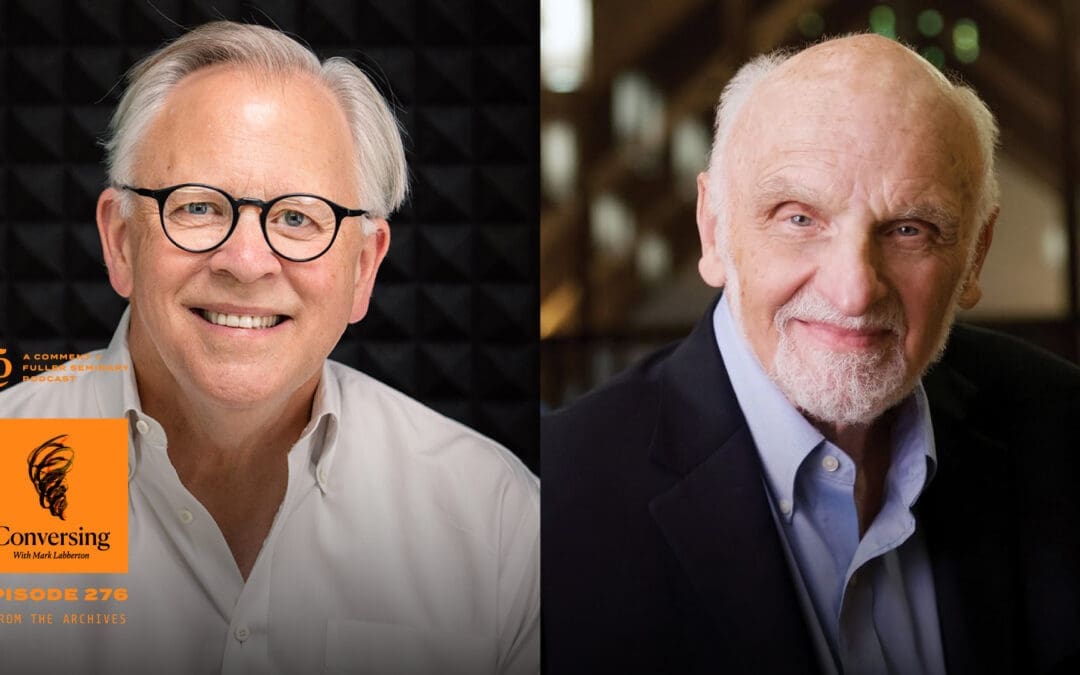
Walter Brueggemann died on June 5, 2025, at the age of ninety-two, and his own influence is unfinished. This episode is from the Conversing archives: a conversation Mark Labberton hosted with Brueggemann at Fuller Seminary for the 2015 Fuller Forum “Justice, Grace, and Law in the Mission of God.” Together they discuss the artistry of biblical language and why art is inherently subversive; Abraham Joshua Heschel on the suffering of God in Jeremiah; the pastor as scribe rather than prophet; the violence of God in the Old Testament and what it means to call it recovery; and justice as the “willingness to be inconvenienced.”
Mark Labberton: What we have in store for Conversing today is a great gift. We went to our archives and decided to share with you today a conversation that I had with Walter Brueggemann over eleven years ago. It was a conversation that happened when he was on Fuller Theological Seminary’s campus for a forum that was going on. And we had a conversation under the title “Justice, Grace, and Law in the Mission of God.”
Walter Brueggemann, for many of you who may not be familiar with him, is an Old Testament scholar. He’s now no longer with us, having passed away in 2025. He saw himself as always a scholar for the sake of the church. He wrote, he spoke. He taught that way for decades.
And though he is sadly no longer with us, the residue of his impact continues to resound in so many places still. Probably his best-known book, a book called The Prophetic Imagination, is one that was in my mind and in his heart and mind as we had our conversation in 2015.
In his leaning toward the church and in his offering to us as people that are part of the church, this kind of reflection on the depth of who God is and what it is that God is doing in the world is a magnificent gift. He was a text wrestler—that is, somebody who approached the Bible both as somebody who took the text in its Hebrew form with the greatest seriousness and his life as an artist with the greatest seriousness, and with the passion and even the appearance and manner that I’ve often come to mentally associate with an Old Testament prophet. He was a vigorous presence. His approach to scripture was that God was not done, and he deliberately felt no need for any kind of artificial closure when God himself seems to be open-ended in God’s own desire to continue to make himself known, and to reveal and affirm and teach and draw the church into the reality that is God’s great passion.
Many of you who are listeners will be familiar with his work and understand fully why it is that I offer this to you today as a great gift, a refreshment in the passions of God by Walter Brueggemann. Enjoy and savour this conversation.
Mark Labberton: Let me just say for starters how really delighted we are that we can host this conversation. It’s a tremendous honour to be able to have Dr. Brueggemann with us this week. I do feel a little giddy actually about you being here, because I’m a fan of yours and because you’re a person that has influenced me for years and years. And I’ve had a rolling conversation with Walter Brueggemann that’s happened in my head and in my heart for a few decades. So I have actually really a lot of things that I could imagine asking you. I’m just going to try to focus in on a few things.
So one of the things that’s amazing about you is your passion. So I want to start there, because first of all, the passion that I encountered with you was passion that I first encountered, I would say, through Abraham Heschel. And it was only later that I learned that he had been an influence on you. I want to come to that later.
Many of the qualities that distinguish your writing is not just that you’re a fine scholar, that you wrestle with texts. I want us to think about all those things. But really, you’re exceptional because you are so passionate about the text and about the ideas that the biblical text is raising. So I’m just curious if you can describe how that even got started, planted in your being, all that.
Walter Brueggemann: Well, my father was a rural pastor. He wasn’t a very good preacher or a scholar at all, but he had great passion about the gospel. And I suppose, since you mentioned Heschel, my doctor father was James Muilenburg, who taught at Union, and he was a very close friend of Heschel. And Muilenburg, in his teaching, brought great passion to the text.
And that was a very long time ago that I studied with him. And I am still discovering the ways in which he shaped me and influenced me about that. So having those kind of teachers made a good bit of difference. But in the end, it’s the text itself that evokes that passion, I think. And I’ve had an incredibly privileged life, in which I’ve just been paid to keep looking and listening to this text. And it’s a strange experience over time that really evokes a response from you if you pay attention to it. So that’s the short story, I think.
Mark Labberton: Right. I mean, I think that a lot of scholars, though, would say that they spend a lot of time attending to the text.
Walter Brueggemann: Yeah.
Mark Labberton: But you don’t feel it is evocative in the way that it is to you. So can you just say a little bit about why?
Walter Brueggemann: And those kinds of scholars criticize me for not doing real scholarship. They say you’re too much of a preacher. So now I say the difference between a sermon and a lecture is about thirty minutes.
Well, I think, as you know, scholars want to think of themselves as scientific and objective. And the whole scene of historical criticism wanted to really screen out passion about the text and look at it reasonably and read it reasonably and so on. And I think that’s a juggling act for those of us who want to have it both ways. But I never had great investment—I had to do it, but I never had great investment in historical critical questions, so I don’t think I ever got talked out of being passionate about the text by that enterprise.
Mark Labberton: Which is partly why you’re thought of as an Old Testament theologian as much as an Old Testament scholar. Isn’t that right?
Walter Brueggemann: That’s right.
Mark Labberton: You’re working on the theology of the Old Testament as opposed to just the texts or the jots and tittles of the Old Testament.
Walter Brueggemann: That’s right. And as you know, very many Old Testament scholars never get around to theological questions because they’re always dealing with preliminary questions.
Mark Labberton: Right, right. I was telling him earlier tonight this story where I was debating about whether I was going to do my PhD in hermeneutics or in Old Testament. So I went to an Old Testament scholar friend of mine, and he had been an Old Testament student for decades. And I said, so give me the pitch. Why should I be—
Walter Brueggemann: Was that you that told me this?
Mark Labberton: I told you.
Walter Brueggemann: That’s fine. It’s fine.
Mark Labberton: Sorry about that. So the funny thing about this story was that he kind of gave me his pitch on the Old Testament. Then I said, okay, but the problem is that I’m afraid I’m going to get lost in the historical critical details. And all of it’s going to be just about microscopic elements of text. And I just don’t want to spend seven years of my life doing that. So give me an idea of a topic that would be a bigger topic than that. And he sat there for just a couple of minutes and his eyes got really bright. He said, adjectives. We really, really need someone to work on adjectives.
And I knew at that moment that I would be doing my PhD in hermeneutics instead, because adjectives were not my future. They were not my past. They are not my present. They are not my future. But somehow, I mean, there must have been decisive moments for you, though, when the pressure to be an adjectivally obsessed person was pressed upon you, and yet you moved through that or beyond it. Were there elements to that?
Walter Brueggemann: Well, the whole experience of my doctoral program was that way. I thought when I went to the program I was going to do biblical theology, and then I found out, no, you’re not going to do biblical theology. That’s not what we do in the doctoral program. And then for a few years, trying to establish some ground in the SBL caused me to try to do that sort of thing. And it took me a while to figure out that I wanted to be a scholar for the church and not for the academy. So what one has to do, and I’m sure it’s true for John Goldingay, you want to maintain your credibility in the academy, but it’s not where you live. And that’s a continual process of sorting that out.
I heard of a guy that spent his whole career studying the dative and the ablative endings in Greek. And at his retirement dinner, someone asked him if he had to do it over, would he do that? Well, he said, I wouldn’t. I would concentrate on the dative.
Yeah. But, you know, we need people who do that. Those of us who try to do the more interpretive stuff really depend on somebody doing that kind of research. I’m just glad I don’t have to.
Mark Labberton: So if I was to ask you to give us the pitch for why we should really fall in love with the Old Testament, what are some of the things you’d say?
Walter Brueggemann: Well, it’s so Jewish, and Jewishness means that it’s conflicted and multivocal and multilayered and complex, and that’s the nature of the text, and I think that’s the nature of the God who indwells the text. So this is a much more interesting and problematic God than most of the church wants to wrestle with. And if you pay attention to the detail of the text, it is just endlessly revelatory in all sorts of ways, I think.
So I am astonished that you can take texts you’ve looked at many times, and when you look at them again—I guess it’s like all great literature, and when you look at it again—it gives you something else. And that’s very energizing.
Mark Labberton: When you say that, we know one of the things that’s often felt about the Old Testament is that, first of all, Bible literacy in general is falling off more and more. And the quality of people’s familiarity, even with the stories, the major stories of the Old Testament are less. And when they’re known, they’re often heard in a kind of two-dimensional way rather than anything that’s as rich as what you’ve just described. And it’s a really old book. And we’re living in a Twitter age where yesterday’s Twitter seems really out of date. So just talk a little bit about reading an old text and how and why that has made such a claim on you.
Walter Brueggemann: Well, if I understand the work of hermeneutics, it is to continually recognize the contemporaneity of old texts. So it is an old text. But I always said to my students, it reads like it was written yesterday. And I think to bring that kind of awareness that we are indeed rooted in a very ancient text, but however one understands that process of it being contemporary and revelatory, if you want to explain that in terms of the work of the Spirit or whatever—it is an old text that refuses to stay old. So the wonder in it is to read the text or to hear the text in ways that lets it connect so immediately with what God has put in front of us. And that’s why historical criticism by itself doesn’t take you very far. You have to do it. You go on beyond that. And I am simply astonished how you can keep at that and receive more.
Mark Labberton: You know, sometimes it’s said of hermeneutics that hermeneutics is the art of interpreting the Bible without ever reading it. And sometimes that’s true, that there’s a lot of hermeneutical theory that’s written, but really not text wrestling.
Walter Brueggemann: Right.
Mark Labberton: And you’re a text wrestler, right?
Walter Brueggemann: I think that’s right.
Mark Labberton: You’ve been a professional text wrestler for your life. So as a text wrestler, you are really engaged in a vigorous experience. I mean, I said this morning when I was introducing you that when I read your books, I often find that my heartbeat picks up, that I’m actually, I’m at times just really overwhelmed by what it is that you’re saying. And I think that comes out of the kind of text wrestling that you’ve done and then the kind of way that that’s captured in your own prose. But just talk about a text. I mean, I’m not asking you to give us an exegetical lesson as much as an experience of what it means to wrestle with a text and not just to know how to poke and prod it.
Walter Brueggemann: Yeah. Well, let me say that I find that I do most of my exegesis—I write everything longhand, and I do most of my exegesis at the end of my pen. And what I have, I don’t know how long I’ve been doing it, but what I’ve been discovering lately when I write longhand, I find myself saying what I’m writing. I didn’t know I was doing that. And my wife hasn’t told me that.
So, well, I was just working on a text in Micah 4, which is about you shall beat your swords into plowshares and your spears into pruning hooks. The verses at the end of chapter 3 are this terrible prophetic lawsuit that Jerusalem will be plowed as a field and turned into a wooded thicket. And then the next verse is, Behold, the days are coming. And I assumed to put those two things together, an editor did that. So who is this editor that had the nerve to put this incredible whacking of Jerusalem next to this vision?
And then in chapter 4, that vision goes on for four verses about the great procession to Jerusalem to get the Torah. And then the fifth verse, which is not in the Isaiah parallel, says, and each nation in this procession of Torah shall walk in the name of its God, but we will walk in the name of our God, Yahweh. I thought, wow, that is ecumenism, to being on the road to justice for people who worship other gods or call the same God by different names.
And so then I just sat back in amazement when I saw this movement from prophetic lawsuit to prophetic promise. And there’s this incredible openness that when you beat your swords into plowshares and your spears into pruning hooks, you don’t have to coerce people into your religious categories. You can let them be. And I thought, wow, that’s a text for the day. It’s just astonishing about how the text got arranged, and I don’t know by who, and I don’t know why. But, you know, for me, that was a whole new insight, because I had never seen that sequence, and I had never seen it culminate. I never heard anybody talk about that verse. It’s Micah 4:5, and it’s just the largest scope of ecumenism that I think is imaginable.
Mark Labberton: One of the things that expresses that, that is in your writing everywhere, I think, is that you’re sort of comfortable with collisions, right? You’re comfortable with shocking juxtapositions, where this comes together with that, comes together with this other thing. This, I think, ties into your interest in art—we’ll come to that later—but part of it is this sense that that helps create your experience, that stages your readiness to receive the collisions that are in the text, right?
And just talk to us about that, because I think in a certain kind of evangelicalism especially, which is, I know, not your tradition, but in a certain kind of evangelicalism, what you’d be looking for is careful order and lack of seams and a readiness to assume that it’s all stitched in a much more easily accessible, more coherent, obvious sort of way. You’re actually pointing out exactly the opposite and finding life in that. So just say a little bit more about that.
Walter Brueggemann: I think that’s right. And I think it’s the discovery for me that universal generalizations are not to be trusted, that it is the ad hoc disclosure of the particular on which we stake our lives, so that the synoptic gospels are not made up of big Christological formulations—they’re made up of particular narrative encounters that are said to have happened in the life of Jesus. And that seems to me to be the primary mode in which evangelical faith is cast at its best. So I think we conservatives and we liberals have been seduced into trying to make universal claims. When in fact, it is really the very particular claims that feed our life and feed our faith, I think.
Mark Labberton: Which is partly the nature of ultimately the incarnation—the claim of the incarnation is the scandal of particularity.
Walter Brueggemann: That’s right.
Mark Labberton: So going back to the Hebrew scriptures then, you know, it would certainly be the case that it would seem that the prophets have really been your—within the wider home of the Old Testament. And you’ve written a lot, a lot, a lot about prophetic literature. And I guess I’m just wondering if you can tie in what we’ve just been talking about with why it was prophetic literature that really kind of most captured your attention within the whole corpus of the Hebrew scriptures.
Walter Brueggemann: Well, I think initially it had to do with thinking that the prophetic literature really funds our passion for justice. So social action and all of that was a big part of my religious inheritance. But then what happened to me as I got underneath that, what I discovered is that the prophetic literature has very few specific agenda. That’s not what they’re doing. They’re doing art. They’re doing poetry.
And then I think Heschel’s book on the pathos of God, particularly in Jeremiah, it was huge for me—that I sort of originally got to through Jürgen Moltmann’s The Crucified God, but he got it from Heschel. It took a Jew to teach us that. So it really is the underneath poetic characterization of God that really has come to preoccupy me. I do think that justice concerns are an urgent spinoff from that, but that’s not the primary focus of the poetry. And I just think that the richness and the daring of the images and the metaphors just preoccupy one.
Mark Labberton: Say more about this. I’m not sure that everyone is familiar with Heschel, and I think it does feel like Heschel’s work on the pathos of God is so—it feels like it’s bristling underneath a lot of the things that you write.
Walter Brueggemann: That’s right, yeah.
Mark Labberton: So I wonder if you could just sort of sketch what it is that he’s arguing and why that’s been so formative.
Walter Brueggemann: Heschel wrote this book a long time ago. It was one of his earliest books, though it wasn’t translated into English for a long time. And he has some chapters on specific prophets, but I think the part of the book that really has staying power and has attracted people—he talks about, particularly in Jeremiah, to some extent in Hosea, and to some extent in Second Isaiah, what he calls the pathos of God, that is God’s capacity to feel in to a situation and suffer.
And he finds that particularly in Jeremiah, for example, in Jeremiah 8 and 9, where you have that question, is there a balm in Gilead and all of that? And three times in that poem, God says, my poor people, oh, my poor people. And then at the beginning of chapter 9—the verses are somewhat different in Hebrew and English, I don’t know how that works—but God says, Oh, that I had bigger tear ducts, because I must cry more than my eyes will permit me. Oh, that I had a place to go in the wilderness just to get away from all this stuff. Oh, you are such slanderers and liars. I can’t bear it anymore.
Now, you know, historical criticism says, well, Jeremiah was a very upset guy when he wrote that poetry. But, of course, that’s not how the text gives it to us. The text gives it to us that this is a disclosure of God’s internal life, and Heschel simply unpacks that in such artistic and compelling ways. If you do not know Heschel’s book, you not only want to read it, you want to have it in your library, because you’ll look at it often, I think.
And there is a book by a Japanese scholar—I’ve lost his name—but it’s all about one verse in Jeremiah 31:20, where God says, is Ephraim my dear son? The answer is no. Is he my darling child? No, because I rejected him. And then God says, but as often as I do not remember him, I think of him still, and therefore I will have mercy. And it’s a—”I do remember him still” is an absolute infinitive.
So what this shows is a parent of a teenager. And, you know, you just want the teenager out of the house. And they said, oh, but he’s my son. He’s my darling child. You know, I think when I read that, what did it cost Jeremiah to get those four lines down like that? And where did they come from? And so Heschel unpacks all of that. It’s just extraordinary.
Mark Labberton: It’s extraordinary. I do think that one of the things that links you and Heschel too is artistry. So let me go on to his use of language and yours, because I think it’s really interesting. I’m not trying to overplay Heschel’s influence in your life, but I do find a deep resonance because of both being so committed to the prophets and to the text and to the pathos of God.
So, I mean, one of the things that’s so amazing about Heschel is what you’ve just named, which is that he’s an artist in the way that he describes this. He’s not just writing a kind of dispassionate declaration about the fact that God has pathos. He’s actually verbalizing the passion of God while he’s actually describing the passion of God, right?
This is what you do. And it’s partly why I think your language is so powerful in both preaching and in writing, is that you have a very—you’re actually writing about really rich, complicated, colliding ideas, but you use prose really in a pretty disciplined, tight way. Your sentences end with surprise. They end with strong single syllable words. They are forceful, artistic English, right? That’s how I read your stuff. I both admire that and envy it, but also I’m taken with the fact that you are an artist as a writer. So you’re a scholar, you’re a passionate person caught up in the pathos of God. And you are an artist as you seek to write and declare that. Is that fair?
Walter Brueggemann: That’s the nicest thing anybody has ever said to me. That’s what I aspire to be.
Mark Labberton: Well, I think you’ve done it.
Walter Brueggemann: And it’s been a hard journey, because when I started out, I had what my teacher called a very Germanic style—complex sentences and all of that. So I really have had to learn and try to work at that.
Mark Labberton: Have there been writers that have influenced you in that way?
Walter Brueggemann: Well, I read a lot, but I couldn’t name people. More helpful to me have been several colleagues who took the time to go over my writing in great detail. And show me how clumsy it was and how it didn’t have to be that way. And that was a big piece of work in my life.
Mark Labberton: Those are friends.
Walter Brueggemann: That’s right. The other thing about an attempt to be artistic is that as a biblical interpreter or as a preacher, you cannot aim at a moral outcome or a doctrinal outcome. You cannot aim at an outcome, because if you do that, it becomes coercive and that violates the possibility of artistry, I think. And I have a great propensity to be didactic because of where I come from and all of that. So it’s a great act of resistance on my part to work at not doing that.
Mark Labberton: So you’ve mentioned earlier today in a couple of different settings about how important the arts are to understanding the Bible as an expression of artists, as opposed to sort of tax keepers who wrote analogues of biblical ideas, and instead really people who were caught in an artistry. Can you comment on that and how that has shaped you?
Walter Brueggemann: The background from which I come had no sensibility about art at all. So it’s taken me a long catch-up on that to see that art is inherently subversive, because it wants to show us reality in a way that we have never before seen it. And what we always want to do with art or with the Bible is that we want to cram it into the categories of the familiar, because if you can make it familiar, then you don’t have to think about it anymore.
And when you ask me who’s influenced, I would say Wendell Berry has influenced me a lot, first in his novels, and then some in his poetry as well. It has been the discovery that words do not have meanings, but that combinations of words do things.
And I find always with seminarians, my pedagogical question is, what do you think is going on in this text? And you always get a meaning. No, no, no, no. What’s being done here? What’s being performed here? And as soon as you say performed, hopefully you’re moving in the direction of art and so on. So to let the text or any piece of artistry do its own work rather than imposing something on it is very difficult, I think.
Mark Labberton: Well, that’s what I was going to say. I mean, it’s partly that you’re comfortable with the collisions we talked about. It’s partly that you’re free with the unfinishedness, which a lot of art needs to be, right? Not all art is that, but probably a great deal of art is. And in your case, you live in the freedom of that. Was that hard to learn?
Walter Brueggemann: It’s very hard to learn. It was hard to move beyond historical criticism. That was not internally hard. That was externally hard, because you get criticized in the guild for doing it that way. So I have taken my share of beating for that. But it was also difficult for me personally, because I want the church to get it right. And on many days, I think I know what that means. Back off. So, yeah, that’s a continually growing edge for me.
Mark Labberton: One of the things that is one of the reasons why reading you has been so inspirational and helpful to me is lies just here. So I want to ask a couple of questions about that and then we’ll open it up to everybody else. So it’s this unfinishedness, right? And especially the unfinishedness of the prophets. So probably few things open us up to the riskiness of faith any more than really looking at the unfinished world that we’re a part of, that’s full of turmoil, that’s full of suffering and anguish and injustice and pain. And the cry of our own individual lives or the cry of our collective hearts is a scream of anguish to God. Where are you? How are you? Why is this not finished? Why didn’t you finish this? Why have you left a world like this? And then, you are a God of salvation and have done even the most decisive things possible in Jesus Christ’s death and resurrection, and it is still unfinished. How do we live with that unfinishedness?
Now, the reason why your writing has been an encouragement to me has been that on Saturday nights when I was finishing sermons that I was going to be preparing to preach the next morning, and I was feeling overwhelmed by the inadequacy of my sermon in relationship to the lives of people I was going to face and the text that I was going to proclaim, it would be easy to just despair in the unfinishedness, right? To feel like, oh my gosh, how can it be so unfinished? But then I would pick up one of your books and read a chapter or two and think, okay, I have to keep this relocated again in a much larger drama, a much bigger story, a much longer story.
Can you comment about that? I mean, I feel like that’s a personal thing as well as something that probably everyone in this gathering tonight in one way or another experiences.
Walter Brueggemann: Yeah. I think the unfinishedness of it is, on the one hand, it’s so Jewish. Because if you ask a rabbi what a text means, she will tell a story. And if you ask what the story means, she will tell another story. The meaning of the text is unfinished. So partly it’s Jewish and partly it’s evangelical, that the God with whom we have to do is not a God who gives closure. This is a God who stays faithful in the unfinishedness. And I’m not into process theology or any stuff like that, but in some ways, God isn’t finished becoming God yet. So there is more light to break forth yet in our midst.
I think the vexation about it being unfinished is a personal one, but it is also a professional one for pastors. Because people in the church want closure. And they want it wrapped up at the end of it. And to leave it open is anxiety-producing. And that’s, in some ways, the nature of the task.
One little vignette about Jeremiah. Somebody gave me a book in which this woman has written a very short, I guess you’d say, tweet about each chapter in the Bible. And for Jeremiah 20, what she writes is, Jeremiah said, woe is me. He should have said, woe is I, but he had enough trouble.
Mark Labberton: We want to open up this conversation to others of you. I could go on asking many more questions, but I will stop for the moment and see if you have questions. I think if we have some, maybe, and we’re going to hear them as they’re read off by our two friends. So please, Alice.
Question Reader: Thank you. So we’ve had multiple questions being asked about the topic of scholarship, the academy, and the church. And as many of us know, it can often feel like you have to choose between being a scholar or academic in the church. How have you reconciled that of how do you be a scholar in the church?
Walter Brueggemann: Well, I think to be credible, one has to maintain one’s credibility in the scholarly community. So you have to do that kind of work. And it’s really hard to do that kind of work and also do the work that mediates stuff for the church. I must say that in Old Testament study, that’s changed a lot, largely because of Brevard Childs. Brevard Childs has made it much more credible to do scholarship that is, in fact, theological interpretation. When I started, no reputable scholar did that kind of work.
And it just takes a lot of intentionality. It takes a lot of hard work. And frankly, it takes a lot of nerve, because you have to let things go that are unfinished. Because you have to publish if you’re going to do that. And with some exceptions, I suppose, what we publish in Old Testament interpretation is never ready to be published. You just have to finally send it off.
And I take great heart. I’ve heard it said that when Karl Barth did a lecture, Charlotte, his associate, simply put the lecture in the mail, and it became the next piece of the Dogmatics. He did not linger. Well, obviously, the Church Dogmatics could stand to good editing.
So it’s just—I think it requires a very self-aware sense of one’s calling and what one is going to do in one’s work. I think the academic end of it is really important and cannot be compromised, but that by itself I find pretty boring, and I’m glad I get to do something else.
Question Reader: We have a question. You’ve written about the need for more prophets in the church? What would a faithful scribe look like?
Walter Brueggemann: Well, I was talking to your homiletics guy, and my argument in an article I wrote about which we had a brief conversation is I don’t think most pastors can be prophets. I think it’s too hazardous when you’re not tenured. So what I propose is that a pastor ought to be a good scribe, and that is, let me tell you about this prophetic scroll. Let me tell you what the prophet said, and let me tell you how what the prophet said is contemporary. So it’s handling scrolls, I think.
As I think I said this morning, what we really have to work at is if people don’t like it, what you hope they don’t like is what the text says rather than not liking the preacher. Now that’s very difficult, because for most church people that’s all coalesced and you can’t separate them, but we have to work at that.
So last week did some lectures on that text. I think it’s in Matthew 13, I’m not sure about that. Jesus tells these parables. And then he says to the disciples, have you understood what I said? And they say, yes. They clearly don’t understand. And then he says, a scribe trained for the kingdom must take out of his treasure things old and things new. So the Matthew version of the gospel, which is very Jewish, really wants the disciples to be scribes. And if you take out of your treasure what is old and what is new, it is the practice of hermeneutics. That’s what hermeneutics is. So I find, you know, it’s just one text, but if it’s the right text, you can get a lot of mileage out of it. So that’s what I think.
Question Reader: Another question. You speak a lot about how interesting, nuanced, and problematic God is, but churches are often not willing to wrestle with that, or our congregations. How, as pastors, can we talk about such a God?
Walter Brueggemann: Textually, textually, textually, textually. You have to make sure that church people understand this is not my idea of God. This is what is given us in the text. And it’s not surprising that when we do that, the people who imagine their life completely settled, they don’t want to hear that. But people whose lives are in turmoil will thank you for that. Because they will say—they don’t have the words for it, but what they mean to say is, I think I’m made in the image of that God. Because I know about conflictedness. And I think anybody that doesn’t know about conflictedness probably doesn’t have a lot of self-awareness.
So, you know, Calvin starts the Institutes by saying you can either start with the knowledge of man, he said, or you can start with the knowledge of God. You can start either way, and that’s how it’ll come out. So our knowledge of God is always connected. It’s not the same, but it’s always connected to our knowledge of self. And that’s how it works in a dialogic faith. And a lively self is a self that’s not finished yet, made in the image of a God who is not finished yet. And so these are vignettes or snapshots along the way of our being unfinished.
Now, I think that, you know, it’s very demanding on the preacher, but it also takes a lot of pressure off the preacher. Because the preacher does not have to articulate global truths. The preacher just has to provide something that we can chew on and see what that piece of the disclosure is like for us today, I think.
So I think, you know, when the prophets uttered these poems, they didn’t think they were writing eternal texts. They had something given to them for that day, and they had to say it. I think Saturday night, the preacher always has to be asking, what is it that’s being given to me for right now? And I don’t have to do more than that. That’s a lot, I think.
Mark Labberton: I think what you’re getting at is one of the reasons why biblical literacy actually really does matter. It’s not because somehow people just need to get more quantities of Bible text in them, but because they need the Bible to be able to do the gritty, gristly work that you’re just describing, right? And if that isn’t in people’s hearts and minds, if going to the text is a really unfamiliar, foreign, disorienting thing and not something that’s just unfamiliar because it’s really calling us to an unfamiliar God, that’s a really, really different reality and not nearly as life-giving. So then it just feels like, oh, you should memorize the catechism or something as opposed to actually encountering God.
Question Reader: I’ve had a few questions regarding the comment that God is unfinished. And so I was wondering maybe if you could clarify for us what that means, especially in the impact of Jesus’s words that it is finished on the cross.
Walter Brueggemann: I preached on “It is finished” on Good Friday. Are any of you basketball fans that remember Red Auerbach coaching the Boston Celtics? He had what he called a victory cigar, and by the third quarter, if he knew the Celts were going to win, he very ostentatiously lit up his victory cigar in order to taunt the opponents. So what I did in my sermon was to say, it is finished, was God’s victory cigar. He said, we’ve already won, and it’s over with. But you have to play the rest of the game. You couldn’t leave the field. I would like to tell you that that’ll preach, but I don’t know whether that’ll preach, even if I did.
Well, by unfinished, I mean a text is a momentary disclosure into the mystery of God, but is certainly not a complete disclosure. I’m reminded of the—I think it’s the last verse of “Love Divine, All Loves Excelling,” which says, Finish then thy new creation, pure and spotless, let us be. It’s a petition, please finish, recognizing you haven’t finished yet. That’s Wesley’s great hymn about that.
So I think that our common recognition, that we are on this journey and that our dialogue partner on the journey is God who is underway. It may be that if we had great insight into metaphysics, we could say something else. But that’s not what we got. We got utterance. And we reiterate and replicate utterance. You know, it may be that more evangelical traditions want and need to say more than that, but that’s what the text feels like to me.
I mean, I can recite the creed, which I do every Sunday, and I do that in good faith, but the creeds are also acts of poetry. You know, who knows what it means to say God from God, true God from true God, begotten not. This is wonderful. But it’s not description. It’s doxological articulation. And I think we so easily misconstrue the nature of our language, I think.
Question Reader: What strategies do you recommend for students to develop moral, creative imaginations?
Walter Brueggemann: Oh, I don’t think I know the answer to that. My homiletics colleague at Columbia Seminary, Anna Carter Florence, requires students to identify and narrate new parables that they have observed in the world around them—a hard piece of work.
I think maybe to take metaphors or images from the prophets or whatever and just walk around them and write down what it’s like to walk around them and to see what all you can see and to hear what all you can hear, because these images and metaphors are very thick. And we live in such an instantaneous society that we want to get everything at first glance. But artists cannot hurry. Artists have to linger. And I think learning to linger is really an important exercise for the practice of evangelical imagination. The good stuff is hidden in the word and the image and the metaphor. And it does not give itself up quickly or easily. And we have to wait, I think.
Mark Labberton: I think that, though, points back to the things we were talking about earlier of your exemplary demonstrations of just letting the text, falling in love with the text, wrestling the text, sticking in the text, letting the text get stuck in you in ways that just play on your heart and mind. It’s just extending in a way what you’re saying about letting metaphors gradually unfold, the thickness of the text become known.
It seems like often the need for moral imagination is nutrient-starved. So it’s that we don’t really have the right nutrients to begin with to be able to actually have a fertile imagination about much that isn’t just handed to us in cultural forms that are pre-digested, vacuum-sealed. So it feels like there’s just an opportunity for letting something as raw and unfinished as the scriptures itself germinate in this way. That just means that I then have to come to the world differently because I’ve just been in Micah 4 in a way that I wouldn’t otherwise.
And I think it’s that—this is one of the reasons why homiletically I’ve often tried to encourage students to stew over texts for a long period of time before they ever preach them. So they would start reading them, the text that they might know that they’re going to preach on in a year, that they just read them regularly a year out so that they begin to let the text just germinate in a different way. They’re not doing it for the sake of an immediate product. They’re not trying to turn it around and produce the sermon by the next morning. They’re actually just putting in the right nutrients and letting it do its work.
Walter Brueggemann: Well, that’s another question to which I do not know the answer. But I think it is one of the tasks of the preacher as the leader to teach people how to read the Bible. It is an educational task, which I suppose we teach best by modelling. I think church people need to see us doing the hard work of reading the text and inviting people to be with us and alongside us in doing that hard work.
My pastor is doing a long-term study on the Gospel of Mark, and I think after the fifth week, they were about to get to chapter 2. And one of the guys in the church said to him, why are we going so slow? Can’t we just get through this and have it? And, you know, that was a teachable moment.
Mark Labberton: I think that as a pastor, one of the things that’s been a help to me is to sometimes just own this in front of the congregation, to say, you know, this text is an equal-opportunity offender. And really, there’s everyone in the room should be offended by this text by the time we’re done. And that is a way of inviting reading that doesn’t presume that we’re going to cut to the quick in some easily resolved way. It doesn’t say that one side is going to win and the other side is going to get pinned down. It’s really exposing, I think, a much richer vision of the Bible and, you know, especially Christologically, a much richer picture of Jesus than, for example, than we often get.
So I think in that sense, there’s plenty to offend everybody. And as long as you feel like you’re really letting the Bible offend in all of the directions that it offends, I think you have a lot greater chance of getting a hearing than if you’re a selective offender, which then really feels like it’s been pre-screened, pre-ideologically screened, and then you’re only offending one end of the spectrum, let’s say.
Question Reader: Dr. Brueggemann, this is a little bit more of a personal question, but you told a story about a man who asked you if you regretted anything at the end of your life or that you would do differently. Is there anything that you would do differently looking back or that you would recommend to pastors, theologians, and scholars to do differently?
Walter Brueggemann: Well, I was an academic dean at my seminary for fourteen years. I wouldn’t do that again. I have a lot of regrets. But, you know, we just live our lives forward. And I use too much energy on unimportant tasks and so on. But I didn’t, at that time, didn’t have the wits to sort out what was important. So, you know, it’s the way my life has gone. For now, you know, I’ve arrived at a pretty good place, but a lot of false starts along the way.
Martin Marty said that nobody wants to admit that they did theology in the seventies because it was such a harum-scarum time. And I went through my, what I call my Harvey Cox period of secular, and Harvey Cox went through his Harvey Cox period, too. So he got out of it and so did I. So, you know, we just live along the best we can.
Question Reader: Is there anything that you wish today’s pastors or scholars knew as they go into their vocation?
Walter Brueggemann: Oh, there’s a lot, but nothing comes to mind. I think what I want to say is those of us who are sort of in this business, to recognize how incredibly urgent the pastoral task is. I think that our society is about to forget what it means to be human in a technological capitalist environment. And I believe that a main testimony of the church is to bear witness to what it means to be human.
And the fact that that is so urgent is also why it is so difficult. Because what it means to be human, among other things, means to be unfinished. And that really is against the grain of the dominant value system of our society. The dominant value system of our society believes that everything can be fixed. If you just get the right beer or the right cosmetic surgery or the right car or the right something, all will be well. All will not be well. All will never all be well, except that all is well. And that’s very difficult, because people know that in their gut, but they don’t want it talked about. And if it’s not talked about, we can’t do anything about it. That’s what I think.
And I think that has all kinds of policy implications. It’s not just intimate one-on-one stuff, but if you start out with the assumption that everything can be fixed, then you give approval to surveillance or to torture or to drones or to whatever that’s necessary. And if you listen to call-in radio, what people say about drones is, I don’t think we ought to use them unless it’ll make us safe. Then I think probably it’s all right to do that because it will fix our life. And that is such a pathology to think that way about our life, I think.
So it is our great joy to bear witness otherwise, because we know otherwise. I’m going to the Festival of Homiletics in a couple weeks, and my sermon is from Matthew 11, where Jesus says, I tell you that prophets and kings would like to know what we know, but it had been entrusted to infants. And by infants, he means the disciples. And what Jesus is saying is that the people that have walked with him know something about the reality of life in God’s world that prophets and kings and power people want to find out, but they don’t know. And so the pastors of the church, I think, may take great joy in thinking what it is that has been entrusted to us—not just to us, but to us.
Question Reader: There are many students here that are getting degrees other than theological degrees, and there are even students that are getting theological degrees that don’t want to necessarily be pulpit pastors. And so how can these students seek justice when their calling is outside of the church?
Walter Brueggemann: Well, praise God for people like that. I think that the practical work of the Jesus movement is to build neighbourhoods. There are opportunities to build neighbourhoods wherever one is in business or whatever vocation one has. And we do that upstream, because the dominant values of our society are anti-neighbourly. So thank God there are people with theological understanding who will be at that work in many places.
Question Reader: Just looking at the news right now, there are just so many issues that are overwhelming. And in reading scripture, we know that as Christians we’re called to work toward justice, but it often feels like how do we do that as just a normal Christian on the street that is more than just having compassion or mercy, that is actually working toward justice.
Walter Brueggemann: Yeah. Well, I think it’s complex, and I don’t think there’s any simple way to do that. But I have become increasingly convinced that community organizing is really important to the life of the church. I was recently with the staff of DART, which is a national organization of community organizing among Christians, and their mantra is 52–1. You worship 52 Sundays a year, one day a year. You want to get all that church attendance to come out to City Hall around one issue, because they are convinced that if you produce a critical mass, power people have to engage you and have to listen. So much of our scattered intentionality about justice really turns out to be kind of irrelevant, even though we have good intentions. So I think that idea of organizing to produce critical mass on occasion around particular issues is really a very important initiative.
They told the story that in Lexington, Kentucky, the local organization asked the city council for $500,000 for low-income housing. And the mayor said, can’t do it. We just spent all the money renovating Rupp Arena. You may know Rupp Arena is where the University of Kentucky plays basketball. It’s kind of the Kentucky temple. No money. So soon after that, they turned up 4,000 people and they got the money. They laughed about it because they taught the leader, now you say to the mayor, ask the mayor, and the mayor will say no, and then you ask the mayor again, and the mayor will say no, and you ask the mayor again. But the mayor crossed him up because the mayor said yes the first time, and he kept asking.
So one approach is to become visible in significant enough numbers that there is political reality to our neighbourly faith. Now, there may be many other ways as well. But that’s what I’m aware of right now.
Mark Labberton: I think one of the anxieties of many groups that are leaders in the justice movements around the U.S. right now are the concern that justice is just a fad of a generation for a season and that it will really pass. So I think part of it has to do with how do you learn lifelong habits and how do you build long-term community that can actually sustainably carry out protracted action that can actually show up again and again and again.
Walter Brueggemann: Those kinds of involvements is that I don’t mind dying for Christ, but I don’t want to be inconvenienced. And, you know, so much of justice work is just being inconvenienced, going to meetings, showing up, stuff like that. And it’s really hard in our kind of society that always lives toward convenience.
Question Reader: Many of us recognize the church’s call to pursue justice. And yet we acknowledge that justice will not be complete until God brings it to fulfilment. How do we live in the tension of these two?
Walter Brueggemann: Well, we are not called to do God’s work. We are called to do our work. And we may trust God to do God’s work. So what we have to be talking about is what’s our work in the meantime. And there’s enough to do.
Question Reader: What do you think when you talk about God is in recovery from violence? We often don’t know what to do with Old Testament violence. Just a small question.
Walter Brueggemann: Yeah. The violence of God is so hard in the Old Testament. And as an Old Testament teacher now, I get asked about that more than any other question. So interesting to me that I never got asked about that until about a decade ago. It’s now on our minds.
And I think that the liberal strategies of, you know, J, E, D, and P, that God used to be primitive but now is more like us, or that was a joke, or that it’s human projection—I don’t think those are adequate answers, because if you say that the violence of God is simply a human projection, that’s a slippery slope about other things being human projections. So I want to entertain the thought that God really has been involved in violence. And there is evidence that God intends to do better than that and often does better than that. That’s why I used the word recovery.
The classic example that’s easy to cite is that incredible text in Hosea 11 where God starts out by saying how I called Israel out of Egypt and as a little child I took care of him. And then for three verses, God just gets enraged at Israel and says, just go on with the Assyrians, see if I care. And then in verse 8, it’s like God catches God’s self in mid-sentence and says, what am I doing here? I can’t treat it like Sodom and Gomorrah. God reverses field.
So that’s what led me to think, and there are other texts like that, that as the poets exhibit God, in some of those texts, God recognizes that God’s violence is a problem and intends not to act that way, and so on and so on. So, you know, I don’t know whether that’s adequate, but I want to take the violence texts as authentic disclosures of where God has been. And it’s not pretty. I don’t want to explain away all the texts that are awkward. That may not be the best way to handle it, but I want to take those texts seriously as theological data. And that’s really hard. You may have a very different take on that.
Mark Labberton: Well, I want to extend it actually in a slightly different way. So if you take that assumption and you think about God and a world of violence—I’m thinking, I’ll be specific about this, morning I had a conversation, a brief conversation with one of our students from Kenya, and she was describing the challenge of living in a Muslim Christian context where these aren’t just ISIS people in some general military and perhaps sometimes invisible sense. But really, they’re your neighbours and they are part of a cohort of people who are in deeply strained relationships with one another, riding the bus together and living and each seeking God. And as a Christian, seeking a God whose call is to love even enemies and to make peace in a world of violence, not least violence that’s pressing in even in different parts of Kenya, for example. Put that assumption of the Bible to work for us to give us a sense of where it lands. How does all that land for a person facing this, what she’s describing as a daily experience?
Walter Brueggemann: Well, I don’t think I know how to respond to that. But what I think is that God is most faithful when God is choosing against such violence. We are most faithful when we choose against such violence, I think. But it’s very difficult.
Mark Labberton: So let’s focus on a slightly different area that’s related, but somewhat different. This is obviously the daily experience of people that live in Israel, both true of Jews who experience violence and true of Palestinians who experience violence. So since you’re the Old Testament dude, give us some perspective on how you think about a God of violence in a land of violence like Israel.
Walter Brueggemann: Well, I think that the chosenness of Israel and the gift of the promised land have been hardened into a political ideology. And I think that in the Old Testament, there are many caveats against that ideological reductionism, so that there is a strand of the Torah that says that the land of promise is held conditionally depending on the practice of neighbourliness. And I think that the ideology of Zionism wants to claim that the land is held unconditionally. So I think that’s kind of a major thing. And I think that the military Zionism of the current state of Israel ought not to be confused with any of the claims of Judaism.
Michael Walzer, a Jewish political scientist, has just written a book in which he studies Israel, Algeria, and I can’t think of the third one. And what he says about all three revolutions is that the revolution was done by secularists. So he says the founders of the state of Israel hated Judaism. But then what they discovered is you cannot sustain the revolution without an appeal to the religious tradition. So you have this strange interface of secular political drivenness and an appeal to a legitimating religious tradition. And I think that the actual practice of contemporary Zionism cannot, in fact, make an honest appeal to the old tradition. Obviously, that’s very different from the way Israel presents itself. That’s what I think.
So the theological claims made by the state of Israel, it seems to me, have no credit in the contemporary world of international affairs. That it may, so to say, activate their base, but it isn’t going to persuade anyone else. And I think it’s politically impossible, but I think U.S. policy finally will have to change from kind of a blank check for the state of Israel about all of that. That’s sort of how my mind works about it.
Mark Labberton: Well, certainly the Israel-Palestinian question is part of the convergence around these themes that we’re looking at this weekend. And the meaning of law and grace and justice is really, really profound. And I wonder if you would send us out with maybe just a little word from one of your favourite psalms, some psalm that captures you that might be a blessing for us tonight as we go.
Walter Brueggemann: My favourite psalm at the moment is Psalm 73, which I’m sure is on the tip of your tongues. But the first verses are about an Israelite who is describing that he almost fell out of faith in envy toward the wicked who prospered and were celebrities and were cynical, and nothing bad ever happened to them, and I want to be like them. And then he says, until I went to the sanctuary—it’s like the prodigal son, I came to myself. And then he goes on to say, I don’t want any of that. All I want is you. Whom have I in heaven, and who do I desire on earth but you?
And I have come to think that that’s kind of a script in our society of being almost talked out of our humanness by this world of commodity and then coming to recognize right in the middle of it, that’s not what my life’s about. My life is about fidelity and communion and all of that stuff. The text tells us nothing about what happened when he went to the sanctuary. But it was obviously a deeply redefining moment. It may be that in our culture, that’s the moment where the church finds itself in some ways.
Mark Labberton: Well, this has been a rich, rich gift to have this conversation and for us to be able to eavesdrop on your own reflections and experience and background. Would you just join me in thanking Walter Brueggemann?
Walter Brueggemann: Thank you. Thanks.
Mark Labberton hosts the Conversing podcast and is the Clifford L. Penner Presidential Chair Emeritus and Professor Emeritus of Preaching at Fuller Seminary.
Walter Brueggemann (1933–2025) was William Marcellus McPheeters Professor Emeritus of Old Testament at Columbia Theological Seminary and the author of more than a hundred books, including The Prophetic Imagination.
Love the show? Help others find it by reviewing it on your favourite podcast app. We also welcome your ideas and feedback. Email us at conversing@comment.org. Thanks for your support.