
Scholars increasingly define evangelicalism around networks and affinities. But these models are made for a disappearing world.

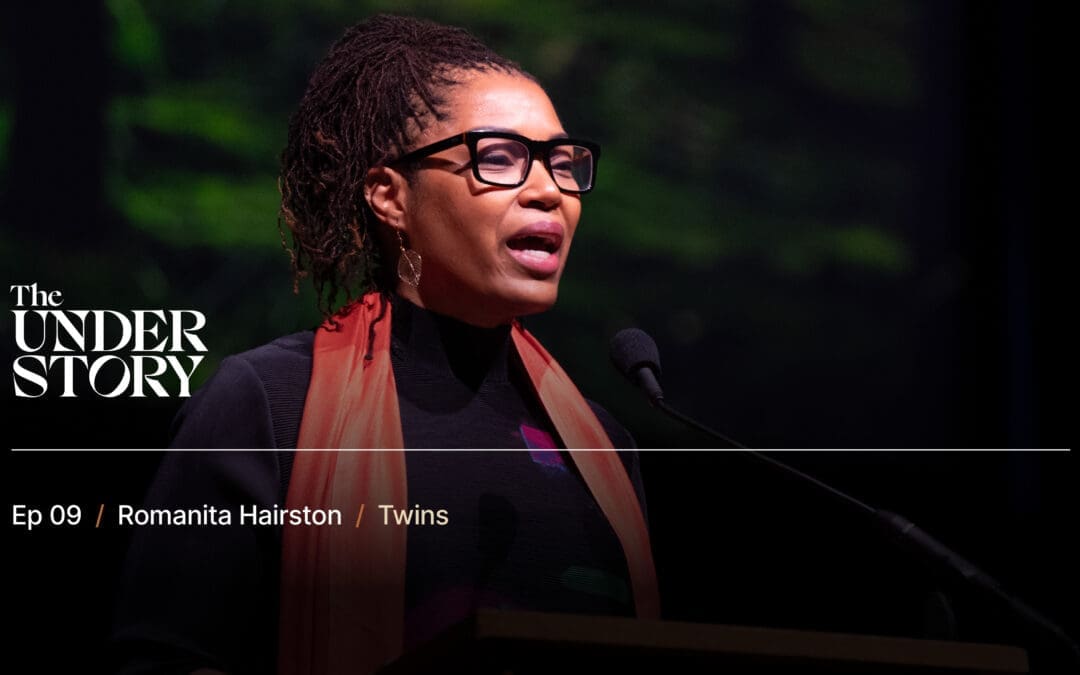
Philanthropic leader Romanita Hairston suggests that what is struggling to be born in our time is not one thing but two … and that neither can survive without the other. Beginning with artificial intelligence and ending with one of the most personal stories of the evening, she invites us to imagine a humanity no longer defined by usefulness alone.
This reflection originally appeared in our episode, What Is Struggling to Be Born?, framed by an address from Fr. Tomáš Halík, and recorded at the National Cathedral on the Understory’s opening night.
Anne Snyder: From Comment magazine, welcome to The Understory, where the future quietly takes root. I’m Anne Snyder.
The new humanity is coming and has come. The new institutional life is coming and has come. It is now and not yet, continually being born. It is not stillborn, but forces are pushing and forces are pulling, and the breath is not yet free.
Philanthropic leader Romanita Hairston suggests that what is struggling to be born in our time is not one thing, but two, and that neither can survive without the other. Beginning with artificial intelligence and ending with one of the most personal stories of the evening, she invites us to imagine a humanity no longer defined by usefulness alone. This reflection originally appeared in our opening night episode, “What Is Struggling to Be Born?” framed by an address from Father Tomáš Halík. Recorded at the National Cathedral on The Understory‘s opening night, here is Romanita Hairston.
Romanita Hairston: I am grateful to be in this cathedral, to follow the voices that have gone before and who will follow, and to be here with all of you.
In 1960, half of all the jobs in America required real physical labor. Today, less than 20 percent do. In 1960, fewer than 8 percent of Americans held a college degree, and today nearly 40 percent do. We handed physical labor over to machines—aspects of farming, factory work, the long day’s labor of the body—and we reorganized civilization around the mind. We built universities. We credentialed work. We rewarded intelligence, analysis, articulation.
Now, with the advance of artificial intelligence, machines are proving capable of forms of cognitive work we are only beginning to understand. They can seemingly write, reason, diagnose, design, predict, persuade. The concerns are very real, and they are consequential. And in five minutes, I will not do them justice, so I will not solve all your AI problems tonight. Job displacement, the concentration of power, the erosion of judgment, and the impact of progress are all real, and they do deserve sober, sustained reckoning.
But beneath all of them, I feel a more familiar, older, and quieter anxiety. We were not as afraid of losing physical labor, but the loss of cognitive labor seems to feel different. Because somewhere, quietly, we have come to believe that cognition does not define what we do. It defines who we are and the value of those around us. That fear of loss is not a technological problem. It is ideological, and it is theological. And it is not complete.
The human person is body and mind, but we are also hearts that feel and a will that desire, a spirit that longs. Each is a gift, and none is the whole.
And so what I want to vulnerably offer tonight, that I believe what is struggling to be born is twins. Congratulations, you’ve got two babies. A new humanity and a new kind of institutional life. They cannot survive apart. A humanity not defined by physical strength or cognitive output, but constituted by love-infused belonging. Beloved before useful. And institutions to match that new humanity, powered not by power that we have abandoned, but converted fully to service of others over self, not absent of self; shaped by love as a foundational ontological conviction of life; disciplined by listening; trustworthy because institutions remember they exist for persons, not the other way around.
The new person cannot flourish inside of institutions or a society that measures worth by usefulness alone. The new institution cannot be built by persons who are still defined only by what they produce through physical or cognitive labor or fiscal output.
Because here’s what I’ve come to see if I take this analogy a little bit further. These twins, these babies of ours, the new person and the new institution, have cords around their neck.
Before I was married, the Lord gave me the name of my first son. The name itself felt like a promise for him, who he could be and what he might become. When I labored to birth him, I pushed for almost a day. There are people in here who know what I’m talking about. When he came, his cord was wrapped around his neck. He was not breathing. There was blood. The panic. I held the promise, and we waited for the breath that would tell us that the promise would hold. The prior 24 hours was cast in a new light of the reality that as I was pushing, the umbilical cord was pulling, chastening every breath.
This is where I believe we are. The new humanity is coming and has come. The new institutional life is coming and has come. It is now and not yet, continually being born. It is not stillborn, but forces are pushing and forces are pulling, and the breath is not yet free.
I see two cords most clearly. The first is our instinct to take our worth and the worth of others from what we produce. We have not yet learned how to be valuable apart from being useful. The second is fear—the internal fear of identities still uncertain of themselves, and the external fear-stoked world around us, the rhetoric that exists that the new humanity is naive, the new institutional life impossible. Fear is the cord that tightens when something new tries to draw breath.
It would be untoward of me not to mention the role of love and loyalty, but time does not permit a deeper dive. But they are the work of the Spirit. The Spirit’s power is the power of connection. There is an understory of connection that is not fueled by the name tags we wear, the jobs we hold, and the things that we can do. Of truly seeing one another, of knowing one another, not merely doing things together.
And so the twins are reaching for this. Not an idea, not agreement, not even understanding—that ancient, inexplicable moment when one person, one community that is whole, present, is truly met by another. Understood in the mind, known in the heart, chosen by the will, and seen in the spirit. That is not manufactured, it is received, and I believe it is the most ordinary miracle of the Spirit. The very thing that love, when it becomes structural and institutionalized, tries to protect.
So tonight, as we are here in the cathedral, in this hour, in the three days ahead, I hope what we are is a people willing to be more than useful, willing to be human. Willing, like the doctors and nurses who gathered around my son by the grace of God, to help the twins draw breath.
Thank you.
Anne Snyder is the editor-in-chief of Comment magazine.
Romanita Hairston is a philanthropic leader and CEO of the M.J. Murdock Charitable Trust, where she draws on more than two decades of work across the nonprofit, corporate, and foundation worlds.
The Understory Festival is a civic and spiritual gathering to rehumanize our common life in a time of cultural fragility. Love the podcast? Help others find it by reviewing it on your favourite podcast app. We also welcome your ideas and feedback. Email us at podcasts@comment.org. Thanks for your support.