
Wayfaring with friends and brothers in search of the holy.

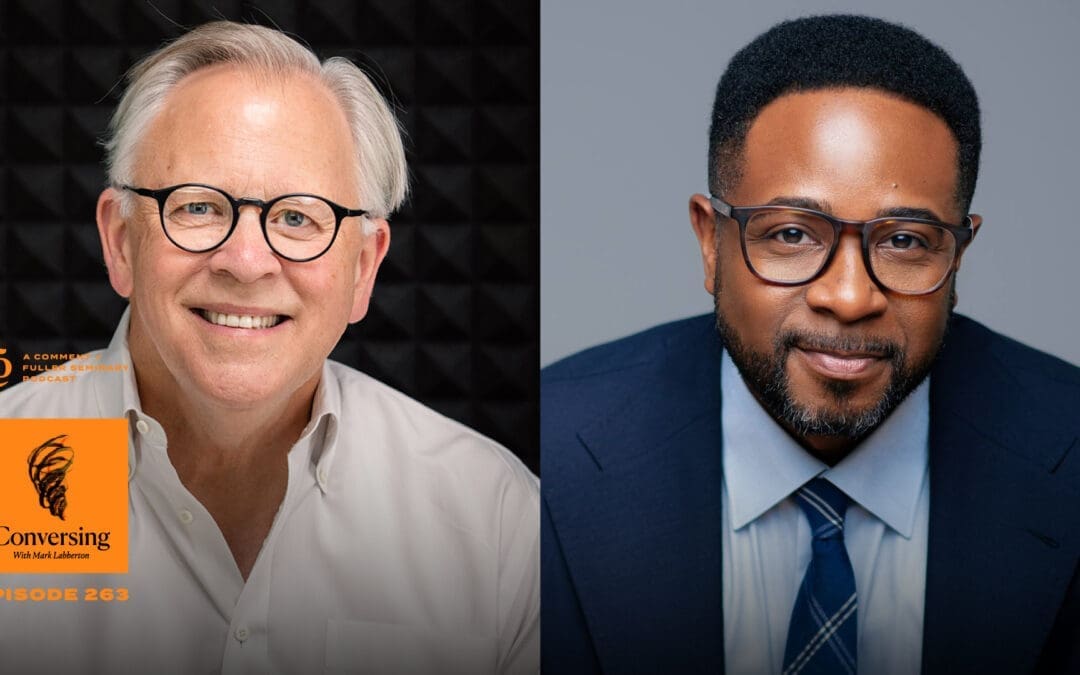
Historian and New York Times bestselling author Jemar Tisby joins Mark Labberton to confront the Supreme Court’s 6–3 ruling in Louisiana v. Callais, which has eviscerated Section 2 of the Voting Rights Act and reopened the door to racial gerrymandering across the South. Recorded in the immediate aftermath, the conversation traces the long arc from the Three-Fifths Clause and Dred Scott through Selma to this hour.
“This has landed in the black community harder and heavier than a lot of what we’ve seen during the Trump administration.”
In this episode with Mark Labberton, Tisby reflects on the history of black disenfranchisement, the cynicism of colorblind jurisprudence, and what remains of multiracial democracy in America. Together they discuss how the legal architecture of Jim Crow reemerges under neutral language, John Roberts’s decades-long campaign against the Voting Rights Act, Justice Kagan’s umbrella analogy, the suspension of Louisiana’s primary, the black church’s response, and why this midterm may be the country’s last political chance.
Mark Labberton:
I’m really delighted to welcome back Dr. Jemar Tisby. He has joined us on Conversing several times and is a writer, thinker, speaker, and Christian — a brother in Christ whose life, faith, and work I greatly admire. His first book, which landed him with tremendous public attention, was The Color of Compromise: The Truth about the American Church’s Complicity in Racism. Since that time, he’s written several other books, including How to Fight Racism and The Spirit of Justice: True Stories of Faith. These reflect his commitments as a historian — to draw us deeply into the past in order to set ourselves clearly in the present.
Today we’ve invited him specifically to talk about the Voting Rights Act decision by the Supreme Court of the United States last week. Jemar Tisby, it is always a delight to have you on Conversing. Welcome back.
Jemar Tisby:
The feeling is mutual. Good to see you again, Mark.
Mark Labberton:
You know, Jemar, we come together on this occasion because of the recent decision by the Supreme Court about the Voting Rights Act — what this decision has meant, what caused it, how we understand it, and where we go from here. But I’d like to start in a somewhat more personal way.
We have watched this Supreme Court move in this direction, and Chief Justice John Roberts has clearly indicated through previous decisions, speeches, and other actions that it was a goal of his to undo the Voting Rights Act of 1965. And I wonder — knowing all that, knowing this decision was before the Court — how did you personally receive it? Where were you when you heard? What were your immediate responses?
Jemar Tisby:
Thank you for asking that. As is often the case these days, I think I first heard about it over a group text message. It’s been critical in these times to cultivate networks of people who share our same concerns and also have different skill sets — lawyers, organizers, clergy, nonprofit leaders, all kinds of folks. It was really helpful to hear from their different angles and perspectives.
But it was devastating. And one thing I would love for your listeners to attend to is that this has landed in the Black community harder and heavier than a lot of what we’ve seen during the Trump administration. And that’s saying a lot, because the chaos has been endless.
But this is personal. And as a historian who is also Black — good night. The first thing I thought of was the march from Selma to Montgomery. Specifically, I thought of John Lewis, who of course became a longtime congressperson from Georgia, but before that was the leader of the Student Nonviolent Coordinating Committee. And it was in that capacity that he was on that march.
One of the historical details that sticks with me is that the police met the marchers with tear gas and batons. John Lewis was hit so hard over the head with a baton that it cracked his skull. And the skull is the hardest bone in the body. So the amount of force and viciousness that this officer of the law wielded against peaceful marchers — who, by the way, were marching for their voting rights — that’s what flooded my consciousness when I heard the news.
In addition to all of that, this is so infuriating because it is so backwards logically. There are so many holes in the reasoning and in the argument. It boggles the mind that people sitting on the highest court in the land, who have attended Ivy League schools and have literally decades of experience, can get it so wrong and stand so arrogantly on such faulty reasoning. If you’re going to make a ruling like this, at least give me something I can chew on and debate — something where I can say, “Well, maybe you have a point there.” But so much of this ruling is just foolish. It’s absolute foolishness.
Mark Labberton:
I read the decision, and Justice Kagan makes the dissenting case — supported by herself and two others — and she makes the same point you’ve just made: it is not only counter to history, to precedent, and to the legitimacy and ongoing need for the Act, but it represents a retrograde step, a reversal for which there is no real logic or case to be made, except the will and capacity to do so.
When I first heard this, I felt like I had gotten seriously kicked in the stomach. I remember I was standing up, and I just fell into a chair thinking: this is such a dark day for America. It undoes one of the most important things that happened in the American civil rights movement. The Voting Rights Act was among the very top tier of accomplishments that came out of that struggle — in part because of that long march and the acknowledgment of the seriousness of what had happened, which motivated President Johnson to urge Congress to draft and pass the bill he then signed into law.
I’ll say, just as a footnote for listeners: there is an amazing a cappella piece performed at Harvard in honour of John Lewis. That piece of music came into my mind, and we’re going to put it in the show notes. I encourage you to listen and to feel what that moment felt like, then consider this conversation again in light of the poignancy and honour those Black students and Harvard showed him that day.
So for the sake of people who may not be tracking all of this closely, who might be thinking, “What are you talking about? What’s happened? Why are you so distressed?” — just recount for us what the Voting Rights Act is, how it’s been challenged but largely sustained by Congress, and how it’s been gradually undone by the courts, culminating in this decision last week. Give us a recap.
Jemar Tisby:
First, I want to make clear to everyone listening: this is not just about Black people. This is about all people. This is about the most fundamental voice of the people, which is the vote. It does strike the Black community in a very personal way, because we fought so hard for the Voting Rights Act in 1965. But understand that the Act applied to all people, and so this ruling now applies to all people.
There’s a long history here. You can go all the way back to the Constitution and the Three-Fifths Compromise. And that was not that Black people were three-fifths of a person, as is frequently cited — it was that for purposes of representation in Congress, enslaved Black people would count as three-fifths of a white person. My mind went back to that, because this ruling is fundamentally about how you draw congressional districts. It’s about representation.
Fast forward to the 1850s and Dred Scott v. Sandford. Dred Scott was an enslaved man. He and his wife were taken by their enslaver to free states in the North — Wisconsin, for example. The rule was that if you crossed into a free state, you were free. But their enslaver kept them anyway. Dred Scott sued, and the case made it all the way to the Supreme Court, where Chief Justice Roger Taney — in what lawyers widely recognize as the worst, or one of the worst, Supreme Court rulings — said he wouldn’t even entertain the merits of the case about crossing into a free state. “Here’s the issue,” Taney said. “You’re enslaved. Therefore you are property. Property can’t sue. You have no standing.”
Just a few years later, the Civil War came — and thankfully the Union won. That led to the Reconstruction Amendments: the Thirteenth Amendment abolishing slavery, the Fourteenth Amendment establishing birthright citizenship (which effectively reverses Dred Scott and is, by the way, currently on the chopping block — I believe it was my own Senator Rand Paul who recently introduced legislation to strike it down). And then the Fifteenth Amendment, which established voting rights for Black men.
That should have been enough. And for a short time, it was. From 1865 to 1877, during Reconstruction, a tremendous number of Black Americans were elected to federal, state, and local office — everything from postmaster to, briefly in Louisiana, governor. And then came Jim Crow.
Jim Crow is characterized by segregation — that’s Plessy v. Ferguson in the 1890s — and by lynching. But one of its main features was voter disenfranchisement. Black voter registration went from a hockey-stick rise right after the Civil War to falling off a cliff for nearly the next hundred years. And the way they did it was savvy: they didn’t use race-based language. They didn’t have to say “Black people can’t vote.” Instead they said, “You have to pay a poll tax.” Or: “You have to pass a literacy test,” where a poll worker gives you an obscure constitutional question and then decides — subjectively — whether you passed. Or there was the grandfather clause: you could vote if your grandfather could vote, which meant that if you were Black, your grandfather was likely enslaved and therefore couldn’t vote.
I say all of that because what the Supreme Court has now essentially done is say: as long as people are not explicitly using race-based language to draw congressional districts, there is no need for the Voting Rights Act. They can draw districts along partisan lines; they just can’t use race. But that’s foolish — because they learned all the way back in the nineteenth century not to use race-based language, and to use all manner of coded mechanisms to produce the same result.
Mark Labberton:
Right. And that’s a gripping history lesson. The church I worship at is Allen Temple Baptist Church in Oakland, California — a Black church. On Sunday, as Pastor Jacqueline Thompson was speaking, she had on a table before her a watermelon, a bowl of bubbles, and a jar of jelly beans. She was describing those literacy tests, and she said that among the qualifying questions were: “How many seeds are in this unopened watermelon?” “How many bubbles are in this bowl?” “How many jelly beans are in this jar?” That was the qualifying factor for whether you could vote — which was of course designed to be impossible, and made the whole thing scandalously offensive. But they went to those kinds of absurdities to avoid saying it had anything to do with race. It made for a very vivid lesson.
Jemar Tisby:
That is so powerful. I’m so glad she did that.
You know, we haven’t even gotten to the Voting Rights Act yet. To briefly recap: it was passed in 1965, but it took years and years of activism to get there. Just within the civil rights movement alone, you can trace the momentum to Brown v. Board of Education in 1954, or to 1955 with the Montgomery Bus Boycott and the lynching of Emmett Till. So it took a decade of activism just within the civil rights movement — not to mention everything before — to arrive at 1965.
And then, as you mentioned, it took a catastrophic event: the march from Selma to Montgomery. The push for voter registration and voting rights in Alabama began in January of 1965. Conflict between activists in Selma and local law enforcement escalated to the point where, a couple of months later, a demonstration ended in the killing of a Black man named Jimmy Lee Jackson.
Here’s where the Black church comes in. They held a meeting at a local church and said: “What are we going to do?” And the answer was: “We’re going to take this struggle straight to the governor in Montgomery. We’re going to march from Selma to Montgomery.” So that’s what they did. About six hundred people lined up to march, and as they crossed the Edmund Pettus Bridge just outside of Selma, they were met by law enforcement — tear gas, batons. But journalists were there. Photographs and film went the equivalent of viral and caused a massive national outcry. That’s when LBJ saw an opening: he sent the bill to Congress, which is not that common. It passed the Senate after a long filibuster by Southern senators, passed the House with bipartisan support, and then crossed LBJ’s desk. He signed it in the presence of Rosa Parks and Dr. King.
The reason this was so significant: the Civil Rights Act of 1964 was huge. But the Voting Rights Act of 1965 was in many ways the culmination of the movement, because voting had always been the holy grail. If we can vote, Black people said, then we have a voice in how we’re governed. Can you imagine — racist, segregationist, white supremacist representatives holding power over your life with almost no recourse? These are the people supposedly representing you. So you can understand the importance of the Voting Rights Act: it meant we can now elect people who understand our communities. We can elect people who look out for our interests, just as white folks had been doing for generations. It was about fairness. It was about everyone participating in the democratic project as they should.
And so this Roberts Court, rolling back the key provisions of the Voting Rights Act — and this isn’t the first rollback — strikes a blow at what was truly a crowning achievement of the civil rights movement.
Mark Labberton:
And it sends tremors across the nation — in the chaos of gerrymandering and redistricting, and therefore in the potential loss once again of meaningful representative votes. I think the thing that’s important to understand is this: what this ruling allows is that overtly, at least, race can’t be part of any redistricting plan. The Court has shifted the standard from racial impact to racial intent. If you have a racist intention — which no one can access in another person’s heart and mind — then it can only be measured by impact. But as long as the motivation is cloaked in partisan language, it’s perfectly acceptable to the Supreme Court. It’s only impermissible if it’s expressed in explicitly racial language. So they simply avoid that language and make it an interior, invisible standard rather than one measured by observable effects.
No wonder the Black community, in the United States and beyond, is responding with such intensity. It deserves every possible reaction.
Jemar Tisby:
There’s a fairly direct way of putting what you just said, and it comes from a lawyer and commentator named Elie Mystal, who often writes for The Nation. Here’s what he wrote in a recent piece that I found so helpful: what this means in reality is that white people can gerrymander away Black political power — just like they did in the old days — as long as they say they’re only trying to take away Democratic political power. It means that even if you can show the gerrymander was obviously targeted to dilute the Black vote and not the “Democratic” vote, it doesn’t matter unless the white gerrymanderers say something explicitly vile enough to get Justice Alito excited. It means the Voting Rights Act is effectively dead.
That’s helpful, because we can get so lost in the legalese. What they’ve done is move the goalposts. The standard used to be: if you can demonstrate racial disparities in results — disparate impact — you had a case. What this ruling has done is say impact is no longer the measuring standard. Now it’s intent. What did they mean to do?
The analogy I use is a fender bender. Somebody rear-ends you, and you file an insurance claim. All you have to do is show the damage — here’s the bent fender, here’s the broken taillight, here are the pictures, here’s the impact. But what the Court has now done is say that damage doesn’t matter. What you have to show is that the driver who rear-ended you meant to do it and targeted you because of your race. Now if you can show that, you’ve got a case. But who can show that? Because as we’ve already established, as far back as the 1800s, the white power structure already knew it could get around using the words “Black” or “Negro” and still produce the same result.
And this is just one section of the Voting Rights Act. They already gutted another section back in 2013 in Shelby County v. Holder — Shelby is a county in Alabama, and the fact that these cases keep coming out of Southern states is not coincidental. In Shelby, they struck down the preclearance requirement: the clause that said if you are a state with a history of racially discriminating against voters, before you make any changes to your voting processes or district maps, you must send them to the federal level for approval. The Roberts Court struck that down in 2013. So the South could just do whatever it wanted after that.
That’s the insidious part — because people can say, “Well, the Voting Rights Act is still on the books. It’s still the law of the land. What are you upset about?” The answer is that they’ve gutted the key provisions that made it effective.
Mark Labberton:
So, Jemar — what is your understanding of why Chief Justice Roberts has so long worked against the Voting Rights Act? Assuming best intent, what does he articulate as the principled case for why these provisions need to go?
Jemar Tisby:
There’s one line that says it all, and it’s been quoted from Roberts time and again. He says: “The way to stop discrimination on the basis of race is to stop discriminating on the basis of race.”
That’s a tautology. What Roberts is appealing to is what we might recognize as the principle of colourblindness — the idea that the law should not see race. A lot of people are confused about what that means and how it gets used. We tend to think of colourblindness as virtuous. Here’s the logic: if this nation has been so racist toward Black people and other people of colour — if it has discriminated on the basis of race, if it has excluded on the basis of race — then the solution is not to consider race anymore, not to see race. The intent, to use that word again, is to treat all people equally.
But what is the impact of colourblindness? It only works if you’re starting from a level playing field — if no group is way ahead because of race, or way behind because of race. And we are not starting from a level playing field.
What Roberts wants to do has roots going back to the 1980s, when he was working for the Reagan administration and then for George H.W. Bush. He still carries this mentality: the way to solve racial discrimination is not to discriminate based on race. Which means, in effect, that within fifteen to twenty years of the Voting Rights Act being passed in 1965, the problem had been solved. Equality had been achieved. That’s what Roberts is saying. Now, sixty-one years later, he’s still saying the same thing. He was saying it within a decade and a half of the Act’s passage, if not sooner — we have the archival records from those administrations.
So Justice Alito wrote the majority opinion, but it was completely cosigned by Roberts because it was saying the same thing: that race-based remedies to racism are themselves racist. Which is wrong. If you have been negatively discriminated against on the basis of race, you cannot simply pretend race doesn’t exist and expect to right that wrong. To make things whole, you actually have to take race into account positively — to focus specifically on the groups that were disadvantaged. But how can you do that if you claim not to see colour? And so these six so-called conservative justices — many of them Catholic, all of them Christian — have rendered an opinion that says the way to solve racism is not to talk about race. Which is completely wrong.
Mark Labberton:
It really is crazy-making. Because it feels like a social and legal fiction that the majority has written for itself — a decision to see reality in a particular way. I read the case, I read Alito’s findings, and I was genuinely offended by the argument. It felt so lacking in substance. It didn’t seem to take the reality of lived experience seriously. It felt like a shifting of the deck chairs toward a predetermined outcome. I’m not saying only conservative courts do that — liberal courts do too. But ideally, our justice system would grapple with both theory and practice and lived experience in real and substantive ways.
So I’ll ask: if you were to try to read Alito’s summary as charitably as possible — the best case for dismantling these provisions — would you have anything positive to say about it?
Jemar Tisby:
They want a time machine to travel forward to a future that hasn’t happened yet — a future where, because of race-based remedies, we are on a more equal playing field. And wouldn’t it be great? Wouldn’t we all celebrate if there had been genuine progress such that we no longer needed these safeguards?
It’s like wearing a cast. You break a bone; eventually it heals enough that you can take the cast off. But what they want to do is cut the cast off before the bone has healed — which means it may fuse back together in ways that are worse than the break and leave you with permanent damage. We would all love to be able to say we’ve made enough progress that we don’t need these safeguards anymore. But I think it was Justice Kagan, in her 2013 dissent in Shelby v. Holder, who put it this way: the decision is like saying you don’t need an umbrella because you’re not getting wet. The umbrella is what’s keeping you dry. You say, “Well, since I’m not getting wet, I don’t need this umbrella anymore.” You take it away — and now you’re getting wet again.
And we have to see this in the totality of its context. These are not good faith actors. The specific plaintiff in this case is called Louisiana v. Callais. Callais is a white person claiming not to be represented — and he was also at January 6, an ardent election denier, a passionate believer in the so-called Big Lie. This is not a regular citizen who says, “Something just doesn’t seem right here, and I feel I have to pursue this in court reluctantly.” That’s not what’s happening.
And by the way, what was happening in Louisiana was that those districts were actually corrective and proportional. About 30 percent of Louisiana’s population is Black. There are six congressional districts in the state. Proportional representation would mean two Black-majority districts and four white-majority districts — which is exactly what the corrected maps reflected. That’s what Callais was suing to undo.
What’s more, Governor Landry has already suspended primary elections, even though mail-in ballots were already being cast. And when you look at the executive order, the statute he used to justify postponing those elections was a state-of-emergency statute meant primarily for natural disasters. There’s even a clause in that statute specifying that law enforcement and the National Guard can be called in to salvage undamaged equipment — language intended for a hurricane, not a Supreme Court ruling.
So even if there were some philosophical point to what the majority is saying, it falls away immediately when you consider the totality of the context. These are not people working toward a representative democracy. They are people working to consolidate power — what political scientists call competitive authoritarianism. Not minority rule in a racial sense, but minority rule in an ideological sense: most people don’t actually want this. And if you can’t win on the merits of what you believe, you have to rig the system so no one can vote you out.
Mark Labberton:
This past week I’ve spoken with many Black leaders — academics, pastors, entrepreneurs, people in business — trying to understand how they’re responding across different parts of the country. I’ve seen a grave sense of weight and an urgency to act. How are you hearing people talk about this? Is there an activism horizon you can see emerging? Is it legislative? Is it civil action? Both?
Jemar Tisby:
There has been a flurry of activity since the ruling came down — marches and protests, particularly in the hot spots: Louisiana, Tennessee, Alabama. These are states whose governors moved to redraw their districts as soon as the ruling was handed down. The far right was in lockstep, ready to act immediately.
The main lever, historically, has been the courts. Throughout the Black freedom struggle, we have most often pursued legal remedies to injustice, because if you can change the law at the federal level, you always have recourse to sue when injustice occurs. I would follow the NAACP Legal Defense Fund. I would follow the Brennan Center for Justice — B-R-E-N-N-A-N — for the longer-term, bigger strategic moves.
Beyond the courts, the response is about flooding the polls at the midterms. The way these gerrymandered districts are rigged depends on average or low voter turnout. The only way to counteract that is with such a massive turnout that you overwhelm the structural advantages. So you’re going to see a lot of churches — particularly Black churches — running huge voter registration drives, organizing activities to get people registered and to the polls, and making announcements about early voting and who is on the ballot.
It is so much more urgent now. Because if they get a supermajority — if they get the House and the Senate in the midterms — we will simply not have the standard political mechanisms to stop them. In my view, this is our last real political window. If we don’t take the opportunity to create that wave, we are going to be stuck in competitive authoritarianism for many years to come.
Mark Labberton:
Jemar, we could talk about this forever. You’ve given us a generous time today because of the urgency of the moment. I want to bring our conversation to a close with a word of genuine thanks for laying things out as clearly as you have. The activism you’ve been engaged in for many years, the voice God has given you as a historian, a speaker, and a public intellectual — I think it’s so important, and I thank you for being a steward of it and exercising it as boldly and courageously as you do.
I want to be a partner with you and others in responding to this time. This is a very alarming moment — a grand reversal of sixty years of hard-won history. It is not for the welfare of America. It is going to fall out along all the standard lines of division and hostility we’ve witnessed. But this feels to me like one that lands close to the heart of God — not because of his political interests, but because what is ultimately at stake is human dignity: the value of every single person made in the image of God, with full rights and appropriate responsibilities, including in a democracy the right to vote. Thank you for being so helpful today. I hope everyone listening will continue to follow this and to enter as fully as possible into what this moment is about.
Jemar Tisby:
Always such an intelligent, well-reasoned conversation with you, Mark. You calm me down a little bit — in a good way — so I appreciate it.
Mark Labberton:
All the best, Jemar. Thank you so much.
Mark Labberton hosts the Conversing podcast and is the Clifford L. Penner Presidential Chair Emeritus and Professor Emeritus of Preaching at Fuller Seminary.
Jemar Tisby is a New York Times bestselling author, historian, speaker, and professor of history at Simmons College of Kentucky, a historically black college in Louisville.
Love the show? Help others find it by reviewing it on your favourite podcast app. We also welcome your ideas and feedback. Email us at conversing@comment.org. Thanks for your support.