
I
Oh, this [Christianity] is live, vital religion. The theosophy God and philosophy are beautiful but cold and remote and mysterious. . . . But here a live Christ leads you to God, and the majestic awfulness is less awful.
—Emily Carr (Hundreds and Thousands)
Jesus has a purpose for me. He wants me to paint.
—Norval Morrisseau (Ruffo, Norval Morrisseua)
It was a question that might have ended my marriage before it even began. My then girlfriend and I were both art history majors, and it was my first visit to the home of my future in-laws, who live in Owen Sound, Ontario, a small harbour town a few hours north of Toronto. News of my major was immediately met with discussion of the Group of Seven. After all, the painter Tom Thomson himself, the forerunner of this troupe of wilderness artists, was buried nearby.
Then came my question: “Who?”
Unbelief followed, and it was deserved unbelief. American insularity ensured I had heard of the Hudson River school, the Ashcan school, Synchromism, Precisionism, and Regionalism. But not the Group of Seven. I’m surprised the courtship wasn’t called off then and there. But I was willing to make amends. What followed was visit after visit first to the Tom Thomson gallery in Owen Sound, and then to Toronto’s Art Gallery of Ontario (AGO), and then visits to the McMichael Collection just outside the same city. And dozens of visits after that.


Tom Thomson (1877–1917), in only four staggering years of artistic production, cut through the labyrinth of subjectivity that bedevils the field of painting. This is because anyone with eyes cannot but conclude that this painter was objectively good—even great, because he conveyed nature truly. As much an outdoorsman as a painter, Thomson took the necessary risks to capture creation in all her moods. J.M.W. Turner (legend has it) strapped himself to the mast of a ship during a storm to capture nature’s surliest attitudes. Thomson carried his ship on his head in wilderness portages deeper into the bush, where he found creation to be infinite in its beauty. Turner’s champion John Ruskin thundered that “the moment we see in a work of any kind whatsoever the expression of infinity, we may be certain the workman has gone to nature for it.” Thomson was just such a workman. His fleeting sketches, to say nothing of his carefully crafted finished paintings, are glimpses of the infinite; and—to cite Ruskin once more—“what is not infinite cannot be true.”
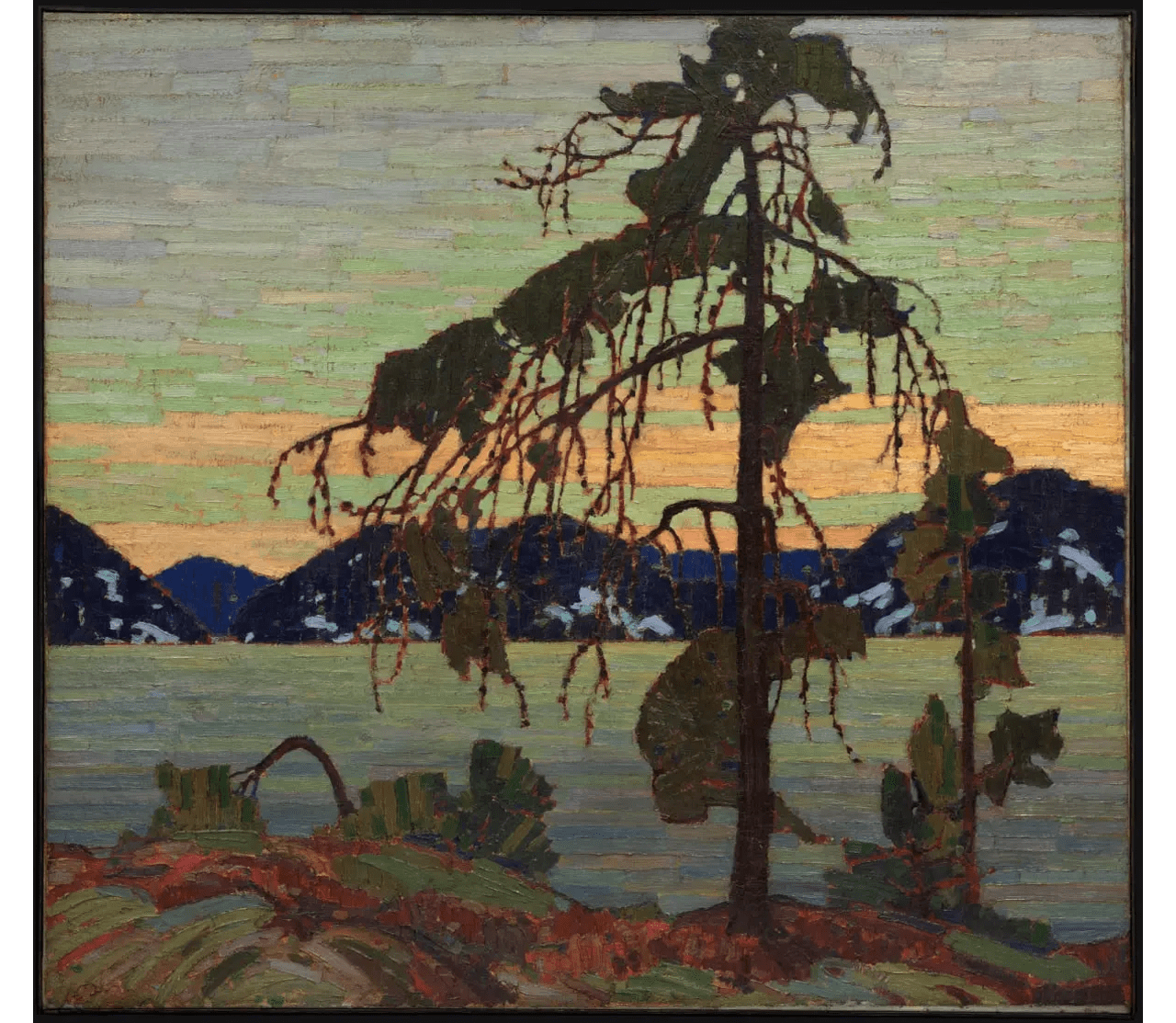
There is no fussing in Thomson about brandable “techniques,” for he altered his painterly style depending on nature’s shifting demands. Just compare two of his 1916 masterpieces, the rectangular impasto bars of The Jack Pine on the one hand and the dissolving impressionist waves in The West Wind on the other. I was lucky enough to once see them side by side when they were exhibited together in Toronto. In the first, creation breathes in lime serenity and cantaloupe stillness; in the second she breathes out white-capped ripples and a violent violet blue.
A Thomson painting, each stroke so evidently hewn by hand, reminds us that the world was created as well, by a person no less; or rather, a Thomson painting reminds us that the world is constantly being created by that person anew. If Maurice Merleau-Ponty could say that a Cézanne painting offered the “impression of an emerging order, an object in the act of appearing,” Thomson similarly offers a world in the process of being made, fresh from the Creator’s hand. This, incidentally, is the reason AI art continues to be so unsatisfying, no matter its technical advances. For the more distant art is from human personality, the more distant it is from creation itself, which was not manufactured but made by personality as well.

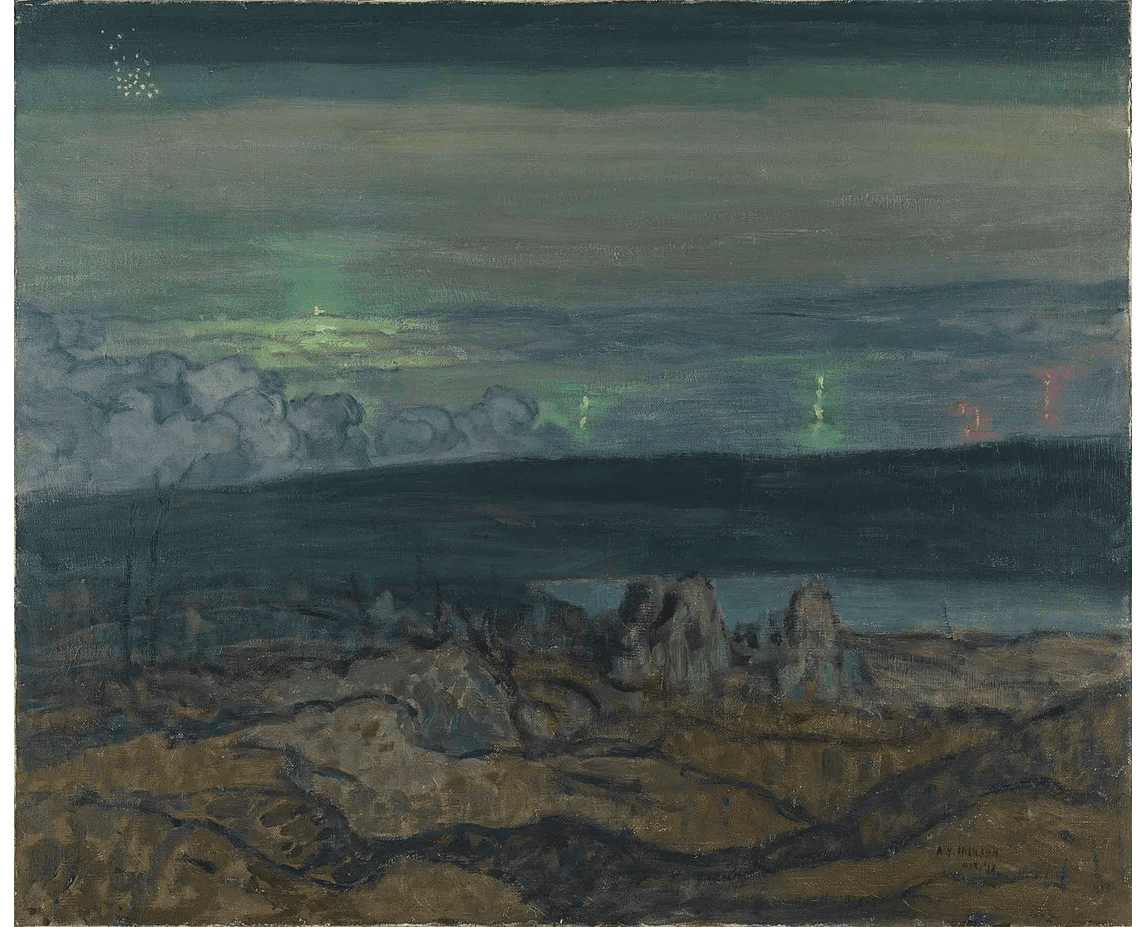
Thomson’s earthly life concluded in a 1917 canoe accident that has been the subject of speculation ever since, offering what Ross King calls Canada’s answers to conspiracies about JFK. But thankfully enough, his untimely death was too late to extinguish Thomson’s vision, for he had already transferred it to seven other painters. The flame had been lit, and as the Great War raged, healing fires from Group of Seven canvases burned as brightly as artillery blasts. One of them even discerns echoes of the northern lights during a trench warfare gas attack, a defiant insistence that despite the reality of evil, evil will not have the last word.

This is because no war, however horrifying, is powerful enough to extinguish beauty. Following the conflict, therefore, the Group of Seven’s pursuit of her intensified. Taking advantage of the new rail lines into Algonquin Park, they aimed, in their own words, “to empty ourselves of everything except nature, here in all its goodness.” Lawren Harris (1885–1970), the group’s wealthy chief patron, at first stayed relatively urban, while the gregarious A.Y. Jackson (1882–1974) gave us visions of rural life. Arthur Lismer (1885–1969) the art teacher was rugged and rough with his subjects, while J.E.H. MacDonald (1873–1932) the poet conveyed creation’s endless variations with remarkable scope. Frederick Varley (1881–1969) was the brigade’s vibrant bohemian, while Franklin Carmicheal (1890–1945) the commercial artist offered images that were comparatively crisp. Finally, A.J. Casson (1898–1992), replacing Franz Johnston, who left prematurely, revealed the freshness of humble Ontario life. It was as if the talent of Thomson the forerunner were divided among the seven, and grew all the stronger for it.

When I first encountered these paintings, I felt as if my favourite artist at the time, Paul Cézanne, had lived three decades longer, moved to Canada, and gone on to paint one hundred new Mont Sainte-Victoires. In these paintings, perhaps the best landscapes in North America, each season is transfigured and the ancient Wisdom through which this land was fashioned is disclosed. The Group of Seven both de-sentimentalized Cornelius Krieghoff’s earlier festive folk paintings—which were already good—and catapulted them to unimaginable levels of painterly effectiveness. In these heart-rending landscapes, the region’s architecture is nimbed with snow like halos on so many saints. Whereas Europe may have developed the new painterly styles we name Impressionism or Post-Impressionism, North America boasted landscapes especially worthy of these new techniques, summoning creation to disclose her secrets, secrets that are laid bare in the heart of Toronto today.
But there was a contest for the heart of these painters. Harris, whose work in the AGO marks him perhaps as the most able of the group, was drawn, as independently wealthy people often are, to Theosophy. Though the term “theosophy” had long been employed by Christians like Dionysius the Areopagite and Jacob Boehme, in the nineteenth century the term was co-opted and branded into an amalgam of faiths by Madame Blavatsky (1831–1891). Dominic Green calls this form of Theosophy “the first global faith of the New Age.” Blavatsky, in Green’s words, “processed the raw materials of the Hindu and Buddhist spirit in the mills of Western science, and planted Western materialism in the temples of the East.”


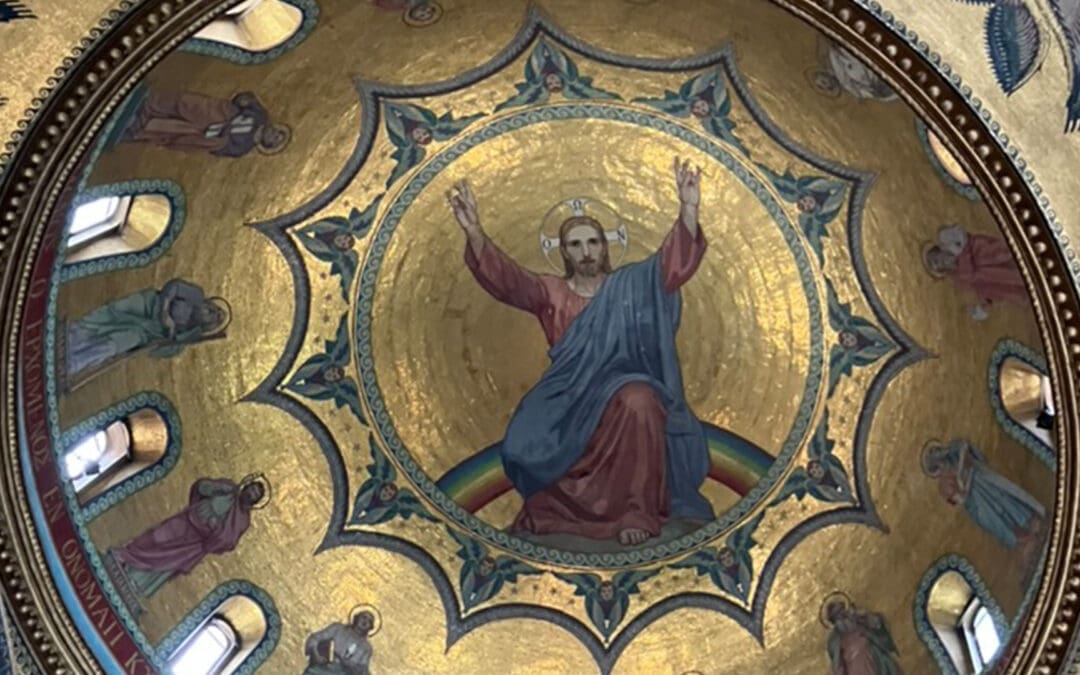
For a long time, the story of modern art was told in a way that gave much credit to Theosophy. Too much, it turns out. In his field-altering book Faith in Art, Joseph Masheck has shown that traditional religion—Catholicism, Orthodoxy, Calvinism, and Judaism—was far more influential than Theosophy on modern painting. We can corroborate the point by looking at Varley’s work. Though he admittedly prevaricated, Varley never rejected Christianity. His confident painting of the risen Christ contrasts nicely with Harris’s elementally phallic totem. Varley paints Christ’s descent deeper into creation in order to transform it, while Harris’s painting, which recalls the lingam of a Hindu temple, marks the first step of an escape.
In his field-altering book Faith in Art, Joseph Masheck has shown that traditional religion—Catholicism, Orthodoxy, Calvinism, and Judaism—was far more influential than Theosophy on modern painting.
It appears that Varley, who (unlike Harris) knew the overseas agonies of the war first-hand, needed more than a Theosophist’s hope. Varley painted not about departing from the body (as taught by Theosophy) but about getting our bodies back. His 1918 painting Some Day the People Will Return depicts a war-wrecked village with a cross at its centre. It is hard not to read the title as a reference not just to future repopulation but to ultimate resurrection as well.
No surprise, then, that the Group of Seven aesthetic, thanks to Varley, even filled an entire church. Varley covered the walls and ceiling of St. Anne’s Anglican in Toronto with extensive murals, marshalling the group’s aesthetic for the purposes of worship. On one of our Toronto pilgrimages, my wife and I made a visit. There we saw his glorious testimony to the Word becoming flesh. Varley even painted himself as a supplicating shepherd. Like the late Cézanne, who said he hoped his painting would be “an absolutely faithful hymn of praise to the glory of God’s creation,” Varley’s faith appears to have grown stronger as he got older. In a 1956 letter to his sisters, he wrote,
I want you to know that I went through vicissitude but came out free and fearless. I want you to know I have an unshakable belief in that mysterious power that illumined the clay and gave me the golden privilege of living. I have no control over what will inevitably be, and care not so long as I live to the utmost of my being remembering always & giving thanks to the Creator.
Tragically, St. Anne’s was recently destroyed in a fire that is now being investigated as arson. Visit beauty while you can, for you do not know how long it will last. What survives of these paintings is being lovingly restored.

But if Lawren Harris did not win over his fellow Group of Seven painters to Theosophy, he did try to convert the honorary “eighth” member of the Group of Seven, the famous Canadian painter Emily Carr (1871–1945). “I didn’t sleep well and woke at 5 o’clock the next morning with a black awfulness upon me,” Carr reported after an evening with Harris. “It seemed as if they had torn at the roots of my being, as if they were trying to rob me of everything—no God, no Christ, no prayer.” Carr was initially intrigued by the new religion, but further investigation caused her to push back. A conversation with a Christian convert from Hinduism lecturing in Victoria, Raja Singh, cured her of Theosophy’s orientalizing conceits. Writing back to Harris in 1934, Carr confessed she was prepared to snap the “theosophical bonds.” She was “willing go back sixty years to where I started. . . . It is good to feel a real God, not the distant, mechanical, theosophical one. I am wonderfully happy and peaceful.”

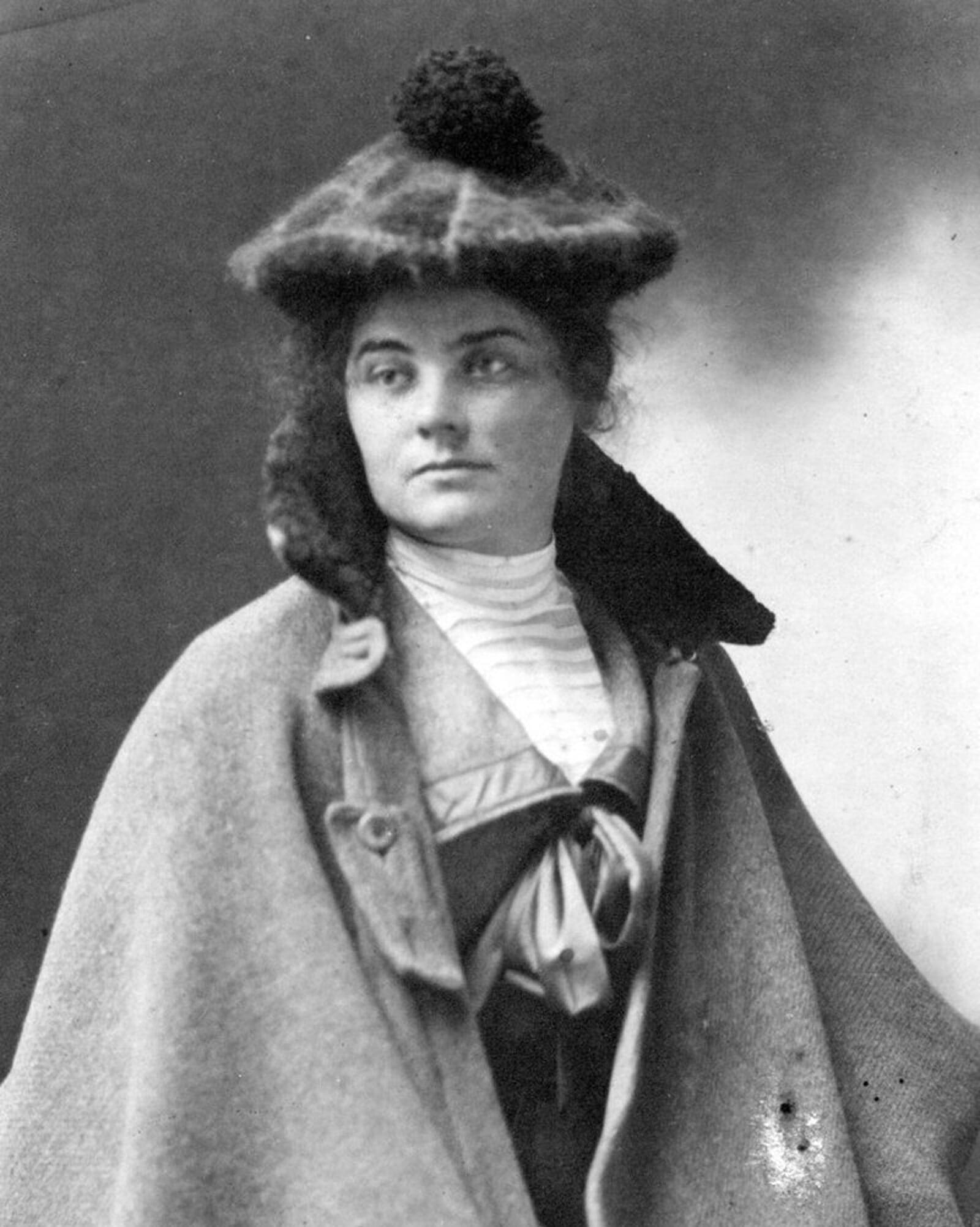
Carr’s refusal of Harris’s Theosophy, moreover, fuelled her desire to paint. Accordingly, her paintings that hang in Toronto today are still tethered to the earth, as are Varley’s. “I was not ready for abstraction,” insisted Carr, reflecting the similar rootedness of her contemporary Georgia O’Keeffe (1887–1986). “I clung to earth and her dear shapes, her density, her herbage, her juice. I wanted her volume, and I wanted to hear her throb.” Ultimately, Carr’s decision to “take my stand on Christ’s side, to let go of philosophers and substitute Christ,” bore ample artistic fruit. Ironically, she did so in continued conversation with the East, but in her case with the Christian East that Theosophy deliberately ignores. Ann Davis reports that for Carr, Sadhu Sunder Singh (1889–1929), the Christian mystic from Punjab, was also a constant inspiration.
To Harris’s credit, he was willing to accept Carr’s return to Christianity, even while he himself was content to leave the throbbing of earth behind. Harris preferred ice, and his images of icebergs and glaciers grew increasingly abstract, until he gave up form altogether. This is no rude dismissal of Harris’s magnificent artistic achievement. It is Harris himself who made this claim. He admitted to Carr that Theosophy “contributes little to the personal life directly—for the personal, as such, is temporary, must eventually be transcended.” But it was this aspect of Theosophy he defended: its “severity—its seeming coldness.” Following a trip to Europe in 1930, where he succumbed to the fashion for modernism, Harris predictably concluded that “abstract painting has greater possibilities of depth and meaning than art based on nature and natural forms.”
Harris’s late and increasingly bloodless work is, in retrospect, conventional. There is good reason that recent shows celebrating Harris, championed by his American admirers like comedian Steve Martin, focus mostly on his early career, before he gave up on the earth. Even so, Harris’s biographer James King charitably states, “The simple fact was that Harris could try to escape landscape, but he remained in its thrall.”


Despite their religious differences, Carr and Harris stayed in contact. Unlike most viewers today, Carr appreciated Harris’s later abstract work, and Harris was especially fond of Carr’s 1929 painting titled Indian Church, which hangs—now renamed Church in Yuquot Village—in Toronto today. Carr knew of Indigenous life thanks to her sister’s missionary work among the Indigenous communities of Vancouver Island. The artist’s 1941 book Klee Wyck (which was Carr’s native name) made a case for Indigenous dignity long before it was a fashionable thing to do. Indian Church is not—as sluggish viewers might assume—just a white church in front of a dramatic Northwestern landscape. It is a church (like the church today) that is desperately in need of the colour of the life around it, and a church that—if you look closely enough—is in the process of receiving it. When the Kwakwaka’wakw artist Sonny Assu “invaded” Carr’s paintings with Northwest Coast design tags, his aim was not to disrespect her but to call attention to the Indigenous elements that Carr’s contemporary viewers too easily miss.

Because of Christianity’s tragic embroilment in the boarding school movement that sought to erase Indigenous culture, many assume that the increasing embrace of Indigenous art in Canadian museum’s more recently would lose the thread of Christianity that was woven into the Group of Seven and Emily Carr. But this casual assumption is a classic case of secular confirmation bias and is easily debunked. The paintings of more recent Indigenous painters that now hang in Canadian collections—those of Norval Morrisseau (Christ as Shaman), Jessie Oonark (Giver of Life), Carl Beam (Time Dissolve), Kent Monkman (Death of the Virgin [After Caravaggio]), to choose only a few—are each in critical conversation with Christianity. Each of these artists draws on explicitly Christian imagery just as Varley and Carr did, whether they embrace the faith themselves or not. Oonark clearly did, while Monkman (I have argued) is in a complex relationship with the Christianity of his father, a Pentecostal minister.
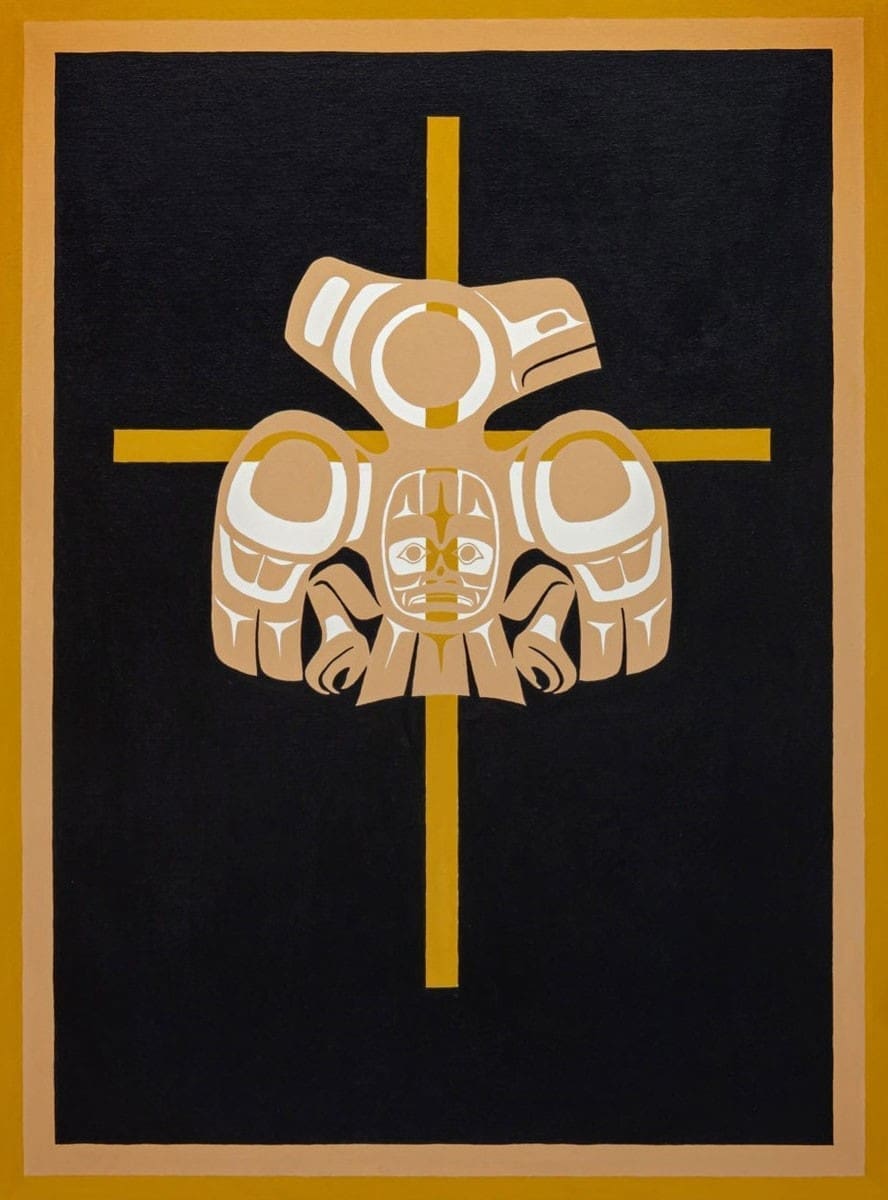
Right now at the AGO, an image by the Haida/Nisga’a artist Luke Parnell (b. 1975) with a cross is lovingly ensconced in a Pacific Northwest traditional design. Parnell’s cruciform raven, titled Challenging Traditions, is no simple endorsement of Christianity. It responds to questions that were raised by an exhibition of the same name when the Haida artist Don Yeomans sculpted a similar piece. The cross juxtaposed with the raven might be considered a meditation on the fact that Christianity crucified Indigenous identity, which, with the abolition of the Potlatch from 1851 to 1951, some Christians arguably did.
But Parnell’s painting might be construed as the cross confirming Indigenous culture as well. More recent research has uncovered the pertinence of these intersections. Susan Neylan shows that Northwest Coast Indigenous communities included those “who made sense of Christian dogmas and histories in terms of their own cultural notions of spirituality.” Christmas and Easter celebrations “took on potlatch-like characteristics.” Baptismal fonts and funerary art were designed in a way that reflected Indigenous aesthetics.
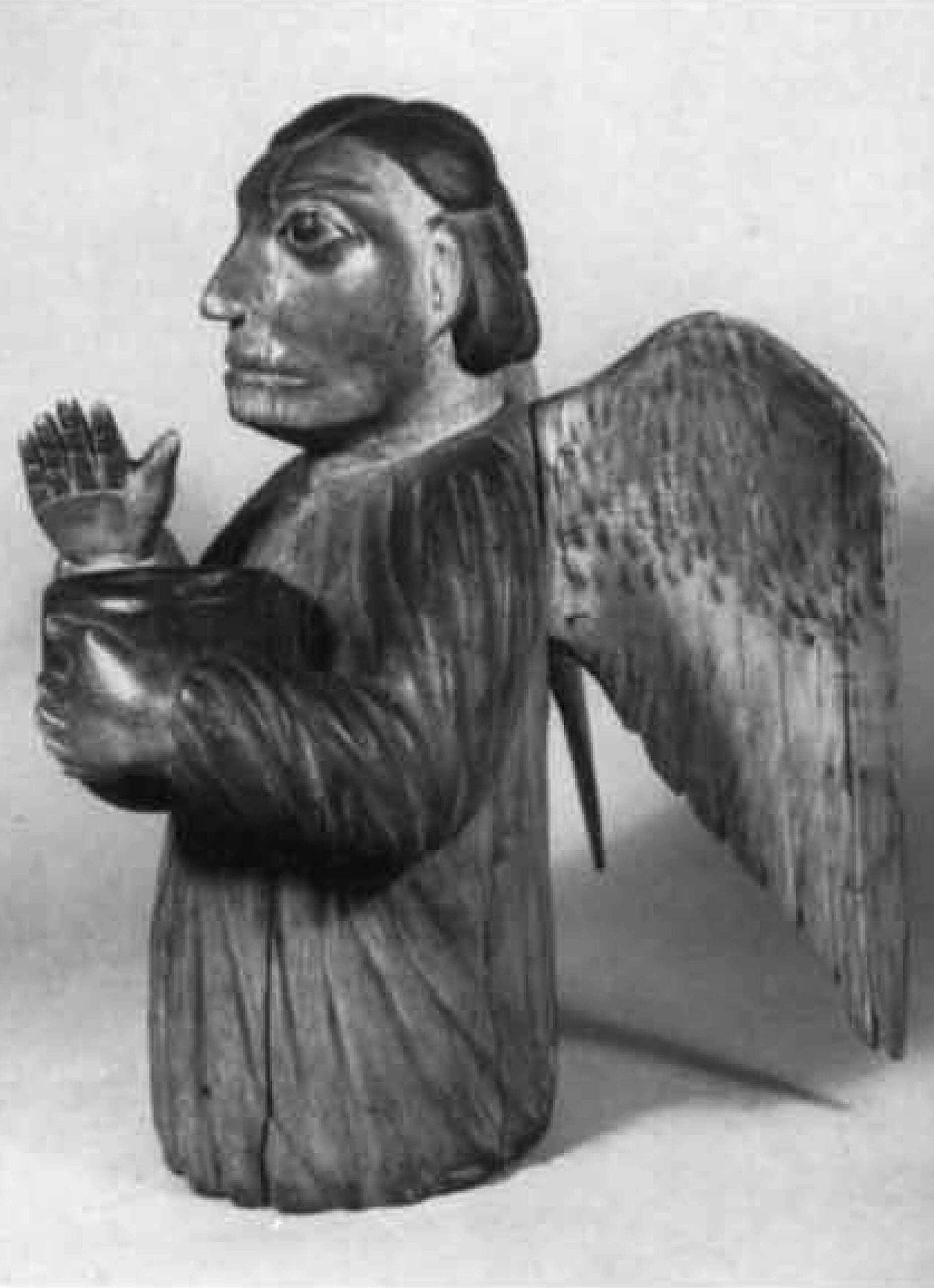

The story that has emerged is far more complex than the banning of Indigenous ceremonies. One account reports that in one Pacific Northwestern church service
extemporaneous prayers were said by an elder before and after the sermon. In Kincolith and elsewhere, services were held in the vernacular language. In Greenville, a drum would beat continuously during a service. The first chapel at Metlakatla was dominated by two traditional carved poles on either side of the alter. Evidence suggests that the missionaries practiced a limited tolerance toward the indigenous social and cultural forms and to a certain extent worked at implementing a king of Christianity capable of adjusting to Tsimshian custom.
All such convergences seem to pour from the cruciform canvas painted by Parnell.
The juxtaposition of Parnell with Lawren Harris’s landscapes at the AGO is therefore especially fitting. Harris, after all, had encouraged Carr to “drop the Indian themes to concentrate on nature.” He had, so he thought, graduated from the personal altogether. Stoked by Theosophy and its post-racial fantasies, he looked for a “new race” with its own “creative zest.” Meanwhile Carr insisted that a genuinely North American art had to be in conversation with Native culture, however imperfectly she may have phrased those intentions. “The art of the Indians” is more than “pretty,” she insisted, and “is in spirit very modern, full of liveness and vitality.” It is hard not to see in Parnell’s image the fulfillment of a pledge made, but not enacted, in Carr’s Indian Church. Parnell, in short, sees fit to include the cross that Harris denied.

But these intersections have not stayed put in the safe confines of Toronto museums. What began for me as hunting down Group of Seven paintings has become a conversation with living artists. It was as if the city of Toronto were asking me, as the angel asked Mary Magdalene, “Why do you seek the living among the dead?” What I have elsewhere called the “Turtle Island Renaissance” is in full flower in the wider city today. Train underpasses, bare concrete walls, and city buildings have been freshly clothed with murals that rival those in any major city in the world. These paintings are not in the style of the Group of Seven. On the contrary, they are in the spirit of Luke Parnell, though obviously expressing more the region’s Ojibwe past than the style of the West Cost. These paintings tell the full story of the Great Lake area’s human habitation, from the Ice Runners that hunted along the borders of glaciers, to the Huron-Wendat, Haudenosaunee, and Anishinaabe, as well as settlers who came later. And yet one of these paintings that emblazons a Toronto high rise, titled The Original Family, transcends ethnic division, perhaps testifying to the collective ancestry of the human race. We might call this mural Toronto’s Adam and Eve.


Cote saw no need to bash out beautiful stained–glass windows that celebrate the Beatitudes, for he well knows the compatibility of Ojibwe and Christian thought.

These paintings are all by the Ojibwe/Potawatomi/Mohawk artist Philip Cote (pronounced Coté), who as a boy experienced a series of formative encounters with the artist Norval Morrisseau (1932–2007), the “Picasso of the North,” founder of the Woodland school. Cote has the enviable ability to toggle between the Indigenous Woodland style and the Renaissance or even Neo-Classical mode (which he admits he prefers), or even graffiti-style tagging, which he also incorporates into his design. If Tom Thomson adapted his style to the occasion, Cote does so even more impressively. All this would be worthy enough to celebrate.


But the publications that rightly celebrate this remarkable effulgence frequently fail to point out that this style enhances churches as much as it enhances museums. Just as the Group of Seven aesthetic found its way into (now destroyed) churches, Cote’s murals have as well. No account of these recent achievements is complete without commentary on the painting that fills the south transept of Roncesvalles United Church in the Woodland style, or the Renaissance-style enhancing of the Chapel Royal at Massey College. In the former, Cote saw no need to bash out beautiful stained-glass windows that celebrate the Beatitudes, for he well knows the compatibility of Ojibwe and Christian thought. The Seven Grandfather Teachings graft perfectly onto the seven gifts of the Spirit from Isaiah 11:2–3. Teachings of the dark abyss of God that Cote received from his Ojibwe elders are a fitting match to the divine abyss in the book of Genesis, a bright abyss that links humans and creatures together through dark power lines of love.


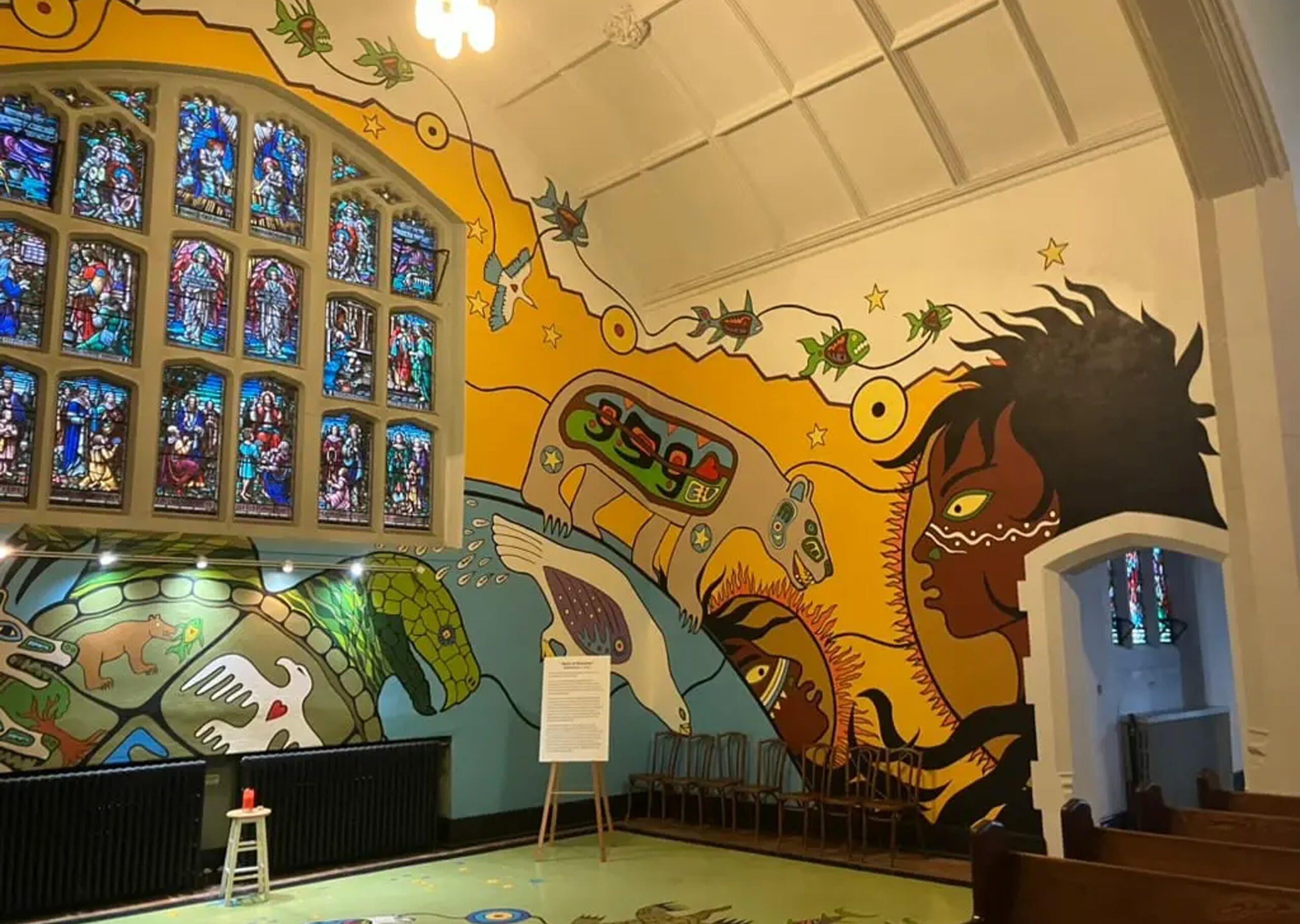

Cote’s paintings, which now mark the city’s waterways and churches, are desperate pleas to a screen-glutted culture to attend to natural rhythms that are deeper than digital algorithms, and the ecclesial partnership in this enterprise can no longer be overlooked. As with the Group of Seven, Christianity is a far more potent conversation partner for navigating Cote’s achievement than the abstract generics of Theosophy. Indeed, public patience with “Native” trinkets being hawked in New Age bookstores is growing thin. Canadian art dealers may have overridden Morrisseau’s Christianity with the New Age amalgam known as Eckankar to make his work more marketable, but Cote has proved to be much less malleable.
Perhaps this work is enough to cause us to forgo the city’s famous nickname, “Toronto the Good,” appended to it by Victorian evangelical activists, for Cote’s work evokes the sacred, the holy beyond the merely good. These paintings are, to recall the title of a recent book, an apocalypse of wisdom, the culmination of a continent, wherein the Christianization of classicism that made Florence and Rome is realized again. “We will share our wisdom with the settlers,” Cote defiantly told me, and he has followed through on that promise. If Emily Carr was the honorary eighth member of the Group of Seven, perhaps we can name Philip Cote—thanks to Morrisseau his mentor—the long-anticipated ninth, bringing the Canadian aesthetic enneagram to satisfying completion. In Cote’s riotous public and church murals, not only does the great tradition of Canadian landscape painting find its fulfillment, but the nearby Peterborough petroglyphs, the Teaching Rocks, do as well.
Of a more exciting aesthetic moment in any North American city I am not aware.
Note: Thank you to Sonny Assu, Luke Parnell, and Philip Cote for their gracious permission to include their work in this article, permission which does not entail agreement with my conclusions. Thank you also to the Trinity College multi-year conference on sacred space for the enriching conversations that contributed to this piece.