C
Creative breakthroughs often happen when you relinquish control. This is a maxim most artists understand. Still, it can be a challenge to muster enough courage to trust the process, get out of the way, and let creative work unfold on its own. I grew better at it over the long hours spent toiling in the studio during my art school years. At times, spent from trying to force something into being, my self-consciousness would fall away and my hand would be mysteriously guided by a new set of decisions that would give rise to something enigmatic on the surface before me. It happened often enough that I began to cultivate a habit of surrender. I was learning that once an idea took form, the challenge was in discerning where spontaneity should be allowed to come into play, and then how to respond to what was produced. I had to learn how to be receptive to what emerged in the moment. Sure enough, I’d find that time and again suspending conscious intention—my control—was essential to creative growth and, inevitably, better art.
After obtaining my degree and exhibiting my work for several years, I quit the artist’s life to pursue other interests. The lessons of the studio, no longer applicable, drifted away to settle like dust in the crevices of my mind. It would be decades later, however, before I rediscovered that the mental posture I had cultivated in artmaking was necessary for certain forms of spiritual discipline. Following graduate school, as I exhibited my work and navigated the art world, my spirituality was concurrently evolving under the influence of Eastern religion. Then I discovered the mystical tradition and returned to Christianity over the bridge of meditation to journey on the contemplative path. As I absorbed the mystics’ teachings on divine awareness, I was reminded of the studio.
Both the apophatic perspective and aesthetic attunement cultivate a receptivity to what emerges when we yield control, culminating in a felt connection to something greater than oneself. They share a common structure of experience, even as they are oriented toward different ends. Through silent prayer, lectio divina, liturgical participation, and other forms of devotion, I sought a direct awareness of the divine, beyond the limits of the self. In art the viewer seeks a connection to the work as a tangible, sensible reality. Powerful art loosens the ego’s boundaries, allowing a relational presence to emerge beyond one’s thoughts and intentions. Enthralled by these parallels, I began to wonder whether my artmaking experience had actually prepared me to take up the demands of spiritual discipline. What I experienced in the studio as isolated moments of awareness began to appear in hindsight like the early formation of a habit of attention, an attitude of non-grasping, a grace of detachment that I was relearning in my return to Christianity. In addition, my creative training prepared me to accept, even to embrace, the kind of unknowing that apophatic (or negative) theology identifies, where meaning arises beyond language and concepts.
I’ve come to realize that spiritual practice makes it possible to sustain what in artmaking was often intermittent and difficult to stabilize. Artmaking is episodic—appearing, intensifying, and then receding. But the contemplative tradition enabled me to return to receptive awareness deliberately through spiritual disciplines like the Jesus Prayer and the Ignatian examen. What was once confined to the elusive artmaking experience became a repeatable posture that I could carry into daily life.
There’s a convergent sequence here. Art primes the mind for wonder, but Christianity orients the experience of wonder toward God as its source and fulfillment. When the art experience is given theological intelligibility, the wonder it stirs in us can be understood as a response to the divine. What contemplative practice works on is the response this wonder awakens. Practices like silent prayer receive and deepen the initial response so that it becomes a more stable position of receptivity to God. When an artist surrenders to chance, they are breaking with the desire for mastery by allowing form to emerge from what cannot be foreseen. Apophatic theology also refuses to conceptualize in advance. It rejects efforts to reduce the divine to concepts, insisting that God is encountered precisely at the limits of language and representation. In both art and spirituality, not knowing is not a deficiency but a condition of deeper encounter. The work of art or the practice of contemplation is where interpretive closure is deferred.
Yet art is unique because it renders the creative potential of uncontrollability, to borrow Hartmut Rosa’s term, visible and tangible. Paradoxically, the material form of art serves as a gateway to the formless, a state of unknowing. Whether through an accumulation of marks, the shaping of form and space, the modulation of light and shadow, or the dynamic energy pulsing through a composition, artworks externalize the mystery in which contemplation dwells. If we allow it, art can train the mind to welcome the unfamiliar or revel in paradox. It can steady the body into heightened stillness and teach the imagination to hold possibilities in suspension. It can coax the unfamiliar to disclose itself gradually. In this sense, art can be seen as a workshop for contemplative practices.
Meaningful encounters with art require humility. This means putting aside our preconceptions and biases to fully engage the image, object, or space on its own terms. Art conditions us to accept the uncertainty that pervades daily life. It provides opportunity, through experiential encounters, to inhabit the state of unknowing. Throughout history, artists have understood the immense creative potential in surrendering to what lies beyond their control. Periodically relinquishing control to allow the creative process to guide decisions is a necessary component in any serious creative practice. Throughout a work’s production, the artist continually faces a choice: impose intentions, or pause, attend to what the work seems to demand, and surrender the plan to follow the process. Often, where the process leads is unexpected. Viewers usually do not perceive the choices in the finished work, which is the accumulation of countless roads not taken. Yet they encounter the effects in a work that feels more exciting than one governed entirely by rigid control.
Art primes the mind for wonder, but Christianity orients the experience of wonder toward God as its source and fulfillment.
At the same time, artists may choose to make the unexpected a basic operating principle in their work through a set of methods that can collectively be labelled “chance operations.” This isn’t a contemporary development, either. The embrace of uncertainty through the deliberate use of chance as an aesthetic strategy has been a recurring impulse across diverse cultures for centuries. By allowing chance to “guide” their work, artists navigate unpredictability in making, while viewers experience a heightened awareness of contingency. In the process, chance-based art invites us to reflect on emergence, the sense that the work has its own life, unfolding in ways that give it a living, dynamic quality beyond the artist’s intention and control.
Some may find it surprising to learn that the aesthetic of unpredictability is an established practice in the arts. This is because “accidents” are often absorbed into the finished work after serving to direct it in ways no longer perceptible. Another reason we overlook the role of chance is that we tend to equate the refined quality of art with control. Pre-modern examples of the aesthetic of unpredictability abound, like the indeterminate patterns of medieval Chinese T’ang and Song pottery. These artists incorporated a degree of chance into what was otherwise highly controlled, seeing it as reflecting the universal ch’i and the Taoist emphasis on impermanence and change as the fundamental conditions of life. Taoist ink landscapes made in China beginning in the tenth century included unplanned effects as well. Zen ink painters in both China and Japan from the twelfth century onward made use of spontaneous brushwork; and beginning in the fourteenth century, the Japanese development of sumi-e calligraphy relied on improvisational ink flow.

In the West, European medieval manuscripts sometimes incorporated playful, spontaneous occurrences in their marginalia. Scribes and readers alike would, on occasion, add images to the pages responding to the written content or elaborating on the illustrations. Artists working in other spiritual traditions also recognized the importance of remaining open to accidents and contingency in the creative process. Consider the ephemeral and process-oriented nature of Navajo sand painting or Aboriginal Australian dot painting, which produce emergent patterns within a formal structure. The shamanistic artistic practices found in ancient traditions throughout the world are often grounded in visions or dreams—chance encounters with a spiritual reality—rather than anything predetermined.
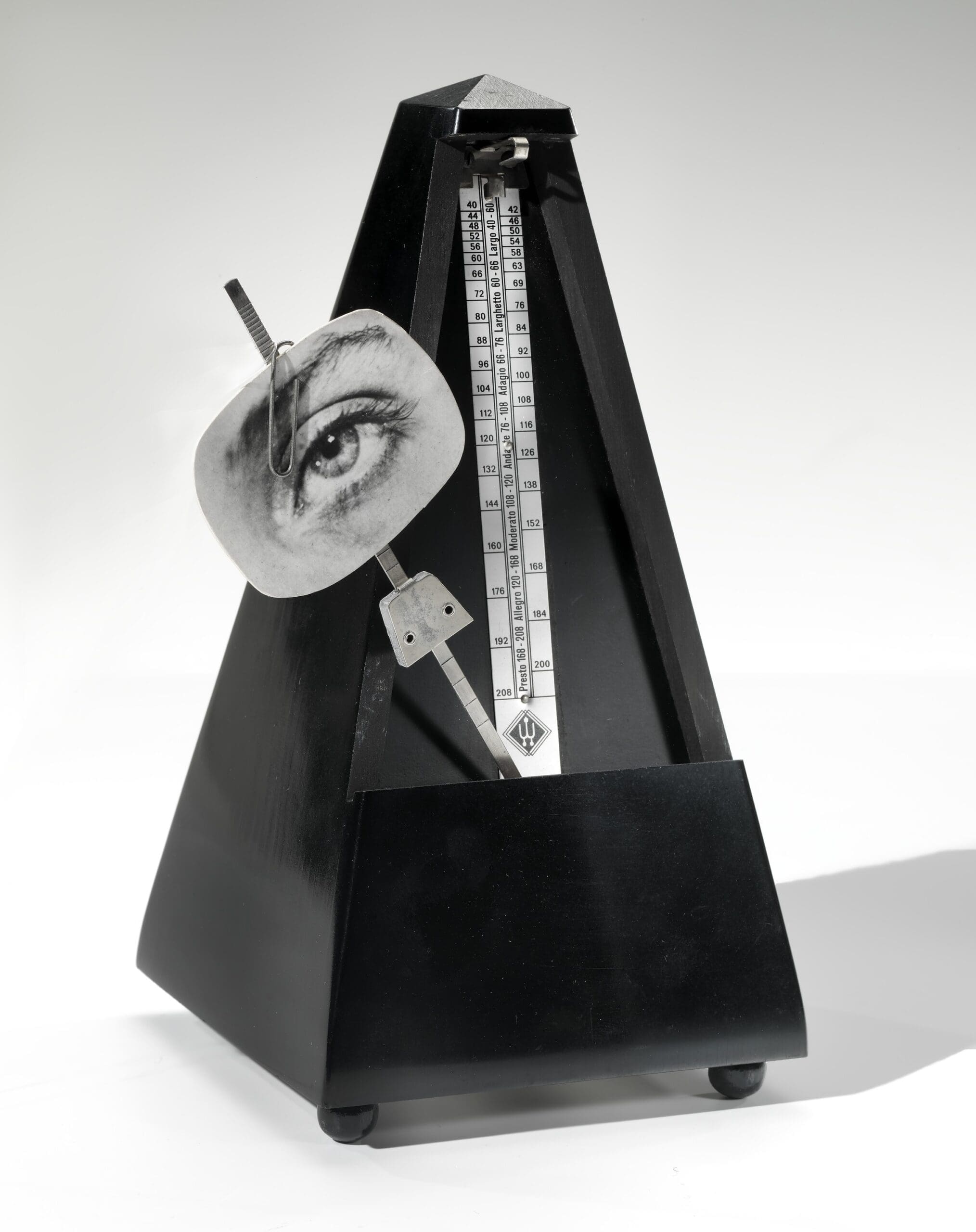
Beginning in the twentieth century, artists would adopt chance methods in response to the uncertainty and fragmentation introduced by modern life. While indeterminacy became a commonly recognized means of expanding one’s creative range, avant-garde artists, musicians, and poets were pursuing a variety of aims. Some wanted to circumvent the rational mind to produce work that critiqued authorship and artistic ego. Others were reacting against the dehumanizing effects of industrialization and mechanization, which, they believed, were the result of living in a society constrained by the rational mind. The random, absurd nature of Dada art was a direct response to the trauma of World War I, a gesture of defiance towards social norms. For the international Dadaists, figures like Hans Arp, Hannah Höch, Kurt Schwitters, Man Ray, and Tristan Tzara, aesthetic rebellion was meant to shake up the oppressive system of cultural norms they felt had led to the madness of large-scale death and destruction in Europe. Their radical aims led each of them, in one way or another, to open their creative process to chance operations. Hans Arp would make collages by dropping scraps of paper onto a surface, fixing them where they landed. Hannah Höch arranged found images to make strange figures that commented on gender. Kurt Schwitters was known for his assemblages of urban debris and his transforming of waste materials. Man Ray would manipulate the photographic process to produce images that were by turns uncanny and haunting. And as the leader of the movement, Tristan Tzara collaborated with other artists on Dada journals and printed works using fragmented typography and abrupt juxtapositions organized by improvisation and chance arrangement.

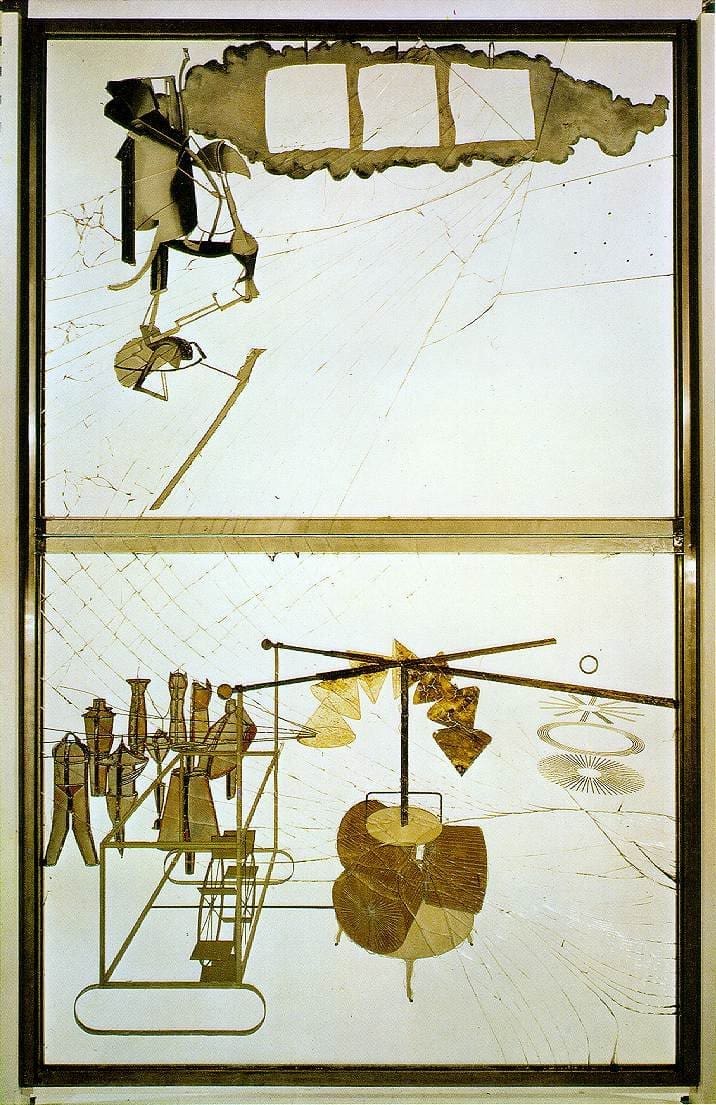
Marcel Duchamp, often associated with Dada but singular in his radicality and massive in his influence on generations of postmodern artists, used chance operations and embraced arbitrariness to question the very meaning of art. His mixed-media work interrogated the cultural conditioning that assigns value to an object when placed in the space of a gallery or museum. In The Bride Stripped Bare by Her Bachelors, Even Duchamp incorporated accidental elements such as dust accumulation and cracks, which he accepted as part of the finished work. His famous ready–mades involved arbitrary selection and displacement of ordinary manufactured objects into the context of art. His work served as a model for institutional critique, a form of art that wouldn’t fully arrive until the late 1960s.
The surrealists, including Rene Magritte, Max Ernst, Salvador Dali, Joan Miro, Yves Tanguy, and Andre Masson used a group of techniques known as automatism to suspend rational control so that images and words could emerge spontaneously. Some of their methods included improvisatory mark-making, associative image generation, allowing accidental forms to suggest imagery, and working in trance-like states. These artists continually mined the unconscious and dreams to make visual art, while surrealist authors and poets engaged in stream-of-consciousness or automatic writing.
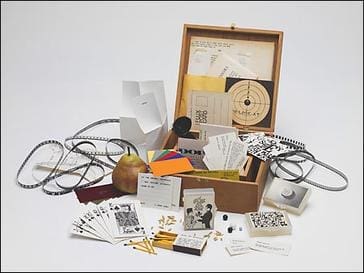
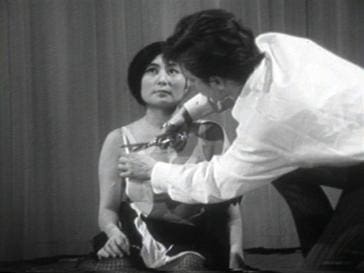
Artists in the post–World War II era increasingly desired to collapse the boundaries between art and life. This meant letting the messiness and unpredictability of lived experience into the work and allowing chance to guide its form. Exemplified early in the twentieth century by the incorporation of everyday materials in the collages of Georges Braque and Pablo Picasso, this impulse was central to the international Fluxus movement in the 1960s and ’70s. Fluxus was an interdisciplinary community of artists that made experimental work based on chance. Many of the artists associated with the movement engaged in highly improvisational performances. Famous examples, from 1964 and 1971 respectively, include Yoko Ono’s Cut Piece, in which the audience was invited to cut away pieces of her clothing, and Nam June Paik’s TV Cello, an absurd sculptural assemblage his collaborator for the piece—the cellist Charlotte Moorman—played in a renowned Fluxus performance. Allan Kaprow, also associated with Fluxus, was pursuing a similar, chance-based methodology through spontaneous constructed environments and performance events called Happenings, in which audiences became active participants in the execution of an artwork.
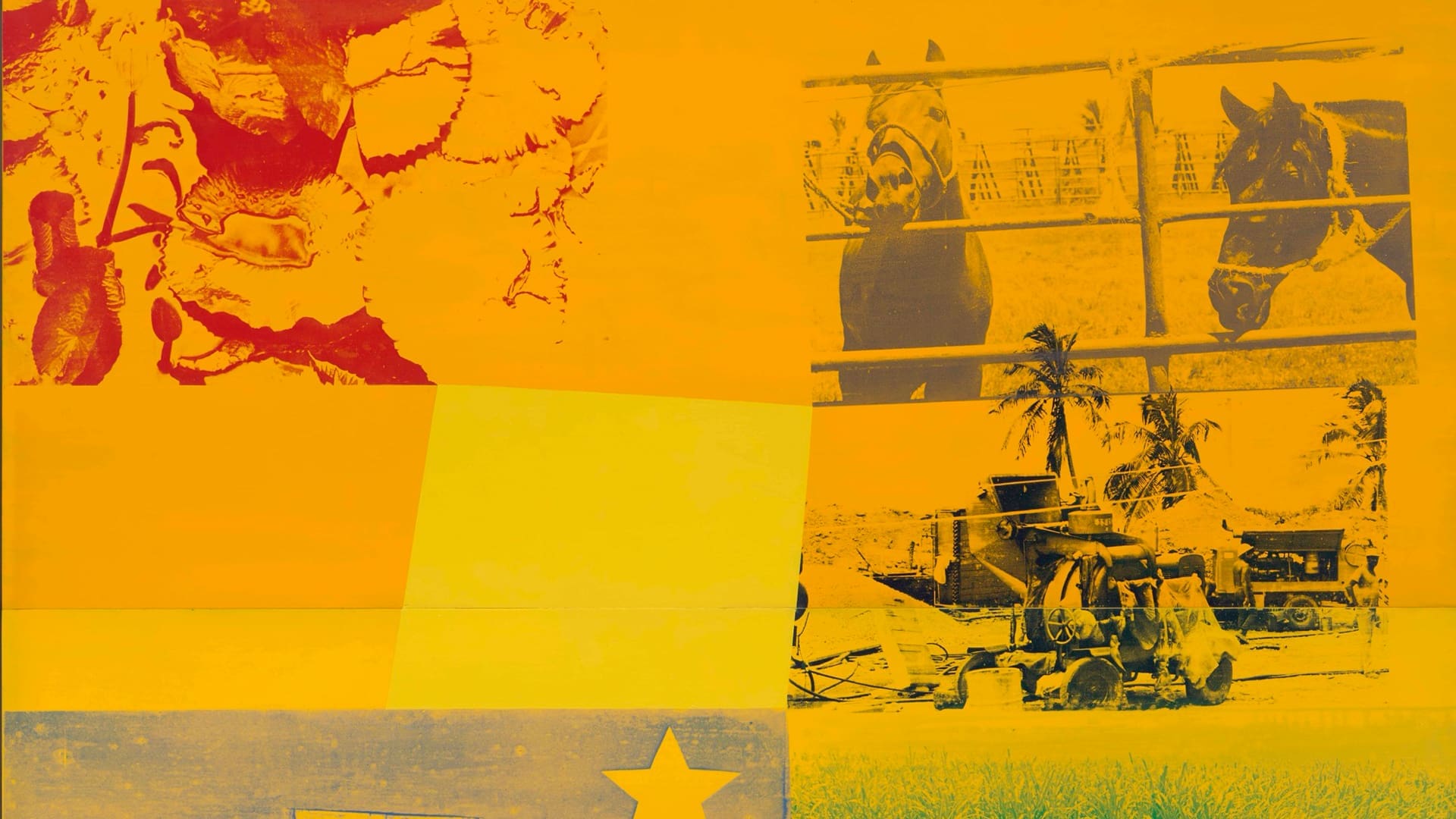
Meanwhile, Robert Rauschenberg and Jasper Johns were incorporating found materials into their paintings, sculptures, and mixed-media works, and the dancer and choreographer Merce Cunningham was revolutionizing dance with his “choreography of chance.” Cunningham would toss coins, dice, or use the I Ching, among other methods, to determine structures and movements that would break from the predictable. Cunningham frequently collaborated with the avant-garde composer John Cage. Chance operations were central to Cage’s work, used to remove personal intention and to open his experiments in sound to indeterminacy. He relied on chance to produce musical compositions as part of a radical practice that continues to inspire a multitude of artists working in a range of media today. The score for his most radical composition, 4′ 33″, instructs musicians to sit in silence throughout its three movements. The time for music becomes filled with the ambient sound of the space in which the piece is performed. He also used chance to determine how to modify ordinary instruments, leading to new sounds and challenging conventional ideas about performance. Cage’s multifaceted practice, like Duchamp’s, was concerned with breaking artistic boundaries to explore what lies beyond the creative individual’s will.
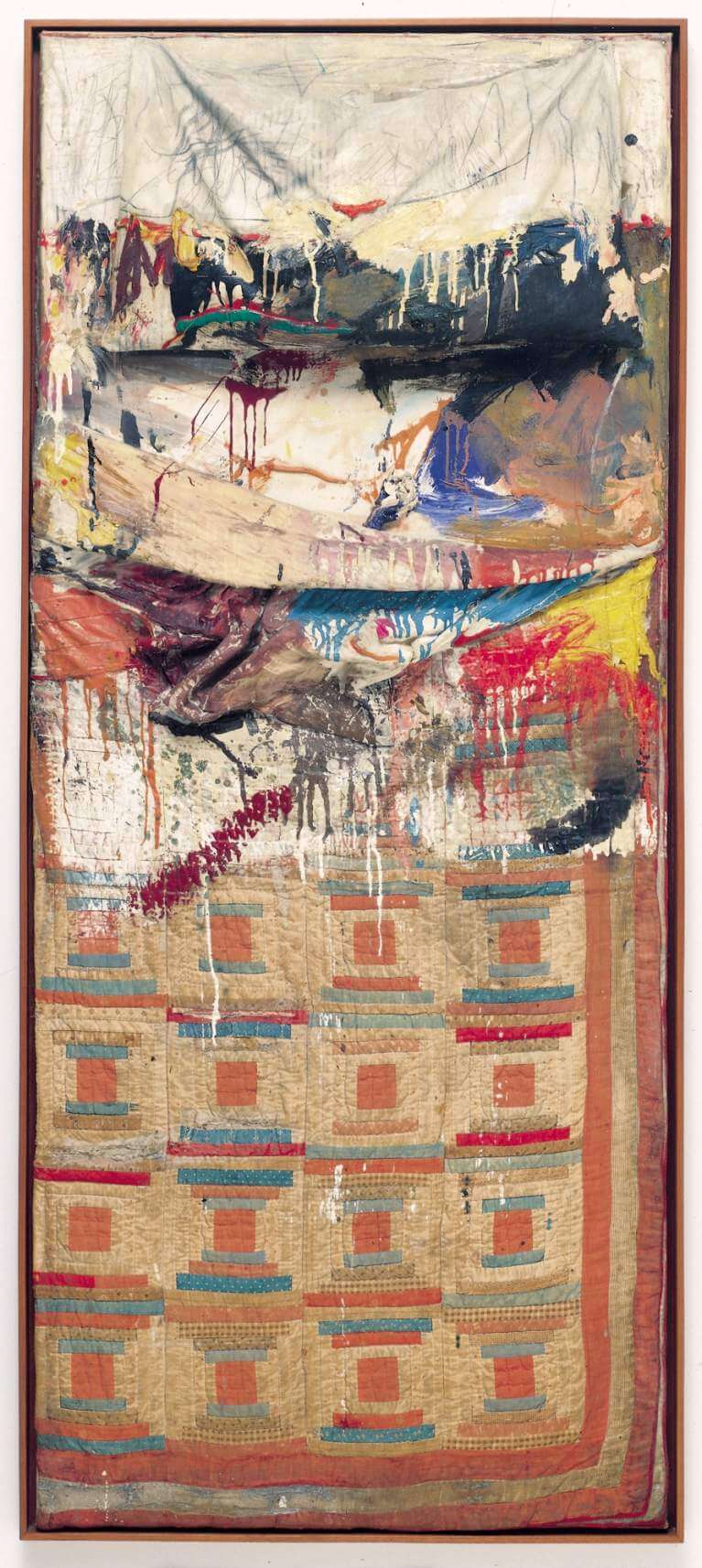
Contemporary artists working with an array of subject matter and a wide variety of mediums will often employ chance operations, like their predecessors, to circumvent deliberate choice and personal bias. But also, to let the messiness of their own worlds seep into or upend intentionality and the work’s formal logic. The unexpected, often surprising results of introducing the unpredictable can lead the artist in new directions or uncover further creative possibilities.
Yet, what of the receiver? How does the use of chance affect the diverse viewers of an artwork? Sometimes a chance method leaves visible traces in the form of drips, folds, stains, collisions, or misalignments. There may be no clear focal point or organizing logic, producing a decentred field or perhaps a dispersed or structurally open surface. Thus, although the use of chance may not always be seen, it often alters how the art is read. If, on the other hand, the artist has disclosed their methodology, the viewer’s perception shifts. Attention is redirected from formal elements to procedure, a second “author function” is introduced alongside the artist, viewers are encouraged to search for structure in contingency (or contingency in structure), and the absence of intention itself becomes meaningful rather than empty. In such instances, the role of chance becomes less a perceptual feature and more a hermeneutic instruction that tells the viewer how to read what they’re already seeing.
Nevertheless, it’s understandable that an artistic reliance on chance raises suspicion. We tend to think great art is a product of years of practice, mastery of materials, deliberate planning, and refined technique. Coherent composition, harmony, clarity, and precision of form cannot be achieved without a high degree of focus and control. So it’s fair to ask how giving up control could be productive or lead to anything of merit. How can we take artists who rely on randomness seriously? Can art made using chance operations have substantive depth? Or is art based on chance, even art that allows it intermittently, simply a gimmick masking itself as serious? Is it using shock and provocation in place of critical engagement?
Plenty of art that plays with chance falls into these traps. Yet the real question isn’t whether the artist’s reliance on chance is a legitimate strategy or not. As I’ve demonstrated, artists have successfully employed it to expand the possibilities of art for centuries. The question is whether it serves the work or collapses into novelty. In art, mastery doesn’t simply mean control. It means achieving a form that feels necessary and alive, as though its formal and conceptual order couldn’t be otherwise. While opening the creative process to unpredictability is perhaps the most immediate way an artist can get beyond their conceptual frame, it also runs the risk of producing results that feel arbitrary instead of coherent, provocative rather than critical.
Which is why, as with contemplative practices, discernment plays a vital role. This is true for all art, but the importance of discernment is most pronounced when applied to chance-based art. Since the artist must choose which chance outcomes to keep and which to discard, they must be selective, attuned to subtle shifts in the work. In the midst of the creative process, the artist must exercise restraint, be responsive and patient, and be able to apply sound judgment. They must be open to self-critique and possess the insight that allows for making decisions with purpose, even through chance.
Here, the affinity between artistic and contemplative practice begins to assert itself most strongly. Just as the artist is challenged to closely observe what emerges through chance without imposing anything prematurely, so too the contemplative must avoid imposing the ego’s desires when listening for the voice of the Spirit. The artist must adjust to what the work calls for as it develops, and in much the same way the contemplative responds to subtle movements of grace or interior prompting. The same dynamic appears if we compare the artist’s need to recognize when the work has achieved coherence or “rightness” to the contemplative’s discernment in finding equanimity. And when the artist allows a work to unfold over time, this is mirrored in the discipline contemplatives need to remain in silence and unknowing without trying to force insight.
In art, mastery doesn’t simply mean control. It means achieving a form that feels necessary and alive, as though its formal and conceptual order couldn’t be otherwise.
Whether applied to creative or spiritual life, discernment relies on the wisdom of experience. It comes with the willingness to approach the world with openness and curiosity, and it requires the courage to be humble and heed the Spirit’s prompting. As with contemplative practice, the artist must apply discipline and discernment to produce anything of merit. Part of this means knowing how and why artists have used chance in the past, and what they have achieved through it. Otherwise, chance-based art can become gimmicky, empty, self-aggrandizing, or excessively performative.
If modern alienation is the result of our desire to control the world, to make it manageable, as Hartmut Rosa argues in The Uncontrollability of the World, the bidirectional insight I’ve been describing between the experience of making and engaging art and the practice of contemplation suggests a way out. Both art and contemplative practices, those disciplines of silence, attention, and receptivity before God, serve as a vital countermeasure to the modern obsession with expanding human reach. Consider how both emphasize stillness over acceleration, presence over distraction, depth over surface, listening over assertion, and surrender to uncertainty. How better to undercut our desire to conquer and broaden our share of the world than to get outside ourselves and nurture relationality? Practices that cultivate a habit of openness and receptivity are fully within Christianity but tend to be underemphasized in religious education.
This is a major reason the teachings of the mystics seem “alternative,” when in truth they form a deeper strand within the tradition than mainstream religious practice or common understanding of what makes up the Christian tradition. The experiences of unknowing that art exposes, when recognized and worked with through contemplative practices, can lead us directly to radical spiritual insights largely obscured in mainstream Christianity. Let’s remember that religion forms within the culture, and without intentional depth it can begin to reflect culture more than resist or transform it. A religious belief system that accommodates efficiency and productivity, or that prioritizes clarity, certainty, and performance, or that promises quick results, is mirroring the culture’s priorities.
Rosa explains how, despite all the technology available to help us control the world, it continues to withdraw, to elude our grasp. The resulting alienation leads to indifference and eventually hostility toward others. This is the deadening predicament of modernity. Rosa identifies a way out through the notion of resonance, which restores the natural balance between subject and world through relationality. He underscores the fact that resonance itself can’t be willed. We cannot control it; it’s a gift we receive. And he rightly includes the experience of art as one way we encounter the resonance of an uncontrollable reality. Rosa proposes we relate to the world with an attitude that encourages resonance. But how can we ensure ongoing connectivity if aesthetic appreciation and other axes of resonance are situational? The question of how resonance can become a continuously lived mode of relation opens directly onto the terrain of mysticism. Reading his book, I’m struck by how much Rosa’s sociological ideas and the nature of resonance align with the relational language of Christian mystical theology—particularly when he discusses resonance as a gift, but also when he explains its dynamics in terms of call, response, and transformation.
It’s easy to understand why Rosa’s work is so appealing. After all, it’s not only creatives who experience the thrill of uncontrollability and the resonance that emerges under such conditions. His book speaks insightfully to our cultural condition and the issues that plague us in terms the general reader can easily grasp. But for me the real value of his book is that, by identifying resonance as the gateway to a different relationship with the world, Rosa brushes up against a mystical lineage spanning centuries, from Origen and Evagrius Ponticus to Hildegard of Bingen and Meister Eckhart. Moreover, the occasions for resonance—aesthetic experience, major life events, interpersonal relationships, interactions with nature—are also recognized by discerning spiritual seekers as important for shaping a deeper attentiveness to reality. A substantive experience with art leaves behind a residue, leading us to ask: What was that presence, that sense of something uncontrollable? Indeed, art awakens fleeting moments in which the world feels responsive rather than mute.
Aesthetic resonance occurs when we’re unexpectedly addressed and drawn beyond our self-imposed limits. While art conditions us to inhabit uncertainty at the level of form and process, foregrounding for both artist and viewer varying degrees of contingency, fragmentation, and ambiguity, or the loosening of authorial control, apophatic theology significantly deepens what the aesthetic experience discloses. In the tradition’s classic texts, like The Cloud of Unknowing, God exceeds any and all attempts at definitive articulation. Apophatic theology further radicalizes the receptivity needed to engage meaningfully with serious art by shifting such an attitude from the aesthetic to the existential dimension. It names a way of relating to reality in which surrender of control becomes the condition for a deeper, though always indirect, form of encounter.
The link between creative life and spiritual life was revealed in hindsight for me through the connective tissue consisting of posture (receptivity), the condition of the encounter (uncontrollability), the mode of appearance (emergence), and the quality of experience (resonance). But for others, too, once the question shifts from the aesthetic to the existential, the search begins for ways to cultivate interconnectivity with the larger world. The seeker may be led by grace to discover practices oriented to receptivity and relational depth. Practices centred in the cultivation of lasting openness. Thanks to its increasing visibility through technology and our networked world, the mystical tradition of Christianity then comes into view as a discipline of attentiveness, receptivity, silence, and communion that resists the modern impulse to dominate. If modernity seeks fulfillment through grasping, optimization, control, and consumption, Christian contemplation proposes a radical alternative. Its practice teaches that meaning emerges not through mastering the world but through learning to be addressed by it in the name of God.