


T
I
The demolition crew came for Mary Lee’s house on a cloudy morning in April. More than a year had passed since the local newspaper had declared: VACANT HOUSES TO BE DEMOLISHED IN RENOVO. The day would have come sooner, but the town lacked the money to knock down the ruined, emptied-out homes—eight in all, along two blocks of Ontario Avenue. Through the persistence of a few borough council members, the funds had finally been secured through an improvement grant from the State of Pennsylvania.
From my apartment in Brooklyn, I had been pestering the secretary of the construction firm with calls, anxious to know the start date. I enlisted several locals as tipsters on my behalf. I told my wife, dramatically, “I’ll have to leave immediately when I get word.” When the demolition date was finally announced, I raced home from work, stuffed a change of clothes into an overnight bag, and drove five hours to central Pennsylvania, arriving in Renovo just past midnight.
I slept restlessly, woke early, and got to Ontario Avenue before the work crew. Waiting in my car, I thought about how my city neighbourhood was a vision of prosperity on weekday mornings: a parade of office professionals heading to work; private-school kids gathered in packs outside Saint Ann’s; athleisure-clad women doing the gym–yoga–smoothie circuit. By contrast, the street outside my windows was lifeless. Rather than dwell on what that meant for the town’s future, I gazed south across the Susquehanna River to the mountains. The winter-brown trees were turning the delicate green colour that marks spring in the Northeast. Nature, at least, was renewing itself.
Ever since I’d learned about the condemned houses, I had been thinking about the people who had lived in them, and for the same reason I hung a postcard of Hyner View State Park on the refrigerator in my apartment and subscribed by mail to The Record, clipping the obituaries of old acquaintances. At midlife, I had come to understand that leaving this tiny Appalachian town had been the most consequential act of my life. I still felt a strong pull back there.
Ontario Avenue was my street, my neighbourhood. The patchwork of row houses and fenced-in backyards was indistinguishable in my mind from childhood itself. And now they were going.
Around nine o’clock, a dump truck rumbled down the street. Three orange-vested men arrived in a pickup, followed by the foreman in his hard hat, barking orders. Finally, an excavator, moving on steel tracks, creaked into view. The yellow cab was rust-speckled, and its extending arm and bucket reached like a huge arthritic claw.
With the sky clouding over, I joined the crowd of onlookers now gathered in the street. The site of workers and machinery, if only to tear something down, provided some excitement. I stood beside Bees O’Brien, a childhood friend who had grown up in the last house of the condemned row. His mother, Patty, who raised five children in that small house, was watching with tears from across the street. The foreman struck Mary Lee’s front door with a sledgehammer, breaking his way in. The crewmen followed. The foreman soon re-emerged, cranked up a chainsaw and cut the saplings that had taken root along the brick foundation. When the brush was cleared and Mary Lee’s basement windows were again visible, the foreman, holding the sledgehammer again, reared back and smashed them out.
II
My parents moved to Ontario Avenue in August 1977, a month shy of my first birthday. Locals called it “Back Street,” perhaps because it ran alongside the river. Erie Avenue, or “Front Street,” faced the Pennsylvania Railroad maintenance shops—Renovo’s defining industry for a century.
Renovo, which has one stoplight and a population of twelve hundred, is a dot in the middle of tens of thousands of acres of state forest preserves. The rugged Allegheny Mountains, more steep than tall, curtail the views and block radio waves, limiting signals from the outside world. The nearest town in any direction is thirty miles through primeval wilderness. In a book published some years ago about America’s last empty places, a forester in New Mexico tells the author, “Go to Renovo. You won’t believe there’s a spot that remote in the East.”
My father’s family were Austro-Hungarians who had settled in the nearby mountaintop village of Bitumen, named after the type of coal mined there. My maternal grandparents, Harold and Margaret Bissman, graduated from Renovo High in 1939 and moved to Buffalo, where my grandfather found employment as a sheet-metal worker in the city’s factories. My mother grew up as a city kid. But after divorcing her first husband, at thirty-three she made a reverse migration, moving to her ancestral hometown, and met my father soon after.
When you grow up in a rural community like mine, you are surrounded by history and family. You attend school with kids whose parents went to school with your parents. You take a summer job, as I did, in a pizzeria that half a century earlier was the A&P your great-grandfather managed. You drive past the cemetery where your ancestors are buried. Even locals who aren’t blood feel like relatives because they know your life story, and you know theirs. Townspeople could look at my features and mark me as a “Kurutz boy.” In my teens this could be stifling, but almost immediately after I moved away, being back home was like being held in a warm embrace. Now, if more than six weeks pass without a visit, the longing—almost physical—begins. When we got married, my wife Cara resigned herself to a third party in our marriage—Renovo.
The house of my childhood, No. 530 Ontario Ave., was a small but handsome Georgian Colonial painted white with black shutters. Our neighbours in those early years were by and large retired couples who lived off modest pensions from the railroad or Piper Aircraft, which also operated a factory in town. Like my grandparents, these men and women had come of age in the Great Depression, in a rural America where indoor plumbing and refrigeration were luxuries. Through decades of physical work and thrift, each had managed to own a red-brick or vinyl-sided semi-detached house they treated like a villa.
At midlife, I had come to understand that leaving this tiny Appalachian town had been the most consequential act of my life. I still felt a strong pull back there.
Lester Geise, a retired railroader who lived three doors down, grew tulips along the chain-link fence that divided each homeowner’s long strip of backyard; each spring they appeared in a bright row. Barney and Jane Owens, retirees across the street, turned their front porch into a cozy outdoor room with the addition of a swing, cushioned rockers, and a shade-giving aluminum awning. Barney spent hours on his porch, reading the paper and benignly spying on the neighbours from beneath a Yankees cap. Farther down the block, the Toots—Margie and her disabled adult son Roger—took pride in the Japanese gingko in front of their double. Margie’s parents, who lived in the adjoining house, had special-ordered the tree by mail.
Though a generation younger than their neighbours, my parents embraced the practice of keeping up one’s house and, by extension, the neighbourhood. After spending his workday covered in grease repairing huge compressor engines that pumped natural gas up from the ground, my father spent evenings digging up our backyard to lay a flagstone patio. He lugged home railroad ties scavenged along the tracks so that my mother would have a border for her marigolds and rose of Sharon. One summer, after we’d been in the house a few years, my father and his work buddy Harold Ransom poured a concrete slab and built a tool shed at the end of our yard. As was custom, my parents paid Harold with a case of beer and a hoagie from Tripp’s gas and grocery.
Our next-door neighbours, the Simons—Ann and Pat and their two children, Jim and Beth Ann—were one of the block’s few other young families. Pat worked at a bank, and the couple socialized with the Maxwells, one of the prominent, business-owning families in town, which gave the Simons a slight air of sophistication. Our neighbours on the opposite side were residents of the “low-incomes”—an L-shaped complex of identical pink-brick townhomes built by the county as public housing after the devastating 1972 flood. Our nickname for these subsidized apartments now sounds insensitive, but we used the shorthand without judgment. Many of the tenants were elderly widows making do on Social Security, hardly the “welfare queens” villainized by conservative politicians of the era, and the rest of us managed on not much income ourselves.
We lived practically on top of one another. From my kitchen window, I had a direct view into the Simons’ kitchen, glowing invitingly under lamplight. The long row of low-incomes ran parallel to our backyard, and the tenants’ kitchen windows and rear patios looked onto us—and the Simons, the Geises, and so on down the block—and we looked onto them. Even in the self-absorption of childhood, playing catch with myself in the yard, I was attuned to our neighbours’ intimate lives: Mrs. Rooney’s undergarments drying on the line; Bobbi Mazzulla’s cooking smell, so unlike my mother’s. On Wednesday evenings, everyone knew, Helen Ziaus’s white-haired boyfriend visited her upstairs apartment, when his wife thought he was playing cards at the Elks.
III
Our closest neighbour—not by proximity but by affection—was Mary Lee Edwards. When my mother took flight from her first marriage and came to Renovo, she got a job at the twenty-four-hour diner inside the YMCA. The “Y”—at six redbrick stories the tallest building in town—was also a hotel where the railroaders stayed when changing crews. Hired to waitress the night shift, my mother was soon made cook as well, despite having no experience in a commercial kitchen. Mary Lee and her widowed mother worked in the kitchen and took the new girl under their wing; they were among my mother’s first friends in town.
Another connection to Mary Lee was through my best friend, Shawn O’Connor, who was the son of Mary Lee’s sister Wendy. The O’Connors lived one up from the Geises. Shawn had two baby sisters and young parents, and their house had a fun, chaotic energy, whereas my mother was a generation older and our house was only my parents and myself. Between her two sisters, Mary Lee was an aunt several times over, but she never had her own family or even, to my knowledge, a boyfriend. She had a childlike quality that made her seem, to us neighbourhood kids, like a sweet big sister. There was her wheezy, excitable laugh. There was her lenient reprimand when we played rough: “You kids.” Her short fuzzy hair, shapeless clothes, and soft, round body invited snuggling beside her on her porch swing.
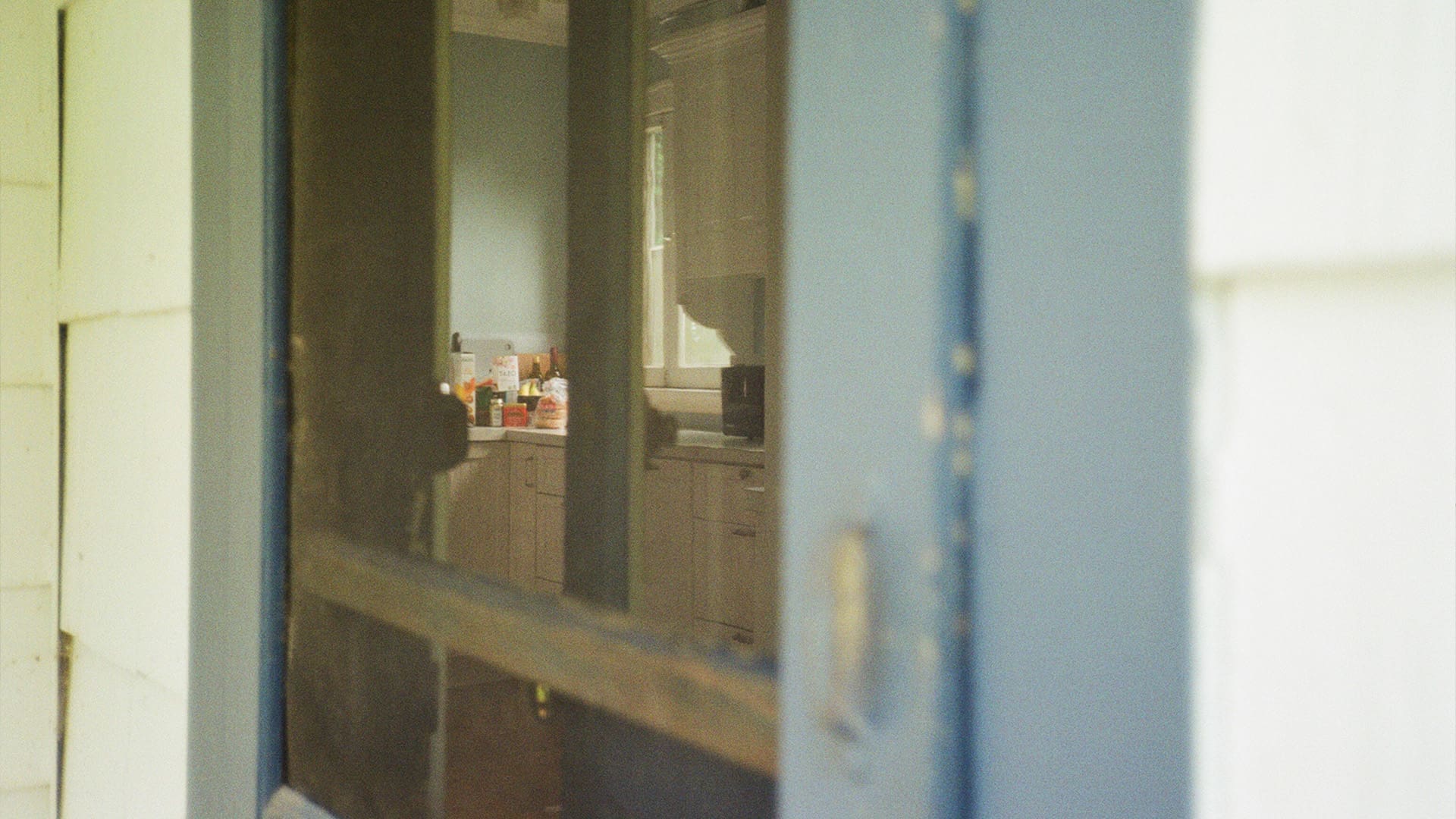
Of all the neighbourhood houses in which I spent time, Mary Lee’s was my favourite to visit. You entered from the side porch, through an aluminum screen door that thwacked as it closed. The flapping door, along with the prickly grey asphalt shingles and rusty wire fence squaring off the yard, made it seem older and more rustic, like a farmhouse. Even in summer, the downstairs rooms held a dusky coolness, almost a presence. By the early eighties, Mary Lee was working as the housekeeper at Summerson’s Four Seasons Motel and living alone in her family homestead. Her mother had died of a heart attack; her father, years earlier, in a gruesome railroad accident. It was this house—her domain over and care for it—that for Mary Lee was an anchor in the world.
Her other anchor was her Christian faith. She’d had a conversion experience in the seventies and read the Bible with scholarly attention. It was Mary Lee’s embodiment of the virtue of Christian charity that led my mother to call on her during a distressing episode. One morning when I was four or five, I unlatched our back gate and slipped the bounds of adult supervision, trailed by our sweet-natured miniature schnauzer, Pretzel. My mother was talking on the kitchen phone and distracted. No neighbours seemed to notice.
Pretzel and I walked the dirt footpath that skirted above the riverbank. After one block, we turned up Sixth Street toward Ontario Avenue. I was on the sidewalk, nearly home, when Pretzel, in one of those moments of animal impulsiveness, darted into the street, where she was run over by a car. One of the searing images of my childhood was seeing our family dog lying limp on the pavement, dark blood oozing from her head. The driver never bothered to stop.
When I ran inside to tell my mother, she was grief-stricken. Pretzel was one of the few things she had brought from her life in Buffalo; the dog slept at her feet. After she got over the shock, my mother found herself in need of burying Pretzel and incapable of doing it. My father was at work and unreachable. It was Mary Lee who came over with a cardboard box and a shovel and carried Pretzel’s body down to the riverbank. To call her a neighbour after that seemed inadequate.
IV
For much of the nineteenth and twentieth centuries, the railroad had been the economic engine of Renovo. The town was founded in the 1860s by the Philadelphia & Erie (later the Pennsylvania Railroad, or PRR) as a maintenance station midway between those cities. Vast brick workshops serviced steam and later diesel locomotives. The railyards boasted a turntable. An iron footbridge spanned the tracks, connecting the shops to the businesses along Erie Avenue, and during shift changes, many hundreds of soot-covered workers poured across it.
In 1968 the mighty PRR, once the largest corporation in the world, was forced to merge with its chief competitor, the New York Central, following years of declining freight and passenger revenues. The merged company soon went bankrupt and was sold off in parts to the newly established, government-managed Conrail and Amtrak. After a century as the bedrock industry in a one-industry town, the shops closed. The townspeople hobbled through the inflationary seventies. A smaller outfit, Berwick Forge & Fabricating, moved into the shops to make boxcars. But Renovo’s remote geography made new employers hard to attract.
Then, in the early eighties, Renovo suffered a Job-like run of misfortune. In September 1982 the A&P closed, eliminating twenty jobs and reducing the town’s markets to one. That October, Berwick, which employed five hundred men and women including Shawn’s father, shut down permanently. In November, Conrail stopped using Renovo as a crew-change location. Without the steady business of the railroaders, the Y—the town’s centre of recreational life—closed its doors.
On the first day of 1983, Piper Aircraft closed its factory across the river in South Renovo, adding a hundred more to the unemployment rolls. Finally, a fire destroyed three businesses on Front Street. The Washington Post sent a reporter to chronicle the misery. The closures “left Renovo a shambles and nearly all of its residents out of work.” The local unemployment rate hit 85 percent.
By some fortune, the plague passed over my house. My father was hired, at eighteen, by Consolidated Natural Gas, a publicly traded energy company with a transmission station on a local mountain. Aside from the state highway or forestry departments, CNG was the best job a high-school-educated male could hope for. In 1982, my father earned $21,700 before taxes, and my mother didn’t work outside the home. But CNG employees enjoyed a union-bargained pension, health care, a stock program, and job security for as long as America ran on fossil fuels, which looked to be forever. My father spent his entire working life—thirty-six years—with the company.
The country was sorting itself into economic winners and losers, even in tiny, remote Renovo. Many families were not as lucky as mine. In the summer of eighty-four, shortly before we were to enter the third grade, Shawn told me his family was moving. After Berwick pulled out of the shops, Shawn’s father, Tom, couldn’t find steady work locally. With mounting bills and three young kids to feed, he and Wendy figured it was either leave Renovo or end up on welfare.
We took on faith that crime and social decay happened out there, in inner-city districts like West Philly and the South Bronx. . . . Out there had become here.
The same worried conversations were taking place in houses across town. For the O’Connors, a life raft appeared in the form of a help-wanted ad in the Sunday Grit. A shipyard in Quincy, Massachusetts—a city of eighty thousand south of Boston—was hiring. A dozen local men grabbed at the opportunity in a strange place more than four hundred miles away.
Thirty years later, sitting on her sister Barbara’s porch during a visit home, Wendy reflected on their difficult choice. “I’ll never forget the morning we moved,” she told me. “That was the hardest thing I ever did. Leaving everybody I knew with three kids. Growing up in this town and going to a city.”
Shawn and I had been inseparable, like brothers. When we were placed in different kindergarten classes, my mother tried to intervene because I cried every day. Yet I don’t remember shedding any tears as his family packed their stuff into a Ryder truck and drove away. Perhaps being so young, I was oblivious to the finality. But I also must have been happy I wasn’t leaving my beloved Renovo. One outweighed the other. Today, the O’Connors’ forced uprooting strikes me as a watershed moment. I can trace a direct line from it to a street of abandoned houses.
That December I received an envelope postmarked Brockton, MA. In a child’s shaky handwriting, Shawn told me about his new home (“You should see the pet shop there were baby sharks”) and let me know he would be visiting for Christmas: “I’ll be home late Friday night, Dec. 21. I’ll be staying at Mary Lee’s.”
I was giddy with joy to see my best friend. A heavy snow fell that week school let out. We spent an afternoon playing outside, climbing crusty snowbanks. But as we caught up, I noticed that Shawn talked funny now. To survive in his new school, he had adopted the local accent: he said “art” like “at” and “car” like “cah.” He said “wicked awesome.” I hardly understood him.
V
One cold January afternoon three months before demolition day, I paid a visit to my old next-door neighbour, Ann Simon, to find out what had happened to our street in the years since I’d been away. Now in her seventies, Ann retained the touch of class I remembered of the Simons, as well as the same short, platinum-blonde hairstyle. A few years after we became neighbours, Ann’s husband Pat had died in a car accident on the treacherous Renovo Road, leaving her a widow to raise their two children. She never remarried. She welcomed me into her home, asking, “Do you want water? Soda? I don’t have colas. I have 7 Up and ginger ale.”
Sitting in Ann’s kitchen, I felt I had stepped through the looking glass. Instead of gazing into this room from my kitchen window as I’d done hundreds of times as a boy, I stared back at my old house. It looked close enough to reach out and touch.
My parents had sold the house in which I grew up in 1998, the same year I graduated college and landed an internship at Entertainment Weekly magazine, which took me, improbably, to New York. My mother had been complaining for years that she had no privacy. “Everyone knows the last time you farted,” she would huff. Finally, my father agreed to move. They bought a wooded half-acre lot outside town and picked a house from a builder’s brochure. Throughout childhood, I panicked whenever my parents talked about moving away from Ontario Avenue. But my excitement over my own move lessened the blow.
My parents sold our house to a pair of newlyweds for $22,000—$3,000 less than they paid two decades earlier. The couple later divorced, and the husband, a state forestry worker, kept the house. He still lived there but hadn’t maintained the property, something I’d observed with growing concern. Paint was peeling from the facade, and the window frames were rotting. The evergreen shrubs in front had been yanked up, giving the house a starkness when viewed from the street. Thankfully, my childhood home wasn’t among those being bulldozed; I was spared that grief. But given the lack of care, how much longer might it stand? I kept my eyes focused on Ann.
Over our soft drinks, I learned that it was Ann who’d led the charge to raze the rundown houses. She had volunteered on the town zoning board and helped secure the state grant that covered the demo cost of around $60,000. As outlined in the grant proposal, the empty lots on the 500 block of Ontario Avenue would be paved over and become a boat launch to the river. There weren’t yet plans for Mary Lee’s row on the next block. I hadn’t known Ann to be active in local politics, but, as she explained, circumstances had moved her.
The first problem was the double at 506-508—the Toots’ old home. In the mid-nineties, Margie entered care, and Roger, who had cerebral palsy, tried to keep the house despite limited resources. Winter pipes burst without heat, flooding rooms. Facing a sheriff’s sale, Roger reluctantly sold both halves for $5,000 to a man who, unbeknownst to him, was a cocaine dealer.
After the dealer went to prison, the place sat empty. The borough seized it for unpaid taxes and sold it at auction for $500 to an out-of-town investor. One night, during a windstorm, Ann returned home from a council meeting to find the new metal roof lying in the yard. After that, the investor lost interest, and a squatter moved in. Ann laughed ruefully as she told me how the squatter made a tent from a tarp and a crude stove from a metal drum and hosted backyard parties, drinking and carrying on with his friends. The squatter eventually left without incident, but years of neglect—and no roof—caused the building to partially collapse, raining bricks onto the street and temporarily closing traffic.
As for the double where the O’Connors had lived, and where I’d spent so many childhood hours playing with Shawn, it had become a rental with a lot of turnover. Two memorable tenants were unemployed brothers, who each rented half. To avoid paying trash-disposal fees, the brothers began dumping their garbage in vacant houses. Over time, they filled every empty house on the block with garbage. Then they trashed their own apartments. Then they left.
“After all the houses were empty,” Ann said, “people would go in and take the copper wire, the copper piping, anything they could get out of there. Lots of times I’d chase them out, call the police.”
As Ann spoke and I listened, we shared a look of—how to describe it? The look said, Really, here? In Renovo?
The town had always been rough around the edges, as industrial towns are, but our self-conception was more Bedford Falls, a “town of yesteryear” with a Miss Flaming Foliage pageant and parade each October, church bake sales for charity, and a police force of two with little to do. Back when Ann’s family and mine were neighbours, we took on faith that crime and social decay happened out there, in inner-city districts like West Philly and the South Bronx. We felt sheltered in our small town. The look Ann and I exchanged suggested our self-image hadn’t caught up with reality. Out there had become here.
In an echo of what had happened to big cities in the 1970s, townspeople with a little money like my parents had moved out to surrounding hamlets, causing Renovo’s tax base to shrink and its centre to wither. Many of the businesses from my childhood—Irvin’s Hardware, J.J. Newberry five-and-dime, the Rialto Theatre, Jack & Jane’s bar—today were grass lots. No new buildings ever went up in their place. No brave gentrifiers had yet to arrive.
Living in New York, a city of constant development and seemingly bottomless wealth, and coming back to Renovo, I found the contrast hard to bear. It was like watching a person you love slowly waste away. Mostly you accept it, and at other moments you feel a sharp sadness.
Ann told me that for years she went to bed afraid that a prowler would drop a lit cigarette in one of the empty houses and she would wake to the whole block in flames. Yet she had stayed, and at considerable sacrifice. In 1997 the small insurance firm Ann worked for closed its Renovo office and offered her a position at another branch, two counties away. Rather than leave her home, each week for fifteen years Ann commuted 120 miles round-trip, some of it on the same Renovo Road where her husband Pat had his fatal crash. “I used to come to this house when I was a girl,” she told me. “It was Julia and Dean Fowler who owned this house. They were friends with my mother.”
Ann let out a wicked laugh. “There’s going to be champagne when the houses come down.” She saw my stricken face. “Sorry,” she said. “There just has to be.”
VI
The demolition date had still not been announced when I visited my parents for Easter, though I suspected, rightly, it would come any day. My parents declined to join me for a final walk down our old street. My mother, who usually needs little prompting to go over the past, said she held no sentiment for Ontario Avenue. “I shut the door and that was it.”
At first, I walked among the houses taking cellphone photos with a tourist’s detachment. CRIP KILLER had been graffitied, absurdly, onto the yellow vinyl siding of one house, the right half of which had once been occupied by a family called the Giulianis, whose teenage daughters had been my babysitters. I stood before the Toots’ double, or rather its shell, and the O’Connors’ old house.
I thought about my old neighbours: the Geises, Barney and Jane, mean Irene McQuarry, who used to chase Shawn and me away from her black walnut tree with its hard, round seeds that we threw like rocks. All dead. Then I thought about how this street and this rugged little town were the only community to which I have ever really belonged. And how I left. Why, I often wondered, was I not spending my one life among my family in the place where I was happiest?
Standing there with my brain swirling, I decided I needed not simply to walk among my former neighbours’ homes, but to go inside one again. Mary Lee’s was the house to which I was drawn.
Why, I often wondered, was I not spending my one life among my family in the place where I was happiest?
During the years I was away at college and then in New York, Mary Lee and my mother had grown closer. They would go to lunch in town, followed by a drive in the woods. In summer they went fishing at Alvin R. Bush Dam, where my mother watched Mary Lee cast from the shore and the two shared their views on life and God. In time Mary Lee’s faith deepened, and she spent two weeks each year visiting and praying with an Anglican order of nuns in Ontario.
My mother, much more than me, was aware of Mary Lee’s mounting difficulties as she aged. Chronic asthma and arthritis in her knees—conditions worsened by her weight—made it hard for her to clean motel rooms any longer. Mary Lee had always been poor; there were years when she didn’t own a car and had to walk several miles to work. She lacked the means to keep up an old house, and maintenance was deferred. My mother would stop by in winter and find her in the living room under blankets, freezing.
In Renovo the solution for someone in Mary Lee’s situation was to move into “the Manor,” a retirement home run by the county. My grandmother Sylvia had spent her last year there, after my pappy died and their farmhouse became too much for her alone. For years Mary Lee refused to consider it, telling her sisters, my mother, and anyone else, “I’ll never go to that Ransdorf Manor!” Her house meant independence. Then, in 2006, when she was nearing sixty, she said she did want to move. She was ready to let go.
One summer day when I was home visiting, my mother sent me to deliver a package to Mary Lee. By then she’d been living at the Manor for more than a year. I expected to find her miserable and longing for her home. To my surprise, she was happy in her one-room efficiency. She had heat in the winter and air conditioning in summer. She could call a maintenance man for any little issue. That afternoon, the last time I would see her alive, Mary Lee told me that after she paid her rent and living expenses from Social Security, she had a hundred dollars left over each month. “Oh, Stevie,” she beamed, “I feel rich.”
VII
Standing in Mary Lee’s darkened living room, it took me a moment to orient myself. Fallen chunks of ceiling plaster covered the carpeting in a chalky rubble. The papered walls were ripped and streaked with huge water stains. The lath slats showed through the ceiling. Yet, amazingly, Mary Lee’s mustard-yellow sofa sat amid the ruin. Her Funk & Wagnalls encyclopedias lined a shelf, and a sampler hung on the wall. Its embroidered message was an ode to friendship: “Friendship buds and blossoms / Like summer in full dress.” I had assumed that Mary Lee’s belongings had come with her to the Manor and was stunned to find them here, eight years after she had collapsed and died in her apartment from a massive heart attack. It gave me an unsettled feeling.
I went into the kitchen, another gutted room stripped of domestic warmth. Suddenly aware that I was trespassing, I became hyper-alert to outside noises: a light wind ruffled the tattered curtains; a muffled radio played surf rock somewhere over in the low-incomes. But I was more keenly aware of Mary Lee’s presence—almost palpable—in this room. Here she had sat on a hot summer day, savouring a ripe tomato from her garden. It was in this sensitive state that I turned around and saw something that made me gasp.
On the back wall was another sampler. Fabric scraps had been sewn together to make the figure of a woman holding a fishing pole, with a fish dangling on the line. The fisherwoman wore a wide-brimmed hat made of straw. Her pole was made of a bent stick, the leader a piece of white string. Around the edges, arranged in a semicircle, black felt letters spelled out MARY LEE’S KITCHEN.
My first reaction was to think how vivid, how out of place, this personal decoration was in this forsaken room. Then all of a sudden I started to cry. Grief welled up, my knees buckled, and I sobbed uncontrollably.
And then, because I have difficulty knowing what to keep from my experience of growing up in Renovo and what I should let go of, I stood there debating whether to grab Mary Lee’s sampler off the wall or leave it for the demolition crew. I stood frozen for a long time.
VIII
Ann had her champagne toast. As the excavator’s bucket slammed into Mary Lee’s house over and over again, tearing through the upper story and roof with ease, Ann and some of the borough council members laid out a sandwich tray and mini bottles of brut on the tailgate of an SUV and celebrated.
I imagined Mary Lee looking down from a heavenly cloud, sadly. I refused to raise a glass myself. But however much I felt I still belonged to Ontario Avenue, however offended I was by the festive mood, the fact was I no longer lived here. I hadn’t had to put up with my neighbours treating their living space like a dump, and thieves hauling off copper pipe in the night. I didn’t have to watch my street deteriorate house by house. I had made a life elsewhere.
A month later, I returned for Memorial Day weekend and drove down Ontario Avenue. Approaching my old block, I gripped the wheel tighter, bracing for the same rush of grief I’d felt before demolition day. But none came. Idling in front of Mary Lee’s old address, now just a lone tall pine and newly planted grass, I was astonished by how quickly my eyes adjusted to the empty space. It was as if no house had ever been there. I looked for a minute more, then drove away, the sampler from Mary Lee’s kitchen rattling in my trunk.


