



“My dad’s at work and he left it unlocked. If you want to see it, now’s your chance. Get here as soon as you can.” I absolutely wanted to see it, so I hung up the phone, clipped my survival knife onto my belt, pointed my Diamond Back BMX bike toward Jamie’s house, and coasted out of my driveway into the street. Like the rest of our friends in 1985, Jamie and I were American Cold War kids—part of a generation whose imaginations were structured by the prospect of impending apocalypse. Our days at school included duck-and-cover drills, in which we took shelter from nuclear blasts under Trapper-Keeper notebooks and particle-board desks. Our nights at home were filled with smoking adults discussing Soviets in Afghanistan and missile silos in Colorado. Our inner lives were shadowed by the inescapable awareness that one day the grown-ups might simply lose control and wreathe the world in inconsolable fire.
Growing up under the threat of imminent destruction has, to understate, a certain impact on one’s understanding of both the world and one’s life within it. Ours was a binary world, a world of good and evil, populated exclusively with allies and enemies. And the courageous work of our besieged lives was that of subversive resistance. Our heroes were spies and soldiers, dissidents and survivors: the US hockey team celebrating in Lake Placid, Lech Walesa staring out from the cover of Time magazine, Matthew Broderick preventing nuclear destruction in War Games, Rocky Balboa stepping into the ring with Ivan Drago, and—perhaps above all—Patrick Swayze leading his friends in Red Dawn. On Saturdays we biked to the Army-Navy store to marvel darkly at Soviet weapons, met our friends in the woods to play “war,” and called out “Wolverines!” to one another as we turned our bikes toward home in the dark. But even for Cold War kids such as ourselves, what Jamie was about to show me was something altogether different.
Ten minutes after hanging up the phone I hopped the curb at Jamie’s house, coasted across the front yard, and dropped my bike at the edge of the woods. Jamie, carrying a flashlight, stepped out of a thicket of trees and motioned for me to follow. We walked into the woods in silence. Coming to a pile of brush and checking that we were alone, he said, “We’re here. Help me move these branches.” As we pulled the branches aside, the grey metal hatch on the ground came into view. Kneeling down, Jamie lifted the hatch, handed me his flashlight, and, gesturing toward the ladder descending into the dark, told me to climb down.
I’d heard about nuclear shelters before, of course, but I’d never been in one. When I reached the bottom and flicked on the flashlight, it was everything I had imagined: a corrugated concrete room, metal shelves lined with canned food, powdered milk, jugs of water, kerosene lanterns, books, and playing cards. At one end was a small table and four small chairs, one for each member of Jamie’s family. At the other end were four bunk beds, each with a gas mask hanging neatly above. As our flashlight cast shadows on the wall, we sat on bunks opposite one another in spine-tingling silence, each of us feeling the weight of the coming conflagration and of the barren life beyond it.
This, a dimly lit Cold War bomb shelter stocked with spartan provisions and baroque fear, is perhaps the most appropriate setting from which to consider Rod Dreher’s latest offering, Live Not by Lies: A Manual for Christian Dissidents. This is because it is fundamentally a Cold War book, though, I am sorry to say, not in the way that Dreher suggests.
His argument is this: The liberal order of America and of the West is currently under attack from a progressive, illiberal, and anti-religious ideology rooted in the Marxist tradition. While the core claims of this ideology have long menaced American culture, it is currently taking on a new and more dangerous shape. Cultivated in the classrooms of our universities, embraced by the elites of our institutions, enabled by the moral malaise of our therapeutic culture, and empowered by the technological ubiquity of surveillance capitalism, this ideology will harden—indeed has already begun to harden—into an entire cultural order. In this cultural order, best understood as “soft totalitarianism,” liberal ideals of individual freedom will give way to tribal collectivism, cultural memory will be replaced by utopian dogma, and civic dissent will be met with firm reprisal. Indeed, the evidence that this has already begun is everywhere around us, and of all citizens swept up into these waves of illiberalism, faithful Christians are among those most at risk. As Dreher puts it, “A progressive—and profoundly anti-Christian militancy—is steadily overtaking society,” taking “material form in government and private institutions, in corporations, in academia and media, and in the changing practices of everyday American life. It is empowered by unprecedented technological capabilities to surveil private life. There is virtually nowhere left to hide.”
In light of this attack, Dreher calls on Christians living in today’s America to resist the new order by taking on the mantle of those courageous dissidents who, from the 1940s to the 1980s, resisted the totalitarian regime of the Soviet Union. Their struggle is our struggle, he writes, and their witness gives us a roadmap: Cling to the memory of truth, refuse to submit to lies, cultivate families of resistance, embody the practices of faith, build bridges with other dissident communities, and prepare for the suffering that is to come. Dreher’s is a rhetorically powerful vision, an account that appeals to both the apocalyptic and the heroic impulses of our imaginations.
I should say first that I do, albeit obliquely and with countervailing instincts, resonate with some of Dreher’s concerns. I am, for instance, concerned about the illiberal ways in which cultural and political perspectives increasingly serve as justification for dehumanization and malice. I am concerned about our increasing default to exclusively identitarian accounts of ourselves and our neighbours, and the potent tribalism this nurtures. I am concerned about a preening civic moralism that feels more performative than principled, and for the plague of self-righteousness that blooms around it. I am concerned about the contradictions of a therapeutic culture that venerates self-expression even as it normalizes self-harm. I am concerned about the ways in which our extraordinary technologies invite exploitation and obstruct wisdom. I am concerned about economic and cultural actors whose power places them beyond the reach of any practicable form of accountability. I am concerned by the ubiquity with which each one of these tendencies manifests itself on both the cultural left and the cultural right and in so doing threatens the health, indeed the very possibility, of our common life.
And not only this, I have also long believed that the two traditions Dreher evokes—the Christian and the dissident—are critical sources of wisdom and corrective for our current moment. Indeed, for nearly three decades I have struggled to follow the leaders of these traditions—Augustine and Benedict, Julian and Teresa, Bonhoeffer and King, Havel and Miłosz—into the darkness of the world in hopes of not only finding but also bearing witness to light.
It is perhaps precisely for these reasons—my resonance with some of Dreher’s cultural concerns and my devotion to the generative traditions he enlists—that I find Live Not by Lies to be so utterly egregious. And not simply egregious but, in spite of its quavering affect and hunted ethos, dangerous. This is because it evinces a willingness to summon both these specters of cultural sickness and these traditions of cultural healing, not in order to properly understand or constructively engage them, but to use them as a pretext for justifying a cultural project that they would not share.
In spite of Dreher’s breathless claims to the contrary, Live Not by Lies is reflective not of the theological imagination of the Christian church, nor of the democratic imagination of the Soviet dissidents, but of the self-protective imagination of the American cold warrior. Histrionic, misleading, and vindictive, this book is bound together not by a clear account of history, a generous view of enemies, a close reading of sources, or a compelling vision of the church, but merely by what has come to be Dreher’s central theme: fear.
Dreher is not unique in his commitment to fear. In fact, it is one of my deep concerns that he is not. My sense is that in our current moment, the long-standing intellectual and moral habits of the American Cold War—the tendency to mythologize American history, to vilify political opponents, to absolutize cultural differences, to catastrophize the coming future, and to idealize the persecuted self—are once again hardening into a malignant form of public orthodoxy in parts of the American Christian church. In this respect, I view Dreher’s book not, as he suggests, as a work that reveals a terrifying cultural future but as a work that both reflects and reinforces a tragic ecclesial present. Indeed, it is its manifesto. Because of this, in what follows I suggest four foundational ways in which Dreher’s fear takes a distinctively Cold War shape, and how these lead him—and all who follow him—not toward but away from both the Christian and dissident traditions.
A Manichaean Account of History
One of the structurally fundamental and politically necessary aspects of a Cold War imagination is its Manichaean account of history—an account that is once starkly binary and intractably moralistic, and displays a tendency to divide the world neatly into black and white, good and evil. This tendency has long been a feature of the American imagination (it was, for example, deeply operative in the Civil War), but it found its most pristine expression during the Cold War.
There is a sense in which such an account is understandable. Geopolitically speaking, from the late 1940s until 1989, the world was functionally binary. The United States, the Soviet Union, and their respective allies created, even in peacetime, a dangerously binary world. And the moral dimensions of this conflict were existential: Not only were the lives of millions of human beings destroyed by these alliances and the conflict between them, but the very future of the planet was at stake.
But this structure of the global order was also a structure of the mind, a psychological instinct to view history fundamentally as a contest between two coherently composed and morally opposed forces. This Manichaean habit of mind is both the structural foundation and fundamental error of Dreher’s book, a distorting influence that corrupts his account of both the liberal order itself and of those who, in his view, are plotting against it.
Consider, for example, Dreher’s account of what he refers to as “old fashioned liberalism.” Dreher’s American liberalism—the side representing goodness and light in his Manichaean framework—has a pristine quality. It is fundamentally oriented toward protecting the rights of the individual, specifically the rights to think, speak, and live in a way that reflects one’s basic beliefs, and to do so without fear of recrimination or reprisal. And correlatively, it is wholly devoid of the exogenous utopian, tribal, and coercive tendencies introduced by “the Left.” It is this order that has, Dreher implies, characterized America until our current moment. And it is this order that is, in his account, currently under mortal threat.
But this seriously mischaracterizes the actual history of the American liberal order. Indeed, throughout its nearly 250 years, American liberalism has been chronically betrayed by its own cultivation of these very tendencies. How can it be plausibly claimed that America, a nation that continues to call itself “exceptional,” whose history is framed by destinarian presumptions within and perfectionist internationalism without, is not utopian? Or that a society whose very legal structure assumed and enshrined a system of racial caste is not tribal? Or that a polity whose own president tweets against its citizens is not coercive? How can it be plausibly claimed that one of the longest-standing white-supremacist social orders in history is nonetheless the paragon of a society based in individual liberty? The truth is that it cannot. And yet on these issues—and on the complicity of the Christian church in them—Dreher is utterly silent.
Dreher’s gauzy invocation of liberalism is reflective not of the rigorous complexities of history but of the simplistic nostalgia of Cracker Barrel.
In spite of Dreher’s tendency to externalize the threats to American liberalism, the fact is that America has always been utopian, tribal, coercive, and contradictory; that even its most extraordinary moments (and there have been many) have been shadowed by its own illiberalism. To evoke Solzhenitsyn, the line between good and evil passes not between American liberalism and its alleged attackers, but through American liberalism’s own heart. What Dreher presents, then, is not the haphazard and at times beautiful liberal order that actually exists, but the mythologized version that his argument requires: a version nourished by an idealism that privileges the ideas of a social order while willfully ignoring its actual material conditions. In sum, Dreher’s gauzy invocation of liberalism is reflective not of the rigorous complexities of history but of the simplistic nostalgia of Cracker Barrel.
In light of this, it is inevitable that Dreher’s version of “progressivism”—the side of menacing darkness—is equally distorted. This is because, in Dreher’s account, “progressivism” (which, for him, functions mostly as a slur) is largely understood simply as the ideological opposite of “old fashioned liberalism.” That is, where liberalism values the individual, progressives value the collective; where liberalism prioritizes freedom, progressives constrain it; and so on. The result of this simplistic approach is that in Dreher’s caricatured account, progressivism emerges as little more than a singularly malignant force for utopian illiberalism. Utopian, in that it smugly presumes to have both the wisdom and the power to create a world of “equity” (a word Dreher derisively characterizes—in what would surely be news to Augustine, Aquinas, and Calvin—as “egalitarian jargon”). Illiberal, in that its pursuit of this utopian vision inevitably devolves into an ideology that constrains thought, a pseudo-religion that corrupts belief, a tribal identity that corrodes community, and, finally, into an institutional order that criminalizes dissent. This is the order of “soft totalitarianism”: the order that shadowed postwar Eastern Europe and that, in Dreher’s account, shadows America today. As he puts it, “Elites and elite institutions are abandoning old fashioned liberalism, based in defending the rights of the individual, and replacing it with a progressive creed that regards justice in terms of groups. It encourages people to identify with groups—ethnic, sexual, and otherwise—and to think of Good and Evil as a pattern of power dynamics among the groups. A utopian vision drives these progressives, one that compels them to seek to rewrite history and reinvent language to reflect their ideals of social justice.”
While in the world of entertainment punditry such a transparently reductive manner of speaking about one’s cultural enemies may be indulged and even celebrated, in a work that claims the intellectual mantle of liberalism and the moral mantle of the Christian church, such an account is a disgrace. Why? Because in characterizing progressivism in this way, Dreher tacitly claims the powerful heritage of liberalism for himself and places his cultural enemies outside of it, all while either unaware of or indifferent to both the moral incoherence and social consequences of doing so.
The truth is that what we are witnessing in our cultural moment is not fundamentally a new struggle between liberalism and totalitarianism, but an old struggle within the liberal order itself. While Dreher, either as a matter of ignorance or convenience, tends to use the term “progressivism” as an umbrella term for things he doesn’t like, the progressive tradition of American liberalism is an actual thing. Indeed, as early as the late eighteenth century, American citizens struggled together for a host of “progressive” causes: the abolition of slavery, the regulation of corporations, the domestic and political equality of women, the improvement of education, and even the deindustrialization of food. These struggles, shaped through the organs of civil society such as churches, co-operatives, communes, and unions and expressed through protests, pamphlets, and alternative communities laid the foundation of the American progressive tradition. And crucially, these citizens understood themselves fundamentally as struggling both within and for the liberal order. That is, they understood themselves to be struggling for more freedom, not less; not for the reduction of individual liberty but for its extension to those beyond its reach. What was—and remains—at issue for the American progressive is not the moral aspirations of the liberal order, but the selective scope of their application.
In saying this, I am seeking neither to romanticize these progressive actors nor to defend their view(s) of the liberal order. I am, however, seeking to situate progressivism as an indigenous and important tradition in American liberalism and not, as Dreher would have us believe, a coherent and coordinated attack on it. The differences between the conservative tradition (which is what Dreher actually means when he says liberalism) and the progressive tradition are real and consequential. But living not by lies requires us to acknowledge that each is, contrary to Dreher’s account, a crucial part of the liberal tradition.
While, as the Cold War films of the 1980s showed us, this Manichaean rendering of history makes for inspiring theatre, as a serious account of contemporary American culture, it is profoundly misleading. In the end, Dreher’s account is the fruit of neither careful labour nor of chaste discernment, but of curated anxiety. And all who seek to clearly understand and faithfully engage our own cultural moment ought to renounce it. This is because in addition to being historically reductive and rhetorically self-interested, it is finally self-defeating. Why? Because it places Dreher in the position of cultivating hysterical fear over a hypothetical totalitarian regime while remaining utterly silent about the illiberalism of the regime that we actually have. And this, of course, is not dissidence. It is complicity.
An Ideological Account of Persons
Given Dreher’s account of history, it should not be a surprise that he also shares a second feature of the Cold War imagination: the tendency to conceive of human beings in fundamentally ideological terms. And yet I confess that I was surprised both by Dreher’s transparent contempt for those whom he views as his enemies, and by his equally transparent lack of criticism toward himself and the tradition he aspires to represent. This is, frankly, one of the most deeply troubling aspects of a uniformly troubling book, and certainly one of the least Christian. For in Dreher’s argument, there appear to be only two categories of person: the vilified other and the victimized self.
We begin with villainy. Like all Cold War imaginations, Dreher’s is populated by a menacing cast of malignant actors. Rather than referring to any of them by their actual human names, however, he prefers to name them himself. In addition to calling them “the Left” or “Progressives” (the old standbys) he refers to his fellow human beings as follows: Social Justice Cultists, Social Justice Warriors (conveniently shortened to SJWs for ease of use), Social Justice Ideologues, Social Justice Progressives, the Woke Left, Woke Capitalists, Political Authoritarians, Left-Wing Totalitarians, Left-Wing Political Cultists, Propagandists, McCarthyites, Heresy Hunters, “Victims” of Oppression (quotations original), Believers in the Myth of Progress, the Pseudo-religious, Faculty Trotskyists, Dictators of Thought and Word, and, my personal favorite, the Antichrist.
What binds this league of illiberal zombies together? Well, “the hatred in their hearts,” of course. Dreher would have his readers believe that people with progressive political views are characterized by the following: They “hate others more than they love truth.” They “inspire hatred.” They “care only about power.” They “have a spiteful disdain for classically held liberal values like free speech, freedom of association, and religious liberty.” They “take away freedom and couch it in the language of liberation.” They “rewrite history and reinvent language to reflect their ideals.” They “forbid alternative accounts of history.” They “demand allegiance to their progressive beliefs.” They “compel us to engage in doublethink every day.” They “terrorize dissenters.” They “come after you as a villain.” They “call for the suppression of others as a matter of righteousness.” They “redline” (yes, he actually said “redline”) “individuals, churches, and other organizations they deem to be bad actors.” They “demonize, exclude, and even persecute all who resist.” And, of course, they “seek the eradication of Christianity.”
This is Rod Dreher’s description of his neighbours. No small number of whom, as it happens, are united to him in Christian baptism. As for Christianity’s insistence that they are made in the image of God and deserve honour? Or wisdom’s knowledge that they might see things that he does not? Or liberalism’s conviction that others are necessary for the creation of a wise society? Or basic humanity’s understanding that they too bear both the beauty and the wounds of life in this world? These are nowhere to be found. What is found instead is an utterly unchristian exercise in dehumanization and an adolescent orgy of name calling. Most of us seek actively to discourage such behavior in our six-year-olds. But in the colourless world of Dreher’s Cold War imagination and the hacker ethos of the blogosphere this is the sort of thing that passes for civic courage. They are, after all, just villains.
Which leads us to the central hero of the story: the victimized self. As with the rest of his argument, Dreher’s portrayal maps unerringly onto his Manichaean pretexts. If the victimizers are the villainous, anti-religious warlocks of illiberalism, then the victims are those noble souls who—in Dreher’s telling—seek nothing more than simply to live the convictions of their faith under the free conditions of a liberal order. Which convictions of their faith, exactly? The Trinity? The imago Dei? The incarnation, crucifixion, resurrection, ascension, and return of Jesus? The communion of saints? The commandment to love? The hope of glory? No, silly. Not those. It’s “the traditional family, male and female gender roles, and the sanctity of [unborn] human life.” It is for holding these “cruel and outdated beliefs” that “they will track us, find us, and punish us.”

Receive our print magazine and get instant digital access to our current issue and our entire archive. Listen to longform essays, bookmark articles, save your reading location, and more.
I do not intend to suggest that these latter issues are unimportant either to the Christian church or to our common life. They are. Nor do I intend to ignore the reality that to hold what are commonly called “conservative” accounts of these issues is, in some parts of our culture, to be subject to suspicion and scorn. It is. What I do intend, however, is to note the extraordinary narrowness of Dreher’s horizon of victimization. It does not, of course, include his cultural enemies, people who are themselves treated with scorn for their convictions (as often as not by Dreher himself). It does not even include Christians as such, many of whom, though more progressive than Dreher on some issues, daily feel the tensions created by their Nicene path. In Dreher’s telling, the only victims of our heated public square are cultural conservatives like Dreher himself. They are the ones, it is alleged, who are living under a regime of terror.
Setting aside the manifestly histrionic nature of Dreher’s villain-victor account, and setting aside its utter incongruity with actual facts of, say, the composition of the United States Supreme Court, I wish to draw attention only to its hypocrisy. Not only does Dreher—through valorizing himself and vilifying his enemies—claim the status of the noble victim, he does this while denying the victimization of other people. Remember, one of the core objects of Dreher’s scorn is progressivism’s obsession with “oppression.” Time and again he chides them for dividing the world into groups, searching for imbalances of power between them, and then framing the work of justice in terms of freeing the oppressed. For Dreher, this bleating fixation on oppression is simply a progressive ruse, a disingenuous strategy to lend moral credibility to its otherwise immoral agenda. The separation of families into cages? The wasteful murder of black men at the hands of police? The abuse of transgender Americans? In Dreher’s account, rather than representing real experiences of oppression, these are simply progressivism’s pretexts for amassing power and punishing enemies. And yet, Dreher’s scorn for the alleged “oppression” of others comes in a book whose central theme, indeed its raison d’être, is the persecution of his own tribe. How are we to understand this contradiction? As hypocrisy. The sad truth is that for Rod Dreher, when suffering happens to his enemies, he dismisses it by calling it “oppression.” But when suffering—real or imagined—happens to him or his tribe, he divinizes it by calling it “persecution.” Sadly, while the Scriptures tell us that love drives out fear, Dreher’s book is evidence that the opposite is also true: fear can drive out love.
This ideological approach to human beings—and to their suffering—is a disgrace. And it is so not only because it manifestly betrays the very faith that Dreher presumes to represent, but it also performs the very totalitarianism that he pretends to protest. After all, one of the universally recognized features of a totalitarian regime is that it begins with dehumanization of other people. And yet Dreher, in a book whose stated goal is to resist totalitarianism enacts its most basic moral impulse. It is a deeply dehumanizing book, a masterclass in the indulgence of identitarian anxiety, an account of human beings that, rather than illuminating the reality of our public life, simply illustrates the depth of Dreher’s tribal prejudices.
An Instrumental Use of Allies
In November of 1989, the forty-six-year-old Lech Walesa, the heavily mustached leader of the Polish worker’s movement Solidarnosc (Solidarity), a future president of the Polish nation, spoke before a packed and enthusiastic United States Congress. It was an inspiring moment, the triumphant conclusion to a frigid war, the vindication of a virtuous alliance. Walesa, the first foreign-born private citizen to address congress since the Marquis de Lafayette in 1824, was showered with awards, lavished with praise, and buoyed with promises of aid. It was a defining moment in the Cold War, a public celebration of the symbolic union between West and East against the forces of totalitarianism.
But it was also illustrative of another feature of the American Cold War imagination: its instrumental approach to allies. For even as President Bush offered aid and adulation for Walesa’s work in Poland, he actively resisted those who shared Walesa’s political views at home. Walesa, after all, was a union man, an electrician who resisted state power through the organization of labour. Indeed, during his visit to America he was publicly honoured by the AFL-CIO. Bush, on the other hand, was an avowed foe of the unions, and strove publicly to subvert the Labor movement—both at home and abroad—throughout his presidency. That is to say, American cold warriors were willing to associate themselves with Soviet dissidents when those dissidents served and advanced pre-established American ends. But when they subverted those ends, they were quietly set aside. My basic concern is that Dreher, like the American cold warriors before him, continues this essentially instrumental approach to the Soviet dissident tradition: evoking that tradition when it suits his personal cultural goals and setting it aside when it does not.
As I noted at the outset, I am in substantive agreement with Dreher’s instinct that the Soviet dissidents are an important source of intellectual and moral inspiration for the work of defending human rights and cultivating a liberal society. But, as with Dreher’s previous engagement with St. Benedict, his treatment of the dissident tradition struck me as strangely superficial, selective, and self-interested. It was like listening to someone sing the right words but to the wrong tune. It reflected not the self-critical openness of a student, but the self-interested instrumentality of a cold warrior.
By way of example, consider his essentially self-reflective portrayal of the dissidents. To read Dreher’s account, one would have the impression that they are in utter alignment with both his read of history and his tribal approach to politics. And while they do certainly agree with him—as I do—about the dangers of illiberalism in a society, there are other ways in which they would disagree with him, and strongly. Of particular significance is Dreher’s enlistment of Hannah Arendt. Arendt, as he rightly notes, is the world’s pre-eminent theorist of totalitarianism; indeed, her work The Origins of Totalitarianism is fundamental to any meaningful account of it. And yet according to her theory, one of the definitional qualities of totalitarianism (in addition to its aspirations for total—including psychological—control) is that it is enacted through state (especially police) organizations and enforced by state violence. Without these, it is not totalitarianism. According to Arendt’s theory, in other words, soft totalitarianism is not possible. To the contrary, totalitarianism is by its very nature, irreducibly hard, rooted in and backed by state violence. This is not to say that one ought not warn against the coercive and potentially illiberal power of non-state actors. One should. It is, however, to say that it is disingenuous to invoke the totalitarian theories of Hannah Arendt while doing so.
In the end, Dreher’s account is the fruit of neither careful labour nor of chaste discernment, but of curated anxiety. And all who seek to clearly understand and faithfully engage our own cultural moment ought to renounce it.
Or consider his invocation of Václav Havel. Havel, the Czech artist turned dissident turned president, came onto the international political stage through his publication of Charter 77. This document, so named because it was published in January of 1977, was a powerful critique of the Soviet Union for its failure to guard human rights as it pledged to do in the United Nations’ International Covenant on Political and Civil Rights of 1968, and in the Helsinki Accords of 1975. In addition to critique, Charter 77 was a call for the creation of a liberal society that prioritized human dignity and expressed that priority by deliberately creating space for multiple perspectives and practices. As evidence of that fact, it was affirmed by a “loose, informal and open association of people of various shades of opinion, faiths and professions united by the will to strive individually and collectively for the respecting of civic and human rights in our own country and throughout the world.” But as we have already seen, if Dreher’s rhetoric is any indication—and it surely is—he does not, in fact, prioritize human dignity, and through his shameless willingness to scapegoat cultural enemies (Arendt would warn against this as well) he actively works against the creation of the very sort of liberal society advocated by Charter 77. Dreher does not, in other words, share Havel’s actual approach to liberal society; he simply invokes him as justification for his own.
These are just two examples of what seem to me to be a strong and troubling pattern in Dreher’s work: to evoke intellectually and morally serious people, many of whom suffered greatly for the sake of liberalism, and yet to do so only in a way that supports his own—largely illiberal—project that they would not fully embrace.
However, the most important—and I believe, telling—example of Dreher’s instrumental approach is found not in those whom he selectively evokes in his story, but in those whom he completely excludes from it. To read Dreher’s account, one gets the distinct impression that to find the intellectual, spiritual, and strategic resources required to resist totalitarianism, one must look outside of America. While this leads Dreher to a wonderful dissident tradition abroad, it also leads him to completely ignore the dissident tradition of his own country—a tradition known the world over for the intellectual, spiritual, and strategic power of its resistance to psychological bondage, political tribalism, and authoritarian violence. I am speaking, of course, of the dissident tradition devoted to black liberation in America.
For over three hundred years, Americans—white and black—have given themselves to the cause of overcoming the power of state-sponsored white supremacy in this nation. Like the Soviet dissidents, they have written plays, charters, speeches, novels, and songs. Like the Soviet Dissidents, they have rendered their struggle in deeply moral and at times explicitly Christian terms. Like the Soviet dissidents, they have nurtured alternative communities designed to bear witness to the possibility of freedom. Like the Soviet dissidents, they have suffered and died under the brutality of state violence. Like the Soviet dissidents, they have inspired millions of people around the world with not only their vision of society but also their willingness to suffer for its realization.
But unlike the Soviet dissidents, they do not appear in Dreher’s book. Why? How is it possible that in a book whose goal is to resist totalitarianism in America, the community that has laboured most faithfully to do so is completely ignored?
The reason, of course, is that they do not fit Dreher’s narrative. Unlike Dreher, the African American dissident tradition is clear-eyed about the illiberalism of America. Unlike Dreher, they know that the greatest threat to human dignity and freedom in America is not from outside but from within. Unlike Dreher, they know that a totalitarian state fuelled by ideology and maintained by state violence is not a future potential but a past and present reality. Unlike Dreher, they know that hazy evocations of “old fashioned liberalism” conceal a willed naïveté and a cold indifference. Why does Rod Dreher not evoke one of the longest-standing and most famous dissident traditions in the modern West? Because they disagree with him. Because they would challenge his history, threaten his moral high ground, and laugh his sense of persecution to scorn.
In light of this instrumental use of the dissident tradition, it is difficult to escape the conclusion that Dreher’s story is finally not about them but about himself and the tribe that he represents. That it is a self-absorbed attempt not to understand and follow these inspiring human beings, but to somehow reflect the light of their inspiration back toward himself, in hopes that we might see him in it. It is, in short, bespoke dissidence, oriented not toward social transformation but toward self-creation. In this respect, even as Dreher decries therapeutic culture, he does so in a book constructed for both the legitimation and actualization of his own dissident identity.
A Self-Interested Account of the Church
In the days following the release of Live Not by Lies, friends and acquaintances began to talk to me about the book. And not a few of them did so under the assumption that I would resonate with it. On the surface of things, this is understandable. This is in part because, as I noted above, I am deeply indebted to the dissident tradition in my own life. But this is also because I speak and write about Christian faithfulness in a way that, again, on the surface, sounds similar. After all, I too am devoted to the Benedictine tradition and, for over a decade, have shaped my daily life by its rhythms. I too am devoted to the nourishment of households as schools of love, gardens of Christian faithfulness. I too am committed to the creation of partnerships between communities for the sake of a just society. I too am committed to the work of cultural memory, and in fact do this work vocationally. And I too believe that as a follower of Jesus in this world, my life is bound with him in his suffering. And indeed, I must confess that as I read Dreher’s section on the church (part 2 of his book), the absence of livid marginalia bears witness to the lessening of my disagreement.
But it also bears witness to my disappointment. Because as much as I agree with him about the practices of the church, I fundamentally disagree with, indeed lament, what I take to be his basic conviction about its purpose. And that purpose is, in a word, survival. In perhaps the most telling phrase in the book, Dreher warns Christians that “there is nowhere left to hide.” This is not a one-off; to the contrary, he repeats it multiple times throughout the book, deploys it as a rhetorical cornerstone in his vision of Christian faithfulness. But honestly, apart from blaspheming the Trinity, it is difficult to think of a less Christian phrase than this. After all, the story that Christianity tells is the story of God’s movement into the world. A movement that began in creation, enfleshed in the incarnation, fell like fire in Pentecost, and will be consummated in the parousia. This is our story, our joy, our hope—that God has come to us, not out of self-interest, but out of love. And the work of the church is to embody that love by itself moving into the world. It would, in other words, never occur to us to hide. But in Dreher’s account, Christianity moves in the opposite direction—away from the world. And as a result, his view of the church, by all appearances, is one in which—in the face of darkness—it gathers its children, closes its curtains, and simply waits it out. It is an ecclesiology crafted not in the missiological outposts of the Christian church, but in the fortified bunker of the Cold War imagination.
And it poisons everything it touches. For example, to “value the truth” means not to confess our own lies and come into the joyful light of God’s revelation, but “to fight for free speech.” To “cultivate cultural memory” means not to come together with our neighbours in the healing work of collaborative truth-telling, but “to fight against the dominant order.” To nourish families (although one notes that “households,” which include more than the nuclear family, is the language of the New Testament) means not to create schools for the love of God and neighbour, but to “create fortresses of memory.” To create a “parallel polis” is not to create alternative communities for the welcoming of the stranger and the healing of the sick (as in the Benedictine tradition), but to enjoy “social and intellectual life outside of official approval.” And on and on.
This is not to say that Dreher is completely wrong. We do need to fight for free speech, to struggle against the dominant order, to cultivate communities of moral strength—we need to do all of it. And many are. Indeed, in virtually every community of the United States one can find Christians—across cultural tribes and ecclesial traditions—deeply engaged in the work contending for the voices of the voiceless, collaborating in the telling of truth, nurturing households of virtue, and creating institutions to care for those who are disfigured by the cruelty of our moment.
It is to say, however, that Dreher’s account of the church is inescapably embedded in and instrumental to his larger project of self-protective withdrawal. This is yet another occasion when Dreher knows the words but does not know the tune. The fruit of this is to take some of the most beautiful aspects of Christian faithfulness—aspects that we absolutely must cultivate—and to twist them by turning them inward, by reinterpreting them not through the joyful light of Christ’s love but through the haunted shadows of Cold War terror. The distressing effect of this reinterpretation is that at the very moment when our culture most needs a missional church, a self-sacrificial community driven by the joy of the resurrection, Dreher prescribes its virtual opposite: a self-protective community driven by a fear of the cross.
In this respect, once again, Dreher has created a self-defeating work. While it is clear that he cares about the church, it is equally clear that he has not seriously engaged with its missiological tradition in the writing of this book. Because of this, Live Not by Lies cannot be properly understood as a manual for Christian dissidents, nor indeed for Christians of any kind, but a manual for the self-interested whose ethical horizons extend only to the boundaries of their own survival.
A few years after Jamie and I shared the spine-tingling experience of that flashlit Cold War bunker, we found ourselves sitting together in silent wonder once again. This time we were in Mr. Ramsey’s World History class. We were watching the Berlin Wall break into pieces, and watching long-estranged people sharing cigarettes, hugs, and kisses through the breach. It was magnificent. In that moment, we realized that the Cold War was over, that the threat had fallen away, and that the work of our lives was to build a world beyond that mortal binary, a world where enemies found one another and learned the work of embrace. I hung up a picture of Gorbachev. Jamie’s family tore out the bunker and built a pool. And we committed ourselves to the work of reimagining both the world and our lives within it—a work that continues to this day.
It is this commitment that leads me so forcefully to reject Dreher’s book and to urge the church to do the same. Why? Because it nurses fears of propaganda even as it misrepresents history. Because it invokes liberalism while holding others in contempt. Because it denies the oppression of others while heralding its own victimization. Because it decries therapeutic culture while indulging in self-actualization. Because it affects dissidence while remaining silent before a destructive regime. Because it assumes a Christian identity while failing to embody Christian practice. Because, in sum, Dreher has produced a historically reductive, relationally tribal, intellectually superficial, and profoundly self-absorbed work that actually performs what it protests. In the end, this is not a work of Christian dissidence, but of Cold War anxiety. It is the work not of Václav Havel’s heir but of J. Edgar Hoover’s. Because of this, Dreher’s book, far from being dissident, actually reflects the essence of the spirit of our age. Living not by lies, it turns out, is not quite the same thing as living by the truth.
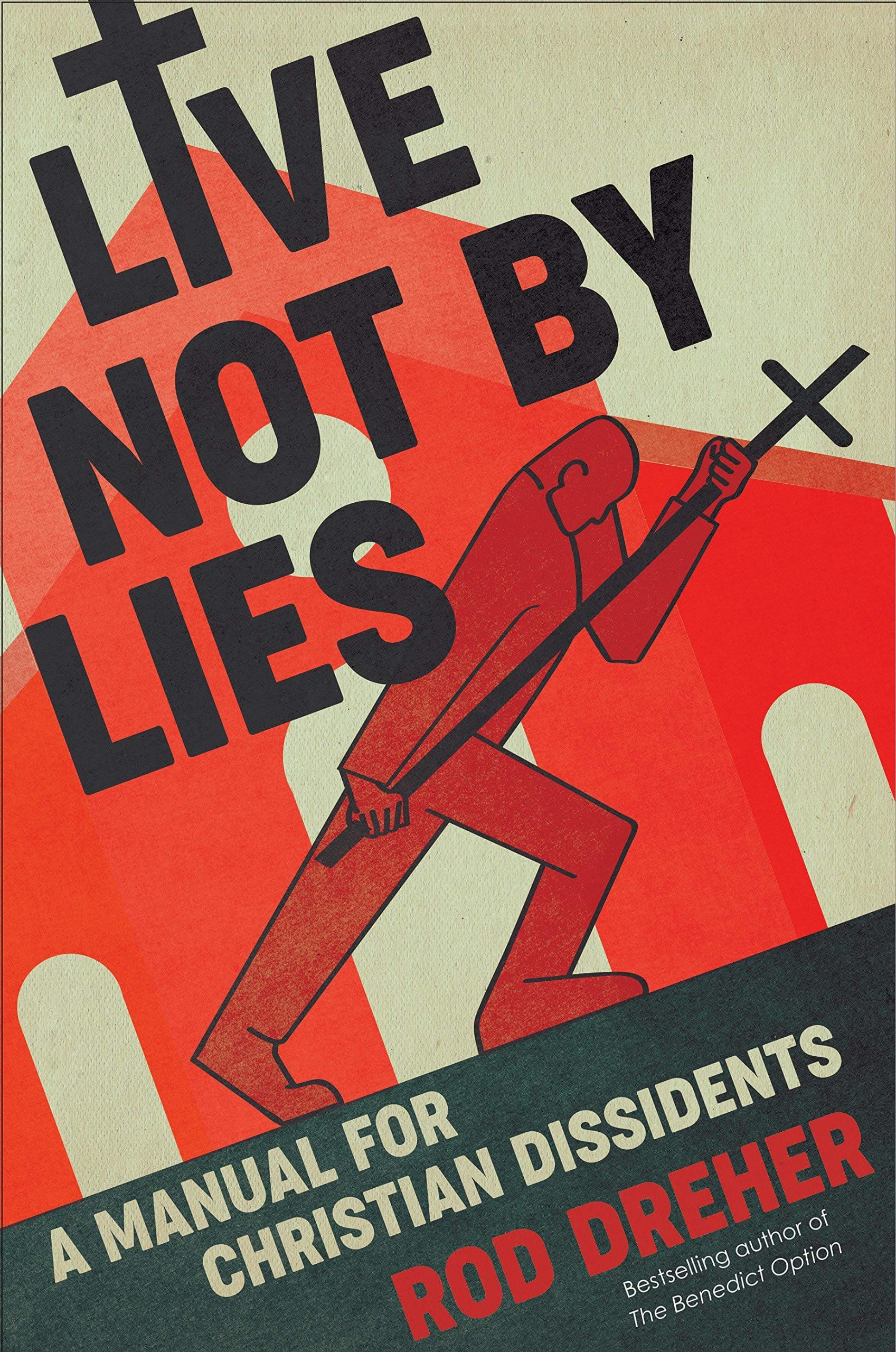
Live Not by Lies.
Sentinel, 2020. 256 pp.

