
I
I am always for the male with all my heart, and strongly on my father’s side.
—Athena (in Aeschylus, Eumenides)
As woman was the first to be tempted, so did God’s message of grace come first to a woman.
—Edith Stein, Essays on Woman
I had one chance to meet the industrial-grade critical theorist Judith Butler when I was in graduate school. I was quite familiar with her (and she still then went by “her”) liquefaction of the ideas of gender, the ways she untethered them from the undeniable biological reality of sex. Her books and articles were mandatory reading in our methodology seminars, assigned like Mom telling me to eat my broccoli when I was four. I knew Butler claimed that gender was entirely a social concoction, even that “language constructs the category of sex.” Still, I was not very interested in making the personal acquaintance, so I passed on the opportunity. I set off to attend a different lecture, but the traffic of graduate students, undergraduate students, and professors making their way to the Butler talk was so heavy that I felt like a lonely salmon swimming upstream. So it often feels for those of us who hold to what is called gender “essentialism” in our metamodern world, even if we qualify that word, as I would, with adjectives like “strategic” (Serene Jones’s Feminist Theory and Christian Theology) or “kind” (Fellipe do Vale’s Gender as Love).
Ultimately, for Christians, gender is not merely a social construct but a gift, a gift that all of us—even those we might consider to be quintessentially masculine or feminine—have imperfectly received. Masculinity and femininity each have an “essence” because both are ideas in the mind of God—good ideas through which God made the world. The mystery of God, of course, fulfills and transcends both categories, a discovery for which we have the monotheistic revolution to thank. And while no cultural manifestation of maleness or femaleness is final, any human culture blinkered enough to think it can transcend these categories (as God certainly does), or come up with new ones, will come to regret it.
Cultures that attempt to overcome gender do not therefore enter bold new terrain but soon find themselves repristinating tired and stale categories instead, categories with which this planet already has millennia of unhappy experience—namely, the hyper-masculinity of the gods, the stereotypical fecundity of the goddesses, and the hermaphroditic deities that stood between them in ancient paganism. Internecine Christian debates about gender have their value, but we do well to pay attention to these inevitable pagan resurfacings wherever they appear. For to deny gender is not to escape it but to issue an inadvertent invitation to Mars and Venus, or Marduk and Innana for that matter, to return.
Any consideration of the world Butler wrought, therefore, ought also to consider the surge of contemporary goddess feminism. According to its own lore, goddess feminism (in America at least) was jump-started in a 1977 session of the American Academy of Religion when Carol Christ (a disaffected student of religion), Starhawk (a leading Wiccan personality), and Z Budapest (celebrant of the “Golden Age of Matriarchy”) claimed to have inspired a movement. Their reasons included frustration regarding the conflict in Vietnam, that God is referred to as a “man of war” in the Bible, and that the prophets are “problematic.” After reading Elie Wiesel, Carol Christ analogized the Jewish Holocaust to her own plight. “What happened,” she asked, “to the mothers, the daughters, the sisters? . . . Where are the Goddesses?”
However the movement began (and Ronald Hutton’s Triumph of the Moon still offers the deepest background), its success can be gauged by Newsweek’s report that the number of practicing witches in the US went from eight thousand in 1990 to more than 1.5 million more recently. In his 2025 book Why Religion Went Obsolete, sociologist Christian Smith offers the following poll response as a representative sample of a prevailing contemporary opinion: “New Age, Wicca, witchcraft, new religious movements. Love them.” Goddess feminism remains today an established portion of what Tara Isabella Burton, in her 2020 book Strange Rites, names the “religiously remixed.”
I went so far as to test these goddess theories before the original statues that enshrined them at the British Museum and the Metropolitan Museum of Art (see “London Goddess Purée” and “Is Goddess Dead?,” both in Comment). But, incorrigible monotheist that I am, these goddesses only led me back to Christianity through images of Christ and the Virgin Mary in, and just outside, the same museums. Still, I wanted to test my conclusions. Perhaps I had come to my confirmation of Christian understandings too quickly. I decided these neopagan theories needed to be more rigorously engaged: not in the relatively safe confines of the museum, but on the island where “the Goddess” would—at least according to neopagans themselves—have the home-court advantage.
That is to say, it was time to embark on my own version of one of the frequently advertised “goddess pilgrimages” that claim to offer liberation from our oppressive Judeo-Christian understandings of gender. In her book Odyssey with the Goddess, Carol Christ boasts of leading over five hundred women on forty such goddess tours to Crete, home of the presumably matriarchal culture of the ancient Minoans. On a return visit to Crete for an academic conference, I aimed to go beyond book learning and to replicate such “experiential archaeology” for myself.
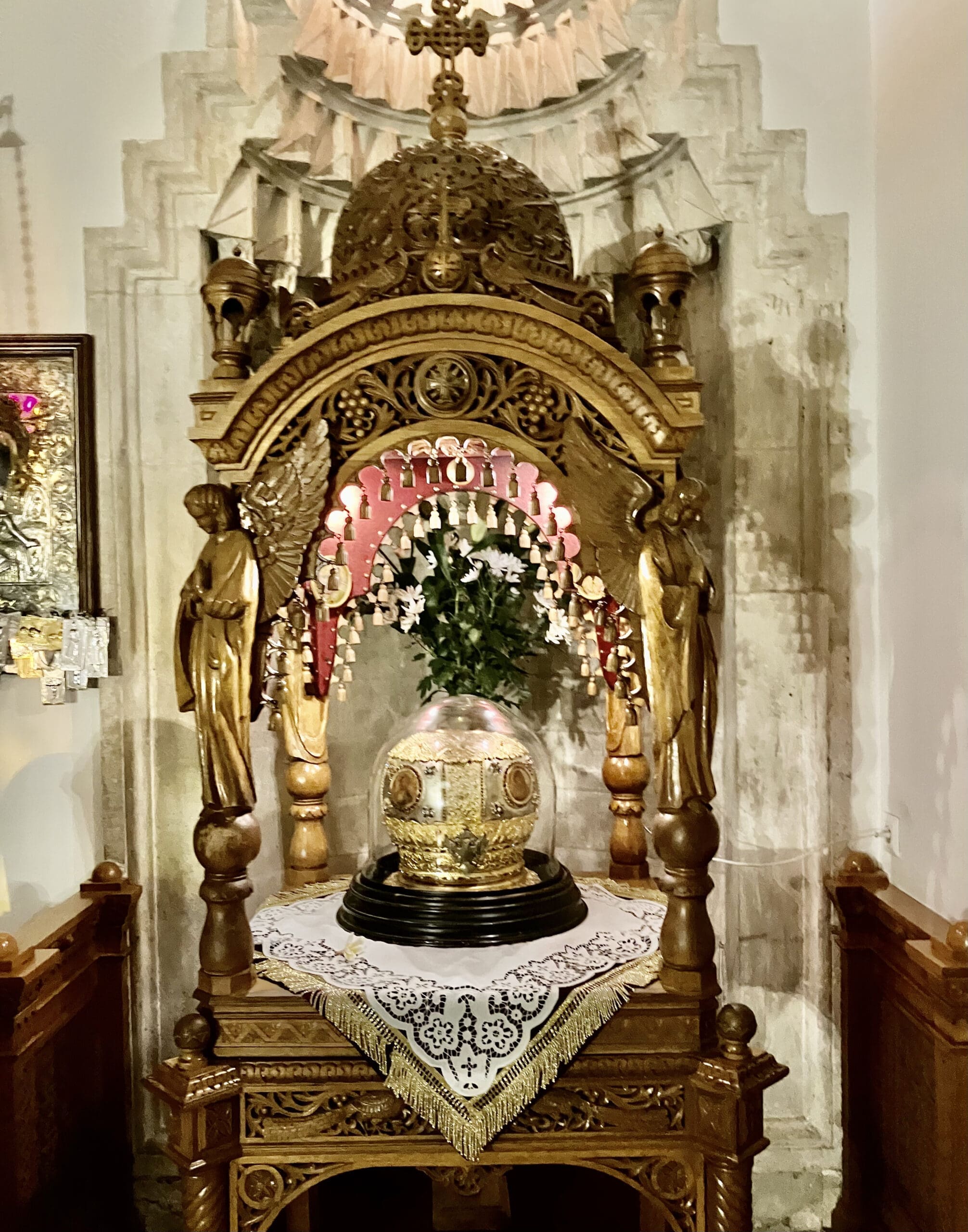
Surrendering any predetermined agenda, I decided to let the island speak to me as it wished. After all, if the goddess was to meet me, I had to give her a chance. I arrived in Heraklion on a Friday night in November, mercifully past tourist season. The streets were packed not with vacationers but with locals, dining al fresco in one massive urban living room, the very experience that American cities so often fail to replicate. Packs of teenagers competed for attention, elderly Cretans sipped their ouzo, and families dined with their toddlers, who, in my country at least, would at that hour all have been in bed. Though it was nearing nine o’clock, all the shops, nightclubs, and chain restaurants were open, and in the midst of it all the Church of St. Titus was open too and was as generously inhabited as the cafés that surrounded it. I entered its precincts to see on full display the skull of St. Titus, the apostle to Crete who boasts his own book in the New Testament. His head is lovingly encased in a golden reliquary. My culture might put a basketball handled by Michael Jordan in a similar shrine, but I far prefer this form of veneration.
“To the pure, all things are pure,” said the apostle Paul to Titus (1:15), and so why should I be hesitant about letting the goddess make her case? Emboldened by Crete’s preeminent apostle, I made my way the next morning to Heraklion’s storied Archaeological Museum and stood before its signature piece, the Ring of Minos, dating to the fifteenth century BC. This tiny ring was found by a young boy in 1928 in a field proximate to the Royal Temple Tomb of Knossos, heart of the Minoan civilization. After its authenticity was proved, it emerged as one of the most precious objects of the culture that has perhaps the strongest claims to association with Plato’s lost civilization of Atlantis.

Here the goddess had her first chance to speak. The seal was affixed to a signet ring used by a high-ranking official in Minoan society. It was not difficult to see why goddess feminists would find this image so attractive, making this museum one of the first stops on the neopagan pilgrimage itinerary. On the left side of the ring, a nude woman shakes a tree that emerges from what may be a sanctuary. At the centre of the signet, a kneeling man plucks a fruit from a similar tree intertwined into a different temple. He in turn offers this fruit to another female figure. Most have speculated that this figure seated on a platform is also a goddess. Then she appears for a third time below, sailing on the seas in what may be a seaborne sanctuary. The museum description puts it this way: “The presence of the goddess in the air as a floating figure, on land as a personified female form, and at sea in a boat, symbolizes her various aspects and her dominion over the celestial, terrestrial, and marine worlds.” All the man can do, surrounded by the sacred feminine, is kneel and offer homage. This, many believe, is a vision of healing and renewal that our society requires: tree worship as the antidote to ravenous deforestation.
As I toured the rest of the museum, I saw countless labryses—double axes—which may have been connected to some kind of fertility ritual. They seemed rather warlike to me, but Carol Christ tells us they instead symbolize “a river of birds in migration, a nation of women with wings.” No wonder the labrys, so construed, has become an emblem for the modern lesbian movement. I then took in the Minoan frescoes and figurines of bare-chested women, the so-called snake goddesses who were especially appreciated by the British archaeologist Sir Arthur Evans. These women, I suppose, show what culture could always have been before women were forced to cover their chests. Debates about the original purposes of such figures continue, but as I stood before them, it was difficult to deny their force. Still, powerful as these museum images were, it was time to encounter an actual holy site, a place where the ancient goddesses were once worshipped. “The Goddess” would have the chance to affect me, I conjectured, only if she were not protected by curatorial glass.

So I drove my rental car to the next stop on goddess itineraries, ancient caves where pilgrims can release their trauma. I chose the Skotino Cave, which turned out to be so large that a modestly sized Manhattan skyscraper could have fit inside. I had this sanctum all to myself. This was a place where the ancient goddess was once worshipped in the form of Britomartis, the goddess of mountains, nets, and hunting, who ultimately took the form of Artemis in the Hellenic world. I entered past some fig trees, which often stand watch at the entrance to such grottoes, reminding me of the sexual shame so many of us carry. Those who attend the goddess tours speak movingly of real grief released in these places, and I do not dismiss these transactions. After all, I have my own share of shame to surrender as well, even if I would name this process confession and repentance.
The fresco of the human Mary “wider than the heavens” in the apse of the same chapel seemed a considerable upgrade from the goddess’s “dominion over the celestial, terrestrial, and marine worlds” in the Heraklion museum.
Again, my aim was to let the island speak to me. And such openness caused me to notice something that most goddess tours fail to recognize, but which was in fact quite difficult to ignore. The Skotino Cave was now sanctified as a place of Christian worship, and it was now even renamed after an early Christian martyr, St. Paraskevi, who by crossing herself once caused the idols in the Temple of Apollo to fall. Moreover, a small chapel dedicated to her testified to the Christian hallowing of these depths over the centuries. Inside it, I saw not votive offerings to “the Goddess” but offerings to Christ. I couldn’t help but light a candle and pray. The fresco of the human Mary “wider than the heavens” in the apse of the same chapel seemed a considerable upgrade from the goddess’s “dominion over the celestial, terrestrial, and marine worlds” in the Heraklion museum. Comparing this image to the Ring of Minos, I realized that the goddess culture, less cosmically ambitious than Christianity, had left out the planets and stars.

Next on Carol Christ’s goddess-tour itinerary is the monastery of Paliani, nestled deep in the mountains of Crete. As I drove to it, my doubts about goddess culture began to reassert themselves. I reviewed in my mind what we actually know about Minoan society. Because the language known as Linear A has not yet been deciphered, we understand very little about this ancient culture, and what we do know is not enough to fuel goddess fantasies. As Cynthia Eller argued decades ago in her book Gentlemen and Amazons, the myth of matriarchal prehistory that sustains goddess tourism today is a wholesale invention. Worse still, it was invented by men with the intention of subordinating women. Johann Jakob Bachofen’s 1861 book Mutterrecht (Mother Right: A Study of the Religion and Juridical Aspects of Gynecocracy in the Ancient World) was the first to popularize the claim that Minoan society, so connected to females, fertility, and the earth, represented the civilizational stage of “Demetrian Matriarchy” (after Demeter, the goddess of grain).
But men, Bachofen went on to argue, were not content with this arrangement. The Dionysian era soon emerged when men dared to challenge their subordinate status, leading to a transitional period. This provoked the Amazonian era (refracted into our culture through the cleverly disguised patriarchy of Wonder Woman), when women reacted with wild rage to the men who dared to challenge them. But this female resistance failed, and what resulted was Apollonian society, the “civilized world” that Bachofen celebrated, the benefits of which were—he speculated—especially on offer in the Victorian age. No serious historian today would suggest Bachofen’s ideas are true. But they have died hard, and they are kept on life support through goddess feminists whose itinerary I was rehearsing. Goddess feminists—forgetting that St. Paraskevi was Apollo’s actual nemesis—instead imagine the age of peaceful Demetrian Matriarchy (which never existed) as something to which we might return.
To complicate matters even further, Bachofen’s bogus notions also survive in psychological form in the Jungian world. Carl Jung had concluded that alchemy—the ancient pseudo-science that claimed to turn base metal into gold—was bad science but insightful psychology. Jung, without acknowledging the Christians like Johann Arndt (1555–1621) who fruitfully theorized about alchemy before him, believed the dense manuals of the alchemists charted very real phases of psychological maturation. The brilliant Jewish psychoanalyst Erich Neumann (1905–1960), a disciple of Jung, similarly concluded that even if Bachofen’s ideas were archaeologically discredited, they did make psychological sense. Each of us, Neumann claimed in his ambitiously titled book The Origins and History of Consciousness, goes through a Demeter phase, when we enjoy the warm comforts of our mother. But we are called out of this into maturity, leading sometimes to Amazonian maternal reactions. Think of a smotheringly affectionate mother unable to control her rebellious teenage son. After the Dionysian adolescent phase comes Apollonian maturity, the man who—unlike the regressive mamma’s boy—knows how to command himself and the world. (Jordan Peterson’s first major book, by the way, Maps of Meaning, is completely and expressly indebted to Neumann, something lost on those who read only Peterson’s bestsellers.)
Whether they survive through goddess feminists or through schools of Jungian thought influenced by Neumann, fantasies about Minoan society are with us still, and not only in Crete. At the Brooklyn Museum of Art, one can still enter a virtual temple to this kind of understanding. Judy Chicago’s The Dinner Party offers visitors (or are they pilgrims?) a triangular table of ceramic, yonic place settings of history’s famous women amalgamated into uniformity. This famous installation gains inspiration from the island of Crete, where once (as the gallery label reads) “the male consort/son was always subordinate to the goddess, never developing an independent god status.” Never mind that this so-called era of matriarchy never existed, and that neither Hildegard of Bingen nor Emily Dickinson would have much appreciated seeing their ceramicized genitalia displayed on a plate.

But I had arrived at Paliani, so it was time to stop theorizing and get out of the car. Surely “the Goddess” would have an answer to my many objections at this next stop. I halted at the entrance to the monastery. The image at the gate showed me Mary again. The Greek letters flanking her announced not that God was strictly a mother—as if any parental attributes could finally confine him—but that he has one, for Mary is the Mother of God. The human Mary surrendered to this mystery, and this portal almost seemed to be saying that I could proceed into this sanctuary only if I were willing to do the same. I wondered whether Jung and Neumann, or their disciples today, might bar my entrance, telling me that to so proceed was a disastrous regression into a mother complex. Or maybe they would say I was advancing into a healthy approach to the feminine, represented by the “Sophia” stage, terrain charted by the Lutheran mystic Jacob Boehme long before Jung (and from whom Jung heavily borrowed). Whatever they would or wouldn’t say, I sensed the key to masculinity might lie in this place as well.

What I saw showed me what true progress in gender relations looks like. In the Ring of Minos, the sacred trees dominate over the figures, maybe even threatening to crush them. Nature, after all, is an especially fickle goddess. She might bless you one year and destroy you the next. No wonder the ancient Minoans tried to placate her, and to no avail. In the form of the volcanic eruption on the island of Thera (also called Santorini) in 1600 BC, she utterly obliterated what was left of the so-called Minoan civilization. The entirety of the palace of King Minos was engulfed in a tsunami, following which came a second annihilating wave of volcanic ash. Minoan attempts to placate nature through the goddess were answered with nothing less than one of the most powerful natural disasters ever witnessed by human beings.
But at the monastery of Paliani, I was overwhelmed in a different way. In the icon that greeted me as I entered the monastery’s main church, I saw that the tree on the Ring of Minos had been tamed, safely nestled in the womb of the Virgin. Even the author of nature was at one point contained within the womb of a woman. After all, Mary represents creation’s ultimate yes to the one who created it. Surely this is what the Scriptures refer to by that elusive feminine figure of Wisdom in Proverbs 8, the Wisdom that would do so much for goddess feminists were they to pay attention. The study of this Wisdom—which goes by Sophiology in advanced theological discussions—is a highly stylized, deeply scriptural way of saying that there is a deep wisdom embedded in how God made the world, a gendered wisdom, a wisdom that cannot be entirely reduced to, but most certainly culminates in, the Virgin Mary’s yes to God. Not to mention our own.
Circling Paliani’s main church, I noticed there was a tree outside the sanctuary as well, a tree that—legend relates—sprung up around an icon of the Virgin Mary. This ancient tree continues to grow, so much so that it has concealed the original icon itself, as if in some kind of olive branch extended to Protestant iconoclasts. But there are replica icons just beyond the tree to signal the invisible original. There are offerings in the tree too, and myrrh is given to pilgrims to remind them of this sacred experience, or perhaps to offer a healing balm that can pacify the perpetual war between the sexes. In comparison to this mountain sanctuary, the Heraklion museum was clinical, for this shrine is actually alive. The liturgy had just taken place, and visitors were welcomed to receive some of the post-service bread, the “antidoron” (which translates literally as “instead of the gifts”), which even as a non-Orthodox Christian I was permitted to receive.
Goddess enthusiasts might say this was all a big con, because men are still in charge here. But one icon of an army of women underneath this image of the Virgin seemed to suggest otherwise. This was no male monastery after all, but a convent, and consecrated nuns, quite confident with their own sanctified sexuality, were clearly running the place. As if men might be tempted to forget this, I noticed another icon of Moses humbling himself before the burning bush, which has long been understood as a premonition of the young woman who maintained her virginity at the Annunciation, just as the bush burned but was not consumed.

If one assumes (falsely) that the male Moses was contemplating the Hebrew God who was biologically male, this icon offers a corrective. Mary breaks up this imagined boys’ club by announcing that the Word would eventually be made flesh, and that the male seed, to the disappointment of Joseph, would have no part in that process at all. In fact, the Moses crouched in the corner of this icon deliberately evokes Orthodox nativity icons, where Joseph is appropriately sidelined as well. Man stands humbled before the woman whose assent led to the salvation of the world. To say the least, my goddess pilgrimage was getting more and more interesting.
Having visited a museum, an ancient cave, and a living monastery, it was time to drive back to Heraklion. There I found myself at the St. Catherine of Sinai Museum, connected to the very monastery in Egypt that claims to tend a bush that descends from the one encountered by Moses. In this museum, Crete gave me an even better answer to the riddle of the Ring of Minos than the ones it had given me thus far.
While the Heraklion Archaeological Museum enshrined a society laid waste by the Thera eruption, this museum represented a living faith. The Cathedral of St. Menas, just across the street, was—like the Church of St. Titus—filled with worshippers. Crete was colonized by the Catholic Venetians, but the Orthodox artistic tradition was so strong that the aesthetics of the icon could not be vanquished. Just as the Italian Renaissance was reaching a crescendo in Italy, Cretan Orthodox painters found new ways of expressing their defiant tradition.
One painting, by Michael Damaskinos, offered a particular surprise. Again, in the Ring of Minos, nature hovers threateningly over her supplicants. But here the tree is grounded, even feminized, owing to the prominence of the Virgin. This motif is traditionally called the Tree of Jesse, a visualization of the genealogies of Christ in the Gospels of Matthew and Luke, where the tree erupts from the father of King David. But this particular image takes the genealogy—as Matthew does—all the way back to Abraham.

Indeed, amid the resurgence of pagan understandings of gender in the present, it is Abraham, and the monotheism that he represents, that offers an enduring solution. In her 1992 book In the Wake of the Goddesses, University of Chicago professor Tikva Frymer-Kensky communicates the essence of the Abrahamic revolution. In paganism, gods and goddesses had to be placated just to get the earth to work, and this bargaining process (as in the Thera eruption) frequently failed. Within this chaotic economy, Frymer-Kensky explains, men erected goddess cults for their own purposes, both to placate nature and to preserve their own social power. But in the wake of Abraham, “all the jobs previously performed by the pantheon, all the forces exemplified by the many nature deities, now have to be performed by the One God of Israel.” Nature, as well as gender, was consequently somewhat desacralized.
The Bible is the living record of this tumultuous cosmic refashioning. Forgetting the way goddesses were sponsors of war, neopagan feminists point in horror to the military, masculine metaphors in the Bible used to describe the Hebrew God: “The Lord will march out like a champion, like a warrior he will stir up his zeal; with a shout he will raise the battle cry, and will triumph over his enemies” (Isaiah 42:13). Frymer-Kensky simply reminds them that they should read on to the very next verse: “For a long time I have kept silent, I have been quiet and held myself back. But now, like a woman in childbirth, I cry out, I gasp and pant” (Isaiah 42:14).
This transcendent God released the pagan pressure that had once been placed on creation, and one result, interestingly enough, was a new accent on human responsibility. Against those who falsely assume that monotheism underwrites the earth’s exploitation, Frymer-Kensky shows that monotheism is what inaugurated the possibility for human accountability in respect to nature. For “God’s absolute power is not arbitrary: it is called into play in reaction to human behaviour. Human beings have a direct impact on the environment: ultimately, the well-being of the earth and the people of Israel—or their destruction—is a result of human action.”
These men and women now responsible to God, moreover, are responsible together. In pagan understandings of gender, there was a massive gulf between the sexes, “a sense that man and woman can never be as like each other as man to man or woman to woman.” But Genesis changed all this. The story of Adam and Eve “presents women and men as the true suitable companions to each other. . . . Male and female are created at the same time, and they are both created in the image and likeness of God. The differences between male and female are only a question of genitalia rather than character.” Frymer-Kensky admits that these ideals were not necessarily realized in Israelite society. Nor have they been fully realized in Christianity. But without the Jewish revolt against paganism, the “biblical metaphysics of gender unity” that is the default assumption for so many today simply would not exist.
Against those who falsely assume that monotheism underwrites the earth’s exploitation, Frymer-Kensky shows that monotheism is what inaugurated the possibility for human accountability in respect to nature.
The icon of the tree of Abraham in the St. Catherine of Sinai Museum in Heraklion seemed a marvellous illustration of this cooperation. I looked closer. Long before Mary said yes to permit Christ to enter her body, Abraham also surrendered his mortal frame, allowing his seed to be the avenue of God’s bringing salvation to the world through the chosen people. But lest the phallus be glorified as it was in the surrounding ancient Near Eastern cultures, initiation into Judaism entailed a ritual damaging of the phallus, which we know as circumcision. A more direct divine response to the ways masculinity has been misused is difficult to imagine.
While a subtle banner with his name may be gently indicating toward Abraham’s loins, his whole person had to be given over. The tree emerges from his entire torso. Abraham looks downcast, saddened, even frustrated. Instead of asserting himself or confidently shaking fruit from a tree, as in the Ring of Minos, he has instead humbly yielded. For all the claims of goddess feminists that women symbolize the fecundity of the earth, here was a man who offered up his own body as earthen soil instead. Moreover, while the surrounding kings themselves might have wished to record their own merits, the painter shows each of them honouring Mary and Christ instead. Conversely, the Ring of Minos shows a solitary man to be closest to the centre.
In fact, while we don’t know for certain, it is entirely likely that the signet ring known as the Ring of Minos would have been yielded by a high-ranking man. But in this image of a tree, all the men have been literally marginalized and the dominant figure is clearly the Virgin, so large in fact that it is as if she were a giant, holding her cross-legged son. Moreover, Mary is not naked, as are the goddesses in the Ring of Minos, but clothed. Here is a woman sent not to titillate desire but to transform it. Tree worship on Crete in a way continues, but with adoration directed at Christ, the ultimate arboreal fruit.
Yes, this icon proclaims, it is true: God took the form of a Jewish man in the incarnation. But this icon also so much as shouts that this was only possible thanks to the Jewish flesh he took from Mary. I suppose, as a Gentile, I could complain that God chose to become Jewish. But in his risen body Christ has incorporated Gentiles like me as well, not to mention women. All of this resulted from Mary’s gracious assent. Christianity’s initiation ritual, moreover, no longer required the ritual damaging of the phallus. Instead, a tender ritual washing grafts both men and women into the endless vine of Christ, where “there is neither Jew nor Greek, there is neither slave nor free, there is no male and female” (Galatians 3:28).With this understanding freshly crystallized thanks to an icon, what could I do but exit the museum, walk across the way to the Cathedral of St. Menas, and light a candle? Wandering into the Church of Little St. Menas right next to it, I could find no image of Eve that was not complemented by a depiction of Mary, the second Eve, holding the fruit that imparts not death but life; no image of shameful Adam that was not corrected by a consoling, blessing icon of Christ. As I gazed on its iconostasis, it struck me that Judith Butler seems to assume Christian understandings of gender to be trapped in the lower register of Eden. But redemption lifts men and women into the upper register, where our respective genders, in the fullness of time, will be fully redeemed. “What we will be has not yet been made known. But we know that when Christ appears, we shall be like him, for we shall see him as he is” (1 John 3:2).

And so, I’m afraid, the results of my island experiment were both obvious and predictable. The same thing that had happened to me in London and New York happened again. I gave the goddess a chance, I let the island speak, and I only found my way back to the true gender revolution of Christianity. On my return from Crete, I spoke of these experiences to some of my students in a course I teach with my colleague and friend the New Testament scholar Amy Peeler. One of our students was a bit skeptical. She saw the beauty of these Tree of Jesse icons, for a copy of one of them even hangs in our classroom. She certainly conceded that they were a step up from the Ring of Minos. But having done some exegetical work on the Gospels for her final project, she was disappointed that more women were not included in this icon. Does not Matthew himself also point to the female descendants of Christ such as Tamar, Ruth, and Bathsheba?
To the astonishment of both her instructors, she then found an icon that served this function. In the fifteenth-century Shuiskaya-Smolensk icon of the Mother of God from Russia, an icon of Mary is surrounded by a later frame that shows foremothers and prophetesses from the same genealogy. It was probably commissioned by the sister of Tsar Peter II, Natalya Alexeevna, in 1698. The very thing that we falsely assumed did not exist in Christianity was found, at least for one enterprising student who cared to look.

I concede of course that the same Christianity that has proved so liberating is spotted with countless instances of men—not to mention women—abusing power, then and now. Christianity is too large, and the effects of sin too pervasive, for this ever not to be the case in any living faith or institution. But a real, not invented, religion is also wide enough to contain the answer to such abuses. The answer is not a formula or a theory but a person, the Holy Spirit, who invigorates and purifies our gendered bodies as we allow ourselves to be grafted into the vine of Christ, to the glory of our heavenly Father. This is something the turbid tree of fertility in the Ring of Minos could never do.
We can obliterate gender with Judith Butler, or fantasize about the Age of Matriarchy, or tell convoluted stories about Jungian psychological maturation. But the real deconstruction of gender—or, rather, its redemptive transformation—is found in the Christian faith itself, where God was “born of a woman” (Galatians 4:4), and even the apostle Paul groans like a woman in labour (Galatians 4:19); where men are called to be brides (2 Corinthians 11:2) and women sons (Romans 8:14); where all things culminate not in the erasure of gender but in a mysterious consummation where men and women, who no longer marry or are given in marriage (Matthew 22:30), are nevertheless welcomed to the marriage supper of the Lamb (Revelation 19). This is not the only answer to the question of gender on offer in human history, but it remains a rather good one: not to annihilate or sacralize the essential categories of male and female, to which all human cultures testify, but to baptize them.
Fittingly enough, as I was leaving the island of Crete, it rained.
Note: Thank you to our student Julia Stauffer for sharing her discovery of the Shuiskaya-Smolensk icon of the Mother of God.