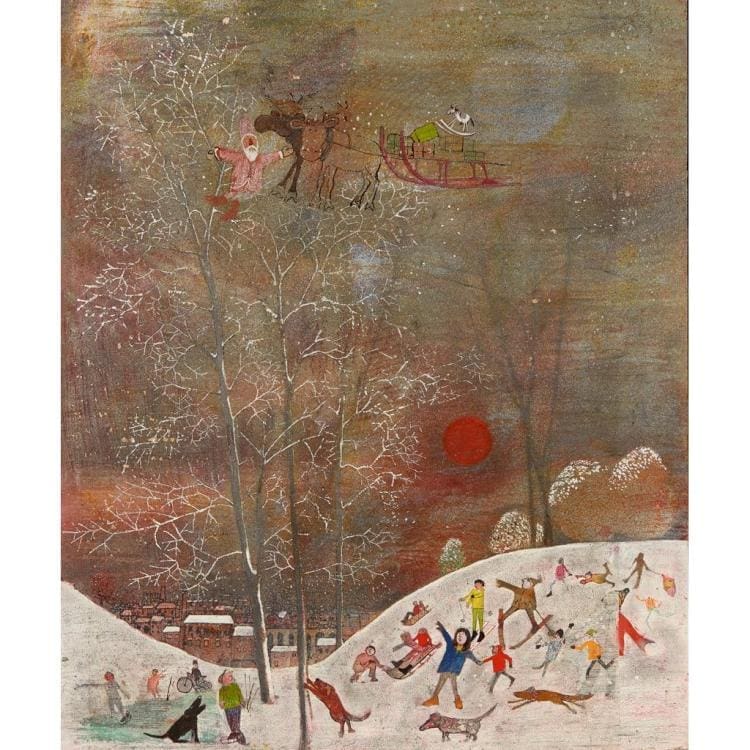
Right now I am especially craving light-hearted things, and “Father Christmas,” like so much else by the late and so-much-lamented John Burningham, lightens my heart.
Still, I remember the reason for the season…. So, have a listen to the Saint Tikhon Choir singing Benedict Sheehan’s gorgeous “Song of Simeon,” from his extraordinary Vespers. It’s not easy to find a true basso profundo, but even among that small crowd one stands out: the profoundest basso I have ever heard is the featured soloist here, Glenn Miller.
A quite different musical gift: my own personal guitar hero, Martin Simpson, just posted a lovely rendition of that old and strange song, the Cherry Tree Carol.
***
“The Wicked Fairy at the Manger” U. A. Fanthorpe
My gift for the child:
No wife, kids, home;
No money sense. Unemployable.
Friends, yes. But the wrong sort –
The workshy, women, wogs,
Petty infringers of the law, persons
With notifiable diseases,
Poll tax collectors, tarts;
The bottom rung.
His end?
I think we’ll make it
Public, prolonged, painful.
Right, said the baby. That was roughly
What we had in mind.
***
That is why the early Christian movement was so threatening – and so simply baffling – to the Roman authorities. It was not revolutionary in the sense that it was trying to change the government. Its challenge was more serious: it was the claim to hold any and every government to account, to test its integrity, and to give and withhold compliance accordingly. But it would be wrong to think of this, as we are tempted to do in our era, in terms of individual conscience. It was about the right of a community to set its own standards and to form its members in the light of what had been given to them by an authority higher than the empire. The early Christians believed that if Jesus of Nazareth was “Lord,” no one else could be lord over him, and therefore no one could overrule his authority. We use the word “Lord” these days mostly in a rather unthinking religious context, as a sort of devotional flourish; for a Roman, it meant the person who made the decisions you had to abide by, from the master of a slave in the household to the emperor himself. To speak of Jesus as “King of Kings and Lord of Lords” was to say that his decisions could not be overridden by anyone.
***
From the OED:
hallalujous, adj. Origin: Formed within English, by derivation. Etymons: hallelujah n.2, -ous suffix. Obsolete. rare.
Filled with hallelujahs (hallelujah n.2 1).
F. Quarles Solomons Recantation (1645) v. 46: “Thus when thy awfull presence shall draw near These Hallalujous Courts.”